Religious tyranny and terrorism: the logical end product of religious absolutism
This topic was continued by "Freedom Of Speech" Vs "Freedom Of Religion"?....
Talk Pro and Con
Join LibraryThing to post.
This topic is currently marked as "dormant"—the last message is more than 90 days old. You can revive it by posting a reply.
1LolaWalser
Salman Rushdie in the wake of the massacre at the offices of Charlie Hebdo:
Disrespect religion. Disrespect it strenuously.
Religion, a medieval form of unreason, when combined with modern weaponry becomes a real threat to our freedoms. This religious totalitarianism has caused a deadly mutation in the heart of Islam and we see the tragic consequences in Paris today.
I stand with Charlie Hebdo, as we all must, to defend the art of satire, which has always been a force for liberty and against tyranny, dishonesty and stupidity.
‘Respect for religion’ has become a code phrase meaning ‘fear of religion’. Religions, like all other ideas, deserve criticism, satire, and, yes, our fearless disrespect.
Disrespect religion. Disrespect it strenuously.
2theoria
Medieval monotheism in its various forms must be combatted using the symbolic weapons of reason, ridicule, and irony.
3LolaWalser
>2 theoria:
There's nothing symbolic about reason, ridicule and irony. Obviously. People wouldn't get killed for them otherwise.
There's nothing symbolic about reason, ridicule and irony. Obviously. People wouldn't get killed for them otherwise.
4LolaWalser
Kill the Buddha (in fact, there's a school of thought believing he WANTS you to), fuck Christ, and for heaven's sake, draw a dirty picture of Muhammad.
5timspalding
If black people blow up something, can we lash out at Asian people because skin color is obviously bad?
6LolaWalser
>5 timspalding:
Your religion amply proved the assertion in the title in the past and there's no reason to disbelieve it wouldn't and couldn't renew the tradition of tyranny, oppression, torture, destruction and totalitarian control (which it never relinquishes completely in any circumstances), if conditions changed again in its favour.
The core division every religion of this type imposes on humanity--those who are "saved" and those who are not--is the problem.
This is why those religions are a problem and always will be a problem.
Your religion amply proved the assertion in the title in the past and there's no reason to disbelieve it wouldn't and couldn't renew the tradition of tyranny, oppression, torture, destruction and totalitarian control (which it never relinquishes completely in any circumstances), if conditions changed again in its favour.
The core division every religion of this type imposes on humanity--those who are "saved" and those who are not--is the problem.
This is why those religions are a problem and always will be a problem.
7timspalding
>6 LolaWalser:
Sure. "My" religion did.
I'm sure you know the counter-arguments--that fanatical atheism not only committed acts of terrorism, but murdered millions within living memory. And weren't you originally Croatian? Can I tar you with the Ustaše or the ethnic cleansing of more recent years?
The core division every religion of this type imposes on humanity--those who are "saved" and those who are not--is the problem.
Every religion? What a bizarrely ignorant thing to say.
It is true that some religions divide the world in a way that can lead to marginalization--once you have an "other" you can generalize. This is of course exactly what you're doing. Fortunately, despite the shared view, I can distinguish between you and Pol Pot.
Sure. "My" religion did.
I'm sure you know the counter-arguments--that fanatical atheism not only committed acts of terrorism, but murdered millions within living memory. And weren't you originally Croatian? Can I tar you with the Ustaše or the ethnic cleansing of more recent years?
The core division every religion of this type imposes on humanity--those who are "saved" and those who are not--is the problem.
Every religion? What a bizarrely ignorant thing to say.
It is true that some religions divide the world in a way that can lead to marginalization--once you have an "other" you can generalize. This is of course exactly what you're doing. Fortunately, despite the shared view, I can distinguish between you and Pol Pot.
8cpg
"Religions, like all other ideas, deserve criticism, satire, and, yes, our fearless disrespect."
I fearlessly disrespect this idea.
I fearlessly disrespect this idea.
9LolaWalser
>7 timspalding:
Every religion? What a bizarrely ignorant thing to say.
What a predictably swinish gambit. Quote me properly or not at all:
This is of course exactly what you're doing. Fortunately, despite the shared view, I can distinguish between you and Pol Pot.
If you're going to liken me to Pol Pot, I'm going to call TOS on your ass. Stay away from me and my posts.
Every religion? What a bizarrely ignorant thing to say.
What a predictably swinish gambit. Quote me properly or not at all:
The core division every religion of this type imposes on humanity
This is of course exactly what you're doing. Fortunately, despite the shared view, I can distinguish between you and Pol Pot.
If you're going to liken me to Pol Pot, I'm going to call TOS on your ass. Stay away from me and my posts.
10LolaWalser
>10 LolaWalser:
Just a public announcement I've flagged >7 timspalding:. I'm announcing it not to invite further flagging--that's what Tim did against me in the past and I cringe at stooping to anything like that--but in order to protect myself from his likely constructions of my motives if I flag his message silently.
Just a public announcement I've flagged >7 timspalding:. I'm announcing it not to invite further flagging--that's what Tim did against me in the past and I cringe at stooping to anything like that--but in order to protect myself from his likely constructions of my motives if I flag his message silently.
11timspalding
>9 LolaWalser:
Ah, I didn't see "of this type." My apologies.
I'm going to call TOS on your ass
Unfortunately, saying that, despite a shared view (militant anti-religious atheism), I can distinguish between you and Pol Pot is not calling you Pol Pot. It's actually rather the opposite. I would wish that you could similarly distinguish between the Hebdo gunmen and all religious people.
Ah, I didn't see "of this type." My apologies.
I'm going to call TOS on your ass
Unfortunately, saying that, despite a shared view (militant anti-religious atheism), I can distinguish between you and Pol Pot is not calling you Pol Pot. It's actually rather the opposite. I would wish that you could similarly distinguish between the Hebdo gunmen and all religious people.
12nathanielcampbell
Nicki posted yesterday an interview with Karen Armstrong in Salon in the Myth of Religious Violence thread that I think bears on this topic: http://www.salon.com/2014/11/23/karen_armstrong_sam_harris_anti_islam_talk_fills...
In her new book, “Fields of Blood,” Armstrong lays out a history of religious violence, beginning in ancient Sumer and stretching into the 21st century. Most writers would — wisely — avoid that kind of breadth. Armstrong harnesses it to a larger thesis. She suggests that when people in the West dismiss violence as a backward byproduct of religion, they’re being lazy and self-serving. Blaming religion, Armstrong argues, allows Westerners to ignore the essential role that violence has played in the formation of our own societies — and the essential role that our societies have played in seeding violence abroad.{Here follows portions of the interview:}
I’d like to go deeper into this comparison between nationalism and religion. Some people would say that the ultimate problem, here, is a strain of irrationality in our society. They would argue that we need to purge this irrationality wherever we see it, whether it appears in the form of religion or nationalism. How would you respond?
I’m glad you brought that up, because nationalism is hardly rational. But you know, we need mythology in our lives, because that’s what we are. I agree, we should be as rational as we possibly can, especially when we’re dealing with the fates of our own populations and the fates of other peoples. But we don’t, ever. There are always the stories, the myths we tell ourselves, that enable us to inject some kind of ultimate significance, however hard we try to be rational.
Communism was said to be a more rational way to organize a society, and yet it was based on a complete myth that became psychotic. Similarly, the French revolutionaries were imbued with the spirit of the Enlightenment and erected the goddess of reason on the altar of Notre Dame. But in that same year they started the Reign of Terror, where they publicly beheaded 17,000 men, women and children.
We’re haunted by terrible fears and paranoias. We’re frightened beings. When people are afraid, fear takes over and brings out all kind of irrationality. So, yes, we’re constantly striving to be rational, but we’re not wholly rational beings. Purging isn’t an answer, I think. When you say “purging,” I have visions of some of the catastrophes of the 20th century in which we tried to purge people, and I don’t like that kind of language.
(...)
How direct is the link between colonial policies in the Middle East and a terrorist attack in New York or London?
I think — and I speak as a British person — when I saw the towers fall on September 11, one of the many, many thoughts that went through my head was, “We helped to do this.” The way we split up these states, created these nation-states that ISIS is pulling asunder, showed absolutely no regard for the people concerned. Nationalism was completely alien to the region; they had no understanding of it. The borders were cobbled together with astonishing insouciance and self-interest on the part of the British.
Plus, a major cause of unrest and alienation has always been humiliation. Islam was, before the colonial period, the great world power, rather like the United States today. It was reduced overnight to a dependent bloc and treated by the colonialists with frank disdain. That humiliation has rankled, and it would rankle, I think, here in the States. Supposing in a few decades you are demoted by China, it may not be so pretty here.
Every fundamentalist movement that I’ve studied, in Judaism, Christianity and Islam, is rooted in a profound fear of annihilation.
When you hear, for example, Sam Harris and Bill Maher recently arguing that there’s something inherently violent about Islam — Sam Harris said something like “Islam is the motherlode of bad ideas” — when you hear something like that, how do you respond?
It fills me with despair, because this is the sort of talk that led to the concentration camps in Europe. This is the kind of thing people were saying about Jews in the 1930s and ’40s in Europe.
This is how I got into this, not because I’m dying to apologize, as you say, for religion, or because I’m filled with love and sympathy and kindness for all beings including Muslims — no. I’m filled with a sense of dread. We pride ourselves so much on our fairness and our toleration, and yet we’ve been guilty of great wrongs. Germany was one of the most cultivated countries in Europe; it was one of the leading players in the Enlightenment, and yet we discovered that a concentration camp can exist within the same vicinity as a university.
There has always been this hard edge in modernity. John Locke, apostle of toleration, said the liberal state could under no circumstances tolerate the presence of either Catholics or Muslims. Locke also said that a master had absolute and despotical power over a slave, which included the right to kill him at any time.
That was the attitude that we British and French colonists took to the colonies, that these people didn’t have the same rights as us. I hear that same disdain in Sam Harris, and it fills me with a sense of dread and despair.
Is Islamophobia today comparable to anti-Semitism?
Let’s hope not. It’s deeply enshrined in Western culture. It goes right back to the Crusades, and the two victims of the crusaders were the Jews in Europe and the Muslims in the Middle East. (...) They became associated in the European mind. We’ve recoiled, quite rightly, from our anti-Semitism, but we still have not recoiled from our Islamophobia. That has remained. It’s also very easy to hate people we’ve wronged. If you wrong somebody there’s a huge sense of resentment and distress. That is there, and that is part of it, too.
I remember speaking at NATO once, and a German high officer of NATO got up and spoke of the Turks resident in Germany, the migrant workers who do the work, basically, that Germans don’t want to do. He said, “Look, I don’t want to see these people. They must eat in their own restaurants. I don’t want to see them, they must disappear. I don’t want to see them in the streets in their distinctive dress, I don’t want to seem their special restaurants, I don’t want to see them.” I said, “Look, after what happened in Germany in the 1930s, we cannot talk like that, as Europeans, about people disappearing.”
Similarly, a Dutch person got up and said, “This is my culture, and these migrants are destroying and undermining our cultural achievements.” I said, “Now you, as the Netherlands, a former imperial power, are beginning to get a pinprick of the pain that happened when we went into these countries and changed them forever. They’re with us now because we went to them first; this is just the next stage of colonization. We made those countries impossible to live in, so here they are now with us.”
13nathanielcampbell
A crucial insight (among many) in Armstrong's interview that I just quoted is that religious fundamentalism does not result from the triumph of political religion -- rather, it comes when modernity threatens to remove religion from the heart of socio-political culture, to separate religion from government.
14LolaWalser
>11 timspalding:
This is absolutely the last time I'm replying to any post of yours. At the end of this message you die to me.
I would wish that you could similarly distinguish between the Hebdo gunmen and all religious people.
I have ALREADY distinguished between terrorists and "all religious people"--in this thread--where I wrote about religion, not people (and holy déjà vu all over again)--and over the years in every discussion I've had. Not out of caution, politesse, or cunning... but because I actually, genuinely, DO distinguish between terrorists and "all religious people", routinely and consistently. If you haven't noticed, it's because you don't argue with me in good faith. This is the sort of basic-slander-as-diversionary-tactic I've no patience to indulge anymore, it's just too idiotic, when it's happening within three-four posts still up there for all to see.
Yes, I think that the problem is in absolutist soteriological religions, inherent in their doctrines and therefore ineradicable as long as the doctrines remain, well, doctrines.
Agree or disagree, who cares.
But I'm not taking any further chances at having to listen in what ways and degrees I'm like Pol Pot and suchlike.
This is absolutely the last time I'm replying to any post of yours. At the end of this message you die to me.
I would wish that you could similarly distinguish between the Hebdo gunmen and all religious people.
I have ALREADY distinguished between terrorists and "all religious people"--in this thread--where I wrote about religion, not people (and holy déjà vu all over again)--and over the years in every discussion I've had. Not out of caution, politesse, or cunning... but because I actually, genuinely, DO distinguish between terrorists and "all religious people", routinely and consistently. If you haven't noticed, it's because you don't argue with me in good faith. This is the sort of basic-slander-as-diversionary-tactic I've no patience to indulge anymore, it's just too idiotic, when it's happening within three-four posts still up there for all to see.
Yes, I think that the problem is in absolutist soteriological religions, inherent in their doctrines and therefore ineradicable as long as the doctrines remain, well, doctrines.
Agree or disagree, who cares.
But I'm not taking any further chances at having to listen in what ways and degrees I'm like Pol Pot and suchlike.
15theoria
>13 nathanielcampbell: "religious fundamentalism ... comes when modernity threatens to remove religion from the heart of socio-political culture, to separate religion from government."
Such as in the United States?
Such as in the United States?
16LolaWalser
>13 nathanielcampbell:
I wasn't going to comment on that worthless interview at all but this:
A crucial insight (among many) in Armstrong's interview that I just quoted is that religious fundamentalism does not result from the triumph of political religion -- rather, it comes when modernity threatens to remove religion from the heart of socio-political culture, to separate religion from government.
is too hilarious to ignore completely.
I wasn't going to comment on that worthless interview at all but this:
A crucial insight (among many) in Armstrong's interview that I just quoted is that religious fundamentalism does not result from the triumph of political religion -- rather, it comes when modernity threatens to remove religion from the heart of socio-political culture, to separate religion from government.
is too hilarious to ignore completely.
18LolaWalser
Speaking of ignoring, I didn't notice any threads on LT about the massacre of the schoolchildren in Pakistan. I want to mention it now because I don't want it to seem that the death of a dozen Parisians has caused more commotion (at least in me) than what happened in Peshawar.
19jjwilson61
>9 LolaWalser: If you're going to liken me to Pol Pot,...
He did nothing of the sort. In fact he specifically said that he can distinguish between you and Pol Pot.
He did nothing of the sort. In fact he specifically said that he can distinguish between you and Pol Pot.
20timspalding
She is correct I said "every" when I meant "most"—all Christians, all Muslims and various others. It's a funny hook to hang things on, as opposed to merely claims of absolute truth; what is one to do with fanatical, murderous Buddhists?
I think she's right that the division salvific religions impose can be a problem. (It's more of a problem when believers claim to actually know who exactly is saved—something Catholics do not claim.) It can create an other. Although the terrorists surely understood it as a matter of blasphemy, not merely killing non-believers, religion does have a tendency to divide people. (It also has the opposite tendency, too, of course—the "the slave is our brother" tendency.)
The problem is that dividing the world into the right (and honest and smart) and the absolutely wrong (and stupid and dishonest) is exactly what Lola herself is doing. Lines exist, but it's important to qualify them. This sort of division, for example, is pretty common to online atheism, but it is no more coextensive with it than murderous hatred is coextensive with religion. And, as I said, there is big difference between seeing large segments of the population as irretrievably evil and stupid, and wanting to kill them.
I think she's right that the division salvific religions impose can be a problem. (It's more of a problem when believers claim to actually know who exactly is saved—something Catholics do not claim.) It can create an other. Although the terrorists surely understood it as a matter of blasphemy, not merely killing non-believers, religion does have a tendency to divide people. (It also has the opposite tendency, too, of course—the "the slave is our brother" tendency.)
The problem is that dividing the world into the right (and honest and smart) and the absolutely wrong (and stupid and dishonest) is exactly what Lola herself is doing. Lines exist, but it's important to qualify them. This sort of division, for example, is pretty common to online atheism, but it is no more coextensive with it than murderous hatred is coextensive with religion. And, as I said, there is big difference between seeing large segments of the population as irretrievably evil and stupid, and wanting to kill them.
22LolaWalser
>20 timspalding:
Turns out I can't put you on ignore.
The problem is that dividing the world into the right (and honest and smart) and the absolutely wrong (and stupid and dishonest) is exactly what Lola herself is doing.
No, that is exactly what you are saying I'm doing and nothing more. I don't entertain any ideas that idiotically simplistic.
This sort of division, for example, is pretty common to online atheism, but it is no more coextensive with it than murderous hatred is coextensive with religion.
Make your own thread and throw a party for any and all strawmen there.
Turns out I can't put you on ignore.
The problem is that dividing the world into the right (and honest and smart) and the absolutely wrong (and stupid and dishonest) is exactly what Lola herself is doing.
No, that is exactly what you are saying I'm doing and nothing more. I don't entertain any ideas that idiotically simplistic.
This sort of division, for example, is pretty common to online atheism, but it is no more coextensive with it than murderous hatred is coextensive with religion.
Make your own thread and throw a party for any and all strawmen there.
23cpg
>22 LolaWalser: "Turns out I can't put you on ignore."
The "Block this member" function works on Tim just like it works on everyone else.
The "Block this member" function works on Tim just like it works on everyone else.
24timspalding
I just don't know how to quit you.
25LolaWalser
>24 timspalding:
It just occurred to me I'm in danger of becoming as humourless as those assholes.
But boy it was sweet to hit that "BLOCK" on your page (once I remembered where to look). :)
It just occurred to me I'm in danger of becoming as humourless as those assholes.
But boy it was sweet to hit that "BLOCK" on your page (once I remembered where to look). :)
26timspalding
Pol Pot was humorless. You are not Pol Pot. ;)
27LolaWalser
Aw, you're too kind. I too can distinguish marvellously well between you and dog poop... most hours of the day. :)
28jjwilson61
>20 timspalding: It's more of a problem when believers claim to actually know who exactly is saved—something Catholics do not claim.
So Catholics don't claim that heathens are not saved? That hasn't always been the case though, especially with Jews.
So Catholics don't claim that heathens are not saved? That hasn't always been the case though, especially with Jews.
29timspalding
>28 jjwilson61:
Catholics don't claim to know anyone in specific who is not saved. Those who truly reject God are not saved, but we don't actually know who those are. One can not believe in God, or believe one is rejecting God, but not indeed be doing so. See the Parable of the Sheep and the Goats, or Pope Francis memorably recently, but it's been a belief for some time. In earlier centuries, there's been more certainty, but all currents of uncertainty. Many Catholic theologians believe—in a tradition going back to some Fathers—that all may in the end be saved; we can't assert it doctrinally, but we can pray that it's so.
Catholics don't claim to know anyone in specific who is not saved. Those who truly reject God are not saved, but we don't actually know who those are. One can not believe in God, or believe one is rejecting God, but not indeed be doing so. See the Parable of the Sheep and the Goats, or Pope Francis memorably recently, but it's been a belief for some time. In earlier centuries, there's been more certainty, but all currents of uncertainty. Many Catholic theologians believe—in a tradition going back to some Fathers—that all may in the end be saved; we can't assert it doctrinally, but we can pray that it's so.
30cpg
Lola blocked Tim by 1:51pm, but Lola saw what Tim posted at 1:52pm. Somebody ought to file a bug report.
31southernbooklady
>12 nathanielcampbell:, >13 nathanielcampbell: religious fundamentalism does not result from the triumph of political religion -- rather, it comes when modernity threatens to remove religion from the heart of socio-political culture, to separate religion from government.
Karen Armstrong has interested me since I once heard her speak on confronting, and reaching a compromise with, fundamentalists (of any kind, but in context she was discussing American Protestant fundamentalists) and her defeated acknowledgement that it seemed impossible because the very tenets of a fundamentalist world view demanded no compromise.
I don't know if she has since modified or come to a more optimistic position, but I think not. I think books like her recent one on violence and religion, or the earlier one on religious fundamentalism, are an ongoing attempt to resolve this issue--that there is, even such a thing as religious conflict, I suppose, and whether it can be eradicated.
I think she is religious in the same sense that I'm an atheist -- that is, neither of us appear very extreme, but both of us acknowledge the "extreme" core of our position. As an atheist I accept the direct connection my position has with the likes of Richard Dawkins, even if he is frequently an infuriating man. I still think him basically "right" about the non-existence of the deity and the irrationality of religious belief. I get the same feeling from Armstrong and her relationship to religion. That she's not "in the church" so to speak, but there's something at the core of belief she thinks is basically right.
So I get it when she says that statements like "Islam is the motherlode of bad ideas" fill her with despair. It's the kind of thing that does nothing except divide people, which in turn does nothing except incite violence. But I think that just as it is pointless to ascribe fanatical violence to "Islam" or "Christianity" it is also pointless to pretend that religion isn't a motivating factor of the violence committed in its name.
The problem, according to Armstrong from what I remember of her talk years ago, isn't Allah or Jesus Christ, it's fear. And not, as Nathan suggests above, fear of "modernity" per se, but simply fear of change. We long for stability, but live in a world of volatility and change. Theocratic governments (and you could call many political ideologies theocratic in this sense) are about enforcing stability, but its a hopeless task because change happens. And really, the more a government, or a religion, resists change, the more fundamentalist it appears.
Religions, and governments, as long as they insist that they have the final word on the "one true way" to be, are all prone to fundamentalism and fanaticism at their core. That includes people who think you must follow Jesus Christ, people who think you must worship Allah, people who think Democracy is the only acceptable form of civil government, and people who think capitalism is the only acceptable kind of economy.
Karen Armstrong has interested me since I once heard her speak on confronting, and reaching a compromise with, fundamentalists (of any kind, but in context she was discussing American Protestant fundamentalists) and her defeated acknowledgement that it seemed impossible because the very tenets of a fundamentalist world view demanded no compromise.
I don't know if she has since modified or come to a more optimistic position, but I think not. I think books like her recent one on violence and religion, or the earlier one on religious fundamentalism, are an ongoing attempt to resolve this issue--that there is, even such a thing as religious conflict, I suppose, and whether it can be eradicated.
I think she is religious in the same sense that I'm an atheist -- that is, neither of us appear very extreme, but both of us acknowledge the "extreme" core of our position. As an atheist I accept the direct connection my position has with the likes of Richard Dawkins, even if he is frequently an infuriating man. I still think him basically "right" about the non-existence of the deity and the irrationality of religious belief. I get the same feeling from Armstrong and her relationship to religion. That she's not "in the church" so to speak, but there's something at the core of belief she thinks is basically right.
So I get it when she says that statements like "Islam is the motherlode of bad ideas" fill her with despair. It's the kind of thing that does nothing except divide people, which in turn does nothing except incite violence. But I think that just as it is pointless to ascribe fanatical violence to "Islam" or "Christianity" it is also pointless to pretend that religion isn't a motivating factor of the violence committed in its name.
The problem, according to Armstrong from what I remember of her talk years ago, isn't Allah or Jesus Christ, it's fear. And not, as Nathan suggests above, fear of "modernity" per se, but simply fear of change. We long for stability, but live in a world of volatility and change. Theocratic governments (and you could call many political ideologies theocratic in this sense) are about enforcing stability, but its a hopeless task because change happens. And really, the more a government, or a religion, resists change, the more fundamentalist it appears.
Religions, and governments, as long as they insist that they have the final word on the "one true way" to be, are all prone to fundamentalism and fanaticism at their core. That includes people who think you must follow Jesus Christ, people who think you must worship Allah, people who think Democracy is the only acceptable form of civil government, and people who think capitalism is the only acceptable kind of economy.
32LolaWalser
Cartoonists from around the world responding to the massacre:
Ann Telnaes, Washington Post
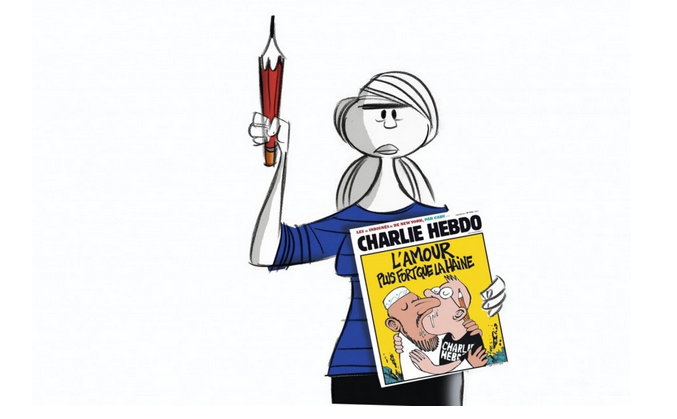
David Pope, Canberra Times

Ann Telnaes, Washington Post
David Pope, Canberra Times

33nathanielcampbell
>31 southernbooklady: "The problem, according to Armstrong from what I remember of her talk years ago, isn't Allah or Jesus Christ, it's fear. And not, as Nathan suggests above, fear of "modernity" per se, but simply fear of change. We long for stability, but live in a world of volatility and change. Theocratic governments (and you could call many political ideologies theocratic in this sense) are about enforcing stability, but its a hopeless task because change happens. And really, the more a government, or a religion, resists change, the more fundamentalist it appears."
That's it exactly -- the reference to a specific fear of "modernity" was drawn specifically from the Salon interview; but I think that modernity's challenge to the theocratic worldview is precisely the motivation for most modern forms religious of fundamentalism.* Of course (and again, as Armstrong insightfully points out in the Salon interview), Islamic fundamentalism is a reaction against the colonialist imposition of a foreign modernity; meanwhile, I would argue, Christian fundamentalism is a reaction against the internal, Western evolution of a liberal, pluralistic society.
Mainstream Christianity (whether Catholic or Protestant; the Orthodox are in a slightly different boat because they either {a} were themselves minorities under an Islamic {Ottoman} empire for many years, or {b} have suffered through Communism and its aftermath) has managed to embrace that pluralism and the specific separation between theology and politics that comes with it -- Protestants figured it out first, with America taking the lead; it took the Catholics until Vatican II to finally get their heads wrapped around the idea.
------------------
*Most, but not all. Another factor (again as Armstrong points out) is nationalism, which is driving Hindu fundamentalism and its violence against Muslims and Christians today in India; though there, too, there's a strain of post-colonial catharsis.
That's it exactly -- the reference to a specific fear of "modernity" was drawn specifically from the Salon interview; but I think that modernity's challenge to the theocratic worldview is precisely the motivation for most modern forms religious of fundamentalism.* Of course (and again, as Armstrong insightfully points out in the Salon interview), Islamic fundamentalism is a reaction against the colonialist imposition of a foreign modernity; meanwhile, I would argue, Christian fundamentalism is a reaction against the internal, Western evolution of a liberal, pluralistic society.
Mainstream Christianity (whether Catholic or Protestant; the Orthodox are in a slightly different boat because they either {a} were themselves minorities under an Islamic {Ottoman} empire for many years, or {b} have suffered through Communism and its aftermath) has managed to embrace that pluralism and the specific separation between theology and politics that comes with it -- Protestants figured it out first, with America taking the lead; it took the Catholics until Vatican II to finally get their heads wrapped around the idea.
------------------
*Most, but not all. Another factor (again as Armstrong points out) is nationalism, which is driving Hindu fundamentalism and its violence against Muslims and Christians today in India; though there, too, there's a strain of post-colonial catharsis.
34nathanielcampbell
>32 LolaWalser: You do understand that every person in this thread condemns the massacre in the strongest of terms, right? We may not have made it explicit because we take the massacre's immorality for granted.
35nathanielcampbell
>15 theoria: "Such as in the United States?"
Well, precisely. The very term "fundamentalist" was an invention to describe a strain of American Christianity of the early 20th-century that formed in large part out of reaction to the perceived "secularization" of American society.
>17 theoria: "His comment is hilarious"
I'm afraid I don't quite understand this -- what makes the sociology of religious fundamentalism "hilarious"?
Well, precisely. The very term "fundamentalist" was an invention to describe a strain of American Christianity of the early 20th-century that formed in large part out of reaction to the perceived "secularization" of American society.
>17 theoria: "His comment is hilarious"
I'm afraid I don't quite understand this -- what makes the sociology of religious fundamentalism "hilarious"?
36LolaWalser
>34 nathanielcampbell:
You do understand I've a triple digit IQ, right? Do you? Don't bug me with condescending twattery, Your Majesty.
You do understand I've a triple digit IQ, right? Do you? Don't bug me with condescending twattery, Your Majesty.
37LolaWalser
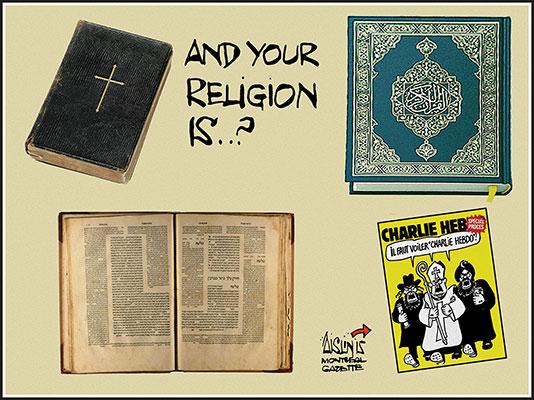
Terry Mosher, Montreal Gazette
38LolaWalser
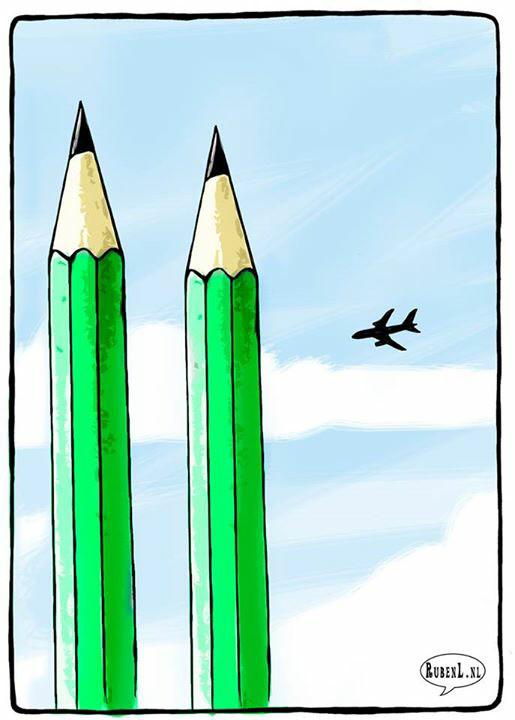
Ruben Oppenheimer, The Netherlands
39nathanielcampbell
>36 LolaWalser: Then I'm afraid I don't understand, as the OP seems to imply that all religion bears responsibility for the massacre in Paris.
40LolaWalser
Steve Marmel
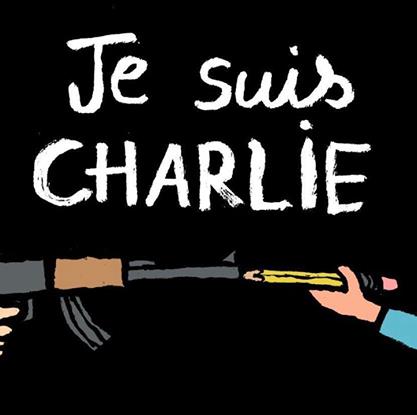
41LolaWalser
>39 nathanielcampbell:
What can I say, I'm glad you found a field of study commensurate to your abilities.
What can I say, I'm glad you found a field of study commensurate to your abilities.
42LolaWalser
Dave Brown, The Independent


43nathanielcampbell
>41 LolaWalser: Do you have any reasonable arguments to articulate here, or just a bunch of insults to scatter indiscriminately against the religious?
That is: is this thread meant to be a serious discussion of religiously-motivated violence, or is meant for catharsis in the face of a terrifying, despicable, deplorable, gut-wrenching tragedy?
(I want to acknowledge seriously and mindfully that we do, in fact, need a space in which to rage, to howl, to give voice to the deepest, rawest emotions that something like this massacre unleashes in us. If we have inappropriately intruded here in such a moment, you have my sincere apologies.)
That is: is this thread meant to be a serious discussion of religiously-motivated violence, or is meant for catharsis in the face of a terrifying, despicable, deplorable, gut-wrenching tragedy?
(I want to acknowledge seriously and mindfully that we do, in fact, need a space in which to rage, to howl, to give voice to the deepest, rawest emotions that something like this massacre unleashes in us. If we have inappropriately intruded here in such a moment, you have my sincere apologies.)
44theoria
>35 nathanielcampbell: "Well, precisely. The very term "fundamentalist" was an invention to describe a strain of American Christianity of the early 20th-century that formed in large part out of reaction to the perceived "secularization" of American society."
Does your line of analysis suggest that the US should become a theocracy in order to ward off religious fundamentalism?
>35 nathanielcampbell: "I'm afraid I don't quite understand this -- what makes the sociology of religious fundamentalism "hilarious"?"
I was referring to the your comment which both I (>15 theoria:) and >16 LolaWalser: quote. I wouldn't associate it (your comment) with the "sociology of religious fundamentalism," rather it appears to expresses the ressentiment towards modernity also frequently articulated by a religiously aggrieved segment of the US population.
For a real sociological study of religious violence see Mark Juergensmeyer, Terror in the Mind of God.
Does your line of analysis suggest that the US should become a theocracy in order to ward off religious fundamentalism?
>35 nathanielcampbell: "I'm afraid I don't quite understand this -- what makes the sociology of religious fundamentalism "hilarious"?"
I was referring to the your comment which both I (>15 theoria:) and >16 LolaWalser: quote. I wouldn't associate it (your comment) with the "sociology of religious fundamentalism," rather it appears to expresses the ressentiment towards modernity also frequently articulated by a religiously aggrieved segment of the US population.
For a real sociological study of religious violence see Mark Juergensmeyer, Terror in the Mind of God.
45timspalding
If I might return to the basics, I've heard a lot of commentary on Twitter today that seeks to question the importance of the attack, or place it within a larger narrative of media bias, for example by noting that the news hasn't similarly covered the device that detonated outside an NAACP office in Colorado.
I won't fight that battle, since nobody's said it here, but it brings up the things that really set this apart. This wasn't some lone-wolf attack ending in suicide, or some mix between personal craziness and a toxic ideology—the Fr. Bliss shooter or Brevik. This was something Europe hasn't seen for a while—a team of calm, well-disciplined and obviously skilled fighters conducting a planned attack on a hard target. And unlike the IRA or ETA, the target was intentionally and murderously civilian. If this isn't just a one-off, it really changes the game. A nation can put a cop in front of a few targeted places. Protecting against teams of well-armed and trained terrorists is rather different. It's the kind of thing that changes laws and societies for the worse.
I won't fight that battle, since nobody's said it here, but it brings up the things that really set this apart. This wasn't some lone-wolf attack ending in suicide, or some mix between personal craziness and a toxic ideology—the Fr. Bliss shooter or Brevik. This was something Europe hasn't seen for a while—a team of calm, well-disciplined and obviously skilled fighters conducting a planned attack on a hard target. And unlike the IRA or ETA, the target was intentionally and murderously civilian. If this isn't just a one-off, it really changes the game. A nation can put a cop in front of a few targeted places. Protecting against teams of well-armed and trained terrorists is rather different. It's the kind of thing that changes laws and societies for the worse.
47LolaWalser
This is Iraq and Syria spilling over into Europe, and given the situation, the increasing tensions surrounding immigration and integration of Muslims, I don't think it is possible for this to remain an isolated incident.
>46 quicksiva:
It seems they are offline today but I presume one can do it online normally.
>46 quicksiva:
It seems they are offline today but I presume one can do it online normally.
48southernbooklady
>45 timspalding: It's the kind of thing that changes laws and societies for the worse.
Here's a New Yorker article that ran in 2012, after a couple blasphemous videos and cartoons were published and violence was threatened--prompting a crackdown, I believe, of "extremist" religious expression (wearing the burka was outlawed, I think?):
http://www.newyorker.com/news/news-desk/the-charlie-hebdo-affair-laughing-at-bla...
Charbonnier was killed in the attack.
Here's a New Yorker article that ran in 2012, after a couple blasphemous videos and cartoons were published and violence was threatened--prompting a crackdown, I believe, of "extremist" religious expression (wearing the burka was outlawed, I think?):
http://www.newyorker.com/news/news-desk/the-charlie-hebdo-affair-laughing-at-bla...
Charbonnier, Charlie Hebdo’s editor, sounds exactly sensible and intelligent when he says that the cartoons will only “shock those who will want to be shocked.” He also told Le Monde, “I don’t feel as though I’m killing someone with a pen. I’m not putting lives at risk. When activists need a pretext to justify their violence, they always find it.”
Charbonnier was killed in the attack.
49nathanielcampbell
>44 theoria: "Does your line of analysis suggest that the US should become a theocracy in order to ward off religious fundamentalism?"
and
"I wouldn't associate it (your comment) with the "sociology of religious fundamentalism," rather it appears to expresses the ressentiment towards modernity also frequently articulated by a religiously aggrieved segment of the US population."
I'm afraid that you've completely misinterpreted my point of view. It was indeed a sociology of religious fundamentalism, because I was trying to explain (or rather, summarize Karen Armstrong's explanation) of a major cause of fundamentalism.
What my comments emphatically were NOT is the supposed expression of "ressentiment towards modernity." I am NOT advocating theocracy; as a citizen, a Christian, and a theologian, I SUPPORT the liberal, pluralistic notion of a separation of church and state as the best means towards an authentic, modern freedom of conscience/religion.
The real puzzler to me is what on earth would give you the idea that I am sympathetic to the complaint of the fundamentalist, given that I am regularly a foe of fundamentalism's misappropriation of religion and attacks upon science.
and
"I wouldn't associate it (your comment) with the "sociology of religious fundamentalism," rather it appears to expresses the ressentiment towards modernity also frequently articulated by a religiously aggrieved segment of the US population."
I'm afraid that you've completely misinterpreted my point of view. It was indeed a sociology of religious fundamentalism, because I was trying to explain (or rather, summarize Karen Armstrong's explanation) of a major cause of fundamentalism.
What my comments emphatically were NOT is the supposed expression of "ressentiment towards modernity." I am NOT advocating theocracy; as a citizen, a Christian, and a theologian, I SUPPORT the liberal, pluralistic notion of a separation of church and state as the best means towards an authentic, modern freedom of conscience/religion.
The real puzzler to me is what on earth would give you the idea that I am sympathetic to the complaint of the fundamentalist, given that I am regularly a foe of fundamentalism's misappropriation of religion and attacks upon science.
50nathanielcampbell
>48 southernbooklady: "prompting a crackdown, I believe, of "extremist" religious expression (wearing the burka was outlawed, I think?)"
The Europeans have this odd notion of freedom, in which draconian restrictions on religious freedom are perfectly acceptable, but blasphemy is not merely tolerated but celebrated as free speech.
The Europeans have this odd notion of freedom, in which draconian restrictions on religious freedom are perfectly acceptable, but blasphemy is not merely tolerated but celebrated as free speech.
51southernbooklady
>50 nathanielcampbell: The Europeans have this odd notion of freedom, in which draconian restrictions on religious freedom are perfectly acceptable, but blasphemy is not merely tolerated but celebrated as free speech.
Perhaps it comes from living with centuries' worth of history where religious extremism fueled civil wars and the punishments for blasphemy were harsh to the point of burning people at the stake.
Perhaps it comes from living with centuries' worth of history where religious extremism fueled civil wars and the punishments for blasphemy were harsh to the point of burning people at the stake.
52LolaWalser
"odd notion of freedom"
53nathanielcampbell
It's hypocritical to defend Charlie Hebdo's right to publish extremely offensive and blasphemous cartoons, but not defend a Muslim's right to wear a burqa.
55southernbooklady
>53 nathanielcampbell: It's hypocritical to defend Charlie Hebdo's right to publish extremely offensive and blasphemous cartoons, but not defend a Muslim's right to wear a burqa
Ah, well, if that's aimed at me, I don't think you can point to anything I've said that suggests I don't think Muslims should wear the burqa. Of course, when you say "Muslim" you really mean "Muslim woman." It's not as if any Muslim men are required to go about covered from head to toe. I can, if you like, give you quite an extensive opinion on what I think of patriarchal institutions that enforce dress codes that restrict and humiliate women, but I'm afraid you'd find my opinion would not be limited to Islam.
No, I'm of the opinion that "freedom" tends towards the "all or nothing" -- if you want full freedom of religion, it is best defended...indeed it requires the full freedom to blaspheme. Everyone's religion is a kind of blasphemy to someone else, after all.
Ah, well, if that's aimed at me, I don't think you can point to anything I've said that suggests I don't think Muslims should wear the burqa. Of course, when you say "Muslim" you really mean "Muslim woman." It's not as if any Muslim men are required to go about covered from head to toe. I can, if you like, give you quite an extensive opinion on what I think of patriarchal institutions that enforce dress codes that restrict and humiliate women, but I'm afraid you'd find my opinion would not be limited to Islam.
No, I'm of the opinion that "freedom" tends towards the "all or nothing" -- if you want full freedom of religion, it is best defended...indeed it requires the full freedom to blaspheme. Everyone's religion is a kind of blasphemy to someone else, after all.
56nathanielcampbell
>55 southernbooklady: Sorry, it was directed at >52 LolaWalser:, and now by extension, >54 theoria:.
58LolaWalser
>55 southernbooklady:
when you say "Muslim" you really mean "Muslim woman."
I began a reply with the same observation. Awfully free with flinging around the charges of hypocrisy, those theological policemen of women's wear.
>53 nathanielcampbell:
It's hypocritical to impose a religious restriction on women that men don't have to suffer.
But, to the point of your "argument", I would not defend any attack on Islamic wear that extended to threats and murder, nor have I noticed any critics of burqas call anti-burqists to such measures.
"odd notion of freedom"
when you say "Muslim" you really mean "Muslim woman."
I began a reply with the same observation. Awfully free with flinging around the charges of hypocrisy, those theological policemen of women's wear.
>53 nathanielcampbell:
It's hypocritical to impose a religious restriction on women that men don't have to suffer.
But, to the point of your "argument", I would not defend any attack on Islamic wear that extended to threats and murder, nor have I noticed any critics of burqas call anti-burqists to such measures.
"odd notion of freedom"
59LolaWalser
>57 nathanielcampbell:
Because the Reign of Terror is a model antithesis of Barbarie.
Because France in 2015 is a model of Reign of Terror.
Do go on.
"odd notion of freedom"
Because the Reign of Terror is a model antithesis of Barbarie.
Because France in 2015 is a model of Reign of Terror.
Do go on.
"odd notion of freedom"
60southernbooklady
>56 nathanielcampbell: Ah, well my confusion is understandable then, since neither Lola nor theoria have mentioned burqas at all.
But one could accuse the French government of hypocrisy with some justification, I think. Then again, it's a government. Hypocrisy is a requirement, although I believe they call it diplomacy when it is committed in the service of the state.
But one could accuse the French government of hypocrisy with some justification, I think. Then again, it's a government. Hypocrisy is a requirement, although I believe they call it diplomacy when it is committed in the service of the state.
61theoria
>57 nathanielcampbell: "Because the Reign of Terror is a model antithesis of Barbarie."
Profound lack of historical understanding.
Profound lack of historical understanding.
62theoria
>56 nathanielcampbell: Still determined to document the existence of liberal hypocrisy eh?
Try again.
http://www.librarything.com/topic/132159#3218883
Try again.
http://www.librarything.com/topic/132159#3218883
63LolaWalser
>60 southernbooklady:
While France's ban of the burqa can be criticised from several viewpoints, I don't know how it can be called "hypocritical". There is no test case to compare, but theoretically, it is the type of the veiling that's the issue, not which religion promotes it. I fully expect that if Buddhists decided to impose burqas on their women, they'd run into the same problems and be subject to the same current French laws regulating such attire in public.
While France's ban of the burqa can be criticised from several viewpoints, I don't know how it can be called "hypocritical". There is no test case to compare, but theoretically, it is the type of the veiling that's the issue, not which religion promotes it. I fully expect that if Buddhists decided to impose burqas on their women, they'd run into the same problems and be subject to the same current French laws regulating such attire in public.
64southernbooklady
>63 LolaWalser: yeah, I don't think so. That sounds like a legalistic fiction to me. The intent of the law seems clear and specifically targeted. It's clearly anti-Islamic, not anti-"extremist." Unless nun are now banned from wearing habits?
65timspalding
>63 LolaWalser:
I fear you've missed the point. The "test case" isn't Buddhists who want to wear big outfits, but press freedom. There is a contradiction between supporting one basic right—the right of speech—and denying another—the right to do simple things that aren't hurting anyone, like wear what clothing you want.
FWIW, I don't find the contradiction as start as N may. France has a long tradition of free speech, but it is far from being absolutist about it. On the contrary, France has some of the most restrictive speech laws of a western democracy. When French Muslims declare that attacks on the prophet should be illegal they can look to the many other forms of speech which are already illegal. That said, I don't think the inconsistency is fatal, and in the context of the actual murder a dozen people, there's no reason to pick at scabs.
Unless nun are now banned from wearing habits?
Well, it's only face covering. According to Wikipedia, the police have picked up balaclava-wearing Pussy Riot supporters, and cartoon animal costumes are technically illegal. But of course the main intent was anti-Islamic, rather than a sudden rise of anti-Mickey-Mousery.
I fear you've missed the point. The "test case" isn't Buddhists who want to wear big outfits, but press freedom. There is a contradiction between supporting one basic right—the right of speech—and denying another—the right to do simple things that aren't hurting anyone, like wear what clothing you want.
FWIW, I don't find the contradiction as start as N may. France has a long tradition of free speech, but it is far from being absolutist about it. On the contrary, France has some of the most restrictive speech laws of a western democracy. When French Muslims declare that attacks on the prophet should be illegal they can look to the many other forms of speech which are already illegal. That said, I don't think the inconsistency is fatal, and in the context of the actual murder a dozen people, there's no reason to pick at scabs.
Unless nun are now banned from wearing habits?
Well, it's only face covering. According to Wikipedia, the police have picked up balaclava-wearing Pussy Riot supporters, and cartoon animal costumes are technically illegal. But of course the main intent was anti-Islamic, rather than a sudden rise of anti-Mickey-Mousery.
66LolaWalser
>64 southernbooklady:
Nuns don't wear burqas. The difference between a burqa and other types of veiling are anything but legalistic, as is the difference between a law targeting full face coverings and a (hypothetical) law that would target ALL Islamic dress.
The discussion was triggered by the demand for passport photos to show the face. Is it unreasonable to refuse to admit this as valid identification?

Nuns don't wear burqas. The difference between a burqa and other types of veiling are anything but legalistic, as is the difference between a law targeting full face coverings and a (hypothetical) law that would target ALL Islamic dress.
The discussion was triggered by the demand for passport photos to show the face. Is it unreasonable to refuse to admit this as valid identification?

67southernbooklady
>66 LolaWalser: The discussion was triggered by the demand for passport photos to show the face. Is it unreasonable to refuse to admit this as valid identification?
Mmmm. I'll admit that I don't find "so the government can identify you" to be all that reassuring a reason for being forced in or out of a religious or cultural costume.
Mmmm. I'll admit that I don't find "so the government can identify you" to be all that reassuring a reason for being forced in or out of a religious or cultural costume.
68LolaWalser
>65 timspalding:
No, I fear that we are not EVER going to agree about "free speech" at all and you aren't paying attention to the argument at all.
the right to do simple things that aren't hurting anyone, like wear what clothing you want.
My going around naked in public wouldn't hurt anyone, and yet such a simple thing is denied to me.
There's nothing "simple" about the imposition of Islamic dress on women or the problems it creates in contexts different from, say, Saudi Arabia. Actually, take a look at movie Wadjda, if you want to see how un-simple it is even there.
No, I fear that we are not EVER going to agree about "free speech" at all and you aren't paying attention to the argument at all.
the right to do simple things that aren't hurting anyone, like wear what clothing you want.
My going around naked in public wouldn't hurt anyone, and yet such a simple thing is denied to me.
There's nothing "simple" about the imposition of Islamic dress on women or the problems it creates in contexts different from, say, Saudi Arabia. Actually, take a look at movie Wadjda, if you want to see how un-simple it is even there.
69LolaWalser
>67 southernbooklady:
You don't have a passport? Never travel? No photo ID papers of any kind? To be sure, we can invent life scenarios in which you wouldn't need or use one. But in general, how is this supposed to function in society as a whole? What if I'm a traffic cop? A teacher? A bank clerk? How do I identify the client, pupil, patient etc.?
And why should this segment of the population have the right to hide their identity as compared to the rest of us?
You don't have a passport? Never travel? No photo ID papers of any kind? To be sure, we can invent life scenarios in which you wouldn't need or use one. But in general, how is this supposed to function in society as a whole? What if I'm a traffic cop? A teacher? A bank clerk? How do I identify the client, pupil, patient etc.?
And why should this segment of the population have the right to hide their identity as compared to the rest of us?
70theoria
I'm not sure why the burqa issue is relevant here (other than as a red herring). All things being equal, the murder of journalists for the sake of religious ideas is not of the same order of harm as restrictions on religious costumes.
71LolaWalser
>65 timspalding:
According to Wikipedia, the police have picked up balaclava-wearing Pussy Riot supporters, and cartoon animal costumes are technically illegal. But of course the main intent was anti-Islamic, rather than a sudden rise of anti-Mickey-Mousery.
Anti-one-kind-of-Islamic. And if they are arresting people with non-religious face coverings, then they are in effect not behaving hypocritically. Whatever anyone's interpretations of "intention".
According to Wikipedia, the police have picked up balaclava-wearing Pussy Riot supporters, and cartoon animal costumes are technically illegal. But of course the main intent was anti-Islamic, rather than a sudden rise of anti-Mickey-Mousery.
Anti-one-kind-of-Islamic. And if they are arresting people with non-religious face coverings, then they are in effect not behaving hypocritically. Whatever anyone's interpretations of "intention".
72LolaWalser
>70 theoria:
I'm not sure why the burqa issue is relevant here (other than as a red herring).
My fault, I rose to the bait. I admit I hate veiling so much I can't resist hypocrites "defending" it.
All things being equal, the murder of journalists for the sake of religious ideas is not of the same order of harm as restrictions on religious costumes.
You obviously have "odd notions of freedom". ;)
I'm not sure why the burqa issue is relevant here (other than as a red herring).
My fault, I rose to the bait. I admit I hate veiling so much I can't resist hypocrites "defending" it.
All things being equal, the murder of journalists for the sake of religious ideas is not of the same order of harm as restrictions on religious costumes.
You obviously have "odd notions of freedom". ;)
73theoria
>72 LolaWalser: Viva odd notions of freedom!
74southernbooklady
>69 LolaWalser: Now now. I can be identified and cataloged and followed and taxed and tagged. For all I know I've been microchipped (and wouldn't that be a solution?). I am a pragmatist. But I don't see the use in rationalizing legislation that is motivated by discrimination.
75LolaWalser
>74 southernbooklady:
Except the rationale, by your own admission (mere pragmatism or not), actually exists.
What exactly "motivates" the legislation--which DEMONSTRABLY does not affect all Muslims or Muslims exclusively--and how does one trace the trail from "islamophobia" to "law" is beyond my powers to elucidate.
But I share your ambivalence on the "use" of such legislation if one wanted to combat Muslim extremism.
Then again. If they catch those bastards they can hit them with an extra charge--weren't they wearing balaclavas?
Except the rationale, by your own admission (mere pragmatism or not), actually exists.
What exactly "motivates" the legislation--which DEMONSTRABLY does not affect all Muslims or Muslims exclusively--and how does one trace the trail from "islamophobia" to "law" is beyond my powers to elucidate.
But I share your ambivalence on the "use" of such legislation if one wanted to combat Muslim extremism.
Then again. If they catch those bastards they can hit them with an extra charge--weren't they wearing balaclavas?
76southernbooklady
>75 LolaWalser: how does one trace the trail from "islamophobia" to "law" is beyond my powers to elucidate.
And it's not like the trail is ever well-marked. But I tend towards the cynical and suspicious in such cases. After all, right now there's a spate of legislation in the United States that has led to women being charged with assault if their baby is born and tests positive for drugs. There's plenty of rationale for that sort of thing as well, but I don't trust the motives of the people writing the laws in the slightest.
And it's not like the trail is ever well-marked. But I tend towards the cynical and suspicious in such cases. After all, right now there's a spate of legislation in the United States that has led to women being charged with assault if their baby is born and tests positive for drugs. There's plenty of rationale for that sort of thing as well, but I don't trust the motives of the people writing the laws in the slightest.
77timspalding
My going around naked in public wouldn't hurt anyone, and yet such a simple thing is denied to me.
It is in some places—for example all of Spain. As for France, there are state-established nude beaches and areas. In most places in the US it's legal to go topless—my town, New York, a majority of states, etc. (http://gotopless.org/topless-laws). But the argument is that it does hurt people—that nakedness is harmful to children. Ultimately I'd be fine with allowing it in the street. If you'd like to go about nude today in Canada, well, I hope you're near a hospital.
As for "imposition," well, it gets to a basic question of how we assess people's actions in law. We do not arrest people who read subversive literature on the theory that their husbands are making them do it. If the state has evidence that a woman is indeed being forced to do something against her will, we should prosecute them.
And why should this segment of the population have the right to hide their identity as compared to the rest of us?
I can see an argument for passport photos. But this is an edge case, far from what France actually has—a law against covering your face, anywhere, not just on a passport.
It is in some places—for example all of Spain. As for France, there are state-established nude beaches and areas. In most places in the US it's legal to go topless—my town, New York, a majority of states, etc. (http://gotopless.org/topless-laws). But the argument is that it does hurt people—that nakedness is harmful to children. Ultimately I'd be fine with allowing it in the street. If you'd like to go about nude today in Canada, well, I hope you're near a hospital.
As for "imposition," well, it gets to a basic question of how we assess people's actions in law. We do not arrest people who read subversive literature on the theory that their husbands are making them do it. If the state has evidence that a woman is indeed being forced to do something against her will, we should prosecute them.
And why should this segment of the population have the right to hide their identity as compared to the rest of us?
I can see an argument for passport photos. But this is an edge case, far from what France actually has—a law against covering your face, anywhere, not just on a passport.
78theoria
Ross Douthat (NY Times):
"In the wake of the vicious murders at the offices of the satirical French newspaper Charlie Hebdo today, let me offer three tentative premises about blasphemy in a free society.
1) The right to blaspheme (and otherwise give offense) is essential to the liberal order.
2) There is no duty to blaspheme, a society’s liberty is not proportional to the quantity of blasphemy it produces, and under many circumstances the choice to give offense (religious and otherwise) can be reasonably criticized as pointlessly antagonizing, needlessly cruel, or simply stupid.
3) The legitimacy and wisdom of such criticism is generally inversely proportional to the level of mortal danger that the blasphemer brings upon himself...
We are in a situation where my third point applies, because the kind of blasphemy that Charlie Hebdo engaged in had deadly consequences, as everyone knew it could … and that kind of blasphemy is precisely the kind that needs to be defended, because it’s the kind that clearly serves a free society’s greater good. If a large enough group of someones is willing to kill you for saying something, then it’s something that almost certainly needs to be said, because otherwise the violent have veto power over liberal civilization, and when that scenario obtains it isn’t really a liberal civilization any more. Again, liberalism doesn’t depend on everyone offending everyone else all the time, and it’s okay to prefer a society where offense for its own sake is limited rather than pervasive. But when offenses are policed by murder, that’s when we need more of them, not less, because the murderers cannot be allowed for a single moment to think that their strategy can succeed.
In this sense, many of the Western voices criticizing the editors of Hebdo have had things exactly backward: Whether it’s the Obama White House or Time Magazine in the past or the Financial Times and (God help us) the Catholic League today, they’ve criticized the paper for provoking violence by being needlessly offensive and “inflammatory” (Jay Carney’s phrase), when the reality is that it’s precisely the violence that justifies the inflammatory content....
Must all deliberate offense-giving, in any context, be celebrated, honored, praised? I think not. But in the presence of the gun — or, as in the darker chapters of my own faith’s history, the rack or the stake — both liberalism and liberty require that it be welcomed and defended." http://douthat.blogs.nytimes.com/2015/01/07/the-blasphemy-we-need/?hp&action...
"In the wake of the vicious murders at the offices of the satirical French newspaper Charlie Hebdo today, let me offer three tentative premises about blasphemy in a free society.
1) The right to blaspheme (and otherwise give offense) is essential to the liberal order.
2) There is no duty to blaspheme, a society’s liberty is not proportional to the quantity of blasphemy it produces, and under many circumstances the choice to give offense (religious and otherwise) can be reasonably criticized as pointlessly antagonizing, needlessly cruel, or simply stupid.
3) The legitimacy and wisdom of such criticism is generally inversely proportional to the level of mortal danger that the blasphemer brings upon himself...
We are in a situation where my third point applies, because the kind of blasphemy that Charlie Hebdo engaged in had deadly consequences, as everyone knew it could … and that kind of blasphemy is precisely the kind that needs to be defended, because it’s the kind that clearly serves a free society’s greater good. If a large enough group of someones is willing to kill you for saying something, then it’s something that almost certainly needs to be said, because otherwise the violent have veto power over liberal civilization, and when that scenario obtains it isn’t really a liberal civilization any more. Again, liberalism doesn’t depend on everyone offending everyone else all the time, and it’s okay to prefer a society where offense for its own sake is limited rather than pervasive. But when offenses are policed by murder, that’s when we need more of them, not less, because the murderers cannot be allowed for a single moment to think that their strategy can succeed.
In this sense, many of the Western voices criticizing the editors of Hebdo have had things exactly backward: Whether it’s the Obama White House or Time Magazine in the past or the Financial Times and (God help us) the Catholic League today, they’ve criticized the paper for provoking violence by being needlessly offensive and “inflammatory” (Jay Carney’s phrase), when the reality is that it’s precisely the violence that justifies the inflammatory content....
Must all deliberate offense-giving, in any context, be celebrated, honored, praised? I think not. But in the presence of the gun — or, as in the darker chapters of my own faith’s history, the rack or the stake — both liberalism and liberty require that it be welcomed and defended." http://douthat.blogs.nytimes.com/2015/01/07/the-blasphemy-we-need/?hp&action...
79LolaWalser
>76 southernbooklady:
Are you saying that you expect the face coverings law to lead to something "more"? Ban on all Islamic dress, widespread multifarious legal discrimination, banning of worship, deportation?
I see no other way to make sense of trusting or distrusting this particular law. For my part, I see its point, so pinpointing something as vague as "motivation" is mostly irrelevant. I mean, it's not like the debate in France hid in any way various antipathies toward Islam, so it's hardly revelatory to ascribe the successful passing of the law to a generalised "islamophobia".
But if someone made the case that there's an actual conspiracy behind it to usher the measures I mention above, that would absolutely affect how I view it.
There's another factor muddying this discussion between Americans and the French, and that's the very different general views on religion. I think Americans in general tend to underestimate the importance of secularism to modern Frenchmen. Americans are used to religion dominating their social lives and politics in ways that have become quite foreign to Europe, France in particular. This has nothing to do with how these modern Frenchmen identify religiously. It's a matter of atmosphere, of noise, of what's in the air, of what is discussed and what isn't, what's "on the table" and what isn't, whether one is a believer or an atheist. The rise of visibility of Islam in Europe has created a new kind of problem for these people, a new condition of life. Americans are used to this, the French are not, and they resent it, they seriously resent it.
What I mean is that it is too facile to ascribe all the problems of the French with Muslims to their "islamophobia". There is islamophobia, but there really is a bigger general problem regarding the sincere need to preserve secularism.
Are you saying that you expect the face coverings law to lead to something "more"? Ban on all Islamic dress, widespread multifarious legal discrimination, banning of worship, deportation?
I see no other way to make sense of trusting or distrusting this particular law. For my part, I see its point, so pinpointing something as vague as "motivation" is mostly irrelevant. I mean, it's not like the debate in France hid in any way various antipathies toward Islam, so it's hardly revelatory to ascribe the successful passing of the law to a generalised "islamophobia".
But if someone made the case that there's an actual conspiracy behind it to usher the measures I mention above, that would absolutely affect how I view it.
There's another factor muddying this discussion between Americans and the French, and that's the very different general views on religion. I think Americans in general tend to underestimate the importance of secularism to modern Frenchmen. Americans are used to religion dominating their social lives and politics in ways that have become quite foreign to Europe, France in particular. This has nothing to do with how these modern Frenchmen identify religiously. It's a matter of atmosphere, of noise, of what's in the air, of what is discussed and what isn't, what's "on the table" and what isn't, whether one is a believer or an atheist. The rise of visibility of Islam in Europe has created a new kind of problem for these people, a new condition of life. Americans are used to this, the French are not, and they resent it, they seriously resent it.
What I mean is that it is too facile to ascribe all the problems of the French with Muslims to their "islamophobia". There is islamophobia, but there really is a bigger general problem regarding the sincere need to preserve secularism.
80LolaWalser
>77 timspalding:
But the argument is that it does hurt people—that nakedness is harmful to children.
Nakedness is harmful to children? More than being raised in a culture that treats women like pariahs?
For the record, I grew up in a predominantly Muslim country and just the sight of veiled women distressed me deeply and left scars I still feel today. In a way they are worse today, when I fully understand what's behind the veiling, than in my childhood, when I was just creeped out.
But the argument is that it does hurt people—that nakedness is harmful to children.
Nakedness is harmful to children? More than being raised in a culture that treats women like pariahs?
For the record, I grew up in a predominantly Muslim country and just the sight of veiled women distressed me deeply and left scars I still feel today. In a way they are worse today, when I fully understand what's behind the veiling, than in my childhood, when I was just creeped out.
81timspalding
I am no big fan of Douthat, but he's totally right here.
Nakedness is harmful to children? More than being raised in a culture that treats women like pariahs?
As I said, that's the argument, not that I agree with it. The argument against the veil is structured differently.
I think we also come a-cropper on our assumptions about government and society. I would prefer if women didn't veil. Although I don't have your visceral reaction to the veil—I've known far too many veiled women on a personal level to feel "deeply distressed" or "creeped out" by them—I don't approve of the practice. But I don't approve of many things. I separate my approval and disapproval very sharply from what I believe the state should use its monopoly of force to prohibit. This is, simply, what liberty is all about. I think we differ here.
I gather you grew up in Syria. Well, it's your childhood, and you've only thumbnailed it, so I can't say much, but I'm taking my son to a majority-Muslim country soon, and I hope he doesn't feel as you apparently did. If he does, I'd be inclined to expose him to the thing that creeps him out, as I have exposed him before, as my focus would be on seeing the person underneath more clearly.
Nakedness is harmful to children? More than being raised in a culture that treats women like pariahs?
As I said, that's the argument, not that I agree with it. The argument against the veil is structured differently.
I think we also come a-cropper on our assumptions about government and society. I would prefer if women didn't veil. Although I don't have your visceral reaction to the veil—I've known far too many veiled women on a personal level to feel "deeply distressed" or "creeped out" by them—I don't approve of the practice. But I don't approve of many things. I separate my approval and disapproval very sharply from what I believe the state should use its monopoly of force to prohibit. This is, simply, what liberty is all about. I think we differ here.
I gather you grew up in Syria. Well, it's your childhood, and you've only thumbnailed it, so I can't say much, but I'm taking my son to a majority-Muslim country soon, and I hope he doesn't feel as you apparently did. If he does, I'd be inclined to expose him to the thing that creeps him out, as I have exposed him before, as my focus would be on seeing the person underneath more clearly.
82LolaWalser
>78 theoria:
I don't know who's that guy, but I like the article.
I feel horribly ashamed for the ideas I defended in the past. Fifteen years ago I was still capable of arguing that Rushdie--not that he deserved death, threats, home arrest!--ought to have "known better". When the Danish protests started, my first reaction was to commiserate with the Muslims. The Danes ought to have "known better". It wasn't nice to provoke people who are so sensitive to provocation.
But today I agree with Douthat--those are the very people and themes that need provoking.
I don't know who's that guy, but I like the article.
I feel horribly ashamed for the ideas I defended in the past. Fifteen years ago I was still capable of arguing that Rushdie--not that he deserved death, threats, home arrest!--ought to have "known better". When the Danish protests started, my first reaction was to commiserate with the Muslims. The Danes ought to have "known better". It wasn't nice to provoke people who are so sensitive to provocation.
But today I agree with Douthat--those are the very people and themes that need provoking.
83theoria
>82 LolaWalser: I supported Rushdie at the time and rushed out to buy The Satanic Verses at a bookstore in Berkeley whose windows were smashed because it displayed the book. I was skeptical of the value of Danish cartoons, probably due to ill-considered book snobbishness.
84timspalding
>81 timspalding:
Douthat is a smart but rather odious Catholic conservative, a rather odd duck at the NYT. That we're all liking him—despite our rather different reasons for NOT liking him!—is some sort of sign of the end of the world.
Douthat is a smart but rather odious Catholic conservative, a rather odd duck at the NYT. That we're all liking him—despite our rather different reasons for NOT liking him!—is some sort of sign of the end of the world.
85madpoet
It is a curious thing, but you can tell the relative level of freedom in a communist country by how tolerant the (officially atheist) state is of religion. The more religious freedom, and religious practice, there is, the more free the society is as a whole. (Compare Cuba and North Korea for example.) It's almost as if totalitarian states feel threatened by religion-- a competing ideology. In fact, there has never been an officially atheist regime that wasn't authoritarian-- the more atheist, the more authoritarian and downright nasty-- even genocidal.
¨Disrespect religion. Disrespect it strenuously.¨ Disrespect atheism. Disrespect it strenuously.
¨Disrespect religion. Disrespect it strenuously.¨ Disrespect atheism. Disrespect it strenuously.
86RickHarsch
>47 LolaWalser: 'This is Iraq and Syria spilling over into Europe, and given the situation, the increasing tensions surrounding immigration and integration of Muslims, I don't think it is possible for this to remain an isolated incident.'
This seems a good place for the discussion to take a break from burqas and Rushdies and place the event in context. I noticed in one post Nathaniel spoke for everyone, claiming we all condemn in the something something terms the terrorist action. Perhaps. But until 'we all' do likewise for terror aimed Islam way this sort of terror will continue. Both Israel and the US must be accountable for atrocities against various Islamic peoples before we can expect any sort of peace. The grotesque actions of the US in particularly Iraq, Yemen, Pakistan, and Afghanistan, and the even more grotesque quotidian atrocities perpetrated by Israel keep the NEED for terror alive...
(In the shadows, so to speak, the latest Hindu nationalist government in India is sprouting anti-Muslim laws along with inviting catastrophic investors such as pharmaceutical companies that are raising prices, cutting poor folk from medicine with laws prohibiting various generic drugs and raising the bar for over the counter drugs. Where are European countries and the US aligned? It's terribly obvious.)
This seems a good place for the discussion to take a break from burqas and Rushdies and place the event in context. I noticed in one post Nathaniel spoke for everyone, claiming we all condemn in the something something terms the terrorist action. Perhaps. But until 'we all' do likewise for terror aimed Islam way this sort of terror will continue. Both Israel and the US must be accountable for atrocities against various Islamic peoples before we can expect any sort of peace. The grotesque actions of the US in particularly Iraq, Yemen, Pakistan, and Afghanistan, and the even more grotesque quotidian atrocities perpetrated by Israel keep the NEED for terror alive...
(In the shadows, so to speak, the latest Hindu nationalist government in India is sprouting anti-Muslim laws along with inviting catastrophic investors such as pharmaceutical companies that are raising prices, cutting poor folk from medicine with laws prohibiting various generic drugs and raising the bar for over the counter drugs. Where are European countries and the US aligned? It's terribly obvious.)
87timspalding
>86 RickHarsch:
There is legitimate spillover from the various conflicts. But the motive to kill cartoonists who abuse the prophet isn't geopolitical and strategic, but about religion and honor. There are certainly many terrorists in the Middle East who'd stop fighting if we abandoned Israel to a grisly fate. Some, like Al-Qaeda, might conclude a prudential, temporary truce if we gave Spain back to Islam. But so long as radical Islam exists—Sunni or Shiite—it is not going to stop lashing out with violence at blasphemous attacks on their prophet. These islamists didn't react with homicidal rage when the first Danish cartoons came out because Denmark took some minor role in Afghanistan. The Ayatollah didn't promise to kill Rushdie because he had a beef with the CIA. Nor did the three terrorists yell something about French meddling; they yelled "the prophet is avenged." This is about something else—blasphemy. And blasphemy isn't a death-penalty offenses in most Muslim countries, with overwhelming majority support ( http://www.pewforum.org/2013/04/30/the-worlds-muslims-religion-politics-society-... ), because of something evil imperialists did. To think this is about some western injustice, not deep traditions of honor and violence, is to mistake their worldview and motives for your own.
There is legitimate spillover from the various conflicts. But the motive to kill cartoonists who abuse the prophet isn't geopolitical and strategic, but about religion and honor. There are certainly many terrorists in the Middle East who'd stop fighting if we abandoned Israel to a grisly fate. Some, like Al-Qaeda, might conclude a prudential, temporary truce if we gave Spain back to Islam. But so long as radical Islam exists—Sunni or Shiite—it is not going to stop lashing out with violence at blasphemous attacks on their prophet. These islamists didn't react with homicidal rage when the first Danish cartoons came out because Denmark took some minor role in Afghanistan. The Ayatollah didn't promise to kill Rushdie because he had a beef with the CIA. Nor did the three terrorists yell something about French meddling; they yelled "the prophet is avenged." This is about something else—blasphemy. And blasphemy isn't a death-penalty offenses in most Muslim countries, with overwhelming majority support ( http://www.pewforum.org/2013/04/30/the-worlds-muslims-religion-politics-society-... ), because of something evil imperialists did. To think this is about some western injustice, not deep traditions of honor and violence, is to mistake their worldview and motives for your own.
88rolandperkins
". . .a prudential temporary
truce IF WE gave Spain back to Islam. . ." (87)
I realize that this if-clause takes us deep into the realm of the hypothetical, but it would be interesting to learn just when Spain became "ours"* to
"give" to Islam -- or to anybodyl
*Here, a definition of "we/ours" would be interersting, too.
truce IF WE gave Spain back to Islam. . ." (87)
I realize that this if-clause takes us deep into the realm of the hypothetical, but it would be interesting to learn just when Spain became "ours"* to
"give" to Islam -- or to anybodyl
*Here, a definition of "we/ours" would be interersting, too.
89quicksiva
"Blasphemy is defined as “Evil or profane speaking of God. The essence of the crime consists in the impious purpose in using the words, and does not necessarily include the performance of any desecrating act.”
The Jewish law is based on the case of the blasphemer, one of the mixed multitude that went out of Egypt with the children of Israel (Lev. xxiv. 10-23). He blasphemed the name of the Lord and cursed; was sentenced to be taken without the camp; and it was decreed that all who heard him should lay their hands upon his head, and that all the congregation should stone him. The judgment in his case was formulated in a general law in verses 15 and 16.
The term "we-noḳeb shem Yhwh," used in verse 16 ("And he that blasphemeth the name of the Lord," A. V.), does not seem to signify that the mere pronunciation of the Ineffable Name was considered blasphemy, but that it was blasphemous to curse or revile the same. The later law, however, took the word "noḳeb" in the sense of "pronouncing," and declared that the Ineffable Name must have been pronounced before the offender could be subjected to the punishment provided by the Law.
Both the lawgiver and the prophets speak of the blasphemer of God and of the king. To revile the king, who was God's representative, was apparently considered a species of blasphemy (Ex. xxii. 27; Isa. viii. 21). This is furthermore shown in the case of Naboth, the indictment against him being: "Thou didst blaspheme God and the king" (I Kings xxi. 10). Beyond the reference to cursing in the text of Leviticus, there is nothing in the Biblical laws to indicate what constitutes the crime, and nothing to show that, to prove blasphemy, it was required to prove that the blasphemer had uttered the name of God. The Mishnah, however, laying stress on the term "noḳeb," declares that the blasphemer is not guilty unless he pronounce the name of God (Mishnah Sanh. vii. 5). The Gemara goes further and extends the crime to an impious use of any words which indicate the sacred attributes of God, such as "The Holy One" or "The Merciful One." As long as the Jewish courts exercised criminal jurisdiction, the death penalty was inflicted only upon the blasphemer who used the Ineffable Name; but the blasphemer of God's attributes was subjected to corporal punishment (Sanh. 56a)."
jewishencyclopedia.com
The Jewish law is based on the case of the blasphemer, one of the mixed multitude that went out of Egypt with the children of Israel (Lev. xxiv. 10-23). He blasphemed the name of the Lord and cursed; was sentenced to be taken without the camp; and it was decreed that all who heard him should lay their hands upon his head, and that all the congregation should stone him. The judgment in his case was formulated in a general law in verses 15 and 16.
The term "we-noḳeb shem Yhwh," used in verse 16 ("And he that blasphemeth the name of the Lord," A. V.), does not seem to signify that the mere pronunciation of the Ineffable Name was considered blasphemy, but that it was blasphemous to curse or revile the same. The later law, however, took the word "noḳeb" in the sense of "pronouncing," and declared that the Ineffable Name must have been pronounced before the offender could be subjected to the punishment provided by the Law.
Both the lawgiver and the prophets speak of the blasphemer of God and of the king. To revile the king, who was God's representative, was apparently considered a species of blasphemy (Ex. xxii. 27; Isa. viii. 21). This is furthermore shown in the case of Naboth, the indictment against him being: "Thou didst blaspheme God and the king" (I Kings xxi. 10). Beyond the reference to cursing in the text of Leviticus, there is nothing in the Biblical laws to indicate what constitutes the crime, and nothing to show that, to prove blasphemy, it was required to prove that the blasphemer had uttered the name of God. The Mishnah, however, laying stress on the term "noḳeb," declares that the blasphemer is not guilty unless he pronounce the name of God (Mishnah Sanh. vii. 5). The Gemara goes further and extends the crime to an impious use of any words which indicate the sacred attributes of God, such as "The Holy One" or "The Merciful One." As long as the Jewish courts exercised criminal jurisdiction, the death penalty was inflicted only upon the blasphemer who used the Ineffable Name; but the blasphemer of God's attributes was subjected to corporal punishment (Sanh. 56a)."
jewishencyclopedia.com
90nathanielcampbell
I'll add my voice to the apparently unanimous approval of Douthat's sentiments in >78 theoria:.
91southernbooklady
>79 LolaWalser: Are you saying that you expect the face coverings law to lead to something "more"?
I think it is in the nature of the law that it builds upon itself -- so in a way, yes. I don't know the specifics of French law, of course, but in a general sense laws codify societal values. So I think you have to be diligent in NOT codifying things that actually violate someone's human rights, especially in the name of the greater good. As you say, "secularism" is a strong value in French society. Religious freedom is a huge thing in American society. But in neither case should those values be codified to the point of actually denying other people their rights. Which is why I have no sympathy, for example, for the Florida justices of the peace that are refusing to perform same-sex marriages. And why I think picking on people who dress a certain way as religious extremism is equally pernicious.
I do empathize with your position. Like you I hate the idea of veiling on feminist grounds. But I'm not in favor of passing laws as the way to get rid of it. Especially if those laws are really expressions of fear and discrimination.
I think it is in the nature of the law that it builds upon itself -- so in a way, yes. I don't know the specifics of French law, of course, but in a general sense laws codify societal values. So I think you have to be diligent in NOT codifying things that actually violate someone's human rights, especially in the name of the greater good. As you say, "secularism" is a strong value in French society. Religious freedom is a huge thing in American society. But in neither case should those values be codified to the point of actually denying other people their rights. Which is why I have no sympathy, for example, for the Florida justices of the peace that are refusing to perform same-sex marriages. And why I think picking on people who dress a certain way as religious extremism is equally pernicious.
I do empathize with your position. Like you I hate the idea of veiling on feminist grounds. But I'm not in favor of passing laws as the way to get rid of it. Especially if those laws are really expressions of fear and discrimination.
92southernbooklady
>78 theoria: But when offenses are policed by murder, that’s when we need more of them, not less, because the murderers cannot be allowed for a single moment to think that their strategy can succeed.
My bar is set somewhat lower than "murder."
My bar is set somewhat lower than "murder."
93timspalding
USA Today: People know the consequences: Opposing view by Anjem Choudary
http://www.usatoday.com/story/opinion/2015/01/07/islam-allah-muslims-shariah-anj...
http://www.usatoday.com/story/opinion/2015/01/07/islam-allah-muslims-shariah-anj...
"Muslims consider the honor of the Prophet Muhammad to be dearer to them than that of their parents or even themselves. To defend it is considered to be an obligation upon them. The strict punishment if found guilty of this crime under sharia (Islamic law) is capital punishment implementable by an Islamic State. This is because the Messenger Muhammad said, "Whoever insults a Prophet kill him."
However, because the honor of the Prophet is something which all Muslims want to defend, many will take the law into their own hands, as we often see.
Within liberal democracies, freedom of expression has curtailments, such as laws against incitement and hatred.
The truth is that Western governments are content to sacrifice liberties and freedoms when being complicit to torture and rendition — or when restricting the freedom of movement of Muslims, under the guise of protecting national security.
So why in this case did the French government allow the magazine Charlie Hebdo to continue to provoke Muslims, thereby placing the sanctity of its citizens at risk?
It is time that the sanctity of a Prophet revered by up to one-quarter of the world's population was protected."
94southernbooklady
>93 timspalding: "Muslims consider the honor of the Prophet Muhammad to be dearer to them than that of their parents or even themselves. "
Holding the honor of an idea dearer than one's family, neighbors, or anyone else is pretty much the root of all violence.
Holding the honor of an idea dearer than one's family, neighbors, or anyone else is pretty much the root of all violence.
95theoria
>92 southernbooklady: "My bar is set somewhat lower than "murder."
I would set mine at the "threat" of physical violence.
I would set mine at the "threat" of physical violence.
96LolaWalser
>91 southernbooklady:
Like you I hate the idea of veiling on feminist grounds. But I'm not in favor of passing laws as the way to get rid of it. Especially if those laws are really expressions of fear and discrimination.
Ataturk wrenched Turkey out of the Middle Ages precisely by such legislative fiats. It saved Turkey. I would welcome and approve a similar reformer and measures in every Islamic state that currently imposes absolute restrictions on women (and men), enshrines inequality and discrimination etc.
Just as I approve of legislating slavery out of society, or admitting women to vote, without waiting for "sea changes" in popular majorities etc.
>93 timspalding:
The guy's an asshat.
>86 RickHarsch:
Whatever noises the West makes, the result is that this will now take more, not less, war to bring about anything resembling viable stability in the Middle East. Let's assume the jihadists stop at Vienna (they tend to)--we are still then looking at another batch of fundamentalist Islamist states in the East, with social conditions deteriorated past anything Saddam had wrought.
And we shall be forced to accept them.
Like you I hate the idea of veiling on feminist grounds. But I'm not in favor of passing laws as the way to get rid of it. Especially if those laws are really expressions of fear and discrimination.
Ataturk wrenched Turkey out of the Middle Ages precisely by such legislative fiats. It saved Turkey. I would welcome and approve a similar reformer and measures in every Islamic state that currently imposes absolute restrictions on women (and men), enshrines inequality and discrimination etc.
Just as I approve of legislating slavery out of society, or admitting women to vote, without waiting for "sea changes" in popular majorities etc.
>93 timspalding:
The guy's an asshat.
>86 RickHarsch:
Whatever noises the West makes, the result is that this will now take more, not less, war to bring about anything resembling viable stability in the Middle East. Let's assume the jihadists stop at Vienna (they tend to)--we are still then looking at another batch of fundamentalist Islamist states in the East, with social conditions deteriorated past anything Saddam had wrought.
And we shall be forced to accept them.
97timspalding
This may interest:
Ayaan Hirsi Ali: Our Duty Is to Keep Charlie Hebdo Alive
http://www.thedailybeast.com/articles/2015/01/08/ayaan-hirsi-ali-our-duty-is-to-...
I tend to think Ali too quickly tars all of Islam with her (painful) experience. But as I noted above, large majorities in many muslim countries believe that apostasy and blasphemy should be punished with death. If you think cartoonists should be put to death, I at least don't see much of a difference between the state doing it after a trial and some concerned citizens doing it themselves on a Wednesday morning.
The guy's an asshat.
Or worse, yet USA Today gives him a platform.
Just as I approve of legislating slavery out of society, or admitting women to vote, without waiting for "sea changes" in popular majorities etc.
Well, you continually mix voluntary and involuntary things. Ataturk did the same. But there's a difference between abolishing religious control over schooling and law, and forbidding people to wear the clothes they like.
Ayaan Hirsi Ali: Our Duty Is to Keep Charlie Hebdo Alive
http://www.thedailybeast.com/articles/2015/01/08/ayaan-hirsi-ali-our-duty-is-to-...
"We do need to wake up to the fact that there is a movement—a very lethal movement, very cruel—that has a political vision about how the world should be organized and how society should live. And in order for them to realize their vision, they are willing to use any means. They are willing to use violence. They are willing to use terror.
Is this some kind of cult? Or are the principles of this cult embedded in Islam? I happen to think they are embedded in Islam. The only way peace-loving Muslims can get rid of this is by reforming their religion so that, for example, it can no longer provide justifications for murdering people deemed to be blasphemers. And while they go about reforming their religion, which will take some time, we who do not adhere to that religion need to defend our own values. Freedom of speech. Freedom of publication. And the rule of law."
I tend to think Ali too quickly tars all of Islam with her (painful) experience. But as I noted above, large majorities in many muslim countries believe that apostasy and blasphemy should be punished with death. If you think cartoonists should be put to death, I at least don't see much of a difference between the state doing it after a trial and some concerned citizens doing it themselves on a Wednesday morning.
The guy's an asshat.
Or worse, yet USA Today gives him a platform.
Just as I approve of legislating slavery out of society, or admitting women to vote, without waiting for "sea changes" in popular majorities etc.
Well, you continually mix voluntary and involuntary things. Ataturk did the same. But there's a difference between abolishing religious control over schooling and law, and forbidding people to wear the clothes they like.
98LolaWalser
>97 timspalding:
Perhaps you're too quick to dismiss painful personal experiences of Islam that come from women? God knows I don't align politically with Ali, but I don't need to, in order to understand and resent the outrage she suffered, or the steady-state outrage of existing as a woman in a misogynistic world even in the most liberal societies.
But there's a difference between abolishing religious control over schooling and law, and forbidding people to wear the clothes they like.
Cautioning as always that every exchange with you is like a Martian and a Zogian first-contact conducted in badly-learned Oyster, so that half the time at least I've no idea why you say the things you say, so that half the time I don't know what direction to give to my replies... Ataturk's reforms imposed measures that DID affect what people (man and women) wore--even, if memory serves, men's shaving habits. This was vitally important, whatever you mean by differences between regulating dress and abolishing religious control over law.
I'll tell you where I see the important difference--in that that was a Turk doing it in Turkey, and not 21st century France doing it (hypothetically--the French law is nowhere close to Ataturk's forced Westernisation campaign) to a handful of immigrants or recent descendants of immigrants of a minority faith.
I said above I was ambivalent about this law, I don't want that drowned in the noise. I think the demand for showing the full face on IDs is reasonable and unexceptional, it's what every one of us conforming to life in the political structure of a modern state more or less tacitly agrees to. I don't think arresting Muslim women in burqas in public is reasonable; in fact it's rather shameful.
Perhaps you're too quick to dismiss painful personal experiences of Islam that come from women? God knows I don't align politically with Ali, but I don't need to, in order to understand and resent the outrage she suffered, or the steady-state outrage of existing as a woman in a misogynistic world even in the most liberal societies.
But there's a difference between abolishing religious control over schooling and law, and forbidding people to wear the clothes they like.
Cautioning as always that every exchange with you is like a Martian and a Zogian first-contact conducted in badly-learned Oyster, so that half the time at least I've no idea why you say the things you say, so that half the time I don't know what direction to give to my replies... Ataturk's reforms imposed measures that DID affect what people (man and women) wore--even, if memory serves, men's shaving habits. This was vitally important, whatever you mean by differences between regulating dress and abolishing religious control over law.
I'll tell you where I see the important difference--in that that was a Turk doing it in Turkey, and not 21st century France doing it (hypothetically--the French law is nowhere close to Ataturk's forced Westernisation campaign) to a handful of immigrants or recent descendants of immigrants of a minority faith.
I said above I was ambivalent about this law, I don't want that drowned in the noise. I think the demand for showing the full face on IDs is reasonable and unexceptional, it's what every one of us conforming to life in the political structure of a modern state more or less tacitly agrees to. I don't think arresting Muslim women in burqas in public is reasonable; in fact it's rather shameful.
99nathanielcampbell
From Facebook:

Caption: "I am *not* Charlie, I am Ahmed the dead cop. Charlie ridiculed my faith and culture and I died defending his right to do so."

Caption: "I am *not* Charlie, I am Ahmed the dead cop. Charlie ridiculed my faith and culture and I died defending his right to do so."
100nathanielcampbell
>1 LolaWalser: quoting Rushdie: "Religion, a medieval form of unreason"
It bespeaks the utter lack of historical consciousness underlying the extremist rhetoric of both sides that medieval Islam was, in fact, far more a champion of reason, philosophy, scholarship, and humanism, than is its modern, fundamentalist reduction.
That is, Islamic fundamentalism is a modern form of unreason and a repudiation of medieval Islam's cultural heritage.
It bespeaks the utter lack of historical consciousness underlying the extremist rhetoric of both sides that medieval Islam was, in fact, far more a champion of reason, philosophy, scholarship, and humanism, than is its modern, fundamentalist reduction.
That is, Islamic fundamentalism is a modern form of unreason and a repudiation of medieval Islam's cultural heritage.
101southernbooklady
>96 LolaWalser: Just as I approve of legislating slavery out of society, or admitting women to vote, without waiting for "sea changes" in popular majorities etc.
I suppose I think when you are trying to change cultural values on that scale, you don't pass laws that say "you are not allow to put collars on your slaves." You pass a law that says "slavery is illegal."
I suppose I think when you are trying to change cultural values on that scale, you don't pass laws that say "you are not allow to put collars on your slaves." You pass a law that says "slavery is illegal."
102southernbooklady
>98 LolaWalser: it's what every one of us conforming to life in the political structure of a modern state more or less tacitly agrees to.
Doesn't this sort of thing come up in a myriad of other, less political ways as well: rules about performing autopsies vs. religious burial rites. Immunization requirements vs. religious objections. Health insurance requirements vs. access to birth control. Even speed limits vs. horse-and-buggy transportation. The freedom to live in accordance to one's conscience is an ever-negotiated balance with the public good.
Mostly, I'm in favor of the public good, but as you say, arresting Muslim women for wearing burqas hardly seems an example of good anything.
Doesn't this sort of thing come up in a myriad of other, less political ways as well: rules about performing autopsies vs. religious burial rites. Immunization requirements vs. religious objections. Health insurance requirements vs. access to birth control. Even speed limits vs. horse-and-buggy transportation. The freedom to live in accordance to one's conscience is an ever-negotiated balance with the public good.
Mostly, I'm in favor of the public good, but as you say, arresting Muslim women for wearing burqas hardly seems an example of good anything.
103theoria
There's a public discussion from The Guardian live streaming at the moment http://www.theguardian.com/membership/2015/jan/08/-sp-guardian-live-we-are-charl...
104LolaWalser
>99 nathanielcampbell:
Do you base your confident knowledge about Ahmed and his relationship to religion (or anything else) on anything other than his name?
>101 southernbooklady:
I suppose I think when you are trying to change cultural values on that scale, you don't pass laws that say "you are not allow to put collars on your slaves." You pass a law that says "slavery is illegal."
We're talking specifically about France. It's a curious twist to go from objecting to France legislating against wearing face coverings in public to apparently expressing support for France committing, hypothetically, incomparably more drastic, actually downright revolutionary, measures that would affect every Muslim individual in most direct, intimate and brutal fashion.
As for trying to change cultural values, that's only one way of looking at it; another is that France is trying to preserve cultural values, its own. I believe both is true, but the latter being much more important to the French (including a good portion of French Muslims).
Incidentally, LT member jcbrunner described the other day the measures Austria pushed in order to help along the assimilation of its Muslim population:
I'd say there's evidence for a much stronger push for cultural change here than in banning couple thousand likely burqa wearers from public eye in France.
Are these measures therefore bad?
Do you base your confident knowledge about Ahmed and his relationship to religion (or anything else) on anything other than his name?
>101 southernbooklady:
I suppose I think when you are trying to change cultural values on that scale, you don't pass laws that say "you are not allow to put collars on your slaves." You pass a law that says "slavery is illegal."
We're talking specifically about France. It's a curious twist to go from objecting to France legislating against wearing face coverings in public to apparently expressing support for France committing, hypothetically, incomparably more drastic, actually downright revolutionary, measures that would affect every Muslim individual in most direct, intimate and brutal fashion.
As for trying to change cultural values, that's only one way of looking at it; another is that France is trying to preserve cultural values, its own. I believe both is true, but the latter being much more important to the French (including a good portion of French Muslims).
Incidentally, LT member jcbrunner described the other day the measures Austria pushed in order to help along the assimilation of its Muslim population:
At least in Austria, the integration of the Muslim immigrants (mostly Turks) is making progress. After two decades of mostly ignoring all problems, politics has accepted the necessity of action. Thus it is now possible to choose Turkish as a main foreign language in school (which combats the phenomenon of a generation that is unable to speak both proper German and proper Turkish). Then, there will be a mandatory Austrian education for Islamic preachers. Up to now, they have been paid and imported from Saudi Arabia and Turkey - preaching dismal anti-democratic and misogynistic stuff. Healthcare services are actively informing people that marrying your cousin is not a winning genetic strategy (Austria's Habsburgs provide splendid illustrations for this). In sum, there will be a lost second generation (growing up 1990 to 2010) but the current ones will be better integrated,
I'd say there's evidence for a much stronger push for cultural change here than in banning couple thousand likely burqa wearers from public eye in France.
Are these measures therefore bad?
105LolaWalser
>103 theoria:
In English, I read the comments (well, several hundred) to Nicholas Kristoff's piece in the NY Times, it serves to cover the range of responses pretty exhaustively.
In English, I read the comments (well, several hundred) to Nicholas Kristoff's piece in the NY Times, it serves to cover the range of responses pretty exhaustively.
106LolaWalser
>103 theoria:
Thanks for the link, they begin mentioning some things my French friends were saying, trying to explain Charlie Hebdo to Anglos--it is disheartening and infuriating to see what kind of shit is taking root in responses, calling them xenophobic, racist etc. Some of it is sheer incomprehension--think morons attacking South Park--but the rest... is something else.
Thanks for the link, they begin mentioning some things my French friends were saying, trying to explain Charlie Hebdo to Anglos--it is disheartening and infuriating to see what kind of shit is taking root in responses, calling them xenophobic, racist etc. Some of it is sheer incomprehension--think morons attacking South Park--but the rest... is something else.
107timspalding
Ataturk's reforms imposed measures that DID affect what people (man and women) wore
Right. Ataturks reforms were a mixture of liberal and illiberal moves. He took Islam out of the government (liberal), and told people what they could wear (illiberal). He was a secularist—good—but he was also a bully and an unelected strongman—bad—who used to state to stifle dissent and enforce his social opinions (also bad). I see distinctions you don't agree on, I think.
Are these measures therefore bad?
Some are, some aren't. Mandatory education classes for preachers, for example, are bad. The state is not there to indoctrinate people, even people with bad views. Here again, we come from different traditions. It seems to me you are basically in favor of illiberal and coercive state action, as long as it's somehow pointing in a socially progressive way. This strikes me as well-intentioned fascism. I object to both in principal—I believe in freedom—and in practice—that a state that takes upon itself the duty of telling citizens what to think (mandatory classes) and what to wear (mandatory clothing rules) will not always do what you want it to do.
Right. Ataturks reforms were a mixture of liberal and illiberal moves. He took Islam out of the government (liberal), and told people what they could wear (illiberal). He was a secularist—good—but he was also a bully and an unelected strongman—bad—who used to state to stifle dissent and enforce his social opinions (also bad). I see distinctions you don't agree on, I think.
Are these measures therefore bad?
Some are, some aren't. Mandatory education classes for preachers, for example, are bad. The state is not there to indoctrinate people, even people with bad views. Here again, we come from different traditions. It seems to me you are basically in favor of illiberal and coercive state action, as long as it's somehow pointing in a socially progressive way. This strikes me as well-intentioned fascism. I object to both in principal—I believe in freedom—and in practice—that a state that takes upon itself the duty of telling citizens what to think (mandatory classes) and what to wear (mandatory clothing rules) will not always do what you want it to do.
108nathanielcampbell
>104 LolaWalser: "Do you base your confident knowledge about Ahmed and his relationship to religion (or anything else) on anything other than his name?"
Here's some links to stories about Ahmed Merabet, the police officer, loyal Frenchman, and Muslim who was executed in the street outside the Charlie building (I highly recommend the first one, from the Atlantic):
http://www.theatlantic.com/international/archive/2015/01/Ahmed-Merabet-police-of...
http://www.independent.co.uk/news/world/europe/the-first-man-killed-in-charlie-h...
http://www.dailymail.co.uk/news/article-2901681/Hero-police-officer-executed-str...
Given that you started this thread on the Paris attacks, and you appear to be following their aftermath with keen interest (judging by all the cartoon responses you've posted, for example), I naturally assumed that you knew the identity of the first victim. I guess his story isn't as compelling as the deaths of the Charlie Hebdo staff.
Here's some links to stories about Ahmed Merabet, the police officer, loyal Frenchman, and Muslim who was executed in the street outside the Charlie building (I highly recommend the first one, from the Atlantic):
http://www.theatlantic.com/international/archive/2015/01/Ahmed-Merabet-police-of...
http://www.independent.co.uk/news/world/europe/the-first-man-killed-in-charlie-h...
http://www.dailymail.co.uk/news/article-2901681/Hero-police-officer-executed-str...
Given that you started this thread on the Paris attacks, and you appear to be following their aftermath with keen interest (judging by all the cartoon responses you've posted, for example), I naturally assumed that you knew the identity of the first victim. I guess his story isn't as compelling as the deaths of the Charlie Hebdo staff.
109binders
>108 nathanielcampbell:
Surely a police officer is a police officer first, and a muslim/christian/buddhist/pastafarian second? That''s not to diminish any officer's personhood or identity, it's just a tenet of a secular state.
Ahmed Merabet's death is no less appalling than those of the magazine's staff, yet the gunmen's purpose was to murder people for saying things they didn't like, not to kill police.
Surely a police officer is a police officer first, and a muslim/christian/buddhist/pastafarian second? That''s not to diminish any officer's personhood or identity, it's just a tenet of a secular state.
Ahmed Merabet's death is no less appalling than those of the magazine's staff, yet the gunmen's purpose was to murder people for saying things they didn't like, not to kill police.
110timspalding
Maybe not. But shooting the officer in the head after he was down and no longer a threat speaks to an indifference or hostility to such men.
111southernbooklady
>104 LolaWalser: We're talking specifically about France.
Well, I was just using an example you provided earlier. But I think it is sort of one-sided to imply that I'm in favor of repression as long as it is equal-opportunity repression.
Are these measures therefore bad?
I'm not familiar with any of the implications of the measures, but as a rule I'm in favor of anything that increases a sense of plurality. I'm in favor of requiring Americans to learn a second language (something many Americans in my neck of the woods would be offended by)--but of course "require" takes on different meanings depending on the consequences if the requirement is not fulfilled. I wouldn't want people to be arrested if they couldn't speak Spanish!
But "integration" is always a two-way process. It's not like the host culture remains unaffected when it demands that its immigrants "integrate."
>108 nathanielcampbell: Like most news stories I suspect that after the dust settles Mr. Ahmed Merabet will be found to have been not simply "hero" or "martyr" or "loyal," but just a person, as those in the offices of Charlie Hebdo were people--worth mourning on that fact alone. I don't expect any of them deserve to be made into tools to win an argument on the Internet.
Well, I was just using an example you provided earlier. But I think it is sort of one-sided to imply that I'm in favor of repression as long as it is equal-opportunity repression.
Are these measures therefore bad?
I'm not familiar with any of the implications of the measures, but as a rule I'm in favor of anything that increases a sense of plurality. I'm in favor of requiring Americans to learn a second language (something many Americans in my neck of the woods would be offended by)--but of course "require" takes on different meanings depending on the consequences if the requirement is not fulfilled. I wouldn't want people to be arrested if they couldn't speak Spanish!
But "integration" is always a two-way process. It's not like the host culture remains unaffected when it demands that its immigrants "integrate."
>108 nathanielcampbell: Like most news stories I suspect that after the dust settles Mr. Ahmed Merabet will be found to have been not simply "hero" or "martyr" or "loyal," but just a person, as those in the offices of Charlie Hebdo were people--worth mourning on that fact alone. I don't expect any of them deserve to be made into tools to win an argument on the Internet.
112binders
I think their indifference to the suffering of others - even other muslims - is a given. One of the gunmen is reported to have said "tu voulais me tuer!" before murdering the stricken officer.
(http://lci.tf1.fr/france/faits-divers/attentat-a-charlie-hebdo-le-scenario-de-la-tuerie-8543818.html)
(http://lci.tf1.fr/france/faits-divers/attentat-a-charlie-hebdo-le-scenario-de-la-tuerie-8543818.html)
113RickHarsch
>87 timspalding: 'To think this is about some western injustice, not deep traditions of honor and violence, is to mistake their worldview and motives for your own.'
To think this has nothing to do with western injustice is to be conveniently naive. To speak of my worldview and motives is to be arrogant.
To think this has nothing to do with western injustice is to be conveniently naive. To speak of my worldview and motives is to be arrogant.
114timspalding
To think this has nothing to do with western injustice is to be conveniently naive
Is that why blasphemy can earn you a death sentence in places like Egypt, Pakistan, Kuwait, Saudi Arabia, Iran, Yemen, Sudan, etc.—imperialist devils? Did Cheney travel back in time to tamper with Medieval Islamic law—a sort of Satanic Verses, but with Cheney?
Is that why blasphemy can earn you a death sentence in places like Egypt, Pakistan, Kuwait, Saudi Arabia, Iran, Yemen, Sudan, etc.—imperialist devils? Did Cheney travel back in time to tamper with Medieval Islamic law—a sort of Satanic Verses, but with Cheney?
115AsYouKnow_Bob
Unsurprisingly, Juan Cole has astute things to say about the attack.
116LolaWalser
>107 timspalding:
It seems to me you are basically in favor of illiberal and coercive state action, as long as it's somehow pointing in a socially progressive way. This strikes me as well-intentioned fascism.
Ah, now I'm a "well-intentioned fascist". Here's a thought: you stop trying to smear my politics, and I'll refrain from describing what sort of fascism you represent.
For my part, I'm reserving opinion on what's going on in Austria... for now.
>108 nathanielcampbell:
I naturally assumed that you knew the identity of the first victim. I guess his story isn't as compelling as the deaths of the Charlie Hebdo staff.
This is low even for you! Yes, of course I knew the identity of the first victim. I'm asking you what it is that you know about his opinions on religion. There's nothing in the first reports or those articles you link on that. He was a Muslim, or at least of Muslim background, that is all.
Where do you get the sheer GALL to ascribe these words to the dead man? (Yeah, I know--Facebook memes.)
"I am *not* Charlie, I am Ahmed the dead cop. Charlie ridiculed my faith and culture and I died defending his right to do so."
Profiling much all the "Ahmeds" in the world? Knowing what any Muslim would want to be said and done in their name?
Disgusting.
It seems to me you are basically in favor of illiberal and coercive state action, as long as it's somehow pointing in a socially progressive way. This strikes me as well-intentioned fascism.
Ah, now I'm a "well-intentioned fascist". Here's a thought: you stop trying to smear my politics, and I'll refrain from describing what sort of fascism you represent.
For my part, I'm reserving opinion on what's going on in Austria... for now.
>108 nathanielcampbell:
I naturally assumed that you knew the identity of the first victim. I guess his story isn't as compelling as the deaths of the Charlie Hebdo staff.
This is low even for you! Yes, of course I knew the identity of the first victim. I'm asking you what it is that you know about his opinions on religion. There's nothing in the first reports or those articles you link on that. He was a Muslim, or at least of Muslim background, that is all.
Where do you get the sheer GALL to ascribe these words to the dead man? (Yeah, I know--Facebook memes.)
"I am *not* Charlie, I am Ahmed the dead cop. Charlie ridiculed my faith and culture and I died defending his right to do so."
Profiling much all the "Ahmeds" in the world? Knowing what any Muslim would want to be said and done in their name?
Disgusting.
117LolaWalser
>111 southernbooklady:
Well, I was just using an example you provided earlier. But I think it is sort of one-sided to imply that I'm in favor of repression as long as it is equal-opportunity repression.
It was Nathaniel who introduced the burqa discussion, by calling me (mainly me, of course) a hypocrite for--apparently, to his lights, and in advance in his usual offensive tactics--not finding a law legislating face coverings as horrible as murder.
I certainly didn't mean to imply you're in favour of equal-opportunity repression, or any kind of repression, I just didn't understand why you think (interpreting the "ending slavery" example as metaphor for somehow "ending Islam") that THAT would be more just or better than this piece of legislation.
I'm actually partly agreeing with, ugh, Tim--I don't believe it's France's job to "improve" Muslims. That's exactly what I said when I mentioned the difference with how one regards Ataturk's reforms. But it can fairly be said, I believe, that it IS France's job to fight to preserve the very excellent values of human rights, equality, secularism, free speech.
Well, I was just using an example you provided earlier. But I think it is sort of one-sided to imply that I'm in favor of repression as long as it is equal-opportunity repression.
It was Nathaniel who introduced the burqa discussion, by calling me (mainly me, of course) a hypocrite for--apparently, to his lights, and in advance in his usual offensive tactics--not finding a law legislating face coverings as horrible as murder.
I certainly didn't mean to imply you're in favour of equal-opportunity repression, or any kind of repression, I just didn't understand why you think (interpreting the "ending slavery" example as metaphor for somehow "ending Islam") that THAT would be more just or better than this piece of legislation.
I'm actually partly agreeing with, ugh, Tim--I don't believe it's France's job to "improve" Muslims. That's exactly what I said when I mentioned the difference with how one regards Ataturk's reforms. But it can fairly be said, I believe, that it IS France's job to fight to preserve the very excellent values of human rights, equality, secularism, free speech.
118LolaWalser
>113 RickHarsch:, >114 timspalding:
Finally back to the train of thought the thread started with. IMO religious doctrine, religious belief, religious indoctrination provides the fuel for these events, but politics and history create the immediate opportunities to play themselves out.
I've now read hundreds of comments all over the internet and these two camps for some reason just can't seem to meet: those who insist on Muslims "doing something" to stop extremists, and those who want something--generally vaguely, I can't pinpoint anything precise--from the West.
I'm pessimistic about all of this--and I put almost all of the blame on the US and Europe for what they did in the Middle East and, just as important, for what they didn't do. If you're going to kill, then fucking do it properly. Iraq and Afghanistan were butchered multiple times and every time ending worse than before. Syria is in a long agony. All that posturing about Assad and his monstrosity ate away years when he could have contained the bastards now EVERYONE has to deal with!
And some fucks protected by their oceans and rigorous airport searches still don't give a fuck. But some of us have to! Some of us are next door to this shitpile!
Finally back to the train of thought the thread started with. IMO religious doctrine, religious belief, religious indoctrination provides the fuel for these events, but politics and history create the immediate opportunities to play themselves out.
I've now read hundreds of comments all over the internet and these two camps for some reason just can't seem to meet: those who insist on Muslims "doing something" to stop extremists, and those who want something--generally vaguely, I can't pinpoint anything precise--from the West.
I'm pessimistic about all of this--and I put almost all of the blame on the US and Europe for what they did in the Middle East and, just as important, for what they didn't do. If you're going to kill, then fucking do it properly. Iraq and Afghanistan were butchered multiple times and every time ending worse than before. Syria is in a long agony. All that posturing about Assad and his monstrosity ate away years when he could have contained the bastards now EVERYONE has to deal with!
And some fucks protected by their oceans and rigorous airport searches still don't give a fuck. But some of us have to! Some of us are next door to this shitpile!
119southernbooklady
>117 LolaWalser: Actually I think I first brought it up, but I'll admit I'm a bit sorry about it now! :-)
I just didn't understand why you think (interpreting the "ending slavery" example as metaphor for somehow "ending Islam") that THAT would be more just or better than this piece of legislation.
well, it was more a metaphor for "ending misogyny" than "ending Islam." But my point was that legislation designed to cause that kind of cultural change has to be broad in its conception and its goals. There might be smaller things that lead up to it: the equality of gay people in the US is a long time in coming, preceded by a thousand little steps (in my lifetime I remember it being removed from the DSM), but the decision to recognize same-sex marriages at the federal level was a broad stroke, not a tiny one.
But it can fairly be said, I believe, that it IS France's job to fight to preserve the very excellent values of human rights, equality, secularism, free speech.
I think the core of the disagreements on this thread are probably owing to the fact that secularism is not considered a human right in the way that freedom of religion is. I would venture a guess that many people think of secularism as simply an absence of religion, not a coherent social philosophy in itself.
I just didn't understand why you think (interpreting the "ending slavery" example as metaphor for somehow "ending Islam") that THAT would be more just or better than this piece of legislation.
well, it was more a metaphor for "ending misogyny" than "ending Islam." But my point was that legislation designed to cause that kind of cultural change has to be broad in its conception and its goals. There might be smaller things that lead up to it: the equality of gay people in the US is a long time in coming, preceded by a thousand little steps (in my lifetime I remember it being removed from the DSM), but the decision to recognize same-sex marriages at the federal level was a broad stroke, not a tiny one.
But it can fairly be said, I believe, that it IS France's job to fight to preserve the very excellent values of human rights, equality, secularism, free speech.
I think the core of the disagreements on this thread are probably owing to the fact that secularism is not considered a human right in the way that freedom of religion is. I would venture a guess that many people think of secularism as simply an absence of religion, not a coherent social philosophy in itself.
120southernbooklady
>118 LolaWalser: those who insist on Muslims "doing something" to stop extremists, and those who want something--generally vaguely, I can't pinpoint anything precise--from the West.
Neither approach seems feasible.
I'm pessimistic about all of this--and I put almost all of the blame on the US and Europe for what they did in the Middle East and, just as important, for what they didn't do.
I don't think there is any question that "the West" is reaping what it has sown. But moaning about the past isn't much use either. I do think there's room for an boatload of improvement in the present.
Neither approach seems feasible.
I'm pessimistic about all of this--and I put almost all of the blame on the US and Europe for what they did in the Middle East and, just as important, for what they didn't do.
I don't think there is any question that "the West" is reaping what it has sown. But moaning about the past isn't much use either. I do think there's room for an boatload of improvement in the present.
121LolaWalser
secularism is not considered a human right in the way that freedom of religion is.
And women aren't human beings like men are human beings.
I do think there's room for an boatload of improvement in the present.
Suggestions welcome.
And women aren't human beings like men are human beings.
I do think there's room for an boatload of improvement in the present.
Suggestions welcome.
122southernbooklady
Peace before oil?
123timspalding
And women aren't human beings like men are human beings.
The human right here is the right to be arrested by the police for what you where, unless you stay in your house?
The human right here is the right to be arrested by the police for what you where, unless you stay in your house?
124reading_fox
Are other religions that much better? What would be the outcome if a US national paper - CH was widely available, it's not just a minor internet site like Jesus and Mo - routinely ran 'Jesus is Gay' or 'Mary was a whore' headlines and cartoons?
125RidgewayGirl
>124 reading_fox: And here's where the sky falls, because here is where I praise FOX News, for allowing bigots and reactionaries a safe outlet for their vitriol.
127southernbooklady
>123 timspalding: The human right here is the right to be arrested by the police for what you where, unless you stay in your house?
Maybe the human right here would be to be allowed to wear what you like without the threat of violence either in or out of the home?
Maybe the human right here would be to be allowed to wear what you like without the threat of violence either in or out of the home?
128nathanielcampbell
>111 southernbooklady: "I don't expect any of them deserve to be made into tools to win an argument on the Internet. "
Except isn't that precisely what Lola has done with this thread? Used the deaths of the Charlie Hebdo staff to advance an agenda that can be summed up as, "Fuck religion"?
>1 LolaWalser:'s sentiments from Rushdie aren't about mourning the deaths in Paris because they are people whose lives mattered. No, those sentiments are about exploiting those deaths in the fight against "medieval religion."
Except isn't that precisely what Lola has done with this thread? Used the deaths of the Charlie Hebdo staff to advance an agenda that can be summed up as, "Fuck religion"?
>1 LolaWalser:'s sentiments from Rushdie aren't about mourning the deaths in Paris because they are people whose lives mattered. No, those sentiments are about exploiting those deaths in the fight against "medieval religion."
129nathanielcampbell
>117 LolaWalser: "It was Nathaniel who introduced the burqa discussion,"
The burqa discussion was first introduced in >48 southernbooklady:.
The burqa discussion was first introduced in >48 southernbooklady:.
130southernbooklady
>128 nathanielcampbell: Lola's anger is born of a conclusion she has reached regarding religion and its propensity to fuel violence. You can disagree with her conclusion, but not with her right to reach it.
Your post at 108, which you've since edited, used Ahmed Merabet as a way to attack her, not her position. (It began "I find it interesting that Lola...."). Usually I excerpt the post I'm responding to, but since I didn't there, and you've moderated your wording, we can let it go.
However, subsequent posters have pointed out that your suggestion that it is unjust to ignore the death of the policeman misses the mark:
>109 binders:, Ahmed Merabet's death is no less appalling than those of the magazine's staff, yet the gunmen's purpose was to murder people for saying things they didn't like, not to kill police.
>110 timspalding: Maybe not. But shooting the officer in the head after he was down and no longer a threat speaks to an indifference or hostility to such men.
Which actually supports the conclusion that in the hands of violent people, religion is a dangerous, dangerous thing.
Your post at 108, which you've since edited, used Ahmed Merabet as a way to attack her, not her position. (It began "I find it interesting that Lola...."). Usually I excerpt the post I'm responding to, but since I didn't there, and you've moderated your wording, we can let it go.
However, subsequent posters have pointed out that your suggestion that it is unjust to ignore the death of the policeman misses the mark:
>109 binders:, Ahmed Merabet's death is no less appalling than those of the magazine's staff, yet the gunmen's purpose was to murder people for saying things they didn't like, not to kill police.
>110 timspalding: Maybe not. But shooting the officer in the head after he was down and no longer a threat speaks to an indifference or hostility to such men.
Which actually supports the conclusion that in the hands of violent people, religion is a dangerous, dangerous thing.
131Kuiperdolin
As someone who is not obsessed by Islam either way, I find it more significant that Charlie Hebdo was consistently pro-crime, pro-impunity, and routinely sniggerred at murder victims (and other deceased). But their own corpses are, natch, sacred, and their own murder is a big deal.
Anyway there was a second shooting yesterday (and now a third today) by the jihadi's associate south of Paris, right on my way to work. Two people shot, one dead. I did the math and I would have been around or very close if I made an effort to show up on time at work. So yeah.
Anyway there was a second shooting yesterday (and now a third today) by the jihadi's associate south of Paris, right on my way to work. Two people shot, one dead. I did the math and I would have been around or very close if I made an effort to show up on time at work. So yeah.
132timspalding
What would be the outcome if a US national paper - CH was widely available, it's not just a minor internet site like Jesus and Mo - routinely ran 'Jesus is Gay' or 'Mary was a whore' headlines and cartoons?
You can cast your mind back to various big art shows and movies—piss Christ, or that movie about Mary and Joseph where a naked Holy Family were shown boning. I don't remember a room of slaughtered people.
Maybe the human right here would be to be allowed to wear what you like without the threat of violence either in or out of the home?
Threatening your spouse with violence is already against the law. If the French want to figure out ways to strengthen or enforce that better, I'm all for it. If French Islamists are threatening their spouses over what they read, they should get the full protection of the law too. But the French state should not start banning books, or forcing everyone to read a book, in order to protect Islamist spouses.
Which actually supports the conclusion that in the hands of violent people, religion is a dangerous, dangerous thing.
I'm not sure it supports that. Hate seems enough to me here—hate and perhaps the desire to leave fewer witnesses. But I agree with your conclusion wholeheartedly. I would even agree that religion, when it becomes fanatical, creates hatreds and violence of a particularly savage nature. It licenses actions that mere bad people would not consider. In that, however, I don't think it's at all unique. Nationalism, racism and militant atheism have a similar ability to license people to do horrible things.
You can cast your mind back to various big art shows and movies—piss Christ, or that movie about Mary and Joseph where a naked Holy Family were shown boning. I don't remember a room of slaughtered people.
Maybe the human right here would be to be allowed to wear what you like without the threat of violence either in or out of the home?
Threatening your spouse with violence is already against the law. If the French want to figure out ways to strengthen or enforce that better, I'm all for it. If French Islamists are threatening their spouses over what they read, they should get the full protection of the law too. But the French state should not start banning books, or forcing everyone to read a book, in order to protect Islamist spouses.
Which actually supports the conclusion that in the hands of violent people, religion is a dangerous, dangerous thing.
I'm not sure it supports that. Hate seems enough to me here—hate and perhaps the desire to leave fewer witnesses. But I agree with your conclusion wholeheartedly. I would even agree that religion, when it becomes fanatical, creates hatreds and violence of a particularly savage nature. It licenses actions that mere bad people would not consider. In that, however, I don't think it's at all unique. Nationalism, racism and militant atheism have a similar ability to license people to do horrible things.
133timspalding
Looks like it's over. Let us now get to work explaining how we should "put almost all of the blame on the US and Europe" for slaughtering Jews at a supermarket.
134LolaWalser
It's incredible that this needs to be said at all, but especially since it's barely three weeks since the massacre in Peshawar or considering that on the same day as the Charlie Hebdo attack there were at least triple the Muslim victims killed in terrorist attacks in Yemen... but considering where the "Je suis Ahmed" gambit came from on this thread, maybe not.
Muslims are not only among the victims of Islamist terrorism, they are frequently predominantly its victims--in terms of actual cadavers and wounded but also in terms of broadest repercussions down to the most minor and intangible circumstances of life.
I am disgusted by the implications of how Muslims are perceived by the hypocritical pricks who defend Islamism because they are in agreement with religious authoritarianism and its push for total control and don't give a fig about the fate of women (you know, those human beings who are somehow not exactly human beings) in communities Islamists rule.
"Muslim" isn't solely a religious designation. In many places it is just as much or more an ethnic and cultural designation. If you wouldn't make assumptions about the religious (and other) opinions of someone who is Jewish, don't make them about someone who is Muslim.
Stéphane Charbonnier's partner Jeannette Bougrab gave an interview on French television. I wasn't going to link it because I couldn't find a transcript and now I can't seem to get the video to load on the original site, here's another:
http://www.euronews.com/2015/01/09/charb-s-partner-jeannette-bougrab-blames-mass...
Bougrab is Muslim. She is also a self-declared atheist, right winger, a supporter of gay rights and former president of the Halde (the French Equal Opportunities and Anti-Discrimination Commission).
The world. It is complicated. So are "Ahmeds".
Muslims are not only among the victims of Islamist terrorism, they are frequently predominantly its victims--in terms of actual cadavers and wounded but also in terms of broadest repercussions down to the most minor and intangible circumstances of life.
I am disgusted by the implications of how Muslims are perceived by the hypocritical pricks who defend Islamism because they are in agreement with religious authoritarianism and its push for total control and don't give a fig about the fate of women (you know, those human beings who are somehow not exactly human beings) in communities Islamists rule.
"Muslim" isn't solely a religious designation. In many places it is just as much or more an ethnic and cultural designation. If you wouldn't make assumptions about the religious (and other) opinions of someone who is Jewish, don't make them about someone who is Muslim.
Stéphane Charbonnier's partner Jeannette Bougrab gave an interview on French television. I wasn't going to link it because I couldn't find a transcript and now I can't seem to get the video to load on the original site, here's another:
http://www.euronews.com/2015/01/09/charb-s-partner-jeannette-bougrab-blames-mass...
Bougrab is Muslim. She is also a self-declared atheist, right winger, a supporter of gay rights and former president of the Halde (the French Equal Opportunities and Anti-Discrimination Commission).
The world. It is complicated. So are "Ahmeds".
136southernbooklady
>134 LolaWalser: In many places it is just as much or more an ethnic and cultural designation.
In the Western world I've only ever heard the word Muslim used to designate people who followed the faith. Parts of my family, who hail from Iran, Iraq, and India, call themselves Arab or Persian, but not Muslim if they don't practice. One uncle, who does, considers himself Muslim.
In the Western world I've only ever heard the word Muslim used to designate people who followed the faith. Parts of my family, who hail from Iran, Iraq, and India, call themselves Arab or Persian, but not Muslim if they don't practice. One uncle, who does, considers himself Muslim.
137nathanielcampbell
>134 LolaWalser: "It's incredible that this needs to be said at all, ... but considering where the "Je suis Ahmed" gambit came from on this thread, maybe not.
Muslims are not only among the victims of Islamist terrorism, they are frequently predominantly its victims--in terms of actual cadavers and wounded but also in terms of broadest repercussions down to the most minor and intangible circumstances of life."
I'm really confused now, because the "Je suis Ahmed" meme was not a gambit, but precisely a statement of what you're saying, i.e., that the first victim of the attack in Paris this week was Muslim.
And what this really shows is that the supposed "religious" motivation of Islamic terrorism isn't entirely religious, when the majority of its victims are Muslims themselves, whose murder the Qur'an explicitly condemns.
(By the way: I got the Je susi Ahmed meme on Facebook from an acquaintance who is a committed secularist, atheist, and far-left socialist.)
Muslims are not only among the victims of Islamist terrorism, they are frequently predominantly its victims--in terms of actual cadavers and wounded but also in terms of broadest repercussions down to the most minor and intangible circumstances of life."
I'm really confused now, because the "Je suis Ahmed" meme was not a gambit, but precisely a statement of what you're saying, i.e., that the first victim of the attack in Paris this week was Muslim.
And what this really shows is that the supposed "religious" motivation of Islamic terrorism isn't entirely religious, when the majority of its victims are Muslims themselves, whose murder the Qur'an explicitly condemns.
(By the way: I got the Je susi Ahmed meme on Facebook from an acquaintance who is a committed secularist, atheist, and far-left socialist.)
138LolaWalser
>136 southernbooklady:
I can't speak to your experience but there are other parts of the Western world where it's recognised that Muslims, like everyone else, can be religious or not religious, and generally diverse in their practice or non-practice of faith or opinions on anything under the sun, as anyone. There are many such prominent Muslims all over the "Western world"--Tim brought up one, Hirsi Ali; it's simple enough to find more.
There are socialist Muslims, communist Muslims, fascist Muslims, libertarian Muslims, anarchist Muslims, right-wing atheist Muslims--didin't I just link to one?--cultural Muslims all over the Balkans and Asia, especially Russia and China.
139southernbooklady
>132 timspalding: In that, however, I don't think it's at all unique. Nationalism, racism and militant atheism have a similar ability to license people to do horrible things.
"Hate" is just fear on steroids. Theoretically, any idea can lead and license people to do horrible things when taken to the extreme. The horrible things aren't always outright murder, but the results can still be pretty bad.
ETA: >138 LolaWalser: I can't speak to your experience but there are other parts of the Western world where it's recognised that Muslims, like everyone else, can be religious or not religious, and generally diverse in their practice or non-practice of faith or opinions on anything under the sun, as anyone
I'm not doubting you, truly. It's just a unfamiliar usage to me.
"Hate" is just fear on steroids. Theoretically, any idea can lead and license people to do horrible things when taken to the extreme. The horrible things aren't always outright murder, but the results can still be pretty bad.
ETA: >138 LolaWalser: I can't speak to your experience but there are other parts of the Western world where it's recognised that Muslims, like everyone else, can be religious or not religious, and generally diverse in their practice or non-practice of faith or opinions on anything under the sun, as anyone
I'm not doubting you, truly. It's just a unfamiliar usage to me.
140nathanielcampbell
>130 southernbooklady: "Which actually supports the conclusion that in the hands of violent people, religion is a dangerous, dangerous thing."
But it also suggests (as I've just said in >137 nathanielcampbell:) that the attacks in Paris this week tell us as much or more about violence as they do about religion per se, since the very first victim was a Muslim, in direct contradiction of the Qur'an's explicit condemnation of the killing of fellow Muslims.
I'm really quite confused by what Lola is trying to say, for on the one hand, she has used the Charlie Hebdo staff victims as symbols of a free press under attack from "medieval religion", while on the other, she refuses to acknowledge the symbolism of an Islamist attack in which the first victim was a Muslim. If she can assume that the victims inside the Charlie Hebdo building were martyrs for the cause of secular liberalism, then why can't we also assume that the police officer was a martyr in defense of those same rights?
I'm similarly confused by the cartoon she posted in the opening post of the blasphemous thread, which shows a Catholic bishop, a Muslim cleric, and a Jewish rabbi armed to the teeth in response to "Dieu n'existe pas..." I gather that the cartoon is supposed to indicate that religious people respond with violence to those who question the existence of God -- but all I really get from the cartoon is that its author has lost touch with reality. The Catholic Church has been among the world's leading advocates of peace and nonviolence for more than a century, as have most Jewish congregations. Equating them with Islamic terrorism simply doesn't make sense -- it's the equivalent of the Islamophobic bigot who thinks that all Muslims are equal to the Paris gunmen.
The cartoon may be subversive, but the only thing that it subverts is reason -- i.e. any reasonable evaluation of the world recognizes quite readily how childish and ludicrous it is to lump all religious people under the one umbrella of violence.
And that's what I don't understand -- elsewhere, Lola champions the use of reason overagainst irrationality; so why, in this case, is she championing so illogical and irrational a point of view?
But it also suggests (as I've just said in >137 nathanielcampbell:) that the attacks in Paris this week tell us as much or more about violence as they do about religion per se, since the very first victim was a Muslim, in direct contradiction of the Qur'an's explicit condemnation of the killing of fellow Muslims.
I'm really quite confused by what Lola is trying to say, for on the one hand, she has used the Charlie Hebdo staff victims as symbols of a free press under attack from "medieval religion", while on the other, she refuses to acknowledge the symbolism of an Islamist attack in which the first victim was a Muslim. If she can assume that the victims inside the Charlie Hebdo building were martyrs for the cause of secular liberalism, then why can't we also assume that the police officer was a martyr in defense of those same rights?
I'm similarly confused by the cartoon she posted in the opening post of the blasphemous thread, which shows a Catholic bishop, a Muslim cleric, and a Jewish rabbi armed to the teeth in response to "Dieu n'existe pas..." I gather that the cartoon is supposed to indicate that religious people respond with violence to those who question the existence of God -- but all I really get from the cartoon is that its author has lost touch with reality. The Catholic Church has been among the world's leading advocates of peace and nonviolence for more than a century, as have most Jewish congregations. Equating them with Islamic terrorism simply doesn't make sense -- it's the equivalent of the Islamophobic bigot who thinks that all Muslims are equal to the Paris gunmen.
The cartoon may be subversive, but the only thing that it subverts is reason -- i.e. any reasonable evaluation of the world recognizes quite readily how childish and ludicrous it is to lump all religious people under the one umbrella of violence.
And that's what I don't understand -- elsewhere, Lola champions the use of reason overagainst irrationality; so why, in this case, is she championing so illogical and irrational a point of view?
141southernbooklady
>140 nathanielcampbell: But it also suggests (as I've just said in >137 nathanielcampbell: nathanielcampbell:) that the attacks in Paris this week tell us as much or more about violence as they do about religion per se,
Eh. I think it really just tells us that if you want a justification for violence, religion is an excellent one.
she refuses to acknowledge the symbolism of an Islamist attack in which the first victim was a Muslim. If she can assume that the victims inside the Charlie Hebdo building were martyrs for the cause of secular liberalism, then why can't we also assume that the police officer was a martyr in defense of those same rights?
Well I think that is a somewhat disingenuous analysis of the situation. The police officer was killed in the performance of his duty. If he had been Jewish or Greek or Chinese that is what we would think about it. We would be very sorry, and call him very brave, and decry his loss (as we should and do now), but his "symbolic worth" would be irrelevant. So all we can really say about Ahmed Merabet is that he was a good policeman on that day. If he was taking a stand as a Muslim against terrorism, we will never know it -- presumably he became a cop because he supported the society he had agreed to defend -- but deciding to call him a "martyr" (your term) is only people imposing their agendas on him after the fact, something I find distasteful.
I'm similarly confused by the cartoon she posted in the opening post of the blasphemous thread, which shows a Catholic bishop, a Muslim cleric, and a Jewish rabbi armed to the teeth in response to "Dieu n'existe pas..." I gather that the cartoon is supposed to indicate that religious people respond with violence to those who question the existence of God
Actually, I kind of thought it was the other way around: that the existence of clerics willing to kill in the name of God is a powerful argument that God doesn't exist.
any reasonable evaluation of the world recognizes quite readily how childish and ludicrous it is to lump all religious people under the one umbrella of violence.
Saying such a position is childish or ludicrous doesn't actually make it so. But I would point out that Lola says that religion leads to violence. Religious people she seems to judge by their actions. So the fault in logic here might be yours.
Eh. I think it really just tells us that if you want a justification for violence, religion is an excellent one.
she refuses to acknowledge the symbolism of an Islamist attack in which the first victim was a Muslim. If she can assume that the victims inside the Charlie Hebdo building were martyrs for the cause of secular liberalism, then why can't we also assume that the police officer was a martyr in defense of those same rights?
Well I think that is a somewhat disingenuous analysis of the situation. The police officer was killed in the performance of his duty. If he had been Jewish or Greek or Chinese that is what we would think about it. We would be very sorry, and call him very brave, and decry his loss (as we should and do now), but his "symbolic worth" would be irrelevant. So all we can really say about Ahmed Merabet is that he was a good policeman on that day. If he was taking a stand as a Muslim against terrorism, we will never know it -- presumably he became a cop because he supported the society he had agreed to defend -- but deciding to call him a "martyr" (your term) is only people imposing their agendas on him after the fact, something I find distasteful.
I'm similarly confused by the cartoon she posted in the opening post of the blasphemous thread, which shows a Catholic bishop, a Muslim cleric, and a Jewish rabbi armed to the teeth in response to "Dieu n'existe pas..." I gather that the cartoon is supposed to indicate that religious people respond with violence to those who question the existence of God
Actually, I kind of thought it was the other way around: that the existence of clerics willing to kill in the name of God is a powerful argument that God doesn't exist.
any reasonable evaluation of the world recognizes quite readily how childish and ludicrous it is to lump all religious people under the one umbrella of violence.
Saying such a position is childish or ludicrous doesn't actually make it so. But I would point out that Lola says that religion leads to violence. Religious people she seems to judge by their actions. So the fault in logic here might be yours.
142nathanielcampbell
>141 southernbooklady: "but deciding to call him a "martyr" (your term) is only people imposing their agendas on him after the fact, something I find distasteful."
I presume you also object to using the term "martyr" for rest of victims, as well?
"But I would point out that Lola says that religion leads to violence."
We've been on this merry-go-round before: religion is neither unique nor extraordinary among the pantheon of human motivations for violence.
ETA: But here's my challenge: find me a Catholic bishop of the last century who has advocated the use of violence. Otherwise, the cartoon is absurd.
I presume you also object to using the term "martyr" for rest of victims, as well?
"But I would point out that Lola says that religion leads to violence."
We've been on this merry-go-round before: religion is neither unique nor extraordinary among the pantheon of human motivations for violence.
ETA: But here's my challenge: find me a Catholic bishop of the last century who has advocated the use of violence. Otherwise, the cartoon is absurd.
143LolaWalser
>139 southernbooklady:
I'm not doubting you, truly. It's just a unfamiliar usage to me.
See, this is exactly the bothersome thing--I don't mean specifically in your case, generally. No one ought to assume that "Muslim" comes with some standard package of opinions and values.
Who's the most prominent Muslim pundit in the US? That Zakaria guy? Is he "typical"? If not, is he less Muslim for that?
The analogy to Jewishness is truly helpful to shake up stereotypes a bit, I mean in the American context. Try to see "Muslim" a bit more like you would "Jewish". (Again, general "you"...)
I'm not doubting you, truly. It's just a unfamiliar usage to me.
See, this is exactly the bothersome thing--I don't mean specifically in your case, generally. No one ought to assume that "Muslim" comes with some standard package of opinions and values.
Who's the most prominent Muslim pundit in the US? That Zakaria guy? Is he "typical"? If not, is he less Muslim for that?
The analogy to Jewishness is truly helpful to shake up stereotypes a bit, I mean in the American context. Try to see "Muslim" a bit more like you would "Jewish". (Again, general "you"...)
144southernbooklady
>142 nathanielcampbell: "Martyr*" is a term that people apply to a victim after the fact to make a point. I suppose you could call the victims in the Charlie offices "martyrs" to free speech, but I don't think any of them would thank you for it. Merabet was not a "martyr" for taking a stand as a Muslim opposed to terrorism. And he wasn't singled out to be killed because the terrorists were hell bent on massacring French policemen. He was an obstacle to their goal of murdering the people of Charlie Hebdo, and he died for it. But don't make it into something it isn't.
*I should probably mention here that I rather despise the way we worship martyrs. I don't think a person should have to die for their cause to be taken seriously. In fact, that we allow people to die in the name of whatever and then indulge ourselves in admiration for them I find repugnant. Instead of feeling energized by their sacrifice, we should feel profoundly ashamed that the sacrifice was required.
*I should probably mention here that I rather despise the way we worship martyrs. I don't think a person should have to die for their cause to be taken seriously. In fact, that we allow people to die in the name of whatever and then indulge ourselves in admiration for them I find repugnant. Instead of feeling energized by their sacrifice, we should feel profoundly ashamed that the sacrifice was required.
145LolaWalser
>141 southernbooklady:
Well I think that is a somewhat disingenuous analysis of the situation. The police officer was killed in the performance of his duty. If he had been Jewish or Greek or Chinese that is what we would think about it. We would be very sorry, and call him very brave, and decry his loss (as we should and do now), but his "symbolic worth" would be irrelevant. So all we can really say about Ahmed Merabet is that he was a good policeman on that day. If he was taking a stand as a Muslim against terrorism, we will never know it -- presumably he became a cop because he supported the society he had agreed to defend -- but deciding to call him a "martyr" (your term) is only people imposing their agendas on him after the fact, something I find distasteful.
Nicki, thanks a million for this, I just... I can't. My god, what next.
What about the policewoman who was killed in Montrouge? Let's see, how do we build up HER symbolic worth? Woman, black--should be plenty of material.
Well I think that is a somewhat disingenuous analysis of the situation. The police officer was killed in the performance of his duty. If he had been Jewish or Greek or Chinese that is what we would think about it. We would be very sorry, and call him very brave, and decry his loss (as we should and do now), but his "symbolic worth" would be irrelevant. So all we can really say about Ahmed Merabet is that he was a good policeman on that day. If he was taking a stand as a Muslim against terrorism, we will never know it -- presumably he became a cop because he supported the society he had agreed to defend -- but deciding to call him a "martyr" (your term) is only people imposing their agendas on him after the fact, something I find distasteful.
Nicki, thanks a million for this, I just... I can't. My god, what next.
What about the policewoman who was killed in Montrouge? Let's see, how do we build up HER symbolic worth? Woman, black--should be plenty of material.
146LolaWalser
Ahmed Merabet is no less a victim and no more a martyr than any of the other victims that day in Paris, in Yemen or three weeks before in Peshawar. Please, can we not... give in to bombast and grandstanding?
These dead people. All the misery, of them, of everyone who suffers in any way because of this--including, yes, the shamed and mortified and insulted and attacked Muslims everywhere. It's enough.
These dead people. All the misery, of them, of everyone who suffers in any way because of this--including, yes, the shamed and mortified and insulted and attacked Muslims everywhere. It's enough.
147jjwilson61
>143 LolaWalser: Are there such things as atheist Catholics and atheist Protestants as well? Should we not assume that any person given a religious label is actually of that religion? Or are Islam and Judaism different somehow?
149southernbooklady
>142 nathanielcampbell: find me a Catholic bishop of the last century who has advocated the use of violence. Otherwise, the cartoon is absurd.
It's telling that you put the caveat of "the last century" in that statement, but no, I don't think of Catholic priests as going about armed with sub machine guns. I'm pretty sure firing them at someone would be against their vows. I still get the point of the cartoon though.
>143 LolaWalser: . Try to see "Muslim" a bit more like you would "Jewish"
I do see what you're saying. And of course there are as many shades of "Muslim" as there are people who are Muslim. Jewish has always been understood by me as an ethnic identity though--a pretty distinct one. Does "Muslim" carry the same sense of distinction? I kind of thought it was more diffuse than that.
It's telling that you put the caveat of "the last century" in that statement, but no, I don't think of Catholic priests as going about armed with sub machine guns. I'm pretty sure firing them at someone would be against their vows. I still get the point of the cartoon though.
>143 LolaWalser: . Try to see "Muslim" a bit more like you would "Jewish"
I do see what you're saying. And of course there are as many shades of "Muslim" as there are people who are Muslim. Jewish has always been understood by me as an ethnic identity though--a pretty distinct one. Does "Muslim" carry the same sense of distinction? I kind of thought it was more diffuse than that.
150LolaWalser
>149 southernbooklady:
It depends on the context, and I can't begin to answer for every possible context. But I'd think that in the American one this is clear enough without too much exposition.
In countries with long histories, longer than that of the US, religion and ethnicity have long become conflated.
Anyway, it's given me an idea for a thread...
Meanwhile, this is incredibly depressing:
No Safety for Christians in the Mideast
This was the first year in almost thirty that I sent no Christmas cards--no, not even e-cards--to anyone in Syria.
It depends on the context, and I can't begin to answer for every possible context. But I'd think that in the American one this is clear enough without too much exposition.
In countries with long histories, longer than that of the US, religion and ethnicity have long become conflated.
Anyway, it's given me an idea for a thread...
Meanwhile, this is incredibly depressing:
No Safety for Christians in the Mideast
This was the first year in almost thirty that I sent no Christmas cards--no, not even e-cards--to anyone in Syria.
151southernbooklady
>150 LolaWalser: It depends on the context
Words that would appear on my gravestone, if I ever have one.
This was the first year in almost thirty that I sent no Christmas cards
My aforementioned cousin usually takes a yearly trip to Iraq or Iran (usually the latter) to tour antiquities. She skipped it this last year for safety reasons.
Words that would appear on my gravestone, if I ever have one.
This was the first year in almost thirty that I sent no Christmas cards
My aforementioned cousin usually takes a yearly trip to Iraq or Iran (usually the latter) to tour antiquities. She skipped it this last year for safety reasons.
152timspalding
>134 LolaWalser:
Whom is that directed toward?
"Hate" is just fear on steroids.
Yeah, I don't buy that. It can be, but it isn't always so. People have a very strong predilection to hate those they consider inferior—the poor, the disabled, the wretched. I suppose one might be "afraid" that the homeless guy is going to breathe on you, but I think mostly people hate for a variety of reasons, and hating the inferior is basic. This is, incidentally, why I've never liked "homophobia," although I don't want to make a big deal of it. I don't think every gay person who's been stomped was stomped because of fear per se. It's also often paired with the notion that those who hurt gays are self-hating gays themselves, which is probably often true, but also a somewhat weird accusation in context.
Whom is that directed toward?
"Hate" is just fear on steroids.
Yeah, I don't buy that. It can be, but it isn't always so. People have a very strong predilection to hate those they consider inferior—the poor, the disabled, the wretched. I suppose one might be "afraid" that the homeless guy is going to breathe on you, but I think mostly people hate for a variety of reasons, and hating the inferior is basic. This is, incidentally, why I've never liked "homophobia," although I don't want to make a big deal of it. I don't think every gay person who's been stomped was stomped because of fear per se. It's also often paired with the notion that those who hurt gays are self-hating gays themselves, which is probably often true, but also a somewhat weird accusation in context.
153southernbooklady
>152 timspalding: I suppose one might be "afraid" that the homeless guy is going to breathe on you, but I think mostly people hate for a variety of reasons, and hating the inferior is basic.
Actually I think they just fear the idea that they could be homeless, and thus hate the person that makes them confront that fear. In the end, it's all about fear of "the other."
Actually I think they just fear the idea that they could be homeless, and thus hate the person that makes them confront that fear. In the end, it's all about fear of "the other."
154timspalding
Yeah, I don't buy it. Hate is more basic than fear, IMHO.
155southernbooklady
>154 timspalding: Hate is more basic than fear
I find that a remarkable statement. Why do you think so?
I find that a remarkable statement. Why do you think so?
157nathanielcampbell
>145 LolaWalser: "Nicki, thanks a million for this, I just... I can't. My god, what next. What about the policewoman who was killed in Montrouge? Let's see, how do we build up HER symbolic worth? Woman, black--should be plenty of material."
Then why did you post the cartoons in, e.g., >32 LolaWalser:, >38 LolaWalser:, and >40 LolaWalser:, or the following, from post 13 in the blasphemy thread:

These are all about turning the Charlie Hebdo victims into symbols -- so color me confused.
>146 LolaWalser: "Please, can we not... give in to bombast and grandstanding?"
Says the author of >4 LolaWalser: "Kill the Buddha (in fact, there's a school of thought believing he WANTS you to), fuck Christ, and for heaven's sake, draw a dirty picture of Muhammad."
So who is it, again, who has given in to bombast and grandstanding?
Then why did you post the cartoons in, e.g., >32 LolaWalser:, >38 LolaWalser:, and >40 LolaWalser:, or the following, from post 13 in the blasphemy thread:

These are all about turning the Charlie Hebdo victims into symbols -- so color me confused.
>146 LolaWalser: "Please, can we not... give in to bombast and grandstanding?"
Says the author of >4 LolaWalser: "Kill the Buddha (in fact, there's a school of thought believing he WANTS you to), fuck Christ, and for heaven's sake, draw a dirty picture of Muhammad."
So who is it, again, who has given in to bombast and grandstanding?
158theoria
>157 nathanielcampbell: I'm afraid this is a failing effort on your part. Trying to prove hypocrisy is a dead end and red herring besides. You even fail to understand the context of >4 LolaWalser: response to my >2 theoria: comment on medieval monotheism.
160nathanielcampbell
>158 theoria: When you misuse the term "medieval," how can I but fail to understand?
161nathanielcampbell
I think that the following articulates the place where Lola and I, despite our epic loggerheads, would actually come together in agreement (that is, it clarifies where both of us only seem, in relation to one another, to obscure):
je suis charlie? its a bit late:
je suis charlie? its a bit late:
What is called ‘offence to a community’ is more often than not actually a struggle within communities. There are hudreds of thousands, within Muslim communities in the West, and within Muslim-majority countries across the world, challenging religious-based reactionary ideas and policies and institutions; writers, cartoonists, political activists, daily putting their lives on the line in facing down blasphemy laws, standing up for equal rights and fighting for democratic freedoms; people like Pakistani cartoonist Sabir Nazar, the Bangladeshi writer Taslima Nasreen, exiled to India after death threats, or the Iranian blogger Soheil Arabi, sentenced to death last year for ‘insulting the Prophet’. What happened in the Charlie Hebdo offices in Paris was viscerally shocking; but in the non-Western world, those who stand up for their rights face such threats every day.
162binders
>139 southernbooklady: "Theoretically, any idea can lead and license people to do horrible things when taken to the extreme"
Perhaps it's particularly repugnant when religion is perverted in this way.
Some (most?) Religion is accompanied with the implicit or explicit notion that its God is both the creator of and authority over all humans, and also that God is the ultimate moral authority. Even non-believers are subsumed into a ranking of good/right or bad/wrong.
So when this is hijacked, *everyone* should find it objectionable - the rules have been changed to suit and justify whatever acts or policy the Hater or other kind of religious fundie wishes (look at the objections that stemmed from Cuius regio eius religio).
I guess i'm asking the off-topic questions "Does freedom of religion mean individual religions have to give up their absolute moral authority? If not, how far should it extend?" 'cos various groups are still trying to enforce it, and I don't think everyone in this thread is in agreement.
Perhaps it's particularly repugnant when religion is perverted in this way.
Some (most?) Religion is accompanied with the implicit or explicit notion that its God is both the creator of and authority over all humans, and also that God is the ultimate moral authority. Even non-believers are subsumed into a ranking of good/right or bad/wrong.
So when this is hijacked, *everyone* should find it objectionable - the rules have been changed to suit and justify whatever acts or policy the Hater or other kind of religious fundie wishes (look at the objections that stemmed from Cuius regio eius religio).
I guess i'm asking the off-topic questions "Does freedom of religion mean individual religions have to give up their absolute moral authority? If not, how far should it extend?" 'cos various groups are still trying to enforce it, and I don't think everyone in this thread is in agreement.
163theoria
>162 binders: Freedom of religion is threatened when individual religions attempt to impose their absolute moral authority using symbolic violence, physical intimidation, and physical violence.
164timspalding
southernbooklady: I find that a remarkable statement. Why do you think so?
LolaWalser: Catholicism?
I don't think it's a particularly Catholic sentiment. I merely mean that there are many reasons to hate someone, and fear is only one among many. When your girlfriend breaks up with you, and you end up hating her, is it really about fear? Sure, one might fear that you are unworthy of love, or whatever, but is this really the primary reason. Sure, negative emotions tend to build on each other, but I see no reason to put fear in the primary place.
The only way it coheres with Catholicism is, I think, that Catholicism--along with many other worldviews--holds that people have an innate "bentness"--a tendency to evil. (This is not to be confused with the idea that people are "basically bad." People are basically both, in different ways, IMHO.) There is a competing idea--that we are blank slates, and everything negative is taught to us or, as here, that it's just a reaction to fear. Weak forms of this idea are very popular--that people have to be "taught" to be racist. There is a lot of truth to that. But, as I've said, if racism were to end tomorrow, but nothing about the social and cultural situation of blacks were to change, it would grow back. The deeper truth seems to me that people are inclined to hate wrechedness. People are inclined to hate difference. They are inclined to hate people above them, and people below them even more. They are even inclined to hate themselves. Fear is in the mix here, of course, but I don't see it as the central, generative factor.
How do you see it?
LolaWalser: Catholicism?
I don't think it's a particularly Catholic sentiment. I merely mean that there are many reasons to hate someone, and fear is only one among many. When your girlfriend breaks up with you, and you end up hating her, is it really about fear? Sure, one might fear that you are unworthy of love, or whatever, but is this really the primary reason. Sure, negative emotions tend to build on each other, but I see no reason to put fear in the primary place.
The only way it coheres with Catholicism is, I think, that Catholicism--along with many other worldviews--holds that people have an innate "bentness"--a tendency to evil. (This is not to be confused with the idea that people are "basically bad." People are basically both, in different ways, IMHO.) There is a competing idea--that we are blank slates, and everything negative is taught to us or, as here, that it's just a reaction to fear. Weak forms of this idea are very popular--that people have to be "taught" to be racist. There is a lot of truth to that. But, as I've said, if racism were to end tomorrow, but nothing about the social and cultural situation of blacks were to change, it would grow back. The deeper truth seems to me that people are inclined to hate wrechedness. People are inclined to hate difference. They are inclined to hate people above them, and people below them even more. They are even inclined to hate themselves. Fear is in the mix here, of course, but I don't see it as the central, generative factor.
How do you see it?
165southernbooklady
>164 timspalding: When your girlfriend breaks up with you, and you end up hating her, is it really about fear?
Yes. In your example I would venture it is fear that you are unlovable.
Yes. In your example I would venture it is fear that you are unlovable.
166LolaWalser
>164 timspalding:
But, as I've said, if racism were to end tomorrow, but nothing about the social and cultural situation of blacks were to change, it would grow back.
Back to normal: I'm going to have to disagree intensely with you here. ;)
First, there's no way that racism could end without a change in social and cultural situation. That's the whole point of getting to grips with systemic racism: it's not individual opinions, bad thoughts and slurs in someone's head, it is ALSO (and in many places predominantly, more seriously) "the situation". How do you end racism when "the situation" IS racism, expressed inequality, breeding ground of intolerance?
It could almost be described in physicalist terms, with diagrams, modelled. A starting position of inequality that tends not only to preserve but deepen the inequality. A starting position of absence that even with changes ("additions") evolves painfully slowly and staggeringly, because of a myriad circumstances, myriad--this is a great term someone introduced to me in another thread--microaggressions. Micro-discriminations, micro-reactions, micro-prejudices.
Second, I firmly believe (and no, I can't offer mathematical proof for this) that nobody is born racist (or sexist, or homophobic). I dislike the term "blank slate" because it is incorrect, we are never blanks, we are beings constantly in a dynamic continuum (even a good while after death), constantly engaging with the environment which excites and develops our tendencies.
I think it is wrong (and honestly, not a little abhorrent) to use biology to explain racism. Biology provides, is, just the raw material for everything we are, do, can be, can do. It makes no sense to see hate and fear as somehow more innate, basic, "natural" than bonding, affection, sympathy, love.
And, finally, from that to understanding terrorism--it's just too much of a stretch theoretically, while practically I see no point to it at all. There's no practically valuable information in the idea that terrorists commit terrorist acts because humans can be evil.
But, as I've said, if racism were to end tomorrow, but nothing about the social and cultural situation of blacks were to change, it would grow back.
Back to normal: I'm going to have to disagree intensely with you here. ;)
First, there's no way that racism could end without a change in social and cultural situation. That's the whole point of getting to grips with systemic racism: it's not individual opinions, bad thoughts and slurs in someone's head, it is ALSO (and in many places predominantly, more seriously) "the situation". How do you end racism when "the situation" IS racism, expressed inequality, breeding ground of intolerance?
It could almost be described in physicalist terms, with diagrams, modelled. A starting position of inequality that tends not only to preserve but deepen the inequality. A starting position of absence that even with changes ("additions") evolves painfully slowly and staggeringly, because of a myriad circumstances, myriad--this is a great term someone introduced to me in another thread--microaggressions. Micro-discriminations, micro-reactions, micro-prejudices.
Second, I firmly believe (and no, I can't offer mathematical proof for this) that nobody is born racist (or sexist, or homophobic). I dislike the term "blank slate" because it is incorrect, we are never blanks, we are beings constantly in a dynamic continuum (even a good while after death), constantly engaging with the environment which excites and develops our tendencies.
I think it is wrong (and honestly, not a little abhorrent) to use biology to explain racism. Biology provides, is, just the raw material for everything we are, do, can be, can do. It makes no sense to see hate and fear as somehow more innate, basic, "natural" than bonding, affection, sympathy, love.
And, finally, from that to understanding terrorism--it's just too much of a stretch theoretically, while practically I see no point to it at all. There's no practically valuable information in the idea that terrorists commit terrorist acts because humans can be evil.
167timspalding
First, there's no way that racism could end without a change in social and cultural situation
Of course I agree with you. It was a counter-factual proposition.
That's the whole point of getting to grips with systemic racism: it's not individual opinions, bad thoughts and slurs in someone's head
Fair enough. Personally I'm a bit uncomfortable with the term, as it conflates many different categories. But I'm not really disagreeing with you. The social and economic status of blacks would not suddenly bounce upward if racism (the thing is people's heads, here) were eliminated. One might call the remainder "systemmic racism" if you like. As you say, that would continue.
My point is that the "system" would be only part of the problem. The actual, in-the-heads racism would also grow back very quickly. People would invent new ways of being racist, because racism is hatred (and fear) and these grow up naturally when there are certain differences. Whites would look at crime and prisons and say "black people are thugs." They'd look at black poverty and say "black people are negligent, disgusting and lazy." And they'd look at the system and say "there must be some reason we're on top—some reason we get the good stuff and they don't; it must be because we're great and they're trash." There are as many ways to create prejudice as there are differences. Needless to say, this isn't victim blaming. It's noticing that over and over again in human culture, a wretched group becomes the object of prejudice by those more fortunate.
The opposite of hatred isn't indifference to others--what you'd get if you eliminated racism with a magic wand--it is active love. We are too strongly wired to hate, that culture can scarcely escape it without actively fighting it.
Second, I firmly believe (and no, I can't offer mathematical proof for this) that nobody is born racist (or sexist, or homophobic).
I agree they're not born racist. But hatred of various kinds--from fear, from difference, against inferiors and superiors is basic and indeed innate. Racism is a subset of that.
as somehow more innate, basic, "natural" than bonding, affection, sympathy, love
I didn't say that. Indeed, I think quite the opposite. They are both basic. Generally speaking, however, hatred limits love. This limit was originally pretty tight. Modern society, by means both religious and secular, has progressively widened the circle of concern, originally shown to only close relatives and members of the band, in ways that would dumbfound our ancestors. A early human or a regular Greek would be surprised to discover most people today regard the children of their enemies as utterly outside the bounds of direct aggression and even worth spending valuable resources to keep alive.
There's no practically valuable information in the idea that terrorists commit terrorist acts because humans can be evil.
We have indeed wandered very far from the topic. The point in introducing these concepts was, however, to disagree with the idea that the wellspring of hatred was only fear. The terrorists who slaughtered cartoonists and Jews acted from intense hatred. That hatred has causes, both in biology and everything else, especially honor, religious licensing of horrible acts, and hatred of the other. But it's not fundamentally all just a symptom of fear.
Of course I agree with you. It was a counter-factual proposition.
That's the whole point of getting to grips with systemic racism: it's not individual opinions, bad thoughts and slurs in someone's head
Fair enough. Personally I'm a bit uncomfortable with the term, as it conflates many different categories. But I'm not really disagreeing with you. The social and economic status of blacks would not suddenly bounce upward if racism (the thing is people's heads, here) were eliminated. One might call the remainder "systemmic racism" if you like. As you say, that would continue.
My point is that the "system" would be only part of the problem. The actual, in-the-heads racism would also grow back very quickly. People would invent new ways of being racist, because racism is hatred (and fear) and these grow up naturally when there are certain differences. Whites would look at crime and prisons and say "black people are thugs." They'd look at black poverty and say "black people are negligent, disgusting and lazy." And they'd look at the system and say "there must be some reason we're on top—some reason we get the good stuff and they don't; it must be because we're great and they're trash." There are as many ways to create prejudice as there are differences. Needless to say, this isn't victim blaming. It's noticing that over and over again in human culture, a wretched group becomes the object of prejudice by those more fortunate.
The opposite of hatred isn't indifference to others--what you'd get if you eliminated racism with a magic wand--it is active love. We are too strongly wired to hate, that culture can scarcely escape it without actively fighting it.
Second, I firmly believe (and no, I can't offer mathematical proof for this) that nobody is born racist (or sexist, or homophobic).
I agree they're not born racist. But hatred of various kinds--from fear, from difference, against inferiors and superiors is basic and indeed innate. Racism is a subset of that.
as somehow more innate, basic, "natural" than bonding, affection, sympathy, love
I didn't say that. Indeed, I think quite the opposite. They are both basic. Generally speaking, however, hatred limits love. This limit was originally pretty tight. Modern society, by means both religious and secular, has progressively widened the circle of concern, originally shown to only close relatives and members of the band, in ways that would dumbfound our ancestors. A early human or a regular Greek would be surprised to discover most people today regard the children of their enemies as utterly outside the bounds of direct aggression and even worth spending valuable resources to keep alive.
There's no practically valuable information in the idea that terrorists commit terrorist acts because humans can be evil.
We have indeed wandered very far from the topic. The point in introducing these concepts was, however, to disagree with the idea that the wellspring of hatred was only fear. The terrorists who slaughtered cartoonists and Jews acted from intense hatred. That hatred has causes, both in biology and everything else, especially honor, religious licensing of horrible acts, and hatred of the other. But it's not fundamentally all just a symptom of fear.
168krolik
>115 AsYouKnow_Bob:
Thanks--interesting link. I think it's generally convincing about the larger context, which is sometimes hard to keep in mind in the heat of events.
Anecdotally...I was in Paris on Wednesday when it was going down but on another side of town. I didn't know what was going on and simply thought that the metro seemed kind of quiet. And then when I was catching a train at Gare Montparnasse (which isn't close to the Charlie Hebdo offices) I saw some young scared-looking, pimply CRS police with machine guns hurrying towards the escalators. Something was up but I didn't bother to speculate about the gravity. CRS police are routinely called in when there's a political demonstration or whatever. I just had a passing thought about how these kiddos were the face of the Republic.
It was only when I got to Poitiers that I found out. That evening there was a vigil, as elsewhere, on the town square. I was impressed by the numbers and dignity of the people. There was a very different tenor from other gatherings and marches. No speeches, no chants or slogans, no ostensible politics. Just locals of all stripes who came out. Honestly, it was a stirring republican moment.
On the other hand, by dawn the local mosque had been vandalized.
This weekend there are other marches, and party politics are coming to the fore, especially regarding Marine Le Pen, etc.
We shall see...
Thanks--interesting link. I think it's generally convincing about the larger context, which is sometimes hard to keep in mind in the heat of events.
Anecdotally...I was in Paris on Wednesday when it was going down but on another side of town. I didn't know what was going on and simply thought that the metro seemed kind of quiet. And then when I was catching a train at Gare Montparnasse (which isn't close to the Charlie Hebdo offices) I saw some young scared-looking, pimply CRS police with machine guns hurrying towards the escalators. Something was up but I didn't bother to speculate about the gravity. CRS police are routinely called in when there's a political demonstration or whatever. I just had a passing thought about how these kiddos were the face of the Republic.
It was only when I got to Poitiers that I found out. That evening there was a vigil, as elsewhere, on the town square. I was impressed by the numbers and dignity of the people. There was a very different tenor from other gatherings and marches. No speeches, no chants or slogans, no ostensible politics. Just locals of all stripes who came out. Honestly, it was a stirring republican moment.
On the other hand, by dawn the local mosque had been vandalized.
This weekend there are other marches, and party politics are coming to the fore, especially regarding Marine Le Pen, etc.
We shall see...
169RidgewayGirl
>164 timspalding: Or fear you can't control your stuff.
170RidgewayGirl
>167 timspalding: Whites would look at crime and prisons and say "black people are thugs." They'd look at black poverty and say "black people are negligent, disgusting and lazy." And they'd look at the system and say "there must be some reason we're on top—some reason we get the good stuff and they don't; it must be because we're great and they're trash."
I think you've nailed the issue here. Nobody thinks they're prejudiced. I suspect even card-carrying members of the KKK think they base their feelings on solid reasons. So when we look at one group not succeeding at the rate the group we're a part of does, we look for reasons that aren't based on systemic racism, because we don't see ourselves as racist.
>168 krolik: I was living in Paris (well, Boulogne-Billancourt) during the first Gulf war and took part in a few of the marches against it. As a rule of thumb, I learned the time to leave the demonstration and go home was when the first CRS officers were sighted.
And I had hoped that the reaction of the French, especially given those first, peaceful vigils, would mirror that of the Australians, with their #I'llridewithyou movement to make sure that Muslims in the community felt safe.
I think you've nailed the issue here. Nobody thinks they're prejudiced. I suspect even card-carrying members of the KKK think they base their feelings on solid reasons. So when we look at one group not succeeding at the rate the group we're a part of does, we look for reasons that aren't based on systemic racism, because we don't see ourselves as racist.
>168 krolik: I was living in Paris (well, Boulogne-Billancourt) during the first Gulf war and took part in a few of the marches against it. As a rule of thumb, I learned the time to leave the demonstration and go home was when the first CRS officers were sighted.
And I had hoped that the reaction of the French, especially given those first, peaceful vigils, would mirror that of the Australians, with their #I'llridewithyou movement to make sure that Muslims in the community felt safe.
171hf22
>170 RidgewayGirl:
would mirror that of the Australians, with their #I'llridewithyou movement to make sure that Muslims in the community felt safe.
To be fair, that Twiter campaign was not particularly broad based here (it had a strong political bias, with the hashtag started by a candidate for our small left wing Green party), and many thought it very inappropriate in timing (as it started while the real victims were still the people with guns pointed at their heads, and not the precisely zero Muslims who had been harassed in public).
Even many local Muslims thought it patronizing, at least in timing. They were not the victims on that day - The soon to be dead hostages were.
would mirror that of the Australians, with their #I'llridewithyou movement to make sure that Muslims in the community felt safe.
To be fair, that Twiter campaign was not particularly broad based here (it had a strong political bias, with the hashtag started by a candidate for our small left wing Green party), and many thought it very inappropriate in timing (as it started while the real victims were still the people with guns pointed at their heads, and not the precisely zero Muslims who had been harassed in public).
Even many local Muslims thought it patronizing, at least in timing. They were not the victims on that day - The soon to be dead hostages were.
172southernbooklady
>167 timspalding: and everything else, especially honor, religious licensing of horrible acts, and hatred of the other. But it's not fundamentally all just a symptom of fear.
And that's just fear dressed up in fancy clothes.
And that's just fear dressed up in fancy clothes.
173RidgewayGirl
>171 hf22: So what was more offensive -- that the person who originated the idea was "left-wing" or that they took action before a mosque was fire-bombed rather than waiting until afterwards?
That a single (or a pair of) extremist could give people an excuse to erupt into a sea of hate and vitriol isn't something utterly unexpected. That someone thought about the likely further victims of a terrible act is a good thing, isn't it? Even if you disagree with her politics? Or do politics trump compassion?
That a single (or a pair of) extremist could give people an excuse to erupt into a sea of hate and vitriol isn't something utterly unexpected. That someone thought about the likely further victims of a terrible act is a good thing, isn't it? Even if you disagree with her politics? Or do politics trump compassion?
174LolaWalser
>167 timspalding:
My point is that the "system" would be only part of the problem. The actual, in-the-heads racism would also grow back very quickly. People would invent new ways of being racist, because racism is hatred (and fear) and these grow up naturally when there are certain differences. Whites would look at crime and prisons and say "black people are thugs." They'd look at black poverty and say "black people are negligent, disgusting and lazy." And they'd look at the system and say "there must be some reason we're on top—some reason we get the good stuff and they don't; it must be because we're great and they're trash." There are as many ways to create prejudice as there are differences. Needless to say, this isn't victim blaming. It's noticing that over and over again in human culture, a wretched group becomes the object of prejudice by those more fortunate.
No, we are talking past each other and we can only keep talking past each other because we simply don't agree on what constitutes racism, on how to view it. I don't agree with you that the "racism in one's head" is in any sense THE "actual" racism. All racism is "actual". The fact that the US disproportionately locks up blacks is actual racism. The fact of the black underclass in urban ghettos and the South is actual racism. You seem to want to keep thinking of it as an idea, whereas I say it cannot be treated as only ideas, but acts and structure. The ideas have materialised.
I'm saying that the "thought experiment" you posit is absurd in its first premise, an oxymoron, because there can be no "end of racism" without a change in social conditions. We can't take off from there, you've divided by zero in the first step.
Let's try this one: imagine two people without history (amnesia, far future, completely different Earth past--say continents completely isolated with no communication, whatever), of different skin colours, ending up on a pristine island together, organising life.
Would there be racism in the picture? If yes, how, where? If no, how do we make racism enter the picture?
Just one more thing before you answer (if you care to answer): our children are born more or less like those two people. They have no social histories, traditions, conventions, habits of thought. Do you seriously believe that racism--or, very important point, absence of racism, could develop without the influence of history, conventions, tradition, habit?
Whatever biological tendencies contribute to our social behaviour, they don't get expressed, and they don't get expressed in specific forms that we see, without the crucial influence of the environment.
My point is that the "system" would be only part of the problem. The actual, in-the-heads racism would also grow back very quickly. People would invent new ways of being racist, because racism is hatred (and fear) and these grow up naturally when there are certain differences. Whites would look at crime and prisons and say "black people are thugs." They'd look at black poverty and say "black people are negligent, disgusting and lazy." And they'd look at the system and say "there must be some reason we're on top—some reason we get the good stuff and they don't; it must be because we're great and they're trash." There are as many ways to create prejudice as there are differences. Needless to say, this isn't victim blaming. It's noticing that over and over again in human culture, a wretched group becomes the object of prejudice by those more fortunate.
No, we are talking past each other and we can only keep talking past each other because we simply don't agree on what constitutes racism, on how to view it. I don't agree with you that the "racism in one's head" is in any sense THE "actual" racism. All racism is "actual". The fact that the US disproportionately locks up blacks is actual racism. The fact of the black underclass in urban ghettos and the South is actual racism. You seem to want to keep thinking of it as an idea, whereas I say it cannot be treated as only ideas, but acts and structure. The ideas have materialised.
I'm saying that the "thought experiment" you posit is absurd in its first premise, an oxymoron, because there can be no "end of racism" without a change in social conditions. We can't take off from there, you've divided by zero in the first step.
Let's try this one: imagine two people without history (amnesia, far future, completely different Earth past--say continents completely isolated with no communication, whatever), of different skin colours, ending up on a pristine island together, organising life.
Would there be racism in the picture? If yes, how, where? If no, how do we make racism enter the picture?
Just one more thing before you answer (if you care to answer): our children are born more or less like those two people. They have no social histories, traditions, conventions, habits of thought. Do you seriously believe that racism--or, very important point, absence of racism, could develop without the influence of history, conventions, tradition, habit?
Whatever biological tendencies contribute to our social behaviour, they don't get expressed, and they don't get expressed in specific forms that we see, without the crucial influence of the environment.
175LolaWalser
For the first time since WWII, the Grand Synagogue of Paris didn't hold Shabbat services:
Jerusalem Post
Jerusalem Post
177LolaWalser

Would you be ready to act to render homage to the victims of the terrorist attack on Charlie Hebdo? --81% Yes (gauche--the left; droite--the right; FN--Front National, Le Pen's fascistoid anti-immigrant chauvinist party)
Which one of these sentiments prevails in you after recent attacks? ANGER--61%, PAIN--49%, SOLIDARITY--46%, FEAR--17%
178hf22
>173 RidgewayGirl:
What was offensive was the idea anyone was going to firebomb a mosque. There was no sign at that stage, nor later, of any sea of hate and vitriol.
Indeed, the only victims at that stage were those hostages waiting to die. It was concern trolling, a display of moral vanity.
The focus needed to be on the real victims, not imaginary ones, who only existed in the false ideological assumptions of political hacks.
What was offensive was the idea anyone was going to firebomb a mosque. There was no sign at that stage, nor later, of any sea of hate and vitriol.
Indeed, the only victims at that stage were those hostages waiting to die. It was concern trolling, a display of moral vanity.
The focus needed to be on the real victims, not imaginary ones, who only existed in the false ideological assumptions of political hacks.
179hf22
>174 LolaWalser:
Have you ever raised kids? I don't like X, because they are different from me in random way Y, is something they come up with all by themselves.
Much parenting effort is required for them to internalize the values which allow them to overcome these instincts.
Have you ever raised kids? I don't like X, because they are different from me in random way Y, is something they come up with all by themselves.
Much parenting effort is required for them to internalize the values which allow them to overcome these instincts.
180RickHarsch
> 'To think this has nothing to do with western injustice is to be conveniently naive
Is that why blasphemy can earn you a death sentence in places like Egypt, Pakistan, Kuwait, Saudi Arabia, Iran, Yemen, Sudan, etc.—imperialist devils? Did Cheney travel back in time to tamper with Medieval Islamic law—a sort of Satanic Verses, but with Cheney?'
Without 'western injustice' we would be on the outside looking in, scoffing, condemning, etcetera.
Is that why blasphemy can earn you a death sentence in places like Egypt, Pakistan, Kuwait, Saudi Arabia, Iran, Yemen, Sudan, etc.—imperialist devils? Did Cheney travel back in time to tamper with Medieval Islamic law—a sort of Satanic Verses, but with Cheney?'
Without 'western injustice' we would be on the outside looking in, scoffing, condemning, etcetera.
181RickHarsch
By the way, I just returned to Slovenia, and it is an intellectul delight to be back in a country in which the first people who brought up Paris to me spoke of economics and education and international injustices, people whose first impulse is not anti-Islamic, pridefully imperialist, condescending.
182RickHarsch
I find it interesting that no matter what, speaking here in broad and simple terms, Spalding and Campbell, regardless of the topic of an international problem, leap to the defense of the US and Christianity. To me this type of knee-jerk conservatism, to put it politely, couched however it may be in lengthy paragraphs, is at the very root of all 'us verses them' hatred. It's no different from what you find in the brains of terrorists. All the historic 'knowledge' and faux compassion of a 'finer' religion and politics cannot conceal this stubborn grip on a 'reality' that those who perpetrate terrorists acts believe just as fanatically is NOT 'reality.
183hf22
And just to acknowledge the fact, up to 2,000 women and elderly people who could not flee fast enough, are thought to have been killed by the Islamic extremist group Boko Haram in Nigeria (http://www.theguardian.com/world/2015/jan/09/boko-haram-deadliest-massacre-baga-nigeria).
I am sure we all stand in solidarity with these victims, just as we do those in Paris, who have all been claimed by the same evil.
I am sure we all stand in solidarity with these victims, just as we do those in Paris, who have all been claimed by the same evil.
184RickHarsch
There should probably be a separate Boko Haram thread, for that mystifying phenomenon has a very specific history. Different questions have to be asked. 2,000! How is that possible after their last welll-known atrocity? What makes the US send the military into Ebola-land (please do not read this as a call for the US in Nigeria). It is easy to understand the true Islamic repulsion toward materialism and the West's lust for oil, but how does that gestate into a group like Boko Haram?
185hf22
>184 RickHarsch:
Because their actions are driven by their ideology, not yours, and there is much difference between the two.
Because their actions are driven by their ideology, not yours, and there is much difference between the two.
187RickHarsch
>All due respect, hf22, you just said absolutely nothing.
188hf22
>187 RickHarsch:
I am suggesting that you keep trying to see these events via your own ideology, which is leading you to misunderstand the actors and actions.
From the perspective of the Islamists, Paris and Nigeria are of a piece, because for them it is not primarily about resisting western imperialism. It is rather about trying to impose their own imperialism, establishing a world-wide Islamic State, in which they can impose their own will.
I am suggesting that you keep trying to see these events via your own ideology, which is leading you to misunderstand the actors and actions.
From the perspective of the Islamists, Paris and Nigeria are of a piece, because for them it is not primarily about resisting western imperialism. It is rather about trying to impose their own imperialism, establishing a world-wide Islamic State, in which they can impose their own will.
189timspalding
Without 'western injustice' we would be on the outside looking in, scoffing, condemning, etcetera.
Western injustice did not fill France with muslims. (Western injustice would be to kick them out—and if the Le Pens have their way, they will.) As I've said, a strong case can be made for all kinds of blow-back. Although of course I don't approve or excuse it, much terrorism against the west has its cause in western action. But defense of the Prophet and the idea that people who blaspheme the prophet should die is not a western creation by any means. It is solidly internal to Islam, deeply rooted in history, law and culture and—as the polls say—a majority view across much of the Islamic world. Of course Christianity had that idea, or ideas similar to it. Spitting on a statue of Stalin was certainly a death sentence once too. In both cases, it wasn't some external injustice that made it so. It isn't so here either. And seeing everything through the lens of western injustice should not blind you to that.
I am suggesting that you keep trying to see these events via your own ideology, which is leading you to misunderstand the actors and actions.
This is exactly the problem. There is no way to turn Boko Haram into a question of western imperialism, except insofar as their core objection is to pesky western ideas like "women should go to school." ("Boko Haram" means "(Western) Education is forbidden.") There is a "wounded civilization" argument here. But, again, that the life of a blasphemer is forfeit is deep is Islamic law. Fortunately, there are counter-narratives and arguments, and many muslims have been making them. But the two ideas have been jostling for a long time, and are not a western creation.
Western injustice did not fill France with muslims. (Western injustice would be to kick them out—and if the Le Pens have their way, they will.) As I've said, a strong case can be made for all kinds of blow-back. Although of course I don't approve or excuse it, much terrorism against the west has its cause in western action. But defense of the Prophet and the idea that people who blaspheme the prophet should die is not a western creation by any means. It is solidly internal to Islam, deeply rooted in history, law and culture and—as the polls say—a majority view across much of the Islamic world. Of course Christianity had that idea, or ideas similar to it. Spitting on a statue of Stalin was certainly a death sentence once too. In both cases, it wasn't some external injustice that made it so. It isn't so here either. And seeing everything through the lens of western injustice should not blind you to that.
I am suggesting that you keep trying to see these events via your own ideology, which is leading you to misunderstand the actors and actions.
This is exactly the problem. There is no way to turn Boko Haram into a question of western imperialism, except insofar as their core objection is to pesky western ideas like "women should go to school." ("Boko Haram" means "(Western) Education is forbidden.") There is a "wounded civilization" argument here. But, again, that the life of a blasphemer is forfeit is deep is Islamic law. Fortunately, there are counter-narratives and arguments, and many muslims have been making them. But the two ideas have been jostling for a long time, and are not a western creation.
190RickHarsch
>189 timspalding: 'Western injustice did not fill France with muslims.' That is one of the most ignorant posted sentences I have ever read.
191RickHarsch
>189 timspalding: '(Western injustice would be to kick them out—and if the Le Pens have their way, they will.)' Not as ignorant as the previous sentence, but unaware. Check the stats beginning with Sarkozy's election.
192RickHarsch
>188 hf22:
'I am suggesting that you keep trying to see these events via your own ideology, which is leading you to misunderstand the actors and actions.'
No, sir or madam, I actually refuse in the case of Boko Haram to apply my ideologies. As a human, I am amazed at the ability of anyone to kill innocents, and that is formative to my ideologies. I am less amazed at religious lunacy, though I find I have little need to condemn what everyone else is condemning. There are only so many ways to say that killing for religious beliefs is horrid.
Regarding Boko Haram, the similarities to other deadly religious fundamentalists, especially Islamic, are obvious, but I think it is in the differences that some understanding of them can be found. Without an external common enemy Islamic fundamentalists as different as these Nigerians and, say, Egyptians would make it impossible for them to stay at the same hotel for a night. 'Our' understanding of the one Islamic world Muslims is in itself superficial.
'I am suggesting that you keep trying to see these events via your own ideology, which is leading you to misunderstand the actors and actions.'
No, sir or madam, I actually refuse in the case of Boko Haram to apply my ideologies. As a human, I am amazed at the ability of anyone to kill innocents, and that is formative to my ideologies. I am less amazed at religious lunacy, though I find I have little need to condemn what everyone else is condemning. There are only so many ways to say that killing for religious beliefs is horrid.
Regarding Boko Haram, the similarities to other deadly religious fundamentalists, especially Islamic, are obvious, but I think it is in the differences that some understanding of them can be found. Without an external common enemy Islamic fundamentalists as different as these Nigerians and, say, Egyptians would make it impossible for them to stay at the same hotel for a night. 'Our' understanding of the one Islamic world Muslims is in itself superficial.
193hf22
>192 RickHarsch:
No, sir or madam, I actually refuse in the case of Boko Haram to apply my ideologies.
When you say "It is easy to understand the true Islamic repulsion toward materialism and the West's lust for oil", you are applying your ideology. Surely you understand that?
Without an external common enemy Islamic fundamentalists as different as these Nigerians and, say, Egyptians would make it impossible for them to stay at the same hotel for a night.
There are surely material differences between these groups, both political and religious. But one of the commonalities is that the whole world, apart from those who pledge allegiance to them, are external enemies. It is not an accident the Islamic State is at war with absolutely every State and non-State actor within reach.
Further, these groups explicitly see themselves as forming part of a global movement, with related goals and principles. And if we want to understand these groups, we have to take their own self-descriptions seriously, and not replace them with our own prior ideological assumptions.
No, sir or madam, I actually refuse in the case of Boko Haram to apply my ideologies.
When you say "It is easy to understand the true Islamic repulsion toward materialism and the West's lust for oil", you are applying your ideology. Surely you understand that?
Without an external common enemy Islamic fundamentalists as different as these Nigerians and, say, Egyptians would make it impossible for them to stay at the same hotel for a night.
There are surely material differences between these groups, both political and religious. But one of the commonalities is that the whole world, apart from those who pledge allegiance to them, are external enemies. It is not an accident the Islamic State is at war with absolutely every State and non-State actor within reach.
Further, these groups explicitly see themselves as forming part of a global movement, with related goals and principles. And if we want to understand these groups, we have to take their own self-descriptions seriously, and not replace them with our own prior ideological assumptions.
194RickHarsch
pt 1: if it takes an ideology to easily understand a portion of a group's thought, call it ideology. If the west does not lust for oil, call me a fool.
pt. 2: If you believe that there is no need to go deeper than the effects of the teachings of Qutb and that what political actors say is gospel, fine.
pt. 2: If you believe that there is no need to go deeper than the effects of the teachings of Qutb and that what political actors say is gospel, fine.
195hf22
>194 RickHarsch:
pt 1: if it takes an ideology to easily understand a portion of a group's thought, call it ideology.
Well, that is the thing, you see. It is a false understanding, because you are still seeing the world through your eyes, rather than trying to see it through the eyes of the Islamists.
The West and oil is one of the prisms through which you see the world, and even granting you have a true insight, it does not mean THEY see the world via that prism.
pt. 2: If you believe that there is no need to go deeper than the effects of the teachings of Qutb and that what political actors say is gospel, fine.
The point is not where we stop, but where we start. And in trying to see the world through the eyes of the Islamists, we need to start with what they say.
I mean, they are not some shadowy cabal, trying to hide from the world their plans. They are an ideological movement, trying to shout their world-view from the roof-tops, in an attempt to bring more Muslim people on board (and with more success than we might hope - the whole Caliphate-in-being thing seems to strike a stronger cord with more Muslims than I would have predicted).
And so we should listen. Not because it is the whole story - Many key participants undoubtedly also have more complex traditional political and personal motivations.
But at the core, these guys actually believe this crap, and their actions mostly make sense within the context of their stated agendas. They are generally doing things for precisely the reasons they say they are, and not alternative reasons which might make more sense to you or I.
pt 1: if it takes an ideology to easily understand a portion of a group's thought, call it ideology.
Well, that is the thing, you see. It is a false understanding, because you are still seeing the world through your eyes, rather than trying to see it through the eyes of the Islamists.
The West and oil is one of the prisms through which you see the world, and even granting you have a true insight, it does not mean THEY see the world via that prism.
pt. 2: If you believe that there is no need to go deeper than the effects of the teachings of Qutb and that what political actors say is gospel, fine.
The point is not where we stop, but where we start. And in trying to see the world through the eyes of the Islamists, we need to start with what they say.
I mean, they are not some shadowy cabal, trying to hide from the world their plans. They are an ideological movement, trying to shout their world-view from the roof-tops, in an attempt to bring more Muslim people on board (and with more success than we might hope - the whole Caliphate-in-being thing seems to strike a stronger cord with more Muslims than I would have predicted).
And so we should listen. Not because it is the whole story - Many key participants undoubtedly also have more complex traditional political and personal motivations.
But at the core, these guys actually believe this crap, and their actions mostly make sense within the context of their stated agendas. They are generally doing things for precisely the reasons they say they are, and not alternative reasons which might make more sense to you or I.
196RickHarsch
If the understanding that Islamists have a repulsion toward materialism and the west's lust for oil is false, as you are saying, please inform me.
I indeed see the world through my eyes. I imagine you do too. In this conversation I am expressing foremost my belief that we each see less than 1) I wish and 2) you think. You think you see me, yet each assessment you make of me is far off. How then believe you understand people far more different from you than I probably am?
Part two, if you believe so much in your own perception, by all means believe you have made a start. My thought is that you (and others, of course) need to retreat and rethink to properly engage the topic--if engaging the topic is even possible. I think that the 'caliphate-in-being thing' has varied in motivational force and even believability among Muslims over time and (here my ideologies make more of an inroad) the belief in it often has much to do with political and economic factors external in source from the Islamic actors.
I indeed see the world through my eyes. I imagine you do too. In this conversation I am expressing foremost my belief that we each see less than 1) I wish and 2) you think. You think you see me, yet each assessment you make of me is far off. How then believe you understand people far more different from you than I probably am?
Part two, if you believe so much in your own perception, by all means believe you have made a start. My thought is that you (and others, of course) need to retreat and rethink to properly engage the topic--if engaging the topic is even possible. I think that the 'caliphate-in-being thing' has varied in motivational force and even believability among Muslims over time and (here my ideologies make more of an inroad) the belief in it often has much to do with political and economic factors external in source from the Islamic actors.
197southernbooklady
>197 southernbooklady: But at the core, these guys actually believe this crap, and their actions mostly make sense within the context of their stated agendas. They are generally doing things for precisely the reasons they say they are
Something every atheist should keep in mind about every religious person. :-)
Something every atheist should keep in mind about every religious person. :-)
198RickHarsch
An anniversary preceding the Paris anniversary: http://www.newsweek.com/wedding-became-funeral-us-still-silent-one-year-deadly-y...
199theoria
Slavoj Žižek http://www.newstatesman.com/world-affairs/2015/01/slavoj-i-ek-charlie-hebdo-mass...
"Now, when we are all in a state of shock after the killing spree in the Charlie Hebdo offices, it is the right moment to gather the courage to think. We should, of course, unambiguously condemn the killings as an attack on the very substance our freedoms, and condemn them without any hidden caveats (in the style of "Charlie Hebdo was nonetheless provoking and humiliating the Muslims too much"). But such pathos of universal solidarity is not enough – we should think further.
Such thinking has nothing whatsoever to do with the cheap relativisation of the crime (the mantra of "who are we in the West, perpetrators of terrible massacres in the Third World, to condemn such acts"). It has even less to do with the pathological fear of many Western liberal Leftists to be guilty of Islamophobia. For these false Leftists, any critique of Islam is denounced as an expression of Western Islamophobia; Salman Rushdie was denounced for unnecessarily provoking Muslims and thus (partially, at least) responsible for the fatwa condemning him to death, etc. The result of such stance is what one can expect in such cases: the more the Western liberal Leftists probe into their guilt, the more they are accused by Muslim fundamentalists of being hypocrites who try to conceal their hatred of Islam. This constellation perfectly reproduces the paradox of the superego: the more you obey what the Other demands of you, the guiltier you are. It is as if the more you tolerate Islam, the stronger its pressure on you will be . . .
This is why I also find insufficient calls for moderation along the lines of Simon Jenkins's claim (in The Guardian on January 7) that our task is “not to overreact, not to over-publicise the aftermath. It is to treat each event as a passing accident of horror” – the attack on Charlie Hebdo was not a mere “passing accident of horror”. it followed a precise religious and political agenda and was as such clearly part of a much larger pattern. Of course we should not overreact, if by this is meant succumbing to blind Islamophobia – but we should ruthlessly analyse this pattern...
How fragile the belief of a Muslim must be if he feels threatened by a stupid caricature in a weekly satirical newspaper? The fundamentalist Islamic terror is not grounded in the terrorists’ conviction of their superiority and in their desire to safeguard their cultural-religious identity from the onslaught of global consumerist civilization. The problem with fundamentalists is not that we consider them inferior to us, but, rather, that they themselves secretly consider themselves inferior. This is why our condescending politically correct assurances that we feel no superiority towards them only makes them more furious and feeds their resentment. The problem is not cultural difference (their effort to preserve their identity), but the opposite fact that the fundamentalists are already like us, that, secretly, they have already internalized our standards and measure themselves by them. Paradoxically, what the fundamentalists really lack is precisely a dose of that true ‘racist’ conviction of their own superiority."
I'm persuaded by his the analysis of the mentality of the religiously and culturally aggrieved.
"Now, when we are all in a state of shock after the killing spree in the Charlie Hebdo offices, it is the right moment to gather the courage to think. We should, of course, unambiguously condemn the killings as an attack on the very substance our freedoms, and condemn them without any hidden caveats (in the style of "Charlie Hebdo was nonetheless provoking and humiliating the Muslims too much"). But such pathos of universal solidarity is not enough – we should think further.
Such thinking has nothing whatsoever to do with the cheap relativisation of the crime (the mantra of "who are we in the West, perpetrators of terrible massacres in the Third World, to condemn such acts"). It has even less to do with the pathological fear of many Western liberal Leftists to be guilty of Islamophobia. For these false Leftists, any critique of Islam is denounced as an expression of Western Islamophobia; Salman Rushdie was denounced for unnecessarily provoking Muslims and thus (partially, at least) responsible for the fatwa condemning him to death, etc. The result of such stance is what one can expect in such cases: the more the Western liberal Leftists probe into their guilt, the more they are accused by Muslim fundamentalists of being hypocrites who try to conceal their hatred of Islam. This constellation perfectly reproduces the paradox of the superego: the more you obey what the Other demands of you, the guiltier you are. It is as if the more you tolerate Islam, the stronger its pressure on you will be . . .
This is why I also find insufficient calls for moderation along the lines of Simon Jenkins's claim (in The Guardian on January 7) that our task is “not to overreact, not to over-publicise the aftermath. It is to treat each event as a passing accident of horror” – the attack on Charlie Hebdo was not a mere “passing accident of horror”. it followed a precise religious and political agenda and was as such clearly part of a much larger pattern. Of course we should not overreact, if by this is meant succumbing to blind Islamophobia – but we should ruthlessly analyse this pattern...
How fragile the belief of a Muslim must be if he feels threatened by a stupid caricature in a weekly satirical newspaper? The fundamentalist Islamic terror is not grounded in the terrorists’ conviction of their superiority and in their desire to safeguard their cultural-religious identity from the onslaught of global consumerist civilization. The problem with fundamentalists is not that we consider them inferior to us, but, rather, that they themselves secretly consider themselves inferior. This is why our condescending politically correct assurances that we feel no superiority towards them only makes them more furious and feeds their resentment. The problem is not cultural difference (their effort to preserve their identity), but the opposite fact that the fundamentalists are already like us, that, secretly, they have already internalized our standards and measure themselves by them. Paradoxically, what the fundamentalists really lack is precisely a dose of that true ‘racist’ conviction of their own superiority."
I'm persuaded by his the analysis of the mentality of the religiously and culturally aggrieved.
200RickHarsch
'How fragile the belief of a Muslim must be if he feels threatened by a stupid caricature in a weekly satirical newspaper?'
This is where he loses me. It is what his 'Western liberal leftist' would say. I think it's a superficial beginning to thought about the killings. Even if I am wrong about that, I think it is worth considering the shock of the Paris events compared to the lack of shock--even of interest--in the event referred to in my post 198.
This is where he loses me. It is what his 'Western liberal leftist' would say. I think it's a superficial beginning to thought about the killings. Even if I am wrong about that, I think it is worth considering the shock of the Paris events compared to the lack of shock--even of interest--in the event referred to in my post 198.
201theoria
>200 RickHarsch: I didn't cut and paste the entire piece. In one section I left out, he contrasts "authentic fundamentalists" with the Charlie Hebdo attackers and analogous figures.
"What they obviously lack is a feature that is easy to discern in all authentic fundamentalists, from Tibetan Buddhists to the Amish in the US: the absence of resentment and envy, the deep indifference towards the non-believers’ way of life. If today’s so-called fundamentalists really believe they have found their way to Truth, why should they feel threatened by non-believers, why should they envy them? When a Buddhist encounters a Western hedonist, he hardly condemns. He just benevolently notes that the hedonist’s search for happiness is self-defeating. In contrast to true fundamentalists, the terrorist pseudo-fundamentalists are deeply bothered, intrigued, fascinated, by the sinful life of the non-believers. One can feel that, in fighting the sinful other, they are fighting their own temptation."
Hence, his evaluation of the "threat" of the cartoons. Put another way: the "pseudo-fundamentalist" envies the enjoyment of the Other.
"What they obviously lack is a feature that is easy to discern in all authentic fundamentalists, from Tibetan Buddhists to the Amish in the US: the absence of resentment and envy, the deep indifference towards the non-believers’ way of life. If today’s so-called fundamentalists really believe they have found their way to Truth, why should they feel threatened by non-believers, why should they envy them? When a Buddhist encounters a Western hedonist, he hardly condemns. He just benevolently notes that the hedonist’s search for happiness is self-defeating. In contrast to true fundamentalists, the terrorist pseudo-fundamentalists are deeply bothered, intrigued, fascinated, by the sinful life of the non-believers. One can feel that, in fighting the sinful other, they are fighting their own temptation."
Hence, his evaluation of the "threat" of the cartoons. Put another way: the "pseudo-fundamentalist" envies the enjoyment of the Other.
202RickHarsch
Thanks--that makes it much more convincing. I wish Slavoj would stick around Slovenia more.
eta: I hope that doesn't sound flip.
eta: I hope that doesn't sound flip.
203LolaWalser
>199 theoria:
Thanks for that.
Regarding "Islamophobia", we're in a bind similar to the one regarding criticism of Israeli politics. There is no way to be critical of it without getting co-opted, slimed by association, or actually chorusing along with assorted antisemites etc. There was a news item somewhere about Netanyahu inviting French Jews to immigrate to Israel. Wonderful, let them too sit on the Palestinians. That'll make everything better.
Being forced into imbecile discussions about whether someone's a Nazi or an Islamophobe shifts the focus of the discussion to me ("liberal West", "the left", if you will), to how I'm perceived, until everything peters out in irrelevancies and nothingness and silence.
There is a clash between fundamentalist demands on lifestyle (not just from Islamic fundamentalists) and modern Western societies. I refuse to kowtow to those demands and I will fight against accommodating them when the accommodation impinges on MY rights and MY freedom, my very humanity.
I can't help how fundamentalists view women but I'll do everything I can that their views remain as confined as possible.
I see the discussion about what brought us to this situation as more of a parallel. Important, absolutely, but not in any way taking precedence over the other, they really ought to connect.
There's a long history to the situation, and Western politics played a major part in mobilising modern fundamentalists. That's one.
But, above and beyond fundamentalism, the increasing visibility of Islam in Europe is creating pressure in various ways. The demands for segregation of the sexes, for women-only facilities which are, or at least were, unisex (beaches, swimming pools, eateries...), for banning "immodest" Western wear such as string bikinis--yes, all of this alarms me. It's barely yesterday we got the vote and we're still regarded generally as hardly more than walking wombs and sex toys even in the West--and we're supposed to accommodate beliefs that take us backward?
Tough proposition.
Thanks for that.
Regarding "Islamophobia", we're in a bind similar to the one regarding criticism of Israeli politics. There is no way to be critical of it without getting co-opted, slimed by association, or actually chorusing along with assorted antisemites etc. There was a news item somewhere about Netanyahu inviting French Jews to immigrate to Israel. Wonderful, let them too sit on the Palestinians. That'll make everything better.
Being forced into imbecile discussions about whether someone's a Nazi or an Islamophobe shifts the focus of the discussion to me ("liberal West", "the left", if you will), to how I'm perceived, until everything peters out in irrelevancies and nothingness and silence.
There is a clash between fundamentalist demands on lifestyle (not just from Islamic fundamentalists) and modern Western societies. I refuse to kowtow to those demands and I will fight against accommodating them when the accommodation impinges on MY rights and MY freedom, my very humanity.
I can't help how fundamentalists view women but I'll do everything I can that their views remain as confined as possible.
I see the discussion about what brought us to this situation as more of a parallel. Important, absolutely, but not in any way taking precedence over the other, they really ought to connect.
There's a long history to the situation, and Western politics played a major part in mobilising modern fundamentalists. That's one.
But, above and beyond fundamentalism, the increasing visibility of Islam in Europe is creating pressure in various ways. The demands for segregation of the sexes, for women-only facilities which are, or at least were, unisex (beaches, swimming pools, eateries...), for banning "immodest" Western wear such as string bikinis--yes, all of this alarms me. It's barely yesterday we got the vote and we're still regarded generally as hardly more than walking wombs and sex toys even in the West--and we're supposed to accommodate beliefs that take us backward?
Tough proposition.
204LolaWalser
A Catholic (Jesuit) online magazine has published a selection of Charlie Hebdo's "anti-Catholic" cartoons:
Nous sommes Charlie
"The unanimous reactions that appeared on the right as on the left, among the believers as among the atheists, call upon us all not to give in to fear, and to defend a diverse society.
We chose to put up online several cartoons from Charlie Hebdo regarding Catholicism. It is a sign of strength to be able to laugh at certain traits of the institution we belong to, because it is a way of saying that that to what we are attached is above all the always transitory and imperfect formalities. Humour in faith is a good antidote to fanaticism and to the too serious spirit which has a tendency to literalism.
We express thus our solidarity to our assassinated colleagues, other victims, their families and friends."
Nous sommes Charlie
"The unanimous reactions that appeared on the right as on the left, among the believers as among the atheists, call upon us all not to give in to fear, and to defend a diverse society.
We chose to put up online several cartoons from Charlie Hebdo regarding Catholicism. It is a sign of strength to be able to laugh at certain traits of the institution we belong to, because it is a way of saying that that to what we are attached is above all the always transitory and imperfect formalities. Humour in faith is a good antidote to fanaticism and to the too serious spirit which has a tendency to literalism.
We express thus our solidarity to our assassinated colleagues, other victims, their families and friends."
205nathanielcampbell
>204 LolaWalser: One notices, however, that they didn't include the one of the persons of the Trinity sodomizing each other. Supporting the right to print such adolescent filth does not mean that we have to respect the filth.
206LolaWalser
Absolutely--don't go around threatening and murdering those who produce what you think is "filth" and you're already on high enough moral ground, apparently.
P.S.
they didn't include the one of the persons of the Trinity sodomizing each other.
Give 'em a break, they are actual real live Jesuit priests! Can you imagine the audience for that magazine?
Charlie Hebdo wasn't expressly catering to Muslims--or any religious souls at all.
P.S.
they didn't include the one of the persons of the Trinity sodomizing each other.
Give 'em a break, they are actual real live Jesuit priests! Can you imagine the audience for that magazine?
Charlie Hebdo wasn't expressly catering to Muslims--or any religious souls at all.
207RickHarsch
> Given the historic prevalence of sodomy, especially in all male environments, I think the reason they did not print that one was because it wasn't original enough.
208LolaWalser
This goes to that feeling Joe Sacco was expressing with his take on "the limits of satire". There's a range of human sympathy, from ordinary, more or less impersonal courtesy to deep affection, that prevents people (generally--if that's not too optimistic) from making others uncomfortable, in ordinary circumstances. It is even worse when the people who might get uncomfortable are already in a precarious position--I bet Sacco thought of his experiences in Palestine and Bosnia through every panel of his strip.
But then one must remember Charlie Hebdo wasn't being shoved into the hands of these individuals, of any individuals likely to be sensitive to its satire, like abusing the Quran, I hear, has been used to torture prisoners in Guantanamo.
Charlie Hebdo, like any amount of "filth" in the media, was there to be picked up or not by voluntary consumers, who presumably found its style exactly to their liking.
If a conservative Catholic, as Tim said that guy Dothat is, understands there is a time to defend the right to "blaspheme" (in quotation marks because nothing is blasphemy to all), then the difference between insulting personally a weak target, and flinging shit in the general direction of ideas, can't be all that hard to grasp.
But then one must remember Charlie Hebdo wasn't being shoved into the hands of these individuals, of any individuals likely to be sensitive to its satire, like abusing the Quran, I hear, has been used to torture prisoners in Guantanamo.
Charlie Hebdo, like any amount of "filth" in the media, was there to be picked up or not by voluntary consumers, who presumably found its style exactly to their liking.
If a conservative Catholic, as Tim said that guy Dothat is, understands there is a time to defend the right to "blaspheme" (in quotation marks because nothing is blasphemy to all), then the difference between insulting personally a weak target, and flinging shit in the general direction of ideas, can't be all that hard to grasp.
209RidgewayGirl
Here's a list of all attacks on French Muslims since Charlie Hebdo.
http://www.vox.com/2015/1/10/7524731/french-muslims-attacks-charlie-hebdo
http://www.vox.com/2015/1/10/7524731/french-muslims-attacks-charlie-hebdo
210nathanielcampbell
Religion is not the problem (Deutsche Welle)
Points out that freedom of religion and freedom of the press are compatriots, and those who would violate the former because they don't like religion are thus compatriots with those who violate the latter because they don't like a cartoon.
Points out that freedom of religion and freedom of the press are compatriots, and those who would violate the former because they don't like religion are thus compatriots with those who violate the latter because they don't like a cartoon.
211theoria
>210 nathanielcampbell: Given the bloody history of religious violence in Central Europe, this editorial makes sense in the German context (which includes the Pegida movement).
The editorial has nothing to say about the violation of freedom of religion in general by those who "don't like religion." It is addressed to antipathy towards Islam specifically (by the Christian Pegida adherents).
The editorial has nothing to say about the violation of freedom of religion in general by those who "don't like religion." It is addressed to antipathy towards Islam specifically (by the Christian Pegida adherents).
212nathanielcampbell
>211 theoria: Yeah, it does read as if he's suggesting that the price of modernity is a forced detente.
213LolaWalser
>209 RidgewayGirl:
It's wrenching. I didn't have time for much surfing today, but the stuff I picked up on Italian news is disgusting--headline shrieking "One million Muslims living among us want us dead!", small print following "says a right-wing wacko his own mamma can't abide".
etc.
It's wrenching. I didn't have time for much surfing today, but the stuff I picked up on Italian news is disgusting--headline shrieking "One million Muslims living among us want us dead!", small print following "says a right-wing wacko his own mamma can't abide".
etc.
214SimonW11
It seems to me that the West has in its War on Terror targeted Mullahs and other propagandists in the middle and near east with rather indiscriminate assassinations.
Now The east has targeted what they see as western Propagandists with rather indiscriminate assassinations.
Tarek Ayoub, Charlie Hebdo, what is the difference?
Now The east has targeted what they see as western Propagandists with rather indiscriminate assassinations.
Tarek Ayoub, Charlie Hebdo, what is the difference?
215cpg
>214 SimonW11: "Tarek Ayoub, Charlie Hebdo, what is the difference?"
One difference is that the killers of Ayyoub claimed it was unintentional, while the Charlie Hebdo killers seemed to have done quite the opposite.
One difference is that the killers of Ayyoub claimed it was unintentional, while the Charlie Hebdo killers seemed to have done quite the opposite.
216timspalding
Snort.
Wait, intentionality matters? Why are we paying attention to Charlie Hebdo when Boko Haram also kill people? But what's the difference between Charlie Hebdo and the people who died in traffic yesterday? What about the Crusades?
Let's see how deep into "whataboutism" we can go!
Wait, intentionality matters? Why are we paying attention to Charlie Hebdo when Boko Haram also kill people? But what's the difference between Charlie Hebdo and the people who died in traffic yesterday? What about the Crusades?
Let's see how deep into "whataboutism" we can go!
217timspalding
A good article on how blasphemy killing is not some sort of western blowback, from some Left-wing British site:
Why it’s wrong to blame western policies for the Paris attacks
http://leftfootforward.org/2015/01/why-it-is-wrong-to-blame-western-policies-for...
Why it’s wrong to blame western policies for the Paris attacks
http://leftfootforward.org/2015/01/why-it-is-wrong-to-blame-western-policies-for...
"To blame this ideology on recent western policies is nothing short of the murder of history. Blasphemy and critical evaluation of Mohammed’s character has always been forbidden and a highly sensitive issue among Muslims in the history of Islam. It is not a new issue.
In 1929, Ilm-ud-din, a Muslim living in British India, took offence at a book published about Prophet Mohammed. He killed the publisher and was sentenced to death by the Indian Penal Code.
Consequently he was considered a martyr; 200,000 people attended his funeral and he was praised by the ideological founder of Pakistan Allama Iqbal. Even today in Pakistan, Ilm-ud-din is used as an inspiration for those who would kill in the name of Islam."
218LolaWalser
The cover of the next issue of Charlie Hebdo:
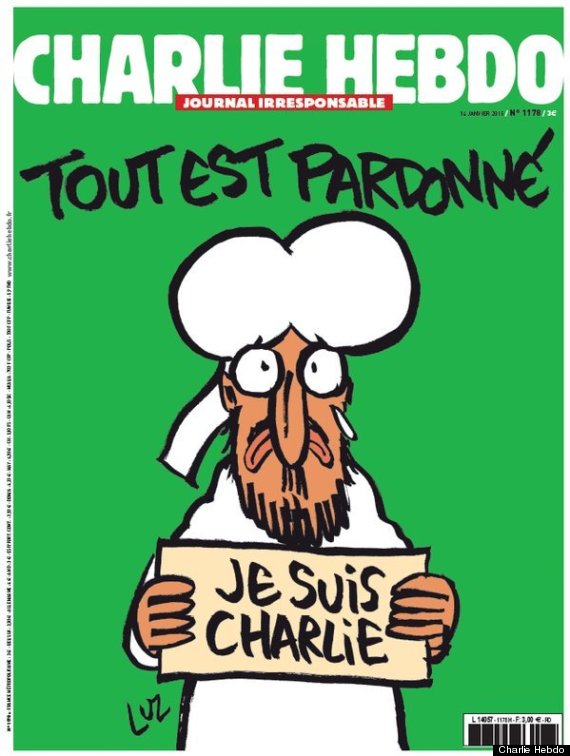
219timspalding
How do you interpret the line? (I think it's obvious, but I've heard a lot of people online trying to parse it out.)
220LolaWalser
From the Guardian:
Paris attacks: unless we overcome fear, self-censorship will spread
I'm not sure what "demands" the Islamists have won in Britain? Last I heard was about some mullah getting expelled...
Anyway, I think he's right about fear--that many ARE afraid and letting it muzzle them. We can't allow the extremist voices--I mean the anti-Muslim voices--to appropriate the publicly expressed concern.
Paris attacks: unless we overcome fear, self-censorship will spread
This is not a small capitulation. In the 19th century, the textual criticism of German scholars revealed that the supposed word of God in the Bible was a mess of competing stories. It did as much damage to Christianity and Judaism as Darwinism. Anyone hoping to repeat the exercise by taking apart the Koran and the hadiths today will be restrained by the fear that they will end up as dead as satirists who try to do the same with anti-clerical humour.
My friend and comrade Maajid Nawaz was a jihadi before he converted to liberalism and understands the totalitarian mind. He says that people still do not realise that radical Islamists do not just want to impose their taboos at gunpoint. They want to “create a civil war” so that European Muslims accept that they can only live in the caliphate; to encourage the rise of the white far-right so that ordinary coexistence becomes impossible. If they win one demand, as they are winning in Britain, then they will up the tension and move to another.
I'm not sure what "demands" the Islamists have won in Britain? Last I heard was about some mullah getting expelled...
Anyway, I think he's right about fear--that many ARE afraid and letting it muzzle them. We can't allow the extremist voices--I mean the anti-Muslim voices--to appropriate the publicly expressed concern.
221LolaWalser
>219 timspalding:
What, "All is forgiven"? Cheeky and touching, mostly. I see it working two ways. The victims taking the high ground and "forgiving" the murderers, AND the cheeky bastards making--I believe it's supposed to be Muhammad--Muhammad himself "forgive" his caricaturists for arsing around with his image.
And still they do it, you see.
What, "All is forgiven"? Cheeky and touching, mostly. I see it working two ways. The victims taking the high ground and "forgiving" the murderers, AND the cheeky bastards making--I believe it's supposed to be Muhammad--Muhammad himself "forgive" his caricaturists for arsing around with his image.
And still they do it, you see.
222timspalding
It's an overall increase of fear.
The point about textual criticism is quite true. Critical, academic research and popularization of research on Islam is severely undercut by Islamic attitudes. There are complexities within the Islamic narrative that could be very helpful in modernization—a fact that indeed helped Christianity. I'd seen it convincingly argued—convincing to me, a non-specialist—that the Hadith grow progressively and suspiciously more misogynistic over time. And the Koranic debt to extra-Koranic thought and poetry has implications that could be chewed over and change minds. But you're not going to get such work, and especially not going to see it discussed openly in the Islamic world, as Biblical criticism was discussed openly in the Christian world, because there's a gun in the discussion.
>222 timspalding:
Yes. I think you're exactly right. The first layer is the Muhammed one, I think. But the other is there too. All things being equal, it was the classy move. One could forgive them if their response had been a middle-finger, as others had done.
Overall, I hope they rise to the occasion. The post-9/11 Onion ( http://www.theonion.com/issue/3734/ ) was one of the best things published after that event.
The point about textual criticism is quite true. Critical, academic research and popularization of research on Islam is severely undercut by Islamic attitudes. There are complexities within the Islamic narrative that could be very helpful in modernization—a fact that indeed helped Christianity. I'd seen it convincingly argued—convincing to me, a non-specialist—that the Hadith grow progressively and suspiciously more misogynistic over time. And the Koranic debt to extra-Koranic thought and poetry has implications that could be chewed over and change minds. But you're not going to get such work, and especially not going to see it discussed openly in the Islamic world, as Biblical criticism was discussed openly in the Christian world, because there's a gun in the discussion.
>222 timspalding:
Yes. I think you're exactly right. The first layer is the Muhammed one, I think. But the other is there too. All things being equal, it was the classy move. One could forgive them if their response had been a middle-finger, as others had done.
Overall, I hope they rise to the occasion. The post-9/11 Onion ( http://www.theonion.com/issue/3734/ ) was one of the best things published after that event.
223SimonW11
>215 cpg: So it is what the attackers claim that makes a difference? Not what they do? For me the protestations that it is the other side that is bad ring hollow from.
There is a were last I heard 3000 French troops deployed in North Africa. It is a nation at war and Charlie Hebdo was a casualty. The deaths there are no less worthy of a tear than are those at Baga, but I see nothing to make them more special.
There is a were last I heard 3000 French troops deployed in North Africa. It is a nation at war and Charlie Hebdo was a casualty. The deaths there are no less worthy of a tear than are those at Baga, but I see nothing to make them more special.
224timspalding
The Charlie Hebdo terrorists singled out one woman to kill, Elsa Cayat. Anyone want to guess her religion?
225timspalding
There is a were last I heard 3000 French troops deployed in North Africa. It is a nation at war and Charlie Hebdo was a casualty.
Is this just a priori? Because the attackers are on record multiple times that it's about depictions Mohammed, not French foreign policy, and, as stated many times, murderous attacks on blasphemers are not a new phenomenon within Islam. At some point you don't get to have your own facts, however nicely they fit your ideas.
The deaths there are no less worthy of a tear than are those at Baga, but I see nothing to make them more special.
I don't really get the issue here. The international community has been up in arms about Boko Haram for more than a year. You have everyone from every pop star alive to Michelle Obama holding up anti-Boko Haram signs. Half the world tweeted about it. Nations, including the US, send aid and even military advisors. It's not ignored. Everyone knows that Boko Haram are horrible, and that they are engaged in a dirty war against civilians.
As for this getting more column inches, well, it was a terrorist attack on media within a major European capital. That makes it newsworthy.
Is this just a priori? Because the attackers are on record multiple times that it's about depictions Mohammed, not French foreign policy, and, as stated many times, murderous attacks on blasphemers are not a new phenomenon within Islam. At some point you don't get to have your own facts, however nicely they fit your ideas.
The deaths there are no less worthy of a tear than are those at Baga, but I see nothing to make them more special.
I don't really get the issue here. The international community has been up in arms about Boko Haram for more than a year. You have everyone from every pop star alive to Michelle Obama holding up anti-Boko Haram signs. Half the world tweeted about it. Nations, including the US, send aid and even military advisors. It's not ignored. Everyone knows that Boko Haram are horrible, and that they are engaged in a dirty war against civilians.
As for this getting more column inches, well, it was a terrorist attack on media within a major European capital. That makes it newsworthy.
226RickHarsch
> 217 I read the posted article, which I found facile--but it is worth reading for the link to a Glenn Greenwald article that is much more thoughtful and provocative of difficult thought--and important for those who end 'arguments' they are not thoughtfully engaged in with words like 'whataboutism'.
Yes, what about the anger fueled by drones wiping out weddings in Yemen? What about drones killing hundreds of children in Pakistan? What about the lack of accountability afforded the US and its allies, including Saudi Arabia? Yes, what about the the fact that ISIS was formed in a US prison in Iraq? What about, let's see, history, that slaughtered innocent, the fact that the Middle East was drawn up in such a way as to exclude a Kurdish state, in such a way as to disregard the populations within the artificial borders drawn by the victors of WW1? What about Savak? What about, yes, the colonization of Algeria and the results, which indeed led to the disenfranchisement and poverty of the Algerian underclass of France.
It really does matter that when the US is attacked it can respond with impunity in whatever way it wishes, at whatever cost to innocents, that when France is attacked leaders from around the world scramble to attend the massive demonstration that results in bizarre couplings on stage, but that when Yemen is attacked there is no possible response.
Yes, what about the anger fueled by drones wiping out weddings in Yemen? What about drones killing hundreds of children in Pakistan? What about the lack of accountability afforded the US and its allies, including Saudi Arabia? Yes, what about the the fact that ISIS was formed in a US prison in Iraq? What about, let's see, history, that slaughtered innocent, the fact that the Middle East was drawn up in such a way as to exclude a Kurdish state, in such a way as to disregard the populations within the artificial borders drawn by the victors of WW1? What about Savak? What about, yes, the colonization of Algeria and the results, which indeed led to the disenfranchisement and poverty of the Algerian underclass of France.
It really does matter that when the US is attacked it can respond with impunity in whatever way it wishes, at whatever cost to innocents, that when France is attacked leaders from around the world scramble to attend the massive demonstration that results in bizarre couplings on stage, but that when Yemen is attacked there is no possible response.
227SimonW11
Do not be silly Rick those are accidents. Like when Journalist Salah Hassan was tortured at Abu Ghraib. I know his accounts of events there are harrowing. The Mullah who was sodomized with a stick for instance before being released because he had done nothing wrong. But as long as you do not admit guilt there is no need for an act of contrition you need offer no recompense no explanation.
Next you will be saying you think that America was trying to the suppress the news when they locked up Sami Al Hajj for 7 years. without charge at Guantanamo. I am sure his claims of torture are bunk no matter what the Senate may say.
Its just silly to think that America would want to bomb Al Jazeera at say Kabul In spite of what Donald Runsfeld said. I know David Keogh was found guilty of revealing the contents of that memo. about Bush considering such things . But America is quite clear that memo was simply not true.
Next you will be saying you think that America was trying to the suppress the news when they locked up Sami Al Hajj for 7 years. without charge at Guantanamo. I am sure his claims of torture are bunk no matter what the Senate may say.
Its just silly to think that America would want to bomb Al Jazeera at say Kabul In spite of what Donald Runsfeld said. I know David Keogh was found guilty of revealing the contents of that memo. about Bush considering such things . But America is quite clear that memo was simply not true.
228RickHarsch
Memos are made to be broken.
229jjwilson61
>226 RickHarsch: Rick, you often reply to posts that are pretty far back in a thread. When you do that it would be a great help to the rest of us if you would just take out the space between the > and the post number which would allow the system to automatically add a link to the post you're responding to.
230RickHarsch
>229 jjwilson61: Sorry, jjW. In this case it was just a minor quip responding to the one above. I do know it is irritating when it happens and I'll try to be more careful.
231cpg
>223 SimonW11: "So it is what the attackers claim that makes a difference?"
It doesn't make a sameness, so, yes, it makes a difference.
"Not what they do?"
A claim is a type of deed; therefore, there is a difference in the attackers' deeds.
It doesn't make a sameness, so, yes, it makes a difference.
"Not what they do?"
A claim is a type of deed; therefore, there is a difference in the attackers' deeds.
232StormRaven
You can cast your mind back to various big art shows and movies—piss Christ, or that movie about Mary and Joseph where a naked Holy Family were shown boning. I don't remember a room of slaughtered people.
On the other hand, someone did try to murder Larry Flynt after he published a cartoon in which Falwell reminisced about having sex in an outhouse with his own mother.
On the other hand, someone did try to murder Larry Flynt after he published a cartoon in which Falwell reminisced about having sex in an outhouse with his own mother.
233timspalding
>232 StormRaven:
The shooter's expressed motives were racial, not religious. Perhaps the movie told it another way.
The shooter's expressed motives were racial, not religious. Perhaps the movie told it another way.
234StormRaven
233: The movie didn't go into the shooter's motives at all. My knowledge of Flynt's cases stems from law school, not the movie.
235timspalding
The movie didn't go into the shooter's motives at all. My knowledge of Flynt's cases stems from law school, not the movie.
Holy fuck! I stand corrected. The shooter WENT FORWARD IN TIME FIVE YEARS to view the parody about Falwell having sex with his mother in an outhouse (1983) and then WENT BACKWARD IN TIME to shoot Falwell (1978).
You, sir, didn't just go to law school. You have a graduate degree in non-Einsteinian Physics!
Sources: http://en.wikipedia.org/wiki/Larry_Flynt#Shooting, http://en.wikipedia.org/wiki/Hustler_Magazine,_Inc._v._Falwell
Holy fuck! I stand corrected. The shooter WENT FORWARD IN TIME FIVE YEARS to view the parody about Falwell having sex with his mother in an outhouse (1983) and then WENT BACKWARD IN TIME to shoot Falwell (1978).
You, sir, didn't just go to law school. You have a graduate degree in non-Einsteinian Physics!
Sources: http://en.wikipedia.org/wiki/Larry_Flynt#Shooting, http://en.wikipedia.org/wiki/Hustler_Magazine,_Inc._v._Falwell
236LolaWalser
Thousands of Muslims marching against "cartoons of Muhammad" in Africa and the Middle East, Jordan, Algeria, Eastern Jerusalem, Senegal, Pakistan, Sudan, Qatar, Bahrain.
At least one French cultural centre was burned, in Niger, and Charlie Hebdo banned from sale in Egypt, Tunis etc.

At least one French cultural centre was burned, in Niger, and Charlie Hebdo banned from sale in Egypt, Tunis etc.

237timspalding
Charlie Hebdo banned from sale in Egypt, Tunis
Uh, what?
Uh, what?
238LolaWalser
What what?
Oh, I see, "sale"--you may have a point, but I don't remember whether I read correctly or mashed one item with another... But as an aside and in general, there ARE French-language newspapers on sale in the Middle East and Africa.
The upshot is, Charlie Hebdo is forbidden (presumably from entering the country, distribution, consumption--any and all of the above?) in "Algérie, Egypte, Maroc, Tunisie et Sénégal".
http://www.afrik.com/charlie-hebdo-interdit-en-algerie-egypte-maroc-tunisie-et-a...
And in Niger:
http://www.afrik.com/niger-le-president-issoufou-interdit-la-diffusion-de-charli...
Oh, I see, "sale"--you may have a point, but I don't remember whether I read correctly or mashed one item with another... But as an aside and in general, there ARE French-language newspapers on sale in the Middle East and Africa.
The upshot is, Charlie Hebdo is forbidden (presumably from entering the country, distribution, consumption--any and all of the above?) in "Algérie, Egypte, Maroc, Tunisie et Sénégal".
http://www.afrik.com/charlie-hebdo-interdit-en-algerie-egypte-maroc-tunisie-et-a...
And in Niger:
http://www.afrik.com/niger-le-president-issoufou-interdit-la-diffusion-de-charli...
239timspalding
>238 LolaWalser:
I'm just figuring Charlie Hebdo was already illegal and already not for sale. I certainly wouldn't want to be the guy selling it!
I'm just figuring Charlie Hebdo was already illegal and already not for sale. I certainly wouldn't want to be the guy selling it!
240LolaWalser
>239 timspalding:
It could very well be that they are merely emphasising a largely academic point, but, fwiw, you could find lots of "prohibited" stuff in Syria, Egypt and Lebanon, if you knew whom to ask, where to go.
Plus, the cultural centres would have some foreign newspapers and magazines.
It could very well be that they are merely emphasising a largely academic point, but, fwiw, you could find lots of "prohibited" stuff in Syria, Egypt and Lebanon, if you knew whom to ask, where to go.
Plus, the cultural centres would have some foreign newspapers and magazines.
241timspalding
Right. Also, I wouldn't be surprised if a law such as this could be used against someone finding it online.
242LolaWalser
Should be mentioned:
the only woman killed in the Charlie Hebdo offices was Elsa Cayat, killed because she was Jewish. The other women were spared because--as the one who let the killers in reported they told her--they "didn't kill women". That same woman was told that she wouldn't be killed but that she would "read the Quran".
Being Jewish apparently trumps the "protection" of gender.
Making it even sadder, Cayat was originally from Tunisia, a place where once upon a time Jews and Muslims co-existed for centuries in imperfect but relatively harmonious situation. French colonialism disrupted that balance, and while the Jews profited in some ways, eventually they were to pay for any advantage gained, by annihilation and more or less forced expulsion.
the only woman killed in the Charlie Hebdo offices was Elsa Cayat, killed because she was Jewish. The other women were spared because--as the one who let the killers in reported they told her--they "didn't kill women". That same woman was told that she wouldn't be killed but that she would "read the Quran".
Being Jewish apparently trumps the "protection" of gender.
Making it even sadder, Cayat was originally from Tunisia, a place where once upon a time Jews and Muslims co-existed for centuries in imperfect but relatively harmonious situation. French colonialism disrupted that balance, and while the Jews profited in some ways, eventually they were to pay for any advantage gained, by annihilation and more or less forced expulsion.
243timspalding
Yeah, I read—but can't confirm—that the French press wasn't talking about her being singled out or why at all.
244timspalding
Short article on the two Japanese citizens in orange jumpsuits while an ISIS thug brandishes a knife, threatening to cut their heads off.
http://www.reuters.com/article/2015/01/22/us-mideastcrisis-islamicstate-japan-id...
"He said that as a Japanese journalist he expected to be treated differently than American or British journalists," Toshi Maeda said, recalling a conversation with Goto before his departure for Syria. "Japan has not participated in bombing and has only provided humanitarian aid. For that reason, he thought he could secure the cooperation of ISIS."
http://www.reuters.com/article/2015/01/22/us-mideastcrisis-islamicstate-japan-id...
"He said that as a Japanese journalist he expected to be treated differently than American or British journalists," Toshi Maeda said, recalling a conversation with Goto before his departure for Syria. "Japan has not participated in bombing and has only provided humanitarian aid. For that reason, he thought he could secure the cooperation of ISIS."
245LolaWalser
No idea what you mean, French sites and newspapers reported the family's information that Cayat had been threatened etc.
http://www.leparisien.fr/espace-premium/fait-du-jour/elsa-avait-ete-menacee-10-0...
http://www.leparisien.fr/espace-premium/fait-du-jour/elsa-avait-ete-menacee-10-0...
This topic was continued by "Freedom Of Speech" Vs "Freedom Of Religion"?....

