AlisonY - from 5 Annually to 50 in 2015?
This topic was continued by AlisonY - from 5 Annually to 50 in 2015? Part II.
Talk Club Read 2015
Join LibraryThing to post.
This topic is currently marked as "dormant"—the last message is more than 90 days old. You can revive it by posting a reply.
1AlisonY
I love reading, but life always seems to get in the way, or I take a break after a particularly brilliant book and then take ages to start another one. At a shockingly low 40 out of the 1001 books read, I need to get my skates on (but I keep getting distracted by other great reads not on the list).
Going to keep this thread to give myself a push to average 4 books a month this year, which is not far off my annual total last year! Gulp!
Planned so far:
January
1. On Chesil Beach - read
2. Fathomless Riches: Or How I Went from Pop to Pulpit - read
3. Miss Smilla's Feeling for Snow - read
4. The Hours - read
5. The Major of Casterbridge - read
6. The Idea of Perfection - read
7. If nobody speaks of remarkable things by Jon McGregor - read
February
8. The Blind Assassin - read
9. Oranges are Not the Only Fruit by Jeanette Winterson - read
10. On the Road - read
11. The Guernsey Literary and Potato Peel Society by Mary Ann Shaffer - read
12. The Woman in White - read
13. To the Lighthouse by Virginia Woolf - read
14. Night by Elie Wiesel - read
15. Dress your Family in Corduroy and Denim by David Sedaris - read
March
16. Someone at a Distance by Dorothy Whipple - read
17. Disgrace by J. M. Coetzee - read
18. The Stone Diaries by Carol Shields - read
19. The Reader by Bernhard Schlink - read
20. The Sense of an Ending - read
21. The Easter Parade by Richard Yates - read
22. The Go-Between - read
23. Stranger's Child - read
24. Between the Acts by Virginia Woolf - read
April
25. This is the Country by William Wall - read
26. The Thirteenth Tale by Diane Setterfield - read
27. Let me Go by Helga Schneider - read
28. Felicia's Journey by William Trevor - read
29. The Shock of the Fall - read
30. Hotel du Lac by Anita Brookner - read
31. The Curious Case of Benjamin Button by F. Scott Fitzgerald - read
32. Brooklyn by Colin Toibin - read (5 stars)
33. Bastard Out of Carolina - read (5 stars)
34. As I Lay Dying by William Faulkner - read (4 stars)
35. Julius Winsome: A Novel by Gerard Donovan - read (3.5 stars)
May
36. The Book of Negroes by Lawrence Hill - read
37. A Death in the Family: My Struggle Book 1 by Karl Ove Knausgaard - read
38. Outpost of Occupation by Barry Turner - read
39. Nothing to Envy by Barbara Demick - read
40. Hotel Iris by Yoko Ogawa - read
41. Death in Venice and Other Stories by Thomas Mann - read
June
42. Wuthering Heights by Emily Bronte - read
43. The Man Who Mistook His Wife for a Hat by Oliver Sacks - read
44. Plainsong by Kent Haruf - read
45. HHhH by Laurent Binet - read
46. Cold Harbor Spring by Richard Yates - read
47. Villages by John Updike - read
July
48. The Corrections by Jonathan Franzen - read
49. Girl With a Pearl Earring by Tracy Chevalier - in progress
Going to keep this thread to give myself a push to average 4 books a month this year, which is not far off my annual total last year! Gulp!
Planned so far:
January
1. On Chesil Beach - read
2. Fathomless Riches: Or How I Went from Pop to Pulpit - read
3. Miss Smilla's Feeling for Snow - read
4. The Hours - read
5. The Major of Casterbridge - read
6. The Idea of Perfection - read
7. If nobody speaks of remarkable things by Jon McGregor - read
February
8. The Blind Assassin - read
9. Oranges are Not the Only Fruit by Jeanette Winterson - read
10. On the Road - read
11. The Guernsey Literary and Potato Peel Society by Mary Ann Shaffer - read
12. The Woman in White - read
13. To the Lighthouse by Virginia Woolf - read
14. Night by Elie Wiesel - read
15. Dress your Family in Corduroy and Denim by David Sedaris - read
March
16. Someone at a Distance by Dorothy Whipple - read
17. Disgrace by J. M. Coetzee - read
18. The Stone Diaries by Carol Shields - read
19. The Reader by Bernhard Schlink - read
20. The Sense of an Ending - read
21. The Easter Parade by Richard Yates - read
22. The Go-Between - read
23. Stranger's Child - read
24. Between the Acts by Virginia Woolf - read
April
25. This is the Country by William Wall - read
26. The Thirteenth Tale by Diane Setterfield - read
27. Let me Go by Helga Schneider - read
28. Felicia's Journey by William Trevor - read
29. The Shock of the Fall - read
30. Hotel du Lac by Anita Brookner - read
31. The Curious Case of Benjamin Button by F. Scott Fitzgerald - read
32. Brooklyn by Colin Toibin - read (5 stars)
33. Bastard Out of Carolina - read (5 stars)
34. As I Lay Dying by William Faulkner - read (4 stars)
35. Julius Winsome: A Novel by Gerard Donovan - read (3.5 stars)
May
36. The Book of Negroes by Lawrence Hill - read
37. A Death in the Family: My Struggle Book 1 by Karl Ove Knausgaard - read
38. Outpost of Occupation by Barry Turner - read
39. Nothing to Envy by Barbara Demick - read
40. Hotel Iris by Yoko Ogawa - read
41. Death in Venice and Other Stories by Thomas Mann - read
June
42. Wuthering Heights by Emily Bronte - read
43. The Man Who Mistook His Wife for a Hat by Oliver Sacks - read
44. Plainsong by Kent Haruf - read
45. HHhH by Laurent Binet - read
46. Cold Harbor Spring by Richard Yates - read
47. Villages by John Updike - read
July
48. The Corrections by Jonathan Franzen - read
49. Girl With a Pearl Earring by Tracy Chevalier - in progress
5AlisonY
>4 AnnieMod:: thanks! Reckon I'll need some cheering on!!
Just noting for myself some more books I have in mind for this year beyond those listed above:
50. Lying Under the Apple Tree by Alice Munro - available in library
51. The Dead by James Joyce
52. The House of Mirth - ordered from library
53. The Adventures of Augie March by Saul Bellow - available in library
54. The Grass is Singing by Doris Lessing - available in library
55. Tess of the d'Urbervilles by Thomas Hardy - on shelf
56. We were the Mulvaneys by Joyce Carol Oates
57. Atonement by Ian McEwan - on shelf
58. The American Boy by Andrew Taylor
59. The Grapes of Wrath - on shelf
Just noting for myself some more books I have in mind for this year beyond those listed above:
50. Lying Under the Apple Tree by Alice Munro - available in library
51. The Dead by James Joyce
52. The House of Mirth - ordered from library
53. The Adventures of Augie March by Saul Bellow - available in library
54. The Grass is Singing by Doris Lessing - available in library
55. Tess of the d'Urbervilles by Thomas Hardy - on shelf
56. We were the Mulvaneys by Joyce Carol Oates
57. Atonement by Ian McEwan - on shelf
58. The American Boy by Andrew Taylor
59. The Grapes of Wrath - on shelf
6NanaCC
That is quite a list Alison. We will be here cheering you on...Alison....Alison...Alison
Enjoy the journey. There are some really good ones.
Enjoy the journey. There are some really good ones.
7Helenliz
That's a really interesting list. Some I really enjoyed, some I have planned to read and some send a cold shiver down my neck. (Hardy - urgh!)
Good luck with them all. I admire anyone who can plan reading and not be distracted - says she with a goldfish's attention span!
Good luck with them all. I admire anyone who can plan reading and not be distracted - says she with a goldfish's attention span!
8AlisonY
>6 NanaCC:, >7 Helenliz:: thank you both!
The planning is the easy bit - just hoping I can get a good way towards my target at least.
Must admit the lengthier tomes seem quite daunting if I'm to average 4 books a month. I may have to go back and check the number of pages in each of them, lol!!!!!
The planning is the easy bit - just hoping I can get a good way towards my target at least.
Must admit the lengthier tomes seem quite daunting if I'm to average 4 books a month. I may have to go back and check the number of pages in each of them, lol!!!!!
9AlisonY
Review of From Fathomless Riches: Or How I Went from Pop to Pulpit by Reverend Richard Coles
----------------------------------------------------------------------------------------------------------------------------------------
To appreciate this autobiography, you firstly need to know who The Communards were, so perhaps this is a book that appeals more to European readers.
I firstly came along this book as being number 1 in Anglican Books on Amazon, and having read it I remain amazed that it is classified in such a way. If you read this expecting a journey on faith, I guess you'll get a snippet of that along the way, but really this is more of an insight into the out of control world of gay pop stars in the 1980s.
Yes, a good third of the book centres on Richard finding religion, and eventually his way to the pulpit, but I can see there would be many devout Christian readers out there who would have a serious issue with reading about a man in training for the clergy using cocaine to stay awake during the final hours of an esteemed colleague in hospital.
I think what Richard wanted to achieve through this autobiography was both a published chronicle of his own life, and a sense of an open door to Jesus for lapsed Christians or atheists.
If you are of the modern world, not homophobic or shocked by gay revelations, have not necessarily always treaded a righteous path, and have a nagging desire in your heart to find your faith again, then yes - I think there is religious relevance to be found in this book.
It's well written and incredible interesting - that one person can have led such polar existences in a single lifetime is enthralling in itself, and Richard's recognition of his own vanities during those heydays of pop makes for an honest read. Bizarrely, there is a sense of growing conceitedness in the period of the book focusing on his new life as a man of the cloth - evidence I guess that this is the part of his life that he's most proud of.
----------------------------------------------------------------------------------------------------------------------------------------
To appreciate this autobiography, you firstly need to know who The Communards were, so perhaps this is a book that appeals more to European readers.
I firstly came along this book as being number 1 in Anglican Books on Amazon, and having read it I remain amazed that it is classified in such a way. If you read this expecting a journey on faith, I guess you'll get a snippet of that along the way, but really this is more of an insight into the out of control world of gay pop stars in the 1980s.
Yes, a good third of the book centres on Richard finding religion, and eventually his way to the pulpit, but I can see there would be many devout Christian readers out there who would have a serious issue with reading about a man in training for the clergy using cocaine to stay awake during the final hours of an esteemed colleague in hospital.
I think what Richard wanted to achieve through this autobiography was both a published chronicle of his own life, and a sense of an open door to Jesus for lapsed Christians or atheists.
If you are of the modern world, not homophobic or shocked by gay revelations, have not necessarily always treaded a righteous path, and have a nagging desire in your heart to find your faith again, then yes - I think there is religious relevance to be found in this book.
It's well written and incredible interesting - that one person can have led such polar existences in a single lifetime is enthralling in itself, and Richard's recognition of his own vanities during those heydays of pop makes for an honest read. Bizarrely, there is a sense of growing conceitedness in the period of the book focusing on his new life as a man of the cloth - evidence I guess that this is the part of his life that he's most proud of.
10AlisonY
Review of On Chesil Beach by Ian McEwan
This is my second Ian McEwan book (The Cement Garden was my first), and he's definitely now up there as one of my favourite authors. He has such tremendous skill in taking a short snapshot of time and delicately describing the horrors that can unfold from the most ordinary of beginnings, happenings which go on to change the course of an individual's life.
The main story of On Chesil Beach revolves around a young couple on their wedding night, and how a failure to do or say the right thing in a single moment can change your life forever. To say much more than that would require a spoiler alert.
McEwan's prose is so quietly and beautifully honest, his characters are within touching distance.
Devoured it in no more than a few days - touched by it for a lifetime.
This is my second Ian McEwan book (The Cement Garden was my first), and he's definitely now up there as one of my favourite authors. He has such tremendous skill in taking a short snapshot of time and delicately describing the horrors that can unfold from the most ordinary of beginnings, happenings which go on to change the course of an individual's life.
The main story of On Chesil Beach revolves around a young couple on their wedding night, and how a failure to do or say the right thing in a single moment can change your life forever. To say much more than that would require a spoiler alert.
McEwan's prose is so quietly and beautifully honest, his characters are within touching distance.
Devoured it in no more than a few days - touched by it for a lifetime.
11AlisonY
Review of Miss Smilla's Feeling for Snow by Peter Hoeg
I enjoyed this book, but felt it got a little slow in the middle at times.
The first 200 pages had me gripped - the descriptions of Denmark, of Greenland, of the winter landscapes, were a vivid and tense scene in which to set the story, and I enjoyed being transported into lands I know little of, told from the perspective of the protagonist who has lived in both. The complexities of Smilla's relationships with the mechanic and her father were intriguing, and up to that point it was a definite page turner, both in terms of plot and depth of characterisation.
Somewhere around the middle of the book it lost pace, however. The period on the boat went on for at least 75 pages too long, and I found myself caring little for what happened to the protagonist, or for finding out what had really happened to the boy, which was the whole point of the book. Smilla became less believable - originally characterised as a fairly ordinary lady who wanted to see justice done, she began to enter the realms of being some kind of fantasy wonder woman.
In all, it became disappointingly far fetched and Hollywood-esque - perhaps the author had his eye on the movie that was to come all along.
I enjoyed this book, but felt it got a little slow in the middle at times.
The first 200 pages had me gripped - the descriptions of Denmark, of Greenland, of the winter landscapes, were a vivid and tense scene in which to set the story, and I enjoyed being transported into lands I know little of, told from the perspective of the protagonist who has lived in both. The complexities of Smilla's relationships with the mechanic and her father were intriguing, and up to that point it was a definite page turner, both in terms of plot and depth of characterisation.
Somewhere around the middle of the book it lost pace, however. The period on the boat went on for at least 75 pages too long, and I found myself caring little for what happened to the protagonist, or for finding out what had really happened to the boy, which was the whole point of the book. Smilla became less believable - originally characterised as a fairly ordinary lady who wanted to see justice done, she began to enter the realms of being some kind of fantasy wonder woman.
In all, it became disappointingly far fetched and Hollywood-esque - perhaps the author had his eye on the movie that was to come all along.
12AlisonY
Review of The Hours by Michael Cunningham
There is a unique sensation of both immense loss and joy when you read the final page of a book that you immediately recognise as one of your life's favourites.
Having seen the film first (and loved it), I feared that it would spoil my enjoyment of the book, knowing exactly what was going to happen. At first I had a sense of rushing the book for that reason, but then the story had me hooked all over again, and I was rushing simply from an urgency to devour more and more of it's clever deliciousness.
To intertwine a modern retelling of a classic story with parallel stories of Virginia Woolf's demons when writing Mrs. Dalloway, and the fragile state of mind of someone reading Mrs. Dalloway is sheer brilliance - complex yet so simple.
I have not yet read Mrs. Dalloway, but feel I will have to, just to gain another perspective of the immense depth of this novel. Certainly, in reading the novel things became clear to me that I did not pick up on when I watched the film, and I'm sure that having an understanding of Mrs. Dalloway would enhance the book still further.
There is a unique sensation of both immense loss and joy when you read the final page of a book that you immediately recognise as one of your life's favourites.
Having seen the film first (and loved it), I feared that it would spoil my enjoyment of the book, knowing exactly what was going to happen. At first I had a sense of rushing the book for that reason, but then the story had me hooked all over again, and I was rushing simply from an urgency to devour more and more of it's clever deliciousness.
To intertwine a modern retelling of a classic story with parallel stories of Virginia Woolf's demons when writing Mrs. Dalloway, and the fragile state of mind of someone reading Mrs. Dalloway is sheer brilliance - complex yet so simple.
I have not yet read Mrs. Dalloway, but feel I will have to, just to gain another perspective of the immense depth of this novel. Certainly, in reading the novel things became clear to me that I did not pick up on when I watched the film, and I'm sure that having an understanding of Mrs. Dalloway would enhance the book still further.
13Helenliz
>9 AlisonY: I have that on my tentative to buy list. He's a local vicar, and one of our book group has worked with him - she read it and was honest that it made her uncomfortable, but that it was well written. He is seen opening fetes and the like. Always strikes me as a very odd mismatch when I remember him from his time in the charts.
15AlisonY
>13 Helenliz:: that's crazy!! You definitely have to read the book then!! Given his job, I am totally gobsmacked that he's been so honest. Seriously - I'd loved to have been in church the first Sunday after some of his congregation read it!
>14 baswood:: thank you for the kind words!!! :)
>14 baswood:: thank you for the kind words!!! :)
16SassyLassy
Seems like you're definitely making your target for average number of books read. Good books and good reviews.
20chlorine
Nice reviews.
On Chesil Beach sounds like something I would really enjoy. Added to my wishlist. :)
I digged up my review for Miss Smilla's feelings for Snow (I have no memory for the books I've read except for a general feeling) and apparently on top on not liking the end I was set back by the fact that we do not always know what the main character is thinking, though the book is told in the first person.
On Chesil Beach sounds like something I would really enjoy. Added to my wishlist. :)
I digged up my review for Miss Smilla's feelings for Snow (I have no memory for the books I've read except for a general feeling) and apparently on top on not liking the end I was set back by the fact that we do not always know what the main character is thinking, though the book is told in the first person.
21ELiz_M
>10 AlisonY: "He has such tremendous skill in taking a short snapshot of time and delicately describing the horrors that can unfold from the most ordinary of beginnings, happenings which go on to change the course of an individual's life."
How perfectly insightful! I've read a handful of McEwan's books and love them when the above works and really dislike them when the beginning doesn't sit well with me.
How perfectly insightful! I've read a handful of McEwan's books and love them when the above works and really dislike them when the beginning doesn't sit well with me.
22VivienneR
>12 AlisonY: Excellent reviews! You got my attention with The Hours, it's been on Mount TBR for much too long. Like you I have seen the movie and thought it would spoil the book. Time to move it forward I think.
23AlisonY
Thanks again folks for the kind comments. I'm finding myself labouring over The Major of Casterbridge somewhat - hopefully it'll hook me soon, as I've a long way to go and life's pretty short! So far (75 pages in) I feel like Hardy's a good story teller, but I'm not wild on the style of prose. Definitely prefer Dickens at this stage, but I remain hopeful that by the end of the book I'll be a fan.
>20 chlorine:: you're perfectly right. I hadn't thought about that before, but indeed we don't get to know much about what Smilla is thinking a lot of the time. Maybe I misread the signs in all those secondhand books I kept seeing it in - maybe a lot of people just threw it out in frustration!!! It annoyed me a little, as I really thought the first half of the book was very good. That's almost worse than the book being completely rubbish.
>20 chlorine:: you're perfectly right. I hadn't thought about that before, but indeed we don't get to know much about what Smilla is thinking a lot of the time. Maybe I misread the signs in all those secondhand books I kept seeing it in - maybe a lot of people just threw it out in frustration!!! It annoyed me a little, as I really thought the first half of the book was very good. That's almost worse than the book being completely rubbish.
24rebeccanyc
>23 AlisonY: I read Jude the Obscure last year and it left me not wanting to read more Hardy for a while. I hope you end up liking The Mayor of Casterbridge better than you do now.
25Helenliz
>23 AlisonY: I read Return of the Native last year, my first attempt at Hardy since I was drastically put off at school. I'd agree that it took some concentration, and it was a bit of a slow burn - maybe your book will be similar. I'm not wild about him, but I had a better impression of him than my 16 year old self had.
26AnnieMod
>25 Helenliz: >23 AlisonY:
I fell in love with Hardy because of Tess of the D'Urbervilles somewhere in my teens, this book managed to convince me that classical English language authors are not so bad - his style is very distinctive and you usually either hate him or love him (most people really do not like him).
I fell in love with Hardy because of Tess of the D'Urbervilles somewhere in my teens, this book managed to convince me that classical English language authors are not so bad - his style is very distinctive and you usually either hate him or love him (most people really do not like him).
27chlorine
>23 AlisonY: AlisonY
That's almost worst than the book being completely rubbish: so true! I understand exactly how you feel.
That's almost worst than the book being completely rubbish: so true! I understand exactly how you feel.
28AlisonY
>26 AnnieMod:: I got into it a bit more last night, so perhaps all is not lost with me and Mr. Hardy just yet!!!
29AnnieMod
>28 AlisonY: Have fun. Just do not try to compare him with other writers from the era (or at all). Just immerse yourself in the prose - and see how it goes. But if it still does not work, leave it alone, read something else. Who knows - you may like him better down the road
30SassyLassy
>23 AlisonY: I'm one of those who truly likes Hardy, and Jude the Obscure is my favourite to date. I had a professor once who seemed to suggest that as one's reading tastes matured, they would "grow out" of Hardy. She felt that way about Thomas Wolfe too. Perhaps I just have not matured yet?
I would say take the advice of >29 AnnieMod: and keep reading.
I would say take the advice of >29 AnnieMod: and keep reading.
31AnnieMod
>30 SassyLassy: Ha. My English teacher used to say that you need to mature enough to be able to appreciate most of Hardy's books (but she was saying the same for a lot of the classic English language authors).
32AlisonY
Review of The Major of Casterbridge by Thomas Hardy
Oh Mr. Hardy - canst thou ever forgive me for doubting thee?
The book is finished. My heart is sore. In my grief I can't bear to put it back on the bookshelf yet. Let it stay beside me on the bedside cabinet just a little while longer.
How wrong was I in my original assessment of Hardy's prose. I wept whilst reading this book. WEPT! Real tears! And not just once either.
Hardy initially cut to the chase with alarming alacrity, and it almost put me off continuing as I felt he had divulged the plot before I was engrossed enough to care much for the characters. More fool me. That was merely the tip of the iceberg, for the tale that developed was to have more twists and turns than a doorknob.
And the characterisation - oh, like nothing I've read before. Mr. Henchard was the most unpleasant of protagonists - harsh, proud, stubborn, jealous, cold, pompous - yet the whole way through the novel I was rooting for him, willing him on, desperately hoping he'd say the right thing here, do the right thing there. In the same way that my husband's wayward driving compels me to pump an imaginary brake as a passenger, so too Henchard's repeated mistakes had me constantly silently screaming "Stop! Look out! Take care!".
I'm now 5 books into my 50 book target. How I fear the 45 others shall now pale by comparison.
Oh Mr. Hardy - canst thou ever forgive me for doubting thee?
The book is finished. My heart is sore. In my grief I can't bear to put it back on the bookshelf yet. Let it stay beside me on the bedside cabinet just a little while longer.
How wrong was I in my original assessment of Hardy's prose. I wept whilst reading this book. WEPT! Real tears! And not just once either.
Hardy initially cut to the chase with alarming alacrity, and it almost put me off continuing as I felt he had divulged the plot before I was engrossed enough to care much for the characters. More fool me. That was merely the tip of the iceberg, for the tale that developed was to have more twists and turns than a doorknob.
And the characterisation - oh, like nothing I've read before. Mr. Henchard was the most unpleasant of protagonists - harsh, proud, stubborn, jealous, cold, pompous - yet the whole way through the novel I was rooting for him, willing him on, desperately hoping he'd say the right thing here, do the right thing there. In the same way that my husband's wayward driving compels me to pump an imaginary brake as a passenger, so too Henchard's repeated mistakes had me constantly silently screaming "Stop! Look out! Take care!".
I'm now 5 books into my 50 book target. How I fear the 45 others shall now pale by comparison.
33NanaCC
>32 AlisonY:. Lovely review Alison. You may even have given me a little push toward Hardy.
34AlisonY
>33 NanaCC:: I hope so!
35AnnieMod
>32 AlisonY: Told you to keep reading :) Loved your review!
36baswood
Hardy is wonderful and I loved your review of The major of Casterbridge. It usually ends badly with Hardy though.
37RidgewayGirl
That's a lovely review of the Hardy. He was, for a stretch in my twenties, my favorite author. I need to return to him and see what he has to say.
38japaul22
You're almost convincing me to give Hardy another try. I've read Tess of the D'Ubervilles and Far From the Madding Crowd and found them so disastrous and depressing that I gave him up. Maybe it's time for another try.
39VivienneR
>32 AlisonY: Excellent review of The Mayor of Casterbridge!
40AlisonY
>38 japaul22:: I fear you may find The Mayor of Casterbridge also disastrous and a little depressing, but when a story's told well I don't mind my fair share of angst.
41AnnieMod
>38 japaul22: Hardy does not really do "happy"...
42AlisonY
Review - The Idea of Perfection by Kate Grenville
I had few preconceptions when starting this book. I'd randomly bought it at a church sale, didn't know anything about the author or the plot, wasn't entirely sure if it was my kind of book. After being bowled over by The Major of Casterbridge I fancied something totally different so I wouldn't be tempted to compare the two in any way.
This was a great book in very quiet, unassuming way, and was all about the journey rather than the destination. Essentially it is a story about life, about how mundaneness, honesty and simplicity can all collide when least expected to put everything in it's place again.
I thought the prose was terrific, capturing so eloquently the little things which often go unsaid, like how we tend to walk awkwardly when we feel we're being watched, or allow a constant stream of negative narrative in our heads to close the door to opportunity. The characters were terrific - very believable, very visual, all people we've come across in our lives at one time or another - and I enjoyed the unfamiliar setting of a backwater town in the Australian outback.
This is definitely a slow burn book that is all about the writing. The plot is nothing more than a snapshot of life itself, but then what more interesting or believable plot is there?
I had few preconceptions when starting this book. I'd randomly bought it at a church sale, didn't know anything about the author or the plot, wasn't entirely sure if it was my kind of book. After being bowled over by The Major of Casterbridge I fancied something totally different so I wouldn't be tempted to compare the two in any way.
This was a great book in very quiet, unassuming way, and was all about the journey rather than the destination. Essentially it is a story about life, about how mundaneness, honesty and simplicity can all collide when least expected to put everything in it's place again.
I thought the prose was terrific, capturing so eloquently the little things which often go unsaid, like how we tend to walk awkwardly when we feel we're being watched, or allow a constant stream of negative narrative in our heads to close the door to opportunity. The characters were terrific - very believable, very visual, all people we've come across in our lives at one time or another - and I enjoyed the unfamiliar setting of a backwater town in the Australian outback.
This is definitely a slow burn book that is all about the writing. The plot is nothing more than a snapshot of life itself, but then what more interesting or believable plot is there?
43AlisonY
Review - If Nobody Speaks of Remarkable Things by Jon McGregor
Disappointingly this is the first clanger of the year. The book is set in modern London and interweaves throughout the lives of residents in the street, working it's way back to a disaster that's alluded to at the beginning of the book. But it just doesn't work for me on so many fronts.
For a start, there are far too many characters at play, many of whom never really take a proper place in the narrative, and it becomes very confusing as McGregor just refers to them by brief physical description and the number of house they live at. On a number of occasions I lost the trail and couldn't figure out who he was talking about, but it mattered little as they were of no consequence to the story. It was therefore very difficult to care much about any of these characters, on which premise the novel failed abjectly for me.
McGregor also switched between first person and third person, moving between one main narrator in the current period to a third person observation of the past, and it just didn't work. With so many house numbers and characters to remember, the protagonist who becomes the first person narrator in part of the book is unremarkable and referred to little when observed through the third person voice, therefore the connection with the first person account is lost.
The first person narrator is a young woman, but all through the novel I was conscious of a male writer trying to imagine what a woman thinks or how she acts. On this occasion the writer didn't manage to pull it off, and at times I had to keep reminding myself what sex the protagonist was.
Finally, there was the metaphor and simile overload. Dear goodness, it was toe curling at times.
'If nobody speaks of remarkable things' - well, no need to on this occasion.
Disappointingly this is the first clanger of the year. The book is set in modern London and interweaves throughout the lives of residents in the street, working it's way back to a disaster that's alluded to at the beginning of the book. But it just doesn't work for me on so many fronts.
For a start, there are far too many characters at play, many of whom never really take a proper place in the narrative, and it becomes very confusing as McGregor just refers to them by brief physical description and the number of house they live at. On a number of occasions I lost the trail and couldn't figure out who he was talking about, but it mattered little as they were of no consequence to the story. It was therefore very difficult to care much about any of these characters, on which premise the novel failed abjectly for me.
McGregor also switched between first person and third person, moving between one main narrator in the current period to a third person observation of the past, and it just didn't work. With so many house numbers and characters to remember, the protagonist who becomes the first person narrator in part of the book is unremarkable and referred to little when observed through the third person voice, therefore the connection with the first person account is lost.
The first person narrator is a young woman, but all through the novel I was conscious of a male writer trying to imagine what a woman thinks or how she acts. On this occasion the writer didn't manage to pull it off, and at times I had to keep reminding myself what sex the protagonist was.
Finally, there was the metaphor and simile overload. Dear goodness, it was toe curling at times.
'If nobody speaks of remarkable things' - well, no need to on this occasion.
44RidgewayGirl
That's too bad. That's the only McGregor I haven't read and I adored his other books. He's my fatal type as mentioned in Poquette's thread.
45AlisonY
>44 RidgewayGirl:: Maybe it just wasn't for me - certainly plenty of others seem to have liked it OK.
With some books I think you need to be at the right age to enjoy them. I was conscious of feeling a little bit past being interested in student lives as I was reading it - perhaps if I'd read it 20 years ago I'd have enjoyed it more and noticed the flaws less.
With some books I think you need to be at the right age to enjoy them. I was conscious of feeling a little bit past being interested in student lives as I was reading it - perhaps if I'd read it 20 years ago I'd have enjoyed it more and noticed the flaws less.
46baswood
I think you are asking for trouble if you title your book If nobody speaks of remarkable things
47AlisonY
>46 baswood:: lol!!! Totally!!! On to The Blind Assassin now. This might take much of February!!
48AlisonY
So January is no more, but I'm all the richer for having (mostly) enjoyed 7 new books from 6 new authors (new to me). I watched zero TV all month and didn't miss it a jot.
1. On Chesil Beach - ****1/2
2. Fathomless Riches: Or How I Went from Pop to Pulpit - ****1/2
3. Miss Smilla's Feeling for Snow - ***1/2
4. The Hours - *****
5. The Major of Casterbridge - *****
6. The Idea of Perfection - ****
7. If nobody speaks of remarkable things - **1/2
In February I feel I'll make slower progress as I've a few weightier novels to get through and I don't want to rush my reading just to achieve my challenge. I'm kind of sticking to my original list of books, but as I've added 40+ new ones to my wish list from reading threads on LT this could easily change! I'll definitely change the order about, as sometimes I just don't fancy a certain kind of book on a given day.
For now, I'm halfway through my 2nd ever Margaret Atwood book - The Blind Assassin. It's a meaty 640 pages - the longest of the books selected yet. I have my eye on Oranges are Not the Only Fruit as my next book after this.
1. On Chesil Beach - ****1/2
2. Fathomless Riches: Or How I Went from Pop to Pulpit - ****1/2
3. Miss Smilla's Feeling for Snow - ***1/2
4. The Hours - *****
5. The Major of Casterbridge - *****
6. The Idea of Perfection - ****
7. If nobody speaks of remarkable things - **1/2
In February I feel I'll make slower progress as I've a few weightier novels to get through and I don't want to rush my reading just to achieve my challenge. I'm kind of sticking to my original list of books, but as I've added 40+ new ones to my wish list from reading threads on LT this could easily change! I'll definitely change the order about, as sometimes I just don't fancy a certain kind of book on a given day.
For now, I'm halfway through my 2nd ever Margaret Atwood book - The Blind Assassin. It's a meaty 640 pages - the longest of the books selected yet. I have my eye on Oranges are Not the Only Fruit as my next book after this.
49Rebeki
Hi Alison, it looks like January was a very successful reading month for you! I think we have similar reading tastes. I also really enjoyed On Chesil Beach and The Hours, and The Blind Assassin and Oranges Are Not the Only Fruit are two of my favourite books.
>32 AlisonY: It's great to see such an enthusiastic review for Thomas Hardy. I've only read Under the Greenwood Tree and am still daunted by his longer books...
>32 AlisonY: It's great to see such an enthusiastic review for Thomas Hardy. I've only read Under the Greenwood Tree and am still daunted by his longer books...
50AlisonY
>49 Rebeki:: Hi, that's interesting. Do you have a thread on LT somewhere? If we have similar reading tastes it would be great to take a look at some of the books you've enjoyed (oh no - I feel another extension of my wish list coming on!!!!).
51Rebeki
>50 AlisonY: Yes, it's here. I haven't read many books yet this year, but you can find my 2014 thread here. No pressure though ;)
52AlisonY
Review - The Blind Assassin by Margaret Atwood
I'm confused as to what I think of this book. Part of me loved it - there is no doubt Atwood is a splendid prose writer, and the last 200 pages or so had me gripped as all the loose ends were finally tied up. I just felt it took so long to get to that point, and I'd figured out many of the plot twists long before the end anyway.
This is a lengthy book (some 600 odd pages), and 300 pages in I still wasn't sure if I was hooked. I enjoy a slow burn if the writing's great, and there can be no denying Atwood's skills in that department, but there's slow and then there's slow. In many early sections of the book it felt as if there was no build up to anything, and as I don't enjoy reading sci-fi I didn't enjoy the 'Blind Assassin' sections that much where a sci-fi story is unfolded.
It is a very clever book, though - Atwood uses numerous literary tools to weave a unique and complex plot. This is an epic, essentially a story within a story within a story, spanning the 3 very different lives of the main protagonist, forcing us to question whether a life of privilege really is a life of privilege at all.
4 stars for me, I think, but I can appreciate why for others this is 5 star material. Personally, I preferred Alias Grace.
I'm confused as to what I think of this book. Part of me loved it - there is no doubt Atwood is a splendid prose writer, and the last 200 pages or so had me gripped as all the loose ends were finally tied up. I just felt it took so long to get to that point, and I'd figured out many of the plot twists long before the end anyway.
This is a lengthy book (some 600 odd pages), and 300 pages in I still wasn't sure if I was hooked. I enjoy a slow burn if the writing's great, and there can be no denying Atwood's skills in that department, but there's slow and then there's slow. In many early sections of the book it felt as if there was no build up to anything, and as I don't enjoy reading sci-fi I didn't enjoy the 'Blind Assassin' sections that much where a sci-fi story is unfolded.
It is a very clever book, though - Atwood uses numerous literary tools to weave a unique and complex plot. This is an epic, essentially a story within a story within a story, spanning the 3 very different lives of the main protagonist, forcing us to question whether a life of privilege really is a life of privilege at all.
4 stars for me, I think, but I can appreciate why for others this is 5 star material. Personally, I preferred Alias Grace.
53AlisonY
My thoughts on The Blind Assassin have still been confusing me. Despite the unnecessary length of the book in my opinion, I think my original 3.5 stars was harsh considering the quality of the writing, so I have edited my previous review to a 4.
54AlisonY
Review - Oranges are Not the Only Fruit by Jeanette Winterson
This was a fairly short, enjoyable read, giving a partially autobiographical account of the author's experiences of growing up and coming out in a world dominated by a strict Evangelist mother and the church they belonged to.
Essentially I found this to be a sad read of immense loneliness; the narrator gave her early life to the church and to God and spent much of her spare time evangelising and preaching, yet when her sexuality was outed within the church and she refused to repent or to be considered demonised, she lost both her home and the family of the church.
A slight frustration for me with this type of book is not knowing where the autobiographical moves into fiction, but as a reader have we any right to know this distinction? I guess that's just plain old human nosiness.
26 years later, Winterson wrote a 'twin' to the book Why be happy when you when you could be normal? which is supposed to separate some of the original fact from fiction, and if the reviews are to be believed the real facts are supposed to be even bleaker than the fiction. But there again, I believe this book is only semi-autobiographical so who knows where the real truth lies.
I'm interested if anyone's read both, and if so how much duplication there is of the tale from Oranges are not the only fruit?
Anyway, I digress. Oranges are not the only fruit was well written, with good pace and well crafted characters (however real or otherwise). This book leaves you with so many questions about the author - how did she mentally deal with having a mother who so readily turned her back on her own child, and where did her relationship with God ultimately end up? It leaves you with that sense of wonder about how, behind closed doors, our friends and neighbours are leading a multitude of different kinds of lives, hidden away from view.
That Winterson went from fairly poor, sporadic education, with no family support, to a degree from Oxford and award-winning books and television spin-offs is the stuff of novels in itself, and to me therein lies the great success of this book. Despite everything, she's swum to the surface, and I am glad.
This was a fairly short, enjoyable read, giving a partially autobiographical account of the author's experiences of growing up and coming out in a world dominated by a strict Evangelist mother and the church they belonged to.
Essentially I found this to be a sad read of immense loneliness; the narrator gave her early life to the church and to God and spent much of her spare time evangelising and preaching, yet when her sexuality was outed within the church and she refused to repent or to be considered demonised, she lost both her home and the family of the church.
A slight frustration for me with this type of book is not knowing where the autobiographical moves into fiction, but as a reader have we any right to know this distinction? I guess that's just plain old human nosiness.
26 years later, Winterson wrote a 'twin' to the book Why be happy when you when you could be normal? which is supposed to separate some of the original fact from fiction, and if the reviews are to be believed the real facts are supposed to be even bleaker than the fiction. But there again, I believe this book is only semi-autobiographical so who knows where the real truth lies.
I'm interested if anyone's read both, and if so how much duplication there is of the tale from Oranges are not the only fruit?
Anyway, I digress. Oranges are not the only fruit was well written, with good pace and well crafted characters (however real or otherwise). This book leaves you with so many questions about the author - how did she mentally deal with having a mother who so readily turned her back on her own child, and where did her relationship with God ultimately end up? It leaves you with that sense of wonder about how, behind closed doors, our friends and neighbours are leading a multitude of different kinds of lives, hidden away from view.
That Winterson went from fairly poor, sporadic education, with no family support, to a degree from Oxford and award-winning books and television spin-offs is the stuff of novels in itself, and to me therein lies the great success of this book. Despite everything, she's swum to the surface, and I am glad.
55Rebeki
>54 AlisonY: I read Why Be Happy When You Could Be Normal? last year and then followed it up with a re-read of Oranges Are Not The Only Fruit, which gave me a pretty good idea of what in the novel was based on the truth and what had been invented, although the fictional Jeanette's story is very much the real Jeanette's. Sadly, whatever I read fades very quickly from my memory, but what I chiefly remember is that the character of Elsie was invented and that the memoir gives far more detail about Winterson's relationship with her father, who is virtually invisible in the novel. And yes, the real-life Mrs Winterson was worse!
I definitely recommend you read Why Be Happy.... It's ultimately uplifting rather than depressing and would fill in some of those gaps for you. It covers more than enough different ground for it not to seem repetitive.
>52 AlisonY: I'm sorry you didn't enjoy The Blind Assassin more. Truth be told, I read it 13 years ago and have been scared to re-read it in case I don't love it quite so much second time around!
I definitely recommend you read Why Be Happy.... It's ultimately uplifting rather than depressing and would fill in some of those gaps for you. It covers more than enough different ground for it not to seem repetitive.
>52 AlisonY: I'm sorry you didn't enjoy The Blind Assassin more. Truth be told, I read it 13 years ago and have been scared to re-read it in case I don't love it quite so much second time around!
56AlisonY
>55 Rebeki:: yes, I think Why be happy... will have to go on the wish list, as the first book has made me very curious about where the truth lies. That's quite a feat for the real Mrs Winterson to be worse than she was in Oranges are not the only fruit!
57dchaikin
>52 AlisonY: i can relate to your response to the blind assassin. I had the same problem with the long dull middle portion. For me the book overall made up for that.
58AlisonY
>57 dchaikin:: yes, it's a funny book that way. The parts I enjoyed were so good I was frustrated that I didn't feel like that from start to finish.
Over halfway through On the Road now. I keep looking at the back to see how many pages I've got left, which isn't a good sign! Review to follow in a few days...
Over halfway through On the Road now. I keep looking at the back to see how many pages I've got left, which isn't a good sign! Review to follow in a few days...
59AlisonY
Review of On the Road
Where to begin with this.... There are numerous novels idling on bookshelves around the world which are indelibly written into the literary history books as 'classics'. We begin them with an impatient expectation that the writing in these books will blow every other book we've ever read out of the water, that the characters will be taken into our hearts forever, and that by the end of the book we'll have a newfound wisdom of places and things we've never encountered before.
For me, this is how On the Road should have been - a wild journey of youth that would take me with it to pockets of America I'd never heard of before, where I'd feel the dirt in my pores and the heartache in my belly. Instead, it was endless of pages of nothingness - car rides between towns and cities that were rarely described in any detail (save for the Mexico portion in the last 50 pages), wild nights out that never amounted to anything of any interest, a multitude of passing characters that were never formed beyond a few cursory sentences.
I understand that this 'wild' portrayal of youth would have been quite shocking in the 1950s, and so the stir it caused when it was first published is wholly understandable. The literary side of my brain also gets what Kerouac wanted to achieve with his prose - to create a rush and franticness that echoed the frenzied energy of the young generation coming of age and looking for kicks. But this book took me nowhere. Perhaps for my generation the novel is no longer radical. Perhaps some books 'date' in the way that favourite records sometimes sound tired in future decades.
For me, much of the book was like listening to a drunk teenager babble on endlessly about the epic night out they've just had. My eyes were glazing over - I had that 'I guess you had to be there...' feeling.
If I was beamed down from Mars knowing nothing of it's classic status in American literature (and hence not feeling obliged to revere it with plaudits which demonstrate that I'm clever enough to enjoy it), I'd have one word for it - dull.
So, at the risk of putting myself out there as a literary Neanderthal, for me that's exactly what On the Road was - endlessly dull.
Where to begin with this.... There are numerous novels idling on bookshelves around the world which are indelibly written into the literary history books as 'classics'. We begin them with an impatient expectation that the writing in these books will blow every other book we've ever read out of the water, that the characters will be taken into our hearts forever, and that by the end of the book we'll have a newfound wisdom of places and things we've never encountered before.
For me, this is how On the Road should have been - a wild journey of youth that would take me with it to pockets of America I'd never heard of before, where I'd feel the dirt in my pores and the heartache in my belly. Instead, it was endless of pages of nothingness - car rides between towns and cities that were rarely described in any detail (save for the Mexico portion in the last 50 pages), wild nights out that never amounted to anything of any interest, a multitude of passing characters that were never formed beyond a few cursory sentences.
I understand that this 'wild' portrayal of youth would have been quite shocking in the 1950s, and so the stir it caused when it was first published is wholly understandable. The literary side of my brain also gets what Kerouac wanted to achieve with his prose - to create a rush and franticness that echoed the frenzied energy of the young generation coming of age and looking for kicks. But this book took me nowhere. Perhaps for my generation the novel is no longer radical. Perhaps some books 'date' in the way that favourite records sometimes sound tired in future decades.
For me, much of the book was like listening to a drunk teenager babble on endlessly about the epic night out they've just had. My eyes were glazing over - I had that 'I guess you had to be there...' feeling.
If I was beamed down from Mars knowing nothing of it's classic status in American literature (and hence not feeling obliged to revere it with plaudits which demonstrate that I'm clever enough to enjoy it), I'd have one word for it - dull.
So, at the risk of putting myself out there as a literary Neanderthal, for me that's exactly what On the Road was - endlessly dull.
60rebeccanyc
Well, I read On the Road when I was about 15 many years ago, so of course I loved it. But I wouldn't dare to read it now.
61lilisin
>59 AlisonY:
Excellent review of which I thumbed favorably on the review page.
I've never had the desire to read this book nor the equivalent Into the Wild as I just can't help but roll my eyes at these so-called "free spirits". Maybe I'm just too rational, always have been, even as a teenager, that I'm not under some weird impression that society is forming a ball and chain on me which I need to escape. I've always had a favorable impression on what we term society and I love the ideology behind it. I've also had the privilege of traveling all my life, every year, to other countries, whether old or new to me and perhaps that has allowed me to grow up with a wide perception of the world that has been refused to these American teenagers. In any case, great review and again, not a book I'll be reading.
Excellent review of which I thumbed favorably on the review page.
I've never had the desire to read this book nor the equivalent Into the Wild as I just can't help but roll my eyes at these so-called "free spirits". Maybe I'm just too rational, always have been, even as a teenager, that I'm not under some weird impression that society is forming a ball and chain on me which I need to escape. I've always had a favorable impression on what we term society and I love the ideology behind it. I've also had the privilege of traveling all my life, every year, to other countries, whether old or new to me and perhaps that has allowed me to grow up with a wide perception of the world that has been refused to these American teenagers. In any case, great review and again, not a book I'll be reading.
62dchaikin
>61 lilisin: I had never heard Into the Wild associated with On the Road, interesting.
>59 AlisonY: Alison - i've read other reviews which complain about how boring On the Road is. I still hope to read it some day. Enioyed reading your frustrated thoughts.
>59 AlisonY: Alison - i've read other reviews which complain about how boring On the Road is. I still hope to read it some day. Enioyed reading your frustrated thoughts.
63lilisin
>62 dchaikin:
Oh, I wouldn't say they were associated. I was just trying to imply that they represent the same sort of story to me.
Oh, I wouldn't say they were associated. I was just trying to imply that they represent the same sort of story to me.
64edwinbcn
Great and honest review of On the Road, Alison. I have not (yet) read On the Road, but started reading Kerouac about two years ago, and often have the same feeling about his work. I can see the historical significance, but do not enjoy reading much of it.
65rachbxl
Hi Alison! I'm glad you liked The Idea of Perfection. I'm a big fan of Kate Grenville's so expected to enjoy it, but even so I was pleasantly surprised. That wonderfully awkward pair of characters...
You've more or less confirmed my suspicions that I've left it too late for On the Road!
You've more or less confirmed my suspicions that I've left it too late for On the Road!
66RidgewayGirl
Yeah, On the Road, like Catcher in the Rye, must be read as a teenager to get the full effect.
67AlisonY
Hello all,
>60 rebeccanyc:, >61 lilisin:, >62 dchaikin:, >63 lilisin:, >64 edwinbcn:, >65 rachbxl: - thanks for entering the debate around On the Road. By the end of the book I felt like I'd been in the car with Kerouac for 4 or 5 days non-stop, with every hour feeling longer than the last.
If you haven't read it yet I hope I haven't put you off for life, but if I have perhaps I've saved you a few days of your life where you can go and do something much more interesting.
>65 rachbxl:: that was my first Kate Grenville. Are there any others that you'd recommend?
After plodding my way through On the Road I felt a need for a nice easy read, so I've started The Guernsey Literary and Potato Peel Society. So far so good - just the tonic.
>60 rebeccanyc:, >61 lilisin:, >62 dchaikin:, >63 lilisin:, >64 edwinbcn:, >65 rachbxl: - thanks for entering the debate around On the Road. By the end of the book I felt like I'd been in the car with Kerouac for 4 or 5 days non-stop, with every hour feeling longer than the last.
If you haven't read it yet I hope I haven't put you off for life, but if I have perhaps I've saved you a few days of your life where you can go and do something much more interesting.
>65 rachbxl:: that was my first Kate Grenville. Are there any others that you'd recommend?
After plodding my way through On the Road I felt a need for a nice easy read, so I've started The Guernsey Literary and Potato Peel Society. So far so good - just the tonic.
68AlisonY
Review - The Guernsey Literary and Potato Peel Society
This was the complete antithesis of On the Road, and just what the doctor ordered - the book equivalent of a big warm hug.
The title sounds like whimsical girly stuff, and the cover certainly looks like it, but really this novel creates a whole genre of it’s own. Unfolded through letters awash with memorable characters and delicious humour, this is truly a book that warms the cockles of your heart.
I’d not read about Guernsey’s occupation by the Nazis before, so it made for a unique and fascinating backdrop to the novel (the book is set in the post-WWII period). I think the mass appeal of this novel has been it’s ability to deftly and subtly cover so many areas - the human impact of war, history, island living, publishing, English literature, love, friendship… it’s all there, yet inter-weaved so cleverly that it all just fits together perfectly.
An easy read, it’s an absolute page-turner - one of those books where you gasp when you get to the last page, despairing that it's finished.
The author Mary Ann Shaffer had tried all her life to write a book but never came up with anything she felt was good enough to be published. She realised that she'd created something special with this novel, but took seriously ill just after the rights to the book were sold and her niece had to finish large sections of rewriting on her behalf. Although she knew that the book would be published in 13 countries, she died before finding out what everyday readers made of it. It's not often an Afterword brings a tear to your eye, but I felt so sad that she'd been cheated out of the rightful glory of basking in her success.
This isn't really Literary Fiction, but it's a great read. By the end I promise you’ll be checking out travel brochures to Guernsey and wishing you were part of the ‘Guernsey Literary and Potato Peel Society’.
This was the complete antithesis of On the Road, and just what the doctor ordered - the book equivalent of a big warm hug.
The title sounds like whimsical girly stuff, and the cover certainly looks like it, but really this novel creates a whole genre of it’s own. Unfolded through letters awash with memorable characters and delicious humour, this is truly a book that warms the cockles of your heart.
I’d not read about Guernsey’s occupation by the Nazis before, so it made for a unique and fascinating backdrop to the novel (the book is set in the post-WWII period). I think the mass appeal of this novel has been it’s ability to deftly and subtly cover so many areas - the human impact of war, history, island living, publishing, English literature, love, friendship… it’s all there, yet inter-weaved so cleverly that it all just fits together perfectly.
An easy read, it’s an absolute page-turner - one of those books where you gasp when you get to the last page, despairing that it's finished.
The author Mary Ann Shaffer had tried all her life to write a book but never came up with anything she felt was good enough to be published. She realised that she'd created something special with this novel, but took seriously ill just after the rights to the book were sold and her niece had to finish large sections of rewriting on her behalf. Although she knew that the book would be published in 13 countries, she died before finding out what everyday readers made of it. It's not often an Afterword brings a tear to your eye, but I felt so sad that she'd been cheated out of the rightful glory of basking in her success.
This isn't really Literary Fiction, but it's a great read. By the end I promise you’ll be checking out travel brochures to Guernsey and wishing you were part of the ‘Guernsey Literary and Potato Peel Society’.
69NanaCC
>68 AlisonY:. I loved The Guernsey Literary and Potato Peel Pie Society when I listened to it several years ago. I don't think I had ever known about the Nazi occupation of Guernsey prior to reading this one. That took me by surprise as well. Very nice review.
70AlisonY
>69 NanaCC:: it's a magic little book, isn't it? Just wish it had a different title - that really put me off buying it for a while!
71SassyLassy
Tim Binding also wrote a novel about the occupation: Island Madness.
72AlisonY
>71 SassyLassy:: thanks for the pointer to Island Madness. I also quite fancy reading a non-fiction historical account of the Channel Islands' occupation; I have my eye on Outpost of Occupation: The Nazi Occupation of the Channel Islands 1940-45.
73AlisonY
Review - The Woman in White
Whilst reading the first two-thirds of this book, it was primed in my mind for a 5 star review. But now that I've finished it, I think it's dropped to 4 stars (which still ranks as very good, but not quite reaching personal 'favourite' status).
Firstly, to the immense positives - this book is a complex, gripping Victorian detective-style story (albeit without a traditional detective), and despite the novel's size (c. 650 pages) I felt it successfully worked towards dramatically building up and then slowly unravelling the plot. There was no treading water, and I can have no causes for complaint about it aimlessly drifting off at any point. It's one of those books were you hardly dare mention any aspect of the plot for fear of creating a spoiler for the next reader, and it was definitely page-turning for much of the way through.
The characters were incredibly well developed, and the larger than life character of the supremely vain Count Fosco was especially memorable - a character I'm sure I will remember for years to come despite my usual inability to remember the plot of any book for more than a nano-second. He really was the most superb villain, full of cunning, power and nerve, his fear-factor heightened fantastically by his patience for the long-game and a calculated ability to never drop his guard as an unimpeachable man of chivalry and position.
So despite my own accolades, why did it not quite reach the hallowed status of personal favourite? Gripping as it was, I think it was just played out a little too long for me, and my attention began to wane. I also found it too explained at times - sometimes it's nice to leave the reader with a little work to do themselves, but Collins regularly made a point of stating the obvious (not completely breaking the rule of 'show, don't tell' - more of a case of 'show but then tell as well just in case they don't entirely get it'). Mind you, at times these recaps were much appreciated, saving me from having to thumb back through the book to remind myself again about something which had happened some 200 pages before.
A somewhat neglected classic which has deservedly received a resurgence in popularity in recent years ( 1001 books you must read before you die effect, no doubt), if you enjoy Victorian suspense, intrigue, foreboding country houses and dastardly doings you are in for a superb treat.
Whilst reading the first two-thirds of this book, it was primed in my mind for a 5 star review. But now that I've finished it, I think it's dropped to 4 stars (which still ranks as very good, but not quite reaching personal 'favourite' status).
Firstly, to the immense positives - this book is a complex, gripping Victorian detective-style story (albeit without a traditional detective), and despite the novel's size (c. 650 pages) I felt it successfully worked towards dramatically building up and then slowly unravelling the plot. There was no treading water, and I can have no causes for complaint about it aimlessly drifting off at any point. It's one of those books were you hardly dare mention any aspect of the plot for fear of creating a spoiler for the next reader, and it was definitely page-turning for much of the way through.
The characters were incredibly well developed, and the larger than life character of the supremely vain Count Fosco was especially memorable - a character I'm sure I will remember for years to come despite my usual inability to remember the plot of any book for more than a nano-second. He really was the most superb villain, full of cunning, power and nerve, his fear-factor heightened fantastically by his patience for the long-game and a calculated ability to never drop his guard as an unimpeachable man of chivalry and position.
So despite my own accolades, why did it not quite reach the hallowed status of personal favourite? Gripping as it was, I think it was just played out a little too long for me, and my attention began to wane. I also found it too explained at times - sometimes it's nice to leave the reader with a little work to do themselves, but Collins regularly made a point of stating the obvious (not completely breaking the rule of 'show, don't tell' - more of a case of 'show but then tell as well just in case they don't entirely get it'). Mind you, at times these recaps were much appreciated, saving me from having to thumb back through the book to remind myself again about something which had happened some 200 pages before.
A somewhat neglected classic which has deservedly received a resurgence in popularity in recent years ( 1001 books you must read before you die effect, no doubt), if you enjoy Victorian suspense, intrigue, foreboding country houses and dastardly doings you are in for a superb treat.
74NanaCC
>73 AlisonY: I loved The Woman in White, and did give it the full 5 stars. I think that I felt the over-explaining might be quite normal for books from that time period.
75Rebeki
>59 AlisonY: Really interesting review of On the Road. I'm sure I'll react to it the same way as you, but I think I'd still like to give it a go some day...
>68 AlisonY: This is on our reading group schedule for this year. I, too, find the saccharine title off-putting, so I'm pleased to read that you enjoyed it.
>68 AlisonY: This is on our reading group schedule for this year. I, too, find the saccharine title off-putting, so I'm pleased to read that you enjoyed it.
76SassyLassy
>73 AlisonY: One of my all time books and authors. The Woman in White was the first Collins I read. He does have shorter novels you might enjoy and some of his female villains are wonderful. Perhaps some of the explaining Collins was doing was due to his exploring what was basically a new type of book genre and he may have felt his readers needed some help.
Enjoyed reading your review.
Enjoyed reading your review.
77AlisonY
>74 NanaCC:, >76 SassyLassy:: I'm beginning to suspect I have a 450 page psychological limit. I have a feeling Vikram Seth's A Suitable Boy will be staying untouched on my shelf for many more years to come!!
>75 Rebeki:: I hope you do enjoy The Guernsey Literary and Potato Peel Pie Society - I look forward to seeing your review in the future. Even if it's not ultimately your type of book, it's an easy read feel-good story.
>75 Rebeki:: I hope you do enjoy The Guernsey Literary and Potato Peel Pie Society - I look forward to seeing your review in the future. Even if it's not ultimately your type of book, it's an easy read feel-good story.
78RidgewayGirl
The Woman is White is one of my favorites. Marion is one of the best female heroines written.
79AlisonY
Interesting reading the preface which talks about Marion having a ménage à trois going on with her sister and Walter. I didn't automatically assume that myself when reading it, but as Collins had a colourful domestic arrangement himself I can see how it could be what he intended.
I agree that Marion was a great heroine - much stronger than the usual heroines from Victorian novels.
I agree that Marion was a great heroine - much stronger than the usual heroines from Victorian novels.
80AlisonY
Review - To The Lighthouse
I should preface this review by explaining that for 25 years To the Lighthouse has been my personal literary nemesis. The year was 1990, I was in my final year of school, and To the Lighthouse was one of the set texts for my English Literature ‘A’ Level course. I read the first five pages, pronounced it the most depressingly dreary load of nonsense I had ever read in my life, and refused to read any further, completing my end of year essays on the back of a study guide. But I could never quite shake the feeling that I’d not given it a fair chance, and resolved to one day come back to it. So it’s taken me a while, but I got there in the end.
This novel has quite simply surpassed just about everything I’ve ever read in terms of truly capturing human relationships. Mostly split between two periods, the novel firstly takes us through a pre-WWI snapshot of the Ramsay family and friends at their holiday home on the Isle of Skye, at a period when Mr. Ramsay’s light is shining brightly as a philosopher, and the eight children are still in the clutches of childhood. Whilst Mr. Ramsay dominates the household with his moods and vain emotional neediness, Mrs. Ramsay is the quiet strength that pulls the family together, relentlessly working to smooth out the creases of everyone's lives. She sees herself as unimportant compared to the significance of her husband and his work, yet as the book develops we see so clearly how she impacts the lives of the people in the house far beyond the human reach of Mr. Ramsay.
The third person narrative is split between the perspective of some of the family and house guests, and the plot of the book is essentially the observation of the human condition. Each of the viewpoints layer vivid observations of Mr. and Mrs. Ramsay in particular, which combine superbly to depict how different people can have such disparate opinions of a person. For me this was one of two standout achievements of the novel - in most books the same side of a character are depicted through different narrators, but this novel so successfully depicted how beauty is so very much in the eye of the beholder.
The second way in which the book blew me away was through very thing I thought I’d abhor - Woolf’s stream of consciousness style. It took a while to get used to, but I found it resonated with me most unexpectedly, especially in the first part of the novel. I really connected with Mrs. Ramsay’s ‘internal chatter’ as a wife, mother and woman. I’m sure it’s not necessarily a good thing that many of Woolf’s autobiographical thoughts spoke to me, but I just “got" where she was coming from with many of these musings. For example, I too have looked at my young children absorbed in the happy straightforwardness of their childhood and wondered how ‘real’ life will turn out for them (yes, alas I am one of life’s worriers).
There is a short middle section to the book which I won’t comment on as it would spoil the book for anyone who hasn’t read it, and then the third part of the book observes a snapshot of some of the group’s life on another day in the island some years later, post WWI. Again, this just brilliantly captures human nature, especially how a seemingly innocuous exchange with a child can stay with them for life, and how people often struggle to be the person they want to be. Perhaps, even more poignantly, how we often struggle to show people our truly good side even though it’s there deep within us, and how many of us need a certain person to make us truly shine. In this section of the book the children are now grown up, and Woolf applies her lightness of touch to demonstrate how life’s people and happenings shape our characters.
Although fairly short, this novel took me quite a while to read as I found I had to have near silence to absorb myself in it. Normally I quite happily read away whilst my husband has the TV blaring at full blast, but Woolf’s prose was so profoundly beautiful I needed to take in every word.
If any of us are afraid of Virginia Woolf, it’s perhaps because she captures life with an alarming honesty. An absolute definite 5 star read for me.
I should preface this review by explaining that for 25 years To the Lighthouse has been my personal literary nemesis. The year was 1990, I was in my final year of school, and To the Lighthouse was one of the set texts for my English Literature ‘A’ Level course. I read the first five pages, pronounced it the most depressingly dreary load of nonsense I had ever read in my life, and refused to read any further, completing my end of year essays on the back of a study guide. But I could never quite shake the feeling that I’d not given it a fair chance, and resolved to one day come back to it. So it’s taken me a while, but I got there in the end.
This novel has quite simply surpassed just about everything I’ve ever read in terms of truly capturing human relationships. Mostly split between two periods, the novel firstly takes us through a pre-WWI snapshot of the Ramsay family and friends at their holiday home on the Isle of Skye, at a period when Mr. Ramsay’s light is shining brightly as a philosopher, and the eight children are still in the clutches of childhood. Whilst Mr. Ramsay dominates the household with his moods and vain emotional neediness, Mrs. Ramsay is the quiet strength that pulls the family together, relentlessly working to smooth out the creases of everyone's lives. She sees herself as unimportant compared to the significance of her husband and his work, yet as the book develops we see so clearly how she impacts the lives of the people in the house far beyond the human reach of Mr. Ramsay.
The third person narrative is split between the perspective of some of the family and house guests, and the plot of the book is essentially the observation of the human condition. Each of the viewpoints layer vivid observations of Mr. and Mrs. Ramsay in particular, which combine superbly to depict how different people can have such disparate opinions of a person. For me this was one of two standout achievements of the novel - in most books the same side of a character are depicted through different narrators, but this novel so successfully depicted how beauty is so very much in the eye of the beholder.
The second way in which the book blew me away was through very thing I thought I’d abhor - Woolf’s stream of consciousness style. It took a while to get used to, but I found it resonated with me most unexpectedly, especially in the first part of the novel. I really connected with Mrs. Ramsay’s ‘internal chatter’ as a wife, mother and woman. I’m sure it’s not necessarily a good thing that many of Woolf’s autobiographical thoughts spoke to me, but I just “got" where she was coming from with many of these musings. For example, I too have looked at my young children absorbed in the happy straightforwardness of their childhood and wondered how ‘real’ life will turn out for them (yes, alas I am one of life’s worriers).
There is a short middle section to the book which I won’t comment on as it would spoil the book for anyone who hasn’t read it, and then the third part of the book observes a snapshot of some of the group’s life on another day in the island some years later, post WWI. Again, this just brilliantly captures human nature, especially how a seemingly innocuous exchange with a child can stay with them for life, and how people often struggle to be the person they want to be. Perhaps, even more poignantly, how we often struggle to show people our truly good side even though it’s there deep within us, and how many of us need a certain person to make us truly shine. In this section of the book the children are now grown up, and Woolf applies her lightness of touch to demonstrate how life’s people and happenings shape our characters.
Although fairly short, this novel took me quite a while to read as I found I had to have near silence to absorb myself in it. Normally I quite happily read away whilst my husband has the TV blaring at full blast, but Woolf’s prose was so profoundly beautiful I needed to take in every word.
If any of us are afraid of Virginia Woolf, it’s perhaps because she captures life with an alarming honesty. An absolute definite 5 star read for me.
81NanaCC
Excellent review of To The Lighthouse. I haven't read it yet, but I have hopes. :)
82AlisonY
>81 NanaCC:: I hope you get to read it one of these days. If you're interested in writing style it's fabulous.
Now on to Night by Elie Wiesel - I think this is going to be very tough.
Now on to Night by Elie Wiesel - I think this is going to be very tough.
83AlisonY
Review - Night by Elie Wiesel
I don't think there's anything to say about this book which haven't been said already by thousands before me. Incredibly harrowing, my brain can't even begin to understand it, to make sense of why the senseless horror in the concentration camps ever happened. It's too far beyond the reaches of human suffering to comprehend. We can read the words, but we will never know.
Were this a fictional novel, there would be another 200 pages chronicling Wiesel's life after the camps, but this is too real, too painful, and it is simply enough to finish where it does.
5 stars for the chronicling of this darkest hour in history, lest we should ever forget.
I don't think there's anything to say about this book which haven't been said already by thousands before me. Incredibly harrowing, my brain can't even begin to understand it, to make sense of why the senseless horror in the concentration camps ever happened. It's too far beyond the reaches of human suffering to comprehend. We can read the words, but we will never know.
Were this a fictional novel, there would be another 200 pages chronicling Wiesel's life after the camps, but this is too real, too painful, and it is simply enough to finish where it does.
5 stars for the chronicling of this darkest hour in history, lest we should ever forget.
84NanaCC
>83 AlisonY: Another book that I know I should read. I will need to be in the right frame of mind.
85japaul22
Lovely review of To the Lighthouse. I read it two years ago and also fell in love with it. I read The Waves last year and loved it just as much or more. It really follows on the style of To the Lighthouse. I had never read any Woolf until I read Mrs. Dalloway about 4 years ago and I'm savoring her novels.
Glad you gave it another go!
Glad you gave it another go!
86Poquette
>80 AlisonY: Loved your review of To the Lighthouse! You have managed to capture the essence of Woolf's accomplishments in this book. I had not particularly avoided this novel, but I had been avoiding Virginia Woolf per se for many years. Then I heard a lecture in which To the Lighthouse featured and I became intrigued. It was a marvelous read. It is hard to believe that such a quiet novel could be shocking, but I had a hard time recovering from the way Woolf covered the central event of the novel in a parenthetical remark and that this bit of intelligence was buried in daily events and tossed off as though it really didn't matter! It was much more dramatic — to this reader anyway — than if she had gone on for pages.
87AlisonY
>86 Poquette:: I totally agree - if another writer tried that it would probably feel like a mistake and a weakness in the book, yet she managed to increase the dramatic tension if anything through her brevity.
>85 japaul22:: I'll have to take a look at The Waves. How did you find Mrs. Dalloway? Is it a more difficult read because of the way she wrote it, or like To the Lighthouse do you just need to get into the groove of it? It's intrigued me since I read The Hours.
It was timely that at the weekend I saw a review of a new book that's just come out - it's a fictional account of the life of Virginia Woolf and her artist sister Vanessa, and chronicles the family from the point when they move to Bloomsbury, and Vanessa and Virginia become part of the legendary Bloomsbury Group. I'm never quite sure how I feel about fictional interpretations of factual events, but the initial reviews are very positive. It's called Vanessa and her Sister if you're interested in checking it out.
>84 NanaCC:: I'm not sure there's ever a good frame of mind to read this book in. It's certainly not one to pack as a holiday read. It's a very quick read - more of a novella - which I think helps, as if it was a lengthy book it would be hard to keep going without a break into something more positive.
>85 japaul22:: I'll have to take a look at The Waves. How did you find Mrs. Dalloway? Is it a more difficult read because of the way she wrote it, or like To the Lighthouse do you just need to get into the groove of it? It's intrigued me since I read The Hours.
It was timely that at the weekend I saw a review of a new book that's just come out - it's a fictional account of the life of Virginia Woolf and her artist sister Vanessa, and chronicles the family from the point when they move to Bloomsbury, and Vanessa and Virginia become part of the legendary Bloomsbury Group. I'm never quite sure how I feel about fictional interpretations of factual events, but the initial reviews are very positive. It's called Vanessa and her Sister if you're interested in checking it out.
>84 NanaCC:: I'm not sure there's ever a good frame of mind to read this book in. It's certainly not one to pack as a holiday read. It's a very quick read - more of a novella - which I think helps, as if it was a lengthy book it would be hard to keep going without a break into something more positive.
88AlisonY
On to some much needed humour - Dress your Family in Corduroy and Denim by David Sedaris.
89japaul22
>87 AlisonY: I think Mrs. Dalloway is easier than To the Lighthouse. There is more of a story to follow.
90baswood
I can empathise with your first encounter with To the Lighthouse. Way back in the late 60's I was struggling to make sense of it for my A Level exams. I have read Virginia Woolf since then and been entranced, but have not yet re-read To the Lighthouse I am encouraged to do so after your review.
91lyzard
Hi, Alison. The "over-explaining" you refer to with respect to The Woman In White and other Victorian novels was usually a consequence of them first appearing as magazine serials, being published section by section over periods up to two years long. Usually the added "reminders" weren't edited out when the novel then appeared in book form. The Woman In White was actually one of the shorter serialisations, appearing over nine months from 1859 - 1860.
92AlisonY
>90 baswood:: I think certain books are very much age-relevant. Having read To the Lighthouse now, I can see that there was nothing of relevance for the 17 year old me, but I could connect with it so much 25 years later. Sounds like maybe you had the same experience - I hope you also enjoy it if you give it a second go.
>91 lyzard:: Sounds like a very plausible reason for the over-explaining, although in the preface there was some discussion about how Dickens and other critics at the time also felt that he didn't quite work the reader enough. I keep sounding very negative on The Woman in White, but I did very much enjoy it. For me personally, books like Great Expectations, Rebecca and Jane Eyre just had an edge over it.
>91 lyzard:: Sounds like a very plausible reason for the over-explaining, although in the preface there was some discussion about how Dickens and other critics at the time also felt that he didn't quite work the reader enough. I keep sounding very negative on The Woman in White, but I did very much enjoy it. For me personally, books like Great Expectations, Rebecca and Jane Eyre just had an edge over it.
93dchaikin
I really loved your review of To the Lighthouse. You certainly make it appeal. Also interesting comments in the posts following.
94AlisonY
>93 dchaikin:: thanks for the kind words. I'm very glad to have got past my 25 year fear of Virginia Woolf!
95AlisonY
Review - Dress Your Family in Corduroy and Denim - David Sedaris
Maybe it's a British thing, maybe I've had my head under a stone for too long, but I've never heard of David Sedaris before. I think it's just me - I'm sure he's done tours in Britain before. Anyway, last week I decluttered my daughter's room and headed to the charity shop with a few bags, and came back with... a few bags of books, this one included.
I'm normally not a short story lover, but this collection of essays about the author's family is smart, witty and fresh. It definitely made me laugh out loud in places, and I devoured it in a couple of days.
Am I going to spend much time in the future thinking about it? Probably not, but no matter - this kind of book has it's place. Sometimes you just want a easy, fun read, and this ticks all the boxes.
Night was tough going, and I needed to head for the light again. Job done. 4 stars.
Maybe it's a British thing, maybe I've had my head under a stone for too long, but I've never heard of David Sedaris before. I think it's just me - I'm sure he's done tours in Britain before. Anyway, last week I decluttered my daughter's room and headed to the charity shop with a few bags, and came back with... a few bags of books, this one included.
I'm normally not a short story lover, but this collection of essays about the author's family is smart, witty and fresh. It definitely made me laugh out loud in places, and I devoured it in a couple of days.
Am I going to spend much time in the future thinking about it? Probably not, but no matter - this kind of book has it's place. Sometimes you just want a easy, fun read, and this ticks all the boxes.
Night was tough going, and I needed to head for the light again. Job done. 4 stars.
96RidgewayGirl
I find David Sedaris very, very funny. He did a bunch of his stories for BBC Radio 4 and he lives in England now - he's been big on tidying up roadsides to the point of having had a local garbage truck (rubbish lorry?) named in his honor.
Anyway, he's an excellent reader of his own work. Here's a link to a few on Radio 4:
http://www.bbc.co.uk/programmes/b00rp3dy
Anyway, he's an excellent reader of his own work. Here's a link to a few on Radio 4:
http://www.bbc.co.uk/programmes/b00rp3dy
97AlisonY
Thanks for the link Kay - brilliant! This was one of the stories out of the book, and it was even more hilarious listening to him read it with an audience reaction.
It's weird to read a book with a certain narrator's voice in your head, and then find out that the actual author's voice is totally different. He definitely has one of those voices that makes the most mundane thing sound funny.
It's weird to read a book with a certain narrator's voice in your head, and then find out that the actual author's voice is totally different. He definitely has one of those voices that makes the most mundane thing sound funny.
98AlisonY
I've got a little bit behind in my reading these last few days. Frustrated that there isn't really a literary site for Northern Ireland I decided to set up my own little blog, so that has kept me busy for a few days (and is still very much WIP!!). Anyway, book #16 of the year to date is now finished:
Review: Someone at a Distance by Dorothy Whipple
This again was out of the pile of books I came home from the charity shop with the other week. I wasn't sure I really wanted to read it, so I moved it up the reading list as I knew if it sat on the bookshelf for a while I'd probably talk myself out of reading it full stop. Well, what do you know - it was an absolute gem.
Part of the Persephone Classics series that covers forgotten authors, Dorothy Whipple (unbeknown to be) wrote 8 successful novels from the 1930s up to 1953, when she wrote this, her final novel.
Someone at a Distance tells the story of the North family, who are leading an idyllic, happy life in the commuter belt until a cold and calculating young French woman comes to live for a short time with Mr. North's mother. Setting her sights on Mr. North, she succeeds in tearing apart not only Ellen and Avery North's happy marriage, but the loving trust and security of the whole family unit.
This quietly disarming book excels at getting into the psychology of it's characters, delving painfully into the complexity of how the affair affects each of the family members, including the perpetrator Mr. North. The affair itself is so subtly and delicately developed, Whipple capturing so perceptively how it only takes the igniting of the tiniest spark to painfully change the course of a happy marriage forever.
This is not a book with any pretensions of literary brilliance, yet it is brilliant - pared back, hard hitting and thought provoking. Is it so simple to put 20 years of marriage in the past? How do children impact the decisions that you make about that marriage?
The characterisation is just fantastic - you are totally drawn into the whole painful mess, feeling the myriad of emotions that the characters swing between. Lust, greed, pride, sloth, shame - how each of these can blind us and send us down the wrong path.
A quietly brilliant observation of human frailty - 4.5 stars.
Review: Someone at a Distance by Dorothy Whipple
This again was out of the pile of books I came home from the charity shop with the other week. I wasn't sure I really wanted to read it, so I moved it up the reading list as I knew if it sat on the bookshelf for a while I'd probably talk myself out of reading it full stop. Well, what do you know - it was an absolute gem.
Part of the Persephone Classics series that covers forgotten authors, Dorothy Whipple (unbeknown to be) wrote 8 successful novels from the 1930s up to 1953, when she wrote this, her final novel.
Someone at a Distance tells the story of the North family, who are leading an idyllic, happy life in the commuter belt until a cold and calculating young French woman comes to live for a short time with Mr. North's mother. Setting her sights on Mr. North, she succeeds in tearing apart not only Ellen and Avery North's happy marriage, but the loving trust and security of the whole family unit.
This quietly disarming book excels at getting into the psychology of it's characters, delving painfully into the complexity of how the affair affects each of the family members, including the perpetrator Mr. North. The affair itself is so subtly and delicately developed, Whipple capturing so perceptively how it only takes the igniting of the tiniest spark to painfully change the course of a happy marriage forever.
This is not a book with any pretensions of literary brilliance, yet it is brilliant - pared back, hard hitting and thought provoking. Is it so simple to put 20 years of marriage in the past? How do children impact the decisions that you make about that marriage?
The characterisation is just fantastic - you are totally drawn into the whole painful mess, feeling the myriad of emotions that the characters swing between. Lust, greed, pride, sloth, shame - how each of these can blind us and send us down the wrong path.
A quietly brilliant observation of human frailty - 4.5 stars.
99AlisonY
Review: Disgrace by J.M. Coetzee
This is an interesting book that I'm finding it very hard to review. I shall borrow a line from another LT review that I think sums it up perfectly: "I can hardly remember being so detached from a book and yet unable to put it down."
That's exactly what is so lacking and yet so skilful about this book. The characters are very unlikable - the main protagonist is an immoral letch who made my skin crawl at times; his daughter Lucy, after enduring the most horrific of attacks, makes the most illogical, incomprehensible decisions about the rest of her life - and yet it is a page-turner.
There was never going to be a happy-ever-after ending to this book, but it was an interesting perspective on the shifting of power in South Africa post-apartheid, and of people and places bankrupt in moral code for a myriad of different reasons. This book is an observation on the bleak reality of life for some people, and why they sometimes make senseless decisions when faced with the bleak reality of the life choices available to them.
This novel has a lot of literary symbolism and perspective which I'm sure makes it an interesting text for literature review courses. At the basic level of pure reading enjoyment, I'm hovering on middle-ground. The writing was good, the plot unusual, and I was certainly gripped at times, but as soon as I finished the last page I felt instantly detached from the novel and ready to move on.
For that reason, 3.5 stars from me.
This is an interesting book that I'm finding it very hard to review. I shall borrow a line from another LT review that I think sums it up perfectly: "I can hardly remember being so detached from a book and yet unable to put it down."
That's exactly what is so lacking and yet so skilful about this book. The characters are very unlikable - the main protagonist is an immoral letch who made my skin crawl at times; his daughter Lucy, after enduring the most horrific of attacks, makes the most illogical, incomprehensible decisions about the rest of her life - and yet it is a page-turner.
There was never going to be a happy-ever-after ending to this book, but it was an interesting perspective on the shifting of power in South Africa post-apartheid, and of people and places bankrupt in moral code for a myriad of different reasons. This book is an observation on the bleak reality of life for some people, and why they sometimes make senseless decisions when faced with the bleak reality of the life choices available to them.
This novel has a lot of literary symbolism and perspective which I'm sure makes it an interesting text for literature review courses. At the basic level of pure reading enjoyment, I'm hovering on middle-ground. The writing was good, the plot unusual, and I was certainly gripped at times, but as soon as I finished the last page I felt instantly detached from the novel and ready to move on.
For that reason, 3.5 stars from me.
100baswood
Interesting reaction to Disgrace
It is one of those books that I have had on my radar for some time.
It is one of those books that I have had on my radar for some time.
101AlisonY
>100 baswood:: yes, it's a strange one. Initially I thought no more of it as soon as I finished it, but it keeps coming to mind over the past week, so perhaps it has resonated with me more than I gave it credit for initially.
102AlisonY
Review - The Stone Diaries by Carol Shields
I know I'm going to be massively in the minority here, but although I didn't dislike this book, I really didn't hugely love it either.
Shields was evidently a great writer, but I feel like this book - in trying so hard to break down literary boundaries - just lacked something. Whilst the faux biography style was interesting, despite reading about Daisy Goodwill's life from birth to death I felt like I never really got to know her character very well.
The style of dipping between first and third person was hailed a literary marvel, yet to me it felt like lazy writing - a convenient way for the author to get herself out of tight spots when the story couldn't easily be told in the first person.
Photos were included in the book - again an attempt to push those literary boundaries and make it feel more like a real biography, but the first photo was so flawed I didn't even bother looking at the rest of them. The first chapter talks at length about how hugely fat Mercy was, and how she was taller than her husband, yet the photo that is supposed to portray them shows a woman who is clearly not hugely obese, and whose husband is taller than her. I read a transcript from a Carol Shields interview in which she was asked about this, and the answer was fairly grey. Including the photos therefore seemed pointless - a new idea about adding photos to fiction, but which wasn't executed with much attention to detail.
Daisy's story itself I found to be quite depressing. I actually don't mind a sad tale in a book, but rather than evoking an emotional response to the characters, this book just left me feeling faintly depressed. The overall message I took away was 'life is sometimes just so disappointing'.
3.5 stars
I know I'm going to be massively in the minority here, but although I didn't dislike this book, I really didn't hugely love it either.
Shields was evidently a great writer, but I feel like this book - in trying so hard to break down literary boundaries - just lacked something. Whilst the faux biography style was interesting, despite reading about Daisy Goodwill's life from birth to death I felt like I never really got to know her character very well.
The style of dipping between first and third person was hailed a literary marvel, yet to me it felt like lazy writing - a convenient way for the author to get herself out of tight spots when the story couldn't easily be told in the first person.
Photos were included in the book - again an attempt to push those literary boundaries and make it feel more like a real biography, but the first photo was so flawed I didn't even bother looking at the rest of them. The first chapter talks at length about how hugely fat Mercy was, and how she was taller than her husband, yet the photo that is supposed to portray them shows a woman who is clearly not hugely obese, and whose husband is taller than her. I read a transcript from a Carol Shields interview in which she was asked about this, and the answer was fairly grey. Including the photos therefore seemed pointless - a new idea about adding photos to fiction, but which wasn't executed with much attention to detail.
Daisy's story itself I found to be quite depressing. I actually don't mind a sad tale in a book, but rather than evoking an emotional response to the characters, this book just left me feeling faintly depressed. The overall message I took away was 'life is sometimes just so disappointing'.
3.5 stars
103AlisonY
Review - The Reader by Bernhard Schlink
I found this to be a fascinating and thought-provoking read, particularly having recently read Night.
The book centres on the passionate affair between a 15 year old boy and a woman 21 years his senior, and then later his lover's trial for Nazi war crimes. It's the first book I've read that opens up questions about the mindset and character of those who worked as German officers in the concentration camps, and given that the author is a German lawyer and judge I found this was handled in a very interesting and balanced way.
We never really get any satisfactory answer to these questions with regards to Hanna, the narrator's lover, but the story raises very interesting psychological questions as it unfolds. If you love someone and then find out they are guilty of a heinous crime, do you have questionable character for having loved such a person? Was the person you were lovers with the same person or different to the person who carried out the crimes? Is there a black and white reason as to how they came to have carried out the crimes - can mitigating circumstances ever be considered when a crime is so horrendous? Can you still love someone knowing what they've done?
In the general post-war context, the book also opened up thoughts about how the next generation of Germans handled the guilt of what their parents had done, passively or impassively.
I really enjoyed Schlink's style of prose - I felt he kept the story moving at the right pace and kept my attention throughout.
I feel that the WWII related books I've read this year keep whetting my appetite for more, to somehow enable me to better get my head around why it could ever have happened, and in particular how a large proportion of a generation of Germans could have become so indoctrinated into the Nazi movement.
I've added a few other books to my wish list that I think will be interesting - these are all non-fictional accounts written from the German perspective:
The Bonfire of Berlin - A Lost Childhood in Wartime Germany by Helga Schneider
Let Me Go by Helga Schneider (sorry - touchstones not working properly on these 2 book titles)
A Child of Hitler: Germany in the Days When God Wore a Swastika by Alfons Heck
4.5 stars for me - an enjoyable and thought-provoking read.
I found this to be a fascinating and thought-provoking read, particularly having recently read Night.
The book centres on the passionate affair between a 15 year old boy and a woman 21 years his senior, and then later his lover's trial for Nazi war crimes. It's the first book I've read that opens up questions about the mindset and character of those who worked as German officers in the concentration camps, and given that the author is a German lawyer and judge I found this was handled in a very interesting and balanced way.
We never really get any satisfactory answer to these questions with regards to Hanna, the narrator's lover, but the story raises very interesting psychological questions as it unfolds. If you love someone and then find out they are guilty of a heinous crime, do you have questionable character for having loved such a person? Was the person you were lovers with the same person or different to the person who carried out the crimes? Is there a black and white reason as to how they came to have carried out the crimes - can mitigating circumstances ever be considered when a crime is so horrendous? Can you still love someone knowing what they've done?
In the general post-war context, the book also opened up thoughts about how the next generation of Germans handled the guilt of what their parents had done, passively or impassively.
I really enjoyed Schlink's style of prose - I felt he kept the story moving at the right pace and kept my attention throughout.
I feel that the WWII related books I've read this year keep whetting my appetite for more, to somehow enable me to better get my head around why it could ever have happened, and in particular how a large proportion of a generation of Germans could have become so indoctrinated into the Nazi movement.
I've added a few other books to my wish list that I think will be interesting - these are all non-fictional accounts written from the German perspective:
The Bonfire of Berlin - A Lost Childhood in Wartime Germany by Helga Schneider
Let Me Go by Helga Schneider (sorry - touchstones not working properly on these 2 book titles)
A Child of Hitler: Germany in the Days When God Wore a Swastika by Alfons Heck
4.5 stars for me - an enjoyable and thought-provoking read.
104ursula
>102 AlisonY: I didn't like The Stone Diaries at all. The photos were definitely part of it for me, too.
105AlisonY
>104 ursula:: glad it wasn't just me! Seriously - what was the point of those photos that didn't match any of the descriptions?!!
106japaul22
Hm. I have The Stone Diaries on my TBR pile, but you're the second person with common book reactions to me that hasn't liked it. That's after hearing lots of rave reviews from others. I'll still read it, but I'll temper my expectations.
Like you, I loved The Reader and found many themes in it to ponder.
Like you, I loved The Reader and found many themes in it to ponder.
107AlisonY
>106 japaul22:: The Stone Diaries is still worth a read, even if you come to the same conclusion that I did. There were some chapters that I really liked - the scenes were very vivid. Just a shame it wasn't consistent throughout.
108baswood
Enjoyed your review of The Reader
The film was also quite good http://www.imdb.com/title/tt0976051/?ref_=fn_al_tt_1
The film was also quite good http://www.imdb.com/title/tt0976051/?ref_=fn_al_tt_1
109AlisonY
>108 baswood:: thank you! I haven't seen the film yet (which was nice - as I didn't know anything about the story when I started the book). It's the kind of film I'd enjoy, so looking forward to seeing it. Haven't spotted it on UK Netflix yet - hopefully they'll have it on soon.
110AlisonY
Review - The Sense of an Ending
This was a book that I admired but didn't fully enjoy (and indeed was glad that it didn't run on for another 200 pages).
Sometimes when you read a book it's quite 'sexless' in that you can't easily determine the sex of the author through the narrative. However, I found this book very 'blokey' (if that's a word); Barnes certainly captured very acurately a male way of thinking and acting, but as a woman I didn't identify with this and it affected my enjoyment of the prose.
This book is the story of 4 boys who meet at school, and how, 40 years later, Tony (one of the boys) struggles to reconcile some of the events that happened in their youth with recent happenings that are now unfolding.
I understand that Barnes has been quite clever in exploring whether, when we look back at events in our past, we can accurately reanalyse this history in the present. However, sometimes this philosophical exploration seemed to go on for too long, and my attention wandered.
The narrative built up to a nice little twist at the end (which wasn't obviously spelt out either - I had to reread the last few paragraphs a few times to make sure I'd got the right gist of it), and I felt the second half of the book had more pace than the first half. However, overall it felt quite 'Booker' to me - less about plot and more about the literary exploring of certain concepts. In great books this can be achieved very subtly and successfully, but The Sense of an Ending read like Barnes had set out to write this book with a Booker-type award in his sights.
So clever, yes, but a little too up it's own ass for me.
3.5 stars
This was a book that I admired but didn't fully enjoy (and indeed was glad that it didn't run on for another 200 pages).
Sometimes when you read a book it's quite 'sexless' in that you can't easily determine the sex of the author through the narrative. However, I found this book very 'blokey' (if that's a word); Barnes certainly captured very acurately a male way of thinking and acting, but as a woman I didn't identify with this and it affected my enjoyment of the prose.
This book is the story of 4 boys who meet at school, and how, 40 years later, Tony (one of the boys) struggles to reconcile some of the events that happened in their youth with recent happenings that are now unfolding.
I understand that Barnes has been quite clever in exploring whether, when we look back at events in our past, we can accurately reanalyse this history in the present. However, sometimes this philosophical exploration seemed to go on for too long, and my attention wandered.
The narrative built up to a nice little twist at the end (which wasn't obviously spelt out either - I had to reread the last few paragraphs a few times to make sure I'd got the right gist of it), and I felt the second half of the book had more pace than the first half. However, overall it felt quite 'Booker' to me - less about plot and more about the literary exploring of certain concepts. In great books this can be achieved very subtly and successfully, but The Sense of an Ending read like Barnes had set out to write this book with a Booker-type award in his sights.
So clever, yes, but a little too up it's own ass for me.
3.5 stars
111ELiz_M
>110 AlisonY: Nice review! I had similar, less well-expressed views of this book.
112AlisonY
>111 ELiz_M:: bit disappointing, wasn't it? Based on reviews on LT and on Amazon I had high hopes for it. I was beginning to think it was 'curse of the prize winning books' for me, as I was also disappointed with The Stone Diaries, but when I looked back at past Booker and Pulitzer winners and short-listed novels I had quite a few favourites, so I think I've just had an unlucky run.
113ursula
>112 AlisonY: I think I have one of those curses with Pulitzer books. I normally go in expecting I will dislike them now.
114baswood
>110 AlisonY: Absolutely agree with your review and it won the 2011 Booker prize.
115AlisonY
Review - The Easter Parade by Richard Yates
This is my second Yates book, and I'm delighted to say I loved it every bit as much as Revolutionary Road, if not more. I don't know what it is about Yates, but I just love, love, LOVE his writing. I also enjoy Updike who writes in a similar sort of style, but I think Yates is a little softer around the edges and his prose is tighter.
Easter Parade tells the story of 2 sisters as they grow up, both leading dysfunctional lives but in very different ways. One conforms to the steady path of marriage and children, and is hell-bent on keeping to that road even though she pays a terrible price for it. The younger sister goes the other way - a career girl with many lovers, she also struggles to find happiness but for very different reasons.
If circumstances had allowed I could have easily devoured this in one sitting without ever stopping. Yates' stories are always melancholy, but I fall in love with his vivid, damaged characters every time, and his writing never loses pace. I find myself racing towards the end but hoping I don't quite get there for a little while longer.
It just has to be 5 stars. What can I say - I love this guy's books.
I will have to space out his remaining books or I will cry when I get to the last one.
This is my second Yates book, and I'm delighted to say I loved it every bit as much as Revolutionary Road, if not more. I don't know what it is about Yates, but I just love, love, LOVE his writing. I also enjoy Updike who writes in a similar sort of style, but I think Yates is a little softer around the edges and his prose is tighter.
Easter Parade tells the story of 2 sisters as they grow up, both leading dysfunctional lives but in very different ways. One conforms to the steady path of marriage and children, and is hell-bent on keeping to that road even though she pays a terrible price for it. The younger sister goes the other way - a career girl with many lovers, she also struggles to find happiness but for very different reasons.
If circumstances had allowed I could have easily devoured this in one sitting without ever stopping. Yates' stories are always melancholy, but I fall in love with his vivid, damaged characters every time, and his writing never loses pace. I find myself racing towards the end but hoping I don't quite get there for a little while longer.
It just has to be 5 stars. What can I say - I love this guy's books.
I will have to space out his remaining books or I will cry when I get to the last one.
116AlisonY
>114 baswood:: there doesn't seem to be a lot of love in this group for The Sense of an Ending, which is interesting as most of the reviews are good. And I thought it was just me...!
117RidgewayGirl
That's very good news about The Easter Parade. I read Revolutionary Road and I thought it was magnificent and so have been nervous of trying another by Yates. What if it wasn't as good? So thanks for the reassurance.
118rebeccanyc
>117 RidgewayGirl: Ditto what Kay said.
119AlisonY
>117 RidgewayGirl:, >118 rebeccanyc:: you will love it - I promise.
120AnnieMod
>116 AlisonY:
You will find that there is very little gushing in this group - especially for books that should have been better. A lot of the positive reviews on books like that are for people that are afraid to be considered uneducated or non-literary or whatever... There are probably people that actually like the book but...
You will find that there is very little gushing in this group - especially for books that should have been better. A lot of the positive reviews on books like that are for people that are afraid to be considered uneducated or non-literary or whatever... There are probably people that actually like the book but...
121dchaikin
I don't even of know Richard Yates. You all have me interested. Wikipedia tells me he was Robert Kennedy's speech writer.
Catching up. I really liked your reviews of Someone at a distance and Disgrace. I saw David Sedaris read once. I had heard him before on This American Life, but was mixed on him and that weird voice. Seeing him it was somehow different. He won me over...but i still haven't read one of his books
Catching up. I really liked your reviews of Someone at a distance and Disgrace. I saw David Sedaris read once. I had heard him before on This American Life, but was mixed on him and that weird voice. Seeing him it was somehow different. He won me over...but i still haven't read one of his books
122AlisonY
>121 dchaikin:: now I didn't know that about Yates and Robert Kennedy - LT is such an educator!
I listened to David Sedaris reading some of Dress Your Family in Corduroy and Denim on the BBC podcasts Kay pointed me to after I'd finished the book. It actually worked so well - he made the stories even funnier with his odd little voice. I can't put my finger on who he reminds me of - a mix of Woody Allen and Greg Proops maybe?
>120 AnnieMod:: no gushing is good, lol! Now there's a thread title for next year...
I listened to David Sedaris reading some of Dress Your Family in Corduroy and Denim on the BBC podcasts Kay pointed me to after I'd finished the book. It actually worked so well - he made the stories even funnier with his odd little voice. I can't put my finger on who he reminds me of - a mix of Woody Allen and Greg Proops maybe?
>120 AnnieMod:: no gushing is good, lol! Now there's a thread title for next year...

124rebeccanyc
>123 AlisonY: How true!
125Poquette
>123 AlisonY: What a riot! That's pretty much the way it is! ;-)
126AlisonY
>124 rebeccanyc:, >125 Poquette: - saw it online and just had to put it on here!!! If only it weren't so true!
127baswood
I love >123 AlisonY:
128bragan
>123 AlisonY: You have summed up my life's philosophy in a flowchart. (This is exactly how I just ended up buying a couple of large boxes of books and having to rearrange my shelves. Again.)
132AlisonY
Review - The Go-Between by L.P. Hartley
Firstly, I have to say it's not today's solar eclipse that has left me seeing spots, but rather the Penguin edition of this book. Clearly it was designed for fairies. Or Smurfs. It's 261 pages long, but with a font size that requires binoculars. Every time I put it down I felt like I'd snow blindness.
Anyway, on to the review. It's taken me longer than usual to get through this book - I was well over halfway in before I started to get drawn into the story.
Set in the year 1900, a young boy goes to Norfolk for a month in the summer to stay with his school friend at their large country house. Over the course of that period, he ends up becoming the messenger go-between for the young lady of the hall and a local farmer, who are lovers. I won't give away any plot spoilers, but suffice to say it all leads up to dramatic climax.
This is another book that is highly revered, yet I struggled to be completely engaged by it. For much of the book nothing of note really happened. There were no sub-plots or twists at play; everything was just slowly building up to the story ending, yet the dramatic tension only really got going in the last few chapters.
The slowness would have been OK if I'd enjoyed the writing, but I found it laborious and stodgy at times, particularly in the first half. I don't mind re-reading a few passages if I'm really enjoying the prose, but I found many of the chapters quite dull. L.P. Hartley successfully typified the detached and aloof manner that would have existed amongst the upper class in that era, but somehow this limited the emotional connections between the characters.
It was an interesting depiction of the darker side of an adult world slowly coming into focus for a teenage boy, and his thoughts and feelings were quite well played out, but somehow the climax wasn't as emotionally impacting as it should have been.
Just 3 stars for me.
Firstly, I have to say it's not today's solar eclipse that has left me seeing spots, but rather the Penguin edition of this book. Clearly it was designed for fairies. Or Smurfs. It's 261 pages long, but with a font size that requires binoculars. Every time I put it down I felt like I'd snow blindness.
Anyway, on to the review. It's taken me longer than usual to get through this book - I was well over halfway in before I started to get drawn into the story.
Set in the year 1900, a young boy goes to Norfolk for a month in the summer to stay with his school friend at their large country house. Over the course of that period, he ends up becoming the messenger go-between for the young lady of the hall and a local farmer, who are lovers. I won't give away any plot spoilers, but suffice to say it all leads up to dramatic climax.
This is another book that is highly revered, yet I struggled to be completely engaged by it. For much of the book nothing of note really happened. There were no sub-plots or twists at play; everything was just slowly building up to the story ending, yet the dramatic tension only really got going in the last few chapters.
The slowness would have been OK if I'd enjoyed the writing, but I found it laborious and stodgy at times, particularly in the first half. I don't mind re-reading a few passages if I'm really enjoying the prose, but I found many of the chapters quite dull. L.P. Hartley successfully typified the detached and aloof manner that would have existed amongst the upper class in that era, but somehow this limited the emotional connections between the characters.
It was an interesting depiction of the darker side of an adult world slowly coming into focus for a teenage boy, and his thoughts and feelings were quite well played out, but somehow the climax wasn't as emotionally impacting as it should have been.
Just 3 stars for me.
134rebeccanyc
I enjoyed The Go-Between but I read it so many years ago I forget why!
135AlisonY
>133 baswood:: don't be put off by my thoughts, as judging from the Amazon and LT reviews I'm in the minority in feeling lukewarm about it.
>134 rebeccanyc:: There are so many books I've really loved but can remember diddly squat about, lol!
>134 rebeccanyc:: There are so many books I've really loved but can remember diddly squat about, lol!
136AlisonY
Review - The Stranger's Child by Alan Hollinghurst
I seem to have had one of those weeks where every time I settled into reading I fell asleep, which is very annoying when you're enjoying a book.
I've had this novel on my shelf for a couple of years now, somewhat avoiding it as I loved The Line of Beauty and enjoyed (to a slightly lesser extent) The Swimming-Pool Library. The Stranger's Child got very mixed reviews after it was published, and I was afraid it might spoil my good Hollinghurst run.
As it turned out I really enjoyed it. An epic of a family saga, The Stranger's Child covers almost a century of family revelations all stemming from the brief but unforgettable life of Cecil Valance, the charismatic and rakish poet of the family who was killed in the First World War. Despite dying at a young age, his legacy permeated the family for years to come, with Hollinghurst very cleverly using the ongoing literary interest in his poetry - and the secrets of his private life - as a way to link together the family stories throughout the decades.
Like all Hollinghurst books, much of the story revolves around the homosexual relations between a number of the central characters, but this gives an interesting alternative narrative to the usual typical upper class country house saga, particularly in the first half of the book covering the pre and post war periods (although somewhat unbelievably there seemed to be hardly a straight man amongst them despite almost a century of marriages).
It's not a perfect book - there were parts in the middle of this longish novel where my attention waned - but in all it's an interesting tale of family debauchery and broken relationships, and as ever I enjoyed Hollinghurst's style of prose. Paul, the main protagonist for the second half of the book, was an intentionally dull character, and I felt his dullness unfortunately permeated the story a little, but still the last 150 pages or so had me gripped.
It's not easy to pull off an epic style book, but I think Hollinghurst just about managed it.
4 stars.
PS - I had to Google why it was called The Stranger's Child as it seemed to have nothing to do with the story whatsoever. I am reliably informed that it's taken from Tennyson's "In memorium A.H.H", a high Victorian elegy to male friendship, which now makes sense.
I seem to have had one of those weeks where every time I settled into reading I fell asleep, which is very annoying when you're enjoying a book.
I've had this novel on my shelf for a couple of years now, somewhat avoiding it as I loved The Line of Beauty and enjoyed (to a slightly lesser extent) The Swimming-Pool Library. The Stranger's Child got very mixed reviews after it was published, and I was afraid it might spoil my good Hollinghurst run.
As it turned out I really enjoyed it. An epic of a family saga, The Stranger's Child covers almost a century of family revelations all stemming from the brief but unforgettable life of Cecil Valance, the charismatic and rakish poet of the family who was killed in the First World War. Despite dying at a young age, his legacy permeated the family for years to come, with Hollinghurst very cleverly using the ongoing literary interest in his poetry - and the secrets of his private life - as a way to link together the family stories throughout the decades.
Like all Hollinghurst books, much of the story revolves around the homosexual relations between a number of the central characters, but this gives an interesting alternative narrative to the usual typical upper class country house saga, particularly in the first half of the book covering the pre and post war periods (although somewhat unbelievably there seemed to be hardly a straight man amongst them despite almost a century of marriages).
It's not a perfect book - there were parts in the middle of this longish novel where my attention waned - but in all it's an interesting tale of family debauchery and broken relationships, and as ever I enjoyed Hollinghurst's style of prose. Paul, the main protagonist for the second half of the book, was an intentionally dull character, and I felt his dullness unfortunately permeated the story a little, but still the last 150 pages or so had me gripped.
It's not easy to pull off an epic style book, but I think Hollinghurst just about managed it.
4 stars.
PS - I had to Google why it was called The Stranger's Child as it seemed to have nothing to do with the story whatsoever. I am reliably informed that it's taken from Tennyson's "In memorium A.H.H", a high Victorian elegy to male friendship, which now makes sense.
137AlisonY
Review - Between the Acts by Virginia Woolf
This, Woolf's last novel (published posthumously after her death), seemed much more complex than To the Lighthouse, with a lot more layers and perspectives to think about, but still it was an amazing reading experience.
The novel unfolds over a single day in June, just weeks before the outbreak of WWII. A local village pageant is taking place in the grounds of a country house, and the narrative of the play itself is interplayed with the narrative of the audience and the players themselves.
There are so many themes at play that it's impossible to do them justice without reading the book. Most interestingly, the amateurish play - which gallops through key periods in English history - forces the villagers to look starkly at themselves as they are that day and asks what they represent - do they stand together as a community or are they more caught up in the business of idle gossip and ill will towards each other'? Most of the audience don't understand the play, or if they do indignantly choose to turn the spotlight away from themselves and back onto the failures of the play itself.
Intertwined in this are the different streams of consciousness of many interesting characters, heavily interspersed with references to other great works of literature, including Shakespeare, Keats and Wordsworth. They watch the play as one, but inside their minds are battling lonely, personal demons.
Having read the introductory notes after I finished the book, I don't for a minute think I'll ever be able to fully understand and appreciate the myriad of layers and influences Woolf wove into her writing. But again, like with To the Lighthouse, she conveyed so sharply both the physical and psychological mood of that day it was like stepping into the garden and becoming part of the audience.
This is definitely not a plot-driven book, but the very rare talent of Virginia Woolf and her brilliant mind shines bright once again.
I'm dropping half a star as parts of the narrative of the play itself were a little dull, but still a sterling 4.5 stars for me.
This, Woolf's last novel (published posthumously after her death), seemed much more complex than To the Lighthouse, with a lot more layers and perspectives to think about, but still it was an amazing reading experience.
The novel unfolds over a single day in June, just weeks before the outbreak of WWII. A local village pageant is taking place in the grounds of a country house, and the narrative of the play itself is interplayed with the narrative of the audience and the players themselves.
There are so many themes at play that it's impossible to do them justice without reading the book. Most interestingly, the amateurish play - which gallops through key periods in English history - forces the villagers to look starkly at themselves as they are that day and asks what they represent - do they stand together as a community or are they more caught up in the business of idle gossip and ill will towards each other'? Most of the audience don't understand the play, or if they do indignantly choose to turn the spotlight away from themselves and back onto the failures of the play itself.
Intertwined in this are the different streams of consciousness of many interesting characters, heavily interspersed with references to other great works of literature, including Shakespeare, Keats and Wordsworth. They watch the play as one, but inside their minds are battling lonely, personal demons.
Having read the introductory notes after I finished the book, I don't for a minute think I'll ever be able to fully understand and appreciate the myriad of layers and influences Woolf wove into her writing. But again, like with To the Lighthouse, she conveyed so sharply both the physical and psychological mood of that day it was like stepping into the garden and becoming part of the audience.
This is definitely not a plot-driven book, but the very rare talent of Virginia Woolf and her brilliant mind shines bright once again.
I'm dropping half a star as parts of the narrative of the play itself were a little dull, but still a sterling 4.5 stars for me.
138Poquette
I read To the Lighthouse a number of years ago and was blown away by it. I appreciate your review of Between the Acts. I was not familiar with it, but now I would like to read it.
139AlisonY
>138 Poquette:: I'm sure you would enjoy it as you loved To the Lighthouse. There are a lot of interesting themes and word techniques at play. I derived so much more from it when I read the introductory notes afterwards (I know you're supposed to read those first, but I always think they're spoilers and leave them to read afterwards!).
140japaul22
Thanks for the review. I'm always interested to hear about reading experiences with Woolf. I just started reading her books a few years ago and I've read Mrs. Dalloway, To the Lighthouse, and The Waves all of which I've loved. I'm going to be reading Orlando in April. I didn't know much about Between the Acts, but I intend to read all of her books at some point.
I've also found that I just have to "let go" of all the layers and get what I can out of her books while appreciating the language and imagery, knowing that I will most likely come back to them for a reread later.
I've also found that I just have to "let go" of all the layers and get what I can out of her books while appreciating the language and imagery, knowing that I will most likely come back to them for a reread later.
141AnnieMod
>136 AlisonY:
Never heard of this author but this sounds interesting. :)
>137 AlisonY:, >140 japaul22:
Part of what had kept me away from Woolf is exactly the layers - I have the tendency to miss some of them in "serious" prose and that had made me unwilling to read some of the authors. Lately I seem to be changing my viewpoint - if I miss it, I miss it - books are to be enjoyed, not to be studied after all. So I will probably be trying some Woolf later this year...
Never heard of this author but this sounds interesting. :)
>137 AlisonY:, >140 japaul22:
Part of what had kept me away from Woolf is exactly the layers - I have the tendency to miss some of them in "serious" prose and that had made me unwilling to read some of the authors. Lately I seem to be changing my viewpoint - if I miss it, I miss it - books are to be enjoyed, not to be studied after all. So I will probably be trying some Woolf later this year...
142AlisonY
>140 japaul22:, >141 AnnieMod:: I totally agree with both of you. Woolf gives more than enough in terms of sheer reading pleasure without worrying about critically understanding all the literary techniques she's employed.
>140 japaul22:: I fancy reading Mrs Dalloway too before the year is out whilst The Hours is still fresh in my mind. Will be interested to hear about Orlando from you as I don't know the synopsis of that at all.
>141 AnnieMod:: I think Alan Hollinghurst is a tremendous writer - up there with Ian McEwan for me. The Line of Beauty won the Booker Prize some years back, and The Stranger's Child was long-listed (don't let that put you off - I appreciate some Booker books are awful!!). His protagonists are always homosexual - he is to gay men what Sarah Waters is to lesbians. I enjoy that his books usually have a theme of writing and books running through them, and very often are set amongst the modern day English upper classes.
>140 japaul22:: I fancy reading Mrs Dalloway too before the year is out whilst The Hours is still fresh in my mind. Will be interested to hear about Orlando from you as I don't know the synopsis of that at all.
>141 AnnieMod:: I think Alan Hollinghurst is a tremendous writer - up there with Ian McEwan for me. The Line of Beauty won the Booker Prize some years back, and The Stranger's Child was long-listed (don't let that put you off - I appreciate some Booker books are awful!!). His protagonists are always homosexual - he is to gay men what Sarah Waters is to lesbians. I enjoy that his books usually have a theme of writing and books running through them, and very often are set amongst the modern day English upper classes.
143kidzdoc
Great review of The Stranger's Child, Alison. I enjoyed it as well, and hopefully I'll be able to get to The Line of Beauty this year or next.
144AlisonY
>143 kidzdoc:: I thought The Line of Beauty was great too. Looking forward to trying out The Folding Star in the next couple of years too.
145kidzdoc
>144 AlisonY: Same here. I bought the Kindle editions of The Folding Star and The Line of Beauty on sale several years ago, but I haven't read either book yet.
146AlisonY
My March round up:
9 books read
3 previously read authors (Yates / Woolf / Hollinghurst)
6 new authors
16. Someone at a Distance - 4.5 stars
17. Disgrace - 3.5 stars
18. The Stone Diaries - 3.5 stars
19. The Reader - 4.5 stars
20. Sense of an Ending - 3.5 stars
21. The Easter Parade - 5 stars
22. The Go-Between - 3 stars
23. The Stranger's Child - 4 stars
24. Between the Acts - 4.5 stars
Getting close to finishing This is the Country. I'm now just 100 pages off being halfway towards my annual target of 50 books for the year - yay!
9 books read
3 previously read authors (Yates / Woolf / Hollinghurst)
6 new authors
16. Someone at a Distance - 4.5 stars
17. Disgrace - 3.5 stars
18. The Stone Diaries - 3.5 stars
19. The Reader - 4.5 stars
20. Sense of an Ending - 3.5 stars
21. The Easter Parade - 5 stars
22. The Go-Between - 3 stars
23. The Stranger's Child - 4 stars
24. Between the Acts - 4.5 stars
Getting close to finishing This is the Country. I'm now just 100 pages off being halfway towards my annual target of 50 books for the year - yay!
147AlisonY
25. This is the Country by William Wall
I picked this up in the library a couple of weeks ago on a whim. When I read the synopsis about an off-the-rails teenager in Ireland from a bad estate who keeps getting into trouble, I was expecting this would be the usual stereotypical Irish novel - fun and gritty, but a little bit tired around the edges.
A Booker longlister, this turned out to be a fabulous read. It took me about 50 pages to get into it - at the start it was definitely feeling a bit like a Roddy Doyle book or Ardal O'Hanlon's The Talk of the Town (I feel like I've read too many of those now) - but this novel had a lot more depth to it. This is a story of real, honest love, of a bad boy trying to make good, of a past that won't release it's hold on him.
Opening with the protagonist's arrival as a witness at court, you know from the beginning that something has happened, but Wall spins a gripping tale, leaving you constantly turning the pages with a sense of foreboding about what's going to transpire. A small-time player with the bad boys in the town, the leading character ups the ante when he gets the sister of a local gangster pregnant, unintentionally propelling himself into the big league at a time when he wants to forge a path on the straight and narrow.
Written in the first person in the voice of the main character, the prose is modern and the rhetoric 'Irish wide boy' urban street talk, yet somehow Wall also manages to make it poetic and lyrical in places, strongly evoking the sense of quiet solidarity and contentment in the gentle harbour village, and the juxtaposed sense of malice and fear around the estates of the town.
I found this to be a very emotional book - a novel about love and loyalty, grudges and revenge, the harsh reality of being tarred by your past, of wanting release but finding yourself pulled back into the quagmire by an invisible thread.
A surprising but well deserved 4.5 stars.
I picked this up in the library a couple of weeks ago on a whim. When I read the synopsis about an off-the-rails teenager in Ireland from a bad estate who keeps getting into trouble, I was expecting this would be the usual stereotypical Irish novel - fun and gritty, but a little bit tired around the edges.
A Booker longlister, this turned out to be a fabulous read. It took me about 50 pages to get into it - at the start it was definitely feeling a bit like a Roddy Doyle book or Ardal O'Hanlon's The Talk of the Town (I feel like I've read too many of those now) - but this novel had a lot more depth to it. This is a story of real, honest love, of a bad boy trying to make good, of a past that won't release it's hold on him.
Opening with the protagonist's arrival as a witness at court, you know from the beginning that something has happened, but Wall spins a gripping tale, leaving you constantly turning the pages with a sense of foreboding about what's going to transpire. A small-time player with the bad boys in the town, the leading character ups the ante when he gets the sister of a local gangster pregnant, unintentionally propelling himself into the big league at a time when he wants to forge a path on the straight and narrow.
Written in the first person in the voice of the main character, the prose is modern and the rhetoric 'Irish wide boy' urban street talk, yet somehow Wall also manages to make it poetic and lyrical in places, strongly evoking the sense of quiet solidarity and contentment in the gentle harbour village, and the juxtaposed sense of malice and fear around the estates of the town.
I found this to be a very emotional book - a novel about love and loyalty, grudges and revenge, the harsh reality of being tarred by your past, of wanting release but finding yourself pulled back into the quagmire by an invisible thread.
A surprising but well deserved 4.5 stars.
148dchaikin
Really enjoyed and learned a lot from your last three reviews. They all intrigue me - the authors and the books. I keep finding reasons to wait to read Woolf. The other two other are less familiar. Wall sounds like he has an interesting take on Ireland.
>146 AlisonY: - half way done on April 1 is a good thing. Keep at it.
>146 AlisonY: - half way done on April 1 is a good thing. Keep at it.
149AlisonY
>148 dchaikin:: Thanks Dan. I felt like that about Woolf too. I expected her novels to be arduous and incomprehensible, but have found the 2 I've read to be just beautifully written observations. Most likely a lot more straightforward than McCarthy!
150AlisonY
26. The Thirteenth Tale by Diane Setterfield
When I first started reading this book, I half thought about giving up before I got 50 pages in. It wasn't for lack of plot - it already was getting quite compelling - but yet...
It would be grossly unfair to say I thought the book was going to be no good, but it all felt a little bit cliched, like Setterfield had immersed herself in the great English classic thrillers, had attended a number of creative writing courses, and then had done her best to include all the usual elements of a great mystery. Crumbling old country house - tick. Antiquarian bookshop - tick. Mysterious figures - tick. Mad family member - tick. Evil child - tick.
But having stuck with it, I feel that in thinking like that I was doing Diane Setterfield a huge disservice. Yes, she does borrow heavily from The Turn of the Screw, Jane Eyre and Rebecca, to name but a few, but she doesn't hide from the fact, and in fact refers to them in her novel. It is so stereotypical in places as to be a little bit cringe-making, but mostly it's just an absolute page-turning rollicking great read. The plot was brilliant - a classic mystery puzzle that only fully unfolded towards the last few pages. Despite being fairly lengthy (456 pages), not once did Setterfield lose her grip on me as a reader, and had circumstances allowed I would have quite happily devoured it in sittings of 8 or 9 hours at a time.
4 stars - not original, and not my usual kind of book, but a highly entertaining read nonetheless.
When I first started reading this book, I half thought about giving up before I got 50 pages in. It wasn't for lack of plot - it already was getting quite compelling - but yet...
It would be grossly unfair to say I thought the book was going to be no good, but it all felt a little bit cliched, like Setterfield had immersed herself in the great English classic thrillers, had attended a number of creative writing courses, and then had done her best to include all the usual elements of a great mystery. Crumbling old country house - tick. Antiquarian bookshop - tick. Mysterious figures - tick. Mad family member - tick. Evil child - tick.
But having stuck with it, I feel that in thinking like that I was doing Diane Setterfield a huge disservice. Yes, she does borrow heavily from The Turn of the Screw, Jane Eyre and Rebecca, to name but a few, but she doesn't hide from the fact, and in fact refers to them in her novel. It is so stereotypical in places as to be a little bit cringe-making, but mostly it's just an absolute page-turning rollicking great read. The plot was brilliant - a classic mystery puzzle that only fully unfolded towards the last few pages. Despite being fairly lengthy (456 pages), not once did Setterfield lose her grip on me as a reader, and had circumstances allowed I would have quite happily devoured it in sittings of 8 or 9 hours at a time.
4 stars - not original, and not my usual kind of book, but a highly entertaining read nonetheless.
151baswood
This is the Country sounds like one of those books where you know almost from the start that things are going to end badly. Enjoyed your review.
152AlisonY
>151 baswood:: thanks. It was an unexpectedly good read - better than I'd hoped.
153AlisonY
27. Review - Let me Go by Helga Schneider
I deliberately sought out this book after some of my earlier reading on WWII. I had a lot of questions in my mind about Nazi Germany - what did regular Germans think of the Nazi activities? Why did people sign up to the SS - was it propaganda, were they naturally evil anyway?
I'm not sure I got all the answers I was looking for from this memoir, but it was an interesting (although not enjoyable) short read nonetheless. The author's mother abandoned her when she was 4 to work as an officer in the SS, and they had only met once previously, a disastrous visit in 1971 which left the author feeling more abandoned and repulsed than ever. Yet 27 years later she agrees to visit her mother one final time, as she is now in her 90s.
Her mother volunteered to go to work at Birkenau, which gives you an idea of the kind of character she was. Her total lack of remorse made for some difficult reading. She totally bought into the Nazi ideology, and felt that the Jews were responsible for anything and everything that was wrong with Germany, from the country's loss in WWI to ongoing defeatism. Her thoughts about the adults extended to the Jewish children who were murdered as well, which was horrifying to read.
Schneider understandably goes through a spectrum of emotions when she meets her mother. On the one hand she is repulsed by her character, disgusted that she is totally unrepentant about the acts she committed, and that the ideology meant more to her than her own children. Yet despite everything she still has the invisible tie of mother/daughter with her, which made for some very confusing emotions.
Reading between the lines, I felt that Schneider still carries a lot of her own guilt about the war too, even though she was just 7 when it finished. Her stepmother's sister was Goebbel's secretary, and the children were invited into Hitler's bunker and also met him. Clearly the children were in no way responsible for their parental connections, yet it's very apparent that the author wishes to play down any such events that she partook in.
3.5 stars for an interesting, if difficult, insight into the horrors of Nazi Germany.
I deliberately sought out this book after some of my earlier reading on WWII. I had a lot of questions in my mind about Nazi Germany - what did regular Germans think of the Nazi activities? Why did people sign up to the SS - was it propaganda, were they naturally evil anyway?
I'm not sure I got all the answers I was looking for from this memoir, but it was an interesting (although not enjoyable) short read nonetheless. The author's mother abandoned her when she was 4 to work as an officer in the SS, and they had only met once previously, a disastrous visit in 1971 which left the author feeling more abandoned and repulsed than ever. Yet 27 years later she agrees to visit her mother one final time, as she is now in her 90s.
Her mother volunteered to go to work at Birkenau, which gives you an idea of the kind of character she was. Her total lack of remorse made for some difficult reading. She totally bought into the Nazi ideology, and felt that the Jews were responsible for anything and everything that was wrong with Germany, from the country's loss in WWI to ongoing defeatism. Her thoughts about the adults extended to the Jewish children who were murdered as well, which was horrifying to read.
Schneider understandably goes through a spectrum of emotions when she meets her mother. On the one hand she is repulsed by her character, disgusted that she is totally unrepentant about the acts she committed, and that the ideology meant more to her than her own children. Yet despite everything she still has the invisible tie of mother/daughter with her, which made for some very confusing emotions.
Reading between the lines, I felt that Schneider still carries a lot of her own guilt about the war too, even though she was just 7 when it finished. Her stepmother's sister was Goebbel's secretary, and the children were invited into Hitler's bunker and also met him. Clearly the children were in no way responsible for their parental connections, yet it's very apparent that the author wishes to play down any such events that she partook in.
3.5 stars for an interesting, if difficult, insight into the horrors of Nazi Germany.
154bragan
>150 AlisonY: Yeah, the impression I got from The Thirteenth Tale -- which I also enjoyed -- is that is was written as a sort of homage to the Gothic tale. Not a case of using old cliches and hoping the reader won't notice or care that they're cliches, but rather a case of trotting them out deliberately and having fun with them
155AlisonY
>154 bragan:: I'm still not sure if she wrote it poking fun at the genre cliches, or if she just borrowed heavily for her own purposes, but entertaining nonetheless!
156AlisonY
28. Review - Felicia's Journey by William Trevor
I'm just back from a very short break down south, to a little town called Killiney south of Dublin (home of a couple of the U2 band members, plus Van Morrison and Enya - definitely more than a few noughts on the price of property there). It was therefore nice to be randomly reading a book by an Irish author, although the majority of the book was set in England. I think I came across this via Jennifer's review from last year.
This is the story of Felicia, a young girl from Ireland who gets swept off her feet by a young local lad whilst he's back home from England for a short visit. Falling pregnant, she heads across to Birmingham to try to find him, but all does not go according to plan, and a sinister plot begins to unfold as she meets someone who is not all he seems.
I thought this book was great - as Trevor teases us with titbits about what might be coming down the line, it becomes a real page-turner, and was definitely one of those books were there was no way I was going to bed until I finished it.
The writing was an older type of prose in style, which I really enjoyed but felt it made the modern setting seem slightly less believable. There was one part where he mentions Felicia bought something for fourpence, which seems totally erroneous as that coin was phased out in 1971, yet in another part of the book he mentions dates which lead you to believe the book is set sometime in the early 1990s. If no dates had been mentioned, I could easily have thought this book was set in the 1950s.
That aside, it was a great read, and I will definitely read some more from William Trevor in the future. The ending was perhaps a little bit of a let down, so dropping a star for that, but still a book I would recommend nonetheless.
4 stars.
I'm just back from a very short break down south, to a little town called Killiney south of Dublin (home of a couple of the U2 band members, plus Van Morrison and Enya - definitely more than a few noughts on the price of property there). It was therefore nice to be randomly reading a book by an Irish author, although the majority of the book was set in England. I think I came across this via Jennifer's review from last year.
This is the story of Felicia, a young girl from Ireland who gets swept off her feet by a young local lad whilst he's back home from England for a short visit. Falling pregnant, she heads across to Birmingham to try to find him, but all does not go according to plan, and a sinister plot begins to unfold as she meets someone who is not all he seems.
I thought this book was great - as Trevor teases us with titbits about what might be coming down the line, it becomes a real page-turner, and was definitely one of those books were there was no way I was going to bed until I finished it.
The writing was an older type of prose in style, which I really enjoyed but felt it made the modern setting seem slightly less believable. There was one part where he mentions Felicia bought something for fourpence, which seems totally erroneous as that coin was phased out in 1971, yet in another part of the book he mentions dates which lead you to believe the book is set sometime in the early 1990s. If no dates had been mentioned, I could easily have thought this book was set in the 1950s.
That aside, it was a great read, and I will definitely read some more from William Trevor in the future. The ending was perhaps a little bit of a let down, so dropping a star for that, but still a book I would recommend nonetheless.
4 stars.
157VivienneR
>156 AlisonY: After reading your review, I've added Felicia's Journey to my wishlist. I have a William Trevor book of short stories on my tbr shelf. You reminded me that I need to move it up a bit.
158AlisonY
>157 VivienneR:: I'm sure you'll enjoy it, as you read quite similar books to me. I've added The Story of Lucy Gault to my wish list too - it's also supposed to be brilliant.
159NanaCC
>158 AlisonY: I added The Story of Lucy Gault, as well. My daughter has it, so I just need to ask. :)
160japaul22
>156 AlisonY: totally agree with your assessment of the book, especially the comments on the time period. Honestly, when I started it, I was envisioning it taking place as far back as the late 1800s! I was shocked when I found out it was set in the present day! As much as I did like Felicia's Journey, The Story of Lucy Gault was a much better book - a five star read for me. Hope you try it!
161AlisonY
>159 NanaCC:: let us know what your daughter thought of it!
>160 japaul22:: totally agree. I think it would have worked better if he'd set it in an earlier period as I also had to keep reminding myself that it was present day as I read. Sloppy editing when some of the period references don't stack up, but nonetheless a great read.
>160 japaul22:: totally agree. I think it would have worked better if he'd set it in an earlier period as I also had to keep reminding myself that it was present day as I read. Sloppy editing when some of the period references don't stack up, but nonetheless a great read.
162NanaCC
>161 AlisonY:. Chris said that she loved it. :)
163VivienneR
I'm convinced! I've put a hold on The Story of Lucy Gault at the library.
164AlisonY
Look forward to the review! I've a feeling that one will be accelerating up my wish list too.
165ursula
I also enjoyed The Story of Lucy Gault a lot. I'm actually currently reading another Trevor, Two Lives, which is I guess two novellas?
166AlisonY
>165 ursula:: let us know what you think of Two Lives when you finish it. Sounds like everyone is really enjoying Trevor's style of writing.
167dchaikin
>153 AlisonY: - on Let Me Go - whoa! Maybe i need to read this book.
Also, I enjoyed your reviews of The Thirteenth Tale and Felicia's Journey. I have a copy of TTT from a library sale, but was unsure whether I would like it. It sounds fun. You make William Trevor appealing.
Also, I enjoyed your reviews of The Thirteenth Tale and Felicia's Journey. I have a copy of TTT from a library sale, but was unsure whether I would like it. It sounds fun. You make William Trevor appealing.
168RidgewayGirl
I've only read a few short stories and The Story of Lucy Gault, but Trevor is an excellent, understated author with a distinctly old-fashioned feel. I've been keeping my eyes out for Felicia's Journey.
169AlisonY
Review - The Shock of the Fall by Nathan Filer
A fictional account of a young man’s struggle with grief, guilt and schizophrenia, this is an easy read in the style of The Curious Incident of the Dog in the Night-Time.
Matt, the protagonist, blames himself for the death of his brother when they were young children, and as he grows into his teenage years and mental illness begins to take hold, this guilt and grief becomes interwound with his schizophrenia.
This is a very poignant tale, well written, and an enjoyable page-turner. Although there was an element of suspense, there was nothing too surprising about how the plot unfolded. In many ways this was fitting - this is a snapshot in time of one person's difficulties living day in, day out with mental illness, which is drama enough in itself, and the climax of the novel was largely a positive one.
All in all it was a nice read, and I devoured it fairly quickly, but it just lacked a bit of punch for me when compared with other books I've read this year.
3.5 stars.
A fictional account of a young man’s struggle with grief, guilt and schizophrenia, this is an easy read in the style of The Curious Incident of the Dog in the Night-Time.
Matt, the protagonist, blames himself for the death of his brother when they were young children, and as he grows into his teenage years and mental illness begins to take hold, this guilt and grief becomes interwound with his schizophrenia.
This is a very poignant tale, well written, and an enjoyable page-turner. Although there was an element of suspense, there was nothing too surprising about how the plot unfolded. In many ways this was fitting - this is a snapshot in time of one person's difficulties living day in, day out with mental illness, which is drama enough in itself, and the climax of the novel was largely a positive one.
All in all it was a nice read, and I devoured it fairly quickly, but it just lacked a bit of punch for me when compared with other books I've read this year.
3.5 stars.
170AlisonY
>168 RidgewayGirl: it sounds like Trevor can do no wrong from everyone's experiences of reading his books. Looking forward to reading more in the future.
>167 dchaikin: Let me Go is a quite self-pitying, so isn't the best memoir in that respect, but then again she did have a cruel, absent, SS bitch for a mother, so I was prepared to cut the author a good deal of slack.
>167 dchaikin: Let me Go is a quite self-pitying, so isn't the best memoir in that respect, but then again she did have a cruel, absent, SS bitch for a mother, so I was prepared to cut the author a good deal of slack.
171dchaikin
>170 AlisonY: good to know. It's her mother I'm mostly curious about
>169 AlisonY: "it just lacked a bit of punch for me when compared with other books I've read this year" - Considering what you have read this year, that's not a terrible criticism.
>169 AlisonY: "it just lacked a bit of punch for me when compared with other books I've read this year" - Considering what you have read this year, that's not a terrible criticism.
172AlisonY
>171 dchaikin:: I wouldn't be so cruel as to compare it with the likes of Woolf or Hardy! It wasn't just as great as some of the modern reading I've done.
173AlisonY

Review - Hotel du Lac by Anita Brookner
Such was the stunning imagery of the Swiss lakes in this novel, I feel like I've just been on a 2 day mini-break.
This short novel (a Booker winner in the 1980s) centres on the character of Edith Hope, a moderately successful romantic novelist who has been banished to a hotel by a Swiss lake at the end of season until an embarrassment at home blows over. The story that unfolds is predominantly that of her observances and relations with the 5 other main guests, and her introspection of the disappointing life of spinsterhood that awaits when she returns home.
I found this to be a wonderful book - beautifully written, with evocative descriptions of the old-fashioned hotel and lake, and amusing and memorable characters. There is an air of melancholy to the story, but it's peppered with enough dry humour to make it a warm and poignant observation. As the main character is a writer, her observance of the lives of the other female guests is sharp and insightful, and I felt that Brookner brought the book to a great conclusion.
This is another of those quiet books that is all about human relationships rather than explosive plot, but it is fantastically executed. Written in a style reminiscent of the best classic novels, to quote from the Observer on the front of the book jacket "A classic... a book which will be read with pleasure a hundred years from now".
5 stars
175AlisonY
>174 japaul22:: I hope you enjoy it as much as I did.
176VivienneR
Excellent review of Hotel du Lac. I believe I have this somewhere, I'm off to search for it right now.
177AlisonY
>176 VivienneR:: will enjoy finding out what you think when you get around to reading it.
178SassyLassy
Sorry to say I haven't been here since @100. I'm not getting much online time these days.
Great reviews and so much to comment on, but since I'm so far behind, I'll just go with first and last. I am another one of those people who was not swept away by The Stone Diaries, which people kept recommending to me as a book I would love, so I was glad to see some more push back here.
I am another Richard Yates fan.
Seconding bas's recommendation for the movie in >108 baswood:. It was the film that brought me to the book.
>173 AlisonY: Anita Brookner is someone I haven't read yet, probably afraid that she is another one of those over hyped authors, but your review sounds intriguing.
Great reviews and so much to comment on, but since I'm so far behind, I'll just go with first and last. I am another one of those people who was not swept away by The Stone Diaries, which people kept recommending to me as a book I would love, so I was glad to see some more push back here.
I am another Richard Yates fan.
Seconding bas's recommendation for the movie in >108 baswood:. It was the film that brought me to the book.
>173 AlisonY: Anita Brookner is someone I haven't read yet, probably afraid that she is another one of those over hyped authors, but your review sounds intriguing.
179AlisonY
>178 SassyLassy: Hi there! Good to see you back. I don't know what the rest of Anita Brookner's novels are liked, but I definitely thought she wrote well in Hotel du Lac. I'll have to put another one of hers on my wish list so I can figure out if she's a one trick pony or not.
180AlisonY

Review - The Curious Case of Benjamin Button by F. Scott Fitzgerald
I read The Great Gatsby and Tender is the Night many years ago, but this was my first read of any of F. Scott Fitzgerald's short story collections.
The stories in this edition are:
The Curious Case of Benjamin Button
Head and Shoulders
The Cut Glass Bowl
The Four Fists
May Day
'O Russet Witch!'
Crazy Sunday
This book was like a masterclass on how to write the perfect short story - I'd forgotten just how genius Fitzgerald is with words on a page. Some of the main threads of the stories were utterly bonkers yet totally brilliant. He manages to combine crazy plots with wry humour, and then interweaves a heavy thread of irony. I was conscious how fresh the stories felt, despite being over 90 years old in many cases, which I think is testament to how ahead of the game he was in his day.
Of the 7, I had 3 favourites. 'The Curious Case of Benjamin Button' is pretty well known now, but I've not seen the film so I was able to delight in this clever tale with fresh eyes. The idea of someone living their life back to front from old to young was inspired, and it was hilarious how he played with this. I really did think this was a funny story.
'The Cut Glass Bowl' was probably my favourite of all - this was about a big glass bowl that a woman is given as a wedding present by a jilted beau with the ill words: "I'm going to give a present that's as hard as you are and as beautiful and as empty and as easy to see through". His words set some kind of curse upon the bowl, which causes a series of significant catastrophes in the woman's life.
'The Four Fists' was also so clever: a man is punched 4 times in his life, and each time he has a total revelation about his own wrongdoings, in effect literally having some sense knocked into him.
The other 4 stories are also sharp and enjoyable. In 'Head and Shoulders' there's huge irony as to the ultimate independent successes of a university prodigy and his uneducated mediocre actress of a wife. 'May Day', set around a Yale sorority alumni party, is about the harsh realities of success and failure, mobs and hard partying. 'O Russet Witch!' is set around a bookshop and a man's fleeting encounters in life with a mysterious enchantress, and 'Crazy Sunday' tells the story of a young Hollywood continuity writer and his bizarre relationship with a director and his wife.
As with most of Fitzgerald's work, many of the stories include a backdrop of parties and excessive drinking. The men invariably tend to end up disillusioned and down on their luck, and the women are generally stereotyped as one dimensional adulteresses who cause the men's downfalls in one form or another. Perhaps because of this I wasn't always riveted the whole way through this book, yet when I think about each story in turn I'm just blown away by their cleverness.
4 stars for me I think. I'm generally not a fan of short stories - the jumping in and out of completely different characters and plots isn't my favourite type of reading, so this was never going to be a favourite book for me, but these are so well crafted I have to doff my hat to the great man once again.
181VivienneR
Excellent review of Fitzgerald, Alison. This has been languishing on my wishlist for some time, you just moved it up a notch.
182AlisonY
>181 VivienneR: thanks Vivienne. I did enjoy it, but I don't think I'm ever going to be a lover of short story books. I'd like to read another of his novels in the not too distant future - I really loved the two I read.
183baswood
Two books I think i will enjoy: Hotel du lac and The curious case of Benjamin Button Thank you for the reviews
184Poquette
>173 AlisonY: Hotel du Lac sounds intriguing. Do you know which Swiss lake? Just curious.
>180 AlisonY: Enjoyed your informative review of Fitzgerald's stories, and I am adding it to my wish list. I love good short stories!
>180 AlisonY: Enjoyed your informative review of Fitzgerald's stories, and I am adding it to my wish list. I love good short stories!
185mabith
Appreciate your review of Hotel du Lac, as I haven't read anything by Brookner yet but feel random pressure to do so. Also interesting to see your comments on Let Me Go, as it's been on my to-read list for a while and I'll probably get to it next month.
186AlisonY
>183 baswood: you're welcome, Bas. Most of it's my own senseless chatting to myself!
>184 Poquette: Suzanne Hotel du Lac is set on Lake Geneva.
>185 mabith: I thought Let me Go was very interesting, Meredith. A lot of the book is about the author's feelings and experience of that last meeting with her mother, but you do get some insight into what it was like for ordinary German families whose relations got involved with the Nazi party.
>184 Poquette: Suzanne Hotel du Lac is set on Lake Geneva.
>185 mabith: I thought Let me Go was very interesting, Meredith. A lot of the book is about the author's feelings and experience of that last meeting with her mother, but you do get some insight into what it was like for ordinary German families whose relations got involved with the Nazi party.
187AlisonY

Review - Brooklyn by Colm Toibin
I know a lot of Club Readers have read this book already so I won't go over the synopsis, but suffice to say like all of you I loved this book. It grabbed me from the first page, and I couldn't put it down.
Yes, it's quite a girly book, but who cares - it has pace, warmth, and loveable characters, and certainly tugs at your heart strings.
It's surprising that this book is written by a man, as he so successfully gives real womanly insight to the character of Eilis and the other women in the book. He achieved something special in that he had me really behind the big decision the character made at one point, and then equally rooting for her when she seemed to have a change of heart. To me that is just proof of wonderful writing - I was right inside the main character's head, feeling the mixed emotions with her.
This is a great beach read. If you haven't got to it yet, put it on your reading list for your next vacation.
Unashamedly 5 stars.
188reva8
>187 AlisonY: I've enjoyed catching up on your reviews: completely agree that Toibin's Brooklyn is a great beach read.
189VivienneR
>187 AlisonY: And my wishlist grows even longer...
190AlisonY
>188 reva8: thanks - it's lovely hearing what other people think of a book after you've read it. Everyone's interaction in Club Read has really inspired me to read so much more than I usually do.
>189 VivienneR: lol - yep, there's no danger of us ever running out of good books to read!
>189 VivienneR: lol - yep, there's no danger of us ever running out of good books to read!
191OscarWilde87
I just (re)discovered your thread. There are many great reviews here. I especially liked the ones of Brooklyn and The Curious Case of Benjamin Button. I also liked Brooklyn a lot and since I have just finished The Great Gatsby and liked Fitzgerald's writing I'm very interested in reading Benjamin Button.
192AlisonY
>191 OscarWilde87: thanks for stopping by! It's so long since I read The Great Gatsby I'd quite like to read it again sometime (but there are so many other books to get through...!). You might also enjoy Tender is the Night - again it's been a while, but I'm pretty sure I enjoyed it.
193Poquette
>186 AlisonY: Thanks! I have spent some time at Lake Geneva and so now I am especially looking forward to Hotel du Lac.
194dchaikin
I want be banished to a hotel by a Swiss lake at the end of season until an embarrassment at home blows over. Better if it doesn't blow over. Enjoyed catching up. Great stuff on FSF and on Toibin's Brooklyn, which I always assumed would take a bit of work.
195AlisonY
>194 dchaikin: you do make me chuckle Dan!
196NanaCC
>187 AlisonY:. Oh I do want to read Brooklyn soon. I must talk to my daughter about borrowing it. Although I have shelves full of her books already just waiting for me to pick them up.
197AlisonY
>196 NanaCC: well that's a nice problem to have! I think anyone would be hard pressed not to enjoy Brooklyn. It's not often a book hooks me from page 1.
198AlisonY
As a follow up to reading Let Me Go (which was the author's memoir of her second and last conversation with her mother after she joined the SS during WWII), I was interested to read today that one of the last ever Nazi war trials is taking place - that of the 'Bookkeeper of Auschwitz".
Posting the link below in case this is of interest to any of you:
Bookkeeper of Auschwitz trial
Posting the link below in case this is of interest to any of you:
Bookkeeper of Auschwitz trial
200AlisonY
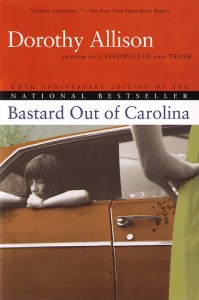
Review - Bastard out of Carolina by Dorothy Allison
This book is so raw, painful, gutsy, vivid and honest it leaves a hole in your heart.
Semi-autobiographical, this is the story of Bone, a child born to southern 'white trash' in Carolina, to a family where illegitimacy, criminality, abuse and hopelessness are a way of life, part of an inevitable cycle that passes from generation to generation.
But this is so much more than yet another survival memoir - this is flawless fiction which I would go so far as to say is of a standard up there with To Kill a Mockingbird (and I don't say that lightly).
Everything in this novel is so vivid. The physical surroundings - the dilapidated houses in the wrong part of town, the dirt ingrained in the window sills, the grassless yards, iced tea on rotting porches, trash floating up the weed encrusted river, the meals of biscuits and gravy, the country music peppering evenings on the porch, the hot days and cool nights. The Boatwright family themselves - the uncles who fall in and out of jobs and jail; the aunts with umpteen kids and no expectations; the forthright granny who pulls no punches; the mother who compartmentalises her love for her child from her love for the man who is destroying that child.
Allison so deftly gets under the skin of the complexities of poverty and abuse, of choiceless existences, of the strength and complications of family love in this environment, of how the impact of all of this can inevitably set out a child's path in life from far too early an age. It makes for difficult reading in parts - it touches on realities most of us would prefer to sweep under the carpet than visualise, but it's profoundly impacting, bringing the hidden violence of our communities out into the open.
There's no warm, fuzzy feeling by the end of this book - this is a book to immensely respect and appreciate. I don't know about the rest of the world, but it's certainly under the radar in the UK, and undeservedly so. This is a book we should be shouting about from the rooftops.
5 stars. An immense writing achievement.
This topic was continued by AlisonY - from 5 Annually to 50 in 2015? Part II.

