THE DEEP ONES: "A Good Man Is Hard to Find" by Flannery O'Connor
Talk The Weird Tradition
Join LibraryThing to post.
1gwendetenebre
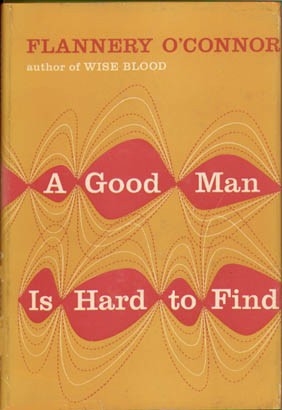
"A Good Man Is Hard to Find" by Flannery O'Connor
Discussion begins March 16.
Written in 1953. First published in A Good Man is Hard to Find and Other Stories (1955).
ONLINE VERSIONS
http://xroads.virginia.edu/~drbr/goodman.html
http://genius.com/3233121
https://www.youtube.com/watch?v=sQT7y4L5aKU
BIBLIOGRAPHY
http://www.isfdb.org/cgi-bin/title.cgi?1344412
SELECTED PRINT VERSIONS
A Good Man is Hard to Find
Dark: Stories of Madness, Murder and the Supernatural
Flannery O'Connor the Complete Stories
And a gazillion other anthologies and collections.
MISCELLANY
http://www2.sunysuffolk.edu/lewiss/Oconnor.htm
http://www.lettersofnote.com/2012/08/i-am-in-state-of-shock.html
https://en.wikipedia.org/wiki/Flannery_O%27Connor
https://www.brainpickings.org/2014/03/25/flannery-o-connor-grotesque-reading/
http://www.jstor.org/stable/810724?seq=1#page_scan_tab_contents
http://tinyurl.com/zcf53qu
Discussion begins March 16.
Written in 1953. First published in A Good Man is Hard to Find and Other Stories (1955).
ONLINE VERSIONS
http://xroads.virginia.edu/~drbr/goodman.html
http://genius.com/3233121
https://www.youtube.com/watch?v=sQT7y4L5aKU
BIBLIOGRAPHY
http://www.isfdb.org/cgi-bin/title.cgi?1344412
SELECTED PRINT VERSIONS
A Good Man is Hard to Find
Dark: Stories of Madness, Murder and the Supernatural
Flannery O'Connor the Complete Stories
And a gazillion other anthologies and collections.
MISCELLANY
http://www2.sunysuffolk.edu/lewiss/Oconnor.htm
http://www.lettersofnote.com/2012/08/i-am-in-state-of-shock.html
https://en.wikipedia.org/wiki/Flannery_O%27Connor
https://www.brainpickings.org/2014/03/25/flannery-o-connor-grotesque-reading/
http://www.jstor.org/stable/810724?seq=1#page_scan_tab_contents
http://tinyurl.com/zcf53qu
2artturnerjr
Reread this today in The Complete Stories. Interesting discussion fodder, to be sure.
ETA: "Reread", not "read"
ETA: "Reread", not "read"
3housefulofpaper
I'll read this in A Circle in the Fire and Other Stories.
4AndreasJ
Well, that was quick. Read it from the first link above. Now looking at the annotations in the second.
5artturnerjr
>4 AndreasJ:
Now looking at the annotations in the second.
The Genius one? Cool. Did you realize you can create your own annotations on that site if you feel so inclined?
Now looking at the annotations in the second.
The Genius one? Cool. Did you realize you can create your own annotations on that site if you feel so inclined?
6AndreasJ
>5 artturnerjr:
Yup, that one. I realized one can add one's own, but I haven't felt the inclination yet.
Yup, that one. I realized one can add one's own, but I haven't felt the inclination yet.
7elenchus
Along with the Genius annotation about Bailey being the host of the radio show Queen for a Day, I found interesting the lyrics of the song "Bill Bailey, Won't You Please Come Home", a song according to its Wikipedia entry that remains a Dixieland standard and presumably familiar to O'Connor.
Now, I first heard "Bill Bailey" in a rendition by The Gun Club, deliciously ironic to be sure, but it seems to be a different song despite listed as "traditional". Then too, The Gun Club came along well after O'Connor's published story.
Now, I first heard "Bill Bailey" in a rendition by The Gun Club, deliciously ironic to be sure, but it seems to be a different song despite listed as "traditional". Then too, The Gun Club came along well after O'Connor's published story.
8paradoxosalpha
In the "I am in a state of shock" letter linked above, O'Connor writes:
The story is a duel of sorts between the Grandmother and her superficial beliefs and the Misfit’s more profoundly felt involvement with Christ’s action which set the world off balance for him.There's an interesting contrast between Red Sam and the Misfit. The Grandmother calls Red Sam a good man, and he accepts the label; when she calls the Misfit a good man, he declines it.
9elenchus
Don't believe I'd read this story before, despite being quite familiar with the title and it being held in high regard.
>8 paradoxosalpha:
That's an intriguing notion of a duel between Grandmother and The Misfit, had not thought of the latter as a center of moral force so much as a force of nature or of reckoning, but certainly I can see it that way. I've read repeatedly that O'Connor's Catholicism leavens her stories in interesting ways, and that would be one.
There's a lot of foreshadowing and symbolism in this story, such that many different interpretations are supported, perhaps even competing or contradictory interpretations. On this first reading, though, I was struck with the impression it was a day of reckoning for Grandmother, and despite the seemingly random or capricious nature of The Misfit's judgment, there is plenty for which Grandmother is held accountable. Principally among them, the less than loving relations among the family of which she is matriarch, and her nostalgia for the classism and racism of the Old South. As you sow, so shall you reap.
>8 paradoxosalpha:
That's an intriguing notion of a duel between Grandmother and The Misfit, had not thought of the latter as a center of moral force so much as a force of nature or of reckoning, but certainly I can see it that way. I've read repeatedly that O'Connor's Catholicism leavens her stories in interesting ways, and that would be one.
There's a lot of foreshadowing and symbolism in this story, such that many different interpretations are supported, perhaps even competing or contradictory interpretations. On this first reading, though, I was struck with the impression it was a day of reckoning for Grandmother, and despite the seemingly random or capricious nature of The Misfit's judgment, there is plenty for which Grandmother is held accountable. Principally among them, the less than loving relations among the family of which she is matriarch, and her nostalgia for the classism and racism of the Old South. As you sow, so shall you reap.
10paradoxosalpha
I like O'Connor's subtle dismissal of Freudian theories of motivation:
"It was a head-doctor at the penitentiary said what I had done was kill my daddy but I known that for a lie. My daddy died in nineteen ought nineteen of the epidemic flu and I never had a thing to do with it."
11elenchus
My favourite lines:
Behind the ditch they were sitting in there were more woods, tall and dark and deep.
And then,
Behind them the line of woods gaped like a dark open mouth.
Behind the ditch they were sitting in there were more woods, tall and dark and deep.
And then,
Behind them the line of woods gaped like a dark open mouth.
12gwendetenebre
>11 elenchus:
Do the woods with their "dark open mouth" represent primal forces older than Christianity or are they a symbolic gateway to Christian hell?
I appreciate O'Connor's typically grotesque imagery, such as the monkey who is "busy catching fleas on himself and biting each one carefully between his teeth as if it were a delicacy."
Another example of the grotesque simultaneously provides both a physical description of a character and her personality when she is described as "a young woman in slacks, whose face was as broad and innocent as a cabbage and was tied around with a green head-kerchief that had two points on the top like rabbit's ears."
Another thing I love about O'Connor are the bizarre names she uses, such as Red Sammy Butts and Pitty Sing. You'll find that a lot in Southern Gothic lit.
Do the woods with their "dark open mouth" represent primal forces older than Christianity or are they a symbolic gateway to Christian hell?
I appreciate O'Connor's typically grotesque imagery, such as the monkey who is "busy catching fleas on himself and biting each one carefully between his teeth as if it were a delicacy."
Another example of the grotesque simultaneously provides both a physical description of a character and her personality when she is described as "a young woman in slacks, whose face was as broad and innocent as a cabbage and was tied around with a green head-kerchief that had two points on the top like rabbit's ears."
Another thing I love about O'Connor are the bizarre names she uses, such as Red Sammy Butts and Pitty Sing. You'll find that a lot in Southern Gothic lit.
13paradoxosalpha
>11 elenchus:, >12 gwendetenebre: the woods with their "dark open mouth"
I was really struck by that sentence also. I think it's just an image of mortality (so I guess "primal forces older than Christianity"), but it really packs a punch and leaves the reader in no doubt about which way things are headed.
I was really struck by that sentence also. I think it's just an image of mortality (so I guess "primal forces older than Christianity"), but it really packs a punch and leaves the reader in no doubt about which way things are headed.
14AndreasJ
>10 paradoxosalpha:
I was somewhat mystified by that date - sounds like it should mean 19019. Is it a feature of Southern dialect?
Judging by what she says under the first misc. link, O'Connor intended both the Grandmother and the Misfit to come across as more sympathetic than they did to me. Likely a cultural gulf at work here: I'm neither Christian nor Southern.
I was somewhat mystified by that date - sounds like it should mean 19019. Is it a feature of Southern dialect?
Judging by what she says under the first misc. link, O'Connor intended both the Grandmother and the Misfit to come across as more sympathetic than they did to me. Likely a cultural gulf at work here: I'm neither Christian nor Southern.
15paradoxosalpha
>14 AndreasJ: sounds like it should mean 19019. Is it a feature of Southern dialect?
I think it's a feature of insularity and lack of education. After ten years of "nineteen-ought-x," speech patterns get stuck!
I also didn't find the Grandmother or the Misfit sympathetic, but if I had to pick one, I'm afraid it would be the Misfit.
I think it's a feature of insularity and lack of education. After ten years of "nineteen-ought-x," speech patterns get stuck!
I also didn't find the Grandmother or the Misfit sympathetic, but if I had to pick one, I'm afraid it would be the Misfit.
16gwendetenebre
I find it intriguing that O'Connor's story pre-dates both the Starkweather rampage (1957-58) and the murder of the Clutter family (1959). She certainly seems to have been able to predict which way the wind would soon be blowing.
17elenchus
>12 gwendetenebre: >13 paradoxosalpha:
One of the Genius annotations makes clear the line "tall and dark and deep" is an allusion to a Frost poem, "Stopping by Woods on a Snowy Evening". There the line is "lovely, dark and deep" and both contrast with the earlier line:
The trees were full of silver-white sunlight and the meanest of them sparkled.
One of the Genius annotations makes clear the line "tall and dark and deep" is an allusion to a Frost poem, "Stopping by Woods on a Snowy Evening". There the line is "lovely, dark and deep" and both contrast with the earlier line:
The trees were full of silver-white sunlight and the meanest of them sparkled.
18gwendetenebre
>15 paradoxosalpha:
The Misfit reminds me a little bit of the Judge in Cormac McCarthy's Blood Meridian: a quasi-supernatural force of pure murder. He certainly seems to have come to terms with his own self-invented mythology.
The Misfit reminds me a little bit of the Judge in Cormac McCarthy's Blood Meridian: a quasi-supernatural force of pure murder. He certainly seems to have come to terms with his own self-invented mythology.
19artturnerjr
Late to the party again. My apologies for that.
My favorite thing about this story is the way it bracingly jumps from domestic slice-of-life/Southern local color writing to horrific (albeit mostly offstage) violence. There seems to me to be something quintessentially American about that, as a glance at a random national news program or headline will most likely tell you.
My favorite line: "She would of been a good woman, if it had been somebody there to shoot her every minute of her life." That speaks for most of us, I suspect.
My favorite thing about this story is the way it bracingly jumps from domestic slice-of-life/Southern local color writing to horrific (albeit mostly offstage) violence. There seems to me to be something quintessentially American about that, as a glance at a random national news program or headline will most likely tell you.
My favorite line: "She would of been a good woman, if it had been somebody there to shoot her every minute of her life." That speaks for most of us, I suspect.
20RandyStafford
>11 elenchus: I was reminded of the reference to dark woods at the beginning of Dante's Inferno.
21paradoxosalpha
>20 RandyStafford: the reference to dark woods at the beginning of Dante's Inferno.
Ah! Interesting, in that it could be read as that allusion, with the idea of the inauguration of a trip to hell.
In Dante, though, it is more a preliminary to the Divina Commedia as a whole, rather than an overture of damnation. Dante himself was probably drawing on medieval traditions that used the silva (his selva oscura) as a figure to represent the undisciplined soul, untrained mind, or uncultivated memory. It serves this same function at the outset of the Hypnerotomachia Poliphili.
Ah! Interesting, in that it could be read as that allusion, with the idea of the inauguration of a trip to hell.
In Dante, though, it is more a preliminary to the Divina Commedia as a whole, rather than an overture of damnation. Dante himself was probably drawing on medieval traditions that used the silva (his selva oscura) as a figure to represent the undisciplined soul, untrained mind, or uncultivated memory. It serves this same function at the outset of the Hypnerotomachia Poliphili.
22paradoxosalpha
This message has been deleted by its author.
24RandyStafford
>21 paradoxosalpha: I think Dante was using a rather common medieval trope. I recall my medieval literature professor referring to it as "the Dark Woods of Error".
26RandyStafford
>24 RandyStafford: You were indeed. That's what I get for being brief instead of clear.
27housefulofpaper
That first miscellany link is interesting. I feel as if I almost understood what was going on in this story, what was important, where my sympathies should lie - what O'Connor's saying there was pretty much what I'd felt when I read the story - but the impact of the most important part of it was blunted for me because I didn't - don't - have a feeling for or real comprehension of the idea of Grace. I didn't appreciate the Misfit's last words in the story could reveal the start of a spiritual unease which could eventually lead to redemption, or at least lead him to become the Prophet he was meant to become ((mis?) quoting from memory, there). Neither did it strike me as any kind of victory for the grandmother.
O'Connor seems to be somewhat callous to her characters here - killing an entire family for the sake of the grandmother's last moments being ones of spiritual or moral clarity, and a dubious possible future redemption for the Misfit.
O'Connor seems to be somewhat callous to her characters here - killing an entire family for the sake of the grandmother's last moments being ones of spiritual or moral clarity, and a dubious possible future redemption for the Misfit.
28elenchus
>27 housefulofpaper:
I also have little instinct for Christian eschatology, and my initial impressions mirrored yours. I am intrigued by O'Connor's use of her spiritual ideas in fiction, however. I have a similar experience with Walker Percy's fiction, though his is not Weird.
I also have little instinct for Christian eschatology, and my initial impressions mirrored yours. I am intrigued by O'Connor's use of her spiritual ideas in fiction, however. I have a similar experience with Walker Percy's fiction, though his is not Weird.
29housefulofpaper
>28 elenchus:
Thanks for that. It's nice to know I'm not alone in my reactions to this story.
I don't know if this adds anything to the discussion, but after writing my comment above last night, it occurred to me that without the religious aspect, "A Good Man is Hard to Find" is rather like something by David Lynch: starting out as virtually a social comedy (or at least casting a sharp eye on normal everyday life) before suddenly lurching into a world of random violence.
Strange how a little knowledge (O'Connor's comments, in this case) can give the whole story a different emphasis and meaning.
30elenchus
I like that reference to Lynch, and I can see that. In fact, it raises the question of whether Lynch has his own "key" to interpretation! I've enjoyed the oddness of his storytelling, similar to Kafka in thinking it would spoil it somewhat if there really were a specific meaning behind the weirdness. And yet, with O'Connor, she provides that key herself.
I hasten to say, it doesn't dilute my appreciation for her stories, though. With Kafka, I've concluded there isn't a single underlying key, and as for Lynch: well, I suspect I wouldn't enjoy his stories as well if there were.
I hasten to say, it doesn't dilute my appreciation for her stories, though. With Kafka, I've concluded there isn't a single underlying key, and as for Lynch: well, I suspect I wouldn't enjoy his stories as well if there were.
31artturnerjr
FWIW, I've always felt like it's a reductive approach to art to sort of approach it like it's supposed to mean one particular thing, or be about one particular thing. I think about it more like that passage from Umberto Eco where he talks about how a novel is a "machine for generating interpretations" - I think you should go to the work with as much of yourself as you can bring to it and try to hear all the different things it has to say to you.
32housefulofpaper
>31 artturnerjr:
In general I'd agree, but in this case I needed the supplementary help of O'Connor's analysis in order to "get" the ending of the story. The "Lynchian" version of my first reading is not simply a different interpretation but an inferior one - it's a little like not getting the point of a joke, and then being given the key to it (or what would be even better, working it out for oneself!)
In general I'd agree, but in this case I needed the supplementary help of O'Connor's analysis in order to "get" the ending of the story. The "Lynchian" version of my first reading is not simply a different interpretation but an inferior one - it's a little like not getting the point of a joke, and then being given the key to it (or what would be even better, working it out for oneself!)
33elenchus
>31 artturnerjr:
Oh, I'd agree. I don't think any one interpretation is definitive or even the only worthy one, at times despite the author insisting a specific meaning was intended. But there are times a peculiar perspective yields a meaning I wouldn't come to otherwise, one I find especially interesting or persuasive, and that's rewarding. It's happened several times for my appreciation of stories here on DEEP ONES, in fact, the primary example being Dunsany's tales from Book of Wonder and the link to the Sime illustrations.
Oh, I'd agree. I don't think any one interpretation is definitive or even the only worthy one, at times despite the author insisting a specific meaning was intended. But there are times a peculiar perspective yields a meaning I wouldn't come to otherwise, one I find especially interesting or persuasive, and that's rewarding. It's happened several times for my appreciation of stories here on DEEP ONES, in fact, the primary example being Dunsany's tales from Book of Wonder and the link to the Sime illustrations.
34artturnerjr
>32 housefulofpaper:
>33 elenchus:
Points taken. As I think we all have an increased understanding of by participating in this group, no work is an island - all works of art are in conversation with (as it were) other works by the author, the author's remarks upon the work, works by different authors, the environments in which they are created, etc. Vis-à-vis this point, our group is especially valuable in the way that we are sort of democratically creating this giant anthology of fiction that keeps growing and growing, and, as it grows, speaks to and sheds light on earlier parts of it. It's pretty amazing actually - I've never really participated in anything quite like it. :)
>33 elenchus:
Points taken. As I think we all have an increased understanding of by participating in this group, no work is an island - all works of art are in conversation with (as it were) other works by the author, the author's remarks upon the work, works by different authors, the environments in which they are created, etc. Vis-à-vis this point, our group is especially valuable in the way that we are sort of democratically creating this giant anthology of fiction that keeps growing and growing, and, as it grows, speaks to and sheds light on earlier parts of it. It's pretty amazing actually - I've never really participated in anything quite like it. :)
35paradoxosalpha
Even with the benefit of something like the "I am in a state of shock" letter, I don't think we need to succumb to the intentional fallacy. Language composes literature through authors, who only partly understand it. While authorial intentions are interesting in their own right, and may illuminate certain aspects of a work, their exposure shouldn't be taken as a fatal end to interpretation.
36elenchus
I find the New Criticism approach uncontroversial, at least as I understand it. Certainly I don't think the author's intention (stated or locked inside their head & heart) is necessary for a valid understanding of a work, nor is it any guarantee of what's in the work. This also shades my understanding of the fallacy: it's invalid to insist intent be part of an interpretation, but not invalid to use biography or context or even the author's explicit comments -- such as with O'Connor's "I am in a state of shock" letter -- to shed light on the meaning to be found. In the end, though, it's about what we find in the text, not anyone's comments about the text except insofar as the text validates them.
In the past I found useful the Roland Barthes essay "The Death of the Author", but it's been years since I read it. Barthes is cited in the wikipedia entry cited in >35 paradoxosalpha:, but under Post-structuralism rather than New Criticism. I might try to review that Barthes essay, this has been an interesting discussion.
In the past I found useful the Roland Barthes essay "The Death of the Author", but it's been years since I read it. Barthes is cited in the wikipedia entry cited in >35 paradoxosalpha:, but under Post-structuralism rather than New Criticism. I might try to review that Barthes essay, this has been an interesting discussion.
39elenchus
>38 frahealee: Colours also factor in, but subliminally for me, since when a priest says Mass, the colour of his vestments reflect the liturgical theme
I was raised Roman Catholic and recognise those particular vestment colours, but never remember the specific meaning, and that accounts for not getting the significance of O'Connor's use of those colours specifically in her story. Nice observation. It's almost as though O'Connor is playing with the idea of an allegory.
I was raised Roman Catholic and recognise those particular vestment colours, but never remember the specific meaning, and that accounts for not getting the significance of O'Connor's use of those colours specifically in her story. Nice observation. It's almost as though O'Connor is playing with the idea of an allegory.
41housefulofpaper
>38 frahealee:
I believe the use of "epiphany" to describe a sudden insight - a lightbulb moment, so to speak - derives from James Joyce's novel Portrait of the Artist as a Young Man.
I believe the use of "epiphany" to describe a sudden insight - a lightbulb moment, so to speak - derives from James Joyce's novel Portrait of the Artist as a Young Man.
43housefulofpaper
>42 frahealee:
Ulysses is not exactly, well not even remotely, manageable. It's famously a novel that people give up on. One of the great unread/unfinished novels, like Moby-Dick or Remembrance of Things Past.
That said, my personal experience of Ulysses was taking it slowly and rather painfully, putting it aside for a few days, reading something else..and then at the halfway point where others have reported finding the going too difficult and giving up, suddenly it all clicked, somehow, and I galloped through the back half of the book in a weekend, as if it was a thriller. I was using the Oxford World's Classics, so I had plentiful notes to help me along..but I began to wish I hadn't used them. I had the (perhaps deluded) notion that the themes, literary echoes, etc. woven through the novel would have become apparent to me, and it would have enriched the reading experience. Indeed it would have enriched it, IF if noticed them without help!
Ulysses is not exactly, well not even remotely, manageable. It's famously a novel that people give up on. One of the great unread/unfinished novels, like Moby-Dick or Remembrance of Things Past.
That said, my personal experience of Ulysses was taking it slowly and rather painfully, putting it aside for a few days, reading something else..and then at the halfway point where others have reported finding the going too difficult and giving up, suddenly it all clicked, somehow, and I galloped through the back half of the book in a weekend, as if it was a thriller. I was using the Oxford World's Classics, so I had plentiful notes to help me along..but I began to wish I hadn't used them. I had the (perhaps deluded) notion that the themes, literary echoes, etc. woven through the novel would have become apparent to me, and it would have enriched the reading experience. Indeed it would have enriched it, IF if noticed them without help!
46gwendetenebre
>42 frahealee:
Brad Dourif is pitch-perfect in John Huston's WISEBLOOD. Actually, Dourif is pitch-perfect in just about any of his roles, but especially so as Hazel Motes.
Brad Dourif is pitch-perfect in John Huston's WISEBLOOD. Actually, Dourif is pitch-perfect in just about any of his roles, but especially so as Hazel Motes.
48gwendetenebre
>47 frahealee:
Great as Wormtongue! And as Billy Bibbit in Cuckoo's Nest, Piter in Dune, and - unforgettable in such a small role - as Raymond in Blue Velvet. So many great performances!
Great as Wormtongue! And as Billy Bibbit in Cuckoo's Nest, Piter in Dune, and - unforgettable in such a small role - as Raymond in Blue Velvet. So many great performances!

