thorold is ankle-deep in anthologies in Q2 (2016 thread, part 2)
This is a continuation of the topic thorold dips a toe into the world of books in 2016.
Talk Club Read 2016
Join LibraryThing to post.
This topic is currently marked as "dormant"—the last message is more than 90 days old. You can revive it by posting a reply.
1thorold
New quarter, new thread.
No very firm targets for Q2:
- Obviously I'll have to look at at least one anthology to live up to the subject line, but that shouldn't be hard.
- I'm still keen to pursue the "French crime" thing I drifted into in Q1, but there are only two or three Fred Vargas books left on the TBR pile, so I'll have to keep on diversifying.
- Over on Reading Globally we've moved on from the Caribbean to Writers at risk, which should give me a few new ideas to chase
- Q1 was very French-dominated, so I should try to read a bit more German - amongst other things, I've still got a few Thomas Bernhards on the TBR shelf
No very firm targets for Q2:
- Obviously I'll have to look at at least one anthology to live up to the subject line, but that shouldn't be hard.
- I'm still keen to pursue the "French crime" thing I drifted into in Q1, but there are only two or three Fred Vargas books left on the TBR pile, so I'll have to keep on diversifying.
- Over on Reading Globally we've moved on from the Caribbean to Writers at risk, which should give me a few new ideas to chase
- Q1 was very French-dominated, so I should try to read a bit more German - amongst other things, I've still got a few Thomas Bernhards on the TBR shelf
2FlorenceArt
On your old thread I enjoyed the review of Pas pleurer. I think I've seen this book before. You made me want to read it.
Thomas Bernhard has been on my wishlist for ages. I'll look forward to your reviews if you get around to reading him.
Thomas Bernhard has been on my wishlist for ages. I'll look forward to your reviews if you get around to reading him.
3thorold
>2 FlorenceArt: Bernhard: I'm sure I shall, sooner or later ...
This will really be "Bernhard part II" for me, I read the five parts of the autobiography and a few other short books in the last three or four years, with a great deal of pleasure, and posted reviews of those. I've still got Holzfällen, Das Kalkwerk, and Der Stimmenimitator waiting for me. Definitely recommended, but you have to dose it a bit, otherwise the force of all that sardonic negativity might start to get a bit too much.
(My TBR collection seems to be getting out of hand - those three have been on the shelf for months, but two of them weren't even in the catalogue. I must do an inventory.)
This will really be "Bernhard part II" for me, I read the five parts of the autobiography and a few other short books in the last three or four years, with a great deal of pleasure, and posted reviews of those. I've still got Holzfällen, Das Kalkwerk, and Der Stimmenimitator waiting for me. Definitely recommended, but you have to dose it a bit, otherwise the force of all that sardonic negativity might start to get a bit too much.
(My TBR collection seems to be getting out of hand - those three have been on the shelf for months, but two of them weren't even in the catalogue. I must do an inventory.)
4thorold
Small diversion: BBC Shakespeare: Much ado about nothing and Coriolanus
Between 1978 and 1984, the BBC made a run of TV productions of Shakespeare's complete dramatic works. In typical BBC fashion, this was a cunning commercial move disguised as a major contribution to British cultural heritage: they had worked out that pretty soon every school would have its own VHS machine, and they foresaw a limitless demand throughout the English-speaking world. The productions tend to play it safe (with this schools market in mind), but they had some very talented actors and directors to draw on, so they certainly aren't completely negligible. I missed most of the later series through being away at college, but I enjoyed what I saw of the earlier ones. Three or four years ago I bought myself the box-set of DVDs (it was on special offer), and from time to time I crack it open and watch one or two of the plays. This weekend I had time for two:
Much ado about nothing (1984), directed by Stuart Burge

This was one from the last series. Its a play I know slightly, but not all that well - I've seen it maybe once in the theatre, and watched the Kenneth Branagh film. The BBC version is relatively uninspired visually: standard Elizabethan costumes with a just a bit of a Sicilian flourish for the ladies, and a set consisting mainly of obviously fake orange trees and a plaster lion. Robert Lindsay and Cherie Lunghi produce the requisite fireworks as Benedick and Beatrice (and since this is the BBC, you catch every line), Jon Finch makes a surprisingly camp Don Pedro, and there are a few unexpected TV faces in the comic parts (Clive Dunn, Gorden Kaye, ...), but otherwise it's all pretty standard.
Coriolanus (1984) directed by Elijah Moshinsky
As in several others that he directed, Moshinsky bent the "Elizabethan costume" rule slightly to give the play a look borrowed from 17th century Dutch art, which is very beautiful and sort of fits, since this is essentially a play about a young republic feeling its way towards a workable form of government. Shakespeare wants to show us why democracy is a dangerous idea, and how we should leave government to those who are born to it - perhaps not surprising that we don't often see this play performed (I've never seen it on stage). But it does also give some very nice insights into the way demagogues operate, so it's not entirely obsolete...
Alan Howard is as stiff and aloof as anyone could want in the title role, but he doesn't really let us build much empathy with him. Joss Ackland, who plays his friend and adviser Menenius, is brilliant, and so is Irene Worth as the Roman mother from Hell. Moshinsky has fun with the hint of a homoerotic bond between Coriolanus and his enemy Aufidius (Mike Gwilym) and we get the requisite blood-stained naked torsos in the fight sequence, but judging from the stills I've seen it's nothing to what Ian McKellen did in his stage productions.
Between 1978 and 1984, the BBC made a run of TV productions of Shakespeare's complete dramatic works. In typical BBC fashion, this was a cunning commercial move disguised as a major contribution to British cultural heritage: they had worked out that pretty soon every school would have its own VHS machine, and they foresaw a limitless demand throughout the English-speaking world. The productions tend to play it safe (with this schools market in mind), but they had some very talented actors and directors to draw on, so they certainly aren't completely negligible. I missed most of the later series through being away at college, but I enjoyed what I saw of the earlier ones. Three or four years ago I bought myself the box-set of DVDs (it was on special offer), and from time to time I crack it open and watch one or two of the plays. This weekend I had time for two:
Much ado about nothing (1984), directed by Stuart Burge

This was one from the last series. Its a play I know slightly, but not all that well - I've seen it maybe once in the theatre, and watched the Kenneth Branagh film. The BBC version is relatively uninspired visually: standard Elizabethan costumes with a just a bit of a Sicilian flourish for the ladies, and a set consisting mainly of obviously fake orange trees and a plaster lion. Robert Lindsay and Cherie Lunghi produce the requisite fireworks as Benedick and Beatrice (and since this is the BBC, you catch every line), Jon Finch makes a surprisingly camp Don Pedro, and there are a few unexpected TV faces in the comic parts (Clive Dunn, Gorden Kaye, ...), but otherwise it's all pretty standard.
Coriolanus (1984) directed by Elijah Moshinsky
As in several others that he directed, Moshinsky bent the "Elizabethan costume" rule slightly to give the play a look borrowed from 17th century Dutch art, which is very beautiful and sort of fits, since this is essentially a play about a young republic feeling its way towards a workable form of government. Shakespeare wants to show us why democracy is a dangerous idea, and how we should leave government to those who are born to it - perhaps not surprising that we don't often see this play performed (I've never seen it on stage). But it does also give some very nice insights into the way demagogues operate, so it's not entirely obsolete...
Alan Howard is as stiff and aloof as anyone could want in the title role, but he doesn't really let us build much empathy with him. Joss Ackland, who plays his friend and adviser Menenius, is brilliant, and so is Irene Worth as the Roman mother from Hell. Moshinsky has fun with the hint of a homoerotic bond between Coriolanus and his enemy Aufidius (Mike Gwilym) and we get the requisite blood-stained naked torsos in the fight sequence, but judging from the stills I've seen it's nothing to what Ian McKellen did in his stage productions.
5FlorenceArt
I watched a few of the earlier ones too I think. I vividly remember The Tempest.
6lilisin
>1 thorold:
For non-Vargas French crime I really liked Rene Fregni's On ne s'endort jamais seul. I read it over a decade ago but I still have strong impressions on that book.
For non-Vargas French crime I really liked Rene Fregni's On ne s'endort jamais seul. I read it over a decade ago but I still have strong impressions on that book.
7thorold
>5 FlorenceArt: That's one I haven't taken out of the box yet, but Michael Hordern as Prospero should be worth watching.
>6 lilisin: Thanks, I'll look out for that
>6 lilisin: Thanks, I'll look out for that
8thorold
Project Fred, part nine, if I'm counting right. Having finished this one I'm now back at the (uncertain) place where I first started:
Dans les bois éternels (2006, This night's foul work) by Fred Vargas
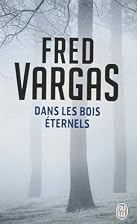
Fifth in the Adamsberg series, and another where one of the Three Evangelists has a walk-on part as an expert. The Commissaire has more or less recovered from his nasty experiences in Quebec and is starting to get used to the idea of being a father, but another unpleasant story from his distant past seems to have come back to bite him. And he's confronted not only with a new subordinate who insists on speaking in alexandrines, but also with a baffling set of incidents that are obviously all linked, since this is a crime novel after all, but for the first three hundred pages or so they stubbornly resist falling into place. Once again, it turns out to be a mystery that can only be solved by refusing to follow strictly logical lines.
Together with Sous les vents de Neptune, this is one of the best I've read so far in the series: Vargas gives herself the time and space to explore her large cast of characters in some depth, and there's a good balance between mystery, suspense and comedy. It is one that you shouldn't read out of sequence if you can avoid it, because there is information in the next book that removes at least some of the doubts you're supposed to have whilst reading this one.
(I was puzzled by the English title, which looks as though it should be another line from Macbeth but isn't: according to Wikipedia it's taken from the translation of one of the many lines of verse in the text. The French title relies on a pun that doesn't work in English, so in this case it's pretty obvious why the English publishers had to come up with something else.)
Dans les bois éternels (2006, This night's foul work) by Fred Vargas
Fifth in the Adamsberg series, and another where one of the Three Evangelists has a walk-on part as an expert. The Commissaire has more or less recovered from his nasty experiences in Quebec and is starting to get used to the idea of being a father, but another unpleasant story from his distant past seems to have come back to bite him. And he's confronted not only with a new subordinate who insists on speaking in alexandrines, but also with a baffling set of incidents that are obviously all linked, since this is a crime novel after all, but for the first three hundred pages or so they stubbornly resist falling into place. Once again, it turns out to be a mystery that can only be solved by refusing to follow strictly logical lines.
Together with Sous les vents de Neptune, this is one of the best I've read so far in the series: Vargas gives herself the time and space to explore her large cast of characters in some depth, and there's a good balance between mystery, suspense and comedy. It is one that you shouldn't read out of sequence if you can avoid it, because there is information in the next book that removes at least some of the doubts you're supposed to have whilst reading this one.
(I was puzzled by the English title, which looks as though it should be another line from Macbeth but isn't: according to Wikipedia it's taken from the translation of one of the many lines of verse in the text. The French title relies on a pun that doesn't work in English, so in this case it's pretty obvious why the English publishers had to come up with something else.)
9thorold
Hmmm. Things I could read next (but probably won't) - a non-exhaustive dip into the TBR and virtual TBR.
If anyone wants to make suggestions, my physical TBR is here: http://www.librarything.com/catalog/thorold/toread
French crime:
Other crime:
Writers at risk (Reading Globally theme for Q2):
General stuff:
Trilogies I’ve started but not finished (eek! this is getting to be a habit):
If anyone wants to make suggestions, my physical TBR is here: http://www.librarything.com/catalog/thorold/toread
French crime:
- Fred Vargas - still another three or four I haven’t read, but I’m trying to space them out
- Daniel Pennac - I enjoyed the first in his series, and I’ve got a couple more from the charity shop on the TBR
- Rene Fregni's On ne s'endort jamais seul - suggested by lilisin above
- Simenon - I’ve still got plenty of these on the TBR, and haven’t read any for ages
- More Léo Malet, more Manchette
- Pascal Garnier, Comment va la douleur?, suggested by @deebee1
Other crime:
- Andrea Camilleri - I’ve got a couple of Montalbanos on the TBR
- Janwillem van de Wetering - I read the first of his Amsterdam novels a few weeks ago, and I’m keen to continue
- Carlo Emilio Gadda Quer pasticciaccio brutto de via Merulana - my Italian isn’t quite there yet, but I do want to read this soon
Writers at risk (Reading Globally theme for Q2):
- Cristo si e fermato a Eboli - this will be a re-read, but I want to read it in Italian this time
Transit (Anna Segher) - another one I’ve been meaning to read for ages- more Herta Müller
- Granny made me an anarchist - probably a mistake, but the title makes it irresistible
- Juan Goytisolo's Marks of Identity - mentioned in connection with Pas Pleurer in the previous thread
- at least something from South Africa: Down Second Avenue, A dry white season (suggested by @Eliz_M); Breyten Breytenbach suggested by @SassyLassy; A separate development suggested by @deebee1
General stuff:
-
Thomas Bernhard (mentioned above) -
Holzfällen, Das Kalkwerk, Der Stimmenimitator are on the TBR shelf - Javier Marías Así empieza lo malo - heard him talking about it on the radio, sounds a bit like more of the same, but in his case “the same” is generally good stuff
Tous les matins du monde - see the comments about Quignard and Annie Ernaux earlier in the thread- La colmena - not sure if it really counts, but it was banned by Franco
Mary McCarthy The Group - heard Margaret Drabble talking about it on the radio, sounds very interesting
Trilogies I’ve started but not finished (eek! this is getting to be a habit):
-
Izzo - still
two partsone part of the Marseilles trilogy to read - Undset, Kristin Lavrandatter - one part left
Robertson Davies - Cornish Trilogy - two parts left
10rebeccanyc
For what it's worth, I love Camilleri and van de Wetering; also Transit, Kristin Lavransdatter. and The Cornish Trilogy. And thanks for the list of French mysteries (for when I finish Vargas).
11ELiz_M
>9 thorold: ...something from South Africa:
Oh! The book I am currently reading fits this perfectly: Down Second Avenue is a a memoir of the author's childhood in South African slums and the struggle to become educated. The author spent 20 years in exile after he was banned from teaching in South Africa.
I loved A Dry White Season. Although the actual writer (Andre Brink) was not at risk, the novel focuses on the risk run by individuals questioning the government.
And as long as I am ignoring the Reading Globally criteria, I have enjoyed (?) the first book in a mystery series set in Johannesburg, Random Violence and Stolen Lives. As suggested by the first title, there is a fair amount of violence depicted.
Oh! The book I am currently reading fits this perfectly: Down Second Avenue is a a memoir of the author's childhood in South African slums and the struggle to become educated. The author spent 20 years in exile after he was banned from teaching in South Africa.
I loved A Dry White Season. Although the actual writer (Andre Brink) was not at risk, the novel focuses on the risk run by individuals questioning the government.
And as long as I am ignoring the Reading Globally criteria, I have enjoyed (?) the first book in a mystery series set in Johannesburg, Random Violence and Stolen Lives. As suggested by the first title, there is a fair amount of violence depicted.
12thorold
>10 rebeccanyc: >11 ELiz_M: - thanks, both! And whilst you were all thinking on my behalf, I spotted that one of the books on my list was a novella that could be knocked off in a single evening whilst listening to the right sort of music...
Tous les matins du monde (1991, All the world's mornings) by Pascal Guignard (France, 1948 - )
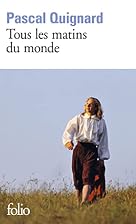

This restrained and delicately ironic novella, set in the countryside around Paris in the second half of the 17th century and dealing with the relationship between two musicians of different generations, became an unlikely popular hit thanks to the very successful film by Alain Corneau, which was made in parallel with the writing of the book.
M. de Sainte-Colombe has an almost legendary standing among his contemporaries as a composer, performer and technical innovator on the viola da gamba, but he lives in rustic isolation with his two daughters on the banks of the Bièvre and refuses to travel the few miles to Versailles to show off his skill, even at the direct command of the King. His ascetic tendency is partly religious (he's associated with the Jansenist Port-Royal movement) but he's also clearly been plunged into a depression by the untimely death of his wife.
Against all his instincts, he accepts the young Marin Marais as his pupil. Marais is the son of a cobbler and has been thrown out of the royal choir-school when his voice broke: it's his evident grief at being cut off from music and probably forced to follow his father's trade that moves Sainte-Colombe to accept him. By the logic of such stories, we would expect him to become a grateful pupil, marry one of the daughters, and inherit his master's secrets, but that would be too neat for Quignard's way of seeing things. The relationship that develops between Marais and the Sainte-Colombe family involves a curious mixture of low comedy and bleak tragedy - baroque, yes, but baroque in an oddly low-key way.
The descriptions in the book are every bit as striking as the visuals of the film, and also draw on the art of the period. The still-life paintings of Lubin Baugin play an important role, and there's a lot of discussion of the way ideas cross over between the different arts: Sainte-Colombe even instructs Marais to listen carefully to the rhythms of Baugin's brush when he's painting and use them as a model for his bowing. Interesting: putting music into literature is always tricky, and writers have to resort to all kinds of tricks to make it work, but until now I've never come across someone who does it principally by using visual images as Quignard is doing here.
Another interesting and very pleasant little diversion, but I suspect that Quignard can do rather better than this: ultimately it seems a rather slight piece of work, and you wonder a bit whether the book or the film was the main goal here.
(My spelling-checker keeps turning Baugin into Gauguin - does Safari have no sense of history at all?)

Tous les matins du monde (1991, All the world's mornings) by Pascal Guignard (France, 1948 - )

This restrained and delicately ironic novella, set in the countryside around Paris in the second half of the 17th century and dealing with the relationship between two musicians of different generations, became an unlikely popular hit thanks to the very successful film by Alain Corneau, which was made in parallel with the writing of the book.
M. de Sainte-Colombe has an almost legendary standing among his contemporaries as a composer, performer and technical innovator on the viola da gamba, but he lives in rustic isolation with his two daughters on the banks of the Bièvre and refuses to travel the few miles to Versailles to show off his skill, even at the direct command of the King. His ascetic tendency is partly religious (he's associated with the Jansenist Port-Royal movement) but he's also clearly been plunged into a depression by the untimely death of his wife.
Against all his instincts, he accepts the young Marin Marais as his pupil. Marais is the son of a cobbler and has been thrown out of the royal choir-school when his voice broke: it's his evident grief at being cut off from music and probably forced to follow his father's trade that moves Sainte-Colombe to accept him. By the logic of such stories, we would expect him to become a grateful pupil, marry one of the daughters, and inherit his master's secrets, but that would be too neat for Quignard's way of seeing things. The relationship that develops between Marais and the Sainte-Colombe family involves a curious mixture of low comedy and bleak tragedy - baroque, yes, but baroque in an oddly low-key way.
The descriptions in the book are every bit as striking as the visuals of the film, and also draw on the art of the period. The still-life paintings of Lubin Baugin play an important role, and there's a lot of discussion of the way ideas cross over between the different arts: Sainte-Colombe even instructs Marais to listen carefully to the rhythms of Baugin's brush when he's painting and use them as a model for his bowing. Interesting: putting music into literature is always tricky, and writers have to resort to all kinds of tricks to make it work, but until now I've never come across someone who does it principally by using visual images as Quignard is doing here.
Another interesting and very pleasant little diversion, but I suspect that Quignard can do rather better than this: ultimately it seems a rather slight piece of work, and you wonder a bit whether the book or the film was the main goal here.
(My spelling-checker keeps turning Baugin into Gauguin - does Safari have no sense of history at all?)

13SassyLassy
>9 thorold: That's quite a TBR. My favourite from those I have read is The Malayan Trilogy, but that was some time ago.
Just for the title alone, I wouldn't be able to resist Surfeit of Lampreys.
Transit was excellent. I'm pretty sure he's on the Reading Globally thread, but from South Africa and a poet as well, how about Breyten Breytenbach?
Just for the title alone, I wouldn't be able to resist Surfeit of Lampreys.
Transit was excellent. I'm pretty sure he's on the Reading Globally thread, but from South Africa and a poet as well, how about Breyten Breytenbach?
14thorold
>13 SassyLassy: Yes, I have actually read The Malayan Trilogy, but it's on the TBR because I found a copy in the charity shop recently and mean to re-read it. I have a bit of a lovehate relationship with Burgess...
Breytenbach is someone I've been meaning to try for ages. Not sure if I'm up for Afrikaans poetry, maybe I'll start with some of his English prose.
Breytenbach is someone I've been meaning to try for ages. Not sure if I'm up for Afrikaans poetry, maybe I'll start with some of his English prose.
16deebee1
>9 thorold: You got some good reading lined up here, thorold. And to read them in the originals, too!
As you're on a French crime kick, a couple more suggestions: Fatale by Jean-Patrick Manchette and How's the Pain by Pascale Garnier. Quick entertainment.
Christ Stopped at Eboli is a book I love dearly, if one could say that of a book. I cast envious eyes on you reading it in Italian!
Would be interesting to know what you think of La Colmena. Not sure why it was banned by Franco, the story itself seemed to me innocuous. Surprising too because José Cela was known to be a Franco supporter.
From South Africa, there is Christopher Hope's A Separate Development which is very good. This author and this particular book would qualify for the RG theme -- Hope was exiled from SA after his poems dealing with politics and racism gained the ire of government. This satirical novel, which came out in the early 1980s, was banned in SA for its themes criticising apartheid. I think he's an author who deserves to be much better known (and whose books deserve to be more available) but I think his political leanings, as usual in such cases, have not made him a commercially viable writer.
I see you got Juan Goytisolo there. He fits the Writers at Risk category, actually. He fled the Franco regime in the 1950s and lived as an exile in France. His books were banned by Franco, and he has never returned to live again in Spain. Marks of Identity is the first in a trilogy. More about him http://www.theguardian.com/books/2000/aug/12/internationalwriting.books
More of the same from Javier Marías is not a bad thing. I'm now reading Tomorrow in the Battle Think on Me which reminds me how good he is (though I sometimes feel, at least in this novel, that the translation is a bit stiff). Look forward to what you think of his new book.
As you're on a French crime kick, a couple more suggestions: Fatale by Jean-Patrick Manchette and How's the Pain by Pascale Garnier. Quick entertainment.
Christ Stopped at Eboli is a book I love dearly, if one could say that of a book. I cast envious eyes on you reading it in Italian!
Would be interesting to know what you think of La Colmena. Not sure why it was banned by Franco, the story itself seemed to me innocuous. Surprising too because José Cela was known to be a Franco supporter.
From South Africa, there is Christopher Hope's A Separate Development which is very good. This author and this particular book would qualify for the RG theme -- Hope was exiled from SA after his poems dealing with politics and racism gained the ire of government. This satirical novel, which came out in the early 1980s, was banned in SA for its themes criticising apartheid. I think he's an author who deserves to be much better known (and whose books deserve to be more available) but I think his political leanings, as usual in such cases, have not made him a commercially viable writer.
I see you got Juan Goytisolo there. He fits the Writers at Risk category, actually. He fled the Franco regime in the 1950s and lived as an exile in France. His books were banned by Franco, and he has never returned to live again in Spain. Marks of Identity is the first in a trilogy. More about him http://www.theguardian.com/books/2000/aug/12/internationalwriting.books
More of the same from Javier Marías is not a bad thing. I'm now reading Tomorrow in the Battle Think on Me which reminds me how good he is (though I sometimes feel, at least in this novel, that the translation is a bit stiff). Look forward to what you think of his new book.
17rebeccanyc
>16 deebee1: I enjoyed Fatale but I enjoyed his The Mad and the Bad (great English title!) more. And I have Marias' Tomorrow in the Battle Think on Me on the TBR, so I'm glad to learn it's good.
18thorold
>16 deebee1: Now that you've provoked me to look it up, I recall that the reason La colmena was initially banned in Spain was that it was considered too pornographic. Apparently it was published in Spain only four years after the Argentinian edition came out, so the censorship wasn't such a big deal. Probably not relevant to the RG theme then, but still a book I want to spend some time on sooner or later.
Manchette is someone I'll probably follow up further, but he's not at the top of the list - I appreciated the quality of the writing in L'affaire N'Gustro, but the subject-matter didn't really appeal. Pascal Garnier sounds like an interesting possibility I didn't know about. (even though the touchstone got hijacked by C.S. Lewis...).
I started a Thomas Bernhard yesterday, and I've got Transit lined up after that (maybe with a Vargas in between), then I'll see where I want to go next. Maybe I will try Goytisolo.
Manchette is someone I'll probably follow up further, but he's not at the top of the list - I appreciated the quality of the writing in L'affaire N'Gustro, but the subject-matter didn't really appeal. Pascal Garnier sounds like an interesting possibility I didn't know about. (even though the touchstone got hijacked by C.S. Lewis...).
I started a Thomas Bernhard yesterday, and I've got Transit lined up after that (maybe with a Vargas in between), then I'll see where I want to go next. Maybe I will try Goytisolo.
19thorold
>16 deebee1: >17 rebeccanyc: Tomorrow in the battle is one I had very mixed feelings about (especially as I'd just read A heart so white, and that also starts with a woman being killed off for no obvious reason) - it has some of Marías's best flights of fancy in it, a lot of scenes and descriptions that really stick in the mind, and some incredibly witty language, but I felt uncomfortable about enjoying it...
20thorold
So, I finished the Bernhard last night - it's an odd thing that you still have the tendency to "read on to the end of the next chapter", even when you know there aren't any chapter breaks in the book: I've noticed before that I tend to read single-paragraph novels in much bigger chunks than more conventional texts.
Holzfällen: eine Erregung (1984; Woodcutters, an irritation, 1985) by Thomas Bernhard (Austria, 1931-1989)

Thomas Bernhard came from a background that belies the conservative Austrian stereotype - a teenaged single mother and anarchist grandparents who never bothered to marry - and he seems to have devoted his life to being awkward, mocking Austria and its traditions and cultural institutions at every opportunity. If you had offered him a Mozartkugel, he would have been looking for a way to fire it at the minister of culture. But he's indisputably one of the greatest modern writers in German: despite his notoriously ungrateful acceptance speeches (on one occasion he managed to provoke a minister to punch him during an awards ceremony), it was probably only his early death that saved him from the Nobel.
The action of Holzfällen can be summed up in a single paragraph - and that's exactly what Bernhard does, but the paragraph in question is 320 pages long. The narrator has been invited to an "artistic supper party" in the rather grand Gentzgasse apartment of some old acquaintances, the Auersbergers (a composer and a singer), whom he happened to bump into in the street after having been away from Vienna for a long time. The guest of honour at the party is an actor, who keeps everyone else waiting until long after midnight before he arrives from the Burgtheater, where he's starring in Ibsen's Wild duck. In the first half of the book the narrator thinks in a wing-chair about the party, the pretentious literary guests, and the funeral of his old friend Joana, which he and most of the others had attended that afternoon. Then the dinner starts, with the actor dominating the conversation in a fatuous monologue (Bernhard carefully constructs this so that Ibsen is never actually mentioned, and several of the guests are left with the impression that he's talking about where you can eat the best wild duck...). After the meal, the guests move into the music room, and the actor gets so drunk that his pretentious façade drops and in a mock-Joycean epiphany he actually talks good sense for a short while. This inspired monologue ends with the enigmatic words "Wald, Hochwald, Holzfällen, das ist es immer gewesen" (Forest, high forest, tree-felling, that's what it's always been), which the narrator takes as an ironic summary of Viennese cultural life, and then the party breaks up, with the narrator deciding as he walks home (in a typical Bernhard touch, he's going in precisely the wrong direction) that he must write about this evening right away, before it's too late.
On the surface this is a satirical novel about a bunch of pretentious artistic people spending an evening in fatuous, self-important posing, and about the way artists and critics live by chopping down whatever is beautiful around them. And it's also presumably a roman-à-clef, since it became a runaway bestseller in Austria as soon as it emerged that Bernhard was being sued for libel by a composer with a name very like Auersberger. (Not that Bernhard was any stranger to libel actions: this one, eventually settled out of court, must have been at least his third.) But the real joy of it, as with everything Bernhard wrote, is the way he uses language to drill down and discover meaning. He manipulates words and phrases the way a composer would in a piece of music, modulating, transposing, inverting, repeating, saying something in three or four or a dozen slightly different ways to help us explore exactly what he might mean by using that particular term or expression. He can take a complete cliché and make us see a profound and quite unexpected meaning in it, or he can make an innocent-looking phrase bounce back and expose the shallowness and hypocrisy of the person who used it (you can imagine the unfortunate Frau Auersberger having nightmares about the expression künstlerisches Abendessen for the rest of her life, even as she strikes Bernhard off her guest-list...).
Wonderful, seriously depressing and hilariously funny all at the same time.
Holzfällen: eine Erregung (1984; Woodcutters, an irritation, 1985) by Thomas Bernhard (Austria, 1931-1989)

Thomas Bernhard came from a background that belies the conservative Austrian stereotype - a teenaged single mother and anarchist grandparents who never bothered to marry - and he seems to have devoted his life to being awkward, mocking Austria and its traditions and cultural institutions at every opportunity. If you had offered him a Mozartkugel, he would have been looking for a way to fire it at the minister of culture. But he's indisputably one of the greatest modern writers in German: despite his notoriously ungrateful acceptance speeches (on one occasion he managed to provoke a minister to punch him during an awards ceremony), it was probably only his early death that saved him from the Nobel.
The action of Holzfällen can be summed up in a single paragraph - and that's exactly what Bernhard does, but the paragraph in question is 320 pages long. The narrator has been invited to an "artistic supper party" in the rather grand Gentzgasse apartment of some old acquaintances, the Auersbergers (a composer and a singer), whom he happened to bump into in the street after having been away from Vienna for a long time. The guest of honour at the party is an actor, who keeps everyone else waiting until long after midnight before he arrives from the Burgtheater, where he's starring in Ibsen's Wild duck. In the first half of the book the narrator thinks in a wing-chair about the party, the pretentious literary guests, and the funeral of his old friend Joana, which he and most of the others had attended that afternoon. Then the dinner starts, with the actor dominating the conversation in a fatuous monologue (Bernhard carefully constructs this so that Ibsen is never actually mentioned, and several of the guests are left with the impression that he's talking about where you can eat the best wild duck...). After the meal, the guests move into the music room, and the actor gets so drunk that his pretentious façade drops and in a mock-Joycean epiphany he actually talks good sense for a short while. This inspired monologue ends with the enigmatic words "Wald, Hochwald, Holzfällen, das ist es immer gewesen" (Forest, high forest, tree-felling, that's what it's always been), which the narrator takes as an ironic summary of Viennese cultural life, and then the party breaks up, with the narrator deciding as he walks home (in a typical Bernhard touch, he's going in precisely the wrong direction) that he must write about this evening right away, before it's too late.
On the surface this is a satirical novel about a bunch of pretentious artistic people spending an evening in fatuous, self-important posing, and about the way artists and critics live by chopping down whatever is beautiful around them. And it's also presumably a roman-à-clef, since it became a runaway bestseller in Austria as soon as it emerged that Bernhard was being sued for libel by a composer with a name very like Auersberger. (Not that Bernhard was any stranger to libel actions: this one, eventually settled out of court, must have been at least his third.) But the real joy of it, as with everything Bernhard wrote, is the way he uses language to drill down and discover meaning. He manipulates words and phrases the way a composer would in a piece of music, modulating, transposing, inverting, repeating, saying something in three or four or a dozen slightly different ways to help us explore exactly what he might mean by using that particular term or expression. He can take a complete cliché and make us see a profound and quite unexpected meaning in it, or he can make an innocent-looking phrase bounce back and expose the shallowness and hypocrisy of the person who used it (you can imagine the unfortunate Frau Auersberger having nightmares about the expression künstlerisches Abendessen for the rest of her life, even as she strikes Bernhard off her guest-list...).
Wonderful, seriously depressing and hilariously funny all at the same time.
21deebee1
>17 rebeccanyc: The Mad and the Bad sounds intriguing, I'll check that out.
>18 thorold: I was looking up references to this ban for its controversial content and found this interesting piece... http://www.3ammagazine.com/3am/camilo-jose-celas-the-hive-revisited/. The Spanish National Library is apparently issuing a special edition, the earliest version of the novel with both censored and previously unknown content, this year on the centenary of Cela's birth.
About Marías, I know what you mean about being "uncomfortable about enjoying" his books. He has indeed a way of drawing us into the labyrinth of a character's mind, we end up like voyeaurs. What strikes me is the way he can develop in a subtle way the same themes in different directions, in a single novel and across his works.
Woodcutters was my introduction to Bernhard, enjoyed it a lot. I have been meaning to read another Bernhard, Extinction for some time now. Don't know though if it's a good idea to follow Marías with Bernhard, I will probably need a light and funny read between.
>18 thorold: I was looking up references to this ban for its controversial content and found this interesting piece... http://www.3ammagazine.com/3am/camilo-jose-celas-the-hive-revisited/. The Spanish National Library is apparently issuing a special edition, the earliest version of the novel with both censored and previously unknown content, this year on the centenary of Cela's birth.
About Marías, I know what you mean about being "uncomfortable about enjoying" his books. He has indeed a way of drawing us into the labyrinth of a character's mind, we end up like voyeaurs. What strikes me is the way he can develop in a subtle way the same themes in different directions, in a single novel and across his works.
Woodcutters was my introduction to Bernhard, enjoyed it a lot. I have been meaning to read another Bernhard, Extinction for some time now. Don't know though if it's a good idea to follow Marías with Bernhard, I will probably need a light and funny read between.
22thorold
>21 deebee1: I will probably need a light and funny read between. - Definitely :-)
Thanks for the article about Cela - La colmena is moving steadily up my priority list. But first I have to get a visa to leave Marseilles...
Thanks for the article about Cela - La colmena is moving steadily up my priority list. But first I have to get a visa to leave Marseilles...
23thorold
Irrelevant aside: I found my old school log tables (Logarithmic and other tables for schools, 1954 edition) wedged between a couple of other books and decided that the cover had to be preserved for posterity. (Yes, that's the front cover, not the title page.)
Before you call me a vandal, I should point out that there are nearly 20 years worth of names inside the front cover.

Before you call me a vandal, I should point out that there are nearly 20 years worth of names inside the front cover.

25thorold
>24 baswood: Logarithms were way beyond my understanding at school.
:-) I'm fairly sure I understood them at the time. It might take me a little while to recover that knowledge when the apocalypse wipes out all the pocket calculators, but at least I know where the book of tables is now...
:-) I'm fairly sure I understood them at the time. It might take me a little while to recover that knowledge when the apocalypse wipes out all the pocket calculators, but at least I know where the book of tables is now...
26thorold
Concert: Henk Neven (baritone) & Hans Eijsackers (piano).
Nieuwe Kerk, 9 April
The concert was marketed as "Espanja" (sic.) - songs by various non-Spanish composers "inspired by" Spanish music. Ravel, of course, but also Iber, Shostakovich(!) and the Norwegian Arne Dørumsgaard. In between the songs, Hans Eijsackers played a couple of short piano pieces by Albeniz and Granados.
I didn't know much of the music - oddly enough I recognised the Dørumsgaard arrangements of Spanish renaissance pieces, even though I was pretty sure I'd never heard of Dørumsgaard. After a lot of digging around on Spotify I worked out that I must have heard Gérard Souzay's old recordings of them on the radio at some point. Everything on the programme was entertaining, anyway. Neven did very well, he has the right voice for this sort of repertoire, and the right sort of stage presence as well: in the Shostakovich you could quite clearly visualise the imaginary glass of vodka on the piano. My Spanish friends were very impressed by his accent in the Dørumsgaard pieces, and his French intonation was very natural too (maybe a shade too much Jacques Brel...). No idea how good the Russian was, but it sounded convincing. A fun evening: not the sort of repertoire that I have a very deep interest in, but it was an interesting and pleasant introduction to it.
Nieuwe Kerk, 9 April
The concert was marketed as "Espanja" (sic.) - songs by various non-Spanish composers "inspired by" Spanish music. Ravel, of course, but also Iber, Shostakovich(!) and the Norwegian Arne Dørumsgaard. In between the songs, Hans Eijsackers played a couple of short piano pieces by Albeniz and Granados.
I didn't know much of the music - oddly enough I recognised the Dørumsgaard arrangements of Spanish renaissance pieces, even though I was pretty sure I'd never heard of Dørumsgaard. After a lot of digging around on Spotify I worked out that I must have heard Gérard Souzay's old recordings of them on the radio at some point. Everything on the programme was entertaining, anyway. Neven did very well, he has the right voice for this sort of repertoire, and the right sort of stage presence as well: in the Shostakovich you could quite clearly visualise the imaginary glass of vodka on the piano. My Spanish friends were very impressed by his accent in the Dørumsgaard pieces, and his French intonation was very natural too (maybe a shade too much Jacques Brel...). No idea how good the Russian was, but it sounded convincing. A fun evening: not the sort of repertoire that I have a very deep interest in, but it was an interesting and pleasant introduction to it.
27dchaikin
Just caught up with about six weeks of your reviews. These were all new to me. I think I learned a lot about French crime novels, and also that Fred Vargas is a she. And I admire your ability to read in six languages. Fun stuff here.
28thorold
>27 dchaikin: I had to laugh at the thought that it took six weeks worth of explanation to communicate the gender of an author. With some of the meetings I've attended this week, I'm in a frame of mind where that doesn't sound at all far-fetched...
(I've been enjoying your sloths and comments on Pynchon, Dan, but I'm not really qualified to comment on either)
For some reason I'm only advancing very slowly with Transit and not at all with Meneer Berta. Probably all those meetings. Maybe I'll get back into reading over the weekend.
(I've been enjoying your sloths and comments on Pynchon, Dan, but I'm not really qualified to comment on either)
For some reason I'm only advancing very slowly with Transit and not at all with Meneer Berta. Probably all those meetings. Maybe I'll get back into reading over the weekend.
29janeajones
I am in awe of your ability to read in six languages.
30thorold
Someone reminded me that yesterday was my 9 year Thingaversary. I got an unexpected invitation to go sailing for the weekend and didn't get back until late, so I didn't even log in to LT yesterday. A good weekend, but a missed excuse to splurge on piles of lovely new books!
Anyway, it's another excuse to collect some numbers...
Since April 2007, I've posted 912 reviews, which is probably pretty close to the number of books I've read in that time, since I'm quite strict about posting reviews. Possibly a slight underestimate, as I only started posting reviews of borrowed books when collections were introduced and it was possible to enter them as "read but not owned". So I'm averaging a bit over 100 books a year.
(I wonder which will come first - the ten-year Thingaversary or my thousandth review?)
I catalogued about 2500 books in LT in the first three months after I joined, so that's probably how big my physical library was in 2007. (I moved house a few months after I joined, and something like 27 of my 40 boxes of stuff were books).
I'm now up to 3473, so I've added slightly more books than I've read. I currently have 103 books on the TBR shelf: from memory I would guess that there were about 20 or 30 when I first started cataloguing, so that probably makes sense.
Of the (roughly 1000) books I've added to LT in the last nine years, 103 (10%) were paid e-books and 273 (30%) were either non-copyright e-books or borrowed. So I must be averaging something in the region of 60 paper books added per year. But I'm sure that's not been linear: "back in 2007" e-books were still not much more than an exotic possibility, and reading anything from Project Gutenberg was difficult.
Anyway, it's another excuse to collect some numbers...
Since April 2007, I've posted 912 reviews, which is probably pretty close to the number of books I've read in that time, since I'm quite strict about posting reviews. Possibly a slight underestimate, as I only started posting reviews of borrowed books when collections were introduced and it was possible to enter them as "read but not owned". So I'm averaging a bit over 100 books a year.
(I wonder which will come first - the ten-year Thingaversary or my thousandth review?)
I catalogued about 2500 books in LT in the first three months after I joined, so that's probably how big my physical library was in 2007. (I moved house a few months after I joined, and something like 27 of my 40 boxes of stuff were books).
I'm now up to 3473, so I've added slightly more books than I've read. I currently have 103 books on the TBR shelf: from memory I would guess that there were about 20 or 30 when I first started cataloguing, so that probably makes sense.
Of the (roughly 1000) books I've added to LT in the last nine years, 103 (10%) were paid e-books and 273 (30%) were either non-copyright e-books or borrowed. So I must be averaging something in the region of 60 paper books added per year. But I'm sure that's not been linear: "back in 2007" e-books were still not much more than an exotic possibility, and reading anything from Project Gutenberg was difficult.
32kidzdoc
Happy Thingaversary and great statistics, Mark! My 10th Thingaversary will be in early June, and I've probably read around 1000 books since I first joined LT, but I've only written about 525-530 reviews. I'll have to think about compiling similar statistics when June approaches.
33thorold
>31 NanaCC: >32 kidzdoc: Thanks!
Given the state of the TBR pile, I'm not going to buy nine books, but I did order three that I've had in the back of my mind for a while:
- The Pursuit of Glory: Europe 1648-1815 by Tim Blanning - I made a note of it because it was mentioned favourably in John Eliot Gardiner's book on Bach, which I read at Christmas 2014, and I haven't read much history lately
- Der Russe ist einer, der Birken liebt by Olga Grjasnowa - a name that came up somewhere during the Reading Globally German theme, and which should fit in with the "writers at risk" theme
- The Motion Of Light In Water by Samuel R. Delany - just when you think you've read all the 1980s gay memoirs, someone always mentions another one...
Given the state of the TBR pile, I'm not going to buy nine books, but I did order three that I've had in the back of my mind for a while:
- The Pursuit of Glory: Europe 1648-1815 by Tim Blanning - I made a note of it because it was mentioned favourably in John Eliot Gardiner's book on Bach, which I read at Christmas 2014, and I haven't read much history lately
- Der Russe ist einer, der Birken liebt by Olga Grjasnowa - a name that came up somewhere during the Reading Globally German theme, and which should fit in with the "writers at risk" theme
- The Motion Of Light In Water by Samuel R. Delany - just when you think you've read all the 1980s gay memoirs, someone always mentions another one...
34dchaikin
Congrats Mark, these are great numbers. I understand your resistance to buying nine more books. (June will be ten years for me.)
35thorold
My motivation to read has been in a bit of a dip lately. No big reason, but spring weather, a busy time at work, and a new computer have all contributed to the distractions. Probably doesn't help that Transit is largely a novel about frustrated people not getting anywhere...
Taking my own advice, generously dished out to fellow LTers on many previous occasions, I picked up something completely different, a more-or-less random pick from my poetry shelf, Auden's late collection About the house. I'm really enjoying it this time round (the first part is an amazing sequence of poems about every room in the house, including the smallest), but I got nowhere with it when I first bought it at some undetermined point between 1966 and 2007(!), and it's been on the shelf largely unread ever since.

(BTW: isn't that a great bit of cover design? No headless women, dragons, swords, or bloodstains, just a bunch of five-letter words and some solid colour...)
Taking my own advice, generously dished out to fellow LTers on many previous occasions, I picked up something completely different, a more-or-less random pick from my poetry shelf, Auden's late collection About the house. I'm really enjoying it this time round (the first part is an amazing sequence of poems about every room in the house, including the smallest), but I got nowhere with it when I first bought it at some undetermined point between 1966 and 2007(!), and it's been on the shelf largely unread ever since.

(BTW: isn't that a great bit of cover design? No headless women, dragons, swords, or bloodstains, just a bunch of five-letter words and some solid colour...)
37thorold
A bit late with the monthly stats for April, and there's not all that much worth recording this month, as I had a bit of a hiatus in my reading.
Only four books actually finished in April: two general fiction, one crime and one poetry (1 German, 2 French, 1 English; 3M 1F).
I'm currently in 18th-century mode, with a substantial history book (The pursuit of glory) and a semi-frivolous historical novel (The blue flower) both on the go, so normal service should be resumed quite soon...
Only four books actually finished in April: two general fiction, one crime and one poetry (1 German, 2 French, 1 English; 3M 1F).
I'm currently in 18th-century mode, with a substantial history book (The pursuit of glory) and a semi-frivolous historical novel (The blue flower) both on the go, so normal service should be resumed quite soon...
38thorold
First substantial history book of this year:
The pursuit of glory: Europe 1648-1815 (2007) by Tim Blanning (1942 - )
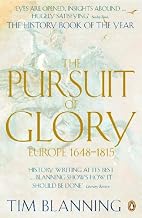
This is the volume in Penguin's History of Europe series covering the "long 18th century", and it's presumably the format of the series that is responsible for some of the odder aspects of the book's design, including the total absence of notes and references, which would render it essentially useless to any serious student. Fortunately I'm only a frivolous student, so that didn't put me off too much, but it is a very important point to bear in mind if you're thinking about buying the book.
Blanning takes a thematic approach, following particular topics across the continent and across the years apparently more-or-less as the fancy takes him, without a very conspicuous plan or agenda. Broadly, the first part of the book is about social and technological questions, the second about kingship and power, the third about ideas, and the rather rushed and neglected fourth about warfare.
This means you're likely to get lost quite quickly if you don't already have a reasonably clear idea of the outlines of 18th century European history, but it does pick up some interesting patterns and connections. It isn't like reading Hobsbawm or someone like that, who can show you how all the pieces effortlessly fall into one clear ideological framework: most of the time Blanning is exploring at least two different ways of reading the same set of facts and showing how both approaches can teach us something interesting.
It's occasionally a little frustrating when there are important chapters Blanning would clearly have liked to write but didn't and others he wrote without much enthusiasm. Warfare, for instance, is a topic that evidently lost its novelty for Blanning long ago, but must have been included at the insistence of the Penguin editors, whilst we never get the chapter on Methodism, Pietism and Jansenism that Blanning keeps referring to.
The period is one that includes a lot of big personalities. Blanning doesn't fall into the temptation of diverting the book into a string of mini-biographies, but he does let Peter and Catherine of Russia, Frederick of Prussia, Louis XIV, Napoleon, Voltaire, Goethe and the rest all get their fair share of attention. Frederick the Great is clearly a favourite, and Blanning quotes frequently from his writings - I have no problem with that. Napoleon, on the other hand, doesn't seem to excite him at all. Altogether, thinkers get more space here than men of action: Marlborough, Wellington and Nelson are all basically offstage characters, but Clausewitz gets his few minutes in the spotlight.
I found this an enjoyable and profitable read: whilst it didn't tell me very much about the 18th century I didn't know at least vaguely already, it did show me a few new ways of linking concepts together. But I don't think it would be a good introduction to the subject for a novice, and it certainly isn't a useful reference book (no footnotes!).
The pursuit of glory: Europe 1648-1815 (2007) by Tim Blanning (1942 - )
This is the volume in Penguin's History of Europe series covering the "long 18th century", and it's presumably the format of the series that is responsible for some of the odder aspects of the book's design, including the total absence of notes and references, which would render it essentially useless to any serious student. Fortunately I'm only a frivolous student, so that didn't put me off too much, but it is a very important point to bear in mind if you're thinking about buying the book.
Blanning takes a thematic approach, following particular topics across the continent and across the years apparently more-or-less as the fancy takes him, without a very conspicuous plan or agenda. Broadly, the first part of the book is about social and technological questions, the second about kingship and power, the third about ideas, and the rather rushed and neglected fourth about warfare.
This means you're likely to get lost quite quickly if you don't already have a reasonably clear idea of the outlines of 18th century European history, but it does pick up some interesting patterns and connections. It isn't like reading Hobsbawm or someone like that, who can show you how all the pieces effortlessly fall into one clear ideological framework: most of the time Blanning is exploring at least two different ways of reading the same set of facts and showing how both approaches can teach us something interesting.
It's occasionally a little frustrating when there are important chapters Blanning would clearly have liked to write but didn't and others he wrote without much enthusiasm. Warfare, for instance, is a topic that evidently lost its novelty for Blanning long ago, but must have been included at the insistence of the Penguin editors, whilst we never get the chapter on Methodism, Pietism and Jansenism that Blanning keeps referring to.
The period is one that includes a lot of big personalities. Blanning doesn't fall into the temptation of diverting the book into a string of mini-biographies, but he does let Peter and Catherine of Russia, Frederick of Prussia, Louis XIV, Napoleon, Voltaire, Goethe and the rest all get their fair share of attention. Frederick the Great is clearly a favourite, and Blanning quotes frequently from his writings - I have no problem with that. Napoleon, on the other hand, doesn't seem to excite him at all. Altogether, thinkers get more space here than men of action: Marlborough, Wellington and Nelson are all basically offstage characters, but Clausewitz gets his few minutes in the spotlight.
I found this an enjoyable and profitable read: whilst it didn't tell me very much about the 18th century I didn't know at least vaguely already, it did show me a few new ways of linking concepts together. But I don't think it would be a good introduction to the subject for a novice, and it certainly isn't a useful reference book (no footnotes!).
39thorold
Staying in the "long 18th century", a little dip into the Romantic movement:
Heinrich von Ofterdingen (1802) by Novalis (Germany, 1772-1801) and
The blue flower (1995) by Penelope Fitzgerald (1916-2000)
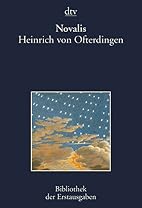

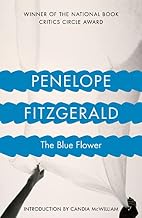
Novalis was the pen-name of Friedrich von Hardenberg, a member of a distinguished but not particularly wealthy noble family, who grew up in Saxony around the time of the French Revolution. He had all the necessary qualifications to be a romantic poet - long hair, good education, early death, unhappy love affair - and during his student days he met most of the important writers of the generation before him (Goethe, Schiller, Schlegel, etc.). In a peculiarly German touch, he was also a trained scientist and worked as a salt-mine inspector.
The unfinished novel Heinrich von Ofterdingen is Novalis's best-known prose work. He only completed about half of it before his death, but it was intended as the first in a series of at least six major novels in which he would deal in turn with all the arts and sciences.
This first novel in the series deals with the most important art, poetry (i.e. "literature" in modern terms). It is set out as a classic Bildungsroman, a response to Goethe's Wilhelm Meister, dealing with the poetic education of the eponymous hero, the legendary 13th century poet who figures in the story of the Sängerkrieg at the Wartburg, and was sometimes credited with being the author of the Nibelungenlied, but is now generally considered to have been a fictional character.
In any case, Novalis doesn't pretend to be writing a realistic historical novel. Heinrich is moved to become a poet as a result of a dream in which he sees a mysterious, beautiful and unattainable blue flower, and he completes his poetic education in a series of encounters in the course of a journey from Eisenach to Augsburg and a one-day poetry workshop in Augsburg with the ubiquitous and equally legendary Klingsohr. During the coffee-breaks he meets, falls in love with and marries Klingsohr's daughter, Mathilde, who is identified with the blue flower image. Unfortunately, she has a child and dies offstage whilst we are busy with an allegorical story-within-a-story, and as Part Two opens, Heinrich is off on his travels again as a journeyman poet. And that's about as far as Novalis got.
Most of the text is taken up by the interpolated stories, songs and poems that Heinrich picks up in the course of his travels, and the foreground narrative consists of little more than short bridging passages. It's a book to read as a linked short-story collection, really, and each story adds a dimension to Novalis's vision of what literature should be and from where the poet needs to approach it. It's interesting to see how this isn't just a simple attack on the rationalism of the previous century, as we might expect, but a more complex invitation to the potential poet to study and learn as much as he can about the physical world, whilst being open to emotional and metaphysical ways of understanding and reacting to it.
Very interesting, and often also very entertaining (the first lesson Heinrich learns from his fellow travellers on the road to Augsburg is that the poet must be an entertainer), but what strikes you continually as a modern reader is how self-centred, even solipsistic, it all is. The poet isn't really meant to be interested in anyone except himself and his literary predecessors, with the possible exception of his love-object (who is anyway just a blank screen onto which the poet projects his idea of what a love-object should be).
The thing about Heinrich von Ofterdingen that probably grates most on a modern reader is the way it treats the poet's Great Love. Poor Mathilde only has about three lines in the whole book (when she blushingly agrees to teach him the guitar, marry him, etc.). The irony here is that this probably reflects very closely Novalis's own Great Tragic Love, for the unfortunate teenager Sophie von Kühn. He met her during a visit to her family when she was 12 and he in his early twenties, they became engaged on her thirteenth birthday, and she died a couple of years later, before they could marry. Penelope Fitzgerald takes this incident as the hook for her historical novel about Novalis, The Blue Flower. Significantly, we never see him as anything other than a charming but rather selfish young man who is training to be a mining official, whilst Sophie is just a dim and slightly puzzled little girl. Fitzgerald puts the focus on the busy social life around them: their various siblings (as usual Fitzgerald handles the eccentric child-characters brilliantly), the frustrated intelligent young women who are rather hoping that Friedrich might notice them, their parents, teachers and doctors.
The book has its irritating aspects - for instance, I didn't like the slightly clumsy Germanisms she puts in to disguise the fact that we're reading the book in English ("the Bernhard"), but on the whole it's an amusing, moderately thought-provoking palate-cleanser when you've been exposed to the worst aspects of Romanticism. And it's not quite a satire: there's a strong element of explaining where the Romantics were coming from, trying to give us a feel for what it might have been like to live in a time when science had made all questions ask able but - at least for practical everyday purposes like healthcare - hadn't yet answered very many of them.
BTW: to complete this circle, another modern reimagining involving Heinrich von Ofterdingen is Robert Löhr's Krieg der Sänger, which I read about a year ago. He turns the Sängerkrieg at the Wartburg into a murder mystery weekend...
Heinrich von Ofterdingen (1802) by Novalis (Germany, 1772-1801) and
The blue flower (1995) by Penelope Fitzgerald (1916-2000)

Novalis was the pen-name of Friedrich von Hardenberg, a member of a distinguished but not particularly wealthy noble family, who grew up in Saxony around the time of the French Revolution. He had all the necessary qualifications to be a romantic poet - long hair, good education, early death, unhappy love affair - and during his student days he met most of the important writers of the generation before him (Goethe, Schiller, Schlegel, etc.). In a peculiarly German touch, he was also a trained scientist and worked as a salt-mine inspector.
The unfinished novel Heinrich von Ofterdingen is Novalis's best-known prose work. He only completed about half of it before his death, but it was intended as the first in a series of at least six major novels in which he would deal in turn with all the arts and sciences.
This first novel in the series deals with the most important art, poetry (i.e. "literature" in modern terms). It is set out as a classic Bildungsroman, a response to Goethe's Wilhelm Meister, dealing with the poetic education of the eponymous hero, the legendary 13th century poet who figures in the story of the Sängerkrieg at the Wartburg, and was sometimes credited with being the author of the Nibelungenlied, but is now generally considered to have been a fictional character.
In any case, Novalis doesn't pretend to be writing a realistic historical novel. Heinrich is moved to become a poet as a result of a dream in which he sees a mysterious, beautiful and unattainable blue flower, and he completes his poetic education in a series of encounters in the course of a journey from Eisenach to Augsburg and a one-day poetry workshop in Augsburg with the ubiquitous and equally legendary Klingsohr. During the coffee-breaks he meets, falls in love with and marries Klingsohr's daughter, Mathilde, who is identified with the blue flower image. Unfortunately, she has a child and dies offstage whilst we are busy with an allegorical story-within-a-story, and as Part Two opens, Heinrich is off on his travels again as a journeyman poet. And that's about as far as Novalis got.
Most of the text is taken up by the interpolated stories, songs and poems that Heinrich picks up in the course of his travels, and the foreground narrative consists of little more than short bridging passages. It's a book to read as a linked short-story collection, really, and each story adds a dimension to Novalis's vision of what literature should be and from where the poet needs to approach it. It's interesting to see how this isn't just a simple attack on the rationalism of the previous century, as we might expect, but a more complex invitation to the potential poet to study and learn as much as he can about the physical world, whilst being open to emotional and metaphysical ways of understanding and reacting to it.
Very interesting, and often also very entertaining (the first lesson Heinrich learns from his fellow travellers on the road to Augsburg is that the poet must be an entertainer), but what strikes you continually as a modern reader is how self-centred, even solipsistic, it all is. The poet isn't really meant to be interested in anyone except himself and his literary predecessors, with the possible exception of his love-object (who is anyway just a blank screen onto which the poet projects his idea of what a love-object should be).
The thing about Heinrich von Ofterdingen that probably grates most on a modern reader is the way it treats the poet's Great Love. Poor Mathilde only has about three lines in the whole book (when she blushingly agrees to teach him the guitar, marry him, etc.). The irony here is that this probably reflects very closely Novalis's own Great Tragic Love, for the unfortunate teenager Sophie von Kühn. He met her during a visit to her family when she was 12 and he in his early twenties, they became engaged on her thirteenth birthday, and she died a couple of years later, before they could marry. Penelope Fitzgerald takes this incident as the hook for her historical novel about Novalis, The Blue Flower. Significantly, we never see him as anything other than a charming but rather selfish young man who is training to be a mining official, whilst Sophie is just a dim and slightly puzzled little girl. Fitzgerald puts the focus on the busy social life around them: their various siblings (as usual Fitzgerald handles the eccentric child-characters brilliantly), the frustrated intelligent young women who are rather hoping that Friedrich might notice them, their parents, teachers and doctors.
The book has its irritating aspects - for instance, I didn't like the slightly clumsy Germanisms she puts in to disguise the fact that we're reading the book in English ("the Bernhard"), but on the whole it's an amusing, moderately thought-provoking palate-cleanser when you've been exposed to the worst aspects of Romanticism. And it's not quite a satire: there's a strong element of explaining where the Romantics were coming from, trying to give us a feel for what it might have been like to live in a time when science had made all questions ask able but - at least for practical everyday purposes like healthcare - hadn't yet answered very many of them.
BTW: to complete this circle, another modern reimagining involving Heinrich von Ofterdingen is Robert Löhr's Krieg der Sänger, which I read about a year ago. He turns the Sängerkrieg at the Wartburg into a murder mystery weekend...
40thorold
I've finally finished reading Transit and posted a review over on the Reading Globally Q2 thread.
Every time I mention Transit, the touchstone for the Hella Haasse novella of the same title (it was the Dutch Boekenweek gift in 1994, but I don't seem to have a copy) pops up first: I'm starting to get curious about it...
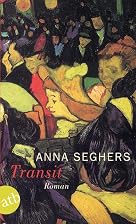
Every time I mention Transit, the touchstone for the Hella Haasse novella of the same title (it was the Dutch Boekenweek gift in 1994, but I don't seem to have a copy) pops up first: I'm starting to get curious about it...
41baswood
>39 thorold: I enjoyed reading your reviews of the unfinished Novalis novel and then Penelope Fitzgerald's The Blue Flower.
42thorold
>38 thorold: Reading about the origins of the Enlightenment made me realise that there were only two things I really know about Spinoza: that he was Jeeves's favourite author and that at one point in his life he lived in Voorburg, just down the road from me. That seemed a rather inadequate basis for further study, so I looked around and came up with this:
A book forged in hell : Spinoza's scandalous treatise and the birth of the secular age (2011) by Steven Nadler (1958-)
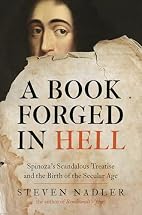

Having had numerous unfortunate experiences with them, I try to avoid books with insanely ambitious American-style subtitles, but I thought I'd risk it for once, since this one looks reassuringly like a dry academic commentary unconvincingly posing as something with mass-market appeal.
That turns out to be pretty much what it is. Nadler gives a solid account of what Spinoza says in his Theological-Political Treatise and how it relates to Spinoza's other works and the writings of his contemporaries. It's written at a level that is - just about - accessible to non-philosophers, but is still pretty demanding on the reader: there doesn't seem to be any question of dumbing-down for a mass audience here. Nadler makes a pretty strong case for how radical Spinoza's ideas were, and explains some of the finer shades of meaning that we need to take into account (I hadn't realised, for instance, that although he dismisses the claims of prophecy, miracles, the authority of scripture, etc., he doesn't see himself as an atheist).
Where Nadler doesn't seem to deliver what he promises, though, is in putting Spinoza into the context of the 17th-century Netherlands and exploring the reception of his ideas. It really looks as though this was something that the publishers persuaded Nadler to bolt onto his project even though he didn't have enough material to do a proper job: the result seems very fragmented and repetitious, especially if you are reading the book from start to finish rather than dipping into it for reference. Not a big deal, since there are plenty of historians who have covered this ground, and Nadler's strength is obviously more on the side of philosophy.
(And let's be honest: who could resist reading a book by a professor with a smile like that...?)
A book forged in hell : Spinoza's scandalous treatise and the birth of the secular age (2011) by Steven Nadler (1958-)

Having had numerous unfortunate experiences with them, I try to avoid books with insanely ambitious American-style subtitles, but I thought I'd risk it for once, since this one looks reassuringly like a dry academic commentary unconvincingly posing as something with mass-market appeal.
That turns out to be pretty much what it is. Nadler gives a solid account of what Spinoza says in his Theological-Political Treatise and how it relates to Spinoza's other works and the writings of his contemporaries. It's written at a level that is - just about - accessible to non-philosophers, but is still pretty demanding on the reader: there doesn't seem to be any question of dumbing-down for a mass audience here. Nadler makes a pretty strong case for how radical Spinoza's ideas were, and explains some of the finer shades of meaning that we need to take into account (I hadn't realised, for instance, that although he dismisses the claims of prophecy, miracles, the authority of scripture, etc., he doesn't see himself as an atheist).
Where Nadler doesn't seem to deliver what he promises, though, is in putting Spinoza into the context of the 17th-century Netherlands and exploring the reception of his ideas. It really looks as though this was something that the publishers persuaded Nadler to bolt onto his project even though he didn't have enough material to do a proper job: the result seems very fragmented and repetitious, especially if you are reading the book from start to finish rather than dipping into it for reference. Not a big deal, since there are plenty of historians who have covered this ground, and Nadler's strength is obviously more on the side of philosophy.
(And let's be honest: who could resist reading a book by a professor with a smile like that...?)
43FlorenceArt
He does have a winning smile!
I have come across references to Spinoza recently and sort of feel intimidated, but also curious. I do have something in my TBR which is a confrontation of two texts on miracles, one by Voltaire and the other by Spinoza.
I have come across references to Spinoza recently and sort of feel intimidated, but also curious. I do have something in my TBR which is a confrontation of two texts on miracles, one by Voltaire and the other by Spinoza.
44baswood
>42 thorold: I will keep that one in mind when I get to The Enlightenment.
45SassyLassy
>42 thorold: Another book to look for.
It seems to me that Spinoza's deity is a very personal one, but one in which he is completely absorbed, so as you say, not an atheist. From my reading of The Ethics it seems the most difficult concept is grasping the idea of sub specie aeternitatis and then it all makes sense (after a lot of work).
It's odd that Spinoza had such a following in Europe and yet didn't get translated into English until the nineteenth century. George Eliot was the initial translator into English.
It seems to me that Spinoza's deity is a very personal one, but one in which he is completely absorbed, so as you say, not an atheist. From my reading of The Ethics it seems the most difficult concept is grasping the idea of sub specie aeternitatis and then it all makes sense (after a lot of work).
It's odd that Spinoza had such a following in Europe and yet didn't get translated into English until the nineteenth century. George Eliot was the initial translator into English.
46thorold
>45 SassyLassy: I haven't looked it up, but Nadler says there was an English translation of the Theological-political treatise in 1689. Maybe it was the complete works that didn't get translated until the 19th century. The Treatise seems to have been aimed at general readers, so there would have been more reason to translate it than the books that were only likely to be attempted by hardcore philosophers who could read Latin anyway.
47thorold
For some reason I haven't posted here for nearly a fortnight, but anyway, I finished another French crime novel. A completely different view of Marseilles from the one in Transit, but just as dark...
Chourmo (1996) by JeanClaude Izzo
This is the second of Izzo's crime novels set in Marseilles and featuring Fabio Montale. He left the police force some time after the end of the previous book, and is contemplating taking on the management of his local café, but (surprise, surprise!) he gets mixed up in another criminal investigation when his cousin's teenage son goes missing. It's more or less the same mix of organised crime, police corruption, and eclectic multi-culti Mediterranean music, food and poetry we enjoyed in the first book, with a bit of Islamic extremism thrown in to complicate things further. The plot is a little bit predictable, and the introduction of yet another of Montale's loved-and-lost childhood sweethearts feels a bit clunky, but it's Montale's very individual view of the world and way of commenting on it - noir, romantic and pessimistic all at the same time - that makes these books worthwhile.
Chourmo (1996) by JeanClaude Izzo
This is the second of Izzo's crime novels set in Marseilles and featuring Fabio Montale. He left the police force some time after the end of the previous book, and is contemplating taking on the management of his local café, but (surprise, surprise!) he gets mixed up in another criminal investigation when his cousin's teenage son goes missing. It's more or less the same mix of organised crime, police corruption, and eclectic multi-culti Mediterranean music, food and poetry we enjoyed in the first book, with a bit of Islamic extremism thrown in to complicate things further. The plot is a little bit predictable, and the introduction of yet another of Montale's loved-and-lost childhood sweethearts feels a bit clunky, but it's Montale's very individual view of the world and way of commenting on it - noir, romantic and pessimistic all at the same time - that makes these books worthwhile.
49thorold
>48 connie53: Hi, Connie!
Last weekend we had beautiful weather here in Holland (there was some talk of thunderstorms, but we never saw them). On Sunday I spent a lot of time on the balcony reading, but on Saturday I took part in a LibraryThing get-together in Leiden - only 20km away from where I live, and the first one I've been to in nine years on LT.
It was great to meet everybody and find out who is behind the user names. I must have been too busy gossiping to take any photos myself - when I got home I found only I had one picture, not showing any of the people who were there. Anyway, here's the obligatory group photo (taken with Darryl's camera by a sprightly waitress at the Pieterskerk café):

Last weekend we had beautiful weather here in Holland (there was some talk of thunderstorms, but we never saw them). On Sunday I spent a lot of time on the balcony reading, but on Saturday I took part in a LibraryThing get-together in Leiden - only 20km away from where I live, and the first one I've been to in nine years on LT.
It was great to meet everybody and find out who is behind the user names. I must have been too busy gossiping to take any photos myself - when I got home I found only I had one picture, not showing any of the people who were there. Anyway, here's the obligatory group photo (taken with Darryl's camera by a sprightly waitress at the Pieterskerk café):

50thorold
...and back to books: I finished another detective story, and started Der Russe ist einer, der Birken liebt by Olga Grjasnowa, which should give me something to say on the "Writers at Risk" thread at last, when I finish it.
Buitelkruid (1976, Tumbleweed) by Janwillem van de Wetering

This is the second "Grijpstra & de Gier" novel: a woman is found stabbed to death in an Amsterdam houseboat, and there are plenty of suspects but very little hard evidence against any of them. Our two intrepid investigators have to go to the North Sea island of Schiermonnikoog whilst their boss, the unnamed Commisaris, pursues a parallel line of investigation in Curaçao - funny how it always seems to work out that way round, isn't it?
As in the first book in the series, the interest is more in the details than in the crime itself, which turns out to be quite straightforward by the standards of detective fiction. There's a bit less of the emphasis on the random events that make up the day-to-day work of police officers that we had in the first book, so we go a bit deeper into the working relationship between Grijpstra and de Gier (and the cat Olivier), and van de Wetering also starts to develop the Commisaris as a character in his own right. I had to stop and think a bit at the notion that someone who was a police officer in the seventies (a period that doesn't seem all that long ago to me) might already have been in the force before the Second World War, but of course it is perfectly possible.
Buitelkruid (1976, Tumbleweed) by Janwillem van de Wetering

This is the second "Grijpstra & de Gier" novel: a woman is found stabbed to death in an Amsterdam houseboat, and there are plenty of suspects but very little hard evidence against any of them. Our two intrepid investigators have to go to the North Sea island of Schiermonnikoog whilst their boss, the unnamed Commisaris, pursues a parallel line of investigation in Curaçao - funny how it always seems to work out that way round, isn't it?
As in the first book in the series, the interest is more in the details than in the crime itself, which turns out to be quite straightforward by the standards of detective fiction. There's a bit less of the emphasis on the random events that make up the day-to-day work of police officers that we had in the first book, so we go a bit deeper into the working relationship between Grijpstra and de Gier (and the cat Olivier), and van de Wetering also starts to develop the Commisaris as a character in his own right. I had to stop and think a bit at the notion that someone who was a police officer in the seventies (a period that doesn't seem all that long ago to me) might already have been in the force before the Second World War, but of course it is perfectly possible.
51rebeccanyc
As I've said befor, I love Grijpstra and De Gier. I'm sorry I finished the series.
52thorold
I've posted a review of Der Russe ist einer, der Birken liebt over on the Writers at Risk thread.
Nice, but maybe a bit too much like a book targeted to be a bestseller. Lots of easy-to-market topics...
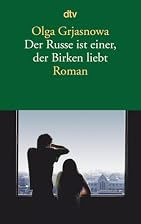
Nice, but maybe a bit too much like a book targeted to be a bestseller. Lots of easy-to-market topics...
53thorold
Finished another short "migrant novel" on the plane yesterday (that's the trouble with ebooks, you never really have a feel for how long they are going to be...), and picked up another of the items from >9 thorold: above by starting on What's bred in the bone.
Short as it was, I enjoyed De reis van de lege flessen very much: Kader Abdolah is another writer I need to read more of. I posted a review in the Writers at Risk thread.
Short as it was, I enjoyed De reis van de lege flessen very much: Kader Abdolah is another writer I need to read more of. I posted a review in the Writers at Risk thread.
54thorold
Pressing on with Robertson Davies, I finished Part 2 of the Cornish Trilogy yesterday (on the train, this time!) and am about halfway through Part 3.
What's bred in the bone (Cornish Trilogy, pt. 2, 1985) by Robertson Davies

This second part of the trilogy leaves most of the threads from the first part dangling, and instead of picking them up it jumps back in time to 1909 to look at the life of the enigmatic and surprisingly wealthy art-critic Francis Cornish. It's essentially a good old-fashioned Bildungsroman, dressed up with a bit of fancy stuff about daemons and angels (because, why not?), but really just a simple linear life-story. Superficially much easier for the reader to deal with than the more static narrative structure of the other two parts, but Davies is still making sure that our brains get a workout. He gives Cornish an (almost) impossibly complicated mix of background influences and explores the nature-versus-nurture implications of this combination (hence the title). In parallel, there's another story going on about the nature of creative art, playing around with our notions of where the lines can be drawn between restoration, forgery and original work, and then twisting things a bit further when we think we've got the point.
It struck me after I'd finished this that Francis Cornish would be a near contemporary of Charles Ryder, and there are a lot of parallels here to themes dealt with in Brideshead revisited. But Robertson Davies is no Evelyn Waugh: he may be prepared to indulge in the occasional joke at the expense of his characters, but he never floats off into lyrical pessimism. The world is as it is, and that's that: no use blaming poor old Hooper.
What's bred in the bone (Cornish Trilogy, pt. 2, 1985) by Robertson Davies

This second part of the trilogy leaves most of the threads from the first part dangling, and instead of picking them up it jumps back in time to 1909 to look at the life of the enigmatic and surprisingly wealthy art-critic Francis Cornish. It's essentially a good old-fashioned Bildungsroman, dressed up with a bit of fancy stuff about daemons and angels (because, why not?), but really just a simple linear life-story. Superficially much easier for the reader to deal with than the more static narrative structure of the other two parts, but Davies is still making sure that our brains get a workout. He gives Cornish an (almost) impossibly complicated mix of background influences and explores the nature-versus-nurture implications of this combination (hence the title). In parallel, there's another story going on about the nature of creative art, playing around with our notions of where the lines can be drawn between restoration, forgery and original work, and then twisting things a bit further when we think we've got the point.
It struck me after I'd finished this that Francis Cornish would be a near contemporary of Charles Ryder, and there are a lot of parallels here to themes dealt with in Brideshead revisited. But Robertson Davies is no Evelyn Waugh: he may be prepared to indulge in the occasional joke at the expense of his characters, but he never floats off into lyrical pessimism. The world is as it is, and that's that: no use blaming poor old Hooper.
55thorold
...which leads inevitably to:
The lyre of Orpheus (Cornish Trilogy, pt. 3, 1988) by Robertson Davies
As is only right and proper, this third part of the trilogy ties up the threads from the previous two parts, bringing us back to the foreground narrative in late-20th century Ottawa and to the heirs of Francis Cornish. The artistic focus this time is a project to realise an opera on the subject of King Arthur which E.T.A. Hoffmann left unfinished at his death. This of course provides the trilogy with a suitably spectacular grand finale, but it also gives Davies the opportunity to play around with a lot of interesting corners of the philosophy of art. We are made to think about what it means to realise an unfinished work, the relationship between music and libretto, artistic integrity versus effective theatre, artist versus patron, and much more. At the same time, of course, there is a plot, and the relationships between the people sponsoring the opera production are seen to be mirrored by the plot of the opera in ways that they find mortifyingly absurd. E.T.A. Hoffmann pops up to comment on the action from the limbo to which unrealised artists are consigned, Kater Murr becomes an allegory of bourgeois Canadian taste, we get some loving caricatures of the PhD examiner from hell and other academic absurdities...
Probably more than a little over the top - but that's as it should be when we're dealing with opera - a very clever and entertaining conclusion to the trilogy.
The lyre of Orpheus (Cornish Trilogy, pt. 3, 1988) by Robertson Davies
As is only right and proper, this third part of the trilogy ties up the threads from the previous two parts, bringing us back to the foreground narrative in late-20th century Ottawa and to the heirs of Francis Cornish. The artistic focus this time is a project to realise an opera on the subject of King Arthur which E.T.A. Hoffmann left unfinished at his death. This of course provides the trilogy with a suitably spectacular grand finale, but it also gives Davies the opportunity to play around with a lot of interesting corners of the philosophy of art. We are made to think about what it means to realise an unfinished work, the relationship between music and libretto, artistic integrity versus effective theatre, artist versus patron, and much more. At the same time, of course, there is a plot, and the relationships between the people sponsoring the opera production are seen to be mirrored by the plot of the opera in ways that they find mortifyingly absurd. E.T.A. Hoffmann pops up to comment on the action from the limbo to which unrealised artists are consigned, Kater Murr becomes an allegory of bourgeois Canadian taste, we get some loving caricatures of the PhD examiner from hell and other academic absurdities...
Probably more than a little over the top - but that's as it should be when we're dealing with opera - a very clever and entertaining conclusion to the trilogy.
56SassyLassy
>55 thorold:
Been following your Cornish Trilogy with interest, my favourite Robertson Davies works. This last was definitely over the top as you say, but such fun and Davies wielded a very skilful skewer. Thank the gods for the cultural diversity that has developed in (urban) Canada since Davies's time. "Lyrical pessimism" would actually fly (float) these days.
>54 thorold: The world is as it is, and that's that
Phyllis Rose says that of Davies too, when discussing The Lyre of Orpheus:
Mr Davies's psychological sense is Jungian, ahistorical, conservative; while revelling in wild invention and bizarre plot turns, he does not believe that human nature changes.
from https://www.nytimes.com/books/97/08/24/reviews/davies-lyre.html
What's up next?
Been following your Cornish Trilogy with interest, my favourite Robertson Davies works. This last was definitely over the top as you say, but such fun and Davies wielded a very skilful skewer. Thank the gods for the cultural diversity that has developed in (urban) Canada since Davies's time. "Lyrical pessimism" would actually fly (float) these days.
>54 thorold: The world is as it is, and that's that
Phyllis Rose says that of Davies too, when discussing The Lyre of Orpheus:
Mr Davies's psychological sense is Jungian, ahistorical, conservative; while revelling in wild invention and bizarre plot turns, he does not believe that human nature changes.
from https://www.nytimes.com/books/97/08/24/reviews/davies-lyre.html
What's up next?
57thorold
>56 SassyLassy: Professor Rose sounds almost as though she could be a Robertson Davies character herself!
I started The group last night - So far I'm rather impressed. But then it does come very highly recommended...
I started The group last night - So far I'm rather impressed. But then it does come very highly recommended...
58thorold
I don't know if it's a general thing, or just me, but I find that there's a real danger that ubiquity can make books (and authors) become invisible. Perhaps it's too many hours spent scanning shelves in libraries and secondhand bookshops: if you have seen a particular book hundreds of times before, you have to assume that you've either read it already or had a good reason for not wanting to read it, and you just filter it out before you get to the point of consciously perceiving it.
Far too many of the books that were popular with my parents' generation fall into that category for me: I'm pretty sure that all the teachers and librarians of our acquaintance had Mary McCarthy sitting somewhere between D.H. Lawrence and Alberto Moravia on their paperback shelves, but I don't remember ever wondering who she was or why her book was so popular in the sixties.
Fortunately, one of my sporadic dips into BBC podcasts recently brought up a programme in which Margaret Drabble was talking about The Group and I realised that this was a book I hadn't read and probably should have.
The Group (1963) by Mary McCarthy (USA, 1912-1989)
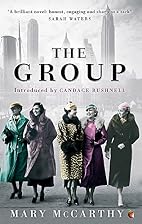

The premise of The Group isn't very promising, on the face of it: an account of a bunch of overprivileged American young women (Vassar Class of '33) making the transition from student life to adulthood in New York City. It's the plot of every romantic comedy, and Virago have made sure you don't miss the point by commissioning the author of Sex and the city to write the introduction.
Except that - of course - whilst McCarthy draws heavily on the imagery, set-piece scenes and language of romantic comedy as well as its plot conventions (even to the extent of having a chapter written from the POV of an English Butler in an obvious Wodehouse-pastiche), there is no way that anyone could possibly mistake this for a conventional romantic comedy. A few pages into the book we are dropped into a detailed and decidedly unerotic description of a young woman's first experience of sexual intercourse, making it abundantly clear to the reader that we are as far away from Lady Chatterley as we are from Jill the reckless. And in case we might still have any delusions about that, we then get a whole chapter on the diaphragm. Later on in the book, McCarthy takes on other sensitive topics, including domestic violence, breast-feeding, rival theories of baby-care, the abuses of psychiatric medicine, Lesbianism (still determinedly large-L in McCarthy's day), and burial practices. This was all written at a time when battles over literary censorship was still raging in most English-speaking countries, and publishers were far from sure that you could get away with talking about such things in print (but they were always willing to try, knowing that controversial books sell like hot cakes...).
There's clearly a roman à clef aspect as well, since she draws quite heavily on her own life for subject-matter (even to the extent of giving one of the most unsympathetic characters the name and occupation of her own first husband...). And McCarthy makes no attempt to hide her left-wing political views, although she does poke a bit of fun at her former Trotskyist affiliation.
The fact that a book broke taboos in 1963 doesn't necessarily make it worth reading now. So what else does McCarthy have to offer? I got a lot of pleasure from her very precise, ironic use of language. She is constantly subverting the idiom of romance by slipping in some ostensibly harmless expression that actually turns the sense of the whole passage on its head. There are hundreds of examples in the text: one that particularly struck me is the scene where the horrible Harald has committed his perfectly sane wife to a mental hospital and spends the day wandering aimlessly around the city thinking about the enormity of what he's just done. Amongst other things, he visits the zoo and looks at "his ancestors, the apes". In context, you hardly notice it going past, but when you've read that you know exactly what to think of Harald and you're not in the least surprised that his conscience does not win out over his desire to get his wife out of the way. Maybe that sort of thing is more a columnist's trick than a building block for a big literary structure, but it does make sure you keep on reading attentively.
The other reason for reading the book today, and probably the important one, is for what it tells us about the way the dominant ideology defines roles for women. The characters in the book have been brought up to see themselves as the crème de la crème (to borrow a phrase from another fifties book about women in the thirties) of the coming generation in America. They have completed an education that should qualify them to go anywhere and do anything, and most of them have the kind of dynastic support and financial resources that ought to mean no door is closed to them. Some of them are the daughters of women who were prominent in the struggle for women's education and the vote. Most have left college with the idea of changing the world (as we all do...), yet by the end of the book, none of them seems to have retained enough belief in herself to achieve anything professionally: sooner or later they all end up measuring success or failure in terms of husbands, babies, furniture and designer clothes. The corollary of this should presumably be "if they can't manage it, what hope is there for working-class women?" - but it isn't really very evident from the book that any of the characters, or even the author, is really aware that working-class women exist (except for faintly comic black maidservants, and they seem to become invisible when off duty too). So I suspect that we might just be reading that into it.
Far too many of the books that were popular with my parents' generation fall into that category for me: I'm pretty sure that all the teachers and librarians of our acquaintance had Mary McCarthy sitting somewhere between D.H. Lawrence and Alberto Moravia on their paperback shelves, but I don't remember ever wondering who she was or why her book was so popular in the sixties.
Fortunately, one of my sporadic dips into BBC podcasts recently brought up a programme in which Margaret Drabble was talking about The Group and I realised that this was a book I hadn't read and probably should have.
The Group (1963) by Mary McCarthy (USA, 1912-1989)

The premise of The Group isn't very promising, on the face of it: an account of a bunch of overprivileged American young women (Vassar Class of '33) making the transition from student life to adulthood in New York City. It's the plot of every romantic comedy, and Virago have made sure you don't miss the point by commissioning the author of Sex and the city to write the introduction.
Except that - of course - whilst McCarthy draws heavily on the imagery, set-piece scenes and language of romantic comedy as well as its plot conventions (even to the extent of having a chapter written from the POV of an English Butler in an obvious Wodehouse-pastiche), there is no way that anyone could possibly mistake this for a conventional romantic comedy. A few pages into the book we are dropped into a detailed and decidedly unerotic description of a young woman's first experience of sexual intercourse, making it abundantly clear to the reader that we are as far away from Lady Chatterley as we are from Jill the reckless. And in case we might still have any delusions about that, we then get a whole chapter on the diaphragm. Later on in the book, McCarthy takes on other sensitive topics, including domestic violence, breast-feeding, rival theories of baby-care, the abuses of psychiatric medicine, Lesbianism (still determinedly large-L in McCarthy's day), and burial practices. This was all written at a time when battles over literary censorship was still raging in most English-speaking countries, and publishers were far from sure that you could get away with talking about such things in print (but they were always willing to try, knowing that controversial books sell like hot cakes...).
There's clearly a roman à clef aspect as well, since she draws quite heavily on her own life for subject-matter (even to the extent of giving one of the most unsympathetic characters the name and occupation of her own first husband...). And McCarthy makes no attempt to hide her left-wing political views, although she does poke a bit of fun at her former Trotskyist affiliation.
The fact that a book broke taboos in 1963 doesn't necessarily make it worth reading now. So what else does McCarthy have to offer? I got a lot of pleasure from her very precise, ironic use of language. She is constantly subverting the idiom of romance by slipping in some ostensibly harmless expression that actually turns the sense of the whole passage on its head. There are hundreds of examples in the text: one that particularly struck me is the scene where the horrible Harald has committed his perfectly sane wife to a mental hospital and spends the day wandering aimlessly around the city thinking about the enormity of what he's just done. Amongst other things, he visits the zoo and looks at "his ancestors, the apes". In context, you hardly notice it going past, but when you've read that you know exactly what to think of Harald and you're not in the least surprised that his conscience does not win out over his desire to get his wife out of the way. Maybe that sort of thing is more a columnist's trick than a building block for a big literary structure, but it does make sure you keep on reading attentively.
The other reason for reading the book today, and probably the important one, is for what it tells us about the way the dominant ideology defines roles for women. The characters in the book have been brought up to see themselves as the crème de la crème (to borrow a phrase from another fifties book about women in the thirties) of the coming generation in America. They have completed an education that should qualify them to go anywhere and do anything, and most of them have the kind of dynastic support and financial resources that ought to mean no door is closed to them. Some of them are the daughters of women who were prominent in the struggle for women's education and the vote. Most have left college with the idea of changing the world (as we all do...), yet by the end of the book, none of them seems to have retained enough belief in herself to achieve anything professionally: sooner or later they all end up measuring success or failure in terms of husbands, babies, furniture and designer clothes. The corollary of this should presumably be "if they can't manage it, what hope is there for working-class women?" - but it isn't really very evident from the book that any of the characters, or even the author, is really aware that working-class women exist (except for faintly comic black maidservants, and they seem to become invisible when off duty too). So I suspect that we might just be reading that into it.
59RidgewayGirl
I do want to read The Group. I think you're right about how we just skip over certain books without giving them much of a second glance.
60FlorenceArt
I'm pretty sure I read The Group as a teenager. I seem to remember my mother recommending it, but maybe it was just on the shelves as so many of the books I read then. I don't remember any of this! I think I wasn't very impressed at the time, but I must have missed a lot.
OT: sometimes I really have to wonder how touchstones work. This time I got a Harry Potter book as the first choice...
OT: sometimes I really have to wonder how touchstones work. This time I got a Harry Potter book as the first choice...
61thorold
>60 FlorenceArt: This time I got a Harry Potter book as the first choice...
Doesn't Tim get a small payment from Ms Rowling every time that happens? ;-)
Doesn't Tim get a small payment from Ms Rowling every time that happens? ;-)
62connie53
>61 thorold: Lol! I think he does, I got that same touchstone with Vuur by Mats Strandberg and the right book isn't even mentioned in the list to change it to the right one.
63thorold
Somebody else who's been on my list for a long time - I've put a couple of her more obvious books on order, but while I was about it I noticed that there was a novella I'd never heard of that is available as an e-book in French:
La vieille fille et le mort (1958) by Violette Leduc (France, 1907-1972)

Violette Leduc was a kind of lesbian feminist counterpart to Jean Genet, a fringe lower-class figure taken up and encouraged as a writer by Simone de Beauvoir. The illegitimate daughter of a maidservant, she didn't go to university and earned her living with a series of humble jobs in the publishing industry until de Beauvoir helped her to get her first book published in 1946. She got a lot of appreciation for her work from other writers, but she never seems to have had the kind of popular success that Genet had, and even today she only seems to excite sporadic bursts of interest from people looking for forgotten feminists to celebrate (see this recent article in the Guardian, for instance). Only a few years apart from Mary McCarthy, but not a whole lot in common!
(And of course she had nothing whatsoever to do with the restoration of medieval castles - that was a man called Eugène Viollet-le-Duc, a century earlier. As P.G. Wodehouse put it, there's a lot of dirty work done at the font...)
La vieille fille et le mort (The old maid and the dead man) is pretty much exactly what it says on the tin. Clarisse, who keeps the village café/grocery is in her fifties and still single, but not from want of offers. One evening a stranger comes into her café who has none of those male faults that have ruled out all previous applicants for her. This finally seems to be a man who might do as a companion, and Clarisse is very tempted to keep him all to herself. There's only one problem: he is inexplicably, but quite indisputably, dead. And doesn't appear to have anything to say to her.
We're definitely in 1950s theatre-of-the-absurd territory here: it's very easy to imagine this as a stage play, with poor Clarisse trying to secure some quality time one-to-one with the corpse, but constantly being interrupted by villagers who want to buy a glass of beer, some salt or a length of ribbon as an excuse to cry on her shoulders about their own problems (because Clarisse is obviously a key figure in the society of the village, even while she thinks of herself as an outsider.)
Of course there's a satirical point that you could reduce to that famous poster about fish and bicycles, but Leduc never makes it that explicit. She keeps the focus tightly on the world as Clarisse sees it. Even when we zoom out from the café in between scenes to pick up some nature imagery, it is all clearly coming from inside Clarisse's head.
Definitely odd, but rewarding.
La vieille fille et le mort (1958) by Violette Leduc (France, 1907-1972)

Violette Leduc was a kind of lesbian feminist counterpart to Jean Genet, a fringe lower-class figure taken up and encouraged as a writer by Simone de Beauvoir. The illegitimate daughter of a maidservant, she didn't go to university and earned her living with a series of humble jobs in the publishing industry until de Beauvoir helped her to get her first book published in 1946. She got a lot of appreciation for her work from other writers, but she never seems to have had the kind of popular success that Genet had, and even today she only seems to excite sporadic bursts of interest from people looking for forgotten feminists to celebrate (see this recent article in the Guardian, for instance). Only a few years apart from Mary McCarthy, but not a whole lot in common!
(And of course she had nothing whatsoever to do with the restoration of medieval castles - that was a man called Eugène Viollet-le-Duc, a century earlier. As P.G. Wodehouse put it, there's a lot of dirty work done at the font...)
La vieille fille et le mort (The old maid and the dead man) is pretty much exactly what it says on the tin. Clarisse, who keeps the village café/grocery is in her fifties and still single, but not from want of offers. One evening a stranger comes into her café who has none of those male faults that have ruled out all previous applicants for her. This finally seems to be a man who might do as a companion, and Clarisse is very tempted to keep him all to herself. There's only one problem: he is inexplicably, but quite indisputably, dead. And doesn't appear to have anything to say to her.
We're definitely in 1950s theatre-of-the-absurd territory here: it's very easy to imagine this as a stage play, with poor Clarisse trying to secure some quality time one-to-one with the corpse, but constantly being interrupted by villagers who want to buy a glass of beer, some salt or a length of ribbon as an excuse to cry on her shoulders about their own problems (because Clarisse is obviously a key figure in the society of the village, even while she thinks of herself as an outsider.)
Of course there's a satirical point that you could reduce to that famous poster about fish and bicycles, but Leduc never makes it that explicit. She keeps the focus tightly on the world as Clarisse sees it. Even when we zoom out from the café in between scenes to pick up some nature imagery, it is all clearly coming from inside Clarisse's head.
Definitely odd, but rewarding.
64thorold
While I waited for my Leduc parcel to arrive...
De gelaarsde Kater (1976, The corpse on the dike) by Janwillem van de Wetering

Third in the Grijpstra & De Gier series, another very entertaining police story. Our heroes stumble upon a corpse in a dodgy neighbourhood of Amsterdam North where the locals believe that good fences make good neighbours — which is fortunate, since one of their neighbours (who sounds suspiciously like a self-portrait of the author as villain) is a supremely talented fence. As usual, the story maunders along for a while in a cloud of music, metaphysics and local colour, and we get a slightly tongue-in-cheek bit of excitement at the end, when the Amsterdammers have to call in the assistance of the local police in Middelburg (who haven't written out a summons since before the war...) for a nighttime raid to arrest an armed suspect.
De gelaarsde Kater (1976, The corpse on the dike) by Janwillem van de Wetering

Third in the Grijpstra & De Gier series, another very entertaining police story. Our heroes stumble upon a corpse in a dodgy neighbourhood of Amsterdam North where the locals believe that good fences make good neighbours — which is fortunate, since one of their neighbours (who sounds suspiciously like a self-portrait of the author as villain) is a supremely talented fence. As usual, the story maunders along for a while in a cloud of music, metaphysics and local colour, and we get a slightly tongue-in-cheek bit of excitement at the end, when the Amsterdammers have to call in the assistance of the local police in Middelburg (who haven't written out a summons since before the war...) for a nighttime raid to arrest an armed suspect.
65thorold
(Off topic) Trying not to think about Cameron's idiotic gamble, but it's hard to avoid it. Even the news on the radio that someone somewhere has proclaimed this "World Typewriter Day" isn't much help...
66FlorenceArt
Well, now we'll all have to think about it. It's going to poison European political and economic life for at least the next two years. And now he suddenly finds he's not the man to deal with the situation he created. Well done.
67thorold
>66 FlorenceArt:
Right. I was far too angry and upset to think about posting anything the last couple of days, and it still feels as if someone has sawn off the branch I was sitting on. I grew up in the UK, I have a British passport and I even got to vote in the referendum, thanks to an obscure regulation one of my colleagues dug up at the last minute, and I used to think I was quite knowledgeable about British culture. But obviously not: aliens have clearly landed on the island and removed the brains of a significant proportion of its residents without me even noticing.
I hope we're all being unnecessarily alarmist and that the "Leave" people do actually have a strategy that will get them out of this mess without doing untold damage to Britain and its neighbours, but I don't see much evidence of that yet. :-(
Anyway, we can't change it, lets talk about books instead. I thought this weekend called for something a bit more cheerful than Violette Leduc, so I cracked open one from the strategic crime reserve:
Les jeux de l'amour et de la mort (1986, French only) by Fred Vargas
This was Fred Vargas's first novel, published five years before the first Adamsberg story. Not quite what you might expect: it's a story about a struggling young artist who gets mixed up in a murder mystery whilst stalking a more famous painter he hopes can help him with his career. The viewpoint is shared roughly equally between him and the policeman investigating the murder, but we keep our distance from both of them. With the lack of any explicit love interest - but plenty of submerged homosocial tensions -, the stalking plot, men who cry, and a strictly amoral narrative voice, it's no surprise that the main character is called Tom: this has Ms Highsmith's Texan bootprints all over it. Which is not a bad thing in itself - it works well, and I'm tempted to say that it's a better Highsmith-pastiche than some of Highsmith's own novels - but it is a disappointment not to find much sign of Vargas's interest in the absurdity of life and the morality of crime that makes the Adamsberg novels so quirky and original.
ETA: And I'm still none the wiser about the cover picture. I'm pretty sure there was nothing in the book about putting evening shoes on a school chair...
Right. I was far too angry and upset to think about posting anything the last couple of days, and it still feels as if someone has sawn off the branch I was sitting on. I grew up in the UK, I have a British passport and I even got to vote in the referendum, thanks to an obscure regulation one of my colleagues dug up at the last minute, and I used to think I was quite knowledgeable about British culture. But obviously not: aliens have clearly landed on the island and removed the brains of a significant proportion of its residents without me even noticing.
I hope we're all being unnecessarily alarmist and that the "Leave" people do actually have a strategy that will get them out of this mess without doing untold damage to Britain and its neighbours, but I don't see much evidence of that yet. :-(
Anyway, we can't change it, lets talk about books instead. I thought this weekend called for something a bit more cheerful than Violette Leduc, so I cracked open one from the strategic crime reserve:
Les jeux de l'amour et de la mort (1986, French only) by Fred Vargas
This was Fred Vargas's first novel, published five years before the first Adamsberg story. Not quite what you might expect: it's a story about a struggling young artist who gets mixed up in a murder mystery whilst stalking a more famous painter he hopes can help him with his career. The viewpoint is shared roughly equally between him and the policeman investigating the murder, but we keep our distance from both of them. With the lack of any explicit love interest - but plenty of submerged homosocial tensions -, the stalking plot, men who cry, and a strictly amoral narrative voice, it's no surprise that the main character is called Tom: this has Ms Highsmith's Texan bootprints all over it. Which is not a bad thing in itself - it works well, and I'm tempted to say that it's a better Highsmith-pastiche than some of Highsmith's own novels - but it is a disappointment not to find much sign of Vargas's interest in the absurdity of life and the morality of crime that makes the Adamsberg novels so quirky and original.
ETA: And I'm still none the wiser about the cover picture. I'm pretty sure there was nothing in the book about putting evening shoes on a school chair...
68baswood
>58 thorold: I read The Group back in the 1960's and can hardly remember it; so it was good to read your review.
I am very angry about Brexit which will take away my EU citizenship.
I am very angry about Brexit which will take away my EU citizenship.
69thorold
>68 baswood: Yes, I caught myself thinking "should I apply for a Dutch passport or a German one?" (Probably German, should it come to that, since I happen to have a qualification by descent; in the Netherlands I would have to take a citizenship exam or something...)
I keep meaning to cancel my subscription to Scribd, but just occasionally it turns up something really interesting I wasn't looking for (hardly ever something I was looking for, since the search tool is so useless...). This book caught my eye because I'm only too well aware that architecture is an area where I'm barely literate. Other than a few unavoidable undergraduate essays about Ruskin and Pugin, I've never really made the effort to look critically at whatever it is that architects do, and the few times I've looked into books on the subject they have turned out to be of the type where the text is there to fill in the spaces between the big glossy pictures, and was certainly never intended to be read.
How architecture works: a humanist's toolkit (2013) by Witold Rybczynski (Scotland, Canada, USA, 1943 - )


Rybczynski, an architect by training, is an emeritus professor at the University of Pennsylvania and a (very) prolific author of books and articles about architecture and related topics.
With its retro cover design, slightly ponderous professorial tone, and the startling use of the word "humanist" in the subtitle, it's hard to tell whether this book is a sophisticated and ironic self-parody or a passive-aggressive conservative attack on the last sixty or seventy years of academic thought in the humanities. Probably something in between the two. Anyway, it's ostensibly an attempt to demonstrate that anyone can build an intellectual structure for the critical analysis of architecture just using the basic tools they already have lying around in their own sheds, with no need to invoke any philosophers or theoreticians at all. DIY for the brain!
Rybczynski looks at a series of key topics to break down the problems architects have to tackle into manageable chunks: the "idea" of the building, its relation to its neighbours, the topography of the site, the building's plan, structure, skin, and detailing, with plenty of reference to examples in each case. And once he's lulled us into a sense of comfortable humanist security with those, he nudges us on into the trickier areas of "style" and "taste". Ideologically suspect it may be, but Rybczynski obviously knows his stuff, and his comments on the choices the architects have made in each case are clear and perceptive.
One thing that particularly struck me is that the book deals only with "Western canon" architecture: high-profile buildings (museums, concert halls, corporate headquarters) designed by people we've read about in the Sunday papers. I would have expected Rybczynski to discuss the reasoning for that - even in literature, the idea of a canon is something that is contentious and can't be taken for granted, and I have to wonder how far it makes sense to talk about individual "authorship" at all in a discipline as complex as the design and construction of large buildings. But he seems to take the Great Men/Great Buildings thing for granted. He does make a few little digs at the more absurd manifestations of the vanity of the great and famous, but never for a moment questions the notion that architecture should be defined by the works of an elite within the profession.
So, definitely useful and interesting, but perhaps a bit limited. Obviously I'm not going to be able to get away with reading just one book about the subject...
I keep meaning to cancel my subscription to Scribd, but just occasionally it turns up something really interesting I wasn't looking for (hardly ever something I was looking for, since the search tool is so useless...). This book caught my eye because I'm only too well aware that architecture is an area where I'm barely literate. Other than a few unavoidable undergraduate essays about Ruskin and Pugin, I've never really made the effort to look critically at whatever it is that architects do, and the few times I've looked into books on the subject they have turned out to be of the type where the text is there to fill in the spaces between the big glossy pictures, and was certainly never intended to be read.
How architecture works: a humanist's toolkit (2013) by Witold Rybczynski (Scotland, Canada, USA, 1943 - )


Rybczynski, an architect by training, is an emeritus professor at the University of Pennsylvania and a (very) prolific author of books and articles about architecture and related topics.
With its retro cover design, slightly ponderous professorial tone, and the startling use of the word "humanist" in the subtitle, it's hard to tell whether this book is a sophisticated and ironic self-parody or a passive-aggressive conservative attack on the last sixty or seventy years of academic thought in the humanities. Probably something in between the two. Anyway, it's ostensibly an attempt to demonstrate that anyone can build an intellectual structure for the critical analysis of architecture just using the basic tools they already have lying around in their own sheds, with no need to invoke any philosophers or theoreticians at all. DIY for the brain!
Rybczynski looks at a series of key topics to break down the problems architects have to tackle into manageable chunks: the "idea" of the building, its relation to its neighbours, the topography of the site, the building's plan, structure, skin, and detailing, with plenty of reference to examples in each case. And once he's lulled us into a sense of comfortable humanist security with those, he nudges us on into the trickier areas of "style" and "taste". Ideologically suspect it may be, but Rybczynski obviously knows his stuff, and his comments on the choices the architects have made in each case are clear and perceptive.
One thing that particularly struck me is that the book deals only with "Western canon" architecture: high-profile buildings (museums, concert halls, corporate headquarters) designed by people we've read about in the Sunday papers. I would have expected Rybczynski to discuss the reasoning for that - even in literature, the idea of a canon is something that is contentious and can't be taken for granted, and I have to wonder how far it makes sense to talk about individual "authorship" at all in a discipline as complex as the design and construction of large buildings. But he seems to take the Great Men/Great Buildings thing for granted. He does make a few little digs at the more absurd manifestations of the vanity of the great and famous, but never for a moment questions the notion that architecture should be defined by the works of an elite within the profession.
So, definitely useful and interesting, but perhaps a bit limited. Obviously I'm not going to be able to get away with reading just one book about the subject...
70SassyLassy
Interesting thoughts on Rybczynski whom I believe was considered a breath of fresh air when he burst on the scene in the late '70s. I haven't read any of his later books, and he hasn't been on radio much since his move to the US, but some of his earlier books were more focussed on the small and the immediate: Home: A Short History of an Idea and The Most Beautiful House in the World, both of which I read and found lots to think about. I hadn't picked up on the "western canon" aspect, a good point, but perhaps it wasn't as obvious when writing about small spaces.
Architecture is something I know little about and he does do a marvellous job of making it less frightening as an "Art" subject.
Landscape design is something I'm more familiar with, and you remind me that I have his A Clearing in the Distance: Frederick Law Olmsted and North America in the Nineteenth Century on the TBR. Summer is always a good time to read such things when you can go outside and actually contemplate green space at first hand.
Architecture is something I know little about and he does do a marvellous job of making it less frightening as an "Art" subject.
Landscape design is something I'm more familiar with, and you remind me that I have his A Clearing in the Distance: Frederick Law Olmsted and North America in the Nineteenth Century on the TBR. Summer is always a good time to read such things when you can go outside and actually contemplate green space at first hand.
71thorold
>70 SassyLassy: I picked the book up knowing nothing about Rybczynski, because the concept sounded interesting: having read it, I feel I enjoyed Rybczynski's way of writing about architecture, but it wasn't really the book I wanted to read. I've put Home: a short history of an idea on the TBR.
72thorold
Q2 is almost over, and I realise that I haven't done much yet to justify my claim to be "ankle-deep in anthologies". So I spent a bit of time last night with an old favourite...
The Penguin Book of Contemporary Verse (1950) edited by Kenneth Allott (UK, 1912-1973)


Kenneth Allott was a poet himself, although never a particularly well-known one, and taught in the English Department at Liverpool University for most of his working life. He wrote several books of literary criticism and biography.
When my friends and I first came across this anthology in the school library, I remember that we had a little giggle at the title: how could it be "contemporary" when the most recent poem had been written in 1948? (some 25 years ago then...). But as soon as we dipped into it we found poems that grabbed our attention, and it's a book I've kept coming back to ever since. I'm very happy that I was able to find an early reprint with the two-colour cover a few years ago, but I had to pay a bit more than the stated 2/6 for it.
Allott's brief was to pick a representative selection of poetry by British writers composed between 1918 and 1948. He cheats a bit on both limitations (he ignores nationality changes for Yeats, Eliot and Auden, for instance), but the rules give him scope to exclude the Georgians (whom he regards as a pointless irrelevance), include a few First World War poems like "Strange meeting", and illustrate the shift in poetic taste from the French-inspired imagist writing of the twenties to the more socially and politically engaged poems of the thirties and forties.
The poets are arranged by date of birth, so the book opens with Yeats and closes with Sidney Keyes, a promising young poet killed in action in 1942. There are a few startling omissions, as you would expect in an anthology (otherwise how could we play "who's in and who's out"?) — Hugh MacDiarmid is perhaps the most glaring, but Allott was not exactly generous in his selection of female poets, either: only Kathleen Raine and Anne Ridler actually got in. Edith Sitwell should have been there too, but Allott had a fight with her about which poems he wanted to include, and they couldn't agree. Stevie Smith is never mentioned - she had published plenty of poems by then, but she only really became fashionable later.
On the "in" side there are a few small surprises - people like Rayner Heppenstall and Laurie Lee whom you wouldn't immediately associate with poetry - and plenty of names that have fallen off the radar. Betjeman is in, although he wasn't all that well-known as a poet yet in 1948 (Allott is spot-on in picking "Death in Leamington"), but some other younger writers who only really came into prominence in the fifties are not (Abse, Alvarez, Larkin, Hughes). Allott has no problem identifying the really big names of his period: Eliot, Yeats, Auden, MacNiece, and Spender all get expanded entries, and Dylan Thomas also gets a bit more space than most of his contemporaries.
Allott seems to be particularly concerned to show us poems that are representative of their times, so his selections often steer clear of the poets' best-known work (but not always: the choice of Yeats includes "Prayer for my daughter" and "Leda and the swan"). Sometimes he picks a piece that seems in hindsight to be super-obvious, but which wasn't necessarily well-known at the time, like Henry Reed's "Naming of parts" (a poem that appeared in just about every classroom anthology in the 60s and 70s, presumably because the editors, and our teachers, all belonged to the National Service generation).
An unusual feature is that every poet gets a short editorial introduction, including a bio as well as critical comments their work. Allott doesn't bother with the gloves: "Rayner Heppenstall is ... a critic of intelligence with a real sensitivity to words, rarely a satisfactory poet".
Definitely an anthology that should be on everyone's shelf!
The Penguin Book of Contemporary Verse (1950) edited by Kenneth Allott (UK, 1912-1973)


Kenneth Allott was a poet himself, although never a particularly well-known one, and taught in the English Department at Liverpool University for most of his working life. He wrote several books of literary criticism and biography.
When my friends and I first came across this anthology in the school library, I remember that we had a little giggle at the title: how could it be "contemporary" when the most recent poem had been written in 1948? (some 25 years ago then...). But as soon as we dipped into it we found poems that grabbed our attention, and it's a book I've kept coming back to ever since. I'm very happy that I was able to find an early reprint with the two-colour cover a few years ago, but I had to pay a bit more than the stated 2/6 for it.
Allott's brief was to pick a representative selection of poetry by British writers composed between 1918 and 1948. He cheats a bit on both limitations (he ignores nationality changes for Yeats, Eliot and Auden, for instance), but the rules give him scope to exclude the Georgians (whom he regards as a pointless irrelevance), include a few First World War poems like "Strange meeting", and illustrate the shift in poetic taste from the French-inspired imagist writing of the twenties to the more socially and politically engaged poems of the thirties and forties.
The poets are arranged by date of birth, so the book opens with Yeats and closes with Sidney Keyes, a promising young poet killed in action in 1942. There are a few startling omissions, as you would expect in an anthology (otherwise how could we play "who's in and who's out"?) — Hugh MacDiarmid is perhaps the most glaring, but Allott was not exactly generous in his selection of female poets, either: only Kathleen Raine and Anne Ridler actually got in. Edith Sitwell should have been there too, but Allott had a fight with her about which poems he wanted to include, and they couldn't agree. Stevie Smith is never mentioned - she had published plenty of poems by then, but she only really became fashionable later.
On the "in" side there are a few small surprises - people like Rayner Heppenstall and Laurie Lee whom you wouldn't immediately associate with poetry - and plenty of names that have fallen off the radar. Betjeman is in, although he wasn't all that well-known as a poet yet in 1948 (Allott is spot-on in picking "Death in Leamington"), but some other younger writers who only really came into prominence in the fifties are not (Abse, Alvarez, Larkin, Hughes). Allott has no problem identifying the really big names of his period: Eliot, Yeats, Auden, MacNiece, and Spender all get expanded entries, and Dylan Thomas also gets a bit more space than most of his contemporaries.
Allott seems to be particularly concerned to show us poems that are representative of their times, so his selections often steer clear of the poets' best-known work (but not always: the choice of Yeats includes "Prayer for my daughter" and "Leda and the swan"). Sometimes he picks a piece that seems in hindsight to be super-obvious, but which wasn't necessarily well-known at the time, like Henry Reed's "Naming of parts" (a poem that appeared in just about every classroom anthology in the 60s and 70s, presumably because the editors, and our teachers, all belonged to the National Service generation).
An unusual feature is that every poet gets a short editorial introduction, including a bio as well as critical comments their work. Allott doesn't bother with the gloves: "Rayner Heppenstall is ... a critic of intelligence with a real sensitivity to words, rarely a satisfactory poet".
Definitely an anthology that should be on everyone's shelf!
73thorold
...and some stats up to the end of Q2:
48 books read in Q1, only 20 in Q2, roughly equally divided between "general fiction", "crime fiction" and "other"...

48 books read in Q1, only 20 in Q2, roughly equally divided between "general fiction", "crime fiction" and "other"...

74baswood
>72 thorold: its on my shelf and much thumbed over the years.
75thorold
>74 baswood: Excellent!
I've made a new thread for Q3, more in order to continue the rather pointless anatomical-literary alliteration in the subject-lines than because we really need it.
I've made a new thread for Q3, more in order to continue the rather pointless anatomical-literary alliteration in the subject-lines than because we really need it.

