This topic is currently marked as "dormant"—the last message is more than 90 days old. You can revive it by posting a reply.
1gkur
In 2016 I took part in the 75 book challenge and I'm planning to just squeak by with 75! But after this week I look forward to a new challenge for 2017. In the new year I will be focusing on reading mostly articles that are library science and archives related, but also plan to keep up with my newly acquired reading habits. This will be a place where I'll track all things read in 2017.
2gkur
January
Article 1: Concerted Thought, Collaborative Action, and the Future of the Print Record by The Future of the Print Record working group
Article 2: Going Mobile: Evaluating Smartphone Capture for Collections by Peter D. Burns in Society for Imaging Science and Technology Archiving 2016 Final Program and Proceedings
Article 3: Books in the Age of Anxiety by Katherine Reagan
Book 1: Shrill: Notes From a Loud Woman by Lindy West
Book 2: Something New: Tales from a Makeshift Bride by Lucy Knisley
Book 3: The Clothing of Books by Jhumpa Lahiri
Book 4: Baggywrinkles: A Lubber's Guide to Life at Sea by Lucy Bellwood
Book 5: Assassination Vacation by Sarah Vowell
Book 6: The Case for Books: Past, Present, and Future by Robert Darnton
Book 7: Fantasies of the Library edited by Anna-Sophie Springer and Etienne Turpin
February
Article 4: The Devil’s Shoehorn: A case study of EAD to ArchivesSpace migration at a large university by Dave Mayo, Kate Bowers
Article 5: The Next Level: Automating the Collection Records at the Peabody Museum by David K. DeBono Shafer, Steven A. LeBlanc
Article 6: Bridging Technologies to Efficiently Arrange and Describe Digital Archives: the Bentley Historical Library’s ArchivesSpace-Archivematica-DSpace Workflow Integration Project by Max Eckard, Dallas Pillen, Mike Shallcross
Article 7: Towards an Archival Critique: Opening Possibilities for Addressing Neoliberalism in the Archival Field by Marika Cifor, Jamie A. Lee
Article 8: Contexts, Original Orders, and Item-Level Orientation: Responding Creatively to Users' Needs and Technological Change by Geoffrey Yeo
Book 8: The Fire This Time: A New Generation Speaks About Race edited by Jesmyn Ward
Book 9: Homegoing: a novel by Yaa Gyasi
Book 10: Hidden Figures by Margot Lee Shetterly
Book 11: American Born Chinese by Gene Luen Yang
Book 12: Where are the Women Architects? by Despina Stratigakos
Book 13: March 4: Scientists, Students, and Society edited by Jonathan Allen
March
Book 14: The Auctioneer: Adventures in the Art Trade by Simon de Pury
Book 15: Words Onscreen: The Fate of Reading in a Digital World by Naomi S. Baron
Book 16: Schadenfreude, A Love Story by Rebecca Schuman
April
Book 17: The Art of the Con: The Most Notorious Fakes, Frauds, and Forgeries in the Art World by Anthony M. Amore
Book 18: Leigh Bowery: The Life and Times of an Icon by Sue Tilley
Book 19: The Little Book of Hygge: Danish Secrets to Happy Living by Meik Wiking
Book 20: Kindred by Octavia Butler
May
Book 21: Chronicle of a Last Summer: A Novel of Egypt by Yasmine El Rashidi
Book 22: A Tale for the Time Being by Ruth Ozeki
Book 23: The Physick Book of Deliverance Dane by Katherine Howe
June
Book 24: All Joy and No Fun: The Paradox of Modern Parenthood by Jennifer Senior
July
Book 25: Swing Time by Zadie Smith
Book 26: Hag-Seed by Margaret Atwood
August
Book 27: Evicted: Poverty and Profit in the American City by Matthew Desmond
Book 28: We Are Market Basket: The Story of the Unlikely Grassroots Movement That Saved a Beloved Business by Daniel Korschun and Grant Welker
Book 29: You Don't Have to Say You Love Me: A Memoir by Sherman Alexie
September
Book 30: The Advantage, Enhanced Edition: Why Organizational Health Trumps Everything Else In Business by Patrick Lencioni
October
Book 31: Americanah by Chimamanda Ngozi Adichie
November
Book 32: Juliet Takes a Breath by Gabby Rivera
December
Book 33: The Lady and the Unicorn by Tracy Chevalier
Article 1: Concerted Thought, Collaborative Action, and the Future of the Print Record by The Future of the Print Record working group
Article 2: Going Mobile: Evaluating Smartphone Capture for Collections by Peter D. Burns in Society for Imaging Science and Technology Archiving 2016 Final Program and Proceedings
Article 3: Books in the Age of Anxiety by Katherine Reagan
Book 1: Shrill: Notes From a Loud Woman by Lindy West
Book 2: Something New: Tales from a Makeshift Bride by Lucy Knisley
Book 3: The Clothing of Books by Jhumpa Lahiri
Book 4: Baggywrinkles: A Lubber's Guide to Life at Sea by Lucy Bellwood
Book 5: Assassination Vacation by Sarah Vowell
Book 6: The Case for Books: Past, Present, and Future by Robert Darnton
Book 7: Fantasies of the Library edited by Anna-Sophie Springer and Etienne Turpin
February
Article 4: The Devil’s Shoehorn: A case study of EAD to ArchivesSpace migration at a large university by Dave Mayo, Kate Bowers
Article 5: The Next Level: Automating the Collection Records at the Peabody Museum by David K. DeBono Shafer, Steven A. LeBlanc
Article 6: Bridging Technologies to Efficiently Arrange and Describe Digital Archives: the Bentley Historical Library’s ArchivesSpace-Archivematica-DSpace Workflow Integration Project by Max Eckard, Dallas Pillen, Mike Shallcross
Article 7: Towards an Archival Critique: Opening Possibilities for Addressing Neoliberalism in the Archival Field by Marika Cifor, Jamie A. Lee
Article 8: Contexts, Original Orders, and Item-Level Orientation: Responding Creatively to Users' Needs and Technological Change by Geoffrey Yeo
Book 8: The Fire This Time: A New Generation Speaks About Race edited by Jesmyn Ward
Book 9: Homegoing: a novel by Yaa Gyasi
Book 10: Hidden Figures by Margot Lee Shetterly
Book 11: American Born Chinese by Gene Luen Yang
Book 12: Where are the Women Architects? by Despina Stratigakos
Book 13: March 4: Scientists, Students, and Society edited by Jonathan Allen
March
Book 14: The Auctioneer: Adventures in the Art Trade by Simon de Pury
Book 15: Words Onscreen: The Fate of Reading in a Digital World by Naomi S. Baron
Book 16: Schadenfreude, A Love Story by Rebecca Schuman
April
Book 17: The Art of the Con: The Most Notorious Fakes, Frauds, and Forgeries in the Art World by Anthony M. Amore
Book 18: Leigh Bowery: The Life and Times of an Icon by Sue Tilley
Book 19: The Little Book of Hygge: Danish Secrets to Happy Living by Meik Wiking
Book 20: Kindred by Octavia Butler
May
Book 21: Chronicle of a Last Summer: A Novel of Egypt by Yasmine El Rashidi
Book 22: A Tale for the Time Being by Ruth Ozeki
Book 23: The Physick Book of Deliverance Dane by Katherine Howe
June
Book 24: All Joy and No Fun: The Paradox of Modern Parenthood by Jennifer Senior
July
Book 25: Swing Time by Zadie Smith
Book 26: Hag-Seed by Margaret Atwood
August
Book 27: Evicted: Poverty and Profit in the American City by Matthew Desmond
Book 28: We Are Market Basket: The Story of the Unlikely Grassroots Movement That Saved a Beloved Business by Daniel Korschun and Grant Welker
Book 29: You Don't Have to Say You Love Me: A Memoir by Sherman Alexie
September
Book 30: The Advantage, Enhanced Edition: Why Organizational Health Trumps Everything Else In Business by Patrick Lencioni
October
Book 31: Americanah by Chimamanda Ngozi Adichie
November
Book 32: Juliet Takes a Breath by Gabby Rivera
December
Book 33: The Lady and the Unicorn by Tracy Chevalier
3gkur
Article 1: Concerted Thought, Collaborative Action, and the Future of the Print Record by The Future of the Print Record working group
This white paper proposes a national system for print collection management. Envisioning a world where academic libraries collect less print individually but have access to way more through shared print collections. It does indicate that attention might shift from general collections to special collections as they will be the truly unique items that libraries have.
This white paper proposes a national system for print collection management. Envisioning a world where academic libraries collect less print individually but have access to way more through shared print collections. It does indicate that attention might shift from general collections to special collections as they will be the truly unique items that libraries have.
4gkur
Article 2: Going Mobile: Evaluating Smartphone Capture for Collections by Peter D. Burns in Society for Imaging Science and Technology Archiving 2016 Final Program and Proceedings
Short article comparing images created with smartphones to FADGI guidelines for preservation scanning. Burns states that "not all collections (eg newspapers vs photographic prints) have the same imaging requirements." (p. 103) This is one reason I'm interested in this article - how do we make mass digitization easier, faster, more efficient? What if we used smart phone images? Burns used an Apple iPhone 5C, a built in Level software too, and 3rd party software to create images in TIFF format. With this set up "...a three-star FADGI performance was achieved for all reflective material except photographic prints, which require 400 PPI sampling." While sort of successful, Burns concludes, "While smartphone cameras are not designed with cultural heritage imaging in mind, recent technical improvements and convenience make them candidates, at least for small projects." Doesn't quite sound like the answer to mass digitization that I was hoping for but a helpful study nonetheless.
Short article comparing images created with smartphones to FADGI guidelines for preservation scanning. Burns states that "not all collections (eg newspapers vs photographic prints) have the same imaging requirements." (p. 103) This is one reason I'm interested in this article - how do we make mass digitization easier, faster, more efficient? What if we used smart phone images? Burns used an Apple iPhone 5C, a built in Level software too, and 3rd party software to create images in TIFF format. With this set up "...a three-star FADGI performance was achieved for all reflective material except photographic prints, which require 400 PPI sampling." While sort of successful, Burns concludes, "While smartphone cameras are not designed with cultural heritage imaging in mind, recent technical improvements and convenience make them candidates, at least for small projects." Doesn't quite sound like the answer to mass digitization that I was hoping for but a helpful study nonetheless.
5gkur
Article 3: Books in the Age of Anxiety by Katherine Reagan, Books in Hard Times Conference, September 22, 2009
Reagan briefly explores some options for the future of print collections in academic libraries. She says there is the Special Collections Graveyard theory (once things are digitized no one will ever want to see the original), and there is the Special Collections Renaissance (digitized things will spur more desire to see the original).
She explains why Special Collections will be more important in the future - general collections duplicate from institution to institution, so "Upon special collections, then, they say, now rests a university library's competitive advantage on behalf of its parent institution..." If archives are the most unique things a library can collect, then let's collect all the most unique stuff. Reagan points out that "a greater focus on unique, scarce or previously ignored categories of printed materials may better serve the interests of future scholars by preserving categories of evidence that may have otherwise disappeared."
She calls for rare book librarians to communicate more with general collection librarians and to get books in the general stacks assessed to their rarity. The conclusion calls for a national cooperative plan to ensure that all libraries don't throw out the same books thinking someone else is going to be keeping them.
Reagan briefly explores some options for the future of print collections in academic libraries. She says there is the Special Collections Graveyard theory (once things are digitized no one will ever want to see the original), and there is the Special Collections Renaissance (digitized things will spur more desire to see the original).
She explains why Special Collections will be more important in the future - general collections duplicate from institution to institution, so "Upon special collections, then, they say, now rests a university library's competitive advantage on behalf of its parent institution..." If archives are the most unique things a library can collect, then let's collect all the most unique stuff. Reagan points out that "a greater focus on unique, scarce or previously ignored categories of printed materials may better serve the interests of future scholars by preserving categories of evidence that may have otherwise disappeared."
She calls for rare book librarians to communicate more with general collection librarians and to get books in the general stacks assessed to their rarity. The conclusion calls for a national cooperative plan to ensure that all libraries don't throw out the same books thinking someone else is going to be keeping them.
6gkur

Book 3: The Clothing of Books by Jhumpa Lahiri
It is interesting to read a book by an author who is honestly critiquing book covers / jackets. As an author it makes sense that she has some strong opinions about the relationship between a book and it's cover. I was surprised to learn about her disdain for contextual information such as a bio and image of the author, also the blurbs that are often found at the beginning or on the back covers of books. "When I purchase a book today, I acquire a range of other things: a picture of the author, biographical information, reviews. All of this complicates matters. It causes confusion. It distracts me. I hate reading the comments on the cover; it is to them that we owe one of the most repugnant words in the English languges: blurb. Personally, I think it deplorable to place the words and opinions of others on the book jacket. I want the first words read by the reader of my book to be written by me." p. 35 The problem with this of course (which Lahiri sees as a positive) is that "to understand them, you have to read them." p. 34
It is funny to read that she does not like most of the designs for her books! Of the process she states, "I have never spoken with the designers of my covers. I don't know them, I'm not involved. I see the final product, these days as an attachment to an email. I can sign off on it or not, perhaps ask for small changes. I ask myself if the artist has read the book, or one chapter, or even a few pages before designing something. I ask myself if she or he liked the book. It's not clear to me." For something that can be so personal and a work of labor that can take many years, I'm surprised that the cover is created so separately. It comes down to business and selling books, it erases any idea that the book is a labor of love, even if the text is to the author.
I admit most of the covers for Lahiri's books are not that great, the one I've liked the most is the one for her first non-fiction book, "In Other Words" which features a photograph of Lahiri in a library. She talks about the experience of creating that cover and how that was at least a little more of a collaboration between author, photographer, and publisher.
"The UK and the American editions have a picture of me in a library in Rome. ... My first reaction to the idea of having my picture on the cover was negative. I was afraid it would be judged as an act of vanity, a brazen way to market a niche book. I later reconsidered.
Both photos of me were taken by Marco Delogu, someone who knows me, who has read my books, someone I trust. Together we chose both protraits. Before he took the shot in the library, we talked about it. I told him what I wanted and he listened to me. Thus, for the first time, I was able to participate in the creation of a book jacket." p. 56-57
I also found interesting her experiences of book covers in libraries and the idea of the naked book as synonymous with a school uniform, something that makes all the books blend in together. Many times the book jackets are not present in libraries, and you have a naked book. But in many public libraries there is now more of an effort to keep the jackets because that does increase circulation. I always rebelled against uniforms, I begged my parents not to send me to Catholic school because I did not want to wear a uniform, so this a very different point of view from my own.
She also writes about the importance of the book cover in the age of e-books. Lahiri explains the cover as only an accessory in the world of e-books. "I don't read e-books, but I don't think that jackets have the same function, the same presence, on a screen. Strangely, the screen privileges the text, and the graphic garment no longer dresses or protects. It remains a detail, an accessory, an element that is ancillary and, I would say, gratuitous. It becomes even more of a label. A paper cover, over time, gets dirty, gets ruined. On the screen, nothing of the kind takes place." p. 59-60
7gkur

Book 5: Assassination Vacation by Sarah Vowell
p. 50 Evidence of labor, "These well-labeled, well-lit artifacts also suggest the existence of: the autopsy surgeon, the file clerk who catalogued and stowed them, the curator who decided to put them on display, the carpenter who built the display case, etc. Even though I am currently the only pilgrim paying my respects to the relics in this out-of-the-way museum, it suddenly feels pretty crowded in here, what with all the people who made this exhibit possible - from John Wilkes Booth on down to the intern who probably typed the labels - breathing down my neck. I can't make up my mind which step in the process is weirder, the murder or this display, unless the weirdest step of all is taking a fourteen-dollar cab ride to look at the display about the murder."
p. 65 Genealogy thoughts, "Thus do I, descendant of racist, pro-slavery teenage terrorist, buy a copy of Dr. Samuel A Mudd Family Home Cooking from her, descendant of racist, slave-owning, convicted assassination accomplice."
p. 135 Garfield loved reading, "I find his book addiction endearing, even a little titillating considering that he would sneak away from the house and the House to carry on a love affair with Jane Austen. In his diary he raves about an afternoon spent rearranging his library in a way that reminds me of the druggy glow you can hear in Lou Reed's voice on 'Heroin'."
p. 197 The Maine memorial at Columbus Circle, Central Park west, "Four days after the Maine went down, Hearst called on the public to contribute to the construction of a monument to the fallen in New York. Dedicated in 1913, the Maine memorial, a forty-foot-tall tower decorated with allegorical sea people and inscribed with the names of the dead, guards the southwestern entrance to Central Part at Columbus Circle. ... At the time it was erected, the Maine memorial was criticized as a park-spoiling monstrosity - a 'cheap disfigurement' for which trees were cut down to make room. Like the obnoxious William Randolph Hearst himself, it seemed to take up too much space."
p. 208 Arcata, California seems like an interesting place, and it has a McKinley statue.
8gkur
Book 6: The Case for Books: Past, Present, and Future by Robert Darnton
p. 149 Chapter "The Mysteries of Reading" opens talking about commonplace books where "Unlike modern readers, who follow the flow of a narrative from beginning to end (unless they are digital natives and click through texts on machines), early modern Englishmen read in fits and starts and jumped from book to book. They broke texts into fragments and assembled them into new patterns by transcribing them in different sections of their notebooks." As I'm getting more into the bullet journaling trend this seems very familiar.
p. 157 Kenneth Lockridge about Thomas Jefferson's commonplace book (1992) - "... he treated Jefferson's commonplace book as one of two great manifestos of misogyny from eighteenth-century Virginia. The other was the commonplace book of William Byrd II, a collection of anecdotes about voracious females and inadequate males, interspersed with sexual folklore."
p. 169 "Segmental reading compelled its practitioners to read actively, to exercise critical judgment, and to impose their own pattern on their reading matter."
p. 170 "They also turned their reading into writing, because commonplacing made them into authors. It forced them to write their own books; and by doing so they developed a still sharper sense of themselves as autonomous individuals." - same is true of women who scrapbooked, no?
p. 192 "Reading remains the most difficult stage to study in the circuit that books follow."
p. 197 "Unfortunately, however, publishers usually treat their archives as garbage. Although they save the occasional letter from a famous author, they throw away account books and commercial correspondence, which usually are the most important sources of information for the book historian."
p. 149 Chapter "The Mysteries of Reading" opens talking about commonplace books where "Unlike modern readers, who follow the flow of a narrative from beginning to end (unless they are digital natives and click through texts on machines), early modern Englishmen read in fits and starts and jumped from book to book. They broke texts into fragments and assembled them into new patterns by transcribing them in different sections of their notebooks." As I'm getting more into the bullet journaling trend this seems very familiar.
p. 157 Kenneth Lockridge about Thomas Jefferson's commonplace book (1992) - "... he treated Jefferson's commonplace book as one of two great manifestos of misogyny from eighteenth-century Virginia. The other was the commonplace book of William Byrd II, a collection of anecdotes about voracious females and inadequate males, interspersed with sexual folklore."
p. 169 "Segmental reading compelled its practitioners to read actively, to exercise critical judgment, and to impose their own pattern on their reading matter."
p. 170 "They also turned their reading into writing, because commonplacing made them into authors. It forced them to write their own books; and by doing so they developed a still sharper sense of themselves as autonomous individuals." - same is true of women who scrapbooked, no?
p. 192 "Reading remains the most difficult stage to study in the circuit that books follow."
p. 197 "Unfortunately, however, publishers usually treat their archives as garbage. Although they save the occasional letter from a famous author, they throw away account books and commercial correspondence, which usually are the most important sources of information for the book historian."
10gkur

Book 8: The Fire This Time: A New Generation Speaks About Race edited by Jesmyn Ward
I loved this collection of essays inspired by recent tragic events, the Black Lives Matter movement, and James Baldwin. Like Baldwin's book, this one includes essays reflecting on personal experiences of being black in America.
The Weight by Rachel Kaadzi Ghansah
There are a few essays that talk about archival research - I found these very interesting. The first appears on page 26 in the story of an intern at a prestigious New York magazine. She spends time in the archives (a "dismal storeroom") and finds writers index card invoices, James Baldwin's in particular. "In 1965, he was paid $350 for an essay that is now legend. The check went to his agent's office. There is nothing particularly spectacular about the faintly yellowed card except that its routineness suggested a kind of normalcy. It was human and it looped a great man back to the earth for me. And in that moment, Baldwin's eminence was a gift. Because he had made it out of the storeroom. ...He had disentangled himself from being treated like someone who was worthless or questioning his worth. And better yet, Baldwin was so good they wanted to preserve his memory."
Lonely in America by Wendy S. Walters
The next instance I found of archival research was in Portsmouth, New Hampshire where the author is researching an African-American burial site that is currently a roadway intersection. At the library she is questioned as to why she wants to consult a report about the site. "The librarian was worried about how I might represent Portsmouth in a piece on the subject, because he cared about the town. I liked the town, too. It is pretty, easy to navigate, and surprisingly friendly for New England. I felt guilty and ashamed about my affinity for the town because at the time I could not muster more than a diffuse intellectual identification with the people who were buried just a few streets over."
"The Dear Pledges of Our Love": A Defense of Phillis Wheatley's Husband by Honoree Fanonne Jeffers
And on page 72 we are brought to the American Antiquarian Society in Worcester, MA and the Northeast National Archives in Waltham, MA where our author is looking for information on Phyllis Wheatley and her husband. I loved the description of researching using microfilm, "It was at the urging of my mentor at the society that I made the drive, even after she told me that records would be on microfiche; the very mention of microfiche made me sick to my stomach. I spent a couple hours looking through the census records, and as I feared, it was not the exhilarating process I'd hoped for. My eyeballs ached and the lobster roll from the day before threatened to repeat on me."
Other essays that I loved were "Black and Blue" by Garnette Cadogan about the danger inherent in walking while black, and Emily Raboteau's essay "Know Your Rights!" about murals in NYC that spell out exactly what your rights are when dealing with the cops.
11threadnsong
>10 gkur: What a fascinating set of essays! I just finished reading Listen to the Lambs for a local library-sponsored book club, and there is a description of police brutality directed at the main character who is a homeless black man. Part of his family includes a homeless white woman who sees first-hand both police brutality towards someone she loves, and the reactions of her fellow Family members who are African-American towards her.
12gkur
>11 threadnsong: That looks like an interesting read, thanks for sharing! I'd also recommend the last book I read Homegoing by Yaa Gyasi for a story on African-American history - it goes back to the 1700s and follows the lineage from two sisters - one who stayed in Africa, the other who was taken to America during the slave trade.
13gkur
Article 7: Towards an Archival Critique: Opening Possibilities for Addressing Neoliberalism in the Archival Field by Marika Cifor, Jamie A. Lee in Journal of Critical Library and Information Studies, No. 1, 2017. http://libraryjuicepress.com/journals/index.php/jclis
"Through economizing, then, people are conceived of solely as interdependent 'market actors,' every activity whether wealth generating or not is conceptualized as a market, and 'every entity (whether public or private, whether person, business, or state) is governed as a firm.' Such governance practices mean that entities, including ones such as archives that are not profit driven, are increasingly submitted to market metrics and managed with techniques and practices drawn directly from the market." p.3
"It is a governing rationality that creates conditions of social injustice, placing the needs and interests of some social groups above those of others and, thereby, at the expense of others through the disparate distribution of material resources, and social, civil, and human benefits, rights, protections, and opportunities. Under neoliberalism, people no longer exist; only markets exist." p.4
"Despite their acknowledged centrality to social justice processes, economic inequalities remain underexplored in archival literature." p.5
" The first explicit mention of neoliberalism in the field was not until a couple of sentences in a 2007 piece by archivist Lajos Kormendy reviewing contemporary changes in archives’ philosophy and functions. In their recent article, information studies scholars Ricardo L. Punzalan and Michelle Caswell highlight the need to examine economic systems, structures, and infrastructures as manifestations of power as key to addressing systemic structural inequalities in the archival field." p.11
"MPLP is aimed at making archival practices more efficient; however, it has not necessarily resulted in more effective practice. Under MPLP archivists become workers on an assembly line aiming for standardization, ever-greater amounts of linear feet processed, and at increased speed. There are dangers in adopting such a method of archival production that is so easily deskilled. MPLP is often adopted across repositories over more critical approaches that are social justice-oriented and that recognize heterogeneous collections and records creators as integral to the breadth and depth of archival collections. The neoliberal agenda seeks to make things more efficient and economical through universalizing and erasing differences in ways that continue to embody tacit hierarchies that are inherent in archival work." p.12
"As government and institutional archives work directly within a neoliberal frame, community archives emerge as spaces for often underrepresented and marginalized peoples to collect and preserve histories based on being pushed out of and left out of mainstream archival representations." p.15
"Although community archives do good when produced critically for and with distinct communities, these same spaces often hold the hierarchies and exclusions that, through the politics of respectability in the processes of the archiving and interpretation of the records/collections as well as the records creations themselves, further instantiate the neoliberal agenda." p.15 - "Community archives" are often thought of as grassroots bottom up operations open to all, but it can be the other way around - think of private historical societies as also being "community archives"
"From this brief review of the state of the neoliberal archival field it is clear that across the board the field has yet to come to terms with the ways in which neoliberal funding structures are increasingly dictating priorities. These neoliberal priorities both produce and replicate structuresof inequality in archives. In particular there is an urgent need to strategize alternative funding structures that reflect social justice aims for scholars, archivists, and communities." p.16
FUTURE ARTICLES TO LOOK AT:
Marika Cifor, “Affecting Relations: Introducing Affect Theory to Archival Discourse,” Archival Science 16, no. 1 (March 2016): 7-31.
Dunbar, Anthony. “Introducing Critical Race Theory to Archival Discourse: Getting the Conversation Started.” Archival Science 6 (2006): 109-129.
Eichhorn, Kate. The Archival Turn in Feminism: Outrage in Order. Philadelphia, PA:Temple University Press, 2014.
Gilliland, Anne J. and Michelle Caswell. “Records and their Imaginaries: Imagining the Impossible, Making Possible the Imagined.” Archival Science 16, no. 1 (March 2016): 53-75.
Punzalan, Ricardo L. and Michelle Caswell. “Critical Directions for Archival Approaches to Social Justice.” Library Quarterly 86, no. 1 (2016): 25-42.
"Through economizing, then, people are conceived of solely as interdependent 'market actors,' every activity whether wealth generating or not is conceptualized as a market, and 'every entity (whether public or private, whether person, business, or state) is governed as a firm.' Such governance practices mean that entities, including ones such as archives that are not profit driven, are increasingly submitted to market metrics and managed with techniques and practices drawn directly from the market." p.3
"It is a governing rationality that creates conditions of social injustice, placing the needs and interests of some social groups above those of others and, thereby, at the expense of others through the disparate distribution of material resources, and social, civil, and human benefits, rights, protections, and opportunities. Under neoliberalism, people no longer exist; only markets exist." p.4
"Despite their acknowledged centrality to social justice processes, economic inequalities remain underexplored in archival literature." p.5
" The first explicit mention of neoliberalism in the field was not until a couple of sentences in a 2007 piece by archivist Lajos Kormendy reviewing contemporary changes in archives’ philosophy and functions. In their recent article, information studies scholars Ricardo L. Punzalan and Michelle Caswell highlight the need to examine economic systems, structures, and infrastructures as manifestations of power as key to addressing systemic structural inequalities in the archival field." p.11
"MPLP is aimed at making archival practices more efficient; however, it has not necessarily resulted in more effective practice. Under MPLP archivists become workers on an assembly line aiming for standardization, ever-greater amounts of linear feet processed, and at increased speed. There are dangers in adopting such a method of archival production that is so easily deskilled. MPLP is often adopted across repositories over more critical approaches that are social justice-oriented and that recognize heterogeneous collections and records creators as integral to the breadth and depth of archival collections. The neoliberal agenda seeks to make things more efficient and economical through universalizing and erasing differences in ways that continue to embody tacit hierarchies that are inherent in archival work." p.12
"As government and institutional archives work directly within a neoliberal frame, community archives emerge as spaces for often underrepresented and marginalized peoples to collect and preserve histories based on being pushed out of and left out of mainstream archival representations." p.15
"Although community archives do good when produced critically for and with distinct communities, these same spaces often hold the hierarchies and exclusions that, through the politics of respectability in the processes of the archiving and interpretation of the records/collections as well as the records creations themselves, further instantiate the neoliberal agenda." p.15 - "Community archives" are often thought of as grassroots bottom up operations open to all, but it can be the other way around - think of private historical societies as also being "community archives"
"From this brief review of the state of the neoliberal archival field it is clear that across the board the field has yet to come to terms with the ways in which neoliberal funding structures are increasingly dictating priorities. These neoliberal priorities both produce and replicate structuresof inequality in archives. In particular there is an urgent need to strategize alternative funding structures that reflect social justice aims for scholars, archivists, and communities." p.16
FUTURE ARTICLES TO LOOK AT:
Marika Cifor, “Affecting Relations: Introducing Affect Theory to Archival Discourse,” Archival Science 16, no. 1 (March 2016): 7-31.
Dunbar, Anthony. “Introducing Critical Race Theory to Archival Discourse: Getting the Conversation Started.” Archival Science 6 (2006): 109-129.
Eichhorn, Kate. The Archival Turn in Feminism: Outrage in Order. Philadelphia, PA:Temple University Press, 2014.
Gilliland, Anne J. and Michelle Caswell. “Records and their Imaginaries: Imagining the Impossible, Making Possible the Imagined.” Archival Science 16, no. 1 (March 2016): 53-75.
Punzalan, Ricardo L. and Michelle Caswell. “Critical Directions for Archival Approaches to Social Justice.” Library Quarterly 86, no. 1 (2016): 25-42.
14gkur

Book 12: Where are the Women Architects? by Despina Stratigakos
This book is a great short introduction to the issues of gender inequality in architecture. Something I sort of knew, but didn't quite know how ingrained it actually was. I found the chapter on Wikipedia especially interesting including an observation by an archivist editor who found that she got extra criticism when working on articles about women than she did when working on similar articles about men.
15gkur

Book 14: The Auctioneer: Adventures in the Art Trade by Simon de Pury
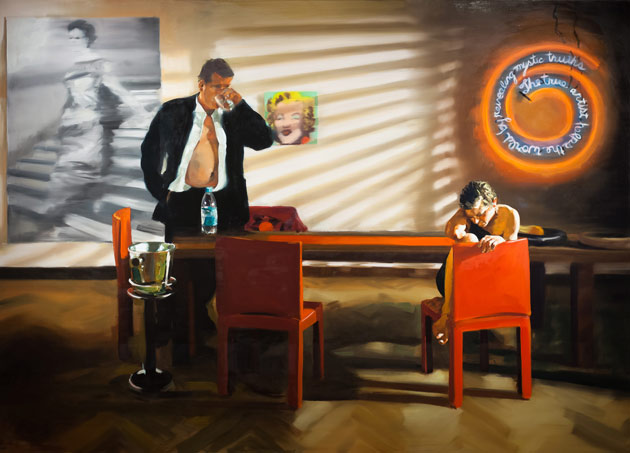
p. 5 I love hearing stories about works of art - how they were made, who owned them in the past, and in general their lives as objects. de Pury's book goes into a few such stories about different works. Including one about trying to purchase Eric Fischl's "Living Room, Scene 2" but then losing it to the Seattle Art Museum.
p. 204-205 writing about the Bravo show Work of Art, "Although it was ultimately not renewed for a third (season), each episode was seen by over a million viewers. Very few artists in history have had an exhibition seen by so many." This comment made me think of notability issues on Wikipedia and why something that seems not very important is considered much more notable because it was on TV and reached a huge audience.
16gkur

Book 15: Words Onscreen: The Fate of Reading in a Digital World by Naomi S. Baron
Baron is rooting for physical books in the digital vs. physical book discussion, but she also weighs in on the pros and cons of both. She lists the affordances that print and ebook have - pointing out that print is better for some reading and ebook for others. She says that the most important affordance of digital is that it is convenient - it takes up less space - and the most important affordance of print is its thingness, its physicality.
------------------------------------------------------------------------------------------------------------------------------------------------------------------------------------------
One of the reasons she prefers print is that it is reading and writing go hand in hand. Writing in the margins is a time honored knowledge boosting activity. My issue with this is that I was reading a print copy from the library. I can't write in the margins. If this was a digital version that I was borrowing from the library I would be able to write notes and highlight text easily. I'm not sure if could export my notes, but just like with the physical, when I have to return the book any notes I make in the book will also be returned. I did read on the library's website that if I borrow the ebook again, all of my highlights and notes will still be there.
------------------------------------------------------------------------------------------------------------------------------------------------------------------------------------------
I learned about this event held at MIT - "Unbound: Speculations on the Future of the Book." There are panels available to watch online - TO DO!
------------------------------------------------------------------------------------------------------------------------------------------------------------------------------------------
p.33 - lack of page numbers on digital print, especially news sources - students were not putting page numbers into their written assignments - didn't see the point
------------------------------------------------------------------------------------------------------------------------------------------------------------------------------------------
p.71 - digital is democratizing
------------------------------------------------------------------------------------------------------------------------------------------------------------------------------------------
p.108 - goes into reading long books, says one figure floating around is 57% of books not read to completion. With ebooks it is about 60% of books bought are not read saying that if it exists in real life than one is more likely to read it. Physical things can work as a memory aid, while digital less so.
------------------------------------------------------------------------------------------------------------------------------------------------------------------------------------------
p.130 "If you are a Kindle reader your privacy is compromised at the corporate level. Someone can track every time you open an eBook, every time you turn one of its pages, every time you make an annotation. Here the social reading relationship is not one you asked for but part of the Faustian bargain for reading onscreen." My take on this is that they should be making an app that can track your reading habits similar to FitBit that tracks your every move. I would love that.
------------------------------------------------------------------------------------------------------------------------------------------------------------------------------------------
p.135 - talking about records management and archival stuff! related to institutional knowledge in academic jobs.
------------------------------------------------------------------------------------------------------------------------------------------------------------------------------------------
p. 209-213 has final list of pros for digital: reduces volume, can search easily, reading extensively (good for series, comics, periodicals), democratizes written word, people think they cost less and are better for the environment. Cons: Distractions in digital world, lack of cognitive connection and not so emotional an experience (I have cried reading eBooks, i have never cried just by holding a book), ebooks discourage - reading longer texts, rereading, deep reading, memory of what you have read, serendipity.
17gkur
Book 22: A Tale for the Time Being by Ruth Ozeki
The book is divided between a diary written by a high schooler in Japan and the woman who finds and reads the diary who lives on an island off the west coast of Canada. Here are some of quotes from the book.
"...by the time you read this, everything will be different, and you will be nowhere in particular, flipping idly through the pages of this book, which happens to be the diary of my last days on earth, wondering if you should keep on reading. And if you decide not to read any more, hey, no problem, because you're not the one I was waiting for anyway. But if you do decide to read on, then guess what? You're my kind of time being and together we'll make magic!" p. 3
"Print is predictable and impersonal, conveying information in a mechanical transaction with the reader's eye. Handwriting, by contrast, resists the eye, reveals its meaning slowly, and is as intimate as skin." p. 12
Recommended reading: Treasury of the True Dharma Eye: Zen Master Dogen's Shobo Genzo
"No writer, even the most proficient, could re-enact in words the flow of a life lived..." p. 64
"Death is certain. Life is always changing, like a puff of wind in the air, or a wave in the sea, or even a thought in the mind. So making a suicide is finding the edge of life. It stops life in time, so we can grasp what shape it is and feel it is real, at least for just a moment. It is trying to make some real solid thing from the flow of life that is always changing." p. 87
"In medieval Japan, people used to believe that earthquakes were caused by an angry catfish who lived under the islands." p. 197
"When somebody says 'Ittekimasu' to you, you're supposed to answer 'Itterashai,' which means: Yes, please go and come back." p. 339
"Think about it. Where do words come from? They come from the dead. We inherit them. Borrow them. Use them for a time to bring the dead to life." p. 345
"The ancient Greeks believed that when you read aloud, it was actually the dead, borrowing your tongue, in order to speak again." p. 346
The book is divided between a diary written by a high schooler in Japan and the woman who finds and reads the diary who lives on an island off the west coast of Canada. Here are some of quotes from the book.
"...by the time you read this, everything will be different, and you will be nowhere in particular, flipping idly through the pages of this book, which happens to be the diary of my last days on earth, wondering if you should keep on reading. And if you decide not to read any more, hey, no problem, because you're not the one I was waiting for anyway. But if you do decide to read on, then guess what? You're my kind of time being and together we'll make magic!" p. 3
"Print is predictable and impersonal, conveying information in a mechanical transaction with the reader's eye. Handwriting, by contrast, resists the eye, reveals its meaning slowly, and is as intimate as skin." p. 12
Recommended reading: Treasury of the True Dharma Eye: Zen Master Dogen's Shobo Genzo
"No writer, even the most proficient, could re-enact in words the flow of a life lived..." p. 64
"Death is certain. Life is always changing, like a puff of wind in the air, or a wave in the sea, or even a thought in the mind. So making a suicide is finding the edge of life. It stops life in time, so we can grasp what shape it is and feel it is real, at least for just a moment. It is trying to make some real solid thing from the flow of life that is always changing." p. 87
"In medieval Japan, people used to believe that earthquakes were caused by an angry catfish who lived under the islands." p. 197
"When somebody says 'Ittekimasu' to you, you're supposed to answer 'Itterashai,' which means: Yes, please go and come back." p. 339
"Think about it. Where do words come from? They come from the dead. We inherit them. Borrow them. Use them for a time to bring the dead to life." p. 345
"The ancient Greeks believed that when you read aloud, it was actually the dead, borrowing your tongue, in order to speak again." p. 346
18dustydigger
>14 gkur: It certainly ingrained in British architecture. I have been enjoying a three part TV series about UKs most famous Brit architects,and there wasnt a woman among them - as one female architect interviewed on the programme ruefully pointed out! :0)
19gkur

Book 29: You Don't Have to Say You Love Me: A Memoir by Sherman Alexie
This is the first Sherman Alexie book that I've read, though I've heard only great things about his books in the past. I found this to be thoroughly enjoyable and heart-breaking to read. As much about him as it is about his mother, there is little chronology to the chapters and as his wife points out they are like the pieces of a quilt - scraps brought together to form a unified work of art. He writes as much about his childhood here as he does about the time around and after his mother's death. There were a number of chapters that were poems.
Some quotes:
"I would learn that Mary's randomness and charm - and her eventual death in a house fire - were fueled by her drug and alcohol addictions. I didn't yet know that romantic heroes - famous and not - are usually aimless nomads in disguise." p. 6
"...the tombstone will never answer. Because the dead have only the voices we give to them." p. 12
"My name is Sherman Alexie. Yes, I have an Indian name. But I ain't going to share it with you. I learned a long time ago that the only way to keep something sacred is to keep it private. So, yeah, you might think I reveal everything, but I keep plenty of good and bad stuff all to myself." p. 141
"It's easy for a white racist to fall in love with and accept one member of a minorty - one Indian - and their real and perceived talents and flaws. But it's much tougher for a racist to accept a dozen Indians. And impossible for a white racist to accept the entire race of Indians - or an entire race of any nonwhite people." p. 222
"...if dealing with white anti-Indian racists is like soft-shoeing through a minefield, then facing anti-Indian Indians is like dodging bullets from camouflaged snipers, sneaky and deadly. But very few of even the most cruel Indians voted for Trump." p. 225
"In Rearden, I was subjected to racism when certain white folks feared I was taking something away from them." p. 227
"I'm overeating but I always eat / Too much, so I think I'm overeating / At my usual pace. Study my face." p. 286
"It will be an Indian baby, shredded by a Gatling gun, lying dead and bloody in the snow. It is a photo taken by a U.S. Cavalry soldier in the nineteenth century. Very few people have seen that photo. I have not seen that photo. But I know it exists. The Smithsonian keeps such photos locked away from us." p. 297
"When did I stop praising the books I hoard / And the bookcases, lovingly restored? / Why do I ignore the baskets and gourds? / O Lord, let my love for things be reborn. / Let me sanctify my hand drums, adorned..." p. 305
"There are so many new Skyscrapers / Being built in our city of rain, I wonder if / Everybody's spirit animal is now the construction crane." p. 411
"Everything, everything, everything / Can be installation art." p. 415

