This topic is currently marked as "dormant"—the last message is more than 90 days old. You can revive it by posting a reply.
1jjwilson61
If Donald Trump is the type of person who succeeds in our Capitalist system, then I have lost faith in the utility of that system. To the barricades!
2timspalding
>1 jjwilson61:
He didn't really succeed in that system. His business success appears to have been modest, given an initial infusion from his father.
He didn't really succeed in that system. His business success appears to have been modest, given an initial infusion from his father.
3jjwilson61
He took a fortune and grew it into a larger fortune, despite having a lot of failures along the way. It seems that bankers are very forgiving to people who had a lot of money and lost it.
4timspalding
I do think Trump shows something is broken. I would identify it as, first and foremost, American political culture. And something is working—Russian political strategy :)
5John5918
>1 jjwilson61: I have lost faith in the utility of that (capitalist) system. To the barricades!
Welcome to the club, although most of us got there much earlier and recognised the inherent flaws of modern capitalism long before Trump appeared!
Welcome to the club, although most of us got there much earlier and recognised the inherent flaws of modern capitalism long before Trump appeared!
6proximity1
>5 John5918:
Said the arbitration man. OMFG! You crack me up. Dream on, won't you?
It's one or the other: "To the barricades!" or "As I see it, this is the best offer you can expect from the counter-parties", but not both at once.
There are few phrases dearer to the heartless exploiters of the 21st century than "binding arbitration."
GOD DAMN THIS MOTHER-FUCKING WORLD.
Said the arbitration man. OMFG! You crack me up. Dream on, won't you?
It's one or the other: "To the barricades!" or "As I see it, this is the best offer you can expect from the counter-parties", but not both at once.
There are few phrases dearer to the heartless exploiters of the 21st century than "binding arbitration."
GOD DAMN THIS MOTHER-FUCKING WORLD.
7John5918
>6 proximity1:
Why does everything have to be "one or the other"? There are other options than the current unfettered modern free market brand of capitalism (I did use the word "modern", you will note), such as the various economy models which worked pretty well in much of Europe.
Why does everything have to be "one or the other"? There are other options than the current unfettered modern free market brand of capitalism (I did use the word "modern", you will note), such as the various economy models which worked pretty well in much of Europe.
8proximity1
Why does everything have to be "one or the other"?
>7 John5918:
This is your ethos "to a 'T'", JTF. The problem is deep and complicated and the very fact that you'd ask so supremely naive a question as that leaves me with no hope that this can ever be made clear to you. It's nearly a case of "if you need this to be explained, then you are simply never going to understand it."
For, similarly, you, per your commentaries here, seem to regard as overbearing and (oddly, because your ideas of what is "fair" are singularly bizarre) as "unfair" the strict application of majoritarian votes--that is, a simple majority (does suffice) to carry a question; but this is essentially what "democracy" means. It doesn't mean that numerical minorities get to thwart and trump the majority's preferred choices. So of course you'd ask,"Why does everything have to be "one or the other"?" Because, by God, so many questions are just that: you either get a living wage or you don't, god fucking damn it! You either get the life-saving/sustaining drug you need or, god fucking damn it, you don't get it and you suffer (and die) as a consequence. Your municipal water supply is either fit for human consumption or it isn't. Your child's school is either in the "safe zone"--surely where the privileged live--or it's potentially or actually at risk of being or currently IS in what's rightly regarded as the danger-zone, that is, where the schools' qualities are seriously deterimental to your children's future prospects.
"There are other options than the current unfettered modern free market brand of capitalism... such as the various economy models which worked pretty well in much of Europe."
In fact, it's false to assert that these have "worked pretty well" "in much of Europe" when, in fact, they've worked "pretty well" practically exclusively in the rather special cases of Scandinavian societies which, we must admit, have put what amounts to the near totality of the rest of "Europe" to shame--if those nations had any shame to start with.
And, now, since the advent of the convenient (from the point of view of the Neo-liberal (N-L) globalists) continuing disaster in Syria, even Scandinavia's exceptional success stories are under growing pressure to yield to N-L imperatives.
We suffer in part from what's known as the Survivorship bias :
Unfortunately, some of those who are --or, that is, who were best-placed to explain to you why the fuck it has to be "one or the other"---they're dead now:
Fears that new cladding made Grenfell Tower 'light up like a matchstick': First bodies are removed from building as 12 are confirmed dead and dozens missing amid chilling warning that 'nobody on top three floors survived'
Tell us: what kind of terms were your arbitrating tactics going to get them? And, now that they're dead and gone, how the hell are you ever going to come to grasp these matters efffectively?
>7 John5918:
This is your ethos "to a 'T'", JTF. The problem is deep and complicated and the very fact that you'd ask so supremely naive a question as that leaves me with no hope that this can ever be made clear to you. It's nearly a case of "if you need this to be explained, then you are simply never going to understand it."
For, similarly, you, per your commentaries here, seem to regard as overbearing and (oddly, because your ideas of what is "fair" are singularly bizarre) as "unfair" the strict application of majoritarian votes--that is, a simple majority (does suffice) to carry a question; but this is essentially what "democracy" means. It doesn't mean that numerical minorities get to thwart and trump the majority's preferred choices. So of course you'd ask,"Why does everything have to be "one or the other"?" Because, by God, so many questions are just that: you either get a living wage or you don't, god fucking damn it! You either get the life-saving/sustaining drug you need or, god fucking damn it, you don't get it and you suffer (and die) as a consequence. Your municipal water supply is either fit for human consumption or it isn't. Your child's school is either in the "safe zone"--surely where the privileged live--or it's potentially or actually at risk of being or currently IS in what's rightly regarded as the danger-zone, that is, where the schools' qualities are seriously deterimental to your children's future prospects.
"There are other options than the current unfettered modern free market brand of capitalism... such as the various economy models which worked pretty well in much of Europe."
In fact, it's false to assert that these have "worked pretty well" "in much of Europe" when, in fact, they've worked "pretty well" practically exclusively in the rather special cases of Scandinavian societies which, we must admit, have put what amounts to the near totality of the rest of "Europe" to shame--if those nations had any shame to start with.
And, now, since the advent of the convenient (from the point of view of the Neo-liberal (N-L) globalists) continuing disaster in Syria, even Scandinavia's exceptional success stories are under growing pressure to yield to N-L imperatives.
We suffer in part from what's known as the Survivorship bias :
Unfortunately, some of those who are --or, that is, who were best-placed to explain to you why the fuck it has to be "one or the other"---they're dead now:
Fears that new cladding made Grenfell Tower 'light up like a matchstick': First bodies are removed from building as 12 are confirmed dead and dozens missing amid chilling warning that 'nobody on top three floors survived'
Tell us: what kind of terms were your arbitrating tactics going to get them? And, now that they're dead and gone, how the hell are you ever going to come to grasp these matters efffectively?
9John5918
>8 proximity1:
Well, I suppose the one thing I can agree with you on is The problem is deep and complicated and the very fact that you'd ask so supremely naive a question as that leaves me with no hope that this can ever be made clear to you. It's nearly a case of "if you need this to be explained, then you are simply never going to understand it."
I doubt whether you will ever understand it.
Well, I suppose the one thing I can agree with you on is The problem is deep and complicated and the very fact that you'd ask so supremely naive a question as that leaves me with no hope that this can ever be made clear to you. It's nearly a case of "if you need this to be explained, then you are simply never going to understand it."
I doubt whether you will ever understand it.
10RickHarsch
>8 proximity1: Look at the rage. And from what I can tell proximity1 and johnthefireman have virtually the same thoughts about 'the inherent flaws of modern capitalism.'
11timspalding
I never really know what people mean by "capitalism" in these contexts.
Terms are silly things to argue about, but, to me, capitalism is freedom under law, by which we may make free decisions, small and large, rather than the government prevent us from making them, or making them for us.
What you all seem to mean is something closer to the modern economic state, with its mix of capitalism, crony capitalism and state control, combined with whatever political situation you don't like. Thus, the election of a president who is markedly less of a supporter of the free market than his predecessors is, somehow, peak capitalism.
Well, it's just a term, and I don't like him either, but I would wish for some definition--what modern political or economic thing you don't like can't be stuffed in this rhetorical construct?
Meanwhile, John talks about "unfettered capitalism," when, excepting the blip of World War II, government spending as a percent of GDP has never been higher.(1) We've had something close to "unfettered capitalism" in the US—it was a century or so ago, when there was no welfare, disability, government medical support, labor laws, income tax, or much in the way of regulation. That was a vibrant world in many ways, but also a cruel one. Either way, we aren't living in that world. We're living in a world where the US government spends about 60% of its budget on income and medical support for old people, support for the unemployed, support for the disabled, and so forth.
Now, maybe people and businesses should have more "fetters," government spending should be higher, and so forth. These are legitimate moral and political questions. I just don't see why we must keep banging on about how unprecedentedly laissez faire everything is, when that's absolute rubbish.
1. Taxes haven't kept pace, however, so the fetters are, I suppose, mostly for our children. If, however, one proposes paying our debts, that's called "austerity" and is another of these "late Capitalism" monsters. So IDK.
Terms are silly things to argue about, but, to me, capitalism is freedom under law, by which we may make free decisions, small and large, rather than the government prevent us from making them, or making them for us.
What you all seem to mean is something closer to the modern economic state, with its mix of capitalism, crony capitalism and state control, combined with whatever political situation you don't like. Thus, the election of a president who is markedly less of a supporter of the free market than his predecessors is, somehow, peak capitalism.
Well, it's just a term, and I don't like him either, but I would wish for some definition--what modern political or economic thing you don't like can't be stuffed in this rhetorical construct?
Meanwhile, John talks about "unfettered capitalism," when, excepting the blip of World War II, government spending as a percent of GDP has never been higher.(1) We've had something close to "unfettered capitalism" in the US—it was a century or so ago, when there was no welfare, disability, government medical support, labor laws, income tax, or much in the way of regulation. That was a vibrant world in many ways, but also a cruel one. Either way, we aren't living in that world. We're living in a world where the US government spends about 60% of its budget on income and medical support for old people, support for the unemployed, support for the disabled, and so forth.
Now, maybe people and businesses should have more "fetters," government spending should be higher, and so forth. These are legitimate moral and political questions. I just don't see why we must keep banging on about how unprecedentedly laissez faire everything is, when that's absolute rubbish.
1. Taxes haven't kept pace, however, so the fetters are, I suppose, mostly for our children. If, however, one proposes paying our debts, that's called "austerity" and is another of these "late Capitalism" monsters. So IDK.
12John5918
>11 timspalding:
Well, I didn't intend to get into an argument about capitalism because I agree with you about labels and I have always advocated a mixed economy.
I think the reason one talks about unfettered capitalism is precisely because a lot of capitalist rhetoric seems to be for it, arguing that they are being too fettered by law. One can argue whether or not they actually are too fettered by law - you seem to believe they aren't, as I do but probably more so than you, while some of them feel they are.
Well, I didn't intend to get into an argument about capitalism because I agree with you about labels and I have always advocated a mixed economy.
I think the reason one talks about unfettered capitalism is precisely because a lot of capitalist rhetoric seems to be for it, arguing that they are being too fettered by law. One can argue whether or not they actually are too fettered by law - you seem to believe they aren't, as I do but probably more so than you, while some of them feel they are.
13timspalding
>11 timspalding:
I think it's a somewhat dreadful mix. My tiny company, for example, has had to fill out forms and pay various different taxes at various different rates in more than a dozen states and localities—a peril of hiring people who are good, not people within one government jurisdiction. When we make money, we pay the highest corporate income tax rate in the developed world. The government yanked our private insurance plan because it was too generous. I'm glad we make little bits go, not participate in some real-world industry with a comprehensive regulatory scheme.
Meanwhile, actual rich people and big companies don't play by these rules. Trump appears to have avoided taxes entirely for two decades, and broke the law repeatedly without consequences. Meanwhile, companies like Walmart, Exxon or Apple have the money and the legal gumption to employ elaborate schemes that reduce their tax burden to almost nothing--those "highest rates" largely apply to smaller companies. And, of course, those big companies and rich people have a big part in writing the regulations that govern them, and that disadvantage their smaller competitors.
In other words, we have a mixed economy! :)
I think, however, we can all agree with carnophile--the real problem is the Mexicans.
I think it's a somewhat dreadful mix. My tiny company, for example, has had to fill out forms and pay various different taxes at various different rates in more than a dozen states and localities—a peril of hiring people who are good, not people within one government jurisdiction. When we make money, we pay the highest corporate income tax rate in the developed world. The government yanked our private insurance plan because it was too generous. I'm glad we make little bits go, not participate in some real-world industry with a comprehensive regulatory scheme.
Meanwhile, actual rich people and big companies don't play by these rules. Trump appears to have avoided taxes entirely for two decades, and broke the law repeatedly without consequences. Meanwhile, companies like Walmart, Exxon or Apple have the money and the legal gumption to employ elaborate schemes that reduce their tax burden to almost nothing--those "highest rates" largely apply to smaller companies. And, of course, those big companies and rich people have a big part in writing the regulations that govern them, and that disadvantage their smaller competitors.
In other words, we have a mixed economy! :)
I think, however, we can all agree with carnophile--the real problem is the Mexicans.
14proximity1
"When we make money, we pay the highest corporate income tax rate in the developed world."
Which is what?, pray, tell.
and, when you don't make money?, maybe you get a tax write-off?
Let's be clear--"making money" means profit, what's left over after expenses (such as interest on debt, all fees and contractual obligation costs,employee salaries and wages and benefits, etc.) have been paid. Below the profit-making level, first comes the break-even point-- no profits but still enough to actually meet all the expenses incurred. Only below that are there actual monetary losses, where there's more paid out in expenses than comes in in revenue. Even then, tax-write offs are commonly available. I don't pretend that this "makes the loss status all alright" any more than I'd pretend that paying only the minimum wage (not saying that you do!) ought to allow one to sleep peacefully at night.
"The government yanked our private insurance plan because it was too generous."
Which 'government' authority did this? and why? Why was it "too generous"?--your characterization or the government authorities'? Since when does the government stamp out arrangements which meet and surpass all minimum statutory requirements, going even beyond what the law requires in fairness or propriety?
E.g., the minimum wage is just that, the minimum legally allowable wage. It's not a decent wage, it's very often not even close to a "living wage"--no, it's the wage below which pay is deemed unfit, improper. Yet many employers actually seem to regard it as somehow a point of pride that they are meeting the minimum wage. In certain ways, the practical effects of this term are quite pernicious. Fuck the "minimum wage." Suppose employees were to respond in kind with the "minimum effort" in return for the "minimum wage."
"I'm glad we make little bits go, not participate in some real-world industry with a comprehensive regulatory scheme."
Too bad the real-world industries and their comprehensive regulatory schemes are typically the result of rich corporate lobbyists writing laws and administrative regulations to suit their uber-rich patrons. But, then, the alternative-- any alternative-- to that requires real, meaningful democratic principles and effective working democratic institutions. Instead, we have the likes of JTF who so cherishes the political variety of life which allows him to enjoy both "To the barricades!" and "In my professional judgment, this is probably the best offer you can expect to get."
GOD DAMN THIS MOTHER-FUCKING WORLD !!!
Which is what?, pray, tell.
and, when you don't make money?, maybe you get a tax write-off?
Let's be clear--"making money" means profit, what's left over after expenses (such as interest on debt, all fees and contractual obligation costs,employee salaries and wages and benefits, etc.) have been paid. Below the profit-making level, first comes the break-even point-- no profits but still enough to actually meet all the expenses incurred. Only below that are there actual monetary losses, where there's more paid out in expenses than comes in in revenue. Even then, tax-write offs are commonly available. I don't pretend that this "makes the loss status all alright" any more than I'd pretend that paying only the minimum wage (not saying that you do!) ought to allow one to sleep peacefully at night.
"The government yanked our private insurance plan because it was too generous."
Which 'government' authority did this? and why? Why was it "too generous"?--your characterization or the government authorities'? Since when does the government stamp out arrangements which meet and surpass all minimum statutory requirements, going even beyond what the law requires in fairness or propriety?
E.g., the minimum wage is just that, the minimum legally allowable wage. It's not a decent wage, it's very often not even close to a "living wage"--no, it's the wage below which pay is deemed unfit, improper. Yet many employers actually seem to regard it as somehow a point of pride that they are meeting the minimum wage. In certain ways, the practical effects of this term are quite pernicious. Fuck the "minimum wage." Suppose employees were to respond in kind with the "minimum effort" in return for the "minimum wage."
"I'm glad we make little bits go, not participate in some real-world industry with a comprehensive regulatory scheme."
Too bad the real-world industries and their comprehensive regulatory schemes are typically the result of rich corporate lobbyists writing laws and administrative regulations to suit their uber-rich patrons. But, then, the alternative-- any alternative-- to that requires real, meaningful democratic principles and effective working democratic institutions. Instead, we have the likes of JTF who so cherishes the political variety of life which allows him to enjoy both "To the barricades!" and "In my professional judgment, this is probably the best offer you can expect to get."
GOD DAMN THIS MOTHER-FUCKING WORLD !!!
15RickHarsch
>13 timspalding: What did you manage to do when your insurance plan was yanked? And for that matter, could you say a little more about the process of it getting quashed?
16proximity1
(passim)
Why should we uncritically grant neo-liberal globalizations' proponents' assumptions* regarding moral, political and economic matters of essential importance ( regarding key terms' definitions, principles, facts and opinions) in the context of this discussion?
We shouldn't. Yet we've been doing just that.
For example, it's simply assumed as given that, in the course of globalization, not only shall there be the “inevitable and unfortunate” serious and durable “dislocations”—to use the scumbag economists' euphemism for dire misery as a result of job-loss—but that the pain and suffering shall of course “naturally” be borne from “the bottom”, “up,” only theoretically ever reaching and seriously disturbing those at the peak of the pyramid of privilege, power and wealth.
Why shouldn't the pain and suffering be carefully managed so that, when it comes to dislocations as the inevitable costs of social and economic progress, the burdens are borne from ”the top, down”, only theoretically ever reaching and seriously disturbing those at the lower ranks of the pyramid of privilege, power and wealth?
You want the “dynamism” of laissez-faire immigration? Fine. Then those who advocate for this—and especially those who are actually banking on making rich returns on it—ought to be the ones to pay for the dislocations and pay in full, and in advance, rather than shunting them off on others who pay by the loss of their livlihoods. In short, first ensure that those families' jobs which are risked and damaged or lost are “made whole” again, maintained in tact—or, of course, if you prefer, materially improved. No penalties for being “too generous.”
And let's be very clear about what “immigration” means. If you have a factory in the U.S. or in Europe and, closing it, you throw your employees out of work as you send their former jobs over-seas to some haven of dirt-cheap wage-labor, for the enrichment of your bottom-line, you have, in effect, “imported” these new ( “foreign” ) laborers, making them de facto economic “immigrants” to the corporations' home-base. Again, in order to do that, you're obliged to pay for the costs up front and in full, not shunt them off on your newly-unemployed former-employees.
Only upon such adjustments to our working-assumptions can we move on to discussing the issues and taking up the work of cost-benefit analyses.
Otherwise, this is just another sterile exercise in conventional economic mumbo-jumbo.
I think that a straight-foward requirement that any social and economic "levelling" be done from "the 'top,' 'down' rather than, as is always the case, "the 'bottom,' 'up,'" would put a very quick and sure end to much of this stuff.
As Uncle Warren says, it's only when the tide goes out that one can see who's been swimming naked.
___________________________
* or those of others who are in effect doing the neo-liberal globalists' theory-and-practice argumentation in their stead.
_______________________________________________
RELATED :
From Alternet.org Books :
The Mega Rich Are Getting Mega Richer: A Former CEO Exposes the Corruption Behind Their Obscene Paychecks | The indirect effect of the increase in income inequality is economically more injurious than the erosion of company earnings or a stock market downturn
By Steven Clifford / Blue Rider Press
July 20, 2017, 8:54 AM GMT
The following is an excerpt from the new book The CEO Pay Machine: How It Trashes America and How to Stop It by Steven Clifford (Blue Rider Press, May 2017),
Why should we uncritically grant neo-liberal globalizations' proponents' assumptions* regarding moral, political and economic matters of essential importance ( regarding key terms' definitions, principles, facts and opinions) in the context of this discussion?
We shouldn't. Yet we've been doing just that.
For example, it's simply assumed as given that, in the course of globalization, not only shall there be the “inevitable and unfortunate” serious and durable “dislocations”—to use the scumbag economists' euphemism for dire misery as a result of job-loss—but that the pain and suffering shall of course “naturally” be borne from “the bottom”, “up,” only theoretically ever reaching and seriously disturbing those at the peak of the pyramid of privilege, power and wealth.
Why shouldn't the pain and suffering be carefully managed so that, when it comes to dislocations as the inevitable costs of social and economic progress, the burdens are borne from ”the top, down”, only theoretically ever reaching and seriously disturbing those at the lower ranks of the pyramid of privilege, power and wealth?
You want the “dynamism” of laissez-faire immigration? Fine. Then those who advocate for this—and especially those who are actually banking on making rich returns on it—ought to be the ones to pay for the dislocations and pay in full, and in advance, rather than shunting them off on others who pay by the loss of their livlihoods. In short, first ensure that those families' jobs which are risked and damaged or lost are “made whole” again, maintained in tact—or, of course, if you prefer, materially improved. No penalties for being “too generous.”
And let's be very clear about what “immigration” means. If you have a factory in the U.S. or in Europe and, closing it, you throw your employees out of work as you send their former jobs over-seas to some haven of dirt-cheap wage-labor, for the enrichment of your bottom-line, you have, in effect, “imported” these new ( “foreign” ) laborers, making them de facto economic “immigrants” to the corporations' home-base. Again, in order to do that, you're obliged to pay for the costs up front and in full, not shunt them off on your newly-unemployed former-employees.
Only upon such adjustments to our working-assumptions can we move on to discussing the issues and taking up the work of cost-benefit analyses.
Otherwise, this is just another sterile exercise in conventional economic mumbo-jumbo.
I think that a straight-foward requirement that any social and economic "levelling" be done from "the 'top,' 'down' rather than, as is always the case, "the 'bottom,' 'up,'" would put a very quick and sure end to much of this stuff.
As Uncle Warren says, it's only when the tide goes out that one can see who's been swimming naked.
___________________________
* or those of others who are in effect doing the neo-liberal globalists' theory-and-practice argumentation in their stead.
_______________________________________________
RELATED :
From Alternet.org Books :
The Mega Rich Are Getting Mega Richer: A Former CEO Exposes the Corruption Behind Their Obscene Paychecks | The indirect effect of the increase in income inequality is economically more injurious than the erosion of company earnings or a stock market downturn
By Steven Clifford / Blue Rider Press
July 20, 2017, 8:54 AM GMT
The following is an excerpt from the new book The CEO Pay Machine: How It Trashes America and How to Stop It by Steven Clifford (Blue Rider Press, May 2017),
"Income inequality in America has risen sharply since 1976. Economists and pundits point to multiple causes—globalization and competition from low-wage countries; growing educational disparities that particularly affect men and minorities; technological changes that reward the highly skilled; decline of labor unions; changes in corporate culture that place stock price and earnings above employees; free market philosophy and the rise of winner-take-all economics; households with high-income couples; lower rates of marriage and of intact families; high incarceration levels; immigration of low-skilled individuals; income tax and capital gains tax cuts and other conservative economic and tax policies; deregulation; and decreased welfare and antipoverty spending coupled with redistribution programs that disproportionately benefit the elderly.
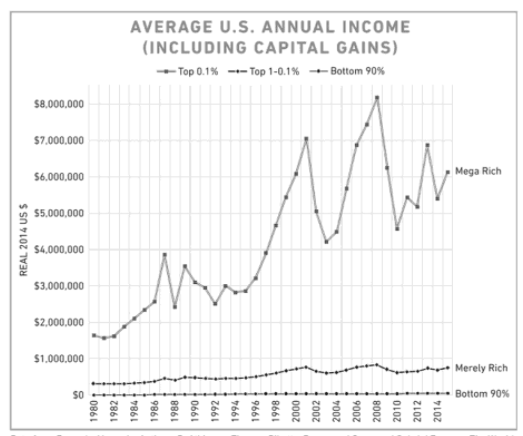
All of the above may contribute to inequality. However, the proximate cause is quite simple. The jump in inequality is due to a small number of people, mostly business executives, who make huge amounts of money. They are the Mega Rich, the top .1 percent in income, who averaged $6.1 million in income in 2014.
... ... ...
"The Mega Rich captured most of the national income gains during the last four decades as their share of income increased from 3.4 percent in 1980 to 10.3 percent in 2014. The share of the Merely Rich rose from 6.6 percent to 11.0 percent over the same period. Thus the Mega Rich snared over three-fifths of the income growth of the 1 percent and nearly 40 percent of all income growth. In the tepid recovery from 2010 to 2012, the 1 percent took virtually all of the income gains. The Mega Rich again got the lion’s share: their average income increased 49 percent in this three-year period.
"The Mega Rich are getting mega richer. Their average household made 113 times as much as the typical American household in 2014. In 1980, this number was 47. In 2014, the 115,000 Mega Rich households had as much wealth as the bottom 90 percent. They now hold 22 percent of the nation’s wealth, nearly double their 1995 share.
"Since Fortune 500 CEOs can account for only 500 of the 115,000 Mega Rich, you might be surprised to learn that the majority of the Mega Rich are business executives. CEOs and other business executives constitute the largest high-income group in America. Not the old families with their inherited wealth. Not the sports heroes with their jaw-dropping contracts. Not the movie stars at $20 million per blockbuster movie. Executives, managers, supervisors, and financial professionals constitute three-fifths of the top 0.1 percent. Moreover, they accounted for about 70 percent of the increase in income going to the top 0.1 percent from 1979 to 2005. As Nobel Prize–winning economist Paul Krugman puts it, “Basically, the top 0.1 percent is the corporate suits, with a few token sports and film stars thrown in.”
"In Capital in the Twenty-First Century, Thomas Piketty, after analyzing enormous amounts of data, wrote:
'The vast majority (60 to 70%, depending on what definitions one chooses) of the top 0.1% of the income hierarchy in 2000–2010 consists of top managers. By comparison, athletes, actors, and artists of all kinds make up less than 5% of this group. In this sense, the new US inequality has much more to do with the advent of “supermanagers” than with “superstars.” '
"Piketty asserts that increasing income inequality is caused not by investment income but by high wages driven by “the emergence of extremely high remunerations at the summit of the wage hierarchy, particularly among top managers of large firms.' "
17timspalding
Tim: "When we make money, we pay the highest corporate income tax rate in the developed world."
Proximity: Which is what?, pray, tell.
Wikipedia: "In 2014 the United States had the third highest general top marginal corporate income tax rate in the world at 39.1 percent (consisting of the 35% federal rate plus a combined state rate), exceeded only by Chad and the United Arab Emirates." You can find this many places, or, you know, just look the corporate income tax tables up.
Now, as the Wikipedia goes on to say, the average tax rate is much lower; the CBO estimates an effective rate of 20%, which is in line with other developed countries. Why? Because the code contains a million creative ways to work the system. Apple doesn't pay that. Exxon does pay that. No large corporation does.
LibraryThing? Yeah, we pay that. Most small companies do. We pay it because we aren't in industries that have carved out special exemptions. And we pay it because it would cost too much—in both money and the warping effects of twisting our business to suit tax law—for us to find and exploit the system to get rid of it.
One study I just found found that small businesses pay twice the corporate income taxes that big businesses do ( http://www.huffingtonpost.com/2013/08/08/small-business-taxes_n_3727270.html ).
Mind you, this isn't taxes we pay and then the owners can take the money; anything disbursed to the owners of a corporation are taxed again, as income or capital gains, depending. This is money we didn't get rid of by December 31, even if we spend it all on January 1. Big companies have financial mechanisms for dealing with that problem too. It's harder for a small company.
Proximity: Which is what?, pray, tell.
Wikipedia: "In 2014 the United States had the third highest general top marginal corporate income tax rate in the world at 39.1 percent (consisting of the 35% federal rate plus a combined state rate), exceeded only by Chad and the United Arab Emirates." You can find this many places, or, you know, just look the corporate income tax tables up.
Now, as the Wikipedia goes on to say, the average tax rate is much lower; the CBO estimates an effective rate of 20%, which is in line with other developed countries. Why? Because the code contains a million creative ways to work the system. Apple doesn't pay that. Exxon does pay that. No large corporation does.
LibraryThing? Yeah, we pay that. Most small companies do. We pay it because we aren't in industries that have carved out special exemptions. And we pay it because it would cost too much—in both money and the warping effects of twisting our business to suit tax law—for us to find and exploit the system to get rid of it.
One study I just found found that small businesses pay twice the corporate income taxes that big businesses do ( http://www.huffingtonpost.com/2013/08/08/small-business-taxes_n_3727270.html ).
Mind you, this isn't taxes we pay and then the owners can take the money; anything disbursed to the owners of a corporation are taxed again, as income or capital gains, depending. This is money we didn't get rid of by December 31, even if we spend it all on January 1. Big companies have financial mechanisms for dealing with that problem too. It's harder for a small company.
18RickHarsch
>17 timspalding: Why not turn your job over to proximity1? That seems to me to be the gist of his argument on this and one other thread.
19proximity1
>17 timspalding:
You seem to resent (what I suppose, perhaps wrongly, to be) the implications of your ethical standards for your tax liablities, begrudging the far more unjustly favorable treatment which the truly earnest corrupters-and-gamers-of-the-system get for themselves because, (again, perhaps unlike you) morally, they see no reason to stop at anything. It certainly sounds that way.
I'm not quite sure whether you've conscientiously rejected the ambition to join the rat-race at the level of the major Evil Motherfuckers--for whom the tax codes are most favorable, though this is my working assumption--or whether, on the other hand, your lament is that, despite your best efforts, you can't get onto the crooked playing-field which these monsters have designed for their self-serving use against others who are always struggling up-hill. But whichever is the case, you're not only well and truly in the rat-race, you're very obviously quite ready and willing to make lots of excuses for it when, really, the world as we find it currently has simply next-to-nothing in its favor morally. (One could not honestly say that between 1932 and, roughly, 1952.) The main differences in the savagery practiced today from that of centuries past are in fashions and technical improvements, not moral ones.
Once upon a time, Levi's blue-jeans, union-made in San Francisco, were affordable and their quality superb for the product's purpses. They were so good in fact that the jeans became a icon of style and even "chic" fashion--something which the most glamorous movi-star could have "in common" with farm laborers. Today, the brand has collapsed and in its place we have a phony choice between which truly ugly, ill-fitting and shittily-made clothes and shoes from China or foreign other wage-labor gulags we are going wear.
That's your fucking "technological progress"
--as "unstoppable" as the weather? BULL-FUCKING-SHIT!!!!!!!!
Suppose I answered your tax-burden laments (Gross unfairness in the tax-schedule?) with this, from you:
Well, it's "pretty much. Unstoppable. The progress of technology, very broadly defined, and the struggle to stay up are constant in history" ?
I won't because, very simply, that's bullshit. And to reply in that way is truly an insult to one's intelligence.
________________________
You ignored my other questions. You ignored Carnophile's most apt challenge, "pick one."
You seem to resent (what I suppose, perhaps wrongly, to be) the implications of your ethical standards for your tax liablities, begrudging the far more unjustly favorable treatment which the truly earnest corrupters-and-gamers-of-the-system get for themselves because, (again, perhaps unlike you) morally, they see no reason to stop at anything. It certainly sounds that way.
I'm not quite sure whether you've conscientiously rejected the ambition to join the rat-race at the level of the major Evil Motherfuckers--for whom the tax codes are most favorable, though this is my working assumption--or whether, on the other hand, your lament is that, despite your best efforts, you can't get onto the crooked playing-field which these monsters have designed for their self-serving use against others who are always struggling up-hill. But whichever is the case, you're not only well and truly in the rat-race, you're very obviously quite ready and willing to make lots of excuses for it when, really, the world as we find it currently has simply next-to-nothing in its favor morally. (One could not honestly say that between 1932 and, roughly, 1952.) The main differences in the savagery practiced today from that of centuries past are in fashions and technical improvements, not moral ones.
Once upon a time, Levi's blue-jeans, union-made in San Francisco, were affordable and their quality superb for the product's purpses. They were so good in fact that the jeans became a icon of style and even "chic" fashion--something which the most glamorous movi-star could have "in common" with farm laborers. Today, the brand has collapsed and in its place we have a phony choice between which truly ugly, ill-fitting and shittily-made clothes and shoes from China or foreign other wage-labor gulags we are going wear.
That's your fucking "technological progress"
--as "unstoppable" as the weather? BULL-FUCKING-SHIT!!!!!!!!
Suppose I answered your tax-burden laments (Gross unfairness in the tax-schedule?) with this, from you:
Well, it's "pretty much. Unstoppable. The progress of technology, very broadly defined, and the struggle to stay up are constant in history" ?
I won't because, very simply, that's bullshit. And to reply in that way is truly an insult to one's intelligence.
________________________
You ignored my other questions. You ignored Carnophile's most apt challenge, "pick one."
20timspalding
You seem to resent (what I suppose, perhaps wrongly, to be) the implications of your ethical standards for your tax liablities, begrudging the far more unjustly favorable treatment which the truly earnest corrupters-and-gamers-of-the-system get for themselves because, (again, perhaps unlike you) morally, they see no reason to stop at anything. It certainly sounds that way.
No, you really aren't understanding words. You just put things in all caps and shout obscenities. There's a reason I have you blocked. I'll stop clicking to see what you're misunderstanding.
No, you really aren't understanding words. You just put things in all caps and shout obscenities. There's a reason I have you blocked. I'll stop clicking to see what you're misunderstanding.
21proximity1
>20 timspalding:
Suit yourself.
_____________________________________
ETA: (for others, Tim isn't reading the criticisms he can't answer)
I note that, by your own account of it, you pay more in taxes compared to others--namely, those " industries that have carved out special exemptions" and you do this, again, in your own words, "...because it would cost too much—in both money and the warping effects of twisting our business to suit tax law—for us to find and exploit the system to get rid of it..
So, in fact, it's a straight-forward business calculation.
It's actually cheaper for you to pay the higher tax rate than to do what others have done in order to "carve out special exemptions," because, indeed, that systematic and continuous corrupting of democratic principles costs a lot of money.
So, compared to other courses which are only by a very far stretch theoretically possible, you're taking the path of least resistance. You're compromising in the face of hard and unpleasant realities. Just think of the hundreds of thousands of small businesses--many much smaller than your operation. They, too, compromise because that way they can get on with what are really their primary interests. Fighting a corrupt system isn't on that list.
Meanwhile, the majority of society--a very mixed and unsavory lot, to be sure--lives in conditions you would never envy. They struggle, too. But they do it without your advantatges. And, rather than make common-cause with them, as the few more politicaily-enlightened among them are waiting and hoping for you and others more socially conscientious than you are to do, you just tabulate, calculate and reason, "Yep, we're better off just paying the higher tax rate."
As I see it, you have what many, many others would consider a sweet deal. Not a perfect deal but a sweet deal. Lots of comforts, lots of ego-satisfaction, lots of ways to think well of yourself and what you do.
You're grumpy because others with vastly larger sums of money at their disposal and far, far fewer scruples than you have take and use these factors to their unfair advantage--leaving you with a higher tax rate to bear than you ought to under a fair system.
But you've settled for that and, since you have, it's unsporting of you to grumble about it.
You should be of good cheer-- or join the rest of us living on the street. I assure you, I see people everyday living in quite miserable conditions and I often see them laughing and very rarely hear them complaining--though they have plenty to complain about, they just don't. The reasons are probably as varied as the people. Some literally lack the intelligence to think about the possibility of complaining; but many more probably see that it's truly useless for them to complain. And they're right. As they're only too well aware, no one is going to give a good goddamn about their problems.
Their megre belongings--the stuff they use to make up a bed at night--are typically stashed somewhere, often in bushes. And every now and then, without warning of course, they find their belongings have been seized and thrown in the dumpster. Oh, well. This, of course, is theft. A crime. But the idea of reporting it to the police would strike them as absurd. The police don't give a fuck. Noise, constant intrusions and a COMPLETE and CONSTANT lack of privacy everywhere except in a toilet or a shower-stall are their everyday life experiences.
Suit yourself.
_____________________________________
ETA: (for others, Tim isn't reading the criticisms he can't answer)
I note that, by your own account of it, you pay more in taxes compared to others--namely, those " industries that have carved out special exemptions" and you do this, again, in your own words, "...because it would cost too much—in both money and the warping effects of twisting our business to suit tax law—for us to find and exploit the system to get rid of it..
So, in fact, it's a straight-forward business calculation.
It's actually cheaper for you to pay the higher tax rate than to do what others have done in order to "carve out special exemptions," because, indeed, that systematic and continuous corrupting of democratic principles costs a lot of money.
So, compared to other courses which are only by a very far stretch theoretically possible, you're taking the path of least resistance. You're compromising in the face of hard and unpleasant realities. Just think of the hundreds of thousands of small businesses--many much smaller than your operation. They, too, compromise because that way they can get on with what are really their primary interests. Fighting a corrupt system isn't on that list.
Meanwhile, the majority of society--a very mixed and unsavory lot, to be sure--lives in conditions you would never envy. They struggle, too. But they do it without your advantatges. And, rather than make common-cause with them, as the few more politicaily-enlightened among them are waiting and hoping for you and others more socially conscientious than you are to do, you just tabulate, calculate and reason, "Yep, we're better off just paying the higher tax rate."
As I see it, you have what many, many others would consider a sweet deal. Not a perfect deal but a sweet deal. Lots of comforts, lots of ego-satisfaction, lots of ways to think well of yourself and what you do.
You're grumpy because others with vastly larger sums of money at their disposal and far, far fewer scruples than you have take and use these factors to their unfair advantage--leaving you with a higher tax rate to bear than you ought to under a fair system.
But you've settled for that and, since you have, it's unsporting of you to grumble about it.
You should be of good cheer-- or join the rest of us living on the street. I assure you, I see people everyday living in quite miserable conditions and I often see them laughing and very rarely hear them complaining--though they have plenty to complain about, they just don't. The reasons are probably as varied as the people. Some literally lack the intelligence to think about the possibility of complaining; but many more probably see that it's truly useless for them to complain. And they're right. As they're only too well aware, no one is going to give a good goddamn about their problems.
Their megre belongings--the stuff they use to make up a bed at night--are typically stashed somewhere, often in bushes. And every now and then, without warning of course, they find their belongings have been seized and thrown in the dumpster. Oh, well. This, of course, is theft. A crime. But the idea of reporting it to the police would strike them as absurd. The police don't give a fuck. Noise, constant intrusions and a COMPLETE and CONSTANT lack of privacy everywhere except in a toilet or a shower-stall are their everyday life experiences.
23timspalding
>22 tombfinger:
No.
Dig a little deeper. We're glad to help out, but this is not where to ask, or how to ask.
No.
Dig a little deeper. We're glad to help out, but this is not where to ask, or how to ask.
24Carnophile
>13 timspalding: I think, however, we can all agree with carnophile--the real problem is the Mexicans.
Oh, tim, you devil, you!
Oh, tim, you devil, you!
25barney67
You don't have to be a nice guy to be president. It's probably better if you're not. An argument could be made that Trump is among the least phony presidents.
I continue to believe that few of us really know him, though it seems everyone claims they do, and it seems everyone has been telling him what to do because they know best.
I continue to believe that few of us really know him, though it seems everyone claims they do, and it seems everyone has been telling him what to do because they know best.

