This topic is currently marked as "dormant"—the last message is more than 90 days old. You can revive it by posting a reply.
1lriley
Today we get this gem:
'We singles live empty lives of quiet desperation and will die alone. Now Rubio (that's Florida's republican Senator Marco Rubio who is a possible monkey wrench to Donald Trump's tax relief for billionaires bill) is demanding that we also fund happy families with children who will fill their days with joy'.
FFS. That's a bit over the top dramatic if you ask me....but also pretty fucking funny that this person who has almost no sympathy for anyone is like wanting people to feel sorry for her. Translation of the above--'I deserve millions and millions of dollars and I shouldn't be taxed on any of it because my life is miserable and no one gives a shit about me and I hate other people's kids and don't want to pay for their education. If I'm unhappy they should be too.'
'We singles live empty lives of quiet desperation and will die alone. Now Rubio (that's Florida's republican Senator Marco Rubio who is a possible monkey wrench to Donald Trump's tax relief for billionaires bill) is demanding that we also fund happy families with children who will fill their days with joy'.
FFS. That's a bit over the top dramatic if you ask me....but also pretty fucking funny that this person who has almost no sympathy for anyone is like wanting people to feel sorry for her. Translation of the above--'I deserve millions and millions of dollars and I shouldn't be taxed on any of it because my life is miserable and no one gives a shit about me and I hate other people's kids and don't want to pay for their education. If I'm unhappy they should be too.'
2margd
Weird, isn't it that with our falling birth rates (= fewer workers and taxpayers if that's all you care about), some people don't want to invest in children or, failing that, allow in immigrants to power our economy.
No saving resources for future generations...
Ditto no investment in work force/potential consumers of one's product--no training, minimal increase in wages, replace them with overseas workers / machines.
This will not end well...
No saving resources for future generations...
Ditto no investment in work force/potential consumers of one's product--no training, minimal increase in wages, replace them with overseas workers / machines.
This will not end well...
3sturlington
>2 margd: Paul Ryan wants us women to do our part and have more babies to replace retiring workers. But as you point out, he's slashing every possible program that might support mothers or families.
https://www.washingtonpost.com/opinions/paul-ryans-recipe-for-a-robust-economy-h...
https://www.washingtonpost.com/opinions/paul-ryans-recipe-for-a-robust-economy-h...
4lriley
It reminds me of Margaret Thatcher's quote: 'There's no such thing as society'. She didn't like schools or public works either.
Coulter is living the Ayn Rand it's lonely at the top dream. My advice to her would be--Stop it. That quote of hers mixing a healthy dose of self pity with a large measure of mean spiritedness and that's a combination that works best for a comedian not someone being absolutely serious and who wants to be taken absolutely seriously. I would say to her if men are a problem she might want to try women--or to get a cat but I'm not sure that would be a good deal for the cat.
Coulter is living the Ayn Rand it's lonely at the top dream. My advice to her would be--Stop it. That quote of hers mixing a healthy dose of self pity with a large measure of mean spiritedness and that's a combination that works best for a comedian not someone being absolutely serious and who wants to be taken absolutely seriously. I would say to her if men are a problem she might want to try women--or to get a cat but I'm not sure that would be a good deal for the cat.
5mmmjay
Ayn Rand was a duplicitous bitch. She scorned anyone who needed government help, but when her husband died (he was an american citizen) she gladly accepted his medicare dollars.
6John5918
>4 lriley: It reminds me of Margaret Thatcher's quote: 'There's no such thing as society'.
That was exactly my thought. Individualism par excellence; if I personally do not need/want something, society should not offer it to others who do need/want it. Appalling.
That was exactly my thought. Individualism par excellence; if I personally do not need/want something, society should not offer it to others who do need/want it. Appalling.
7timspalding
What a funny cri de coeur. That quote almost made me like her, briefly, for an instant, just a teeny tiny bit.
>6 John5918:
I wonder what you think of the quote in its context, rather than as a free-floating abstraction which you can put anything onto you want onto:
>6 John5918:
I wonder what you think of the quote in its context, rather than as a free-floating abstraction which you can put anything onto you want onto:
I think we have gone through a period when too many children and people have been given to understand “I have a problem, it is the Government's job to cope with it!” or “I have a problem, I will go and get a grant to cope with it!” “I am homeless, the Government must house me!” and so they are casting their problems on society and who is society? There is no such thing! There are individual men and women and there are families and no government can do anything except through people and people look to themselves first. It is our duty to look after ourselves and then also to help look after our neighbour and life is a reciprocal business and people have got the entitlements too much in mind without the obligations, because there is no such thing as an entitlement unless someone has first met an obligation and it is, I think, one of the tragedies in which many of the benefits we give, which were meant to reassure people that if they were sick or ill there was a safety net and there was help, that many of the benefits which were meant to help people who were unfortunate—“It is all right. We joined together and we have these insurance schemes to look after it”. That was the objective, but somehow there are some people who have been manipulating the system and so some of those help and benefits that were meant to say to people: “All right, if you cannot get a job, you shall have a basic standard of living!” but when people come and say: “But what is the point of working? I can get as much on the dole!” You say: “Look! It is not from the dole. It is your neighbour who is supplying it and if you can earn your own living then really you have a duty to do it and you will feel very much better!”
There is also something else I should say to them: “If that does not give you a basic standard, you know, there are ways in which we top up the standard. You can get your housing benefit.”
But it went too far. If children have a problem, it is society that is at fault. There is no such thing as society. There is living tapestry of men and women and people and the beauty of that tapestry and the quality of our lives will depend upon how much each of us is prepared to take responsibility for ourselves and each of us prepared to turn round and help by our own efforts those who are unfortunate. And the worst things we have in life, in my view, are where children who are a great privilege and a trust—they are the fundamental great trust, but they do not ask to come into the world, we bring them into the world, they are a miracle, there is nothing like the miracle of life—we have these little innocents and the worst crime in life is when those children, who would naturally have the right to look to their parents for help, for comfort, not only just for the food and shelter but for the time, for the understanding, turn round and not only is that help not forthcoming, but they get either neglect or worse than that, cruelty.
How do you set about teaching a child religion at school, God is like a father, and she thinks “like someone who has been cruel to them?” It is those children you cannot … you just have to try to say they can only learn from school or we as their neighbour have to try in some way to compensate. This is why my foremost charity has always been the National Society for the Prevention of Cruelty to Children, because over a century ago when it was started, it was hoped that the need for it would dwindle to nothing and over a hundred years later the need for it is greater, because we now realise that the great problems in life are not those of housing and food and standard of living. When we have got all of those, when we have got reasonable housing when you compare us with other countries, when you have got a reasonable standard of living and you have got no-one who is hungry or need be hungry, when you have got an education system that teaches everyone—not as good as we would wish—you are left with what? You are left with the problems of human nature, and a child who has not had what we and many of your readers would regard as their birthright—a good home—it is those that we have to get out and help, and you know, it is not only a question of money as everyone will tell you; not your background in society. It is a question of human nature and for those children it is difficult to say: “You are responsible for your behaviour!” because they just have not had a chance and so I think that is one of the biggest problems and I think it is the greatest sin. ( https://www.margaretthatcher.org/document/106689 )
8RickHarsch
>7 timspalding:
I find this bewildering and disgusting:
"I think we have gone through a period when too many children and people have been given to understand “I have a problem, it is the Government's job to cope with it!” or “I have a problem, I will go and get a grant to cope with it!” “I am homeless, the Government must house me!” and so they are casting their problems on society and who is society? There is no such thing! There are individual men and women and there are families and no government can do anything except through people and people look to themselves first. It is our duty to look after ourselves and then also to help look after our neighbour and life is a reciprocal business and people have got the entitlements too much in mind without the obligations, because there is no such thing as an entitlement unless someone has first met an obligation and it is, I think, one of the tragedies in which many of the benefits we give, which were meant to reassure people that if they were sick or ill there was a safety net and there was help, that many of the benefits which were meant to help people who were unfortunate—“It is all right. We joined together and we have these insurance schemes to look after it”. That was the objective, but somehow there are some people who have been manipulating the system and so some of those help and benefits that were meant to say to people: “All right, if you cannot get a job, you shall have a basic standard of living!” but when people come and say: “But what is the point of working? I can get as much on the dole!” You say: “Look! It is not from the dole. It is your neighbour who is supplying it and if you can earn your own living then really you have a duty to do it and you will feel very much better!”
I lived through the period when such crap became a predominant socio-political lie, from the start of the Reagan years, when I actually was an adult at times on welfare and very often working with people on welfare. And the myth of the system enabling such people, making them lazy, etc., was clearly a myth. At its best welfare was no picnic, it kept you yoked, it kept you secure only that you would be among the lowest people in the system in terms of food, housing, and ambition (you were required to look for work but not in any serious way, and there was no training available).
The belief that a government should solve peoples' problems, educate people, heal people, provide housing and work for people is as old as civilization and rather seems the point of it. But where profit must be the ultimate good, where greed must be unfettered, where the very very few of the richest actualy exceed the number of people Thatcher and Coulter scorn--for they do not exist in the way she (Thatcher) describes--government aid must be presented as anathema.
I find this bewildering and disgusting:
"I think we have gone through a period when too many children and people have been given to understand “I have a problem, it is the Government's job to cope with it!” or “I have a problem, I will go and get a grant to cope with it!” “I am homeless, the Government must house me!” and so they are casting their problems on society and who is society? There is no such thing! There are individual men and women and there are families and no government can do anything except through people and people look to themselves first. It is our duty to look after ourselves and then also to help look after our neighbour and life is a reciprocal business and people have got the entitlements too much in mind without the obligations, because there is no such thing as an entitlement unless someone has first met an obligation and it is, I think, one of the tragedies in which many of the benefits we give, which were meant to reassure people that if they were sick or ill there was a safety net and there was help, that many of the benefits which were meant to help people who were unfortunate—“It is all right. We joined together and we have these insurance schemes to look after it”. That was the objective, but somehow there are some people who have been manipulating the system and so some of those help and benefits that were meant to say to people: “All right, if you cannot get a job, you shall have a basic standard of living!” but when people come and say: “But what is the point of working? I can get as much on the dole!” You say: “Look! It is not from the dole. It is your neighbour who is supplying it and if you can earn your own living then really you have a duty to do it and you will feel very much better!”
I lived through the period when such crap became a predominant socio-political lie, from the start of the Reagan years, when I actually was an adult at times on welfare and very often working with people on welfare. And the myth of the system enabling such people, making them lazy, etc., was clearly a myth. At its best welfare was no picnic, it kept you yoked, it kept you secure only that you would be among the lowest people in the system in terms of food, housing, and ambition (you were required to look for work but not in any serious way, and there was no training available).
The belief that a government should solve peoples' problems, educate people, heal people, provide housing and work for people is as old as civilization and rather seems the point of it. But where profit must be the ultimate good, where greed must be unfettered, where the very very few of the richest actualy exceed the number of people Thatcher and Coulter scorn--for they do not exist in the way she (Thatcher) describes--government aid must be presented as anathema.
9John5918
>7 timspalding:
Thanks, Tim. I remember Thatcher's words when she first said them, and I'm afraid re-reading the wholequote doesn't make me feel any different.Of course my generation of Britons will never forget that she also stopped free milk in primary schools.
Thanks, Tim. I remember Thatcher's words when she first said them, and I'm afraid re-reading the wholequote doesn't make me feel any different.Of course my generation of Britons will never forget that she also stopped free milk in primary schools.
10proximity1
>7 timspalding:
"I wonder what you think of the quote in its context, rather than as a free-floating abstraction which you can put anything ... you want onto: ... "
my reply borrows heavily from some of my current reading-- a study by a brilliant scholar, Lily B. Campbell, (1883-1967) professor of English at UCLA (1922-50)
Thus, if there be no “society” but, instead, only individuals going about their affairs, yet the conditions of these individuals, taken and surveyed from a certain much more general perspective, shall determine in what way it may happen that, in going from Aleppo to Amsterdam, even the casual observer notices a marked change in the details of the modes of daily-living and the immediate concerns of individuals. Even the casual observer notices that the individuals in these two localities have a rather different set of living conditions in which to dissolve the concept of a “society” into a convenient figment of the imagination. Most individuals a year ago and perhaps still today, given a choice, would flee the non-existent “society” of Aleppo's individuals for a place in the non-existent society of Amsterdam.
________________
* My note added: and, surely, at least to some degree, the inverse. (final emphasis added; elsewhere, all emphasis in the originals as cited)
“Shakespeare”, in the above, to be understood as an alias, a pen-name used by Edward de Vere, Earl of Oxford (1550-ca. 1604-8)
___________________________________
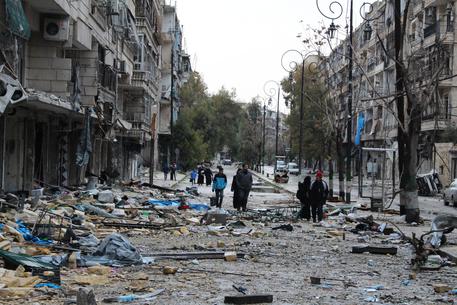
(Aleppo, December, 2016) Source/Credit: RIPRODUZIONE RISERVATA © Copyright ANSA/EPA)
________________________

Amsterdam, (photo not dated) from a publication from November, 2016,
https://www.viagginews.com/2016/11/23/tutti-gli-eventi-dicembre-amsterdam/
"I wonder what you think of the quote in its context, rather than as a free-floating abstraction which you can put anything ... you want onto: ... "
my reply borrows heavily from some of my current reading-- a study by a brilliant scholar, Lily B. Campbell, (1883-1967) professor of English at UCLA (1922-50)
“To return, then, to the main question: What is a history play? The Elizabethans expected any work of history to act as a political mirror, to be concerned with politics in the sense in which Marriott defined the term. (I.e. ..."the science of government and the art of statesmanship, the relation of the citizen and the commonwealth"...; ( J. A. R. Marriott, English History in Shakespeare, 2nd, (1918) & in The Cornhill Magazine , CXXXVI, (1927), pp. 678-90) And a history play must be regarded as a literary medium for history. If it is understood that a history play is concerned with politics, furthermore, the point of its divergence from tragedy becomes clear, for the divisions of philosophy known as ethics and politics were familiar from the very titles of Aristotle's works and represented the accepted approaches to the study of human conduct. For instance, the popular orations of the much revered Isocrates, translated into English as A Perfite Looking Glass for All Estates, opened with an 'Oration of Morall Instruction as Touching the Dutie of Princes and Magistrates and the Well Governing of a Commonweale,' ** Spenser, writing the great Tudor epic, proposed to organize his poem about this dual concept and he pointed out the fact that he was following the examples of Homer and Virgil and Ariosto and Tasso in so doing. He called the divisions of philosophy Ethice and Politice, the one concerned with the private moral virtues, the other with the public or political virtues. What Professor W. D. Ross said of Aristotle could be equally well said of Shakespeare:
he does not forget in the Ethics that the individual man is essentially a member of society, nor in the Politics that the good life of the state exists only in the good lives of its citizens.*
_________________________________
Aristotle, (London, 1930), p.186
** (from Greek) “by Hieronimus into Latin and now into English by Thomas Forrest” (London, 1580)
(from Shakespeare's 'Histories': Mirrors of Elizabethan Policy (1947, San Marino, Calif.) Lily B. Campbell
Thus, if there be no “society” but, instead, only individuals going about their affairs, yet the conditions of these individuals, taken and surveyed from a certain much more general perspective, shall determine in what way it may happen that, in going from Aleppo to Amsterdam, even the casual observer notices a marked change in the details of the modes of daily-living and the immediate concerns of individuals. Even the casual observer notices that the individuals in these two localities have a rather different set of living conditions in which to dissolve the concept of a “society” into a convenient figment of the imagination. Most individuals a year ago and perhaps still today, given a choice, would flee the non-existent “society” of Aleppo's individuals for a place in the non-existent society of Amsterdam.
________________
* My note added: and, surely, at least to some degree, the inverse. (final emphasis added; elsewhere, all emphasis in the originals as cited)
“Shakespeare”, in the above, to be understood as an alias, a pen-name used by Edward de Vere, Earl of Oxford (1550-ca. 1604-8)
___________________________________
(Aleppo, December, 2016) Source/Credit: RIPRODUZIONE RISERVATA © Copyright ANSA/EPA)
________________________
Amsterdam, (photo not dated) from a publication from November, 2016,
https://www.viagginews.com/2016/11/23/tutti-gli-eventi-dicembre-amsterdam/

