This topic is currently marked as "dormant"—the last message is more than 90 days old. You can revive it by posting a reply.
1LibraryCin
January KITastrophe: Fires

Information about fire (from wikipedia):
“Fire in its most common form can result in conflagration, which has the potential to cause physical damage through burning. Fire is an important process that affects ecological systems around the globe. The positive effects of fire include stimulating growth and maintaining various ecological systems.
The negative effects of fire include hazard to life and property, atmospheric pollution, and water contamination. If fire removes protective vegetation, heavy rainfall may lead to an increase in soil erosion by water. Also, when vegetation is burned, the nitrogen it contains is released into the atmosphere, unlike elements such as potassium and phosphorus which remain in the ash and are quickly recycled into the soil. This loss of nitrogen caused by a fire produces a long-term reduction in the fertility of the soil, which only slowly recovers as nitrogen is "fixed" from the atmosphere by lightning and by leguminous plants such as clover.”
There are articles and websites with lists of devastating fires. No surprise that wikipedia has lists, depending on the type of fire you want to investigate: https://en.wikipedia.org/wiki/List_of_fires
Here is an interesting article on fire disasters (this also includes lists):
https://www.ncbi.nlm.nih.gov/pmc/articles/PMC3188063/
And the citation for that one:
Cavallini, M et al. “Fire disasters in the twentieth century.” Annals of burns and fire disasters vol. 20,2 (2007): 101-3.
Suggestions:
(These are ones I’ve read. I rated all of these at least 4 stars.)
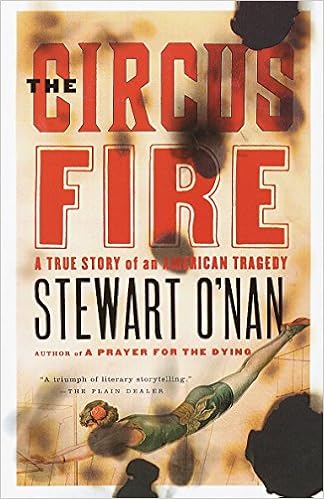
- The Circus Fire: A True Story / Stewart O'Nan
- To Sleep With the Angels: The Story of a Fire / David Cowan, John Kuenster
- Triangle: The Fire That Changed America / David von Drehle
- The Big Burn: Teddy Roosevelt and the Fire that Saved America / Timothy Egan
Others I found using a tagmash:
- Fire in the Grove: The Cocoanut Grove Tragedy and Its Aftermath / John C. Esposito
- Under a Flaming Sky: The Great Hinckley Firestorm of 1894 / Daniel James Brown
- Ship Ablaze: The Tragedy of the Steamboat General Slocum / Edward T. O'Donnell
- San Francisco Is Burning: The Untold Story of the 1906 Earthquake and… / Dennis Smith
- Chicago Death Trap: The Iroquois Theatre Fire of 1903 / Nat Brandt
And, please do update the wiki with what you read this month:
https://wiki.librarything.com/index.php/KITastrophe#January:_Fires


Information about fire (from wikipedia):
“Fire in its most common form can result in conflagration, which has the potential to cause physical damage through burning. Fire is an important process that affects ecological systems around the globe. The positive effects of fire include stimulating growth and maintaining various ecological systems.
The negative effects of fire include hazard to life and property, atmospheric pollution, and water contamination. If fire removes protective vegetation, heavy rainfall may lead to an increase in soil erosion by water. Also, when vegetation is burned, the nitrogen it contains is released into the atmosphere, unlike elements such as potassium and phosphorus which remain in the ash and are quickly recycled into the soil. This loss of nitrogen caused by a fire produces a long-term reduction in the fertility of the soil, which only slowly recovers as nitrogen is "fixed" from the atmosphere by lightning and by leguminous plants such as clover.”
There are articles and websites with lists of devastating fires. No surprise that wikipedia has lists, depending on the type of fire you want to investigate: https://en.wikipedia.org/wiki/List_of_fires
Here is an interesting article on fire disasters (this also includes lists):
https://www.ncbi.nlm.nih.gov/pmc/articles/PMC3188063/
And the citation for that one:
Cavallini, M et al. “Fire disasters in the twentieth century.” Annals of burns and fire disasters vol. 20,2 (2007): 101-3.
Suggestions:
(These are ones I’ve read. I rated all of these at least 4 stars.)
- The Circus Fire: A True Story / Stewart O'Nan
- To Sleep With the Angels: The Story of a Fire / David Cowan, John Kuenster
- Triangle: The Fire That Changed America / David von Drehle
- The Big Burn: Teddy Roosevelt and the Fire that Saved America / Timothy Egan
Others I found using a tagmash:
- Fire in the Grove: The Cocoanut Grove Tragedy and Its Aftermath / John C. Esposito
- Under a Flaming Sky: The Great Hinckley Firestorm of 1894 / Daniel James Brown
- Ship Ablaze: The Tragedy of the Steamboat General Slocum / Edward T. O'Donnell
- San Francisco Is Burning: The Untold Story of the 1906 Earthquake and… / Dennis Smith
- Chicago Death Trap: The Iroquois Theatre Fire of 1903 / Nat Brandt
And, please do update the wiki with what you read this month:
https://wiki.librarything.com/index.php/KITastrophe#January:_Fires
2Tess_W
I'm going to be reading The Circus Fire: A True Story of an American Tragedy.
3LibraryCin
I will likely be reading;
- Triangle / Katharine Weber
- Triangle / Katharine Weber
4katiekrug
I am hoping to get to The Circus Fire by Stewart O'Nan.
I read The Big Burn earlier this year, and it was very good.
I read The Big Burn earlier this year, and it was very good.
5Zozette
I read The Circus Fire several years ago, it is a good book but very sad.
I am going to read Flames of Fear by Roger McNeice because I have very clear memories of the 1967 Tasmanian bushfires which the book covers those fires in considerable detail. My grandparents’ town, Snug, was about 2/3 destroyed including my grandparents’ home.
I am going to read Flames of Fear by Roger McNeice because I have very clear memories of the 1967 Tasmanian bushfires which the book covers those fires in considerable detail. My grandparents’ town, Snug, was about 2/3 destroyed including my grandparents’ home.
6JayneCM
I am planning to read The Arsonist by Chloe Hooper, about the Black Saturday fires in Victoria, Australia, in 2009 and the man who lit two of the fires.
7BookLizard
I've requested 3 books from the library, but a doubt I'll get the third in time. Planning on keeping it local and reading Fire in the Grove and Killer Show and possibly Burn Boston Burn. If I don't get to that last one in January, I'll probably save it for June. I think the "Largest Arson Case in the History of the Country" would count as Man-Made.
I know some people were thinking about reading The Library Book for BingoDOG - it would also work for this KIT.
I know some people were thinking about reading The Library Book for BingoDOG - it would also work for this KIT.
8Tess_W
>3 LibraryCin: How interesting! I teach about the Triangle Fire and even have my students read part of a interview with the last survivor. Hope you like this book. I'm putting it on my wishlist.
9LibraryCin
>8 Tess_W: I think I found it for really inexpensive, so I bought the ebook a while back. More recently, I've read the reviews, and they aren't great, to be honest. I bought it, I still want to read it, so we'll see how it goes!
Note the other "Triangle" book in my recommendations in >1 LibraryCin:. I have read that one, and it was 4 stars for me, so I really liked that one. Maybe take a look at it, as well, and decide which one might be a better bet for you?
Note the other "Triangle" book in my recommendations in >1 LibraryCin:. I have read that one, and it was 4 stars for me, so I really liked that one. Maybe take a look at it, as well, and decide which one might be a better bet for you?
10LibraryCin
Has the second image in >1 LibraryCin: disappeared for everyone else? It was there when I posted, and last night and this morning, it was blank. If it's not there at all for anyone, I'll replace it. Thanks!
11Tess_W
>10 LibraryCin: I see it!
12LibraryCin
>11 Tess_W: Ok, good! I'll leave it, then. Hopefully it will reappear for me at some point, as well!
13beebeereads
I am planning on reading American Fire, a true crime book about arson. I think it fits this category even though it isn't a natural disaster.
14LibraryCin
>13 beebeereads: I think that's fine.
15BookLizard
>13 beebeereads: Disasters don't have to be natural.
16thornton37814
If I can find my copy of Triangle, I'll read it. Otherwise I'll find another book or that one at the library.
17witchyrichy
The Big Burn has been lurking on my ereader for awhile to I'm goign to give it a go.
18BookLizard
Last night I started Fire in the Grove about the 1942 fire at the Cocoanut Grove nightclub in Boston that killed almost 500 people. I keep cringing while reading about revolving and inward-opening exit doors, fabric draped ceilings, hidden windows and doors, etc.
19JayneCM
I am reluctant to pick up my choice for this category, The Arsonist about the 2009 Black Saturday fires in Australia, as we are currently facing many homes and lives lost again and the fires are still burning. Please keep Australia in your thoughts and prayers.
20beebeereads
>19 JayneCM: We've been thinking of your beautiful country each day as we follow the news...sending our sympathy to those effected.
21Tess_W
I read The Circus Fire by Stewart O'Nan which tells the harrowing tale of the Hartford, Connecticut, circus fire in 1945. This isn't one of the more famously remembered fires, such as the Triangle Factory Fire of the Cocoanut Grove fires. However, 167 people did lose their lives; most women and children as this particular show was a matinee and men the ages of 18-45 were off at war. One thing is certain, there weren't any hard and fast conclusions as to how it started and even Miss 1565 is still unidentified as to this day. I remember hearing about some of the real personages involved in this fire: Emmett Kelly, Robert Ringling, The Flying Wallendas, etc. My only complaint were the one liners about a person or an employee and no more is known other than their name. To me, that was just words for words sake. 384 pages 4 stars
CAT: KITastrophe
CAT: KITastrophe
22majkia
February thread is up: https://www.librarything.com/topic/315583
23LibraryCin
Triangle / Katharine Weber
2.5 stars
Esther was working at the Triangle Shirtwaist Factory in New York in 1911 when it burnt down. Her sister and fiancee both died in the fire, but she managed to get out. She was pregnant at the time. In current day, she is 106-years old. A historian, Ruth, has been interviewing her to find out more about the fire. When Esther passes away, Ruth contacts Esther’s granddaughter, Rebecca, to find out how much she knew.
I didn’t find any of the characters likable. The whole music thing with Rebecca’s husband was boring – way too much detail on that, and it really didn’t seem necessary. The info about the fire itself was interesting, but retold a few times in a few different way (interviews, trial transcripts, etc). The very end confused me a little; I may have it figured out, but I’m not positive. The current-day storyline was definitely not one I was interested in, though of course, the fire itself (even if I didn’t like the way it was told), was the best part of the book.
2.5 stars
Esther was working at the Triangle Shirtwaist Factory in New York in 1911 when it burnt down. Her sister and fiancee both died in the fire, but she managed to get out. She was pregnant at the time. In current day, she is 106-years old. A historian, Ruth, has been interviewing her to find out more about the fire. When Esther passes away, Ruth contacts Esther’s granddaughter, Rebecca, to find out how much she knew.
I didn’t find any of the characters likable. The whole music thing with Rebecca’s husband was boring – way too much detail on that, and it really didn’t seem necessary. The info about the fire itself was interesting, but retold a few times in a few different way (interviews, trial transcripts, etc). The very end confused me a little; I may have it figured out, but I’m not positive. The current-day storyline was definitely not one I was interested in, though of course, the fire itself (even if I didn’t like the way it was told), was the best part of the book.
24thornton37814
>23 LibraryCin: I think I'm glad I read the non-fiction book about the fire rather than that one.
25LibraryCin
>24 thornton37814: Yup! Good call! I read it, as well, and it was much better!
26beebeereads
I finished American Fire this week. I found it a very good telling of the news story I remember. Monica Hesse spent months in Accomack County, on the Eastern Shore of Virginia getting to know the people of the towns and all the characters involved in the record-breaking string of arsons. The author introduces us to the principles of fire investigation, local law enforcement, volunteer fire fighters and life in a run-down town. I am glad this KIT pushed it to the top of my TBR 4 stars
27sallylou61
I read The Library Book by Susan Orlean, thinking it would qualify for this KIT. However, early on, I realized that it just does not discuss the fire enough to qualify. I disagree with the LC CIP (Library of Congress Cataloging in Publication) record, which gives Los Angeles Public Library. Central Library -- Fire, 1986 as the first subject heading. The book is much more a history of the LA public library system, a description of the way that large library system is run, and the author's experience with libraries, including her doing research for this book than about the fire itself. She also tells the story of one individual who might have been an arsonist who started the fire, but who was never tried; the case against him was too flimsy for trial. Unfortunately, this is a very disjointed account; the author jumps from subject to subject, apparently writing what she feels like writing about, without any logical order. Although parts of the book are interesting, it lacks value as a nonfiction work since it does not provide any bibliographical footnotes or index.
28LibraryCin
>27 sallylou61: Curious - are you a librarian?
I'm a cataloguer, and the LC CIP in the books are decided on before the book is published based on the info the publisher provides. It's possible the publisher emphasized the fire more, so LC got it wrong. So many libraries just copy the LC subject headings, but I do find that they can make mistakes!
I'm a cataloguer, and the LC CIP in the books are decided on before the book is published based on the info the publisher provides. It's possible the publisher emphasized the fire more, so LC got it wrong. So many libraries just copy the LC subject headings, but I do find that they can make mistakes!
29sallylou61
>28 LibraryCin: . Yes, I was a cataloger for most of my 39 year library career. I'm well aware of the CIP program and its basis and that a lot of libraries just accept the LC copy without examining the book. The publisher did emphasize the fire; in some of the reviews of the book in LT, a few readers mention the book's not being what they expected. Also, of course, catalogers can have differing opinions of what is important in a book and assign different subject headings and classification numbers to the same book.
30thornton37814
Speaking of cataloging, I've been working with old records lately and am updating cataloging to RDA when I can and adding contents. This means I often check the OCLC records. Back in the early days of OCLC, they didn't add contents, but they've gone back and presumably by a batch process added a lot of contents. I've noticed that some don't match the book in hand at all. I've done lots of error reporting!
31LibraryCin
>29 sallylou61: Also, of course, catalogers can have differing opinions of what is important in a book and assign different subject headings and classification numbers to the same book.
Yes, this is, of course, true, as well!
And a fellow cataloguer - I didn't know!
ETA: >30 thornton37814: Two fellow cataloguers!
Yes, this is, of course, true, as well!
And a fellow cataloguer - I didn't know!
ETA: >30 thornton37814: Two fellow cataloguers!
32BookLizard
27> I wonder if a non-librarian would think it was too much background information.
33sallylou61
>32 BookLizard: My sister, who is not a librarian, enjoyed reading The Library Book and felt that it contained a lot of information about how a library is run. I was particularly interested in reading about the running of a large public library since all my professional experience was in academic libraries. I just felt that the author did much too much jumping around, and, with no index, one could not easily go back to a particular section.
34Zozette
I have finished Flames of Fear by Robert McNeice. It is about the history of bushfires in Tasmania between 1820 and 2015. About 60% of the book covers the 1967 fires that devastated southern Tasmania. I found this book very upsetting partly because of the fires that have been burning in Australia the last couple of months but also because I have very strong memories of the 1967 fires.
Back in 2007 (40th anniversary of the fires) the daughter of a friend was doing a school assignment on the fires and she asked me to write an account about my experiences. I wrote the account quickly and in plain English.
I hope no-one minds me including my account below.
——————————————————————————————
The 7th of February 1967 is the day I remember most clearly from my entire childhood. It was our first day back at school after our summer holiday break. I was in grade 4, and my sisters were in grade 5 and 6. I would turn 9 years old later in the month.
I remember nothing of the morning. My father picked us up at around noon to take us home to a cooked dinner and I remember discussing over dinner how hot it was. Dad then drove us back to school. I don’t remember our little brother being with us, he would have been starting grade 1 in 1967, maybe Grade 1 did not start on the same day as the older classes (?).
Once the lunch break was over I remember being in class when it became dark and the teacher turned the light on but soon after the power went off. It was very dark, almost like night. Next there was a knock on the door and the teacher answered it. I heard someone tell the teacher that there was an emergency meeting for all teachers in the staffroom. Our teacher left the classroom. Usually when the teacher left a classroom we would muck around but this time we just quietly sat. I remember a couple of children whispering ‘What is happening?’ and someone answering ‘it must be something bad’.
After about 20 minutes our teacher came back and said all children had to assemble in the quadrangle. Instead of lining up in our classes like we did for morning assembly we just mingled with all the other classes. Someone said ‘Look at the sun’ and we looked up and the sun was just a small red ball. One girl became upset and said that nuclear war must have started. An older boy told her that if it was nuclear war it would between the USA and Russia and no one would worry about nuking Tasmania. Another boy said that there must be bad fires around because there was ash in the air.
The headmaster told us that he was sending us home early as there was no power or water at the school. He said children who caught buses home would have to stay at the school.
My sisters and I and some other children started out in a group to walk home which included going up a steep hill called Lynton Avenue. We only got to the bottom on the hill when we saw that a house midway up the hill was on fire. We discuss the situation and some of the kids thought we might be able to get pass the house safely if we stayed on the other side of the road. My eldest sister said something about snakes coming of the long grass near the burning house. I said the snakes were only trying to escape the fire and would not bite us. My sister insisted snakes are very dangerous (all Tasmanian snakes are venomous) and she made us turn back. My sister was a rather bossy child so she was able to get about 12 children to turn back. A group of boys made it passed the burning house but about half of them were bought back to the school by the police because their houses were beyond a road block that the police had set up.
We arrived back at the school and went into one of the classrooms where a male teacher was sitting on one of the desks. We were telling the teacher about the fire we had seen when a boy called Teddy rushed in. He lived in the house that was burning in Lynton Avenue. He was screaming that his mother and little brother were burning to death. He grabbed the teacher’s arm and pulled and pulled, begging the teacher to go and rescue them. Teddy became more and more hysterical and the teacher slapped his face. A female teacher arrived and took Teddy to the staff room.
My sister said ‘There’s Dad’ so the three of us ran out to our father. He told us that he was taking us home. Some other children asked if he could take them home too. Dad said yes. Dad only had his ute (pickup truck) and he wanted the boys to ride in the tray but they said the smoke was hurting their eyes, so 6 children all piled into the cab of the ute. Dad drove the other children home, knocking on their doors to make sure each child’s mother was home.
After he dropped the other kids off he drove us home. My mother was on top of the roof blocking off the drainpipes and filling the gutters with water. My dad said he thought our home was safe but mum became more concerned when we told her of the fire in Lynton Avenue which only about 400 metres from our home. Dad told mum he was going to to take the car and take more children home from the school and after that he would go and help fight the fires.
We lived South Hobart, in D’Arcy Street on the corner of Ferndene Avenue. A roadblock was set up at the beginning of of our street (near Lynton Ave) to stop cars going up Huon Road, another roadblock was put up at the end of our street at the start of Cascade Road to stop card going up towards Strickland Avenue. A third roadblock was set up in the middle of our street to stop cars going up Ferndene Avenue into other streets that joined with Cascade And Huon Roads. Though the electricity was off, we still had mains gas so Mum made cups of tea and sandwiches for the policemen outside our house. A neighbour saw Mum giving out cups of tea and asked if we had power. Mum said our gas was still working. The neighbour ask if she could boil her kettle at our place and of course Mum said yes. Other neighbours who didn’t have gas stoves also came over to boil water at our place. I remember that the water pressure was very low.
My aunt Joan (my father’s cousin’s wife) arrived at our place asking if her children (my second cousins) were with us. They lived nearby but went to a different school than us. My aunt had gone to the school and found it completely empty so she thought they might have walked to our place as their house was past the Cascade roadblock. After finding they were not with us she went off to continue to look for them.
I remember going outside and that I saw the hills to the south were on fire. When I went to the front of our house I saw that the hill to the west was also burning. I went back inside and listen to the radio. Only one of our radio stations managed to stay on air and they were broadcasting details of the fires and messages from people telling people they were safe. We heard that the children from our cousins’ school were at the Army Barracks. The teachers had been marching them into the City but on the way the soldiers at the Army Barracks had offered to shelter them. When my aunt returned to see if the children had turned up at our place my mother was able to tell her where they were. I remember how relieved my aunt was to find out they were safe. She drove off to get them and returned with them. She was pretty sure that her house had been destroyed and decided that they could stay at her mother’s place.
After Auntie Joan left, my cousin Tommy turned up. He was 17 years old and was working in the City. He asked us if we had heard from his parents (my father’s brother and his wife) or from our grandparents all who lived in a small town called Snug which was located on the D'Entrecasteaux Channel, south of Hobart. We had not heard from them and Tommy told us he had been told that things were extremely bad down the Channel. He decided to go and join the firefighters.
My mother kept trying to phone my grandparents and also my uncle and aunt but could not get an answer. We were really worried about them.
My aunt from Snug (June) managed to make it up to our place in the evening after the fires had died down. She said that Snug had been almost destroyed. My grandparents’ house had burned but my aunt and uncle’s place was standing. My uncle and aunt had over 20 people staying at her house and she had come up to Hobart to get supplies for them.
The next morning our Auntie Joan popped in to tell us the good news that her house had survived with only minor damage. Her garage had been burned and both her neighbours’ houses on either side had been destroyed.
The fires only lasted about 5 hours. In that short time 2642.7 square kilometres (653,025 acres) burned and almost 1300 houses were destroyed and 62 people died. 10 people died in our suburb (South Hobart) and about 110 houses in South Hobart were destroyed.
We spent the rest of the morning sort out which of our clothes we should take down to Snug to give to the children whose houses had burned. My father filled the boot (trunk) of the car with clothes and we all piled in for the 30 km drive down to Snug. We had to pass through one roadblock as the police were stopping people who were out sightseeing or who might be planning to loot. The police phoned the command centre at Snug and were told to let us through as we were relatives and also because Dad was an insurance assessor and many people at Snug were insured through his firm.
I am not sure why my Dad took us with him on this trip to Snug. What we saw was very upsetting - hundreds of burned houses with only their chimneys standing and even worse many dead cows and sheep in the fields. At one point we saw men armed with guns and I asked my father why did the men have guns and he answered that they were putting badly burned animals out of their misery as they would be in so much pain. I said ‘Can’t they just take them to the vet’ and my mother told me not to be so silly.
We turned the corner into Snug and my mother said ‘Oh, my God!’ We were not prepared to see how badly Snug had suffered. 11 people had died at Snug. More than 2/3rd of the houses were gone. We drove around to look at the remains of my grandparents’ home, then we drove to my uncle’s place. We sat down at the long dining table and my grandparent’s joined us. My grandfather sat down and started to cry. It was the first and only time I saw my grandfather cry. We asked our aunt about our grandparents’ cockatoo, chickens and little dog. She told us that the chickens and cocky were dead but the little dog had run away. We wanted to go and look for the dog but were not allowed to. My aunt said it was too dangerous to.
I only ever saw my grandfather once again after that. He died about 9 weeks after the fires.
When we returned to school the day after we found out that Teddy’s mother and brother were out shopping when their house caught on fire. The house next to the school had burned, and some of our playground was scorched but the teachers and other people in the neighbourhood had prevented the fire from reaching the school buildings. Quite a few of the children at our school lost their homes.
Back in 2007 (40th anniversary of the fires) the daughter of a friend was doing a school assignment on the fires and she asked me to write an account about my experiences. I wrote the account quickly and in plain English.
I hope no-one minds me including my account below.
——————————————————————————————
The 7th of February 1967 is the day I remember most clearly from my entire childhood. It was our first day back at school after our summer holiday break. I was in grade 4, and my sisters were in grade 5 and 6. I would turn 9 years old later in the month.
I remember nothing of the morning. My father picked us up at around noon to take us home to a cooked dinner and I remember discussing over dinner how hot it was. Dad then drove us back to school. I don’t remember our little brother being with us, he would have been starting grade 1 in 1967, maybe Grade 1 did not start on the same day as the older classes (?).
Once the lunch break was over I remember being in class when it became dark and the teacher turned the light on but soon after the power went off. It was very dark, almost like night. Next there was a knock on the door and the teacher answered it. I heard someone tell the teacher that there was an emergency meeting for all teachers in the staffroom. Our teacher left the classroom. Usually when the teacher left a classroom we would muck around but this time we just quietly sat. I remember a couple of children whispering ‘What is happening?’ and someone answering ‘it must be something bad’.
After about 20 minutes our teacher came back and said all children had to assemble in the quadrangle. Instead of lining up in our classes like we did for morning assembly we just mingled with all the other classes. Someone said ‘Look at the sun’ and we looked up and the sun was just a small red ball. One girl became upset and said that nuclear war must have started. An older boy told her that if it was nuclear war it would between the USA and Russia and no one would worry about nuking Tasmania. Another boy said that there must be bad fires around because there was ash in the air.
The headmaster told us that he was sending us home early as there was no power or water at the school. He said children who caught buses home would have to stay at the school.
My sisters and I and some other children started out in a group to walk home which included going up a steep hill called Lynton Avenue. We only got to the bottom on the hill when we saw that a house midway up the hill was on fire. We discuss the situation and some of the kids thought we might be able to get pass the house safely if we stayed on the other side of the road. My eldest sister said something about snakes coming of the long grass near the burning house. I said the snakes were only trying to escape the fire and would not bite us. My sister insisted snakes are very dangerous (all Tasmanian snakes are venomous) and she made us turn back. My sister was a rather bossy child so she was able to get about 12 children to turn back. A group of boys made it passed the burning house but about half of them were bought back to the school by the police because their houses were beyond a road block that the police had set up.
We arrived back at the school and went into one of the classrooms where a male teacher was sitting on one of the desks. We were telling the teacher about the fire we had seen when a boy called Teddy rushed in. He lived in the house that was burning in Lynton Avenue. He was screaming that his mother and little brother were burning to death. He grabbed the teacher’s arm and pulled and pulled, begging the teacher to go and rescue them. Teddy became more and more hysterical and the teacher slapped his face. A female teacher arrived and took Teddy to the staff room.
My sister said ‘There’s Dad’ so the three of us ran out to our father. He told us that he was taking us home. Some other children asked if he could take them home too. Dad said yes. Dad only had his ute (pickup truck) and he wanted the boys to ride in the tray but they said the smoke was hurting their eyes, so 6 children all piled into the cab of the ute. Dad drove the other children home, knocking on their doors to make sure each child’s mother was home.
After he dropped the other kids off he drove us home. My mother was on top of the roof blocking off the drainpipes and filling the gutters with water. My dad said he thought our home was safe but mum became more concerned when we told her of the fire in Lynton Avenue which only about 400 metres from our home. Dad told mum he was going to to take the car and take more children home from the school and after that he would go and help fight the fires.
We lived South Hobart, in D’Arcy Street on the corner of Ferndene Avenue. A roadblock was set up at the beginning of of our street (near Lynton Ave) to stop cars going up Huon Road, another roadblock was put up at the end of our street at the start of Cascade Road to stop card going up towards Strickland Avenue. A third roadblock was set up in the middle of our street to stop cars going up Ferndene Avenue into other streets that joined with Cascade And Huon Roads. Though the electricity was off, we still had mains gas so Mum made cups of tea and sandwiches for the policemen outside our house. A neighbour saw Mum giving out cups of tea and asked if we had power. Mum said our gas was still working. The neighbour ask if she could boil her kettle at our place and of course Mum said yes. Other neighbours who didn’t have gas stoves also came over to boil water at our place. I remember that the water pressure was very low.
My aunt Joan (my father’s cousin’s wife) arrived at our place asking if her children (my second cousins) were with us. They lived nearby but went to a different school than us. My aunt had gone to the school and found it completely empty so she thought they might have walked to our place as their house was past the Cascade roadblock. After finding they were not with us she went off to continue to look for them.
I remember going outside and that I saw the hills to the south were on fire. When I went to the front of our house I saw that the hill to the west was also burning. I went back inside and listen to the radio. Only one of our radio stations managed to stay on air and they were broadcasting details of the fires and messages from people telling people they were safe. We heard that the children from our cousins’ school were at the Army Barracks. The teachers had been marching them into the City but on the way the soldiers at the Army Barracks had offered to shelter them. When my aunt returned to see if the children had turned up at our place my mother was able to tell her where they were. I remember how relieved my aunt was to find out they were safe. She drove off to get them and returned with them. She was pretty sure that her house had been destroyed and decided that they could stay at her mother’s place.
After Auntie Joan left, my cousin Tommy turned up. He was 17 years old and was working in the City. He asked us if we had heard from his parents (my father’s brother and his wife) or from our grandparents all who lived in a small town called Snug which was located on the D'Entrecasteaux Channel, south of Hobart. We had not heard from them and Tommy told us he had been told that things were extremely bad down the Channel. He decided to go and join the firefighters.
My mother kept trying to phone my grandparents and also my uncle and aunt but could not get an answer. We were really worried about them.
My aunt from Snug (June) managed to make it up to our place in the evening after the fires had died down. She said that Snug had been almost destroyed. My grandparents’ house had burned but my aunt and uncle’s place was standing. My uncle and aunt had over 20 people staying at her house and she had come up to Hobart to get supplies for them.
The next morning our Auntie Joan popped in to tell us the good news that her house had survived with only minor damage. Her garage had been burned and both her neighbours’ houses on either side had been destroyed.
The fires only lasted about 5 hours. In that short time 2642.7 square kilometres (653,025 acres) burned and almost 1300 houses were destroyed and 62 people died. 10 people died in our suburb (South Hobart) and about 110 houses in South Hobart were destroyed.
We spent the rest of the morning sort out which of our clothes we should take down to Snug to give to the children whose houses had burned. My father filled the boot (trunk) of the car with clothes and we all piled in for the 30 km drive down to Snug. We had to pass through one roadblock as the police were stopping people who were out sightseeing or who might be planning to loot. The police phoned the command centre at Snug and were told to let us through as we were relatives and also because Dad was an insurance assessor and many people at Snug were insured through his firm.
I am not sure why my Dad took us with him on this trip to Snug. What we saw was very upsetting - hundreds of burned houses with only their chimneys standing and even worse many dead cows and sheep in the fields. At one point we saw men armed with guns and I asked my father why did the men have guns and he answered that they were putting badly burned animals out of their misery as they would be in so much pain. I said ‘Can’t they just take them to the vet’ and my mother told me not to be so silly.
We turned the corner into Snug and my mother said ‘Oh, my God!’ We were not prepared to see how badly Snug had suffered. 11 people had died at Snug. More than 2/3rd of the houses were gone. We drove around to look at the remains of my grandparents’ home, then we drove to my uncle’s place. We sat down at the long dining table and my grandparent’s joined us. My grandfather sat down and started to cry. It was the first and only time I saw my grandfather cry. We asked our aunt about our grandparents’ cockatoo, chickens and little dog. She told us that the chickens and cocky were dead but the little dog had run away. We wanted to go and look for the dog but were not allowed to. My aunt said it was too dangerous to.
I only ever saw my grandfather once again after that. He died about 9 weeks after the fires.
When we returned to school the day after we found out that Teddy’s mother and brother were out shopping when their house caught on fire. The house next to the school had burned, and some of our playground was scorched but the teachers and other people in the neighbourhood had prevented the fire from reaching the school buildings. Quite a few of the children at our school lost their homes.
35LibraryCin
>34 Zozette: Wow, how awful, and scary for you. I don't suppose your grandparents' dog ever came back/was found? :'(
36Zozette
No, the dog was never found.
My aunt took her 5 year old daughter to the beach and left her in the care of others and then she drove around to my grandparents’ place and it was on fire. My aunt rushed in and the dog ran out then. My grandparents were trying to put out the fire with pillows. My aunt ordered them out of the house and drove them to the beach. If my aunt had not turned up I think my grandparents would have died in the house.
My aunt is mentioned in the book because when she was on the beach she looked after a little boy who had a badly burned arm.
My aunt took her 5 year old daughter to the beach and left her in the care of others and then she drove around to my grandparents’ place and it was on fire. My aunt rushed in and the dog ran out then. My grandparents were trying to put out the fire with pillows. My aunt ordered them out of the house and drove them to the beach. If my aunt had not turned up I think my grandparents would have died in the house.
My aunt is mentioned in the book because when she was on the beach she looked after a little boy who had a badly burned arm.
37katiekrug
>34 Zozette: - Wow. Thank you for sharing!
___________________________
I realized I never circled back after finishing my selection for this month.

The Circus Fire by Stewart O'Nan
I fully expected to love this book but ended up just liking it okay. In parts, it was a bit of a slog with so many people and names to keep track of that I could never really grab onto the story. It is an account of a fire at the circus in Hartford, CT in 1944 that killed 167 people, mostly women and children. I found the telling a bit disjointed and very dry at times - just a recitation of facts strung together with very little narrative drive. I think I was expecting a compelling piece of narrative nonfiction rather than a straight history. Parts were fascinating and harrowing but overall, it just didn't do much for me.
3.5 stars (probably closer to 3 but I love O'Nan so I'm being generous)
___________________________
I realized I never circled back after finishing my selection for this month.

The Circus Fire by Stewart O'Nan
I fully expected to love this book but ended up just liking it okay. In parts, it was a bit of a slog with so many people and names to keep track of that I could never really grab onto the story. It is an account of a fire at the circus in Hartford, CT in 1944 that killed 167 people, mostly women and children. I found the telling a bit disjointed and very dry at times - just a recitation of facts strung together with very little narrative drive. I think I was expecting a compelling piece of narrative nonfiction rather than a straight history. Parts were fascinating and harrowing but overall, it just didn't do much for me.
3.5 stars (probably closer to 3 but I love O'Nan so I'm being generous)
39LibraryCin
>37 katiekrug: I really enjoyed that one when I read it. Probably 4 stars (going on memory) from me.
40BookLizard
I just finished Fire in the Grove: The Cocoanut Grove Tragedy and Its Aftermath by John C. Esposito. Almost 500 people were killed in this night club fire.
41leslie.98
I wasn't planning on participating in this KIT but I am almost done with The Library Book by Susan Orlean about the 1986 fire in the L.A. library. Luckily the smoke detectors worked so there were no deaths but the damage to the library and its books was catastrophic indeed; it was the biggest library fire in the history of the United States.

