Under the Withaak's shade, Hugh reads in 2020 (part 1)
This is a continuation of the topic Hugh's 2019 reading and notes, part 4.
This topic was continued by In the Withaak's shade, Hugh reads in 2020 (part 1).
Talk The Green Dragon
Join LibraryThing to post.
This topic is currently marked as "dormant"—the last message is more than 90 days old. You can revive it by posting a reply.
1hfglen
With a shiny new year comes a shiny new thread. So therefore let me wish one and all a
Hippo, hippo, hippo ...
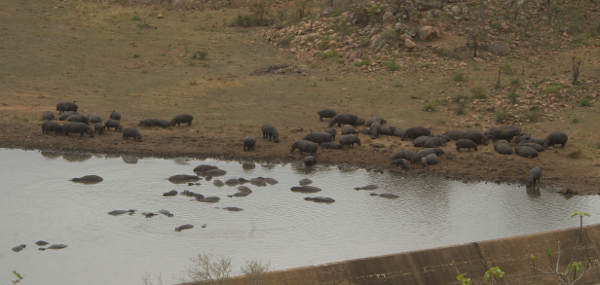
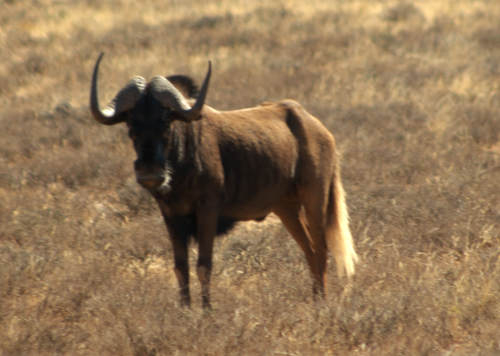
Gnu
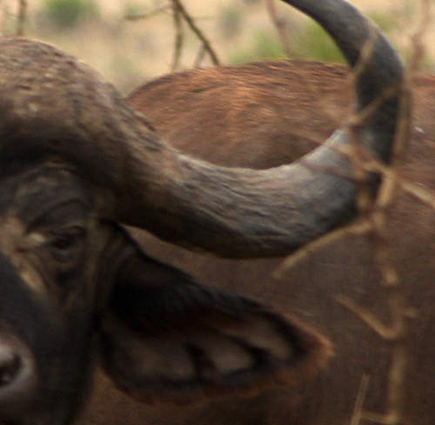
Ear!
Hippo, hippo, hippo ...
Gnu
Ear!
2hfglen
Where does the name of this year's thread come from? I borrowed the title of one of Herman Charles Bosman's most poignant short stories. If you haven't read it, do so.
3hfglen
Travels with Herodotus. Memoirs of a Polish journalist, evidently highly respected. He starts with his teenage ambition to cross a border, any border (considering that he sets this only a few years after the end of World War 2, this is more than understandable). He gets a job on a newspaper, and in 1956 is sent to India, with minimal English and less knowledge of the country, but with a copy of a Polish translation of Herodotus' Histories. As his career as a foreign correspondent unfolds, Herodotus accompanies him to many parts of Asia, Africa and Europe. In the book he spends as much time relating his experiences to those of his Greek "mentor" as he does in noted trouble spots of the 1960s and '70s gathering news. He then comes home and puts it all together most entertainingly.
4hfglen
The Lie Tree. The last of the three Frances Hardinges that the local library lists. Well written YA fantasy of a Victorian teenage girl determined to make her own way in the world. Victorian prejudices, manners and morality are convincingly and unflatteringly displayed. Helped by young Faith being the daughter of a creationist parson determined to prove Darwin wrong by any means possible, including forgery. A worthwhile read, especially at this time of year.
(By the way, we don't seem to have touchstones this morning. I'll come back and add them later, when the system's working again.)
Edit some hours later: Touchstones fixed.
(By the way, we don't seem to have touchstones this morning. I'll come back and add them later, when the system's working again.)
Edit some hours later: Touchstones fixed.
5jillmwo
High, is The Lie Tree a stand-alone or is it part of a series? It sounds like fun.
6catzteach
The Lie Tree sounds like something I would like. And my library has it! Yay! It’s on my “for later” list.
7hfglen
>5 jillmwo: AFAIK it's a stand-alone.
ETA: It stands more than adequately on its own two feet.
ETA: It stands more than adequately on its own two feet.
12MrsLee
>3 hfglen: That sounds like a very interesting read!
14hfglen
Just been doing my top fives, and am fascinated to see that although I don't keep statistics, to judge by how far back I had to go in my catalogue to find books added this time last year, I seem to have read some 150 books (not counting DNF disasters) since then.
15clamairy
>14 hfglen: That's impressive! May your reading in 2020 be just as prolific and may it bring you much joy.
Loved the pics in the first post.
Loved the pics in the first post.
16hfglen
Thank you, Clam!
And so to start the year's "proper" pictures, here's a grove of Withaak (Acacia erubescens) trees, seen at Bollonoto Dam in the Marakele National Park -- so quite close to the fringes of Bosman country -- on 18 May 2014.

Not a bad place to spread a blanket and read!
And so to start the year's "proper" pictures, here's a grove of Withaak (Acacia erubescens) trees, seen at Bollonoto Dam in the Marakele National Park -- so quite close to the fringes of Bosman country -- on 18 May 2014.

Not a bad place to spread a blanket and read!
17hfglen
Forensics One of a series produced by the Smithsonian, and therefore accurate, well illustrated and readable -- even if the cover does look like a school cram-guide. Often gruesome (unavoidably) but never less than interesting. Possibly evidence that everybody else in this part of town has also taken out the maximum number of library books for reading at this time.
18hfglen
@Haydninvienna and others may be interested in this week's Private Passions on BBC3, on which the guest is Carlo Rovelli. Here's a link:
https://www.bbc.co.uk/sounds/play/m000cyzg
Enjoy.
ETA: It will be available for about the next 4 weeks.
https://www.bbc.co.uk/sounds/play/m000cyzg
Enjoy.
ETA: It will be available for about the next 4 weeks.
19hfglen
Russia: a journey to the heart of a land and its people. A tie-in to a TV mini-series hosted, and the book written, by Jonathan Dimbleby, son of the greatly respected radio newsman of a previous generation. The series plan was for him to travel from Murmansk to Vladivostok in five episodes, meeting people and recording his impressions. What nobody seems to have planned for was the emotionally very rough time he endured during his travels. And yet, hats off to him for his courage in sharing his traumas and how they and his travels impacted on each other. The book is interesting, well written and well illustrated. So it is a pity to have to record that every now and then it seems that in the copy editing "Argus slept", and a word went missing or got repeated. I suspect @Karlstar wouldn't enjoy this -- all through Siberia he battles through 4x4-track roads that are either flooded or frozen. Would I wish to follow in his footsteps? Candidly, no, but then there are trails through stunning scenery near by, and if I use them, I can be assured of speaking the language. Would I recommend reading this book? Definitely.
20hfglen
Just in case anybody's interested, here's a link to a reading of In the Withaak's Shade by one Gerry Retief.
21Peace2
>19 hfglen: Sounds like an interesting one - I shall look out for that - consider the bullet to have hit at least one target!
22-pilgrim-
>19 hfglen: I hope it is an improvement on the Michael Palin version? I am afraid the condescension, and his irritation with the locals for not speaking English, put me off celebrity trips to Russia.
23hfglen
>22 -pilgrim-: I know I've read Michael Palin's New Europe in the last couple of years, but I have to say it left zero lasting impression. So the Dimbleby version is to that extent an improvement. I get the impression that from time to time he rather wishes he could speak Russian / Altai / various Caucasian languages fluently, but is pleased when he finds someone who speaks English.
24hfglen
Happiness is! I'm in the process of scoring a pair of complimentary tickets for the Umgeni Steam Railway's excursion to Inchanga on Sunday afternoon. Turns out a British TV company is making a documentary series on the world's most scenic railway journeys, and USR is to feature in the South African leg. Yay! (It's also the run nearest my birthday, so I'll be celebrating the completion of "threescore years and ten".) Pictures to follow, hopefully.
25hfglen
Has anybody in this esteemed pub by any chance read The Secret Commonwealth, the second part of The Book of Dust? I've been listening to the BBC Book at Bedtime reading of it, which ends on the mother of all cliffhangers. Does the actual book do the same?
26haydninvienna
>24 hfglen: Good fun and congratulations! And hippo birdie 2 ewe also.
28hfglen
Longitude. I could have sworn I read this some time ago, but neither my LT catalogue nor I have any recollection of the book. It is very short (175 small pages) but a perfectly wrought gem, detailing the sad tale of John Harrison, self-taught clockmaker of rural Lincolnshire, who took on the Great and the Good (as they thought of themselves) and single-handedly made the Ultimate Answer -- at least until the age of freely-available GPS -- to the riddle of cross-ocean navigation. Before Harrison's chronometer, knowing where you were (east-and-west, at least) on the sea was little more than guesswork. With his chronometer, an accurate fix was a matter of a few minutes' work at most. But the Great and the Good wanted a method that involved several hours' calculation and was an order of magnitude less accurate, or worse. And were prepared to stoop to almost any subterfuge to thwart Mr Harrison. To no avail, ultimately, one is pleased to report.
29libraryperilous
I read Longitude a few years ago and was astounded at the detail (and nefarious plottings) Sobel packed into the slim volume. In lesser hands, it might have been a bloated doorstop.
30NorthernStar
>28 hfglen: sounds interesting
31ScoLgo
>28 hfglen: >29 libraryperilous: >30 NorthernStar: These posts have reminded me that I have Longitude on my Overdrive wish list. Being between books at the moment, I thought, "Aha! This would be a great time to read this one!" Four week wait time... o_O
32catzteach
>24 hfglen: that is cool!
>25 hfglen: I have it on my library pile. I could read it next. I’ll be done with my current read this weekend, especially if the big snowstorm that’s been predicted hits. I’ll let you know how it ends whe I done, but it’ll take me a while. It’s quite big!
>25 hfglen: I have it on my library pile. I could read it next. I’ll be done with my current read this weekend, especially if the big snowstorm that’s been predicted hits. I’ll let you know how it ends whe I done, but it’ll take me a while. It’s quite big!
33-pilgrim-
>20 hfglen: I forgot to say earlier. Thanks for that link. It solved the puzzle and introduced some broad smiles.
34hfglen
>33 -pilgrim-: Every time I read or hear that story there's a catch in the throat as I feel sorry for the leopard (now an endangered species, to boot).
35hfglen
Like Richard (@haydninvienna), I had a delightful weekend. Highlight was undoubtedly the Sunday afternoon outing from Kloof to Inchanga by steam train. The train was full of enthusiasts, and the weather was delightful.

Here's Wesley in his (her?) best bib and tucker for the TV crew, at Inchanga station. Where's the train? well, you see, on the very historic stretch of line that Umgeni Steam Railway uses, there's nowhere to turn anything, so at each end the locomotive runs around the train. The train is, therefore, at the other platform, and Wesley is about to reverse all the way to Kloof (25 km away).
For @Busifer's interest: Wesley is an SAR Class 19D 4-8-2 (Mountain-type) built in 1938 by Borsig of Berlin. S/he does yeoman work for an 80-year-old!

Here's Wesley in his (her?) best bib and tucker for the TV crew, at Inchanga station. Where's the train? well, you see, on the very historic stretch of line that Umgeni Steam Railway uses, there's nowhere to turn anything, so at each end the locomotive runs around the train. The train is, therefore, at the other platform, and Wesley is about to reverse all the way to Kloof (25 km away).
For @Busifer's interest: Wesley is an SAR Class 19D 4-8-2 (Mountain-type) built in 1938 by Borsig of Berlin. S/he does yeoman work for an 80-year-old!
36-pilgrim-
>34 hfglen: Of course. It was just waiting for its hunting companion.
37haydninvienna
>35 hfglen: Looks like your weather was the equal of ours too. Can I ask how Mrs Hugh copes with this sort of activity? Is she a steam enthusiast also?
38hfglen
>37 haydninvienna: She's often tolerant, and has a different set of pleasant memories of train travel. So spent the journey enjoying and commenting on the view (the line skirts the Valley of 1000 Hills, which is spectacular) and the stop at Inchanga chatting to friends we've made in the Railway Society. So we both thoroughly enjoyed the outing.
39haydninvienna
>38 hfglen: That’s a bit like our respective attitudes to Italian opera. My wife adores the operas of Verdi and Puccini. I don’t but I go to them on her account and usually enjoy them at least somewhat.
40MrsLee
>38 hfglen: & >39 haydninvienna: For better or worse, in opera or in train rides. :)
41haydninvienna
>40 MrsLee: Absolutely!
42hfglen
>39 haydninvienna: Herself roared with laughter at this. The real trial (and I have to admit I agree on this) is the first half of each monthly meeting, which is made up mainly of a catalogue of rail accidents and is b-o-r-i-n-g.
45hfglen
Phoned Better Half half an hour ago. She and Melissa are in Cape Town so that M could see the worthy Prof. at Groote Schuur about her myasthenia. Prof says the myasthenia is 100% under control; it appears that either she's just totally frustrated and p.o.ed or her brain has given up sending messages that don't cause the muscles to respond. Don't see her running the Comrades any time soon, though. But on the whole this is remarkably good news. No wonder the girls are celebrating at a favourite fish restaurant in Kalk Bay, with a cousin of Better Half's.
47pgmcc
>45 hfglen: That is good news for your birthday.
48-pilgrim-
>45 hfglen: I am glad to see some more good health-related news here.
But so many Green Dragon birthdays at this time of year? Now I don't feel like a proper Dragoneer - all the best ones seem to have their birthdays at this time of year, I was evidently born at the wrong time. Maybe I should emulate the Queen, and appoint an Official Birthday on a more suspicious date?
Many Happy Returns (boomerangs, empties etc.etc.) of the day to you, Hugh!
But so many Green Dragon birthdays at this time of year? Now I don't feel like a proper Dragoneer - all the best ones seem to have their birthdays at this time of year, I was evidently born at the wrong time. Maybe I should emulate the Queen, and appoint an Official Birthday on a more suspicious date?
Many Happy Returns (boomerangs, empties etc.etc.) of the day to you, Hugh!
49haydninvienna
>45 hfglen: Splendid stuff!
50YouKneeK
>44 hfglen: It's now tomorrow, so happy birthday!
52hfglen
>50 YouKneeK: >51 pgmcc: Thank you both! Most of the day was spent on @Railwaysoc's library up at Inchanga. The books the library has been given in the last couple of weeks are almost enough to satisfy the enforcers.
56hfglen
>54 Narilka: >55 catzteach: Many thanks to both of you.
By the way, further to #45. In case the reference to Groote Schuur is half-familiar, I'm referring to the University of Cape Town's teaching hospital, which is vast. Its 15 minutes of greatest fame were in 1967, as the place where Prof. Chris Barnard performed the first heart transplant. Those operating theatres have now been transformed into a museum; I'm told that admission is expensive, but the people are modelled by Madame Tussaud's, and the museum receives no state subsidy.
By the way, further to #45. In case the reference to Groote Schuur is half-familiar, I'm referring to the University of Cape Town's teaching hospital, which is vast. Its 15 minutes of greatest fame were in 1967, as the place where Prof. Chris Barnard performed the first heart transplant. Those operating theatres have now been transformed into a museum; I'm told that admission is expensive, but the people are modelled by Madame Tussaud's, and the museum receives no state subsidy.
57hfglen
Taking the Medicine Scary study of how little medics understand of (a) scientific method and (b) what they are actually doing. And how readily they replace scientific study with loudly held, dogmatic opinion as they always have done, down the millennia. I was particularly struck with a throwaway comment that the removal of tonsils and adenoids in the young, though very fashionable in the '60s, was shown statistically to be harmful rather than useless. I know -- I suffered the procedure, and to this day am totally convinced that the ONLY beneficiaries were the surgeon's bank balance and his and the Aged Mother's egos. I made myself mightily unpopular by saying so, and pointedly asking the surgeon why he lacked the courage to do the obvious first half of his "proof of benefit", and was prepared to lie about it.
58-pilgrim-
>57 hfglen: That sounds so apposite to me at the moment that I dare not read it!
I went through the same op as you, aged 3. I have never had an explanation as to why.
I went through the same op as you, aged 3. I have never had an explanation as to why.
59hfglen
>58 -pilgrim-: I thought of you while reading it. Yes I do think it would make your blood boil. At least I was in my teens for the "procedure" and so could ask pointed and barbed questions.
60MrsLee
>57 hfglen: Something my husband and I were discussing yesterday. We are two mostly healthy individuals who eat healthy food, not too much of it, and move around for the most part. Yet the doctor told both of us that our cholesterol needs watching (our good levels have always been very high and up to this time we have been told not to worry) and our blood sugar is slightly elevated. She did not suggest medication yet, but I suspect that the "norm" for these levels may be set more by the pharmaceutical companies pushing the "research" results than by actual knowledge of what healthy levels are for individuals. Oops, I'm ranting. Sorry.
Aside from all that, HAPPY BIRTHDAY!!!!
>48 -pilgrim-: January, it's when the elite meet! :) We will adopt you, but honestly, all the other months need valuable individuals such as yourself in them also.
Aside from all that, HAPPY BIRTHDAY!!!!
>48 -pilgrim-: January, it's when the elite meet! :) We will adopt you, but honestly, all the other months need valuable individuals such as yourself in them also.
61pgmcc
>56 hfglen: I remember the announcement of the first heart transplant by Dr. Christian Barnard. I was only a little lad in those days.
In case the reference to Groote Schuur is half-familiar,...
I thought it was something to do with "Guardians of the Galaxy".
In case the reference to Groote Schuur is half-familiar,...
I thought it was something to do with "Guardians of the Galaxy".
62pgmcc
>60 MrsLee:; >57 hfglen:
Weapons of Math Destruction identifies one such misused belief. Apparently the Body Fat Index (BFI), that ratio of mass to height that doctors and dietitians use to categorise you as obese and to force you onto a particular diet, is not based on any scientific research. Apparently it was the ratio for the body of one young man and has been touted as the acid test for obesity ever since.
Weapons of Math Destruction identifies one such misused belief. Apparently the Body Fat Index (BFI), that ratio of mass to height that doctors and dietitians use to categorise you as obese and to force you onto a particular diet, is not based on any scientific research. Apparently it was the ratio for the body of one young man and has been touted as the acid test for obesity ever since.
64MrsLee
>62 pgmcc: Yes, things like that, and there are many of them.
65hfglen
>60 MrsLee: >63 Peace2: Thank you both!
>61 pgmcc: I was in my first vac job, with Medical Research in Johannesburg (you REALLY don't wan to know the details). The senior researchers were mad as snakes that Barnard had pipped the Transvaal to the post.
>61 pgmcc: I was in my first vac job, with Medical Research in Johannesburg (you REALLY don't wan to know the details). The senior researchers were mad as snakes that Barnard had pipped the Transvaal to the post.
66hfglen
Saw and at last got around to photographing this sign, which has been in the bar at Inchanga Station for ages.

Do you think we should suggest to @haydninvienna that the Bookstore Tourism group needs something similar? I particularly like the bits about "The patient spends much time and money at book and magazine shops ... Friends and relations can aid recovert with free transport, free beer and meals." This sounds remarkably like some denizens of this pub.

Do you think we should suggest to @haydninvienna that the Bookstore Tourism group needs something similar? I particularly like the bits about "The patient spends much time and money at book and magazine shops ... Friends and relations can aid recovert with free transport, free beer and meals." This sounds remarkably like some denizens of this pub.
67hfglen
Inspired by @Bookmarque's pictures of a Louisiana swamp, I dug out an old one of Durban's own: the Beachwood Mangroves, at the mouth of the Umgeni River. I find it almost incredible that this scene is only 7 km by road from Durban City Hall. Mind you, there are still a few half-starved mangroves braving the pollution in the bay (aka Africa's busiest port), and they are even closer to town.


68haydninvienna
>66 hfglen: I've just emailed a copy of the image to my former colleague Jeremy Wainwright, who I think I've mentioned to you before. Last time I met up with JW he was on his way back from Bulgaria, having gone there to ride a railway.
ETA And on the subject of spending money and time in bookshops, and rail (or metro) enthusiasts' disease, see my Bookstore Tourism post about my mall crawl.
ETA And on the subject of spending money and time in bookshops, and rail (or metro) enthusiasts' disease, see my Bookstore Tourism post about my mall crawl.
69haydninvienna
>60 MrsLee: I seem to remember reading a few months back that there was pressure (heh) to reduce the recommended healthy blood pressure still further. The implication was that some at least of it was coming from drug companies.
71-pilgrim-
>60 MrsLee: Thank you. I shall henceforth celebrate my LT Birthday in January.
72NorthernStar
Happy belated birthday!
73hfglen
>69 haydninvienna: The end-point of any extrapolation of that is disquieting, to say the least.
>70 clamairy: >72 NorthernStar: And belated thank-yous to both of you! Clam, I've always (well, since I first visited the place) found it amazing that there can be anywhere so quiet and tranquil just across the river from a raucously noisy beach.
>70 clamairy: >72 NorthernStar: And belated thank-yous to both of you! Clam, I've always (well, since I first visited the place) found it amazing that there can be anywhere so quiet and tranquil just across the river from a raucously noisy beach.
74haydninvienna
>73 hfglen: Indeed yes.
I emailed your image from #66 to my former colleague Jeremy, who I think I've mentioned to you before. Last time I saw him he was on his way back from Bulgaria having gone there to ride a train.
I emailed your image from #66 to my former colleague Jeremy, who I think I've mentioned to you before. Last time I saw him he was on his way back from Bulgaria having gone there to ride a train.
75hfglen
>74 haydninvienna: ... and I was working the Railway Society's library at Inchanga. So most of the people I saw suffer from thoroughly enjoy some degree of "Rail Enthusiasts Disease".
76hfglen
Mission to South Africa Not the easiest book to review in this pub. It is an avowedly totally political account of South Africa's transition to democracy, written by the then British ambassador, from notes he kept and despatches he sent home at the time. And it shows. I can say nothing about the content, but oh dear! The style is purest Civil Service Deadly, and as stuffy as they come.
77pgmcc
>76 hfglen:
Civil service speak: how to say a lot and not be seen to say anything at all.
Civil service speak: how to say a lot and not be seen to say anything at all.
78-pilgrim-
>76 hfglen: I suppose stuffy is better than smugly self-congratulatory.
79hfglen
Empress. A veritable brick at over 700 pages. The first 200 or so were indeed a breath of fresh air, but then the problems chafed and eventually I skimmed the last third, and have decided to bail out. In the story, the unrelieved cruelty and bloodshed finally got to me; in the section I skimmed it seems that the one character who tries to inject a little humanity into this violent culture is murdered for her pains. In style, I'm sure I was taught way back in the middle ages that it is a great crime to join two sentences with a comma when they should be separated by a full stop, or at least a semi-colon. She commits this gaffe every couple of pages, and it grates. The other point that grates, which wouldn't be so bad if I actually enjoyed the read, goes like this. I suppose I should remember that as a Canadian who has lived in Australia since the age of 2, she cannot be expected to know other variants of Commonwealth English, however. She uses the word sadsa to mean a drinkable liquid, evidently lightly fermented milk something similar to what in this neck of the woods is called amasi. Fair enough, except that many of us in southern Africa know and use the Shona word sadza for a form of maize-meal porridge cooked to a dry crumbly texture. The idea of drinking sadza is bizarre, to say the least, and yet her characters achieve this feat repeatedly. That said, I may well borrow the next book in the trilogy from the library one day; actually reading it is another matter, given the less-than-encouraging reviews on LT.
80haydninvienna
>79 hfglen: sadza = nshima, which I managed to get quite fond of in the space of a few days last year?
81hfglen
>80 haydninvienna: Google tells me that's a Zambian word for the same thing, but the furthest north I know is the basic Zimbabwean word. It can be good, but not by any stretch of the imagination drinkable!
82haydninvienna
>81 hfglen: Wikipedia (under "ugali)" lists something like 60 names in different parts of Africa, including both "sadza" and "nshima".
The only other hit in Wikipedia for anything like "sadsa" was in the article on the morphology of Tunisian Arabic, in which occurs the word "sādsa", Tunisian Arabic for "sixth" (feminine). Maybe she just invented it?
The only other hit in Wikipedia for anything like "sadsa" was in the article on the morphology of Tunisian Arabic, in which occurs the word "sādsa", Tunisian Arabic for "sixth" (feminine). Maybe she just invented it?
83hfglen
>82 haydninvienna: I'm sure she did. It's just an unfortunate choice for readers here, doubly so when the mind wanders while reading.
84hfglen
Wicked Charms. A typical piece of Evanovich fluff, which is exactly as action-packed and inconsequential as one has come to expect. Sometimes this is all that is needed, neither more nor less. And enjoyed for being exactly what it says on the can.
85hfglen
This week's picture is fallout from the steam expedition to Inchanga two weeks ago. At some stage in the past I posted a winter picture of the Valley of 1000 Hills, all dry and brown and dusty. Here's the same beauty spot in its summer green.


86pgmcc
>85 hfglen: Lovely.
87hfglen
>86 pgmcc: Thank you, Peter.
88haydninvienna
>85 hfglen: Yes, just gorgeous. And it still reminds me of tropical Queensland.
89hfglen
The Invention of Nature. Who knows anything about Alexander von Humboldt these days? About nobody if you're English-speaking and live in the southern hemisphere. Not all that many more in the northern hemisphere. But if you're Latin American or German, most everybody. I have to admit that if I'd been asked in a quiz for the immediate association of the name, I'd either have said "Humboldt Current" off the west coast of South America or the H in H.B.K., the authority behind many South American plant names (the abbreviation being Humboldt, Bonpland and Kunth, if anybody wants to know). So who was this guy? Read Ms Wulf's book, it's well worth the effort. One of the reviews in LT says he met most of the Important People who were his contemporaries. Not quite, it seems: they fell over themselves to meet him. Which tells you what you need to know. Now go read the book.
ETA: Among other things, there's a direct line between Humboldt and Greta Thunberg. Fascinating.
ETA: Among other things, there's a direct line between Humboldt and Greta Thunberg. Fascinating.
90hfglen
>88 haydninvienna: Thank you, Richard. This is about 20 km from home, so the reference to tropical Queensland isn't all that fanciful.
91haydninvienna
>89 hfglen: I've seen Humboldt described as the last man who tried to know everything.
92MrsLee
>89 hfglen: One of the counties here in California, which is the one I attended college at, is named after him. Humboldt county, and university. I should probably read that book.
93hfglen
>91 haydninvienna: I could well believe that!
>92 MrsLee: She does say that both North and South America are peppered with place-names commemorating him. Africa, not so much.
>92 MrsLee: She does say that both North and South America are peppered with place-names commemorating him. Africa, not so much.
94hfglen
The Cyclist who went out in the Cold. I suspect that someone of @Karlstar's disposition would hate this book, as it is the account of a journey from northern Norway along the line of the postwar Iron Curtain to the Black Sea, on the border between Bulgaria and Turkey. On a badly-made, East German, folding shopping bicycle. I see the author is described on LT as a humorist, and to be sure there were wry smiles to be had quite often. When not doing almost suicidally insane things like riding through Finland in early March, thus courting death by hypothermia, he asks himself thoughtful and evidently quite well researched questions about the countries he rides through and their recent history. Well written and never less than interesting; recommended.
95clamairy
>85 hfglen: Wonderful! That's an Ireland-type green you've got going on there!
96hfglen
>95 clamairy: Thank you, Clam! Here it lasts for several months each summer; on the Highveld, three weeks if they're lucky.
97libraryperilous
>89 hfglen: I have a gorgeous US hardcover first edition of Wulf's book. She also adapted Humboldt's story into a 2019 graphic novel that I'm keen to read.
98hfglen
>97 libraryperilous: That would be a treasure! Still trying to wrap my mind around a biography presented as a graphic novel.
99hfglen
The Riven Kingdom. Second part of Karen Miller's Godspeaker trilogy, and very different to the first. I expected the writing to be irritating, and so skimmed and read chapters out of order shamelessly. It was not nearly as irritating: the sentences made sense and nobody attempted to drink solids. Mercifully, the story hardly touched that of the first volume. I gather from the reviews here on LT that I am missing nothing by the fact that the Durban library system has no copies of the third volume in any branch. No problem; I think I can guess the ending.
100libraryperilous
>98 hfglen: I've had mixed success with graphic nonfiction, especially memoirs and biographies. The Faithful Spy is a miss because the illustration style is busy. I had trouble focusing on the plot. John Lewis' March trilogy about his activism in the Civil Rights Movement is wonderful, especially the second volume.
101hfglen
Harbours of Memory Even 50 years ago Lawrence G. Green's seafaring stories were somewhat old-fashioned -- not always in a good way. Here he has gathered them up by harbour and heading up the east coast of Africa from Cape Town (where he lived) to Cairo and Suez, then across the Mediterranean to Marseilles, Tangier and London (but not sticking strictly to these localities). He is, naturally, strongest on South Africa, but it was good to read his stories of Lourenço Marques (now Maputo) and Beira, which are seldom mentioned in this kind of travel writing. At the time of writing (1968/9) "L.M." was a very popular tourist resort, and L.M. Radio was a popular, laid-back alternative to the dourness of the South African Broadcasting Corporation (one didn't worry that it was all recorded in Johannesburg and the tapes flown to LM; they still played the Beatles!). Here he tells of LM and Beira (later a very popular destination for Rhodesians) in the early years of the 20th Century. And yet he fails to mention that at that early time Beira was run not by the Portuguese colonial government but by the Companhia de Moçambique, memorable among collectors for a number of beautiful series of stamps and a very rare set of banknotes.
102hfglen
The word iNchanga in isiZulu signifies the knife used to cut sugar-cane (a common crop on the KZN coast). Here is the ridge of Inchanga, near the station. One can see the steep cliff that gives the place its name.


103haydninvienna
>102 hfglen: Do you have a pic of the weapon itself? Googling gives lots of hits for places (and trains!) but none for the knife. I'm curious to see whether it looks like what we boringly called a cane-knife (though I think it was also used on bananas) when I was a lad. Similar to a machete or parang, I think.
ETA: One of the hits returned this picture:

Now where have I seen a pic very like that before ...
ETA: One of the hits returned this picture:

Now where have I seen a pic very like that before ...
104hfglen
>103 haydninvienna: That looks like Wesley!
I myself don't have such a picture, but I've just sent an SOS to a gent called Steven Kotze of the S.A. National Society, whose day-job is as historian in the Durban Local History Museum. If he comes up with one I'll post it here.
AFAIK the local cane-knife differs from a machete in having a serrated blade.
I myself don't have such a picture, but I've just sent an SOS to a gent called Steven Kotze of the S.A. National Society, whose day-job is as historian in the Durban Local History Museum. If he comes up with one I'll post it here.
AFAIK the local cane-knife differs from a machete in having a serrated blade.
105hfglen
>103 haydninvienna: Steve has sent out a search party.
106hfglen
The Great Reformer. A full review of a biography of Jorge Mario Bergoglio (aka Pope Francis) cannot do other than offend against the rules of the pub, with regard to both religion and politics. Suffice to say that this book is both informative and readable in full measure, and thus recommended to those who wish to know more about the subject. The only other comment I can make that's safe it to wish I'd had an English-speaking equivalent to the way he taught literature when he was young. His class got to meet Jorge Luis Borges; our English teacher just droned on interminably.
107pgmcc
>106 hfglen:
On the subject of English teachers:
That is wonderful that his class got to meet Jorge Luis Borges. I have only read a few of his short stories but have loved them. I have a couple of books of his stories in the house, so his work is some of the value in my unmined resource.
My first English teacher at grammar school was Mr. O'Callaghan. His nickname was sleepy. When he came to our first class he wrote "Mr. O'Callaghan" on the board and announced in an very asserive manner, "My name is Mr. O'Callaghan and nothing else!"
He was a lovely man.I regret that I only had him for one year. We had him first thing on Monday mornings. It did not take long for us to learn that he liked the TV programme, "The World About Us", that showed on BBC2 at 7:25pm on Sunday. Mr. O'Callaghan would start the lesson and within two or three minutes someone would ask a question about the previous evening's World About Us. That would be us away on a tangent and we all thought ourselves very good at avoiding the homework discussion that he had started on. On some Mondays Mr. O'Callaghan would start the conversation on the programme or some other nature related topic that he had recently come across.
We were all so smug.
Of course, in later years I realised that Sleepy was not so sleepy. Our work avoiding ramblings were, now obviously, a ploy to help us all talking and conversing in an intelligent fashion and using language we would not necessarily have come across in books. None of those rambling sessions descended into chaos. We were all focused on the conversation and there was great involvement and contribution.
The two English teachers I had for my subsequent years (No, I did not leave after three years. I had the other teachers for multiple years.) were Dirty Dick and Big Jack Gillick. They were both full of themselves and education was not really their strength. They focused on letting us know how wonderful they were.
I wish I had had Sleepy for English every year.
On the subject of English teachers:
That is wonderful that his class got to meet Jorge Luis Borges. I have only read a few of his short stories but have loved them. I have a couple of books of his stories in the house, so his work is some of the value in my unmined resource.
My first English teacher at grammar school was Mr. O'Callaghan. His nickname was sleepy. When he came to our first class he wrote "Mr. O'Callaghan" on the board and announced in an very asserive manner, "My name is Mr. O'Callaghan and nothing else!"
He was a lovely man.I regret that I only had him for one year. We had him first thing on Monday mornings. It did not take long for us to learn that he liked the TV programme, "The World About Us", that showed on BBC2 at 7:25pm on Sunday. Mr. O'Callaghan would start the lesson and within two or three minutes someone would ask a question about the previous evening's World About Us. That would be us away on a tangent and we all thought ourselves very good at avoiding the homework discussion that he had started on. On some Mondays Mr. O'Callaghan would start the conversation on the programme or some other nature related topic that he had recently come across.
We were all so smug.
Of course, in later years I realised that Sleepy was not so sleepy. Our work avoiding ramblings were, now obviously, a ploy to help us all talking and conversing in an intelligent fashion and using language we would not necessarily have come across in books. None of those rambling sessions descended into chaos. We were all focused on the conversation and there was great involvement and contribution.
The two English teachers I had for my subsequent years (No, I did not leave after three years. I had the other teachers for multiple years.) were Dirty Dick and Big Jack Gillick. They were both full of themselves and education was not really their strength. They focused on letting us know how wonderful they were.
I wish I had had Sleepy for English every year.
108hfglen
>107 pgmcc: The one I keep bellyaching about was a Home Counties Englishman, devoid alike of hu manity, insight and humour, by the name of Caroe. His main aim seemed to be to emphasise how very much superior he was to us mere colonials; fortunately after four years he had a nervous breakdown and returned to Surrey. We then got a Johannesburg Jew straight from teacher-training college, who if nothing else could identify with Johannesburg teenage boys. Things improved immensely. The other day I was informed by a lad I know who was in the class ahead of me that they had Jeremy Taylor (of Ag Pleez Deddy fame, no. 5 in LT) for a year. I had him as Latin teacher, and wish it wasn't for first-year beginning.
109haydninvienna
I still remember my Senior (years 11 and 12 in Queensland at the time) English teacher with affection. It's thanks to her that I can still quote bits of Hopkins and Arthur Waley 50 years later.
110hfglen
>109 haydninvienna: Indeed, it's thanks to David Adler that I can still quote Chaucer in Middle English!
111hfglen
Lloyd George and Churchill specialises in the relationship between the two statesmen, and so often tends to omit or skimp on the historical background that might have added to one's appreciation of what the argument was about. It seems that for almost the whole of the first half of the 20th century (that phrase does make sense if you unpack it carefully!) they worked together in a "can't live with him, can't live without him" kind of way. Both were great in their separate ways, Churchill probably marginally more so than Lloyd George (though it may be tactful not to say so in Wales!). More detail may involve infringing the pub rules. Sadly, the print is small and the lines close together; this is a slow and not always comfortable read. Also, it often reads rather like a PhD thesis. That said, effort put in to doing so is well rewarded.
112Karlstar
>111 hfglen: I'm not sure that discussing historical politics is against the rules, as long as is it more than 30 years in the past?
113pgmcc
I interpret the GD politics and religion rule as a bar on political or religious argument or trying to promote any political or religious point of view. The intention was to prevent the type of argument and on-line flaming and bullying that makes people uncomfortable and makes other groups and websites upsetting for some people. The GD is a refuge from that.
I would not see reporting on the content of a book on politics or religion as breaking the rule as long as it does not fall into the trap of comment or argument supporting points of view in the book or criticising people who might have a particular belief or follow a particular political philosophy.
@GreenDragon is the ultimate arbiter on these matters.
I would not see reporting on the content of a book on politics or religion as breaking the rule as long as it does not fall into the trap of comment or argument supporting points of view in the book or criticising people who might have a particular belief or follow a particular political philosophy.
@GreenDragon is the ultimate arbiter on these matters.
114-pilgrim-
>113 pgmcc: I concur. The ban is on the discussion of these issues i.e. of the reviewer arguing their own point of view.
Simply providing information on the content of the book, and hence, perhaps, the author's political or religious position, provides a useful service to Dragoneers of any political or religious persuasion as to whether they are likely to enjoy reading that book.
Simply providing information on the content of the book, and hence, perhaps, the author's political or religious position, provides a useful service to Dragoneers of any political or religious persuasion as to whether they are likely to enjoy reading that book.
115MrsLee
>113 pgmcc: & >114 -pilgrim-: For what it is worth, I agree. Although I could see where if someone was bent on breaking the rules and committing troll-like behavior they might only "review" political or religious books, quoting the author's views. It could go bad, but I haven't seen anything like that in the pub for a long time.
117hfglen
>115 MrsLee: And this is why even when commenting on books with historical-political or -religious themes, I prefer not to describe the theme in any detail. It makes it difficult for the discussion to go bad, and this going bad is the very last thing one wants for our esteemed Pub.
118Darth-Heather
>115 MrsLee: I would imagine that if someone were to engage in such behavior, most of us would decline to comment. My personal online philosophy involves not feeding the trolls.
119MrsLee
>118 Darth-Heather: In the early days, there was some trolling behavior here. It was decided to respond to them only with pictures of newts. Although I don't want trolls, I do sometimes miss the newt photos.
120suitable1
>119 MrsLee:
Newt's cat?
Newt's cat?
121hfglen
>120 suitable1: Even if I only had a small one, it would still be my newt.
122hfglen
Outspan Golden Harvest. Seeing I was reading A.P. Cartwright's histories, I ordered this one from the library and, after a while, it came. This one celebrates the golden jubilee of the South African Citrus Exchange, and so was published a while back, in 1977 to be precise. It's thorough enough that the little orange-shaped minis that scooted around UK (and, IIRC, here) get a mention, but not so young that it can recount the tale of how, in the sanctions era, Swaziland's citrus exports reached four times their total crop each year -- with no shortage on the home market! Well written, decently illustrated, but I doubt if it's worth the considerable effort other Dragoneers would need to put in, to locate a copy.
ETA: A Google search shows that the Outspan name is still very much in use, and the present owners buy in fruit from 43 countries. Evidently they learned something from Swaziland.
ETA: A Google search shows that the Outspan name is still very much in use, and the present owners buy in fruit from 43 countries. Evidently they learned something from Swaziland.
123hfglen
>119 MrsLee: Sorry, I don't have any newt photos. In any case, @MrsLee is well known to be the exact opposite of a troll (an angel, perhaps?), so the best I can do is this Agama lizard.

Seen in Kruger National Park in 2015.

Seen in Kruger National Park in 2015.
124haydninvienna
>123 hfglen: What a handsome, er, fellow! A bit of quick Wikipedia-ing tells me that the eastern water dragon, which appeared in my thread a while ago. is a relative. Your one is much more colourful though.
125hfglen
>124 haydninvienna: And yes, he is a he. I gather this is the male coloration in breeding season.
127hfglen
Eleanor of Aquitaine A biography, yes. But also a history of the areas that are now called England and France, in the 12th century. With a look at the Middle East in Crusader times, too. Well written, interesting, and recommended if you find the subject interesting. Possibly a tad low on pictures (the one and only map, by the way, is awful) , but then there are next to no pictures surviving from the period, and precious little relevant photographable material.
128hfglen
In the French kitchen garden: the joys of cultivating a potager French? in northern California? Though she does admit to spending significant time in Haute Provence as well. The gardening advice is probably spot on for somewhere near where @MrsLee lives, and may work for the KZN Midlands, but not here in Durban without extensive modification. For one thing, we have monkeys (one of the most destructive garden pests known to humankind) and numerous insects; she scarcely mentions any problems. There's also precious little (if any) comment on the possibility of composting spent plants, and little more on organic "fertilisers". The watercolour illustrations are Arty, and help one's understanding hardly at all. I think I'll be glad to return this one to the library, and not have to house it myself.
129hfglen
This week's picture is a quiet corner of a suburb near ours, seen from the train on 12 January.


130MrsLee
>128 hfglen: While we are lacking in monkeys, the deer, opossums, raccoons, skunks, ducks, peacocks and numerous varied snails, slugs, caterpillars, and other bugs here have put a damper on my desire for a kitchen garden. Not to mention the cats and dogs that like to use it for a bathroom. Now I only grow some herbs and a few fruit trees as edibles. Thanks for the heads up, I won't seek that book out! :)
131hfglen
>130 MrsLee: We also have birds, some of which eat the numerous invertebrates!
132hfglen
Dr. James Barry. What an amazing person! Margaret Anne Bulkley is not the only Irish lass (born in Cork) in history who evidently inherited some genes from the Dragon rather than St. George, which gave her nerves and a backbone of finest steel. And so when she and her mother were almost bankrupt in London at the time of the Napoleonic Wars, she assumed male attire and her late uncle's name (he had been James Barry, RA), and went to Edinburgh to study medicine and surgery. In due course James Barry MD was admitted to the Fellowship of the Royal College of Surgeons (well over a century before the second woman to achieve that distinction). James then joined the army as a medic, and in due course was appointed to the garrison at Cape Town, where his caring bedside manner made many friends, and his explosive temperament almost as many enemies. Fortunately one of the friends was Lord Charles Somerset, the somewhat dictatorial Governor of the Cape Colony. This enabled James to force through more than few improvements to civic, hospital, prison and military hygiene. He also had a private practice, of which one of the highlights was when he delivered a Mrs Munnik of a son by caesarian section, and both mother and baby survived. In the 1820s, this was almost a first; the grateful parents invited James to name his fee. All he wanted was that the baby to be named after him, and so it came to pass that James Barry Munnik had a long and prosperous life in Cape Town. I believe there are still descendants around bearing the James Barry Munnik name. Now among the Cape Dutch, then as now, everybody was related to everybody else, and children were named after various grandparents and senior relatives in a set order. And one Albertus Hertzog married a Munnik girl, and they had a son whom they named, inevitably, James Barry Munnik Hertzog -- students of 1930s South African history may recognize the name. The authors wonder, justifiably, what Dr Barry, who was reform-minded and often of a liberal persuasion, would have made of finding his name attached to one of the narrowest-minded reactionaries ever to (dis)grace the South African political scene .
Anyway, Dr James Barry was posted to St. Helena after the Cape, where he again got on famously with his patients and fought endlessly with the government. Then to Malta, where he spent a brief while agreeing with the bigwigs, and on to Corfu, where he by now was head of the army medical establishment. Here he arrived just in time to settle in and start treating the sick and wounded from the Crimean War. James visited Scutari hospital; the visit started in brilliant Barry style with him chewing Florence Nightingale out for her inadequate headgear. Though eventually they were determined to bring about the same improvements. After that war he was sent to the West Indies, where attacks of malaria and yellow fever did little to slow him down. He was then promoted to a medical rank equivalent to Brigadier-General, 158 years before the next woman to achieve that rank. He went to Canada, but as he was by now, er, getting on a bit, he was retired back to the UK in the early 1860s. James died a few years later in straitened circumstances in London. Over 200 years after admitting their first woman FRCS, the Royal College of Surgeons elected their first female President.
The background is very nearly as interesting as the story itself, though it rarely peeks through the main story. When James travelled to Cape Town the first time, the journey was by sail and took nearly three months. When he returned from Canada he went in a screw-propelled steamer, and the journey took barely two weeks. In the time between those two journeys railways were invented and spread out across Europe and North America, and steam started to replace sail on the high seas. Medical advances James saw and, as far as we know, embraced, included early anaesthetics, basic hygiene and the germ theory of disease.
The book is so much a page-turner that even the endnotes demand to be read. If the illustrations seem few and far between, it is because there is precious little authentic material surviving of either of James / Margaret's personae. The authors are to be congratulated not only on ferreting out hitherto unknown history and reporting it so readably.
Anyway, Dr James Barry was posted to St. Helena after the Cape, where he again got on famously with his patients and fought endlessly with the government. Then to Malta, where he spent a brief while agreeing with the bigwigs, and on to Corfu, where he by now was head of the army medical establishment. Here he arrived just in time to settle in and start treating the sick and wounded from the Crimean War. James visited Scutari hospital; the visit started in brilliant Barry style with him chewing Florence Nightingale out for her inadequate headgear. Though eventually they were determined to bring about the same improvements. After that war he was sent to the West Indies, where attacks of malaria and yellow fever did little to slow him down. He was then promoted to a medical rank equivalent to Brigadier-General, 158 years before the next woman to achieve that rank. He went to Canada, but as he was by now, er, getting on a bit, he was retired back to the UK in the early 1860s. James died a few years later in straitened circumstances in London. Over 200 years after admitting their first woman FRCS, the Royal College of Surgeons elected their first female President.
The background is very nearly as interesting as the story itself, though it rarely peeks through the main story. When James travelled to Cape Town the first time, the journey was by sail and took nearly three months. When he returned from Canada he went in a screw-propelled steamer, and the journey took barely two weeks. In the time between those two journeys railways were invented and spread out across Europe and North America, and steam started to replace sail on the high seas. Medical advances James saw and, as far as we know, embraced, included early anaesthetics, basic hygiene and the germ theory of disease.
The book is so much a page-turner that even the endnotes demand to be read. If the illustrations seem few and far between, it is because there is precious little authentic material surviving of either of James / Margaret's personae. The authors are to be congratulated not only on ferreting out hitherto unknown history and reporting it so readably.
133hfglen
PS to #132 above. For some decades the civil airport in Bloemfontein (Free State) bore the name of J.B.M. Hertzog. One wonders what James Barry would have made of being indirectly commemorated in a facility unimaginable, in a town that didn't exist, when he arrived at the Cape.
134-pilgrim-
>133 hfglen: Did Dr Barry ever serve in the Royal Navy? I seemed to remember having already heard of her career, and I think it was in Female Tars, which may also have covered women in male attire in both services.
I read it about 25 years ago, so my memory of the details were rather rusty. It was an excellent book, which identified multiple reasons for women impersonating men: some should probably be understood as transgender individuals who identified as male (in which cases impersonation is not really the appropriate word) while others simply wanted the opportunities denied women, but happily reclaimed their feminine gender when they found a husband whom they wished to settle down with. Some were lesbians who found that this way they could live with another woman without encountering problems, others were married women attempting to follow a husband who had been impressed into the service.
I was particularly impressed by the women who successfully kept their secret whilst serving in the lower ranks, given the compulsory communal hygiene practised by the Navy at that time. There was one formidable ship's carpenter,who served for over twenty years, and was only found out when wounded in action in such a manner as to cause her lower regions to be undressed. She then wrote an autobiography which described how she handled the practical problems.
I read it about 25 years ago, so my memory of the details were rather rusty. It was an excellent book, which identified multiple reasons for women impersonating men: some should probably be understood as transgender individuals who identified as male (in which cases impersonation is not really the appropriate word) while others simply wanted the opportunities denied women, but happily reclaimed their feminine gender when they found a husband whom they wished to settle down with. Some were lesbians who found that this way they could live with another woman without encountering problems, others were married women attempting to follow a husband who had been impressed into the service.
I was particularly impressed by the women who successfully kept their secret whilst serving in the lower ranks, given the compulsory communal hygiene practised by the Navy at that time. There was one formidable ship's carpenter,who served for over twenty years, and was only found out when wounded in action in such a manner as to cause her lower regions to be undressed. She then wrote an autobiography which described how she handled the practical problems.
135hfglen
>134 -pilgrim-: No, s/he was army first to last. Apparently her reason was almost entirely economic, though her original plan was to follow General de Miranda to Venezuela when his revolution was successful. Unfortunately the revolution was taken over by Simón Bolívar, and de Miranda ended his days in a prison in Spain. As an MD and Surgeon, Dr Barry started as a junior officer rather than a member of the "other ranks". But she was immensely lucky to survive student days.
136-pilgrim-
>135 hfglen: You do realise that you have hit me with a BB, don't you?
Other possibly relevant books are the historical novels about apothecary Jem Flockhart (who has a lot in common with Dr Barry), written by a lecturer at Edinburgh's Napier University, Elaine Thomson.
Other possibly relevant books are the historical novels about apothecary Jem Flockhart (who has a lot in common with Dr Barry), written by a lecturer at Edinburgh's Napier University, Elaine Thomson.
137hfglen
>136 -pilgrim-: I hope you're as impressed as I was when I finished reading it. (Hint: you really need two bookmarks; one in the text and the other in the endnotes.)
138hfglen
>136 -pilgrim-: If you can find a copy, you may be interested in an earlier version of Dr Barry's story, in fact one of the places I first became aware of it. See if you can find a copy of a book called Grow lovely, growing old by one Lawrence G. Green. As this was published in Cape Town in 1951 it's getting scarce here, and may be even harder to find where you are. Anyway, Mr Green has a chapter on Dr James Barry, among other Cape worthies and odd bods.
139hfglen
In totally unrelated news, we've just bidden a fond farewell to the snake catcher. He came to remove an unwanted visitor from the verandah, and says it's a Rhombic Night Adder. Not that poisonous, he says cheerfully, but packs a nasty bite. What it would do to Jinni the Kitten we leave to the imagination. Aren't we glad he took the snake away with him!
140haydninvienna
>139 hfglen: I take it Leo and Mephistophilis and my mate Jess have sense enough to stay away. Wikipedia backs up the “not that poisonous” assertion, but also says:
Most specimens are docile, seldom attempting to bite unless severely provoked. FitzSimons is quoted ... as saying that, in captivity, they "become so tame that you may allow them to creep, climb and slither round your neck and inside your garments." Others, however, are more temperamental.Um, no thanks.
141hfglen
>140 haydninvienna: Leo and Mister Mistoffelees were nowhere to be seen. Jess insisted on inspecting, but not from close enough to get bitten.
142-pilgrim-
>138 hfglen: Thank you for that recommendation. I will look out for it, but suspect that it may be even harder to find over here.
>139 hfglen: You do have the most interesting visitors!
>139 hfglen: You do have the most interesting visitors!
143hfglen
>142 -pilgrim-: If you weren't so far away, I'd volunteer to lend you my copy.
144-pilgrim-
>143 hfglen: Thank you, Hugh. The thought is appreciated.
145hfglen
Tonight's TV news ended with a report that I think I saw somewhere else a day or 2 ago. Apparently the Georgian national art gallery in Tbilisi is having a display of the works of a local artist, who has found a way of adding motion to the animate subjects of famous paintings. Reality (of sorts) begins to catch up with Harry Potter.
146hfglen
Murderers, Miscreants and Mutineers. Six shortish stories from the seedier parts of Cape history in the 18th and early 19th centuries. Sometimes I wonder if this country has progressed at all since then; in many ways I'm sure it hasn't. Well written and exhaustively annotated as befits a serious (!) work of history. Nevertheless, you may not enjoy reading these stories. I gave up on the first two, detailing a farm murder and a rape. However the deserters, unruly soldiers, rough frontier justice and crooked missionary were easier to take.
147hfglen
Richard Hammond's Caravans. Not always any more serious than one might expect from the Hamster of Top Gear fame, but a much-needed piece of light relief (if taken with large doses of salt) after the previous entry. Having said that, I must draw attention to the many, often historic, photos that contribute to making this one a meatier offering than it may at first appear.
148clamairy
>123 hfglen: I love it. Is it a Pictish lizard?
149pgmcc
>148 clamairy:
Its name is Mel.
Its name is Mel.
150hfglen
>148 clamairy: Pure Sarf Efrican :-)
The males go that colour in the mating season.
The males go that colour in the mating season.
151hfglen
And so, Clam, I have a partly greenish dragon for you!

A monitor lizard seen in Addo National Park in the Eastern Cape (near Port Elizabeth) in October 2016. He's about a foot high and a yard-and-a-bit long, and tasting the air with his tongue as he walks along.

A monitor lizard seen in Addo National Park in the Eastern Cape (near Port Elizabeth) in October 2016. He's about a foot high and a yard-and-a-bit long, and tasting the air with his tongue as he walks along.
153-pilgrim-
>151 hfglen: Aren't they known for being rather, er, testy?
154hfglen
>153 -pilgrim-: Not nearly as bad as crocodiles! I've seen a couple in the last decade or so, and they simply got on with their lives. Mind you, so did I, though I did try to take pictures of them as part of getting on with my life. They'll hiss like snakes if they think you're getting up their noses, but mostly, again like snakes, they try first to get out of the way. If push comes to shove they could give a nasty bite, and as they don't brush their teeth you could get some really horrible bacteria from them. But you'd have to annoy it seriously first.
155-pilgrim-
>154 hfglen: That's good to know. Have you been photographing any crocodiles recently?
156hfglen
>155 -pilgrim-: No. And they're not subjects for up-close photography, ever. There are just too many stories, easily verified from the safety of your car, of crocodiles impersonating riverside logs until prey (possibly a human) comes within range, then swinging into action.
The picture in #151 was taken from a car, by the way. One could be more nervous of the herd of elephants on the other side of the road, even though Addo elephants are notably placid.
The picture in #151 was taken from a car, by the way. One could be more nervous of the herd of elephants on the other side of the road, even though Addo elephants are notably placid.
157-pilgrim-
>156 hfglen: I am glad to hear that. I am well aware that those "logs" can produce an impressive turn of speed when they have a mind to.
158hfglen
To Hull and back. The Times's staff travel writer dreamed up the idea of spending 11 long weekends each in a different, er, less obvious centre in the UK; mostly in England, as Wales and Northern Ireland got one each and Scotland none. Which might just mean that most of Scotland, Wales and Ireland are more obviously scenic than industrial England. Precisely why anybody would want to go to Croydon, Salford or Port Talbot would escape most of us -- it certainly passed the writer's Best Beloved by. Yet he found interesting places to see and things to do, even in Croydon (the former airport has a visitor centre and museum). And he didn't get mugged, which is possibly an achievement. One may wonder how unsung some of these places actually are; after all, nearly 40 years ago Better Half and I visited two of them on day trips when I was based at Kew (Coventry and Norwich), and we detoured a journey to use the then new Humber Road Bridge at Hull. And in UK, we're foreigners! If money were no object, I'd move heaven and earth to visit more of his places, namely Bletchley Park, which was still very secret when we were there, and Hell Bay for Tresco Abbey Garden. My research at the time involved a number of specimens grown there by Major Dorrien-Smith, about whom the Kew-ites could tell me next to nothing. Croydon Airport surely deserves a visit, too. In all, a book worth reading and thinking about.
159hfglen
@pgmcc asked, in his new thread, for pictures of a crocodile and a pride of lions. Here's the crocodile

seen in 2012 on the banks of the Luvhuvhu River near where it flows into the great grey-green greasy Limpopo.

seen in 2012 on the banks of the Luvhuvhu River near where it flows into the great grey-green greasy Limpopo.
160hfglen
I have only two pictures of a whole pride of lions, both dreadful (not aided by their habit of hunting at night). Here's the less awful

Kruger Park, near Satara I think, in 2009.

Kruger Park, near Satara I think, in 2009.
161pgmcc
>160 hfglen:
I think that is a great picture of the pride of lions. It shows them in a very dangerous mood; ready to fight the wild rumpus.
>159 hfglen: The crocodile also looks suitably menacing.
Now it is up to me to provide the image of the wild rumpus.
I think that is a great picture of the pride of lions. It shows them in a very dangerous mood; ready to fight the wild rumpus.
>159 hfglen: The crocodile also looks suitably menacing.
Now it is up to me to provide the image of the wild rumpus.
162hfglen
>161 pgmcc: Thank you Peter! Here's Madame, showing why the wild rumpus is in serious danger

Also from 2009.

Also from 2009.
163clamairy
>159 hfglen: Sweet mother of cheese balls, what has that beastie been eating? Its stomach is enormous!
(Love the lions!)
(Love the lions!)
164hfglen
>163 clamairy: Sorry, but I didn't ask it. But I suspect it's fairly elderly -- don't see how it could have gotten that size overnight! (On second thoughts, knowing where I saw it, the flip answer might turn out to be "Zimbabweans", if that doesn't offend against pub rules.)
165clamairy
>164 hfglen: Bwahahaha....
166hfglen
>163 clamairy: More seriously, elephants' children, kudu, impala, wildebeest (gnus) or anything else that comes to the river to drink with inadequate caution.
And my flip answer in #164 has a darker side: it's well known, but possibly not where the knowledge might do some good, that during the Mozambican civil war the Kruger Park predators dined quite well on Mozambican refugees. These, and rhino poachers from the same source, still occasionally provide the carnivores with a bit of variety in their diet.
And my flip answer in #164 has a darker side: it's well known, but possibly not where the knowledge might do some good, that during the Mozambican civil war the Kruger Park predators dined quite well on Mozambican refugees. These, and rhino poachers from the same source, still occasionally provide the carnivores with a bit of variety in their diet.
167clamairy
>166 hfglen: "What do they eat when they can't get Hobbit?"
Crocodiles in the US nearly went extinct a few decades ago, but they are making a slow comeback. They don't interact with humans much. The alligators in the US are much more likely to attack/eat a human. Apparently that's not the case in Central and South America, though. Their crocodiles like to eat humans, but not as much as yours do! I found this info.
"The saltwater and Nile crocodiles are responsible for more attacks and more deaths than any other wild predator that attacks humans for food."
Crocodiles in the US nearly went extinct a few decades ago, but they are making a slow comeback. They don't interact with humans much. The alligators in the US are much more likely to attack/eat a human. Apparently that's not the case in Central and South America, though. Their crocodiles like to eat humans, but not as much as yours do! I found this info.
"The saltwater and Nile crocodiles are responsible for more attacks and more deaths than any other wild predator that attacks humans for food."
168hfglen
>167 clamairy: How very interesting. And how delightfully typical of this pub that a nonsense comment should give rise to a fascinating discussion of the rarity and habits of the world's wildlife. Congratulations and gratitude to our Noble Founder. *stands reverently with head bared and bowed*
170clamairy
>168 hfglen: & >169 pgmcc: Thank you, but I'm not taking any credit for this. You posted the amazing pics. ( And Google is my friend.)
172pgmcc
I believe @-pilgrim- found the appropriate image of a Wild Rumpus for this case.
http://forreadingaddicts.co.uk/bookshop-reviews/wild-rumpus-minneapolis-mn
There is no way such a Wild Rumpus could be beaten by a crocodile or a pride of lions.
http://forreadingaddicts.co.uk/bookshop-reviews/wild-rumpus-minneapolis-mn
There is no way such a Wild Rumpus could be beaten by a crocodile or a pride of lions.
173Sakerfalcon
It's March and I have only just found your thread, Hugh! I've been enjoying catching up on your photos and stories, and look forward to more as the year progresses.
174hfglen
>173 Sakerfalcon: Thank you, Claire!
175hfglen
By the way, Richard (@haydninvienna) may be pleased that "his mate Jess" came first in the dog show yesterday.
176pgmcc
>175 hfglen: Well done, Jess!
177clamairy
>175 hfglen: Congrats to Jess!
178haydninvienna
Good dog, Jess!
179hfglen
>177 clamairy: >178 haydninvienna: Jess says woof. I think that translates as Thank You.
180hfglen
Richard (@haydninvienna) and others have (thank you all) supplied us with a number of absurdly over-the-top coronavirus regulations and responses. But I am mildly bemused by a possibly lethal non-virus-related example. We are told that the Car Of Tomorrow will be electric and self-driving, apparently with no scope for manual override. We are also told that it will plot its course by means of freely available satellite mapping. Yet as an example, I invite you to ask you to get a route from possibly the most obvious of these showing the way and timings from Twee Rivieren to Nossob restcamps in the Kgalagadi Transfrontier Park, and compare what you get with the Park's own tourist map, here. They differ. A closer look shows that the first half of the satnav route is along a no-entry game management track, and the rest along a firebreak. The satnav site suggests maintaining an average speed of 100 km/h, yet the standard speed limit in our national Parks is 40 km/h on gravel -- hence the park management saying it takes three times as long to get from one camp to the other as the satnav site thinks it should. Just saying.
181pgmcc
>180 hfglen: But, but, but, the computer says...
182Peace2
>180 hfglen: The thought of no manual override for a sat nav is just terrifying. I used a sat nav when driving alone on a visit to Canada - I was driving along a very long and straight road for miles - on one side was a very large, very deep lake and on the other a mountain... The sat nav was absolutely adamant that I should take a left into the lake! With the self-driving car in mind, that becomes, rather than an amusing anecdote, a much more frightening prospect.
183-pilgrim-
>180 hfglen:, >182 Peace2: I don't live anywhere recondite. I currently reside in an ordinary, well-established built-up area. I have several times had ambulances struggle to find my house because their satnavs have persisted in directing them down the wrong road, and their drivers trusted to the little box rather than the evidence of their own eyes (the roads are clearly signposted).
184hfglen
>183 -pilgrim-: Precisely. The main road from town into our suburb continues to a major shopping centre. It is narrow, steep and winding, with a 9-ton weight limit. At least once a fortnight we see a 43-ton horse-and-two-trailers struggling to make one of the bends or the steep bit, with a long tailback of frustrated, legitimate traffic behind. All because the satnav says this is the shortest route. Fortunately the neighbourhood watch has installed CCTV cameras at both ends of the section they patrol, and prosecute owners and drivers of these monsters vigorously and usually successfully. I believe that reduces the number of eejits, but there's one born every minute.
>182 Peace2: Eek! My problem precisely.
>182 Peace2: Eek! My problem precisely.
185Peace2
>183 -pilgrim-: >184 hfglen: They are far from infallible - I live on an island approximately 45 sq miles - many of the roads are not listed on most sat navs at all and some of the road names are repeated in different areas of the island just to add to the confusion. Many are either in Jerriais (local language spoken by very few) or have more than one name (one in Jerriais and the other English) and often the Jerriais names are a pain to spell (as if someone went along and said let's just throw an extra vowel in there to confuse everyone - Ouaisne springs to mind pronounced Waynay) so sat navs aren't a lot of use for anything off of a main road anyway. We also have useful road names like La Rue du Bu de la Rue (the road at the end of the road) and Le Mont du Bu de la Rue (the hill at the end of the road) and the two of those are nowhere near (in relative terms) each other nor at opposite ends of the same road! In my College days I worked for the local tourist department, when booking tourists into the Bu de la Rue Guest House, I never volunteered a translation of the name in case it put them off!
186hfglen
The Planets Heavens, but Dava Sobel writes beautifully, indeed sometimes almost poetically. She not only gives facts, but the cultural background against which the facts were won; so, a history of astronomy as well as the astronomy itself. A very quick but also a very enjoyable read.
187pgmcc
>186 hfglen: I got my daughter to buy me The Planets for Christmas some years ago. Of course I have not read it yet.
I asked for it as I had enjoyed Sobel's Longitude so I am encouraged by your post to push The Planets further up Mount TBR. By the way, I will have to adjust the Tourchstone for The Planets. Currently it is showing Gustav Holts Opus 32 instead of the book. :-)
I asked for it as I had enjoyed Sobel's Longitude so I am encouraged by your post to push The Planets further up Mount TBR. By the way, I will have to adjust the Tourchstone for The Planets. Currently it is showing Gustav Holts Opus 32 instead of the book. :-)
188Peace2
>186 hfglen: Definitely need to find that one from wherever it's hiding in the TBR piles because it's been there a while and I keep meaning to read it.
189hfglen
>188 Peace2: I think you'll enjoy it. It would be worth the search.
190hfglen
And this week's picture: a chamaeleon hating one of the tarred main roads in the Kruger National Park (not, in truth, the safest place for the little fella).

Spotted in March 2014.

Spotted in March 2014.
191pgmcc
>190 hfglen: Fantastic looking guy. Great picture.
192haydninvienna
>190 hfglen: That is absolutely adorable!
193Narilka
>190 hfglen: He's spectacular!
194MrsLee
>190 hfglen: Love him!
196Sakerfalcon
Love the cameleon! He is being very safety conscious by not blending into the colour of the road surface.
197clamairy
>186 hfglen: & >187 pgmcc: I have read Galileo's Daughter, but I have Longitude and The Planets waiting patiently for my attention... somewhere.
>190 hfglen: Love this!
>190 hfglen: Love this!
198hfglen
>196 Sakerfalcon: -- >197 clamairy:
Thank you both! Claire, on the other hand, he crosses so slowly that he has an uncomfortably serious chance of being run over. And he's trying to blend in -- look at the black dots ;-)
Clam, if the Coronavirus achieves to get you to read those, it'll have measurably improved the human condition. Not a lot, but improved.
Thank you both! Claire, on the other hand, he crosses so slowly that he has an uncomfortably serious chance of being run over. And he's trying to blend in -- look at the black dots ;-)
Clam, if the Coronavirus achieves to get you to read those, it'll have measurably improved the human condition. Not a lot, but improved.
199hfglen
"Of Hominins, Hunter-gatherers and Heroes". Stories from the Veld (the series, according to the author)? Sort of. Twenty chapters, each highlighting an important "unsung" tourist place, some with attached stories. Well, yerrrssss, the petroglyphs in the Northern Caoe are out in the veld (tourist note: the easiest place to see several in situ is an open-air museum in the middle of nowhere between Kimberley and Barkly West), and he has a most interesting tale of how -- and how very long ago -- they were made and what they mean. But what many of us still call "the war museum" (South African National Museum of Military History)? It's deeply embedded in Johannesburg suburbia, even though it does have a story to tell. Other places include (in no particular order) the Cradle of Mankind, Cape Point, Mapungubwe, the Kruger Park, Mont-aux-Sources, the West Coast Fossil Park and more. He writes well, but is ill-served by the copy editor, with a clanger left by sheer carelessness in almost every story. For example, here the Spanish Flu "interceded" to prevent something (it didn't; it intervened); there somebody arrived at the Cape in 1776 and took part in a 1676 expedition. But still well worth reading for anybody planning or wishing to visit this mad and sunny land after Covid-19 dies down.
200hfglen
City Council announced today that all the city's libraries are closed until 30 April, and all books currently out are only due on 1 May. I foresee much (re)reading of own books and e-books. Thank goodness for Gutenberg and the Faded Page.
I also think it's time for a new thread, which will probably only happen on Sunday, as tomorrow's a working day at Inchanga.
I also think it's time for a new thread, which will probably only happen on Sunday, as tomorrow's a working day at Inchanga.
This topic was continued by In the Withaak's shade, Hugh reads in 2020 (part 1).

