1punkzip
I was wondering what everyone thought were the most desirable Schiff era LECs?
80s - Hiroshima
90s - don't know much about the books from this era (they are expensive) - but maybe Wuthering Heights?
80s - Hiroshima
90s - don't know much about the books from this era (they are expensive) - but maybe Wuthering Heights?
3punkzip
>2 wcarter: Where do the prices in your photos come from? Are those the original prices?
4wcarter
>3 punkzip:
They are the prices I paid including taxes but excluding shipping.
They are the prices I paid including taxes but excluding shipping.
5astropi
>1 punkzip: All the King's Men - it's a masterpiece!
The Sea Around Us - beautiful and much appreciated unusual (for the LEC) book!
will add more later
The Sea Around Us - beautiful and much appreciated unusual (for the LEC) book!
will add more later
6eanson
I think The Fall of the House of Usher (1985) is wonderful, especially as it was Alice Neel's last project and includes her harrowing skull "self-portrait", which may have been her last executed work as she passed during production and only signed under a third of the limitation sheets. While I don't have much else to compare it to and am barely even a novice at such things, I do love the binding/traycase/presentation. Not sure how desirable it is compared to others of this era -- but it's a book that hits a lot of notes for me between the production and the history surrounding it.
7SolerSystem
My own favorite is Borges’ Ficciones. I’ve seen a lot of people not too thrilled with the artwork, but for me the way those lines build on themselves suggest multitudes that make them the perfect visual accompaniment to Borges’ stories. It’s also the only fine collection of his stories.
8Sport1963
>1 punkzip: Many of the later Shiff-era books are truly spectacular, my favorites by decade below:
1980s: Hiroshima, Frank O'Hara's Poems, All the King's Men
1990s: Un Coup De Des Jamais N'Abolira Le Hasard, Wuthering Heights, Seven Years in Tibet
2000s: Arabian Days and Nights, Requiem, Letter From a Birmingham City Jail
There are easily another nine books I could add to this list. Keep in mind you will need a good atlas stand or library table to open and read many of them, but they are all fantastic examples of the book-making craft.
1980s: Hiroshima, Frank O'Hara's Poems, All the King's Men
1990s: Un Coup De Des Jamais N'Abolira Le Hasard, Wuthering Heights, Seven Years in Tibet
2000s: Arabian Days and Nights, Requiem, Letter From a Birmingham City Jail
There are easily another nine books I could add to this list. Keep in mind you will need a good atlas stand or library table to open and read many of them, but they are all fantastic examples of the book-making craft.
9ultrarightist
Joyce's Dubliners is a very nice Schiff-era LEC production.
10eanson
>1 punkzip: you have created a very dangerous thread for my wallet :)
12dlphcoracl
>1 punkzip:
You must separate the Sidney Schiff LEC books into two separate and distinct groups:
1. Transitional period (1979 - 1989)
2. Livre d'artiste and folio-sized books (1990 - 2008)
You must separate the Sidney Schiff LEC books into two separate and distinct groups:
1. Transitional period (1979 - 1989)
2. Livre d'artiste and folio-sized books (1990 - 2008)
13jveezer
Dubliners and The Secret Sharer for me off the top of my head, without having any of them on my shelf, unfortunately.
14affle
>12 dlphcoracl:
Not quite as clear-cut date of change as that. The old man and the sea and my latest prized acquisition The bottom of the harbor are from 1990 and 1991, but are stylistically akin to the earlier books.
Edited for touchstone
Not quite as clear-cut date of change as that. The old man and the sea and my latest prized acquisition The bottom of the harbor are from 1990 and 1991, but are stylistically akin to the earlier books.
Edited for touchstone
15SebRinelli
I sometimes have the impression that I am one of the few here on this board who vastly prefer the Schiff era output over Macy's books.
Two of my favorites that haven't been mentioned yet are The Man Who Planted Trees and Portrait of Shunkin.
>2 wcarter: The Old Man and the Sea is beautiful!
>7 SolerSystem: Agree
>8 Sport1963: What are your thoughts on Arabian Nights and Requiem?
>11 gmacaree: The LEC Snow Country is a wonderful book. I was unable to find a copy without a sunned spine so mine went to binder. Still waiting but I am expecting extraordinary results.
Two of my favorites that haven't been mentioned yet are The Man Who Planted Trees and Portrait of Shunkin.
>2 wcarter: The Old Man and the Sea is beautiful!
>7 SolerSystem: Agree
>8 Sport1963: What are your thoughts on Arabian Nights and Requiem?
>11 gmacaree: The LEC Snow Country is a wonderful book. I was unable to find a copy without a sunned spine so mine went to binder. Still waiting but I am expecting extraordinary results.
16punkzip
>15 SebRinelli: My impression was that the Macy era books were popular because they are generally less expensive? (although many of the transitional era books are not expensive). It seems like the Macy era books only get expensive when they have famous signatures (Joyce, Alice Hargreaves) or the greatest artists/signatures (Matisse, Picasso). On the other hand, a copy of Hiroshima with multiple problems (I asked for a condition report - binding scuffed, slipcase in bad shape) just sold today in auction for a $1600 hammer price (substantially more of course after fees). https://www.liveauctioneers.com/item/114585273_limited-editions-club-hersey-john...
17EdmundRodriguez
>15 SebRinelli: The Man Who Planted Trees is my favourite (only one I own of the expensive later editions).
Of the earlier ones I like Dubliners, One Hundred Years of Solitude, and The Diary of a Country Priest.
Of the earlier ones I like Dubliners, One Hundred Years of Solitude, and The Diary of a Country Priest.
18dlphcoracl
>14 affle:
Disagree.
Both Old Man and Bottom of the Harbor are indeed livre d’artiste books. They are illustrated with photographs from world-famous photographers.
Disagree.
Both Old Man and Bottom of the Harbor are indeed livre d’artiste books. They are illustrated with photographs from world-famous photographers.
20BuzzBuzzard
>15 SebRinelli: I do not think you are alone. However, Macy's legacy is popular because of price, quality and available titles. Shiff did not publish much Hardy, France, Tolstoy, Dostoevsky, Hugo, Cooper, etc.
21laotzu225
>1 punkzip: This is a very good inquiry and the answers will help us all.
22Sport1963
>12 dlphcoracl: Oracle - your time lines are off by a bit. 1988 and Octavio Paz/Robert Motherwell's "Three Poems" heralded the entry to Shiff's livre d'artist era. O'Hara/de Kooning "Poems" is also a 1988 copyright, although its LEC biblio #561 places it along other releases from 1990. Jacob Lawrence's "First Book of Moses, Genesis" is also 1989.
23abysswalker
To elaborate and opine on the periodization provided by >12 dlphcoracl:
Most/all of these books are impressively crafted from high quality materials.
"1. Transitional period (1979 - 1989)"
Generally less current in focus (culturally speaking).
"2. Livre d'artiste and folio-sized books (1990 - 2008)"
Later Schiff publications have more of a finger on the then-current (and to some degree still-current) cultural pulse than the transitional books, especially in choice of illustrator or artist (though only time will tell whether the abstract expressionists and other fine artists he tended to work with will maintain their aura), but also in terms of subject or author.
Worth emphasizing how big, page dimension-wise, many of the later books are. I saw a copy of the Balthus Wuthering Heights a week or so ago, and it is massive. Poems of Frank O'Hara has a 17¾ x 22 inches page size!
Limitations for many of these decreased as well, so increased priced do not necessarily represent higher quality, even all else equal, since price is a function of supply and demand; decrease supply, keep quality the same (so demand remains the same roughly speaking), then price goes up. Obviously this is a slight oversimplification, but I think it explains a lot of the empirical price dynamics one sees with these books.
Personally, for just one example, Simplicissimus is one of my favorite Schiff-published books, but it has a higher limitation (2000), less immediate relevance to current tastes (15th century German baroque/grotesque picaresque novel that most people probably haven't even heard of), and illustrations by an artist more associated with book illustration (Eichenberg) than fine art. Multiple copies in stated fine condition for less than $100 on Abe at the time of this writing.
So I suppose in the end it really comes down to what one means by desirable.
Most/all of these books are impressively crafted from high quality materials.
"1. Transitional period (1979 - 1989)"
Generally less current in focus (culturally speaking).
"2. Livre d'artiste and folio-sized books (1990 - 2008)"
Later Schiff publications have more of a finger on the then-current (and to some degree still-current) cultural pulse than the transitional books, especially in choice of illustrator or artist (though only time will tell whether the abstract expressionists and other fine artists he tended to work with will maintain their aura), but also in terms of subject or author.
Worth emphasizing how big, page dimension-wise, many of the later books are. I saw a copy of the Balthus Wuthering Heights a week or so ago, and it is massive. Poems of Frank O'Hara has a 17¾ x 22 inches page size!
Limitations for many of these decreased as well, so increased priced do not necessarily represent higher quality, even all else equal, since price is a function of supply and demand; decrease supply, keep quality the same (so demand remains the same roughly speaking), then price goes up. Obviously this is a slight oversimplification, but I think it explains a lot of the empirical price dynamics one sees with these books.
Personally, for just one example, Simplicissimus is one of my favorite Schiff-published books, but it has a higher limitation (2000), less immediate relevance to current tastes (15th century German baroque/grotesque picaresque novel that most people probably haven't even heard of), and illustrations by an artist more associated with book illustration (Eichenberg) than fine art. Multiple copies in stated fine condition for less than $100 on Abe at the time of this writing.
So I suppose in the end it really comes down to what one means by desirable.
24FvS
I love
ALL THE KINGS MEN and A SEASON IN HELL
These are both incredible... and if I'm not mistaken available on the secondary market now for reasonable-ish prices.
The photogravures are really amazing. Exceptional.
ALL THE KINGS MEN and A SEASON IN HELL
These are both incredible... and if I'm not mistaken available on the secondary market now for reasonable-ish prices.
The photogravures are really amazing. Exceptional.
25kermaier
>13 jveezer:
I own The Secret Sharer, and think it's nearly perfect.
I covet Dubliners -- one day I'll find a copy in the right condition at the right price.
I own The Secret Sharer, and think it's nearly perfect.
I covet Dubliners -- one day I'll find a copy in the right condition at the right price.
26Lukas1990
>15 SebRinelli: Don't forget Helen Macy :)
27SDB2012
>25 kermaier: https://www.vialibri.net/searches?title=Dubliners&publisher=Limited+Editions...
Several of those are less than I paid many years ago.
Several of those are less than I paid many years ago.
28Sport1963
>25 kermaier: Once you do find Dubliners in NF to Fine condition, keep that spine protected. I've had mine for 20 years and been very careful to keep it out of direct sunlight, in a climate-controlled library, and still the spine has faded. I recommend you shelve it spine in, slipcase back out. Good hunting, it is a beautiful book.
29abysswalker
I just checked my catalog, and I only own six Schiff era books, all transitional according to the above categorization.
Here they are, ranked, and rated according to my own idiosyncratic preferences. My rating scale is 1 - 5 (5 = truly special in some way, would seek out aggressively if I did not already own; 4 = attractive, with some remarkable aspect or quality; 3 = decent, no regrets, plan to keep; 2 = some dissatisfaction, would offload; 1 = seriously flawed, would avoid at all costs).
Rilke (1982). The Notebooks of Malte Laurids Brigge
Rating: 5
Flawless printing by the Stamperia Valdonega, bound in perfect austere full vellum. Enrico Magnani mould-made paper. An excellent edition of the only novel by Rilke. The platonic ideal for a book in this style. No illustrations.
Grimmelshausen (1981). The Adventures of Simplicissimus
Rating: 5
A fascinating, uncommon text with historical importance that is often forgotten now. The Eichenberg engravings are Meriden Gravure reproductions (rather than pulled from the block), but are excellent reproductions, maybe the best showing of Eichenberg's work from the LEC, and there are 18 large full page prints with numerous smaller images as well. Also, the images themselves (the artistic composition and so forth) are really good. A nice use of the oversize (large quarto, probably) format; readable without being overwhelming. An impressive and understated design that has something of the old Macy style and something of the developing Schiff style.
Dostoevsky (1982). The House of the Dead
Rating: 5
More Eichenberg. Good presswork. A less-commonly printed work by Dostoevsky in a non-P&V translation. Just enough heft in terms of size for gravitas but still convenient to read. Feels solid, with stern, almost brutalist architectural feel, but touches like the caligraphic title and copper-color foil stamping stand out. Binding design by the same person that did Simplicissimus, and it shows.
Conrad (1985). The Secret Sharer
Rating: 4
High production values, classy binding and solander. Binding maybe slightly prone to lean, but this could be a feature if you like that edge of slight variation due to hand-crafting (which is certainly the cause of this). Lovely illustrations. Excellent paper and printing of a compelling short story. Only one short story though (small amount of text). This is not a downside for me, but I know many people like to get a certain weight of words in a book.
Grass (1985). The Flounder
Rating: 3
This is a strange one; I really want to like it, but there are just as many cons as pros. The physical quality is quite remarkable. Eel skin binding that feels both supple and strong, wonderful paper with very faint sea color tint, both signed and illustrated by Grass, a winner of the Nobel prize in literature. I don't usually care much about author signatures, but that still seems somewhat special. Nicely divided into three volumes. However, the book design seems unfortunately somewhat amateurish. Too avant garde simply for the sake of being different. Huge expanse of outside margins, no paragraph indent, no paragraph leading. Nice choice of typeface at least. Also, I have some interest in the text, but it is definitely an acquired taste, leaning toward the overly clever and self-congratulatory style characteristic of the postmodern turn in literature. But, dude can write and clearly has a deep understanding of intellectual, literary, and cultural history.
Rilke (1981). Selected Poems
Rating: 3
Nice reading size, bilingual, attractive book design. At first, "selected poems" may seem less compelling than one of Rilke's personal curations (such as Duino Elegies), but the editorial selection makes more sense than you might at first think (it is a particular set of poems from his early work, which aren't as commonly printed). The illustrations are by a famous artist (Kipnis) and work well in the design, but are few, unobtrusive, and don't quite seem to communicate much feeling, at least for me. Additionally, the paper over the boards on the binding will show oil fingerprints if you are not very careful, which I consider to be a design flaw.
Here they are, ranked, and rated according to my own idiosyncratic preferences. My rating scale is 1 - 5 (5 = truly special in some way, would seek out aggressively if I did not already own; 4 = attractive, with some remarkable aspect or quality; 3 = decent, no regrets, plan to keep; 2 = some dissatisfaction, would offload; 1 = seriously flawed, would avoid at all costs).
Rilke (1982). The Notebooks of Malte Laurids Brigge
Rating: 5
Flawless printing by the Stamperia Valdonega, bound in perfect austere full vellum. Enrico Magnani mould-made paper. An excellent edition of the only novel by Rilke. The platonic ideal for a book in this style. No illustrations.
Grimmelshausen (1981). The Adventures of Simplicissimus
Rating: 5
A fascinating, uncommon text with historical importance that is often forgotten now. The Eichenberg engravings are Meriden Gravure reproductions (rather than pulled from the block), but are excellent reproductions, maybe the best showing of Eichenberg's work from the LEC, and there are 18 large full page prints with numerous smaller images as well. Also, the images themselves (the artistic composition and so forth) are really good. A nice use of the oversize (large quarto, probably) format; readable without being overwhelming. An impressive and understated design that has something of the old Macy style and something of the developing Schiff style.
Dostoevsky (1982). The House of the Dead
Rating: 5
More Eichenberg. Good presswork. A less-commonly printed work by Dostoevsky in a non-P&V translation. Just enough heft in terms of size for gravitas but still convenient to read. Feels solid, with stern, almost brutalist architectural feel, but touches like the caligraphic title and copper-color foil stamping stand out. Binding design by the same person that did Simplicissimus, and it shows.
Conrad (1985). The Secret Sharer
Rating: 4
High production values, classy binding and solander. Binding maybe slightly prone to lean, but this could be a feature if you like that edge of slight variation due to hand-crafting (which is certainly the cause of this). Lovely illustrations. Excellent paper and printing of a compelling short story. Only one short story though (small amount of text). This is not a downside for me, but I know many people like to get a certain weight of words in a book.
Grass (1985). The Flounder
Rating: 3
This is a strange one; I really want to like it, but there are just as many cons as pros. The physical quality is quite remarkable. Eel skin binding that feels both supple and strong, wonderful paper with very faint sea color tint, both signed and illustrated by Grass, a winner of the Nobel prize in literature. I don't usually care much about author signatures, but that still seems somewhat special. Nicely divided into three volumes. However, the book design seems unfortunately somewhat amateurish. Too avant garde simply for the sake of being different. Huge expanse of outside margins, no paragraph indent, no paragraph leading. Nice choice of typeface at least. Also, I have some interest in the text, but it is definitely an acquired taste, leaning toward the overly clever and self-congratulatory style characteristic of the postmodern turn in literature. But, dude can write and clearly has a deep understanding of intellectual, literary, and cultural history.
Rilke (1981). Selected Poems
Rating: 3
Nice reading size, bilingual, attractive book design. At first, "selected poems" may seem less compelling than one of Rilke's personal curations (such as Duino Elegies), but the editorial selection makes more sense than you might at first think (it is a particular set of poems from his early work, which aren't as commonly printed). The illustrations are by a famous artist (Kipnis) and work well in the design, but are few, unobtrusive, and don't quite seem to communicate much feeling, at least for me. Additionally, the paper over the boards on the binding will show oil fingerprints if you are not very careful, which I consider to be a design flaw.
30Sport1963
>15 SebRinelli: My take below:
"Arabian Days and Nights" by Naguib Mahfouz, LEC, NY, NY (2005), original seriograph prints by Nazli Madkour
This is a big, heavy book, a square 16" x 16". Madkour's illustrations have been strikingly reproduced by George Drexel via the Giclee process. Michael and Winifred Bixler's overall design and typography is amongst the best produced for the LEC. The title page with Mohamed Zakariya's calligraphy is to quote the LEC Newsletter "...a bilingual masterpiece, with the book's title displayed in both Arabic and Roman characters." The paper is imported hand-moulded and the binding is full light tan cloth, design with gold title in Arabic on burgundy leather label on front; matching cloth burgundy-lined, clam-shell box, burgundy leather label, titled in gold, on spine.
As for the setting and the story, while it is old Arabia, Persia and India - could easily be present day (especially the last several decades). And therein is Mahfouz's brilliance - taking a literary classic of dreams and stories, turning it on its head and making it all too real. The man didn't win the Nobel prize for nothing...
This is a true livre d'artiste. The Limited Editions Club website has copies available for sale (new old stock). Louise Scalia runs the Club these days and is a pleasure to work with.
http://limitededitionsclub.com/list-of-books/
"Requiem" by Anna Akhmatova, LEC, NY, NY (2000), illustrated by Grisha Bruskin, music composed by Sir John Tavener
Another large format book at 13.625" x 16.25", this is a somber tome in appearance and design. Bruskin's two etchings at first look evoke Stalin era state-sponsored Soviet art, but on closer inspection are symbols that can elicit irony or sympathy, depending upon one's perspective. Dan Carr and Julia Ferrari (Ferrari Carr - has a familiar ring) of the Golgonooza Letter Foundry and Press designed and printed the book with the original Russian in Cyrillic on the verso and the English translation on the recto on Rives BFK paper. The binding is black morocco spine and black linen covered boards, Cyrillic lettering in gilt to upper board on black morocco inlaid label, English title and author stamped in gilt to backstrip, fore- and tail-edges uncut; black linen solander box with black leather spine label with gilt lettering (in English), lined in black felt with a sleeve in the lining for the CD recording.
The CD remains in the sleeve untouched, I listened to the work once via Apple Music, and it's just not to my taste...I've never been a Tavener afficionado.
Bruskin, who defected from the Soviet Union in 1988 while on a cultural exchange program in the US, is an ideal pick to handle this large poem about fear, love, and hope set against Stalin's brutality. Akhmatova's work has found a fitting home. This is a beautiful book, whose poem holds a great deal of meaning for those who lived and survived the Soviet system - ask any well-educated Russian.
Copies exist on the secondary market, expect to pay at least $1,000 or more for a NF to Fine copy. Beware of fading/sunning to the solander case, particularly the spine.
"Arabian Days and Nights" by Naguib Mahfouz, LEC, NY, NY (2005), original seriograph prints by Nazli Madkour
This is a big, heavy book, a square 16" x 16". Madkour's illustrations have been strikingly reproduced by George Drexel via the Giclee process. Michael and Winifred Bixler's overall design and typography is amongst the best produced for the LEC. The title page with Mohamed Zakariya's calligraphy is to quote the LEC Newsletter "...a bilingual masterpiece, with the book's title displayed in both Arabic and Roman characters." The paper is imported hand-moulded and the binding is full light tan cloth, design with gold title in Arabic on burgundy leather label on front; matching cloth burgundy-lined, clam-shell box, burgundy leather label, titled in gold, on spine.
As for the setting and the story, while it is old Arabia, Persia and India - could easily be present day (especially the last several decades). And therein is Mahfouz's brilliance - taking a literary classic of dreams and stories, turning it on its head and making it all too real. The man didn't win the Nobel prize for nothing...
This is a true livre d'artiste. The Limited Editions Club website has copies available for sale (new old stock). Louise Scalia runs the Club these days and is a pleasure to work with.
http://limitededitionsclub.com/list-of-books/
"Requiem" by Anna Akhmatova, LEC, NY, NY (2000), illustrated by Grisha Bruskin, music composed by Sir John Tavener
Another large format book at 13.625" x 16.25", this is a somber tome in appearance and design. Bruskin's two etchings at first look evoke Stalin era state-sponsored Soviet art, but on closer inspection are symbols that can elicit irony or sympathy, depending upon one's perspective. Dan Carr and Julia Ferrari (Ferrari Carr - has a familiar ring) of the Golgonooza Letter Foundry and Press designed and printed the book with the original Russian in Cyrillic on the verso and the English translation on the recto on Rives BFK paper. The binding is black morocco spine and black linen covered boards, Cyrillic lettering in gilt to upper board on black morocco inlaid label, English title and author stamped in gilt to backstrip, fore- and tail-edges uncut; black linen solander box with black leather spine label with gilt lettering (in English), lined in black felt with a sleeve in the lining for the CD recording.
The CD remains in the sleeve untouched, I listened to the work once via Apple Music, and it's just not to my taste...I've never been a Tavener afficionado.
Bruskin, who defected from the Soviet Union in 1988 while on a cultural exchange program in the US, is an ideal pick to handle this large poem about fear, love, and hope set against Stalin's brutality. Akhmatova's work has found a fitting home. This is a beautiful book, whose poem holds a great deal of meaning for those who lived and survived the Soviet system - ask any well-educated Russian.
Copies exist on the secondary market, expect to pay at least $1,000 or more for a NF to Fine copy. Beware of fading/sunning to the solander case, particularly the spine.
31astropi
Really great books discussed! I would also like to add Todesfuge by Paul Celan.
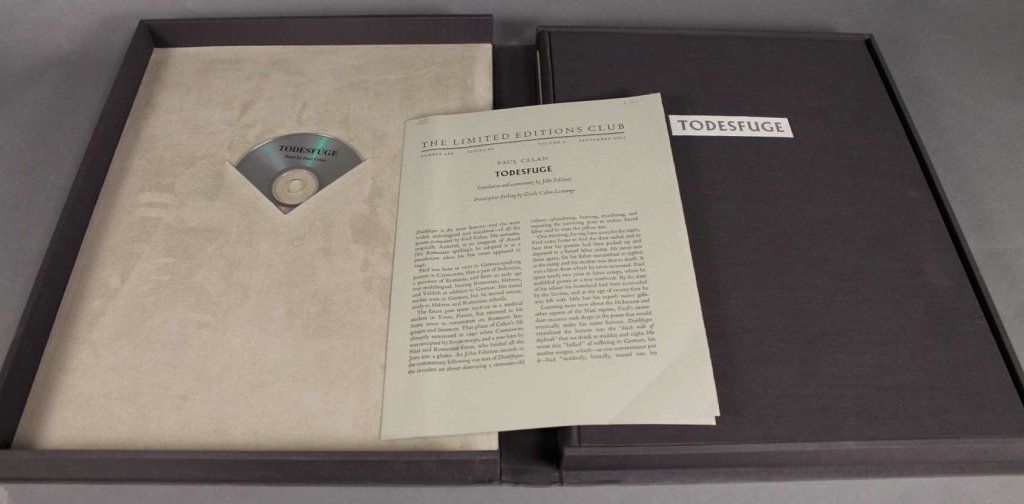
That has really gone up in price over the years! I would say 5 or so years ago, you could have paid under $500 for it, now the lowest price is $1500. Honestly, I'm glad such beautiful books are getting the love they deserve :)
That has really gone up in price over the years! I would say 5 or so years ago, you could have paid under $500 for it, now the lowest price is $1500. Honestly, I'm glad such beautiful books are getting the love they deserve :)
32Sport1963
>31 astropi: This is another one of my favorites, tough material though.
33elladan0891
>23 abysswalker: Later Schiff publications have more of a finger on the then-current (and to some degree still-current) cultural pulse... Simplicissimus is one of my favorite Schiff-published books, but it has a higher limitation (2000), less immediate relevance to current tastes (15th century German baroque/grotesque picaresque novel that most people probably haven't even heard of), and illustrations by an artist more associated with book illustration (Eichenberg) than fine art
I'm not so sure I'd agree that the later phase was more relevant/had more of a finger on the cultural pulse. Simplicissimus wasn't a representative book of the earlier period, and you can pick similarly non-current books from the later period, e.g. Cosi Fan Tutte. Shiff's very first book was Isaac Bashevis Singer's The Gentleman from Cracow signed by the author, illustrated by Raphael Soyer - an artist with works at the Met and the National Gallery - and published within a year of Singer winning the Nobel Prize. The materials and the overall production of this particular book might not be up to par to practically all books that followed, but we're talking about cultural relevancy. Early Shiff output includes the author-signed, Henry Pearson-illustrated Seamus Heaney volume published 13 years prior to Heaney receiving his Nobel; a volume of Derek Walcott poetry illustrated by "the nation's foremost collagist" Romare Bearden, signed by both and published a decade before Walcott's Nobel; Czeslaw Milosz's The Captive Mind, signed by the author and published 3 years after Milosz's Nobel; author-signed and illustrated The Flounder by Gunther Grass, published just a few years after its initial publication in German and 14 years prior to Grass' Nobel; two volumes of Ray Bradbury-signed editions of his works, etc.
So I wouldn't single out Shiff's later output as more modern or culturally relevant.
I think comparing Shiff's earlier and later output in terms of illustrations and selected works themselves is more a matter of personal preference. Myself, I'm actually more interested in works of the earlier period. I also don't necessarily think that big name fine artists make superior illustrators. I might love Dali's book illustrations (not LECs), and I concede it's cool to have a book illustrated by Willem de Kooning, but quite honestly as far as book illustration is concerned, much more often than not I'd pick a no-name artist/illustrator over a MOMA-exhibiting current art world darling that would slap some irrelevant squares, circles and lines on every plate (looking at you, Sean Scully). Off the top of my head I can think of only one later period livre d'artiste where such art somehow works - Snow Country.
I'm not so sure I'd agree that the later phase was more relevant/had more of a finger on the cultural pulse. Simplicissimus wasn't a representative book of the earlier period, and you can pick similarly non-current books from the later period, e.g. Cosi Fan Tutte. Shiff's very first book was Isaac Bashevis Singer's The Gentleman from Cracow signed by the author, illustrated by Raphael Soyer - an artist with works at the Met and the National Gallery - and published within a year of Singer winning the Nobel Prize. The materials and the overall production of this particular book might not be up to par to practically all books that followed, but we're talking about cultural relevancy. Early Shiff output includes the author-signed, Henry Pearson-illustrated Seamus Heaney volume published 13 years prior to Heaney receiving his Nobel; a volume of Derek Walcott poetry illustrated by "the nation's foremost collagist" Romare Bearden, signed by both and published a decade before Walcott's Nobel; Czeslaw Milosz's The Captive Mind, signed by the author and published 3 years after Milosz's Nobel; author-signed and illustrated The Flounder by Gunther Grass, published just a few years after its initial publication in German and 14 years prior to Grass' Nobel; two volumes of Ray Bradbury-signed editions of his works, etc.
So I wouldn't single out Shiff's later output as more modern or culturally relevant.
I think comparing Shiff's earlier and later output in terms of illustrations and selected works themselves is more a matter of personal preference. Myself, I'm actually more interested in works of the earlier period. I also don't necessarily think that big name fine artists make superior illustrators. I might love Dali's book illustrations (not LECs), and I concede it's cool to have a book illustrated by Willem de Kooning, but quite honestly as far as book illustration is concerned, much more often than not I'd pick a no-name artist/illustrator over a MOMA-exhibiting current art world darling that would slap some irrelevant squares, circles and lines on every plate (looking at you, Sean Scully). Off the top of my head I can think of only one later period livre d'artiste where such art somehow works - Snow Country.
34elladan0891
>1 punkzip: I love 80s LECs. My favorite LEC decade along with the 30s. I really like the selection of titles - an eclectic but outstanding mix. Many modern works, with many a book signed by the author. One testament to Shiff's taste is the fact that several of the authors won the Nobel Prize years after Shiff published them. And so many of these wonderful books could be acquired at a steal, contrary to the 90s LECs. Here are some of my favorites:
1982 The Circus of Dr Lao: one of my favorite LEC across all decades. Great design and illustrations by Claire Van Vliet. See the link for pictures. Van Vliet used her designs and published the book two years later herself as a much more limited and expensive edition. It might look more impressive in comparison in the pics, but don't let it be detracting, the LEC is a really, really beautiful fine press book, an outstanding marriage of text, illustrations, and tactile experience. This one is an absolute steal at current prices - you should be able to get it for $50, and it's a book that would easily cost a grand if published now.
https://booksandvines.com/2014/09/09/the-circus-of-dr-lao-by-charles-finney-janu...
1982 Fahrenheit 451: signed by Bradbury. One of the most unusual bindings out there - it's bound in aluminum boards! Great typesetting. I know many love the illustrations, although personally I'm not too crazy about them. However, I appreciate that Joe Mugnaini was Bradbury's favorite illustrator of his works. Bradbury is a perennial favorite, of course, and this edition really stands out. This one you won't find for $50, the cost would be rather closer to the temperature of the title. Btw, LEC also published Bradbury-signed Martian Chronicles. Not as striking, but still a nice book and the nicest fine press edition of the work I'm aware of.
1982 Poems of the Caribbean: this is a placeholder, will add some thoughts when I get some free time in the next few days
1985 The Flounder: this is a placeholder, will add some thoughts when I get some free time in the next few days
1982 The Circus of Dr Lao: one of my favorite LEC across all decades. Great design and illustrations by Claire Van Vliet. See the link for pictures. Van Vliet used her designs and published the book two years later herself as a much more limited and expensive edition. It might look more impressive in comparison in the pics, but don't let it be detracting, the LEC is a really, really beautiful fine press book, an outstanding marriage of text, illustrations, and tactile experience. This one is an absolute steal at current prices - you should be able to get it for $50, and it's a book that would easily cost a grand if published now.
https://booksandvines.com/2014/09/09/the-circus-of-dr-lao-by-charles-finney-janu...
1982 Fahrenheit 451: signed by Bradbury. One of the most unusual bindings out there - it's bound in aluminum boards! Great typesetting. I know many love the illustrations, although personally I'm not too crazy about them. However, I appreciate that Joe Mugnaini was Bradbury's favorite illustrator of his works. Bradbury is a perennial favorite, of course, and this edition really stands out. This one you won't find for $50, the cost would be rather closer to the temperature of the title. Btw, LEC also published Bradbury-signed Martian Chronicles. Not as striking, but still a nice book and the nicest fine press edition of the work I'm aware of.
1982 Poems of the Caribbean: this is a placeholder, will add some thoughts when I get some free time in the next few days
1985 The Flounder: this is a placeholder, will add some thoughts when I get some free time in the next few days
35abysswalker
>33 elladan0891: "Myself, I'm actually more interested in works of the earlier period. I also don't necessarily think that big name fine artists make superior illustrators."
Likewise, and I agree.
Regarding the overall cultural pulse, my broad impression is as I wrote above, though I don't make any claim to having done a systematic study. I am sure one could find exceptions when considering either the earlier or later periods, but the point is about strength of overall trends. I also haven't seen enough of the later books to have a strong opinion.
The Balthus illustrations for the Sonnets to Orpheus work well, but are a bit spare. And that is another very expensive book.
Likewise, and I agree.
Regarding the overall cultural pulse, my broad impression is as I wrote above, though I don't make any claim to having done a systematic study. I am sure one could find exceptions when considering either the earlier or later periods, but the point is about strength of overall trends. I also haven't seen enough of the later books to have a strong opinion.
The Balthus illustrations for the Sonnets to Orpheus work well, but are a bit spare. And that is another very expensive book.
36elladan0891
>28 Sport1963: Once you do find Dubliners in NF to Fine condition, keep that spine protected... I recommend you shelve it spine in, slipcase back out
This is a sound advice for most if not all Shiff-era books with leather spines, both from the earlier and the later eras. They are beautiful, high-quality books - except, annoyingly, the leather dyes used are very prone to fading...
This is a sound advice for most if not all Shiff-era books with leather spines, both from the earlier and the later eras. They are beautiful, high-quality books - except, annoyingly, the leather dyes used are very prone to fading...
37kdweber
>34 elladan0891: "I love 80s LECs. My favorite LEC decade along with the 30s." I couldn't agree more, I have all of the early shiff books and most of the LECs from the 30s except Ulysses, Lysistrata, and A Christmas Carol. Lots of bang for the buck.
38punkzip
Question for owners of the LEC Hiroshima. How much - if any - difference should there be between the black of the spine and the boards, and the spine of the slipcase and the rest of the slipcase? Is is correct to assume that any difference is fading (likely from sunning?).
40punkzip
>39 wcarter: Thanks. In your own pictures, it looks like the spine of the book is faded compared to the boards - or is this the lighting?
41SebRinelli
>30 Sport1963:
Thanks for taking the effort, that's very helpful!
Thanks for taking the effort, that's very helpful!
42wcarter
>40 punkzip:
That’s the lighting.
Used a strong side light as a totally black book difficult to photograph.
The spine with the book vertical is completely black.
That’s the lighting.
Used a strong side light as a totally black book difficult to photograph.
The spine with the book vertical is completely black.
43elladan0891
>35 abysswalker: You might very well be right. I haven't done any comprehensive comparisons either, of course. My personal impression is that Shiff's era in general was much more current than the previous decades. What I can say is that the later Shiff phase is leaning more heavily into poetry than the first. So poetry lovers, or rather poetry lovers with $$$ should definitely look into the later years.
44SebRinelli
>15 SebRinelli: I finally received my new binding of Snow Country and wanted to share it with you here on the board.
The design of the binding was a collaborative effort between Joëlle Bocel (the binder: http://www.joelle-bocel.com) and me. The choice of forms (triangle and mosaic-esque style of the inside) and colours correspond with Kuwayama's abstract illustrations. The cover is meant to resemble snow and refers to the first sentence of the book and Snow Country as the overall setting of the book. The insides are meant to resemble a starry night, as the milky way is also referred a couple of times, especially in the last sentence of the book.
Material is calf leather, obviously heavily treated.
I think Joëlle did an amazing job worth every (of the many) penny.


The design of the binding was a collaborative effort between Joëlle Bocel (the binder: http://www.joelle-bocel.com) and me. The choice of forms (triangle and mosaic-esque style of the inside) and colours correspond with Kuwayama's abstract illustrations. The cover is meant to resemble snow and refers to the first sentence of the book and Snow Country as the overall setting of the book. The insides are meant to resemble a starry night, as the milky way is also referred a couple of times, especially in the last sentence of the book.
Material is calf leather, obviously heavily treated.
I think Joëlle did an amazing job worth every (of the many) penny.


45mnmcdwl
>15 SebRinelli: That is gorgeous!! A beautiful nod to both the artist and the novel. I finally found an unsunned copy of this one late last year, and it is one of the stars of my library. If I hadn't, your copy would have pushed me into getting a sunned copy and rebinding it.
46Lukas1990
>44 SebRinelli: Amazing and obviously a costly effort! Well thought designs like that are a joy to see. Thank you! You've preserved the book for many years to come as one George Macy devotee used to say about his rebindings.
47ultrarightist
>44 SebRinelli: Very nice! Is that leather? If so, was the grain treated in some manner to produce that particular texture?
48SebRinelli
>47 ultrarightist: Yes, that's smooth calf leather treated through various methods, e.g. embossing with an oxidised zinc-plate and hot-foil!
49DenimDan
Of the mid-era or transitional Schiff books: Three Poems (1987), In The Penal Colony (1986), and Snow Country (1990) are my top-3 favorites.
I recognize that A Season in Hell (1987) is probably a very good book, but I don't care for artist's books that involve photography primarily. I especially dislike the art for Hunting Stories (1988) and Genesis (1989). Most of the others from this era I've only seen in photographs.
To me, 1986 best represents (or indicates or whatever) the switch in Schiff's fundamental understanding of the LEC. Not that he didn't have some of those more "traditional-LEC" aspects after this, nor that there were no elements of the livre d'artiste already.
I recognize that A Season in Hell (1987) is probably a very good book, but I don't care for artist's books that involve photography primarily. I especially dislike the art for Hunting Stories (1988) and Genesis (1989). Most of the others from this era I've only seen in photographs.
To me, 1986 best represents (or indicates or whatever) the switch in Schiff's fundamental understanding of the LEC. Not that he didn't have some of those more "traditional-LEC" aspects after this, nor that there were no elements of the livre d'artiste already.
50abysswalker
>49 DenimDan: "I recognize that A Season in Hell (1987) is probably a very good book, but I don't care for artist's books that involve photography primarily."
I generally have the same preference, but I make an exception for this book (of which I do own a copy). The photographs are not abstract, but do have a tasteful and mannered style that suits book illustration in my opinion. Something about the shadow forms reminds me of the way wood engravings work well as accompaniment for print.
(This is actually one of my favorite books from my collection considering style and construction, though I wouldn't class Rimbaud in my short list of favorite authors. The book itself compares favorably in my eyes with the other best books in my collection while also feeling modern and lacking any sense of nostalgia. I can see that uncompromising lack of nostalgia as either a pro or con for others, but as someone who generally prizes slightly more traditional book aesthetics, it is nice to see a modern take so masterfully executed.)
I generally have the same preference, but I make an exception for this book (of which I do own a copy). The photographs are not abstract, but do have a tasteful and mannered style that suits book illustration in my opinion. Something about the shadow forms reminds me of the way wood engravings work well as accompaniment for print.
(This is actually one of my favorite books from my collection considering style and construction, though I wouldn't class Rimbaud in my short list of favorite authors. The book itself compares favorably in my eyes with the other best books in my collection while also feeling modern and lacking any sense of nostalgia. I can see that uncompromising lack of nostalgia as either a pro or con for others, but as someone who generally prizes slightly more traditional book aesthetics, it is nice to see a modern take so masterfully executed.)

