1wcarter
Bhagavad Gita, The Song Celestial - LIMITED EDITIONS CLUB 1964
A PICTORIAL REVIEW
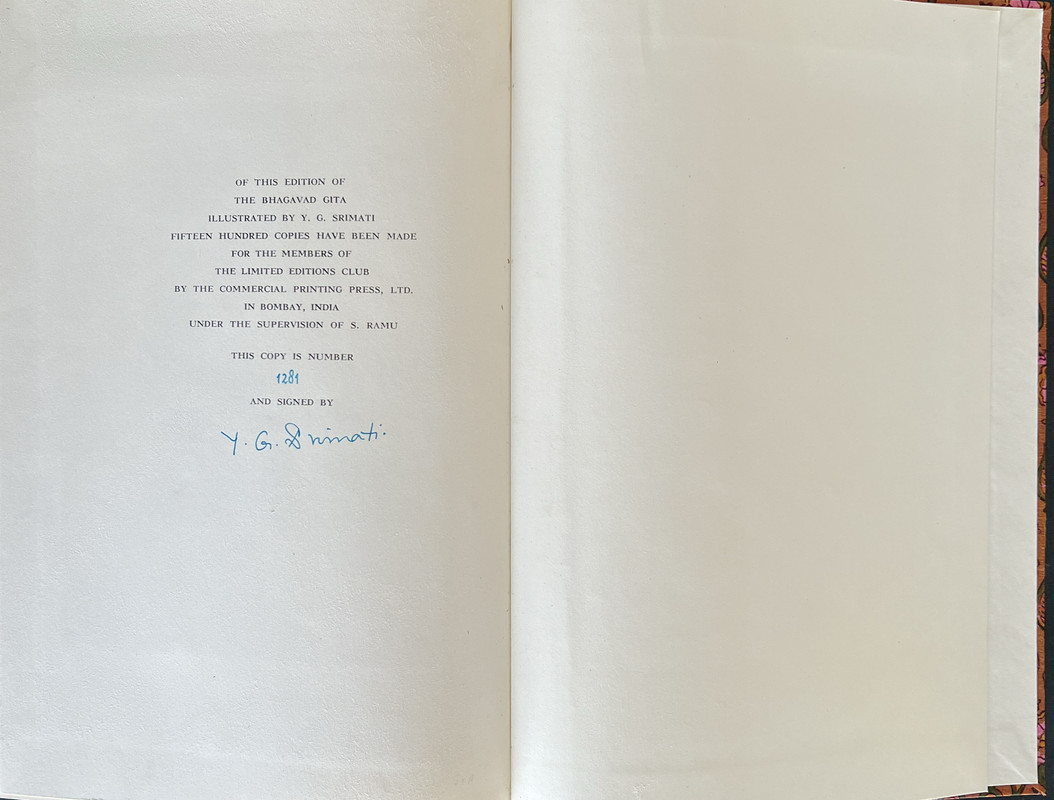
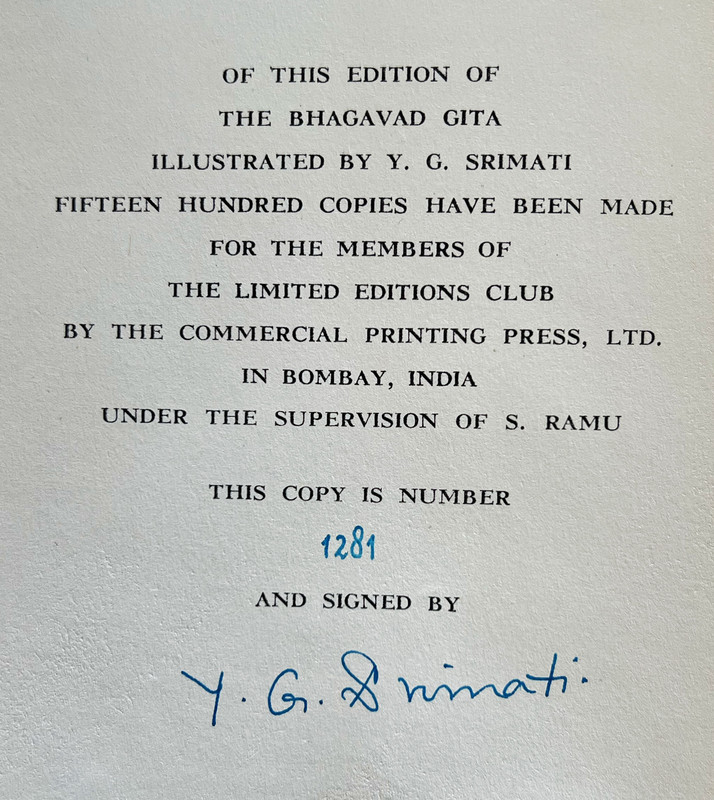
No.1281 of 1500 copies
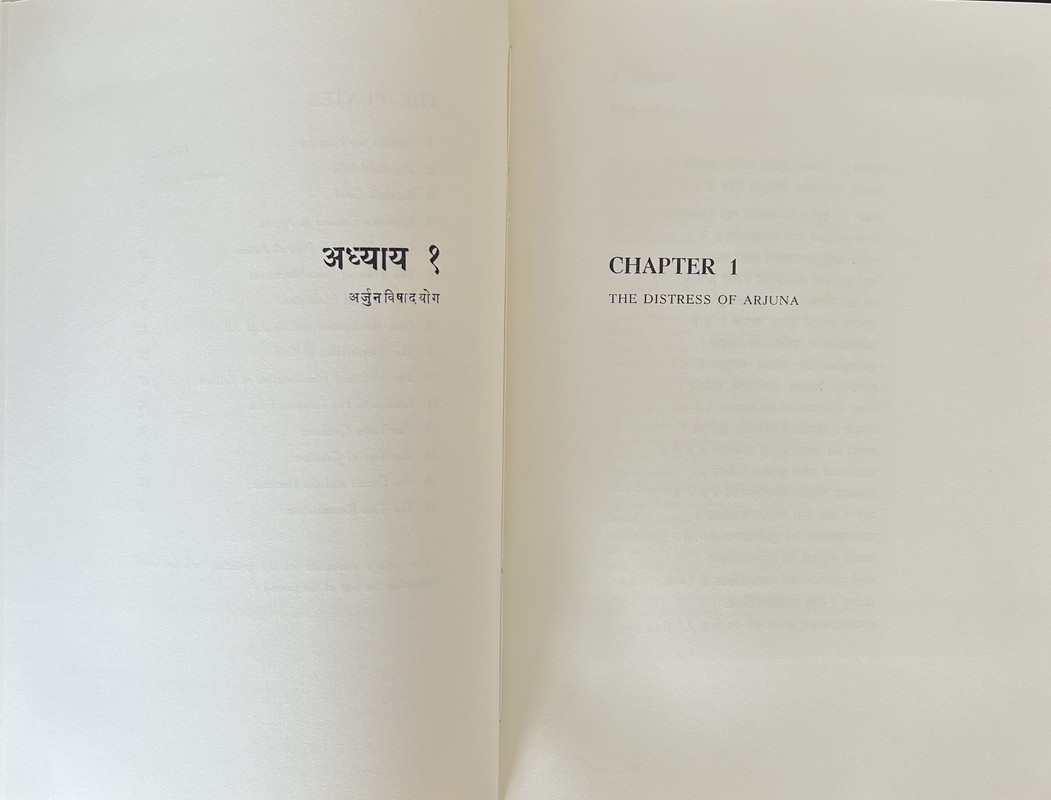
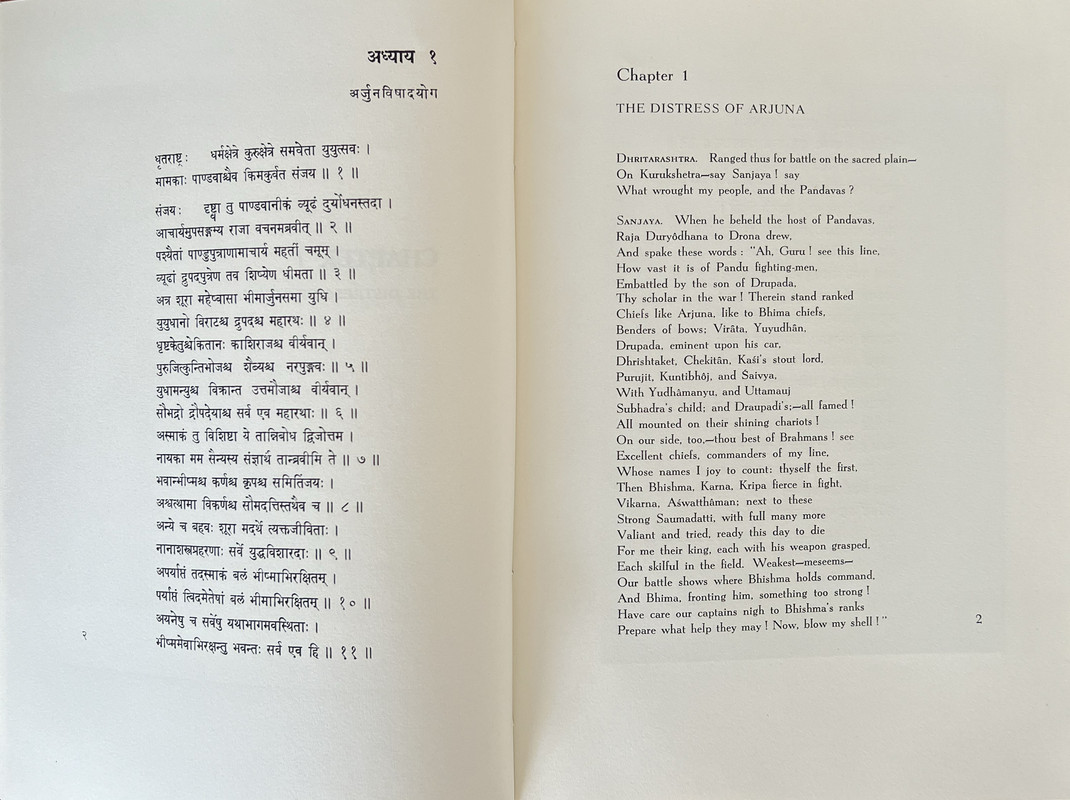
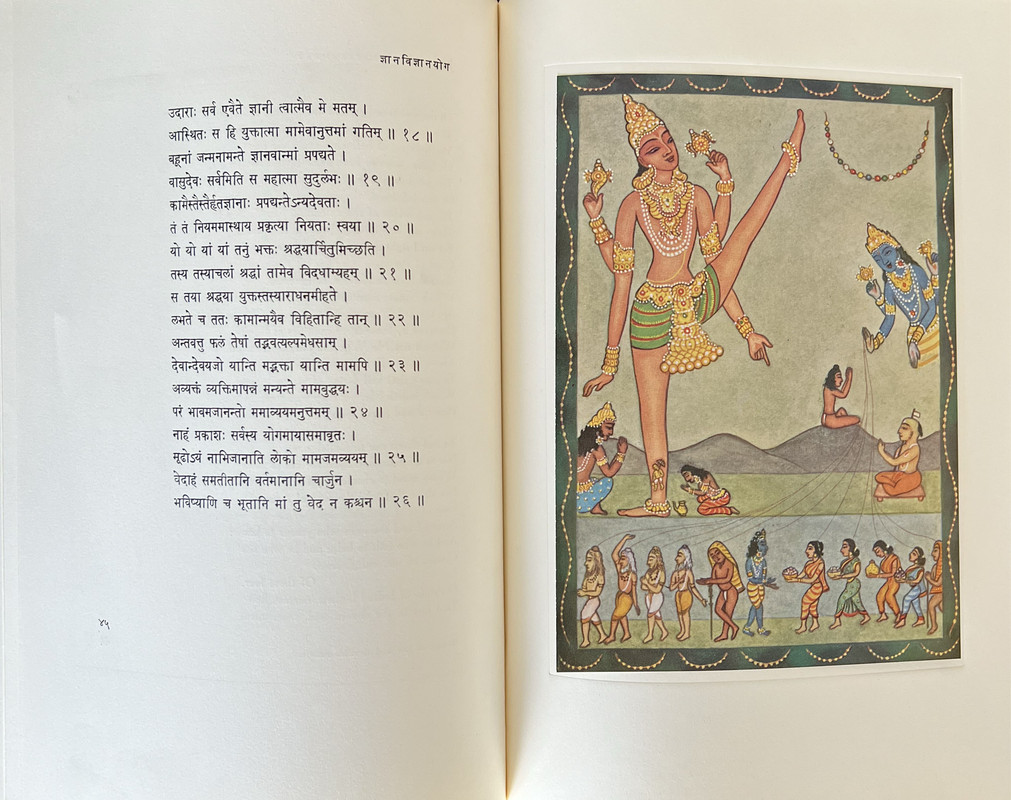
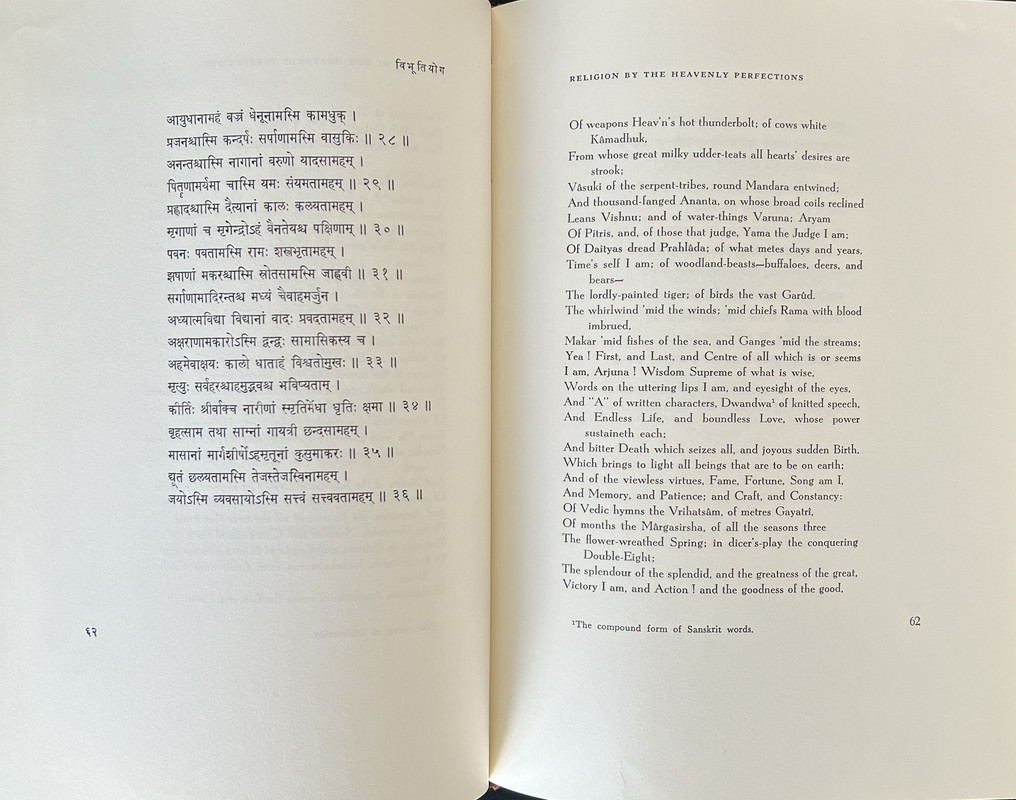
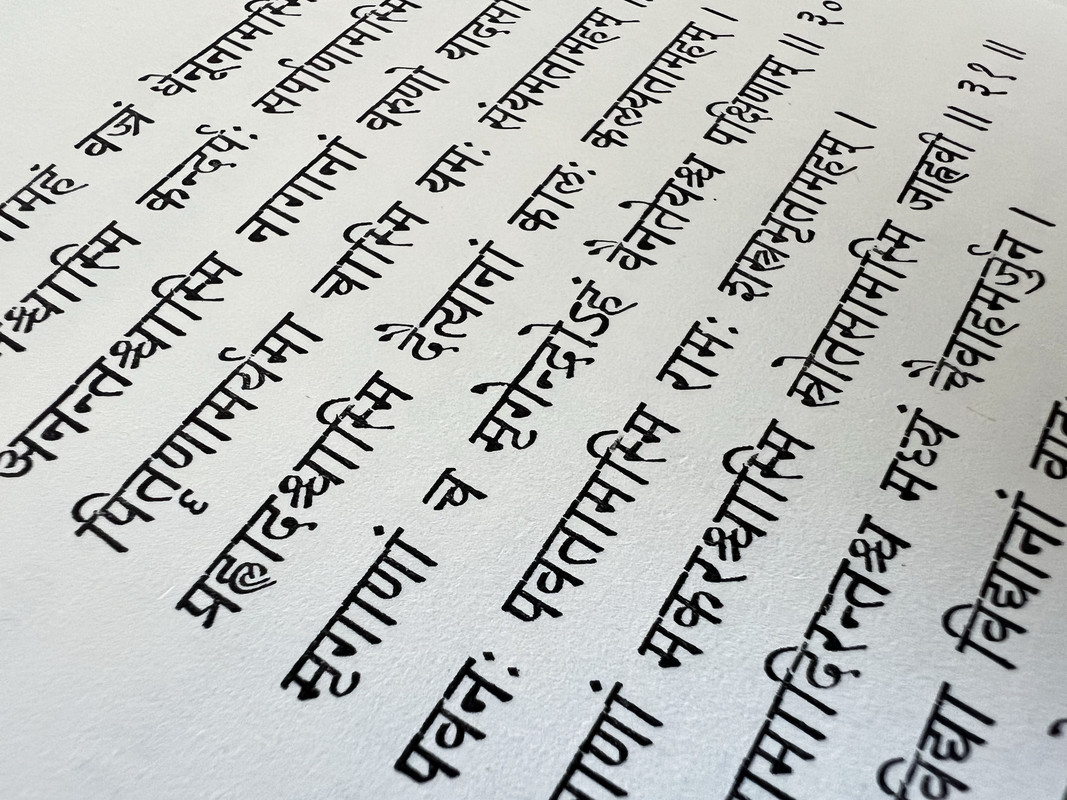
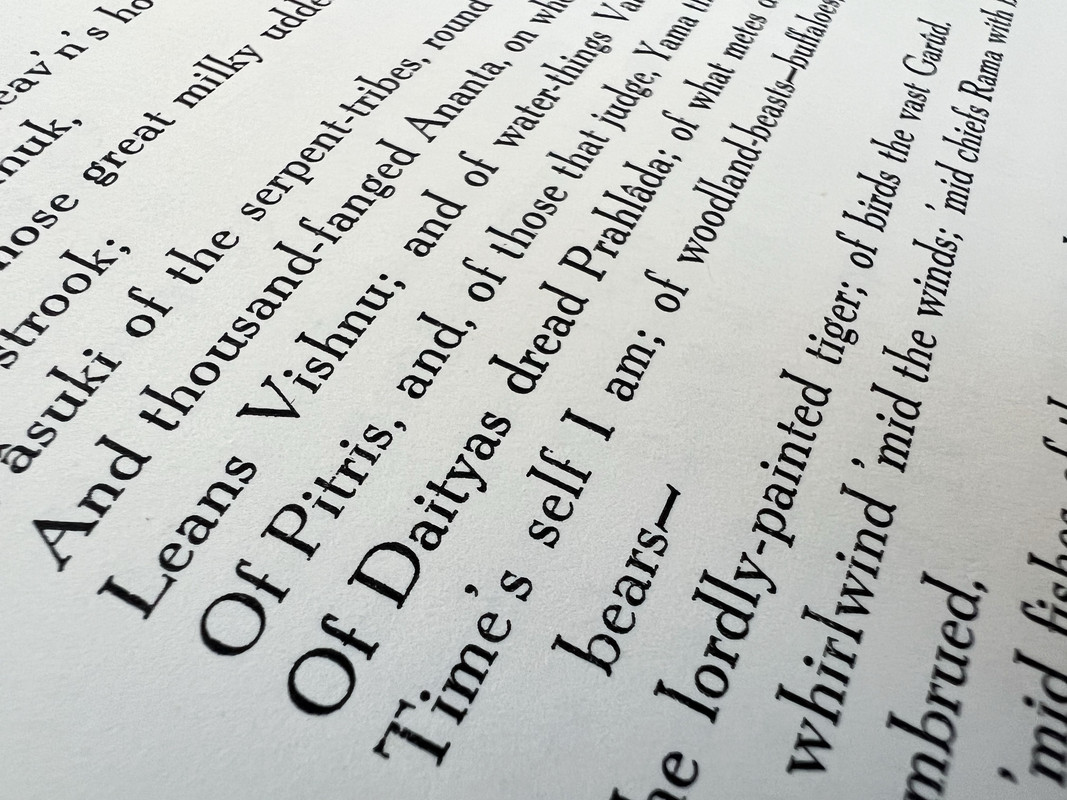
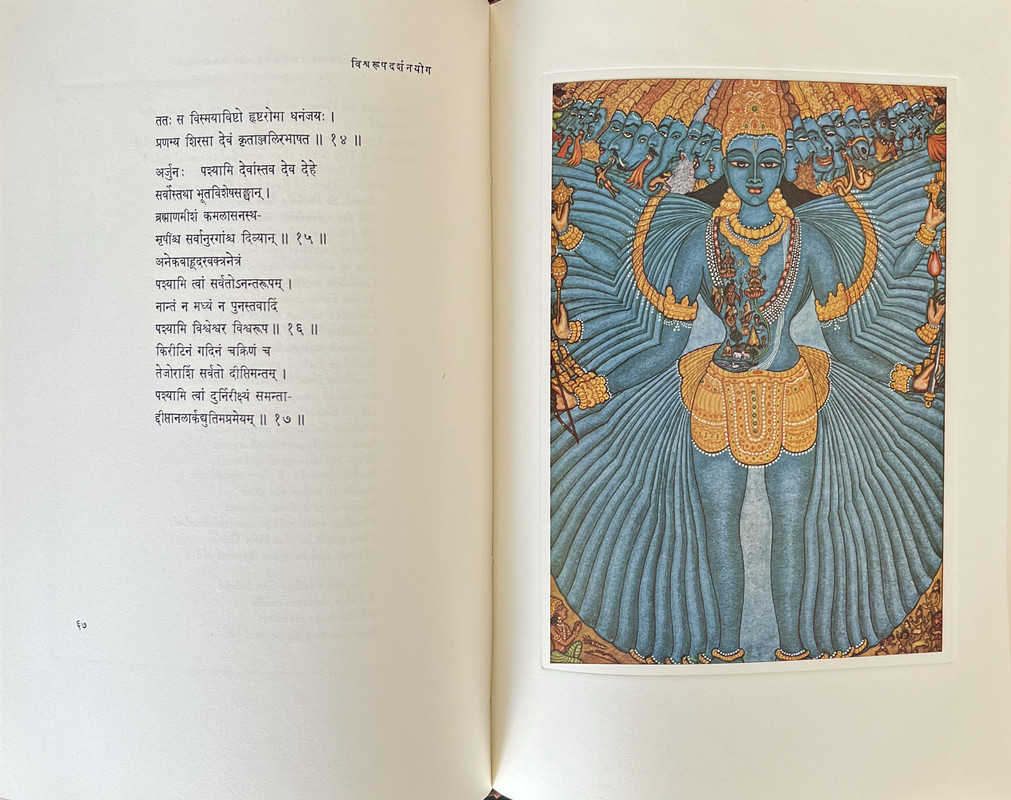
Printed in Sanskrit on verso and English on opposite recto page.
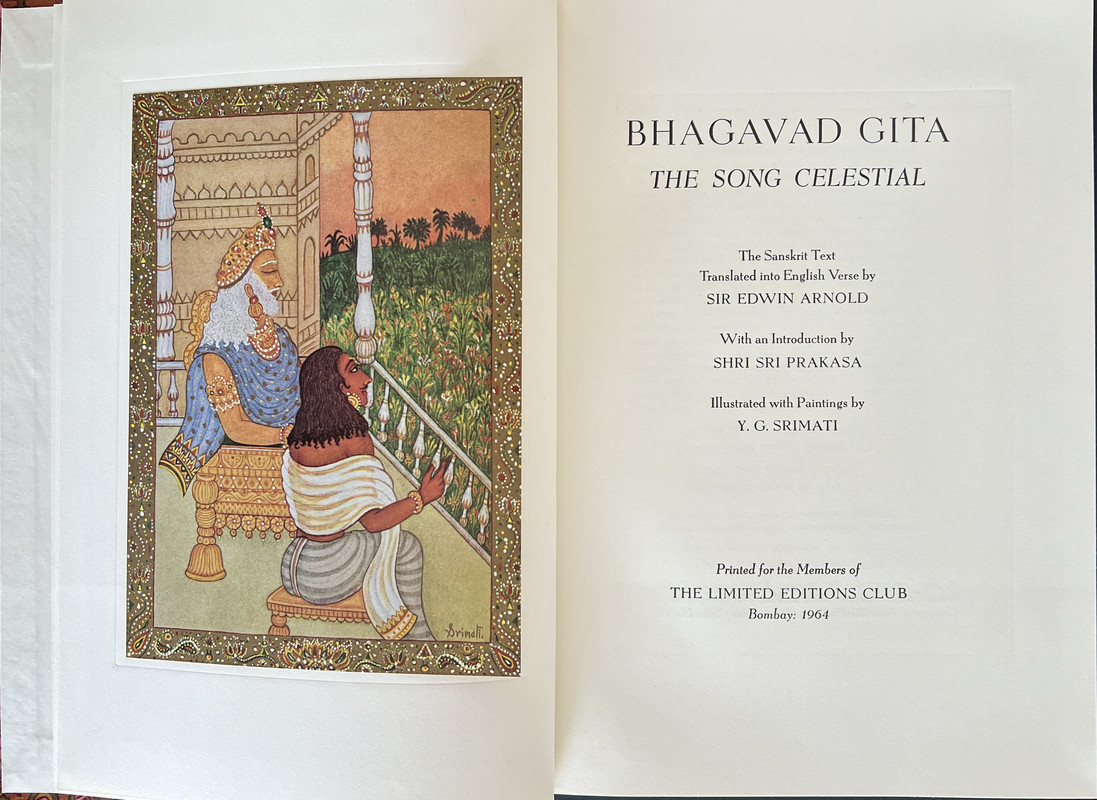
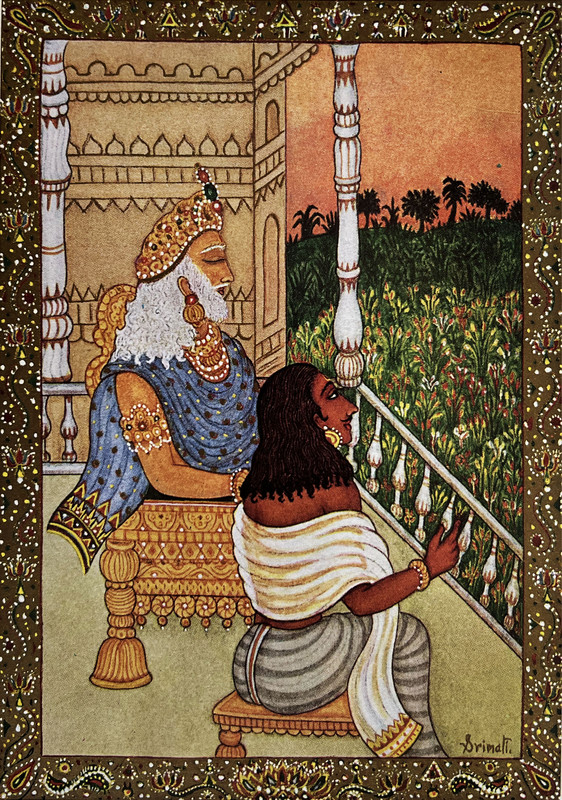
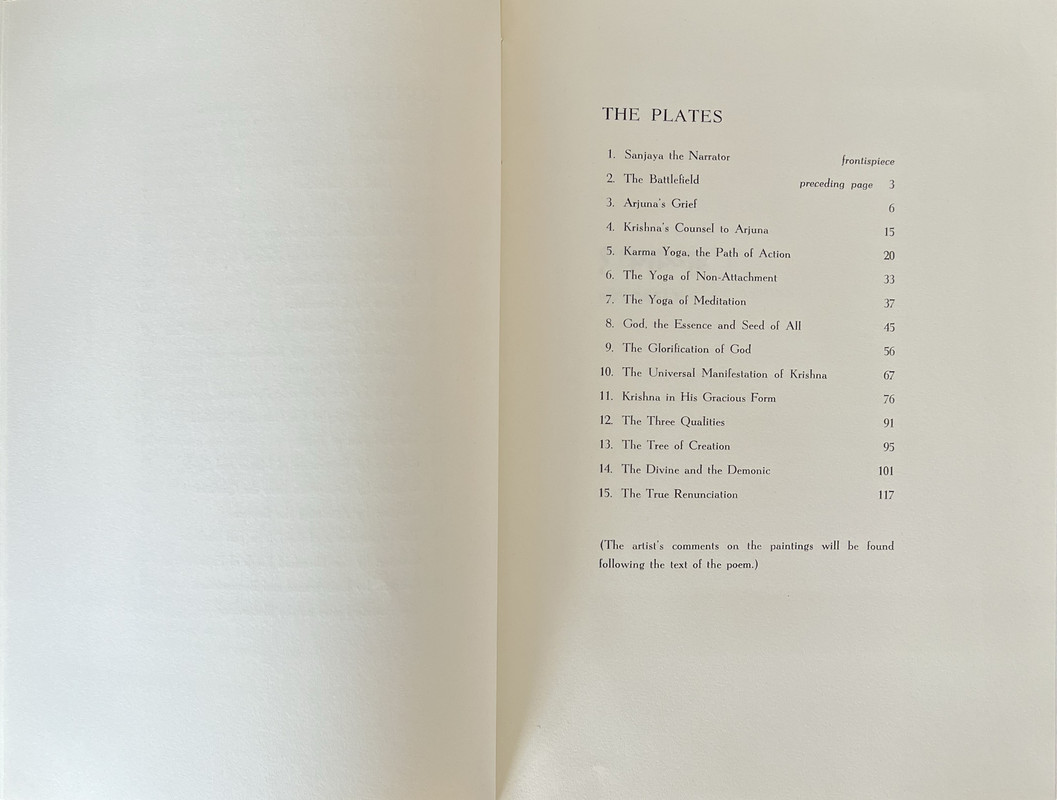
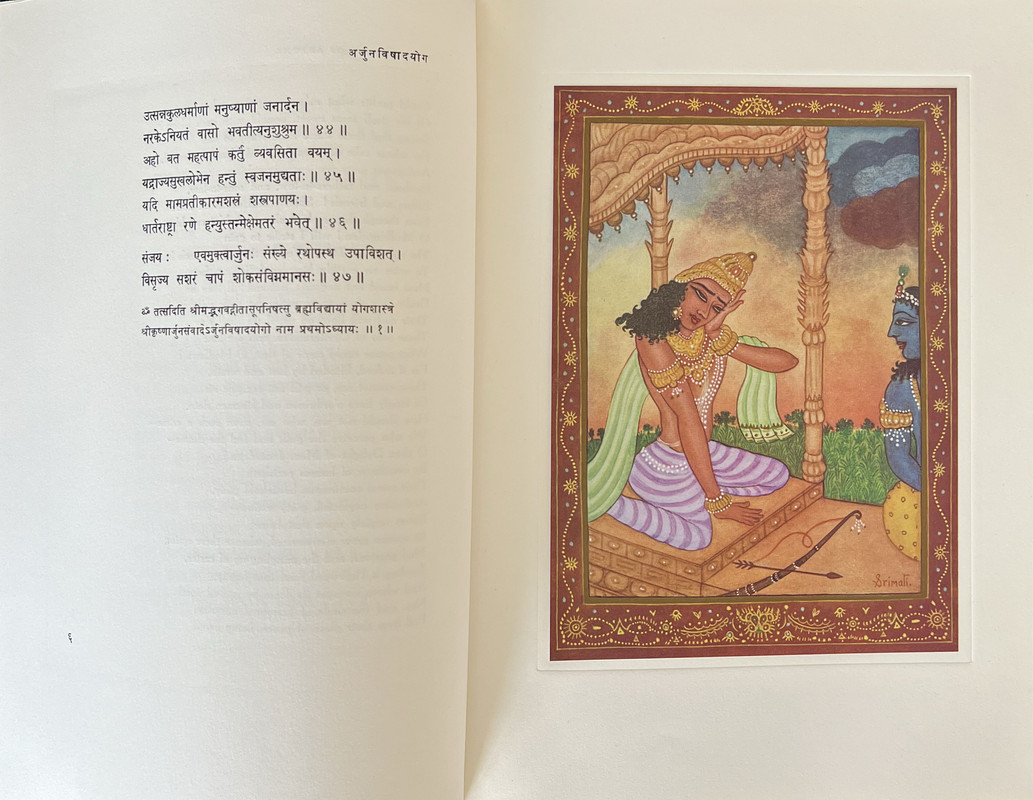
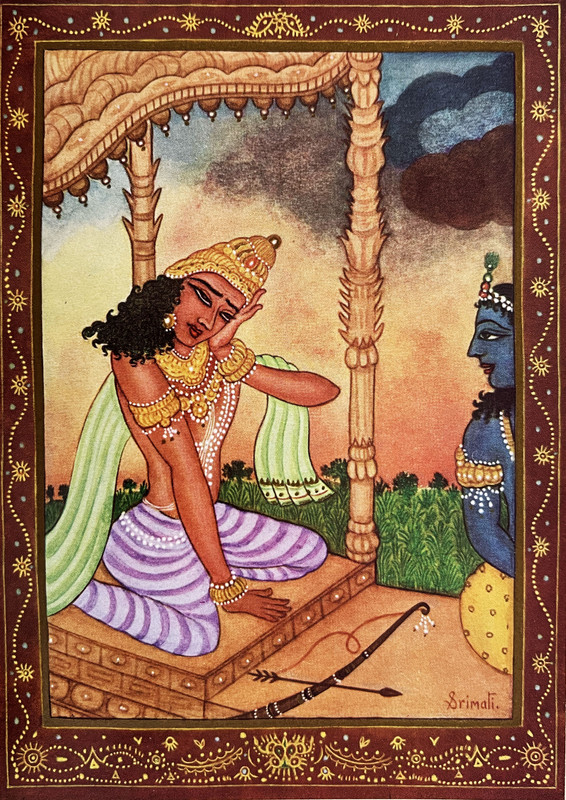
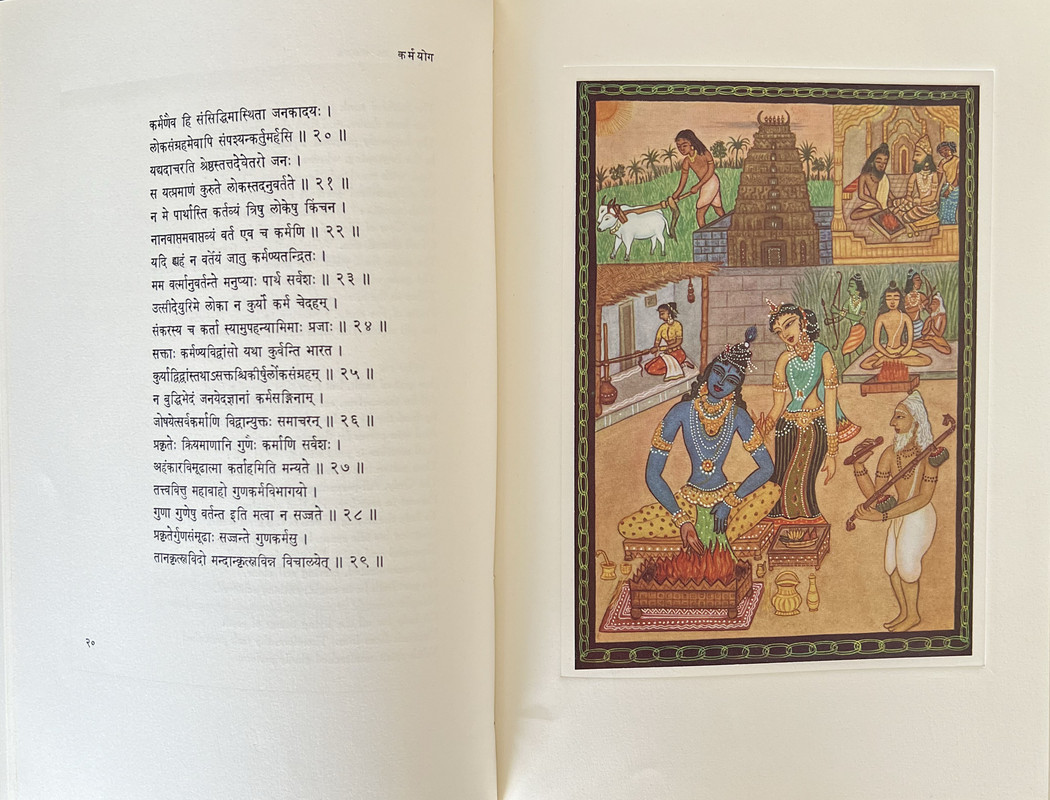
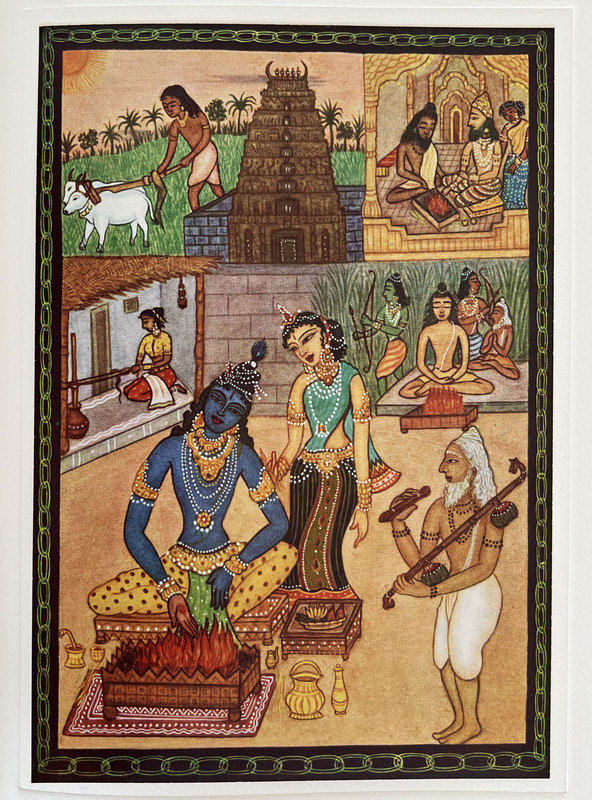
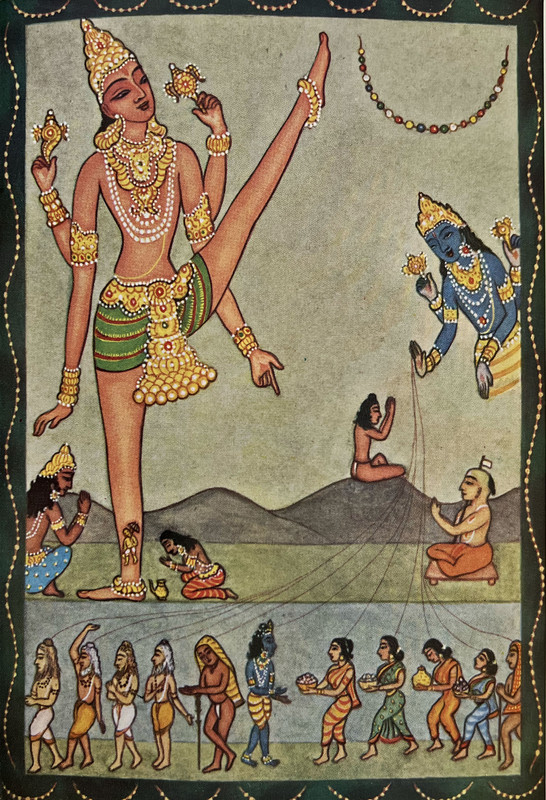
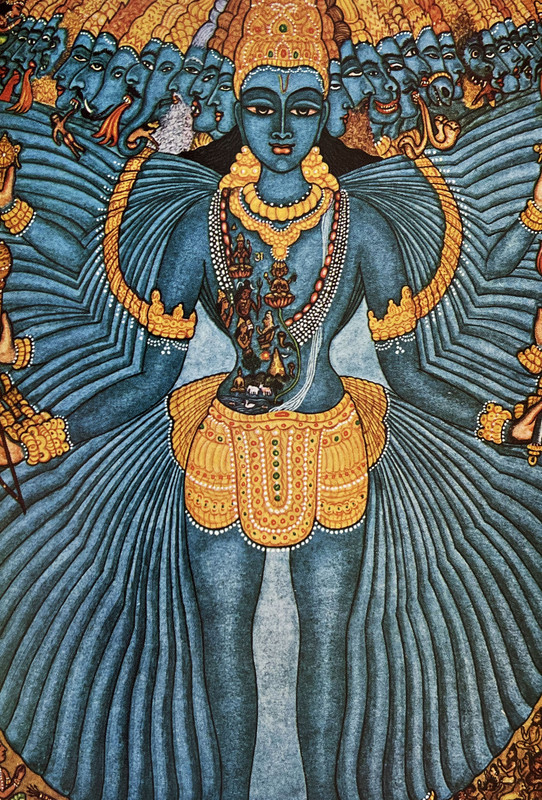
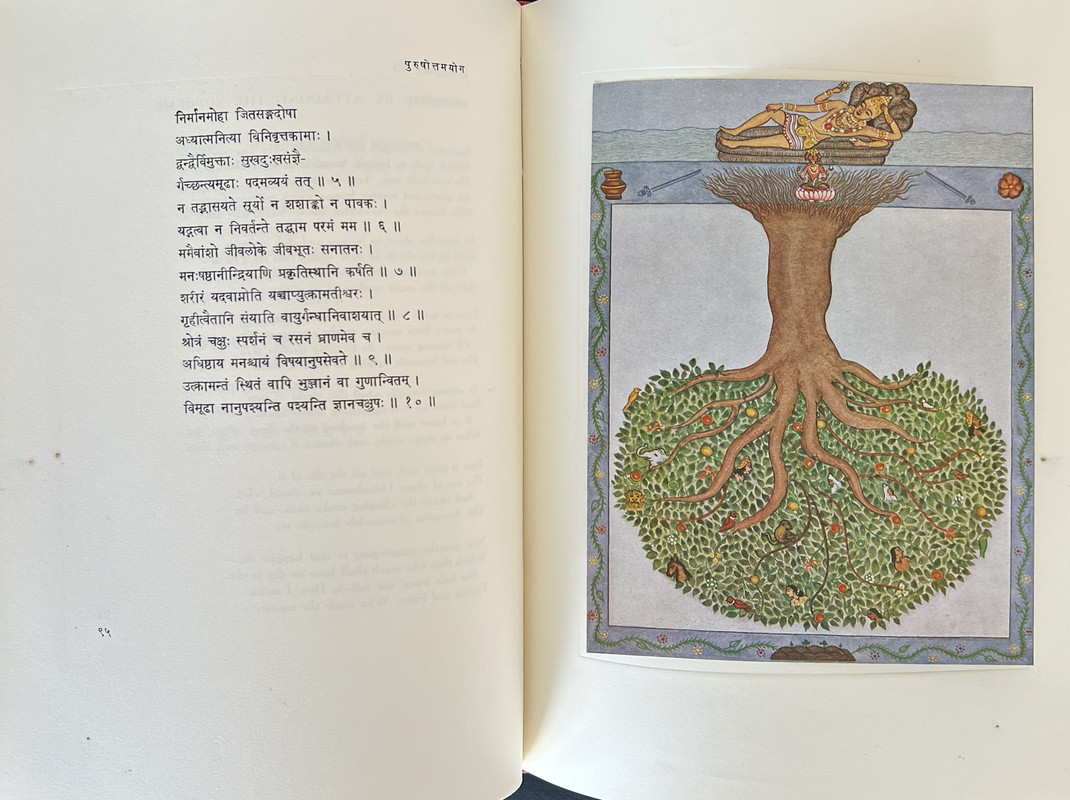
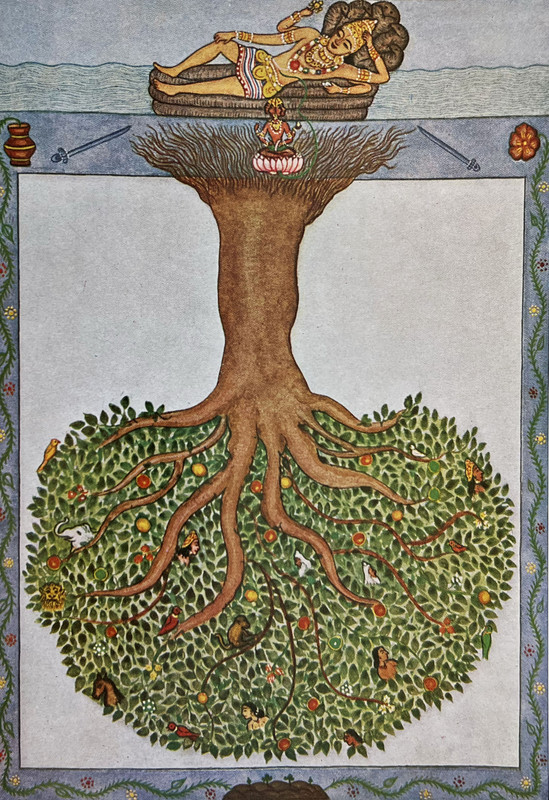
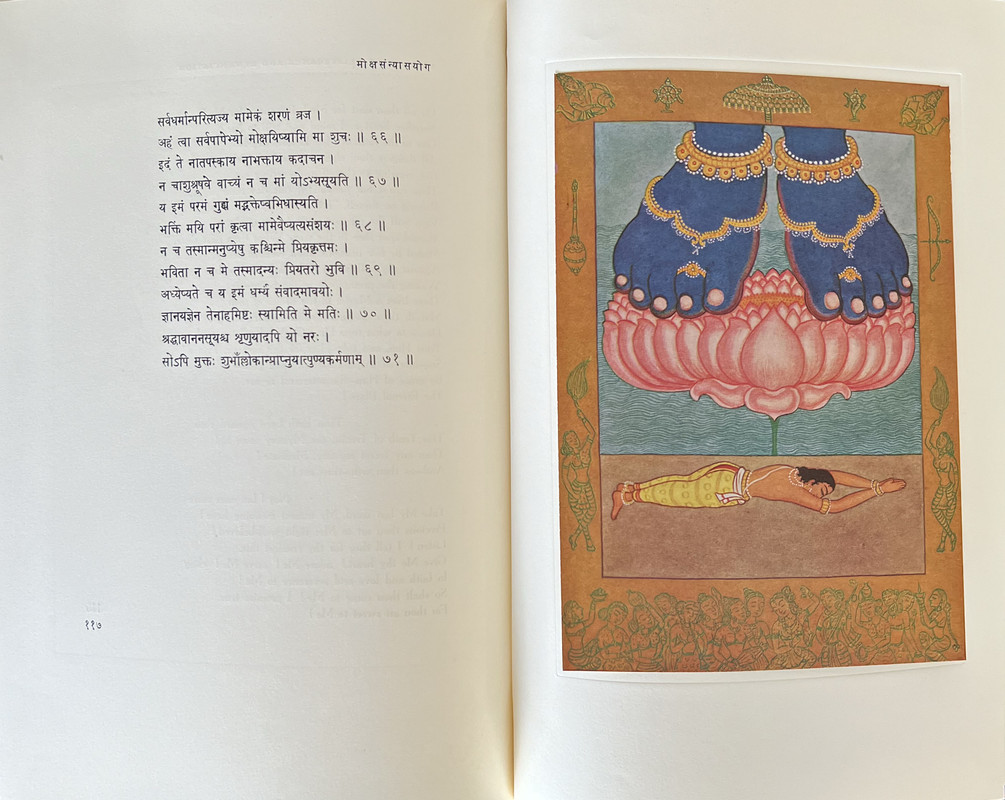
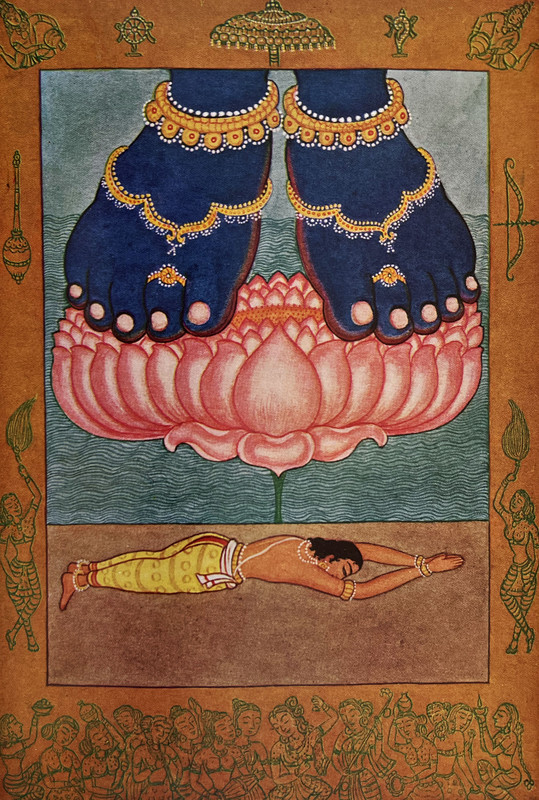
15 full page colour illustrations tipped-in at the top edge.
Illustrated by Y.G.Srimati who signed the book.
Translated by Sir Edwin Arnold.
15 page introduction by Shri Sri Prakasa.
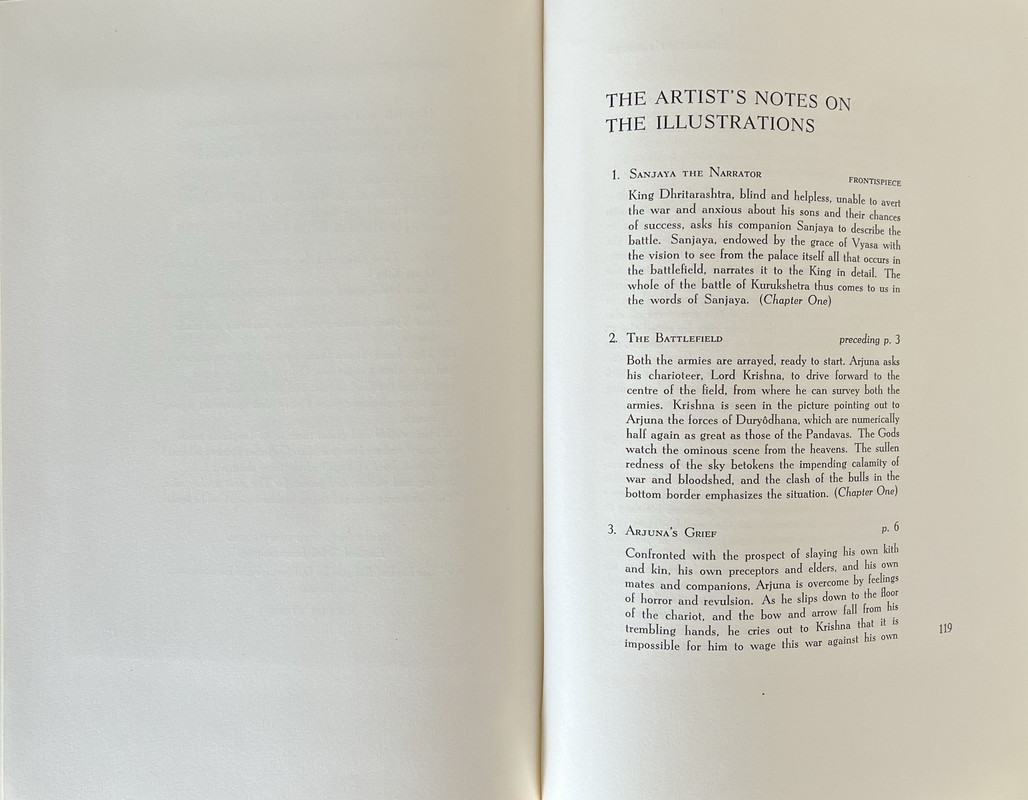
Ten pages of artist’s notes on the illustrations at back of book.
Designed by S. Ramu.
Printed at the Commercial Printing Press, Bombay.
White endpapers.
Glassine dust-jacket.
Bound in Indian silk hand-woven in a multicolour lotus and mango pattern, gold title label on upper-outer corner of front cover.
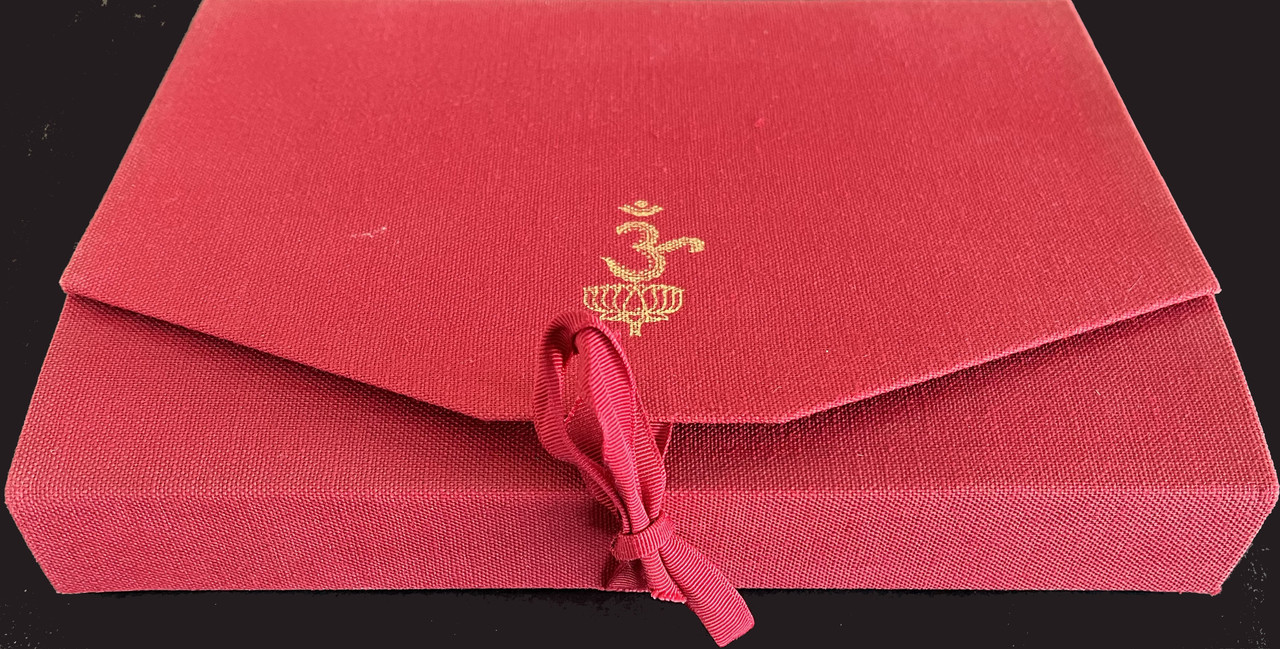
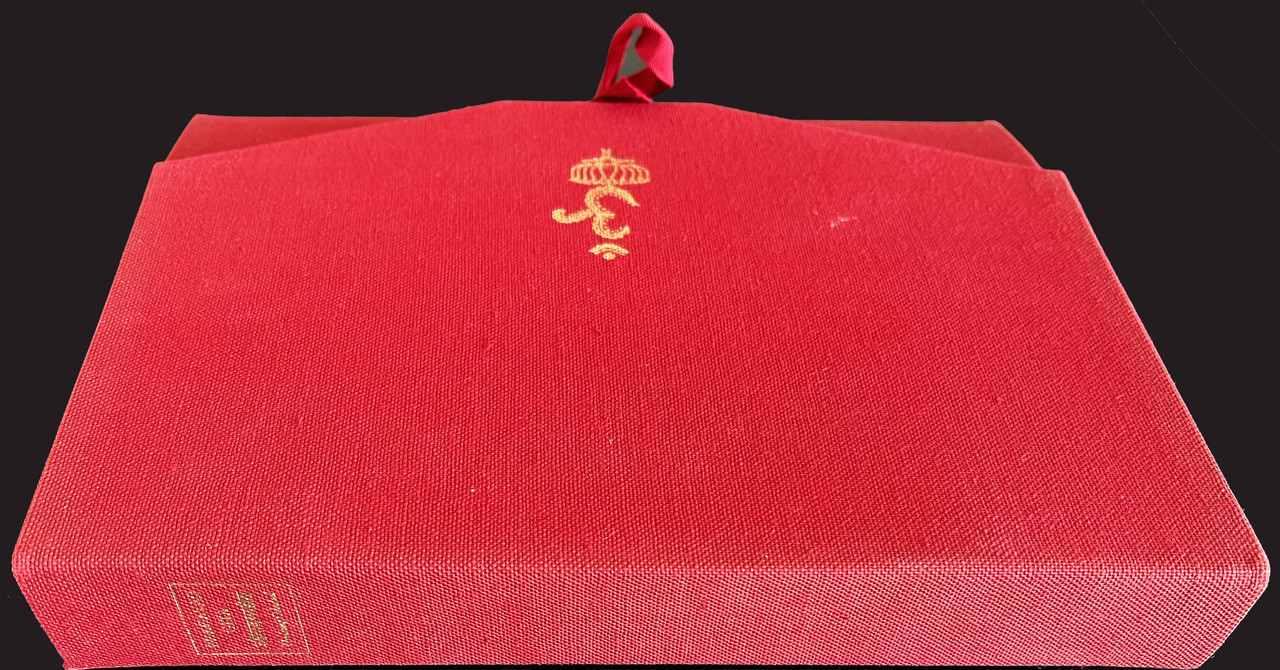
Dark red cloth wallet flap enclosure with title printed on edge, gilt image blocked and printed on flap, lined in green felt and closed with a silk ribbon.
364pp. (Page numbering is confusing as English and Sanskrit pages numbered separately).
27x19.4cm.
US$50
Purchased in fine unread condition in 2024. Even the glassine dust-jacket was intact and in fine condition, which for a 60 year old book is amazing! Monthly letter and announcement card laid in.









An index of the other illustrated reviews in the this series can be viewed here.
The Folio Society edition of the Bhagavad Gita is reviewed here.
A PICTORIAL REVIEW
No.1281 of 1500 copies
Printed in Sanskrit on verso and English on opposite recto page.
15 full page colour illustrations tipped-in at the top edge.
Illustrated by Y.G.Srimati who signed the book.
Translated by Sir Edwin Arnold.
15 page introduction by Shri Sri Prakasa.
Ten pages of artist’s notes on the illustrations at back of book.
Designed by S. Ramu.
Printed at the Commercial Printing Press, Bombay.
White endpapers.
Glassine dust-jacket.
Bound in Indian silk hand-woven in a multicolour lotus and mango pattern, gold title label on upper-outer corner of front cover.
Dark red cloth wallet flap enclosure with title printed on edge, gilt image blocked and printed on flap, lined in green felt and closed with a silk ribbon.
364pp. (Page numbering is confusing as English and Sanskrit pages numbered separately).
27x19.4cm.
US$50
Purchased in fine unread condition in 2024. Even the glassine dust-jacket was intact and in fine condition, which for a 60 year old book is amazing! Monthly letter and announcement card laid in.
An index of the other illustrated reviews in the this series can be viewed here.
The Folio Society edition of the Bhagavad Gita is reviewed here.
2Whaiwhakaiho
The breadth of the LEC output continues to impress.
There are so many things about this book to like; the artistic style, the wallet flap enclosure, the condition and the price. I know of one or two LEC’s with dual language format in a different alphabet but they are rare.
What a find! Well done.
There are so many things about this book to like; the artistic style, the wallet flap enclosure, the condition and the price. I know of one or two LEC’s with dual language format in a different alphabet but they are rare.
What a find! Well done.
4venkysuniverse
A gorgeous edition. Thanks for the pics.
5jveezer
It's my favorite edition of the Gita. I wish someone would do a similar production for the Yoga Sutras of Patanjali
6blue.eyes2
This is the best published edition of the Gita that I know of. However, there are so many issues with this book--published 8 years after Macy's death-- that I doubt whether he would have been happy with it. I am highlighting a few defects (as I see them):
1.
Does a translator have the right to either insert additional material or omit any material present in a book they are translating? Surely the answer is No. The problem with any such interpolation is compounded when it is done to a book considered sacred by many people. So the omissions as indicated in the footnotes in the pages I give below are a poor performance:


(It is possible there are other such footnotes--I haven't read the entire book yet.)
With respect to the second footnote, the problem is that the Gita is attempting to synthesize various different Hindu (and, also arguably, some aspects of Buddhist) philosophy such as Vedanta, Sankhya, Mimansa, etc. Since these philosophies are often mutually contradictory it could be argued (and in fact has been argued) by an unbiased reader who has studied these philosophies in some detail that the Gita is not entirely successful in the review-synthesis it attempts to do. That is a separate point. The issue is that what appears to be a later interpolation could actually be reflecting an unsuccessful effort to reconcile and synthesize various different philosophies which are mutually contradictory in some important aspects. But let us say, for argument's sake, that it is a later interpolation. Should the lines reflecting this 'later interpolation' be excluded from the text or should they included with some way of denoting that these might be a later interpolation? I think the second option is the correct one. I also believe Macy would have agreed with me on this since the text of the book being produced was very important to him (as just one example, consider the effort he put in to include the original ending of the novel for the LEC 'Great Expectations').
Either a new translation ought to have been prepared or the existing translation of Sir Edwin Arnold (which is considered to be a good one) ought to have been revised appropriately by some Sanskrit expert as was done in the case of Constance Garnett's translation of the Brothers Karamazov for the LEC edition.
2.
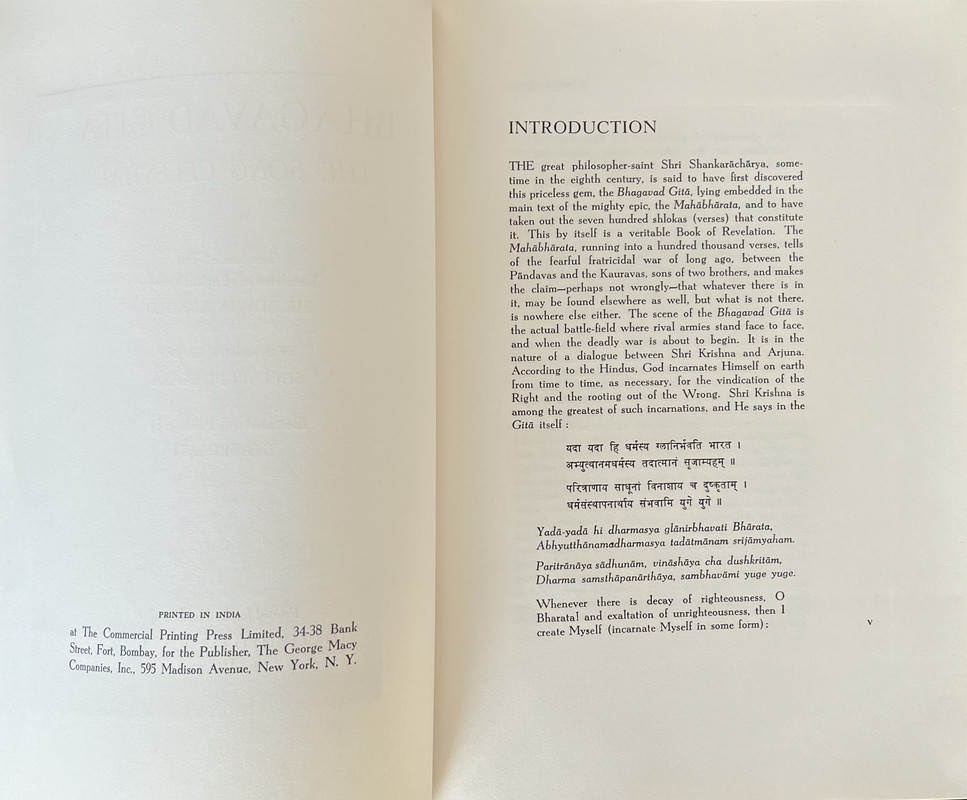
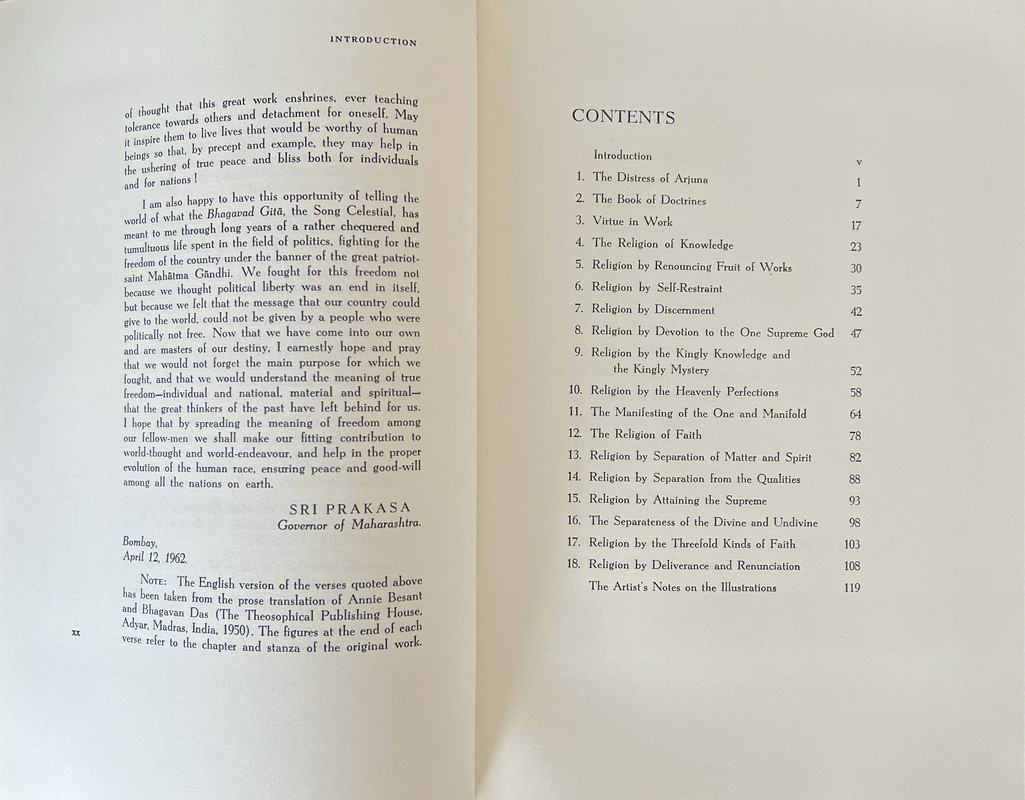
The person who wrote the introduction to this book appears to have been an Indian bureaucrat-politician with no scholarly credentials in the field of philosophy. In his introduction he prefers to give quotations not from the translation of the book he is introducing, but from another translation--a translation prepared by his father (as noted by the ML), which is certainly very odd and not anything I've seen before. One point to note: Sri Prakasa, who wrote the introduction, begins his writeup with crediting the philosopher Sankara (circa 8th century AD) for highlighting this text which is embedded in the Hindu epic, Mahabharata. This is a questionable claim (there are those who claim that there were others who highlighted the text of the Gita before Sankara), but the fact that Sri Prakasa makes this claim and calls Sankara a 'great philosopher-saint' makes one wonder whether he was personally a Vedantin (follower of the Vedanta philosophy). Sankara is well known for being one of the founding fathers of the Vedanta philosophy which is the dominant philosophy amongst the Hindu intelligentisa of today.
This much is clear though, from reading the introduction, that Sri Prakasa was a religious Hindu (note how he defends the Hindu caste system for instance). It must have annoyed Sri Prakasa when he read Sir Edwin Arnold's translation and found that there is an instance in which Sir Edwin discards ten lines of the text on the ground that these are undoubtedly a later interpolation by some Vedantin.
I would have preferred the introduction to have been written by some scholar who would have given a detached and unbiased albeit sympathetic perspective on the Gita. Someone like Will Durant for example. The problem with a religious Hindu writing an introduction to a Hindu text is that bias invariably creeps in due to such a person having affiliation with some particular system of Hindu philosophy (keeping in mind that the various systems of Hindu philosophy are mutually contradictory in important aspects).
3.
The paper used in this book is good, but I found the typography to be mediocre (at least for an LEC book) and the illustrations could have better.
4. I don't think the Gita was a good choice for the LEC. After all, the LEC books were catering to a western (primarily American) audience. The problem is that it is not possible to have a sound understanding of the text in the Gita without some knowledge of the various systems of Hindu philosophy since the Gita is attempting some kind of review-synthesis of these philosophies. Certain philosophical terminologies are used which are highly technical and make the material esoteric for the general reader. A better choice of book of Indian origin, which would have been a lot easier to comprehend, would have been the Arthasastra of Kautilya (who was also known as Chanakya) which is, in some respects, the Indian counterpart to Machiavelli's 'The Prince' and which one can read about in Will Durant's 'Our Oriental Heritage'. I also have in my library a commentary on the Arthasastra by Roger Boesche which appears to be a good analysis of the book with several penetrating insights:
https://www.amazon.com/gp/product/0739106074/
1.
Does a translator have the right to either insert additional material or omit any material present in a book they are translating? Surely the answer is No. The problem with any such interpolation is compounded when it is done to a book considered sacred by many people. So the omissions as indicated in the footnotes in the pages I give below are a poor performance:


(It is possible there are other such footnotes--I haven't read the entire book yet.)
With respect to the second footnote, the problem is that the Gita is attempting to synthesize various different Hindu (and, also arguably, some aspects of Buddhist) philosophy such as Vedanta, Sankhya, Mimansa, etc. Since these philosophies are often mutually contradictory it could be argued (and in fact has been argued) by an unbiased reader who has studied these philosophies in some detail that the Gita is not entirely successful in the review-synthesis it attempts to do. That is a separate point. The issue is that what appears to be a later interpolation could actually be reflecting an unsuccessful effort to reconcile and synthesize various different philosophies which are mutually contradictory in some important aspects. But let us say, for argument's sake, that it is a later interpolation. Should the lines reflecting this 'later interpolation' be excluded from the text or should they included with some way of denoting that these might be a later interpolation? I think the second option is the correct one. I also believe Macy would have agreed with me on this since the text of the book being produced was very important to him (as just one example, consider the effort he put in to include the original ending of the novel for the LEC 'Great Expectations').
Either a new translation ought to have been prepared or the existing translation of Sir Edwin Arnold (which is considered to be a good one) ought to have been revised appropriately by some Sanskrit expert as was done in the case of Constance Garnett's translation of the Brothers Karamazov for the LEC edition.
2.
The person who wrote the introduction to this book appears to have been an Indian bureaucrat-politician with no scholarly credentials in the field of philosophy. In his introduction he prefers to give quotations not from the translation of the book he is introducing, but from another translation--a translation prepared by his father (as noted by the ML), which is certainly very odd and not anything I've seen before. One point to note: Sri Prakasa, who wrote the introduction, begins his writeup with crediting the philosopher Sankara (circa 8th century AD) for highlighting this text which is embedded in the Hindu epic, Mahabharata. This is a questionable claim (there are those who claim that there were others who highlighted the text of the Gita before Sankara), but the fact that Sri Prakasa makes this claim and calls Sankara a 'great philosopher-saint' makes one wonder whether he was personally a Vedantin (follower of the Vedanta philosophy). Sankara is well known for being one of the founding fathers of the Vedanta philosophy which is the dominant philosophy amongst the Hindu intelligentisa of today.
This much is clear though, from reading the introduction, that Sri Prakasa was a religious Hindu (note how he defends the Hindu caste system for instance). It must have annoyed Sri Prakasa when he read Sir Edwin Arnold's translation and found that there is an instance in which Sir Edwin discards ten lines of the text on the ground that these are undoubtedly a later interpolation by some Vedantin.
I would have preferred the introduction to have been written by some scholar who would have given a detached and unbiased albeit sympathetic perspective on the Gita. Someone like Will Durant for example. The problem with a religious Hindu writing an introduction to a Hindu text is that bias invariably creeps in due to such a person having affiliation with some particular system of Hindu philosophy (keeping in mind that the various systems of Hindu philosophy are mutually contradictory in important aspects).
3.
The paper used in this book is good, but I found the typography to be mediocre (at least for an LEC book) and the illustrations could have better.
4. I don't think the Gita was a good choice for the LEC. After all, the LEC books were catering to a western (primarily American) audience. The problem is that it is not possible to have a sound understanding of the text in the Gita without some knowledge of the various systems of Hindu philosophy since the Gita is attempting some kind of review-synthesis of these philosophies. Certain philosophical terminologies are used which are highly technical and make the material esoteric for the general reader. A better choice of book of Indian origin, which would have been a lot easier to comprehend, would have been the Arthasastra of Kautilya (who was also known as Chanakya) which is, in some respects, the Indian counterpart to Machiavelli's 'The Prince' and which one can read about in Will Durant's 'Our Oriental Heritage'. I also have in my library a commentary on the Arthasastra by Roger Boesche which appears to be a good analysis of the book with several penetrating insights:
https://www.amazon.com/gp/product/0739106074/
7ManishBadwal
>6 blue.eyes2: Thank you for pointing out that some lines have been omitted from the book.
I completely agree with you that these lines should have been retained and any personal views that the translator had about those lines should have been mentioned in the footnote instead.
As for translation, most of the Sanskrit texts have had to suffer this problem, and I am aware of only the recent translation by Bibek Debroy (who has translated the entire Mahabharata, Ramayana, and many Puranas and is still at it) that is a literal translation done in modern English and stays true to the Sanskrit text. Thus, whatever translation that would have been adopted by LEC for Bhagavad Gita in 1960's would have suffered from the same problem. So, I am not too critical about this.
You wrote that "Since these philosophies are often mutually contradictory it could be argued (and in fact has been argued) by an unbiased reader who has studied these philosophies in some detail that the Gita is not entirely successful in the review-synthesis it attempts to do". Now, there are multiple claims being made here:
1. These philosophies are often mutually contradictory. Contradictory in which sense ?
2. Unbiased reader has said something. How do we know whether someone is unbiased ? It's just not possible.
3. Gita is not entirely successful in the review-synthesis it attempts to do.
How do we know that Gita is trying to do a synthesis of different philosophies ? It could very well be that Gita is just like many other Sanskrit texts which are essentially knowledge repositories that put together learnings from various schools of thoughts researching on matters important for human beings to get by in the world. And since no two people in the world face the same set of time, location and situation, it is not possible to arrive at a set of teachings or commandments that are applicable to everybody everywhere for all time to come. Does it then make sense to synthesize the teachings ? Or is it better to have different schools of thoughts and it is up to the individual to figure out and follow a path that makes sense to him ? In other words, it is not at all obvious that Gita is attempting to synthesize the philosophies to come up with a grand unified philosophy applicable to everybody everywhere for all time to come. In fact, that would run counter to the teaching attitudes of Indian and Eastern traditions. It seems that the "unbiased" reader is imputing Western/ Christian motives to a text from a completely different culture.
Regarding claim 1 above, below is the link of an interesting article that brings out what these seemingly contradictory philosophies are trying to do. I have included below the link, a snippet from the article that takes the example of a middle-aged person who has attained enlightenment and one of the aspects of this state is the insight that he is not the agent. This insight is common to all schools, but they differ in what they do with this insight.
https://www.hipkapi.com/2013/02/13/how-to-speak-for-the-indian-traditions-an-age...
====== Snippet begins ======
One possibility of understanding his experience is to say that he was never an agent (nor could he be one) because there are no agents. This is the answer, for example, of the Buddhist traditions. I say ‘traditions’, because there are several ways of understanding the absence of agency. One could say there is no agency at all and that the experience of agency is totally illusory. (This is the ‘doctrine’ of anatta.) Or one could say that acts give birth to an illusory ‘experience’ of agency. To understand the illusory nature of this experience requires an insight into the relation between the organism and the actions. These different accents roughly indicate in the direction of the different traditions in Buddhism.
The second possibility lies in taking the insight in another direction: Who is the ‘he’ who realizes that ‘he’ was never an agent and all agencies are illusions? ‘Whose’ illusion was it, and why did ‘he’ succumb to this illusion? When these questions arise, a new ‘interiority’ opens up that is different from and other than the internal mental life. That is to say, the middle-aged man discovers that there is a difference between his persona and ‘himself’. Here too different possibilities open up. Either the person discovers that the ‘he’ cannot be a particular, because particularity is a property of the organism and the persona. In that case, he is heading towards the Advaita traditions. Or he could experience the particularity of the ‘he’ in a different way than the particularity of the persona: in that case, he could head either towards the Jain traditions or towards the Dvaita traditions.
The third possibility is this: the illusion lay in the fact that the middle-aged person thought that he was the agent, while he never was. Actually, someone else is the Agent and this agent is acting through the middle-aged person all the time. The middle-aged person now sees his role as a conduit, and no more than that. Now, we approach the various Bhakti traditions.
====== Snippet ends ======
Now, if such differences as above are supposed to be the "contradictions", then what is wrong with having these contradictions and why should the Gita or any Indian text try to synthesize these contradictions ? By synthesis, I am assuming it is meant that these contradictions need to be somehow removed and a unified philosophy created that doesn't have these contradictions.
As for your point regarding Sri Prakasa being biased, I again ask how do we know whether anyone is not biased ? Every human being is biased. Will Durant too would have been biased. So, the problem is not that a Hindu would have been biased, a Christian too would have been biased, so would an atheist or a muslim.
You wrote that "The problem is that it is not possible to have a sound understanding of the text in the Gita without some knowledge of the various systems of Hindu philosophy since the Gita is attempting some kind of review-synthesis of these philosophies". The same can be said for any text of a different culture since all texts naturally imbibe a whole host of assumptions that make sense only in that particular cultural milieu. On top of that, translations invariably lose out on accurately communicating the nuances. That however doesn't mean that we shouldn't translate texts. I do intend to read the Bible some day even though I am sure that I am not going to be able to appreciate the nuances given that I don't know much about the philosophies of various Christian sects.
Before I conclude my post, I do wish to emphasize that nothing you have said has offended me as a Hindu. And even if it did, that should not stop a frank exchange of thoughts as long as the intention is to understand each other and gain knowledge.
I completely agree with you that these lines should have been retained and any personal views that the translator had about those lines should have been mentioned in the footnote instead.
As for translation, most of the Sanskrit texts have had to suffer this problem, and I am aware of only the recent translation by Bibek Debroy (who has translated the entire Mahabharata, Ramayana, and many Puranas and is still at it) that is a literal translation done in modern English and stays true to the Sanskrit text. Thus, whatever translation that would have been adopted by LEC for Bhagavad Gita in 1960's would have suffered from the same problem. So, I am not too critical about this.
You wrote that "Since these philosophies are often mutually contradictory it could be argued (and in fact has been argued) by an unbiased reader who has studied these philosophies in some detail that the Gita is not entirely successful in the review-synthesis it attempts to do". Now, there are multiple claims being made here:
1. These philosophies are often mutually contradictory. Contradictory in which sense ?
2. Unbiased reader has said something. How do we know whether someone is unbiased ? It's just not possible.
3. Gita is not entirely successful in the review-synthesis it attempts to do.
How do we know that Gita is trying to do a synthesis of different philosophies ? It could very well be that Gita is just like many other Sanskrit texts which are essentially knowledge repositories that put together learnings from various schools of thoughts researching on matters important for human beings to get by in the world. And since no two people in the world face the same set of time, location and situation, it is not possible to arrive at a set of teachings or commandments that are applicable to everybody everywhere for all time to come. Does it then make sense to synthesize the teachings ? Or is it better to have different schools of thoughts and it is up to the individual to figure out and follow a path that makes sense to him ? In other words, it is not at all obvious that Gita is attempting to synthesize the philosophies to come up with a grand unified philosophy applicable to everybody everywhere for all time to come. In fact, that would run counter to the teaching attitudes of Indian and Eastern traditions. It seems that the "unbiased" reader is imputing Western/ Christian motives to a text from a completely different culture.
Regarding claim 1 above, below is the link of an interesting article that brings out what these seemingly contradictory philosophies are trying to do. I have included below the link, a snippet from the article that takes the example of a middle-aged person who has attained enlightenment and one of the aspects of this state is the insight that he is not the agent. This insight is common to all schools, but they differ in what they do with this insight.
https://www.hipkapi.com/2013/02/13/how-to-speak-for-the-indian-traditions-an-age...
====== Snippet begins ======
One possibility of understanding his experience is to say that he was never an agent (nor could he be one) because there are no agents. This is the answer, for example, of the Buddhist traditions. I say ‘traditions’, because there are several ways of understanding the absence of agency. One could say there is no agency at all and that the experience of agency is totally illusory. (This is the ‘doctrine’ of anatta.) Or one could say that acts give birth to an illusory ‘experience’ of agency. To understand the illusory nature of this experience requires an insight into the relation between the organism and the actions. These different accents roughly indicate in the direction of the different traditions in Buddhism.
The second possibility lies in taking the insight in another direction: Who is the ‘he’ who realizes that ‘he’ was never an agent and all agencies are illusions? ‘Whose’ illusion was it, and why did ‘he’ succumb to this illusion? When these questions arise, a new ‘interiority’ opens up that is different from and other than the internal mental life. That is to say, the middle-aged man discovers that there is a difference between his persona and ‘himself’. Here too different possibilities open up. Either the person discovers that the ‘he’ cannot be a particular, because particularity is a property of the organism and the persona. In that case, he is heading towards the Advaita traditions. Or he could experience the particularity of the ‘he’ in a different way than the particularity of the persona: in that case, he could head either towards the Jain traditions or towards the Dvaita traditions.
The third possibility is this: the illusion lay in the fact that the middle-aged person thought that he was the agent, while he never was. Actually, someone else is the Agent and this agent is acting through the middle-aged person all the time. The middle-aged person now sees his role as a conduit, and no more than that. Now, we approach the various Bhakti traditions.
====== Snippet ends ======
Now, if such differences as above are supposed to be the "contradictions", then what is wrong with having these contradictions and why should the Gita or any Indian text try to synthesize these contradictions ? By synthesis, I am assuming it is meant that these contradictions need to be somehow removed and a unified philosophy created that doesn't have these contradictions.
As for your point regarding Sri Prakasa being biased, I again ask how do we know whether anyone is not biased ? Every human being is biased. Will Durant too would have been biased. So, the problem is not that a Hindu would have been biased, a Christian too would have been biased, so would an atheist or a muslim.
You wrote that "The problem is that it is not possible to have a sound understanding of the text in the Gita without some knowledge of the various systems of Hindu philosophy since the Gita is attempting some kind of review-synthesis of these philosophies". The same can be said for any text of a different culture since all texts naturally imbibe a whole host of assumptions that make sense only in that particular cultural milieu. On top of that, translations invariably lose out on accurately communicating the nuances. That however doesn't mean that we shouldn't translate texts. I do intend to read the Bible some day even though I am sure that I am not going to be able to appreciate the nuances given that I don't know much about the philosophies of various Christian sects.
Before I conclude my post, I do wish to emphasize that nothing you have said has offended me as a Hindu. And even if it did, that should not stop a frank exchange of thoughts as long as the intention is to understand each other and gain knowledge.
8blue.eyes2
>7 ManishBadwal: By 'religious Hindus' I did not mean 'all Hindus' but only those Hindus who are resistant to reform. For instance, Hindus who wish to somehow or other perpetuate the Hindu caste system. I couldn't really think of a better term for such people. As regards your three points here is my response:
1. An optimal way for anyone to understand that Hindu philosophies contradict one another is to go over Sankara's commentary to the Vedanta Sutras (also known as Brahma Sutras). The text is available online in the translation of George Thibaut which is considered a standard translation of the work:
https://sacred-texts.com/hin/sbe34/index.htm
Here is Sankara arguing that the Sankhya philosophy (whose founder was Kapila) is invalid because among other things it contradicts the Veda and it also contradicts Manu (of Manu Smriti fame) who follows the Veda:
𝑴𝒂𝒏𝒖 𝒉𝒊𝒎𝒔𝒆𝒍𝒇, 𝒘𝒉𝒆𝒓𝒆 𝒉𝒆 𝒈𝒍𝒐𝒓𝒊𝒇𝒊𝒆𝒔 𝒕𝒉𝒆 𝒔𝒆𝒆𝒊𝒏𝒈 𝒐𝒇 𝒕𝒉𝒆 𝒐𝒏𝒆 𝑺𝒆𝒍𝒇 𝒊𝒏 𝒆𝒗𝒆𝒓𝒚𝒕𝒉𝒊𝒏𝒈 ('𝒉𝒆 𝒘𝒉𝒐 𝒆𝒒𝒖𝒂𝒍𝒍𝒚 𝒔𝒆𝒆𝒔 𝒕𝒉𝒆 𝑺𝒆𝒍𝒇 𝒊𝒏 𝒂𝒍𝒍 𝒃𝒆𝒊𝒏𝒈𝒔 𝒂𝒏𝒅 𝒂𝒍𝒍 𝒃𝒆𝒊𝒏𝒈𝒔 𝒊𝒏 𝒕𝒉𝒆 𝑺𝒆𝒍𝒇, 𝒉𝒆 𝒂𝒔 𝒂 𝒔𝒂𝒄𝒓𝒊𝒇𝒊𝒄𝒆𝒓 𝒕𝒐 𝒕𝒉𝒆 𝑺𝒆𝒍𝒇 𝒂𝒕𝒕𝒂𝒊𝒏𝒔 𝒔𝒆𝒍𝒇-𝒍𝒖𝒎𝒊𝒏𝒐𝒖𝒔𝒏𝒆𝒔𝒔,' 𝒊.𝒆. 𝒃𝒆𝒄𝒐𝒎𝒆𝒔 𝑩𝒓𝒂𝒉𝒎𝒂𝒏, 𝑴𝒂𝒏𝒖 𝑺𝒎𝒓𝒊𝒕𝒊 𝑿𝑰𝑰, 91), 𝒊𝒎𝒑𝒍𝒊𝒄𝒊𝒕𝒍𝒚 𝒃𝒍𝒂𝒎𝒆𝒔 𝒕𝒉𝒆 𝒅𝒐𝒄𝒕𝒓𝒊𝒏𝒆 𝒐𝒇 𝑲𝒂𝒑𝒊𝒍𝒂. 𝑨𝒍𝒍 𝒘𝒉𝒊𝒄𝒉 𝒑𝒓𝒐𝒗𝒆𝒔 𝒕𝒉𝒂𝒕 𝒕𝒉𝒆 𝒔𝒚𝒔𝒕𝒆𝒎 𝒐𝒇 𝑲𝒂𝒑𝒊𝒍𝒂 𝒄𝒐𝒏𝒕𝒓𝒂𝒅𝒊𝒄𝒕𝒔 𝒕𝒉𝒆 𝑽𝒆𝒅𝒂, 𝒂𝒏𝒅 𝒕𝒉𝒆 𝒅𝒐𝒄𝒕𝒓𝒊𝒏𝒆 𝒐𝒇 𝑴𝒂𝒏𝒖 𝒘𝒉𝒐 𝒇𝒐𝒍𝒍𝒐𝒘𝒔 𝒕𝒉𝒆 𝑽𝒆𝒅𝒂.
https://sacred-texts.com/hin/sbe34/sbe34140.htm
Here, Sankara claims that reason as a source of knowledge is unreliable because philosophers like Kapila and Kanada (founder of the Vaisesika philosophy) relying on reason are known to differ from one another:
𝑰𝒏 𝒎𝒂𝒕𝒕𝒆𝒓𝒔 𝒕𝒐 𝒃𝒆 𝒌𝒏𝒐𝒘𝒏 𝒇𝒓𝒐𝒎 𝑺𝒄𝒓𝒊𝒑𝒕𝒖𝒓𝒆 𝒎𝒆𝒓𝒆 𝒓𝒆𝒂𝒔𝒐𝒏𝒊𝒏𝒈 𝒊𝒔 𝒏𝒐𝒕 𝒕𝒐 𝒃𝒆 𝒓𝒆𝒍𝒊𝒆𝒅 𝒐𝒏 𝒇𝒐𝒓 𝒕𝒉𝒆 𝒇𝒐𝒍𝒍𝒐𝒘𝒊𝒏𝒈 𝒓𝒆𝒂𝒔𝒐𝒏 𝒂𝒍𝒔𝒐. 𝑨𝒔 𝒕𝒉𝒆 𝒕𝒉𝒐𝒖𝒈𝒉𝒕𝒔 𝒐𝒇 𝒎𝒂𝒏 𝒂𝒓𝒆 𝒂𝒍𝒕𝒐𝒈𝒆𝒕𝒉𝒆𝒓 𝒖𝒏𝒇𝒆𝒕𝒕𝒆𝒓𝒆𝒅, 𝒓𝒆𝒂𝒔𝒐𝒏𝒊𝒏𝒈 𝒘𝒉𝒊𝒄𝒉 𝒅𝒊𝒔𝒓𝒆𝒈𝒂𝒓𝒅𝒔 𝒕𝒉𝒆 𝒉𝒐𝒍𝒚 𝒕𝒆𝒙𝒕𝒔 𝒂𝒏𝒅 𝒓𝒆𝒔𝒕𝒔 𝒐𝒏 𝒊𝒏𝒅𝒊𝒗𝒊𝒅𝒖𝒂𝒍 𝒐𝒑𝒊𝒏𝒊𝒐𝒏 𝒐𝒏𝒍𝒚 𝒉𝒂𝒔 𝒏𝒐 𝒑𝒓𝒐𝒑𝒆𝒓 𝒇𝒐𝒖𝒏𝒅𝒂𝒕𝒊𝒐𝒏. 𝑾𝒆 𝒔𝒆𝒆 𝒉𝒐𝒘 𝒂𝒓𝒈𝒖𝒎𝒆𝒏𝒕𝒔, 𝒘𝒉𝒊𝒄𝒉 𝒔𝒐𝒎𝒆 𝒄𝒍𝒆𝒗𝒆𝒓 𝒎𝒆𝒏 𝒉𝒂𝒅 𝒆𝒙𝒄𝒐𝒈𝒊𝒕𝒂𝒕𝒆𝒅 𝒘𝒊𝒕𝒉 𝒈𝒓𝒆𝒂𝒕 𝒑𝒂𝒊𝒏𝒔, 𝒂𝒓𝒆 𝒔𝒉𝒐𝒘𝒏, 𝒃𝒚 𝒑𝒆𝒐𝒑𝒍𝒆 𝒔𝒕𝒊𝒍𝒍 𝒎𝒐𝒓𝒆 𝒊𝒏𝒈𝒆𝒏𝒊𝒐𝒖𝒔, 𝒕𝒐 𝒃𝒆 𝒇𝒂𝒍𝒍𝒂𝒄𝒊𝒐𝒖𝒔, 𝒂𝒏𝒅 𝒉𝒐𝒘 𝒕𝒉𝒆 𝒂𝒓𝒈𝒖𝒎𝒆𝒏𝒕𝒔 𝒐𝒇 𝒕𝒉𝒆 𝒍𝒂𝒕𝒕𝒆𝒓 𝒂𝒈𝒂𝒊𝒏 𝒂𝒓𝒆 𝒓𝒆𝒇𝒖𝒕𝒆𝒅 𝒊𝒏 𝒕𝒉𝒆𝒊𝒓 𝒕𝒖𝒓𝒏 𝒃𝒚 𝒐𝒕𝒉𝒆𝒓 𝒎𝒆𝒏; 𝒔𝒐 𝒕𝒉𝒂𝒕, 𝒐𝒏 𝒂𝒄𝒄𝒐𝒖𝒏𝒕 𝒐𝒇 𝒕𝒉𝒆 𝒅𝒊𝒗𝒆𝒓𝒔𝒊𝒕𝒚 𝒐𝒇 𝒎𝒆𝒏'𝒔 𝒐𝒑𝒊𝒏𝒊𝒐𝒏𝒔, 𝒊𝒕 𝒊𝒔 𝒊𝒎𝒑𝒐𝒔𝒔𝒊𝒃𝒍𝒆 𝒕𝒐 𝒂𝒄𝒄𝒆𝒑𝒕 𝒎𝒆𝒓𝒆 𝒓𝒆𝒂𝒔𝒐𝒏𝒊𝒏𝒈 𝒂𝒔 𝒉𝒂𝒗𝒊𝒏𝒈 𝒂 𝒔𝒖𝒓𝒆 𝒇𝒐𝒖𝒏𝒅𝒂𝒕𝒊𝒐𝒏. 𝑵𝒐𝒓 𝒄𝒂𝒏 𝒘𝒆 𝒈𝒆𝒕 𝒐𝒗𝒆𝒓 𝒕𝒉𝒊𝒔 𝒅𝒊𝒇𝒇𝒊𝒄𝒖𝒍𝒕𝒚 𝒃𝒚 𝒂𝒄𝒄𝒆𝒑𝒕𝒊𝒏𝒈 𝒂𝒔 𝒘𝒆𝒍𝒍-𝒇𝒐𝒖𝒏𝒅𝒆𝒅 𝒕𝒉𝒆 𝒓𝒆𝒂𝒔𝒐𝒏𝒊𝒏𝒈 𝒐𝒇 𝒔𝒐𝒎𝒆 𝒑𝒆𝒓𝒔𝒐𝒏 𝒐𝒇 𝒓𝒆𝒄𝒐𝒈𝒏𝒊𝒔𝒆𝒅 𝒎𝒆𝒏𝒕𝒂𝒍 𝒆𝒎𝒊𝒏𝒆𝒏𝒄𝒆, 𝒎𝒂𝒚 𝒉𝒆 𝒏𝒐𝒘 𝒃𝒆 𝑲𝒂𝒑𝒊𝒍𝒂 𝒐𝒓 𝒂𝒏𝒚𝒃𝒐𝒅𝒚 𝒆𝒍𝒔𝒆; 𝒔𝒊𝒏𝒄𝒆 𝒘𝒆 𝒐𝒃𝒔𝒆𝒓𝒗𝒆 𝒕𝒉𝒂𝒕 𝒆𝒗𝒆𝒏 𝒎𝒆𝒏 𝒐𝒇 𝒕𝒉𝒆 𝒎𝒐𝒔𝒕 𝒖𝒏𝒅𝒐𝒖𝒃𝒕𝒆𝒅 𝒎𝒆𝒏𝒕𝒂𝒍 𝒆𝒎𝒊𝒏𝒆𝒏𝒄𝒆, 𝒔𝒖𝒄𝒉 𝒂𝒔 𝑲𝒂𝒑𝒊𝒍𝒂, 𝑲𝒂𝒏𝒂̂𝒅𝒂, 𝒂𝒏𝒅 𝒐𝒕𝒉𝒆𝒓 𝒇𝒐𝒖𝒏𝒅𝒆𝒓𝒔 𝒐𝒇 𝒑𝒉𝒊𝒍𝒐𝒔𝒐𝒑𝒉𝒊𝒄𝒂𝒍 𝒔𝒄𝒉𝒐𝒐𝒍𝒔, 𝒉𝒂𝒗𝒆 𝒄𝒐𝒏𝒕𝒓𝒂𝒅𝒊𝒄𝒕𝒆𝒅 𝒐𝒏𝒆 𝒂𝒏𝒐𝒕𝒉𝒆𝒓.
https://sacred-texts.com/hin/sbe34/sbe34150.htm
Several such quotations may be given from this work since a substantial portion of it comprises of Sankara attacking rival philosophies (including not just Hindu philosophies but also Buddhism and Jainism). It should be noted though that what Sankara does in this work is not particularly unusual. It was standard practice for an Indian philosopher to refute the views of a rival school after first presenting the views one wished to refute (the views of the philosophical opponent were known as purva paksa).
In his 'History of Hindu Chemistry', the eminent Indian scientist Prafulla Chandra Ray has argued that the havoc that ensued from Sankara's attack on reason and logic based Indian philosophies (like the Vaisesika) resulted in a deleterious impact on the development of Indian science.
----
2. In the case of Sri Prakasa, who wrote the introduction to the LEC Gita, my concern about the bias stemmed primarily from his defence of the Hindu caste system and also just from his basic approach towards analyzing the text. For instance, his declaration that 'This is a veritable Book of Revelation'. Of course, if it is a book of revelation--straight from the mouth of God-- than I imagine any criticism directed at the text would be blasphemy.
Of course everyone brings a certain bias to the table when reading or writing any work. But some biases are more optimal--from an intellectual viewpoint. For instance, when analyzing religious or philosophical books, a bias in favour of a certain intellectual detachment, neutrality, and 'total perspective' is preferable to a bias in favour of religious obscurantism and revivalism. There is another kind of bias, which is that of rationalism, secularism and science-orientation which is the bias adopted by eminent Indian scientists like Prafulla Chandra Ray and Meghnad Saha when they have shared their perspective on how the Hindu caste system retarded the development of both the sciences and the arts in India.
---
3.
With respect to contradictions in the Gita itself, here is one such instance: there is a school of Hindu philosophy called the Mimansa in which rituals and rites (yajnas) form an integral part of the belief system. Gita ii.42-4 derides the Mimansakas--without naming them-- for their exclusive concern with pleasure resulting from the rituals (see last few lines of page 12 and first few lines of page 13 in the LEC edition). However in Gita iii.14 it is admitted that the yajnas (rituals and rites--translated as 'sacrifice' in the LEC edition) are the generator of rain without which food and life would be impossible (see second paragraph of page 19 in the LEC edition).
1. An optimal way for anyone to understand that Hindu philosophies contradict one another is to go over Sankara's commentary to the Vedanta Sutras (also known as Brahma Sutras). The text is available online in the translation of George Thibaut which is considered a standard translation of the work:
https://sacred-texts.com/hin/sbe34/index.htm
Here is Sankara arguing that the Sankhya philosophy (whose founder was Kapila) is invalid because among other things it contradicts the Veda and it also contradicts Manu (of Manu Smriti fame) who follows the Veda:
𝑴𝒂𝒏𝒖 𝒉𝒊𝒎𝒔𝒆𝒍𝒇, 𝒘𝒉𝒆𝒓𝒆 𝒉𝒆 𝒈𝒍𝒐𝒓𝒊𝒇𝒊𝒆𝒔 𝒕𝒉𝒆 𝒔𝒆𝒆𝒊𝒏𝒈 𝒐𝒇 𝒕𝒉𝒆 𝒐𝒏𝒆 𝑺𝒆𝒍𝒇 𝒊𝒏 𝒆𝒗𝒆𝒓𝒚𝒕𝒉𝒊𝒏𝒈 ('𝒉𝒆 𝒘𝒉𝒐 𝒆𝒒𝒖𝒂𝒍𝒍𝒚 𝒔𝒆𝒆𝒔 𝒕𝒉𝒆 𝑺𝒆𝒍𝒇 𝒊𝒏 𝒂𝒍𝒍 𝒃𝒆𝒊𝒏𝒈𝒔 𝒂𝒏𝒅 𝒂𝒍𝒍 𝒃𝒆𝒊𝒏𝒈𝒔 𝒊𝒏 𝒕𝒉𝒆 𝑺𝒆𝒍𝒇, 𝒉𝒆 𝒂𝒔 𝒂 𝒔𝒂𝒄𝒓𝒊𝒇𝒊𝒄𝒆𝒓 𝒕𝒐 𝒕𝒉𝒆 𝑺𝒆𝒍𝒇 𝒂𝒕𝒕𝒂𝒊𝒏𝒔 𝒔𝒆𝒍𝒇-𝒍𝒖𝒎𝒊𝒏𝒐𝒖𝒔𝒏𝒆𝒔𝒔,' 𝒊.𝒆. 𝒃𝒆𝒄𝒐𝒎𝒆𝒔 𝑩𝒓𝒂𝒉𝒎𝒂𝒏, 𝑴𝒂𝒏𝒖 𝑺𝒎𝒓𝒊𝒕𝒊 𝑿𝑰𝑰, 91), 𝒊𝒎𝒑𝒍𝒊𝒄𝒊𝒕𝒍𝒚 𝒃𝒍𝒂𝒎𝒆𝒔 𝒕𝒉𝒆 𝒅𝒐𝒄𝒕𝒓𝒊𝒏𝒆 𝒐𝒇 𝑲𝒂𝒑𝒊𝒍𝒂. 𝑨𝒍𝒍 𝒘𝒉𝒊𝒄𝒉 𝒑𝒓𝒐𝒗𝒆𝒔 𝒕𝒉𝒂𝒕 𝒕𝒉𝒆 𝒔𝒚𝒔𝒕𝒆𝒎 𝒐𝒇 𝑲𝒂𝒑𝒊𝒍𝒂 𝒄𝒐𝒏𝒕𝒓𝒂𝒅𝒊𝒄𝒕𝒔 𝒕𝒉𝒆 𝑽𝒆𝒅𝒂, 𝒂𝒏𝒅 𝒕𝒉𝒆 𝒅𝒐𝒄𝒕𝒓𝒊𝒏𝒆 𝒐𝒇 𝑴𝒂𝒏𝒖 𝒘𝒉𝒐 𝒇𝒐𝒍𝒍𝒐𝒘𝒔 𝒕𝒉𝒆 𝑽𝒆𝒅𝒂.
https://sacred-texts.com/hin/sbe34/sbe34140.htm
Here, Sankara claims that reason as a source of knowledge is unreliable because philosophers like Kapila and Kanada (founder of the Vaisesika philosophy) relying on reason are known to differ from one another:
𝑰𝒏 𝒎𝒂𝒕𝒕𝒆𝒓𝒔 𝒕𝒐 𝒃𝒆 𝒌𝒏𝒐𝒘𝒏 𝒇𝒓𝒐𝒎 𝑺𝒄𝒓𝒊𝒑𝒕𝒖𝒓𝒆 𝒎𝒆𝒓𝒆 𝒓𝒆𝒂𝒔𝒐𝒏𝒊𝒏𝒈 𝒊𝒔 𝒏𝒐𝒕 𝒕𝒐 𝒃𝒆 𝒓𝒆𝒍𝒊𝒆𝒅 𝒐𝒏 𝒇𝒐𝒓 𝒕𝒉𝒆 𝒇𝒐𝒍𝒍𝒐𝒘𝒊𝒏𝒈 𝒓𝒆𝒂𝒔𝒐𝒏 𝒂𝒍𝒔𝒐. 𝑨𝒔 𝒕𝒉𝒆 𝒕𝒉𝒐𝒖𝒈𝒉𝒕𝒔 𝒐𝒇 𝒎𝒂𝒏 𝒂𝒓𝒆 𝒂𝒍𝒕𝒐𝒈𝒆𝒕𝒉𝒆𝒓 𝒖𝒏𝒇𝒆𝒕𝒕𝒆𝒓𝒆𝒅, 𝒓𝒆𝒂𝒔𝒐𝒏𝒊𝒏𝒈 𝒘𝒉𝒊𝒄𝒉 𝒅𝒊𝒔𝒓𝒆𝒈𝒂𝒓𝒅𝒔 𝒕𝒉𝒆 𝒉𝒐𝒍𝒚 𝒕𝒆𝒙𝒕𝒔 𝒂𝒏𝒅 𝒓𝒆𝒔𝒕𝒔 𝒐𝒏 𝒊𝒏𝒅𝒊𝒗𝒊𝒅𝒖𝒂𝒍 𝒐𝒑𝒊𝒏𝒊𝒐𝒏 𝒐𝒏𝒍𝒚 𝒉𝒂𝒔 𝒏𝒐 𝒑𝒓𝒐𝒑𝒆𝒓 𝒇𝒐𝒖𝒏𝒅𝒂𝒕𝒊𝒐𝒏. 𝑾𝒆 𝒔𝒆𝒆 𝒉𝒐𝒘 𝒂𝒓𝒈𝒖𝒎𝒆𝒏𝒕𝒔, 𝒘𝒉𝒊𝒄𝒉 𝒔𝒐𝒎𝒆 𝒄𝒍𝒆𝒗𝒆𝒓 𝒎𝒆𝒏 𝒉𝒂𝒅 𝒆𝒙𝒄𝒐𝒈𝒊𝒕𝒂𝒕𝒆𝒅 𝒘𝒊𝒕𝒉 𝒈𝒓𝒆𝒂𝒕 𝒑𝒂𝒊𝒏𝒔, 𝒂𝒓𝒆 𝒔𝒉𝒐𝒘𝒏, 𝒃𝒚 𝒑𝒆𝒐𝒑𝒍𝒆 𝒔𝒕𝒊𝒍𝒍 𝒎𝒐𝒓𝒆 𝒊𝒏𝒈𝒆𝒏𝒊𝒐𝒖𝒔, 𝒕𝒐 𝒃𝒆 𝒇𝒂𝒍𝒍𝒂𝒄𝒊𝒐𝒖𝒔, 𝒂𝒏𝒅 𝒉𝒐𝒘 𝒕𝒉𝒆 𝒂𝒓𝒈𝒖𝒎𝒆𝒏𝒕𝒔 𝒐𝒇 𝒕𝒉𝒆 𝒍𝒂𝒕𝒕𝒆𝒓 𝒂𝒈𝒂𝒊𝒏 𝒂𝒓𝒆 𝒓𝒆𝒇𝒖𝒕𝒆𝒅 𝒊𝒏 𝒕𝒉𝒆𝒊𝒓 𝒕𝒖𝒓𝒏 𝒃𝒚 𝒐𝒕𝒉𝒆𝒓 𝒎𝒆𝒏; 𝒔𝒐 𝒕𝒉𝒂𝒕, 𝒐𝒏 𝒂𝒄𝒄𝒐𝒖𝒏𝒕 𝒐𝒇 𝒕𝒉𝒆 𝒅𝒊𝒗𝒆𝒓𝒔𝒊𝒕𝒚 𝒐𝒇 𝒎𝒆𝒏'𝒔 𝒐𝒑𝒊𝒏𝒊𝒐𝒏𝒔, 𝒊𝒕 𝒊𝒔 𝒊𝒎𝒑𝒐𝒔𝒔𝒊𝒃𝒍𝒆 𝒕𝒐 𝒂𝒄𝒄𝒆𝒑𝒕 𝒎𝒆𝒓𝒆 𝒓𝒆𝒂𝒔𝒐𝒏𝒊𝒏𝒈 𝒂𝒔 𝒉𝒂𝒗𝒊𝒏𝒈 𝒂 𝒔𝒖𝒓𝒆 𝒇𝒐𝒖𝒏𝒅𝒂𝒕𝒊𝒐𝒏. 𝑵𝒐𝒓 𝒄𝒂𝒏 𝒘𝒆 𝒈𝒆𝒕 𝒐𝒗𝒆𝒓 𝒕𝒉𝒊𝒔 𝒅𝒊𝒇𝒇𝒊𝒄𝒖𝒍𝒕𝒚 𝒃𝒚 𝒂𝒄𝒄𝒆𝒑𝒕𝒊𝒏𝒈 𝒂𝒔 𝒘𝒆𝒍𝒍-𝒇𝒐𝒖𝒏𝒅𝒆𝒅 𝒕𝒉𝒆 𝒓𝒆𝒂𝒔𝒐𝒏𝒊𝒏𝒈 𝒐𝒇 𝒔𝒐𝒎𝒆 𝒑𝒆𝒓𝒔𝒐𝒏 𝒐𝒇 𝒓𝒆𝒄𝒐𝒈𝒏𝒊𝒔𝒆𝒅 𝒎𝒆𝒏𝒕𝒂𝒍 𝒆𝒎𝒊𝒏𝒆𝒏𝒄𝒆, 𝒎𝒂𝒚 𝒉𝒆 𝒏𝒐𝒘 𝒃𝒆 𝑲𝒂𝒑𝒊𝒍𝒂 𝒐𝒓 𝒂𝒏𝒚𝒃𝒐𝒅𝒚 𝒆𝒍𝒔𝒆; 𝒔𝒊𝒏𝒄𝒆 𝒘𝒆 𝒐𝒃𝒔𝒆𝒓𝒗𝒆 𝒕𝒉𝒂𝒕 𝒆𝒗𝒆𝒏 𝒎𝒆𝒏 𝒐𝒇 𝒕𝒉𝒆 𝒎𝒐𝒔𝒕 𝒖𝒏𝒅𝒐𝒖𝒃𝒕𝒆𝒅 𝒎𝒆𝒏𝒕𝒂𝒍 𝒆𝒎𝒊𝒏𝒆𝒏𝒄𝒆, 𝒔𝒖𝒄𝒉 𝒂𝒔 𝑲𝒂𝒑𝒊𝒍𝒂, 𝑲𝒂𝒏𝒂̂𝒅𝒂, 𝒂𝒏𝒅 𝒐𝒕𝒉𝒆𝒓 𝒇𝒐𝒖𝒏𝒅𝒆𝒓𝒔 𝒐𝒇 𝒑𝒉𝒊𝒍𝒐𝒔𝒐𝒑𝒉𝒊𝒄𝒂𝒍 𝒔𝒄𝒉𝒐𝒐𝒍𝒔, 𝒉𝒂𝒗𝒆 𝒄𝒐𝒏𝒕𝒓𝒂𝒅𝒊𝒄𝒕𝒆𝒅 𝒐𝒏𝒆 𝒂𝒏𝒐𝒕𝒉𝒆𝒓.
https://sacred-texts.com/hin/sbe34/sbe34150.htm
Several such quotations may be given from this work since a substantial portion of it comprises of Sankara attacking rival philosophies (including not just Hindu philosophies but also Buddhism and Jainism). It should be noted though that what Sankara does in this work is not particularly unusual. It was standard practice for an Indian philosopher to refute the views of a rival school after first presenting the views one wished to refute (the views of the philosophical opponent were known as purva paksa).
In his 'History of Hindu Chemistry', the eminent Indian scientist Prafulla Chandra Ray has argued that the havoc that ensued from Sankara's attack on reason and logic based Indian philosophies (like the Vaisesika) resulted in a deleterious impact on the development of Indian science.
----
2. In the case of Sri Prakasa, who wrote the introduction to the LEC Gita, my concern about the bias stemmed primarily from his defence of the Hindu caste system and also just from his basic approach towards analyzing the text. For instance, his declaration that 'This is a veritable Book of Revelation'. Of course, if it is a book of revelation--straight from the mouth of God-- than I imagine any criticism directed at the text would be blasphemy.
Of course everyone brings a certain bias to the table when reading or writing any work. But some biases are more optimal--from an intellectual viewpoint. For instance, when analyzing religious or philosophical books, a bias in favour of a certain intellectual detachment, neutrality, and 'total perspective' is preferable to a bias in favour of religious obscurantism and revivalism. There is another kind of bias, which is that of rationalism, secularism and science-orientation which is the bias adopted by eminent Indian scientists like Prafulla Chandra Ray and Meghnad Saha when they have shared their perspective on how the Hindu caste system retarded the development of both the sciences and the arts in India.
---
3.
With respect to contradictions in the Gita itself, here is one such instance: there is a school of Hindu philosophy called the Mimansa in which rituals and rites (yajnas) form an integral part of the belief system. Gita ii.42-4 derides the Mimansakas--without naming them-- for their exclusive concern with pleasure resulting from the rituals (see last few lines of page 12 and first few lines of page 13 in the LEC edition). However in Gita iii.14 it is admitted that the yajnas (rituals and rites--translated as 'sacrifice' in the LEC edition) are the generator of rain without which food and life would be impossible (see second paragraph of page 19 in the LEC edition).
9ManishBadwal
>8 blue.eyes2: My responses below on your claims. I will desist from replying further, as I am not sure if such exchanges are in accordance with the rules of this forum.
1. Reform should not be resisted.
Here the underlying assumption is that reform is always a good thing by default, irrespective of time, place and situation. The two colonizations that India went through - Islamic and British - caused the Indian society to prioritize conservation over innovation for the sake of survival. That doesn't mean that Indian traditions didn't undergo change and discard undesirable practices. The word "reform" has extremely loaded Protestant connotations, so it is not at all obvious that what the word "reform" has come to denote today is universally desirable.
The link below provides insights on what really happened in the name of "reform" of Hindu dharma. Hindu traditions were distorted to such an extent that they were virtually reduced to an inferior version of Christianity. The story isn't much different today. Thus, the claim that reform of Hindu dharma is automatically a good thing is not at all obvious.
https://www.hipkapi.com/2011/04/02/why-understand-the-western-culture-s-n-balaga...
The ‘reformers’ tried to build a purer form of Hinduism: they accepted that the pujas in the temples and at home constituted ‘idol worship’ and, therefore, were intolerable; they discovered that, indeed, the Upanishads did not talk about the ‘rituals’ that the people practiced and, therefore, the ‘Brahmin’ priests had corrupted this purer religion of the Indians; and so on. Having agreed with the British about almost everything they said, these intellectuals began the process of constructing a pure religion called ‘Hinduism’ that was modeled upon their understanding of Protestant Christianity. They discovered the ‘Nirguana Brahma’ that some people had spoken of earlier; they found out that the Indians too had spoken of ‘God’ in the singular; etc. In short, their only ‘disagreement’ with the Protestant Christians was this: could the ‘Indian religion’ be reformed to resemble some or another respectable variant of Christianity or not’ The Brahmo Samaj, the Arya Samaj, the Prarthana Samaj, etc. began to create ‘respectable’ versions of ‘Hinduism’ that would not overly shock the sensibilities of Protestant Christians. Like all ‘respectable religions’, these versions of Hinduism identified its ‘scriptures’ and codified them into clear sets of beliefs; they also had ‘God’ at the centre of their ‘doctrines’; had their own versions of ‘ethical commandments’ and their ‘vocation’ of service to fellow-human beings. And, much like their Protestant brethren, they wanted to ‘reform’ Hinduism, abolish ‘the caste system’ (and all such ills), and looked down upon the ‘ignorant’ mass of the Indians who were not knowledgeable about the subtle tenets of the Upanishadic doctrines and were sunk in superstitious practices.
2. Caste system is bad.
This is the favorite stick that the world, especially the West uses to beat up Hindu dharma with. Yet, it is not at all clear as to what exactly is meant by caste "system". That castes or jaatis exist in India is trivially true. However, what is the caste or jaati "system" and what is so uniquely bad about it that doesn't occur in any other human society ? Answers to such questions are far from clear. Nobody really knows what the so-called caste system is, but everybody is sure that it is a bad thing ! In the name of social sciences related to India and the East, all that we really have are assumptions trumpeted as facts till nobody questions them any more.
The below link, from which I have excerpted a few lines, would give you an indication that this is not merely idle speculation, but a big problem with social sciences related to India that would take decades if not a century to solve.
https://www.hipkapi.com/2015/10/01/what-can-india-offer/
No ancient book exists that tells us what the principles of the caste system are; no Indian can tell you about its structure or its organization; no scientific theory has been developed that explains how or why it continues to exist. Simply put, nobody understands what it is or how it functions. In that case, how can anyone be pro or contra the caste system?
Let us look at the existing descriptions and their consequences.
(a) Caste is an antiquated social system that arose in the dim past of India. If this is true, it has survived many challenges – the onslaught of Buddhism and the Bhakti movements, the Islamic and British colonization, Indian independence, world capitalism – and might even survive ‘globalization’. It follows, then, that the caste system is a very stable social organization.
(b) There exists no centralized authority to enforce the caste system across the length and breadth of India. In that case, it is an autonomous and decentralized organization.
(c) All kinds of social and political regulations, whether by the British or by the Indians, have not been able to eradicate this system. If true, it means that the caste system is a self-reproducing social structure.
(d) Caste system exists among the Hindus, the Sikhs, the Jains, the Christians, the Muslims… It has also existed under different environments. This means that this system adapts itself to the environments it finds itself in.
(e) Because new castes have come and gone over the centuries, this system must also be dynamic.
(f) Since the caste system is present in different political organizations and survives under different political regimes, it is also neutral with respect to political ideologies.
If indeed such a system ever existed, would it also not have been the most ideal form of social organization one could ever think of?
How can we try to understand this odd state of affairs? The question of the immorality of the caste system became immensely important after the British came to India. Consequently, there are two interesting possibilities to choose from: one, Indians did not criticize the caste system (before the British came to India) because Indians are immoral; two, the Europeans ‘discovered’ something that simply does not exist in India, viz. the social organization that the caste system is supposed to be.
You mention later that "Hindu caste system retarded the development of both the sciences and the arts in India". When nobody really knows what the caste system is, how can they make any comments upon the effect of such a "system" ? The fallacy of petitio principii runs amuck when it comes to social sciences, especially those related to India and the East.
3. Contradictions are bad.
I have desisted from using the word "contradictions" since it has the negative connotation of being undesirable. I prefer the word "differences" instead. Of course there are differences (or contradictions) between various schools of thoughts. However, India and the East have always looked at differences as being desirable, or at least not undesirable. Since, there cannot be only one path for everybody, everywhere, for all times to come, under all situations, each follows a path that works for them.
Of course there are heated debates between various Indian traditions due to their differences. However, to propose that these contradictions are undesirable and need to be removed through synthesis of teachings of different schools of thoughts is something that is against the attitude of Indian traditions.
4. Is Gita a revelation ?
Here we are in agreement that Gita is not a revelation. There is no concept of revelation in Indian traditions and hence there is no concept of blasphemy. In fact there is no concept of God in Indian traditions in the sense that the West understands the term "God". The below link explains what is and is not picked up by 'I' when Krishna speaks in one of the shlokas.
https://www.hipkapi.com/2011/03/09/is-the-bhagavad-gita-revelation/
In other words, the ‘I’ in English is a guarantee for the uniqueness of the person uttering the indexical. In the Indian traditions (especially in the adhyatmic contexts), that is not the case. The ‘I’ does not make us into individual persons but picks something out that is present in each entity capable of self-reference. It is only thus that we understand the beginning of the sentence in the translation: “I am seated in the hearts of all”. Krishna can be this ‘I’ only in the sense that each organism has an ‘I’. Indians do not ascribe the status of an indexical to this ‘I’, even if it is guaranteed an invariant reference.
5. Certain types of bias are preferable.
Again, who decides what types of bias are preferable ? For example, why should neutrality or secularism be a preferred bias ?
The link below indicates that there is nothing neutral about distinction between religious and secular. These terms make sense only within a Christian framework.
https://www.hipkapi.com/2011/03/02/is-the-distinction-between-secularand-religio...
1. Reform should not be resisted.
Here the underlying assumption is that reform is always a good thing by default, irrespective of time, place and situation. The two colonizations that India went through - Islamic and British - caused the Indian society to prioritize conservation over innovation for the sake of survival. That doesn't mean that Indian traditions didn't undergo change and discard undesirable practices. The word "reform" has extremely loaded Protestant connotations, so it is not at all obvious that what the word "reform" has come to denote today is universally desirable.
The link below provides insights on what really happened in the name of "reform" of Hindu dharma. Hindu traditions were distorted to such an extent that they were virtually reduced to an inferior version of Christianity. The story isn't much different today. Thus, the claim that reform of Hindu dharma is automatically a good thing is not at all obvious.
https://www.hipkapi.com/2011/04/02/why-understand-the-western-culture-s-n-balaga...
The ‘reformers’ tried to build a purer form of Hinduism: they accepted that the pujas in the temples and at home constituted ‘idol worship’ and, therefore, were intolerable; they discovered that, indeed, the Upanishads did not talk about the ‘rituals’ that the people practiced and, therefore, the ‘Brahmin’ priests had corrupted this purer religion of the Indians; and so on. Having agreed with the British about almost everything they said, these intellectuals began the process of constructing a pure religion called ‘Hinduism’ that was modeled upon their understanding of Protestant Christianity. They discovered the ‘Nirguana Brahma’ that some people had spoken of earlier; they found out that the Indians too had spoken of ‘God’ in the singular; etc. In short, their only ‘disagreement’ with the Protestant Christians was this: could the ‘Indian religion’ be reformed to resemble some or another respectable variant of Christianity or not’ The Brahmo Samaj, the Arya Samaj, the Prarthana Samaj, etc. began to create ‘respectable’ versions of ‘Hinduism’ that would not overly shock the sensibilities of Protestant Christians. Like all ‘respectable religions’, these versions of Hinduism identified its ‘scriptures’ and codified them into clear sets of beliefs; they also had ‘God’ at the centre of their ‘doctrines’; had their own versions of ‘ethical commandments’ and their ‘vocation’ of service to fellow-human beings. And, much like their Protestant brethren, they wanted to ‘reform’ Hinduism, abolish ‘the caste system’ (and all such ills), and looked down upon the ‘ignorant’ mass of the Indians who were not knowledgeable about the subtle tenets of the Upanishadic doctrines and were sunk in superstitious practices.
2. Caste system is bad.
This is the favorite stick that the world, especially the West uses to beat up Hindu dharma with. Yet, it is not at all clear as to what exactly is meant by caste "system". That castes or jaatis exist in India is trivially true. However, what is the caste or jaati "system" and what is so uniquely bad about it that doesn't occur in any other human society ? Answers to such questions are far from clear. Nobody really knows what the so-called caste system is, but everybody is sure that it is a bad thing ! In the name of social sciences related to India and the East, all that we really have are assumptions trumpeted as facts till nobody questions them any more.
The below link, from which I have excerpted a few lines, would give you an indication that this is not merely idle speculation, but a big problem with social sciences related to India that would take decades if not a century to solve.
https://www.hipkapi.com/2015/10/01/what-can-india-offer/
No ancient book exists that tells us what the principles of the caste system are; no Indian can tell you about its structure or its organization; no scientific theory has been developed that explains how or why it continues to exist. Simply put, nobody understands what it is or how it functions. In that case, how can anyone be pro or contra the caste system?
Let us look at the existing descriptions and their consequences.
(a) Caste is an antiquated social system that arose in the dim past of India. If this is true, it has survived many challenges – the onslaught of Buddhism and the Bhakti movements, the Islamic and British colonization, Indian independence, world capitalism – and might even survive ‘globalization’. It follows, then, that the caste system is a very stable social organization.
(b) There exists no centralized authority to enforce the caste system across the length and breadth of India. In that case, it is an autonomous and decentralized organization.
(c) All kinds of social and political regulations, whether by the British or by the Indians, have not been able to eradicate this system. If true, it means that the caste system is a self-reproducing social structure.
(d) Caste system exists among the Hindus, the Sikhs, the Jains, the Christians, the Muslims… It has also existed under different environments. This means that this system adapts itself to the environments it finds itself in.
(e) Because new castes have come and gone over the centuries, this system must also be dynamic.
(f) Since the caste system is present in different political organizations and survives under different political regimes, it is also neutral with respect to political ideologies.
If indeed such a system ever existed, would it also not have been the most ideal form of social organization one could ever think of?
How can we try to understand this odd state of affairs? The question of the immorality of the caste system became immensely important after the British came to India. Consequently, there are two interesting possibilities to choose from: one, Indians did not criticize the caste system (before the British came to India) because Indians are immoral; two, the Europeans ‘discovered’ something that simply does not exist in India, viz. the social organization that the caste system is supposed to be.
You mention later that "Hindu caste system retarded the development of both the sciences and the arts in India". When nobody really knows what the caste system is, how can they make any comments upon the effect of such a "system" ? The fallacy of petitio principii runs amuck when it comes to social sciences, especially those related to India and the East.
3. Contradictions are bad.
I have desisted from using the word "contradictions" since it has the negative connotation of being undesirable. I prefer the word "differences" instead. Of course there are differences (or contradictions) between various schools of thoughts. However, India and the East have always looked at differences as being desirable, or at least not undesirable. Since, there cannot be only one path for everybody, everywhere, for all times to come, under all situations, each follows a path that works for them.
Of course there are heated debates between various Indian traditions due to their differences. However, to propose that these contradictions are undesirable and need to be removed through synthesis of teachings of different schools of thoughts is something that is against the attitude of Indian traditions.
4. Is Gita a revelation ?
Here we are in agreement that Gita is not a revelation. There is no concept of revelation in Indian traditions and hence there is no concept of blasphemy. In fact there is no concept of God in Indian traditions in the sense that the West understands the term "God". The below link explains what is and is not picked up by 'I' when Krishna speaks in one of the shlokas.
https://www.hipkapi.com/2011/03/09/is-the-bhagavad-gita-revelation/
In other words, the ‘I’ in English is a guarantee for the uniqueness of the person uttering the indexical. In the Indian traditions (especially in the adhyatmic contexts), that is not the case. The ‘I’ does not make us into individual persons but picks something out that is present in each entity capable of self-reference. It is only thus that we understand the beginning of the sentence in the translation: “I am seated in the hearts of all”. Krishna can be this ‘I’ only in the sense that each organism has an ‘I’. Indians do not ascribe the status of an indexical to this ‘I’, even if it is guaranteed an invariant reference.
5. Certain types of bias are preferable.
Again, who decides what types of bias are preferable ? For example, why should neutrality or secularism be a preferred bias ?
The link below indicates that there is nothing neutral about distinction between religious and secular. These terms make sense only within a Christian framework.
https://www.hipkapi.com/2011/03/02/is-the-distinction-between-secularand-religio...
10Glacierman
Religion 101???
11Django6924
I first read the Bhagavad Gita over 60 years ago in a class in Comparative Literature. The text used was a Penguin paperback which I no longer have so I don’t know the translator. It was my first introduction to the literature of India (along with Shakuntala, which we read also in that class), and I remember it made quite an impression, comparing most favorably with other world classics. I received the HP edition (which I still have) not long afterward as part of my Club membership, and I thought at the time I preferred the Penguin translation. This was often the case as the translations I was reading in class were usually much newer than the ones used by Macy. I have often revised my opinions about this as I have come to respect many of the translations used by Macy as classics in their own right, as long as the translator did not misrepresent the original author’s intentions.
Which brings me to this thread. Translation is a most unforgiving practice. The translator is usually doomed to fail, as there are very few instances (if any) where a translation is a perfect reflection of the original. (I’m mainly speaking about poetry as prose offers fewer pitfalls for the translator.) And when it comes to works where the element of religious faith is strong, the pits are even more numerous and deeper.
Is any subject more prone to dissent and disagreement than matters of religious faith? I look back through history and aside from greed, I can’t think of anything that has caused more human suffering than differences of opinion when it comes to religious matters. But I am a strong advocate of agreeing to disagree, and not letting differences of opinions lead to blows.
I did not mean to get so far off the purpose of the site, but I think it’s important to recognize that there is value, when evaluating a literary work in translation, to recognize when an author has strayed from the meaning and spirit of the original. The above discussion has been very fruitful in giving me new material for thought when I reread my HP Bhagavad Gita—which I am now prompted to do.
Which brings me to this thread. Translation is a most unforgiving practice. The translator is usually doomed to fail, as there are very few instances (if any) where a translation is a perfect reflection of the original. (I’m mainly speaking about poetry as prose offers fewer pitfalls for the translator.) And when it comes to works where the element of religious faith is strong, the pits are even more numerous and deeper.
Is any subject more prone to dissent and disagreement than matters of religious faith? I look back through history and aside from greed, I can’t think of anything that has caused more human suffering than differences of opinion when it comes to religious matters. But I am a strong advocate of agreeing to disagree, and not letting differences of opinions lead to blows.
I did not mean to get so far off the purpose of the site, but I think it’s important to recognize that there is value, when evaluating a literary work in translation, to recognize when an author has strayed from the meaning and spirit of the original. The above discussion has been very fruitful in giving me new material for thought when I reread my HP Bhagavad Gita—which I am now prompted to do.
12blue.eyes2
>11 Django6924: Something for you to reflect upon whenever you read the HP Bhagavad Gita: On page 25 of the book Krishna claims that he has created the caste system, while on page 57 there is mention of the Vaisya and sudra castes (I am assuming the page numbering is in accordance with the LEC edition of the book). Sudras are the lowest caste in caste hierarchy.
One clarification is important though. Hindu scripture comprises of sruti and smriti. Sruti comprises of the Vedas (in which are included the Samhitas, Brahmanas, Aranyakas, and Upanisads) while smriti includes the Ramayana and Mahabharata and also the various texts composed by the law givers like the Manu Smriti. Sruti, in Hinduism, has a higher scriptural status than Smriti so that if there is any contradiction between what Sruti says and what Smriti says, Sruti always prevails. The Gita, which is embedded in the Mahabharata, does *not* have the status of Sruti. Like the entire Mahabharata, the Gita has the status of Smriti. I am of course talking about traditional Hinduism here. I am well aware of modern age Hindu sects for whom the Gita is akin to the Bible (and who disregard or pay lip service only to the Vedas) but followers of these sects comprise a minuscule percentage of Hindus.
One clarification is important though. Hindu scripture comprises of sruti and smriti. Sruti comprises of the Vedas (in which are included the Samhitas, Brahmanas, Aranyakas, and Upanisads) while smriti includes the Ramayana and Mahabharata and also the various texts composed by the law givers like the Manu Smriti. Sruti, in Hinduism, has a higher scriptural status than Smriti so that if there is any contradiction between what Sruti says and what Smriti says, Sruti always prevails. The Gita, which is embedded in the Mahabharata, does *not* have the status of Sruti. Like the entire Mahabharata, the Gita has the status of Smriti. I am of course talking about traditional Hinduism here. I am well aware of modern age Hindu sects for whom the Gita is akin to the Bible (and who disregard or pay lip service only to the Vedas) but followers of these sects comprise a minuscule percentage of Hindus.
13mr.philistine
Interesting backdrop on how this title and 13 others were shortlisted for Macy's 'Booklover’s Tour of the World':
https://georgemacyimagery.wordpress.com/2017/07/30/of-interest-the-lecs-booklove...
https://georgemacyimagery.wordpress.com/2017/07/30/of-interest-the-lecs-booklove...
Join to post

