1rocketjk

OK! I'm back again and ready for more reading adventures. A recent "off the shelf" history: Five years ago, given my second full year of retirement and first year of Covid, I hit an amazing 82 books read, 31 of which I counted as "Off the shelf." Over the next 3 years, my "off-the-shelf" reading was off somewhat for one reason and another. Anyway, my 2021 totals were 67 books read, with only 22 off-the-shelfers, well short of my 30-book OTS goal. 2022 brought me 53 books read, and 24 OTS, just short of my 25-book goal. In 2023 I bumped the goal back up to 30 and read 27 OTS, so better but still a little short. Last year, feeling optimistic, I left my goal at 30 books, but hit a couple of major speed bumps. The major one was the fact that my wife and I moved mid-year from Northern California to New York City. There was a cross-country drive from New York to California, a couple of months' packing project, a flight back to New York, and then about a month's worth of unpacking and settling in. All that negatively affected my reading totals. C'est la vie! Anyway, in 2024 I read 41 books, with only 18 of them counting in my system as "off the shelf." So I'm throttling down the goal to 25 OTS this year.
In addition to the books I read straight through, I like to read anthologies, collections and other books of short entries one story/chapter at a time instead of plowing through them all at once. I have a couple of stacks of such books from which I read in this manner between the books I read from cover to cover (novels and histories, mostly). So I call these my "between books." When I finish an "Off the Shelf between book," I add it to my yearly list. Cheers, all!
Book 1: Holiday Magazine - March, 1958 edited by Ted Patrick
Book 2: Selected Writings of Thomas De Quincey edited by Philip Van Doren Stern
Book 3: Ill Wind by W.L. Heath
Book 4: Adventures of Huckleberry Finn by Mark Twain
Book 5: The Towers of Trebizond by Rose Macaulay
Book 6: The Sleep of the Just by Mouloud Mammeri
Book 7: Charlie's Good Tonight: The Life, the Times, and The Rolling Stones by Paul Sexton
Book 8: Shosha by Isaac B. Singer
Book 9: The Saturday Evening Post, November, 1974 edited by Beurt SerVaas
Book 10: Quietly My Captain Waits by Evelyn Eaton
Book 11: The Little World of Dom Camillo by Giovanni Guareschi
Book 12: The Betrayers by David Bezmozgis
Book 13: Plunkitt of Tammany Hall by William L. Riordon
Book 14: Living by Henry Green
Book 15: Machine Dreams by Jayne Anne Phillips
Book 16: Emma by Jane Austen
Book 17: The Decameron by Giovanni Boccaccio
Book 18: The Betrothed by Sir Walter Scott
Book 19: Party Going by Henry Green
Book 20: Heart of Darkness by Joseph Conrad
Book 21: Loving by Henry Green
Book 22: We Called it Music: A Generation of Jazz by Eddie Condon
2connie53
Hi, Jerry. Great to see you are back too. Looking forward to see what you are doing and reading. Happy New Year!
3Cecilturtle
I hope you're all settled in and ready for a full year's reading! All the best for 2025.
4detailmuse
Welcome back!
And haha: Book 1: Coming Soon! by P.L. "Ace" Holder A local radio host (John Williams on WGN) reads several "speed jokes" (like dad jokes) each day -- the funniest are the groups of book titles and author names like yours :)
And haha: Book 1: Coming Soon! by P.L. "Ace" Holder A local radio host (John Williams on WGN) reads several "speed jokes" (like dad jokes) each day -- the funniest are the groups of book titles and author names like yours :)
7rocketjk
>4 detailmuse: You mean like File Miles to the Rest Stop by Willie Maykit! My wife and I still give each other the giggles with that one from time to time.
Thanks to all the well wishers. It's great to be back for another go at things. I'll be visiting everybody's threads over the next few days. Cheers!
Thanks to all the well wishers. It's great to be back for another go at things. I'll be visiting everybody's threads over the next few days. Cheers!
8Robertgreaves
Happy ROOTing in 2025, Jerry
9detailmuse
>7 rocketjk: :) exactly!
11rocketjk
>10 connie53: Done! Thanks for the reminder.
13MissWatson
Welcome back and happy ROOTing, Jerry!
14rocketjk
OK! My first "off the shelf" reading of the year!
Book 1: Holiday Magazine - March, 1958 edited by Ted Patrick

Read as a "between book" (see first post). Here is another off the stack of old magazines sitting (now, since our move) in my hallway closet. Holiday, as you'd imagine, was a magazine about travel, both actual and armchair. They must have had quite a budget, as this edition is stuffed with:
* A hilarious poem about life as a passenger on an ocean liner by Ogden Nash, "A Day on a Cruise"
* "The Worlds of Tangier" by Paul Bowles, an interesting walk through that city by one of its more famous Western denizens. Bowles takes the readers through an interesting and unsensationalized walk through the city's neighborhoods.
* "How Texas Won Her Freedom," a fascinating--though less than politically correct through modern eyes--piece by Robert Penn Warren, including descriptions of the battles and profiles of the adventurers who showed up in Texas to help wrest the territory from Mexico and gain the "freedom" to join the United States as a slave state. That last bit is my own editorializing. Warren doesn't mention slavery.
* A piece on how New Orleans upper crust society experiences Mardi Gras by Pulitzer Prize winning author Shirley Ann Grau (she won the Pulitzer for Literature in 1965 for her novel, The Keepers of the House.) If there is any sort of irony or satire going on here, it's very subtle. Given the fact that Grau's novels were often about race relations in the South, it's a little surprising she plays her description of the Upper Crust so straight. On the other hand, the editorial policies of the publication, and their knowledge of their target audience, may well have demanded a relatively uncritical piece, and a gig's a gig, after all.
* A very fine history and profile of the Basques by V.S. Pritchett.
* A funny opening piece, "Party of One -- Ah! The Literary Life!" by Clifton Fadiman
There is also a long, well-done profile of Billy Graham, including an in-depth look at all the logistics, planning and PR that went into his length and extremely well-attended preaching tours by Noel Houston and a description of a sailing and motor trip through Key West and (pre-Castro) Cuba by Bill Ballantine.
All in all an intriguing tour through some interesting places and history, as scene through the eyes of very good writers looking through late-50s eyes.
Book 1: Holiday Magazine - March, 1958 edited by Ted Patrick

Read as a "between book" (see first post). Here is another off the stack of old magazines sitting (now, since our move) in my hallway closet. Holiday, as you'd imagine, was a magazine about travel, both actual and armchair. They must have had quite a budget, as this edition is stuffed with:
* A hilarious poem about life as a passenger on an ocean liner by Ogden Nash, "A Day on a Cruise"
* "The Worlds of Tangier" by Paul Bowles, an interesting walk through that city by one of its more famous Western denizens. Bowles takes the readers through an interesting and unsensationalized walk through the city's neighborhoods.
* "How Texas Won Her Freedom," a fascinating--though less than politically correct through modern eyes--piece by Robert Penn Warren, including descriptions of the battles and profiles of the adventurers who showed up in Texas to help wrest the territory from Mexico and gain the "freedom" to join the United States as a slave state. That last bit is my own editorializing. Warren doesn't mention slavery.
* A piece on how New Orleans upper crust society experiences Mardi Gras by Pulitzer Prize winning author Shirley Ann Grau (she won the Pulitzer for Literature in 1965 for her novel, The Keepers of the House.) If there is any sort of irony or satire going on here, it's very subtle. Given the fact that Grau's novels were often about race relations in the South, it's a little surprising she plays her description of the Upper Crust so straight. On the other hand, the editorial policies of the publication, and their knowledge of their target audience, may well have demanded a relatively uncritical piece, and a gig's a gig, after all.
* A very fine history and profile of the Basques by V.S. Pritchett.
* A funny opening piece, "Party of One -- Ah! The Literary Life!" by Clifton Fadiman
There is also a long, well-done profile of Billy Graham, including an in-depth look at all the logistics, planning and PR that went into his length and extremely well-attended preaching tours by Noel Houston and a description of a sailing and motor trip through Key West and (pre-Castro) Cuba by Bill Ballantine.
All in all an intriguing tour through some interesting places and history, as scene through the eyes of very good writers looking through late-50s eyes.
15rabbitprincess
>14 rocketjk: Ogden Nash! Haven't heard that name for ages :) I have a collection of his poems but not sure if that one's in it.
16rocketjk
Book 2: Selected Writings of Thomas De Quincey edited by Philip Van Doren Stern

Read as a "between book" (see first post). Thomas de Quincy (1785-1859) was an English memoirist and essayist, very widely published in England in his day. The opening essays in the collection were, for me, the most enjoyable, as de Quincy looked back on his upper-middle class childhood and family life. He became friends with Samuel Taylor Coleridge, William Wordsworth and Robert Southey, living near them, sometimes as a tenant of one or the other, in the Lakes District of England. and the next set of essays recount his relationships with and impressions of them. During this time, he began writing and publishing himself, chiefly in magazines like Blackwood's. Also around this time, de Quincy began the opium habit that led to his writing the work he is best known for, Confessions of an English Opium Eater. That work was originally a tidy 95-page affair, though de Quincy eventually went back to it and rewrote it to a bloated 240 pages. The editor of this volume, and even, evidently, de Quincy himself, both admit that the original version is the more effective. Stern writes in his introduction to the volume that he'd included the longer version because it included a lot of autobiographical material that de Quincy didn't write about elsewhere. I had no hesitation, however, in buying a Penguin Classics edition of the original and reading that, which was interesting reading but quite enough. The collection finishes up with a series of six of de Quincey's published essays that add to a readers sense of his feel for the macabre, including, especially, the 108-page essay, "On Murder Considered as One of the Fine Arts." De Quincey certainly wrote in what I guess was the style of his day, which is to say somewhat floridly. At his best, his writing flows along quite nicely nevertheless, but otherwise it's easy for a modern reader to get bogged down and have to consciously push through. So, unless one is particularly interested in that period of English writing, I can't say I really recommend this big book particularly, other than for its possible historic interest. Reading it straight through would have been entirely impossible for me. As a "between book" it was more or less fine.
Book note: As you might notice from the cover image I used, my copy is a Modern Library Giant edition. In fact, my copy is a Modern Library First Edition, first published in 1949. On the first page inside the cover, I found this inscription:

Of course I ran an online search for Byron H. Knapp. The only link I could find for him is an obituary that is unfortunately behind a paywall, but we can discern that he was a professor at East Stroudsburg State College in Pennsylvania, and died in 1993 at the age of 66. So he was born in 1927, making him 31 when he bought the book I now own. However, I did find this obituary of his wife, Vertie, who outlived him by many years, in which we read that Byron was a biology professor, and also read about Vertie's quite interesting life:
https://www.dignitymemorial.com/obituaries/east-stroudsburg-pa/vertie-knapp-1002...

Read as a "between book" (see first post). Thomas de Quincy (1785-1859) was an English memoirist and essayist, very widely published in England in his day. The opening essays in the collection were, for me, the most enjoyable, as de Quincy looked back on his upper-middle class childhood and family life. He became friends with Samuel Taylor Coleridge, William Wordsworth and Robert Southey, living near them, sometimes as a tenant of one or the other, in the Lakes District of England. and the next set of essays recount his relationships with and impressions of them. During this time, he began writing and publishing himself, chiefly in magazines like Blackwood's. Also around this time, de Quincy began the opium habit that led to his writing the work he is best known for, Confessions of an English Opium Eater. That work was originally a tidy 95-page affair, though de Quincy eventually went back to it and rewrote it to a bloated 240 pages. The editor of this volume, and even, evidently, de Quincy himself, both admit that the original version is the more effective. Stern writes in his introduction to the volume that he'd included the longer version because it included a lot of autobiographical material that de Quincy didn't write about elsewhere. I had no hesitation, however, in buying a Penguin Classics edition of the original and reading that, which was interesting reading but quite enough. The collection finishes up with a series of six of de Quincey's published essays that add to a readers sense of his feel for the macabre, including, especially, the 108-page essay, "On Murder Considered as One of the Fine Arts." De Quincey certainly wrote in what I guess was the style of his day, which is to say somewhat floridly. At his best, his writing flows along quite nicely nevertheless, but otherwise it's easy for a modern reader to get bogged down and have to consciously push through. So, unless one is particularly interested in that period of English writing, I can't say I really recommend this big book particularly, other than for its possible historic interest. Reading it straight through would have been entirely impossible for me. As a "between book" it was more or less fine.
Book note: As you might notice from the cover image I used, my copy is a Modern Library Giant edition. In fact, my copy is a Modern Library First Edition, first published in 1949. On the first page inside the cover, I found this inscription:

Of course I ran an online search for Byron H. Knapp. The only link I could find for him is an obituary that is unfortunately behind a paywall, but we can discern that he was a professor at East Stroudsburg State College in Pennsylvania, and died in 1993 at the age of 66. So he was born in 1927, making him 31 when he bought the book I now own. However, I did find this obituary of his wife, Vertie, who outlived him by many years, in which we read that Byron was a biology professor, and also read about Vertie's quite interesting life:
https://www.dignitymemorial.com/obituaries/east-stroudsburg-pa/vertie-knapp-1002...
17rabbitprincess
>16 rocketjk: What a lovely obituary. If only Vertie had had LibraryThing!
18rocketjk
>17 rabbitprincess: Right! I mean I can't avoid loving anyone who says, “I don’t think I am my books, but books are a part of me and I don’t want ever to be without them.”
I have to laugh, though, to realize that the most interesting thing about this review is not the book being reviewed, or even the story of the person who inscribed his name in the book, but that person's spouse! Though maybe if we could see Byron's obit things would even out a bit. Maybe.
I have to laugh, though, to realize that the most interesting thing about this review is not the book being reviewed, or even the story of the person who inscribed his name in the book, but that person's spouse! Though maybe if we could see Byron's obit things would even out a bit. Maybe.
19detailmuse
Lovely, Jerry!
>17 rabbitprincess: Maybe she was, in her late 70s or 80s! ... I did a little search but came up with nothing promising :)
>17 rabbitprincess: Maybe she was, in her late 70s or 80s! ... I did a little search but came up with nothing promising :)
20connie53
>16 rocketjk: That's a very interesting story, Jerry. I love it when a book, in this case, an inscription, make me do some research. It doesn't happen that often but I love doing that.
21rocketjk
Book 3: Ill Wind by W.L. Heath

Ill Wind is a novel first published in 1957 about politics and human nature in a small Alabama town. The town of Morgan, Alabama is shocked one day in April 1955 to wake and discover that one of their leading, most liked and most trusted citizens, tax collector Charlie Mott, has shot himself in his office. But was it suicide or an accident? All agree that Charlie Mott was not the kind of man to shoot himself. On the other hand, he was also not at all likely to fool enough to be cleaning a loaded gun. Charlie is rushed to the hospital, in critical condition. But the wound is not as serious as he might be. Charlie is in a coma, and he clearly might die, but then he might pull through, too. At first, everyone is simply appalled by the situation and rooting for Charley's recovery. But this is a small town, and elections are coming up. Charlie is due for a reelection campaign, soon. Morgan Walker, Kawana County commissioner and Morgan's political boss, wants to get his son-in-law, Fred Nixson, a man whose last significant accomplishment took place on a high school football field, elected into Charley's job. Paul Rushton, the circuit solicitor of Kawana County, has an election coming up, too, as well as a family to support. As Charley's coma continues, rumors about his possible suicide attempt, and speculation for the possible reasons for it, begin to circulate. People who at first seem like friends of Charley's, and more or less neutral bystanders, begin to take sides. Word gets around that Charley had received word that the state would be sending auditors to town to look at his books in two months' time. Rushton protests that this was a normally scheduled event, but the rumors continue to fester, much to Walker's satisfaction. This is the bare outline of the setup. I found the characterizations and interactions to be pretty good, here, as almost every person gets a decent backstory. Nobody is really a villain, except maybe for Nixson, and even he is portrayed more as being over his head than as evil. And there are no superheroes, either. I found this a relatively quick and nicely engaging reading experience. Unless you share my enthusiasm for relatively obscure novels that provide pictures of particular times and places, I don't suppose I'd recommend Ill Wind as being especially worth seeking out, but I did enjoy the portrait Heath drew of this small 1950s Southern American town.
Not surprisingly, the black population in Morgan is kept very much on the borders of this story. Mostly, any African Americans who appear are not even given names. One hotel porter who figures in a few scenes has the demeaning nickname of Sugarfoot. On the other hand, other than his relatively subservient role (and that name) he is not portrayed in an insulting manner, but rather as a clearheaded individual. And there are several references to the fact that the blacks of the town make up a voting block. I found that of interest, but don't know how realistic it would have been in a small Alabama town in 1955.
William L. Heath was a well-known Alabama author in his day, at least locally, as per his page here on the Encyclopedia of Alabama website:
https://encyclopediaofalabama.org/article/william-l-heath/
He wrote several novels, the first of which, Violent Sunday, was made into a movie with Victor Mature, Ernest Borgnine and Lee Marvin. My copy of Ill Wind is a 1985 reprint by Black Lizard Books, generally a noir imprint.

Ill Wind is a novel first published in 1957 about politics and human nature in a small Alabama town. The town of Morgan, Alabama is shocked one day in April 1955 to wake and discover that one of their leading, most liked and most trusted citizens, tax collector Charlie Mott, has shot himself in his office. But was it suicide or an accident? All agree that Charlie Mott was not the kind of man to shoot himself. On the other hand, he was also not at all likely to fool enough to be cleaning a loaded gun. Charlie is rushed to the hospital, in critical condition. But the wound is not as serious as he might be. Charlie is in a coma, and he clearly might die, but then he might pull through, too. At first, everyone is simply appalled by the situation and rooting for Charley's recovery. But this is a small town, and elections are coming up. Charlie is due for a reelection campaign, soon. Morgan Walker, Kawana County commissioner and Morgan's political boss, wants to get his son-in-law, Fred Nixson, a man whose last significant accomplishment took place on a high school football field, elected into Charley's job. Paul Rushton, the circuit solicitor of Kawana County, has an election coming up, too, as well as a family to support. As Charley's coma continues, rumors about his possible suicide attempt, and speculation for the possible reasons for it, begin to circulate. People who at first seem like friends of Charley's, and more or less neutral bystanders, begin to take sides. Word gets around that Charley had received word that the state would be sending auditors to town to look at his books in two months' time. Rushton protests that this was a normally scheduled event, but the rumors continue to fester, much to Walker's satisfaction. This is the bare outline of the setup. I found the characterizations and interactions to be pretty good, here, as almost every person gets a decent backstory. Nobody is really a villain, except maybe for Nixson, and even he is portrayed more as being over his head than as evil. And there are no superheroes, either. I found this a relatively quick and nicely engaging reading experience. Unless you share my enthusiasm for relatively obscure novels that provide pictures of particular times and places, I don't suppose I'd recommend Ill Wind as being especially worth seeking out, but I did enjoy the portrait Heath drew of this small 1950s Southern American town.
Not surprisingly, the black population in Morgan is kept very much on the borders of this story. Mostly, any African Americans who appear are not even given names. One hotel porter who figures in a few scenes has the demeaning nickname of Sugarfoot. On the other hand, other than his relatively subservient role (and that name) he is not portrayed in an insulting manner, but rather as a clearheaded individual. And there are several references to the fact that the blacks of the town make up a voting block. I found that of interest, but don't know how realistic it would have been in a small Alabama town in 1955.
William L. Heath was a well-known Alabama author in his day, at least locally, as per his page here on the Encyclopedia of Alabama website:
https://encyclopediaofalabama.org/article/william-l-heath/
He wrote several novels, the first of which, Violent Sunday, was made into a movie with Victor Mature, Ernest Borgnine and Lee Marvin. My copy of Ill Wind is a 1985 reprint by Black Lizard Books, generally a noir imprint.
23rocketjk
>22 connie53: Yes, "interesting" is a good word for Ill Wind. And fun. It's not a great book by any means, but it does provide a decent, absorbing plot without a lot of extraneous verbiage, and a pretty good sense of place.
24rocketjk
Book 4: Adventures of Huckleberry Finn by Mark Twain

The book group I've recently joined is discussing James at the end of the month, and I decided to reread Huckleberry Finn as a refresher before reading Everett's novel. I first read Adventures of Huckleberry Finn in high school, and then again in grad school. At least those are the two readings I can recall. At any rate, that grad school reading was around 35 years ago. Well, nobody needs lengthy review of Adventures of Huckleberry Finn from the likes of me at this late date. I enjoyed this reread thoroughly. For one thing, I had forgotten, if I'd ever appreciated, Twain's wonderful descriptions of the natural world that Huck and Jim move through. But also, I have more of a comprehension of the fraught nature of the reality that Huck and Jim are experiencing. The very real danger that Jim is in, as a runaway slave, and Huck is in as well, as Jim's enabler, is the subtext of the narrative, even if Huck expresses it all in less explicit terms, is an undercurrent throughout the story. {Spoilers commence here} When the Duke and the King arrive, two scam artists that Huck identifies immediately as frauds, not only do are Huck and Jim in danger from angry locals should any of the fraudsters scams be uncovered in the various towns they visit, but they are also in danger from the Duke and King themselves, should they take it into their heads to turn Jim in to local authorities and claim the offered reward. While the episodes entailing the Duke and the King become uncomfortable in the reading, in part due to their relative length in the narrative, they make sense in helping us understand the peril are heroes are enduring, and how hard it is for them to shake free of this peril. The casual cruelty that the newly arriving Tom Sawyer puts Jim through, turning a simple escape plan (once Jim has been discovered and locked up) into a long ordeal, due only to Tom's romantic ideals of what real heroes due when escaping imprisonment, also becomes difficult to read, but is also thematically relevant. In the notes of the Penguin Classics edition I read, the point is made that Twain despised the novels of Sir Walter Scott, believing their romanticism contributed strongly to the Southern culture and mythology that played a significant role in bringing about the Civil War. Tom's insistence on following his warped romantic agenda, and Huck's reluctant accedence to Tom's demands, make sense when viewed in this light. (Toni Morrison referred, approvingly to these elements of the book as "the hell Twain puts the reader through.") And even though Huck in particular has a very strong regard and affection for Jim, the two boys' offhand disregard for the discomfort and danger they are putting Jim through is also very telling of their built-in belief system of black inferiority. Huck has to wrestle with his conscience, which tells him throughout that he is committing a despicable act in helping Jim escape, despite the fact that he never really considers doing anything else. Huck's optimism and sense of morality (even when the values he's been taught tells him that that morality is evil) put him at odds with his world. The Duke, the King and, in the book's final chapters, Tom Sawyer himself, show us the kind of minefield that a person with Huck's attributes, innocence notwithstanding, would have had to navigate--in the satirical eyes of Mark Twain--in the pre-Civil War South.
Book note: The cover shown here is of my grad school copy of Huck Finn. It even has my name written on the inside front cover. However, by the time I was ready to start reading, my darling wife, who's in the same book group, had already grabbed that one off our shelves. However, I found the Penguin Classics edition I referred to above on a sidewalk book sale table just a couple of blocks from our building, so that's the one I actually read. I'm still counting this as an off-the-shelfer, though. Sue me!

The book group I've recently joined is discussing James at the end of the month, and I decided to reread Huckleberry Finn as a refresher before reading Everett's novel. I first read Adventures of Huckleberry Finn in high school, and then again in grad school. At least those are the two readings I can recall. At any rate, that grad school reading was around 35 years ago. Well, nobody needs lengthy review of Adventures of Huckleberry Finn from the likes of me at this late date. I enjoyed this reread thoroughly. For one thing, I had forgotten, if I'd ever appreciated, Twain's wonderful descriptions of the natural world that Huck and Jim move through. But also, I have more of a comprehension of the fraught nature of the reality that Huck and Jim are experiencing. The very real danger that Jim is in, as a runaway slave, and Huck is in as well, as Jim's enabler, is the subtext of the narrative, even if Huck expresses it all in less explicit terms, is an undercurrent throughout the story. {Spoilers commence here} When the Duke and the King arrive, two scam artists that Huck identifies immediately as frauds, not only do are Huck and Jim in danger from angry locals should any of the fraudsters scams be uncovered in the various towns they visit, but they are also in danger from the Duke and King themselves, should they take it into their heads to turn Jim in to local authorities and claim the offered reward. While the episodes entailing the Duke and the King become uncomfortable in the reading, in part due to their relative length in the narrative, they make sense in helping us understand the peril are heroes are enduring, and how hard it is for them to shake free of this peril. The casual cruelty that the newly arriving Tom Sawyer puts Jim through, turning a simple escape plan (once Jim has been discovered and locked up) into a long ordeal, due only to Tom's romantic ideals of what real heroes due when escaping imprisonment, also becomes difficult to read, but is also thematically relevant. In the notes of the Penguin Classics edition I read, the point is made that Twain despised the novels of Sir Walter Scott, believing their romanticism contributed strongly to the Southern culture and mythology that played a significant role in bringing about the Civil War. Tom's insistence on following his warped romantic agenda, and Huck's reluctant accedence to Tom's demands, make sense when viewed in this light. (Toni Morrison referred, approvingly to these elements of the book as "the hell Twain puts the reader through.") And even though Huck in particular has a very strong regard and affection for Jim, the two boys' offhand disregard for the discomfort and danger they are putting Jim through is also very telling of their built-in belief system of black inferiority. Huck has to wrestle with his conscience, which tells him throughout that he is committing a despicable act in helping Jim escape, despite the fact that he never really considers doing anything else. Huck's optimism and sense of morality (even when the values he's been taught tells him that that morality is evil) put him at odds with his world. The Duke, the King and, in the book's final chapters, Tom Sawyer himself, show us the kind of minefield that a person with Huck's attributes, innocence notwithstanding, would have had to navigate--in the satirical eyes of Mark Twain--in the pre-Civil War South.
Book note: The cover shown here is of my grad school copy of Huck Finn. It even has my name written on the inside front cover. However, by the time I was ready to start reading, my darling wife, who's in the same book group, had already grabbed that one off our shelves. However, I found the Penguin Classics edition I referred to above on a sidewalk book sale table just a couple of blocks from our building, so that's the one I actually read. I'm still counting this as an off-the-shelfer, though. Sue me!
25MissWatson
>24 rocketjk: That’s an interesting comment, about Mark Twain hating Walter Scott’s books. I have always found Tom Sawyer’s romantic hero-emulation annoying and there was a time I would have loved to box his ears...
26rocketjk
>25 MissWatson: "I have always found Tom Sawyer’s romantic hero-emulation annoying . . . "
My supposition is that it's supposed to be discomfiting rather than amusing, or at least some of both. It definitely made Huck uneasy. Another potential point, adding to the social commentary of the storyline, isthe ease with which the heretofore independent Huck falls under the sway of the more strong-willed Tom (i.e. the ease with apparently independent people fall under the power of more charismatic figures).
My supposition is that it's supposed to be discomfiting rather than amusing, or at least some of both. It definitely made Huck uneasy. Another potential point, adding to the social commentary of the storyline, is
27rocketjk
Book 5: The Towers of Trebizond by Rose Macaulay

The Towers of Trebizond is a delightful novel about trio of privileged Englanders traveling around Turkey in the mid-1950s (the book was published in 1956). The narrator is a relatively young woman (early 30s perhaps) named Laurie traveling essentially in support of her aunt Dot. Also on the journey is their friend a High Anglican priest named Father Hugh Chantry-Pigg. Father Hugh's goal is to proselytize for the Anglican Church among the Moslems of Turkey. Aunt Dot is alarmed at the social condition of the women of the Turkish countryside, who are still weighed by the rules governing Moslem women despite Kemal Ataturk's secularization efforts in the 1920s and 30s, and imagines she can wage an educational campaign to encourage oppressed Turkish women to demand their rights. She also wants to write a book about her travels and efforts. Laurie is on hand to be a helper to her aunt, and also to contribute to Dot's book with short descriptive passages and artwork. They gain several co-travelers along the way. Also, Dot has brought along her camel, which Dot and sometimes the Father ride during a good part of the journey. ("'Take my camel, dear,' said my aunt Dot, as she climbed down from this animal on her return from High Mass," is the book's marvelous opening line, a line that, according to writer Jan Morris in her introduction in my NYRB edition, was much quoted when the novel was new and in the public consciousness.) The first half of the book in particular is a satire on both these upper class English folks rolling around Turkey expecting to impress the locals with their sincerity on matters both social and religious. The Turks come in for some satirizing, as well. Since these are upper class English people, they are classically educated, and their interest in, and over-romanticizing of, the ancient artifacts and remains of churches, mosques, castles and cities they search out, and the civilizations that produced them, are described as essentially a matter of course. The characters' preoccupations and prejudices are there to chuckle at, and yet the romance of those histories and ancient empires is often described quite movingly.
Laurie has other preoccupations, though. One is religion and faith. She speaks movingly and in depth, several times, about her love for the Christian church as standing for a precious ideal, despite all of its past errors, crimes, ferocities and prejudices. The High Anglican Church she was raised in is her preferred entrance into this idea. But she forlornly sees herself as probably irredeemably outside the Church, due to her crisis of faith and her life of sin: she is unapologetically and irrevocably in love with a married man with whom she's been intwined in an adulterous affair for years. The tone of the novel shifts in the book's second half, not entirely away from the satire of the earlier sections, but perceptibly in the direction of these more grounded issues. Though there is certainly humor and whimsey, and a bit of fantasy, throughout. For example, I'm not entirely sure that a single English woman could really have traversed Turkey and Syria on her own and on camelback, as Laurie does as the journey winds down.
The Towers of Trebizond is both a funny and a thought-provoking novel. It is certainly of its day, though if a reader is prepared to see events through a 1950s lens, there is also much insight into human nature to be gleaned, or at least I found it so. Macaulay (1881-1958) was a well-known writer for decades. Towers was her final of (as per Wikipedia) 23 novels and is generally considered her masterpiece. I very much enjoyed the book.

The Towers of Trebizond is a delightful novel about trio of privileged Englanders traveling around Turkey in the mid-1950s (the book was published in 1956). The narrator is a relatively young woman (early 30s perhaps) named Laurie traveling essentially in support of her aunt Dot. Also on the journey is their friend a High Anglican priest named Father Hugh Chantry-Pigg. Father Hugh's goal is to proselytize for the Anglican Church among the Moslems of Turkey. Aunt Dot is alarmed at the social condition of the women of the Turkish countryside, who are still weighed by the rules governing Moslem women despite Kemal Ataturk's secularization efforts in the 1920s and 30s, and imagines she can wage an educational campaign to encourage oppressed Turkish women to demand their rights. She also wants to write a book about her travels and efforts. Laurie is on hand to be a helper to her aunt, and also to contribute to Dot's book with short descriptive passages and artwork. They gain several co-travelers along the way. Also, Dot has brought along her camel, which Dot and sometimes the Father ride during a good part of the journey. ("'Take my camel, dear,' said my aunt Dot, as she climbed down from this animal on her return from High Mass," is the book's marvelous opening line, a line that, according to writer Jan Morris in her introduction in my NYRB edition, was much quoted when the novel was new and in the public consciousness.) The first half of the book in particular is a satire on both these upper class English folks rolling around Turkey expecting to impress the locals with their sincerity on matters both social and religious. The Turks come in for some satirizing, as well. Since these are upper class English people, they are classically educated, and their interest in, and over-romanticizing of, the ancient artifacts and remains of churches, mosques, castles and cities they search out, and the civilizations that produced them, are described as essentially a matter of course. The characters' preoccupations and prejudices are there to chuckle at, and yet the romance of those histories and ancient empires is often described quite movingly.
Laurie has other preoccupations, though. One is religion and faith. She speaks movingly and in depth, several times, about her love for the Christian church as standing for a precious ideal, despite all of its past errors, crimes, ferocities and prejudices. The High Anglican Church she was raised in is her preferred entrance into this idea. But she forlornly sees herself as probably irredeemably outside the Church, due to her crisis of faith and her life of sin: she is unapologetically and irrevocably in love with a married man with whom she's been intwined in an adulterous affair for years. The tone of the novel shifts in the book's second half, not entirely away from the satire of the earlier sections, but perceptibly in the direction of these more grounded issues. Though there is certainly humor and whimsey, and a bit of fantasy, throughout. For example, I'm not entirely sure that a single English woman could really have traversed Turkey and Syria on her own and on camelback, as Laurie does as the journey winds down.
The Towers of Trebizond is both a funny and a thought-provoking novel. It is certainly of its day, though if a reader is prepared to see events through a 1950s lens, there is also much insight into human nature to be gleaned, or at least I found it so. Macaulay (1881-1958) was a well-known writer for decades. Towers was her final of (as per Wikipedia) 23 novels and is generally considered her masterpiece. I very much enjoyed the book.
28rocketjk
Book 6: The Sleep of the Just by Mouloud Mammeri

Mouloud Mammeri (1917-1989) was an Algerian writer and professor, a scholar and teacher of Berber, his native language. The Sleep of the Just, a novel about a Berber family from a small village in Algeria, was first published in its original French in 1956 and in the U.S, in English translation in 1958. My copy seems to be a first American edition, published by Beacon Press. The description on the inside flyleaf begins with the claim that "This is the first book by an Algerian Arab to appear in translation in America." Whether this is accurate, I've no idea.
At any rate, I found this novel to be mostly fascinating. 1956, when the book was published, was two years after the beginning of the Algerian War of Independence from French colonial rule, but Mammeri begins his tale at the beginning of World War Two, just as the shooting has begun. Young Arezki feels smothered by life in his family's small village. The village's culture is a mix of Islam, and ancient Berber customs, including a generations-long blood feud involving his family, and the injustices of French colonial rule, in the person of a local administrator entirely contemptuous of the town's inhabitants. In addition is the presence of Toudert, Arezki's cousin, effectively rapacious and, with the administrator's blessing, gradually buying up all the agricultural land of the village. They speak Berber, not Arabic, which they do not even understand. As the tale begins, Arezki's younger brother Sliman is exclaiming that the war is going to be good for the poor of Algeria, sweeping the country clean. "The whole business will start afresh," he says. "It'll be like a game of dominos; there'll be a new deal." This is referred to as "Sliman's dominos theory" for the rest of the book. In the book's opening pages, Arezki makes a statement in the town square doubting the existence of God. Soon his father had dragged him home to explain himself. Arezki elaborates, and his father, enraged, goes for his rifle. Arezki dives out a window and tumbles into a creek bed, with his father's rifle shot missing him by inches. The novel, for the most part, follows Arezki and Sliman in turn as both leave the village and have their separate experiences, which add up to Mammeri's descriptions of the various pressures and lures of life for these young Berber men, reared and expected to live out their lives in subservient poverty: subservient to their religious leaders, to the stifling (to them) ancient customs of their village, and to their French colonial rulers. Mammeri moves his lens around frequently, from Arezki to Sliman, as well as to some of the book's supporting characters, showing us the various pressures, temptation and cultural influences that combine to sculpt their lives. This is a very interesting timepiece of a very interesting historical moment, and we come to care about both brothers as they try to make their separate ways.
The Wikipedia page on Mammeri (https://en.wikipedia.org/wiki/Mouloud_Mammeri) tells us that he fought with the French Army in World War Two and that after the war, "He was forced to leave Algiers in 1957 because of the Algerian War. Mammeri came back to Algeria shortly after its independence in 1962." It's unclear whether it was the French authorities or the Algerian revolutionaries who forced him to leave. I have no idea where I got this book. It's been on my shelves since before my LT "big bang" in 2008.

Mouloud Mammeri (1917-1989) was an Algerian writer and professor, a scholar and teacher of Berber, his native language. The Sleep of the Just, a novel about a Berber family from a small village in Algeria, was first published in its original French in 1956 and in the U.S, in English translation in 1958. My copy seems to be a first American edition, published by Beacon Press. The description on the inside flyleaf begins with the claim that "This is the first book by an Algerian Arab to appear in translation in America." Whether this is accurate, I've no idea.
At any rate, I found this novel to be mostly fascinating. 1956, when the book was published, was two years after the beginning of the Algerian War of Independence from French colonial rule, but Mammeri begins his tale at the beginning of World War Two, just as the shooting has begun. Young Arezki feels smothered by life in his family's small village. The village's culture is a mix of Islam, and ancient Berber customs, including a generations-long blood feud involving his family, and the injustices of French colonial rule, in the person of a local administrator entirely contemptuous of the town's inhabitants. In addition is the presence of Toudert, Arezki's cousin, effectively rapacious and, with the administrator's blessing, gradually buying up all the agricultural land of the village. They speak Berber, not Arabic, which they do not even understand. As the tale begins, Arezki's younger brother Sliman is exclaiming that the war is going to be good for the poor of Algeria, sweeping the country clean. "The whole business will start afresh," he says. "It'll be like a game of dominos; there'll be a new deal." This is referred to as "Sliman's dominos theory" for the rest of the book. In the book's opening pages, Arezki makes a statement in the town square doubting the existence of God. Soon his father had dragged him home to explain himself. Arezki elaborates, and his father, enraged, goes for his rifle. Arezki dives out a window and tumbles into a creek bed, with his father's rifle shot missing him by inches. The novel, for the most part, follows Arezki and Sliman in turn as both leave the village and have their separate experiences, which add up to Mammeri's descriptions of the various pressures and lures of life for these young Berber men, reared and expected to live out their lives in subservient poverty: subservient to their religious leaders, to the stifling (to them) ancient customs of their village, and to their French colonial rulers. Mammeri moves his lens around frequently, from Arezki to Sliman, as well as to some of the book's supporting characters, showing us the various pressures, temptation and cultural influences that combine to sculpt their lives. This is a very interesting timepiece of a very interesting historical moment, and we come to care about both brothers as they try to make their separate ways.
The Wikipedia page on Mammeri (https://en.wikipedia.org/wiki/Mouloud_Mammeri) tells us that he fought with the French Army in World War Two and that after the war, "He was forced to leave Algiers in 1957 because of the Algerian War. Mammeri came back to Algeria shortly after its independence in 1962." It's unclear whether it was the French authorities or the Algerian revolutionaries who forced him to leave. I have no idea where I got this book. It's been on my shelves since before my LT "big bang" in 2008.
29rocketjk
Book 7: Charlie's Good Tonight: The Life, the Times, and The Rolling Stones by Paul Sexton
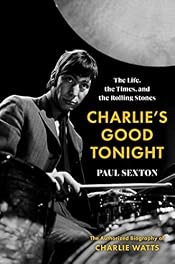
Charlie's Good Tonight is a biography of Charlie Watts, the legendary drummer for The Rolling Stones from their beginnings in 1962 through his death at the age of 80 in 2021. The author, Paul Sexton, is an English music journalist, documentary maker and radio producer who has interviewed the Stones musicians since the 1990s. He started working with Watts on this book several years before Watts' passing (from squamous-cell carcinoma). As the biography, then, was authorized by Watts, Watts' bandmates, family members and friends were willing to sit with Sexton for interviews as well.
This is a chatty and relatively well-written narrative about the life of a great musician. We learn a lot about who Charlie Watts was as a person, which is nice, as he was evidently a very nice guy for the most part. Watts' first musical love, and a love which lasted throughout his life, was jazz. Especially over the latter part of his life, Watts led several jazz bands, which he took on tour during lulls in the Stones' touring schedules. From the very beginning, Watts had nothing but boredom and disdain when it came to the trappings of rock and roll stardom. When his mates were partying, especially during the heady days of the 60s and 70s, Watts was generally in his hotel room on the phone with his wife, Shirley. Unusually for a rock and roll marriage, Watts' marriage to Shirley lasted from 1964 through their entire lives (Shirley died in 2022). They had one daughter and one grand-daughter, and a very strong family unit.
The drawback of the biography, as I experienced it anyway, is that there is precious little detail, especially little musical information, about the group's most famous period, those 60s and 70s albums when the Rolling Stones were breaking all sorts of musical ground and attaining a breathtaking level of musical excellence. We spend no time, via interviews, in the studio with the band during the creation of early hits like "Satisfaction," "Paint it Black" and "Get Off of My Cloud." The period that many fans consider the band's creative acme, when excellent lead guitarist Mick Taylor joined the group and they produced "Beggars' Banquet," "Sticky Fingers" and "Exile on Main Street," is described but rushed through. It isn't until later in the band's life, when their albums stayed good but were no longer groundbreaking, that we begin to get blow-by-blow details about the albums' writing and production and learn about the experience of touring in support of those albums. I suspect one issue here is the fact that Sexton doesn't really begin digging in until he gets to (or at least close to chronologically) the period of the band's life that he experienced personally. Another hurdle for Sexton was probably the fact that Watts claimed never to listen back to Rolling Stones albums once they were released. Still, questions about what it was like to be in the studio during the recording of "Satisfaction," or about how he came up with the iconic drum beat for "Paint it Black," for example, might have gotten some sort of interesting answers. We also don't learn, until about the book's 3/4 point, what it was about Watts' drumming, from a musician's point of view, that set him apart, and even then we get precious little. When I read a musician's biography, I do want to learn about what makes that person special as a musician. I'm not a musician myself, but I have spent quite a bit of time interviewing musicians, so I know that this can be done without descending into the kind of technical musical jargon that won't help most readers. Sexton seemed to think his readers would care more about dozens of pages about Watts' mania for antique collecting than about what made him a unique rock and roll percussion stylist. Even if Watts himself was reticent about such things, fellow Stones Mick Jagger, Keith Richards and Bill Wyman might have had much more to say on the topic. They are quoted fairly extensively, but mostly about what a great guy Watts was.
There is plenty that Sexton leaves out and/or that he assumes his readers already know, about the history of the band and even about Watts. The mid-career falling out between Jagger and Richards is alluded to but never explained. Why were they mad at each other? I guess the point is that anyone who'd read Richards' autobiography, or any number of Stones tell-all histories, would already know. I haven't read any of those and I'm unlikely to. Give us a hint, couldn't ya, Paul? Similarly, Watts' relatively late in life (his 40s) 5-year plunge into drug addiction is rushed through in three or four pages. What drugs was he on? How did it start? How did it all affect his family life? A mention and a couple of whispers is about all we get. It's not like I need to know gory details, but this is a biography after all.
Well, as I said up top, we do get a pretty good idea of what Charlie Watts was like as a person here. Basically, however, never, really, is heard a discouraging word on that score. So do we trust Sexton about this? The preponderance of evidence here, anyway, suggests we can. We also get, I think, a fairly good picture of what being a Rolling Stone was like for Watts. There are few "juicy" stories, but then I'd conjecture that writing a biography about the retiring, self-effacing, family man Rolling Stone was a relatively tough task. One thing it's nice to learn is, that Richards/Jagger squabble aside, what a close knit crew the Stones have remained with each other over the years. And also, not having read any other Rolling Stones-related bios or histories, what intelligent, thoughtful people Jagger, Richards and Wyman are.
Charlie's Good Tonight is a biography of Charlie Watts, the legendary drummer for The Rolling Stones from their beginnings in 1962 through his death at the age of 80 in 2021. The author, Paul Sexton, is an English music journalist, documentary maker and radio producer who has interviewed the Stones musicians since the 1990s. He started working with Watts on this book several years before Watts' passing (from squamous-cell carcinoma). As the biography, then, was authorized by Watts, Watts' bandmates, family members and friends were willing to sit with Sexton for interviews as well.
This is a chatty and relatively well-written narrative about the life of a great musician. We learn a lot about who Charlie Watts was as a person, which is nice, as he was evidently a very nice guy for the most part. Watts' first musical love, and a love which lasted throughout his life, was jazz. Especially over the latter part of his life, Watts led several jazz bands, which he took on tour during lulls in the Stones' touring schedules. From the very beginning, Watts had nothing but boredom and disdain when it came to the trappings of rock and roll stardom. When his mates were partying, especially during the heady days of the 60s and 70s, Watts was generally in his hotel room on the phone with his wife, Shirley. Unusually for a rock and roll marriage, Watts' marriage to Shirley lasted from 1964 through their entire lives (Shirley died in 2022). They had one daughter and one grand-daughter, and a very strong family unit.
The drawback of the biography, as I experienced it anyway, is that there is precious little detail, especially little musical information, about the group's most famous period, those 60s and 70s albums when the Rolling Stones were breaking all sorts of musical ground and attaining a breathtaking level of musical excellence. We spend no time, via interviews, in the studio with the band during the creation of early hits like "Satisfaction," "Paint it Black" and "Get Off of My Cloud." The period that many fans consider the band's creative acme, when excellent lead guitarist Mick Taylor joined the group and they produced "Beggars' Banquet," "Sticky Fingers" and "Exile on Main Street," is described but rushed through. It isn't until later in the band's life, when their albums stayed good but were no longer groundbreaking, that we begin to get blow-by-blow details about the albums' writing and production and learn about the experience of touring in support of those albums. I suspect one issue here is the fact that Sexton doesn't really begin digging in until he gets to (or at least close to chronologically) the period of the band's life that he experienced personally. Another hurdle for Sexton was probably the fact that Watts claimed never to listen back to Rolling Stones albums once they were released. Still, questions about what it was like to be in the studio during the recording of "Satisfaction," or about how he came up with the iconic drum beat for "Paint it Black," for example, might have gotten some sort of interesting answers. We also don't learn, until about the book's 3/4 point, what it was about Watts' drumming, from a musician's point of view, that set him apart, and even then we get precious little. When I read a musician's biography, I do want to learn about what makes that person special as a musician. I'm not a musician myself, but I have spent quite a bit of time interviewing musicians, so I know that this can be done without descending into the kind of technical musical jargon that won't help most readers. Sexton seemed to think his readers would care more about dozens of pages about Watts' mania for antique collecting than about what made him a unique rock and roll percussion stylist. Even if Watts himself was reticent about such things, fellow Stones Mick Jagger, Keith Richards and Bill Wyman might have had much more to say on the topic. They are quoted fairly extensively, but mostly about what a great guy Watts was.
There is plenty that Sexton leaves out and/or that he assumes his readers already know, about the history of the band and even about Watts. The mid-career falling out between Jagger and Richards is alluded to but never explained. Why were they mad at each other? I guess the point is that anyone who'd read Richards' autobiography, or any number of Stones tell-all histories, would already know. I haven't read any of those and I'm unlikely to. Give us a hint, couldn't ya, Paul? Similarly, Watts' relatively late in life (his 40s) 5-year plunge into drug addiction is rushed through in three or four pages. What drugs was he on? How did it start? How did it all affect his family life? A mention and a couple of whispers is about all we get. It's not like I need to know gory details, but this is a biography after all.
Well, as I said up top, we do get a pretty good idea of what Charlie Watts was like as a person here. Basically, however, never, really, is heard a discouraging word on that score. So do we trust Sexton about this? The preponderance of evidence here, anyway, suggests we can. We also get, I think, a fairly good picture of what being a Rolling Stone was like for Watts. There are few "juicy" stories, but then I'd conjecture that writing a biography about the retiring, self-effacing, family man Rolling Stone was a relatively tough task. One thing it's nice to learn is, that Richards/Jagger squabble aside, what a close knit crew the Stones have remained with each other over the years. And also, not having read any other Rolling Stones-related bios or histories, what intelligent, thoughtful people Jagger, Richards and Wyman are.
30connie53
Hi Jerry, you've read some interesting and diverse books in the last few months. Great job.
31rocketjk
Book 8: Shosha by Isaac Bashevis Singer

I read Shosha as a continuation of my project of reading all of Singer's novels in order of their publication in English, two novels per year, the first book I start in January and the first book I start in July.
Shosha, was originally published in English in 1978, after having been published in serialized form in 1974 in the Yiddish language publication Jewish Daily Forward. In Shosha, Singer brings us back into the Jewish community in Warsaw in the mid-1930s. The community is fractured into Bundists (the Jewish Socialist Labor Movement), Communists, Zionists, assimilationists, and, of course, traditional religious Jews and Hasids intent on sticking to the old ways. But everyone can discern the growing twin shadows of Hitler and Stalin. These people are expecting a Nazi invasion and know what their fate is likely to be. Our narrator is Aaron Griedinger, known to his friends as Tsutsik, a young struggling writer trying to find his way amid these philosophies and his possible futures. There are several women in Tsutsik's life, each, perhaps (or so it seemed to me, at any rate) representing a possible route for him. Celia, somewhat older and married, is assimilated and, along with her husband, more than a little hedonist. Dora, Tsutsik's on again, off again lover, is a Communist, preparing to leave for Soviet Russia until one of her former comrades comes staggering back from that country with tales of the arrests, torture, banishment and even executions awaiting Polish Jews who, professed Communists though they may be, cross the border hoping to join the workers' paradise. Betty Slonim is an American/Jewish actress who comes to Warsaw with her rich lover, Sam Dreiman. Sam and Betty represent a way out. They want Tsutsik to write a play for Betty and come with them to America, where Sam will produce it. But, almost by chance, Tsutsik returns one day to the old Jewish neighborhood of his youth, reconnects with a childhood friend, Shosha, and is immediately smitten. On the surface naive and trusting, her physical growth stunted by long years of malnutrition, Shosha, as Tsutsik soon comes to know, and for all her innocence, understands much more of the world than she lets on. A union with Shosha, however, most likely means death, for she will never leave Warsaw and the Nazis won't hold off their invasion forever.
Throughout this novel we receive Singer's deft, often humorous, touch describing human nature. In addition, the neighborhoods and streets of 1930s Warsaw and of Jewish life there (Singer himself grew up in Warsaw and left in the '30s, the lucky recipient of an extremely rare (for Jews at that time) U.S. visa) is delightfully and lovingly rendered, as the Jews of Warsaw continue their daily lives with the shadow of calamity. In addition to narrative beauty, humor, and the strength of Singer's character portrayals is the tension surrounding the fates of each of Tsutsik's friends. Who will stay and who will go. And for those who chose to stay, why are they staying? And of course in the center of it all there is Tsutsik and Shosha, and the drama of their fates. I found the last 50 or 75 pages of Shosha to be among the most moving and memorable of anything I've read by Singer. That, for me, is saying a lot.
Weaved throughout this narrative are many wonderful conversations about philosophy, religion and fate. One of Tsutsik's friends says to him, as they sit over coffee, "I remember your words. 'The world is a slaughterhouse and a brothel.' . . . Still, everything is forced upon us, even hope. The dictator on high, the celestial Stalin, says, 'You must hope!' And if he says you must, you hope. But what can I hope for any more? Only for death. Where is the sugar?"
Book note: My hardcopy edition of Shosha has been in my collection since before my LT "big bang" in 2008. My copy is a first edition, sixth printing.

I read Shosha as a continuation of my project of reading all of Singer's novels in order of their publication in English, two novels per year, the first book I start in January and the first book I start in July.
Shosha, was originally published in English in 1978, after having been published in serialized form in 1974 in the Yiddish language publication Jewish Daily Forward. In Shosha, Singer brings us back into the Jewish community in Warsaw in the mid-1930s. The community is fractured into Bundists (the Jewish Socialist Labor Movement), Communists, Zionists, assimilationists, and, of course, traditional religious Jews and Hasids intent on sticking to the old ways. But everyone can discern the growing twin shadows of Hitler and Stalin. These people are expecting a Nazi invasion and know what their fate is likely to be. Our narrator is Aaron Griedinger, known to his friends as Tsutsik, a young struggling writer trying to find his way amid these philosophies and his possible futures. There are several women in Tsutsik's life, each, perhaps (or so it seemed to me, at any rate) representing a possible route for him. Celia, somewhat older and married, is assimilated and, along with her husband, more than a little hedonist. Dora, Tsutsik's on again, off again lover, is a Communist, preparing to leave for Soviet Russia until one of her former comrades comes staggering back from that country with tales of the arrests, torture, banishment and even executions awaiting Polish Jews who, professed Communists though they may be, cross the border hoping to join the workers' paradise. Betty Slonim is an American/Jewish actress who comes to Warsaw with her rich lover, Sam Dreiman. Sam and Betty represent a way out. They want Tsutsik to write a play for Betty and come with them to America, where Sam will produce it. But, almost by chance, Tsutsik returns one day to the old Jewish neighborhood of his youth, reconnects with a childhood friend, Shosha, and is immediately smitten. On the surface naive and trusting, her physical growth stunted by long years of malnutrition, Shosha, as Tsutsik soon comes to know, and for all her innocence, understands much more of the world than she lets on. A union with Shosha, however, most likely means death, for she will never leave Warsaw and the Nazis won't hold off their invasion forever.
Throughout this novel we receive Singer's deft, often humorous, touch describing human nature. In addition, the neighborhoods and streets of 1930s Warsaw and of Jewish life there (Singer himself grew up in Warsaw and left in the '30s, the lucky recipient of an extremely rare (for Jews at that time) U.S. visa) is delightfully and lovingly rendered, as the Jews of Warsaw continue their daily lives with the shadow of calamity. In addition to narrative beauty, humor, and the strength of Singer's character portrayals is the tension surrounding the fates of each of Tsutsik's friends. Who will stay and who will go. And for those who chose to stay, why are they staying? And of course in the center of it all there is Tsutsik and Shosha, and the drama of their fates. I found the last 50 or 75 pages of Shosha to be among the most moving and memorable of anything I've read by Singer. That, for me, is saying a lot.
Weaved throughout this narrative are many wonderful conversations about philosophy, religion and fate. One of Tsutsik's friends says to him, as they sit over coffee, "I remember your words. 'The world is a slaughterhouse and a brothel.' . . . Still, everything is forced upon us, even hope. The dictator on high, the celestial Stalin, says, 'You must hope!' And if he says you must, you hope. But what can I hope for any more? Only for death. Where is the sugar?"
Book note: My hardcopy edition of Shosha has been in my collection since before my LT "big bang" in 2008. My copy is a first edition, sixth printing.
32EGBERTINA
>31 rocketjk: Wow! that sounds really good. unfortunately i dont think i can deal with sadness and heartbreak right now. but i will keep this in mind in case....
33rocketjk
Book 9: The Saturday Evening Post, November, 1974 edited by Beurt SerVaas
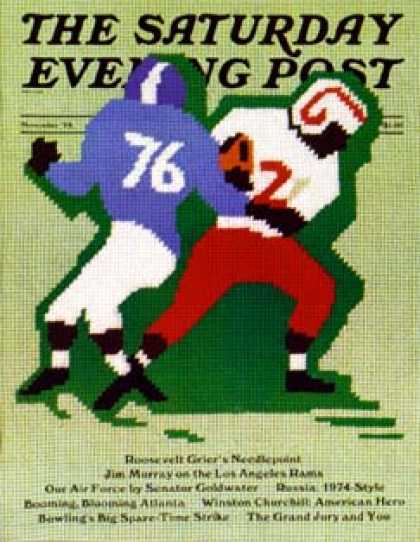
Read as a "Between Book" (see first post). This is another off the stack of old magazines sitting in my hallway closet. This magazine is not quite as old as some of the other magazines I've read through over the past few years, and not quite as interesting. Also, The Saturday Evening Post by editorial policy was aimed at a mainstream readership rather than an audience interested in more in-depth articles on politics, history or science. At any rate, this edition of the SEP did offer some interesting fare. There was a good profile of Pat Schroeder. A Democrat, Schroeder was first female U.S. Representative elected from Colorado and served in Congress from 1973 through 1997. In 1974 she was still something of a novelty in national politics, or at least in Colorado politics. I do remember Schroeder but was happy to read a contemporary profile. None other than Barry Goldwater contributed a long essay on the state of the U.S. Air Force as of '74. Other articles of note are:
* a fairly in-depth article on life in Russia in 1974 by Beurt SerVaas, the magazine's editor;
* an approving piece on the history and "current" state of things in Atlanta by Celestine Sibley;
* a profile of the Los Angles Rams' "new" coach Jim Knox by esteemed sports writer Jim Murray;
* a profile of Winston Churchill ("The Glowworm at 100") by Frank Gannon
The magazine also includes an investigation of the state of America's food supply and an indictment of the grand jury system, and several other articles. There are two rather mediocre short stories and one good story, "Stopover" by Betty Ren Wright.
The next magazine off the top of the stack to be added to the "Between Book" rotation, is the November 7, 1955 edition of Life Magazine. That's four months and three days after the day I was born!
Read as a "Between Book" (see first post). This is another off the stack of old magazines sitting in my hallway closet. This magazine is not quite as old as some of the other magazines I've read through over the past few years, and not quite as interesting. Also, The Saturday Evening Post by editorial policy was aimed at a mainstream readership rather than an audience interested in more in-depth articles on politics, history or science. At any rate, this edition of the SEP did offer some interesting fare. There was a good profile of Pat Schroeder. A Democrat, Schroeder was first female U.S. Representative elected from Colorado and served in Congress from 1973 through 1997. In 1974 she was still something of a novelty in national politics, or at least in Colorado politics. I do remember Schroeder but was happy to read a contemporary profile. None other than Barry Goldwater contributed a long essay on the state of the U.S. Air Force as of '74. Other articles of note are:
* a fairly in-depth article on life in Russia in 1974 by Beurt SerVaas, the magazine's editor;
* an approving piece on the history and "current" state of things in Atlanta by Celestine Sibley;
* a profile of the Los Angles Rams' "new" coach Jim Knox by esteemed sports writer Jim Murray;
* a profile of Winston Churchill ("The Glowworm at 100") by Frank Gannon
The magazine also includes an investigation of the state of America's food supply and an indictment of the grand jury system, and several other articles. There are two rather mediocre short stories and one good story, "Stopover" by Betty Ren Wright.
The next magazine off the top of the stack to be added to the "Between Book" rotation, is the November 7, 1955 edition of Life Magazine. That's four months and three days after the day I was born!
34rocketjk
Book 10: Quietly My Captain Waits by Evelyn Eaton
Quietly My Captain Waits is an historical novel of Acadia (described by Eaton as "modern Nova Scotia, New Brunswick, and a portion of Maine"), part of New France, at the end of the 17th century and the beginning of the 18th, in the French colony's final years, before the English pushed the French out of the territory during what became known as Queen Anne's War. The book, published in 1940, was Evelyn Eaton's third, but the first to bring her commercial success. Eaton went on to have a fascinating career as a poet, novelist and journalist. Always interested in spirituality and Native American culture, Eaton connected later in life (beginning in the early 1960s) with the Shoshone and Washoe tribes of California and became a Medicine Woman in their culture.
To write Quietly My Captain Waits, Eaton combed through the archives of the public archives of Halifax, Nova Scotia, and Annapolis Royal to uncover the story of real life, and very romantic, figures, especially Madame Louise de Freneuse and naval captain Pierre de Bonaventure, whose public love affair became a scandal in the New France stronghold of Port Royal because de Bonaventure had a wife and children in France. Eaton used this romance, which had begun when the two were quite young (in the novel, the young Louise's father refuses to allow the pair to marry the then lowly ensign Pierre) as the framework for her entirely engaging novel. It's an historical romantic novel of the old school, but the book rises above the ordinary through her rewarding storytelling skills, including excellent plotting that often takes unexpected, non-formulaic turns, the fact that we know she's created the story from real events and real people. For example, several of the letters sent from Port Royal's governors to the authorities in France are direct reproductions of the letters Eaton found in those archives. In addition, there is the doom that we know awaits the colony, which was finally taken by the British in an overwhelming assault in 1711. We only wait to learn the individual fates of our heroes. Members of several Native American tribes become major players in the events (and the story), and though the sort of paternalism we might expect from a 1940s novel does come into play, still the Native Americans are described what I suppose is basically realistic fashion. As noted above, Eaton felt a lifelong connection to Native American culture, so we would not expect her to be significantly patronizing. In Louise we have a strong, self-reliant and self-possessed heroine who does not bow to any man, be they military governors or even Pierre, the object of her lifelong romantic passion and a strong character himself.
I don't want to overstate what one will find in Quietly My Captain Waits. I wouldn't call it great literature, but within the genre of the old school historic novel, I'd say it stands strongly above the average offering. Eaton had a very good facility for describing the natural surroundings of the area in summer and winter. She, herself, grew up in Halifax, and her interest in the area and its history is clearly genuine. It's always interesting to me to read one of these old novels that were popular in their day but eventually sank entirely out of the public consciousness. And for me it's fascinating to know that the story and characters, if not, certainly, all of the plot points, come directly out of those obscure Halifax archives.
Here's a short biography of Eaton and also her daughter: https://www.winddaughter.com/evelyn-terry-eaton
Quietly My Captain Waits is an historical novel of Acadia (described by Eaton as "modern Nova Scotia, New Brunswick, and a portion of Maine"), part of New France, at the end of the 17th century and the beginning of the 18th, in the French colony's final years, before the English pushed the French out of the territory during what became known as Queen Anne's War. The book, published in 1940, was Evelyn Eaton's third, but the first to bring her commercial success. Eaton went on to have a fascinating career as a poet, novelist and journalist. Always interested in spirituality and Native American culture, Eaton connected later in life (beginning in the early 1960s) with the Shoshone and Washoe tribes of California and became a Medicine Woman in their culture.
To write Quietly My Captain Waits, Eaton combed through the archives of the public archives of Halifax, Nova Scotia, and Annapolis Royal to uncover the story of real life, and very romantic, figures, especially Madame Louise de Freneuse and naval captain Pierre de Bonaventure, whose public love affair became a scandal in the New France stronghold of Port Royal because de Bonaventure had a wife and children in France. Eaton used this romance, which had begun when the two were quite young (in the novel, the young Louise's father refuses to allow the pair to marry the then lowly ensign Pierre) as the framework for her entirely engaging novel. It's an historical romantic novel of the old school, but the book rises above the ordinary through her rewarding storytelling skills, including excellent plotting that often takes unexpected, non-formulaic turns, the fact that we know she's created the story from real events and real people. For example, several of the letters sent from Port Royal's governors to the authorities in France are direct reproductions of the letters Eaton found in those archives. In addition, there is the doom that we know awaits the colony, which was finally taken by the British in an overwhelming assault in 1711. We only wait to learn the individual fates of our heroes. Members of several Native American tribes become major players in the events (and the story), and though the sort of paternalism we might expect from a 1940s novel does come into play, still the Native Americans are described what I suppose is basically realistic fashion. As noted above, Eaton felt a lifelong connection to Native American culture, so we would not expect her to be significantly patronizing. In Louise we have a strong, self-reliant and self-possessed heroine who does not bow to any man, be they military governors or even Pierre, the object of her lifelong romantic passion and a strong character himself.
I don't want to overstate what one will find in Quietly My Captain Waits. I wouldn't call it great literature, but within the genre of the old school historic novel, I'd say it stands strongly above the average offering. Eaton had a very good facility for describing the natural surroundings of the area in summer and winter. She, herself, grew up in Halifax, and her interest in the area and its history is clearly genuine. It's always interesting to me to read one of these old novels that were popular in their day but eventually sank entirely out of the public consciousness. And for me it's fascinating to know that the story and characters, if not, certainly, all of the plot points, come directly out of those obscure Halifax archives.
Here's a short biography of Eaton and also her daughter: https://www.winddaughter.com/evelyn-terry-eaton
35rabbitprincess
>34 rocketjk: Perfect timing for this one, because August 15 is la fête nationale de l'Acadie! Will have to add it to my "hope it comes up in the used bookstores" list.
36rocketjk
>35 rabbitprincess: Oh, how cool! What I know about Acadians I mostly learned during my time living in New Orleans. I do think Quietly My Captain Waits is worth a good used bookstore "keep an eye out" project.
37rocketjk
Book 11: The Little World of Don Camillo by Giovanni Guareschi

"My parents had decided that I should become a naval engineer and so I ended up studying law and thus, in a short time, I became famous as a signboard artist and caricaturist."
So writes Giovanni Guareschi (1908-1968) in his humorous autobiographical introduction, "How I Got This Way," to The Little World of Don Camillo, the first collection of the satirical short stories he wrote in the late 1940s and early 50s about the rivalry between a village priest, Don Camillo, and the village's Communist mayor, Peppone. The stories were originally published individually in a periodical called Candido. (Guareschi says, " . . . {A} new magazine called Candido* was established in Milan and, in working for it, I found myself up to my eyes in politics although I was then, and still am, an independent. Nevertheless the magazine values my contributions very highly--perhaps because I am editor-in-chief.") Guareschi tells us that "The background of these stories is my home, Parma, the Emilian Plain along the Po where political passion often reaches a disturbing intensity, and yet these people are attractive and hospitable and generous and have a highly developed sense of humor."
Both Don Camillo and Perrone have considerable brute strength and large fists, and not infrequently the two come to blows, though Don Camillo is portrayed as the stronger and almost always the victor in these tussles. But they also have strong personal ties significantly strengthened by the fact that, during World War Two, both were members of resistance militias that took to the hills to fight the Nazis after the German occupation following Italy's armistice with the Allies in 1943. So when push comes to shove, they look out for each other and have each others' backs.
Don Camillo has one other major advantage over Perrone. In the village church that Don Camillo oversees hangs a large crucifix, and the Christ hanging on that crucifix often speaks to the Don, advising him toward patience and compassion, talking him down from impulsive actions, all with fond smiles and understanding towards the all-too-human priest.
The opening stories in the collection are relatively light in subject matter, and lines are frequently blurred. For as resolved as Perrone and his party followers are in the advancement of Communism, they are still often to be found in church on Sunday morning. In the second story, when Don Camillo refuses to baptize Perrone's infant son because Perrone is intent in naming him Lenin, he finds both Perrone and Christ arrayed against him. In another tale, Don Camillo attempts to convince Mayor Perrone to use village funds to fix a crack in the church bell tower. In a third, Perrone plays a joke on Don Camillo by having firecrackers tied to the church bells. Later, after Don Camillo has prevented Perrone from committing a crime of political passion by stealing Perrone's bicycle, Perrone shows up at the church looking for his bike after a long walk in the nighttime fog.
Towards the end, though, the stories become a bit more serious, though never losing their satirical edge entirely. These work particularly well because the rivalry and bonds between the two antagonists has already been well established. One of the final stories is entitled, "The Fear Spreads."
Overall, these stories are fun and insightful for all their humor, and provide a very interesting look at the post-war period in Italy when the country's future political system was in doubt, with rivalries between those vying for Communist control, the solidification of a democratic parliamentary republic or the return of the monarchy.
One final note: Guareschi occasionally provides writing like this . . .
Book note: My copy of The Little World of Don Camillo seems, from the online photos I've found, to be a first edition. It has been in my book collection since 2010. Also, I remember that my father loved this book.
* fwiw, Wikipedia describes Candido as a monarchist publication.

"My parents had decided that I should become a naval engineer and so I ended up studying law and thus, in a short time, I became famous as a signboard artist and caricaturist."
So writes Giovanni Guareschi (1908-1968) in his humorous autobiographical introduction, "How I Got This Way," to The Little World of Don Camillo, the first collection of the satirical short stories he wrote in the late 1940s and early 50s about the rivalry between a village priest, Don Camillo, and the village's Communist mayor, Peppone. The stories were originally published individually in a periodical called Candido. (Guareschi says, " . . . {A} new magazine called Candido* was established in Milan and, in working for it, I found myself up to my eyes in politics although I was then, and still am, an independent. Nevertheless the magazine values my contributions very highly--perhaps because I am editor-in-chief.") Guareschi tells us that "The background of these stories is my home, Parma, the Emilian Plain along the Po where political passion often reaches a disturbing intensity, and yet these people are attractive and hospitable and generous and have a highly developed sense of humor."
Both Don Camillo and Perrone have considerable brute strength and large fists, and not infrequently the two come to blows, though Don Camillo is portrayed as the stronger and almost always the victor in these tussles. But they also have strong personal ties significantly strengthened by the fact that, during World War Two, both were members of resistance militias that took to the hills to fight the Nazis after the German occupation following Italy's armistice with the Allies in 1943. So when push comes to shove, they look out for each other and have each others' backs.
Don Camillo has one other major advantage over Perrone. In the village church that Don Camillo oversees hangs a large crucifix, and the Christ hanging on that crucifix often speaks to the Don, advising him toward patience and compassion, talking him down from impulsive actions, all with fond smiles and understanding towards the all-too-human priest.
The opening stories in the collection are relatively light in subject matter, and lines are frequently blurred. For as resolved as Perrone and his party followers are in the advancement of Communism, they are still often to be found in church on Sunday morning. In the second story, when Don Camillo refuses to baptize Perrone's infant son because Perrone is intent in naming him Lenin, he finds both Perrone and Christ arrayed against him. In another tale, Don Camillo attempts to convince Mayor Perrone to use village funds to fix a crack in the church bell tower. In a third, Perrone plays a joke on Don Camillo by having firecrackers tied to the church bells. Later, after Don Camillo has prevented Perrone from committing a crime of political passion by stealing Perrone's bicycle, Perrone shows up at the church looking for his bike after a long walk in the nighttime fog.
"As he turned from the door Peppone said, 'I have made one mistake in my life. I tied firecrackers to your bells. It should have been half a ton of dynamite.'
'Errare humanum est,' remarked Don Camillo"
Towards the end, though, the stories become a bit more serious, though never losing their satirical edge entirely. These work particularly well because the rivalry and bonds between the two antagonists has already been well established. One of the final stories is entitled, "The Fear Spreads."
Overall, these stories are fun and insightful for all their humor, and provide a very interesting look at the post-war period in Italy when the country's future political system was in doubt, with rivalries between those vying for Communist control, the solidification of a democratic parliamentary republic or the return of the monarchy.
One final note: Guareschi occasionally provides writing like this . . .
Between one and three o'clock of an August afternoon, the heat in those fields of hemp and buckwheat can be both seen and felt. It is almost as though a great curtain of boiling glass hung a few inches from your nose. If you cross a bridge and look down into the canal, you find its bed dry and cracked, with here and there a dead fish, and when you look at a cemetery from the road along the river bank you almost seem to hear the bones rattling beneath the boiling sun. Along the main road you will meet an occasional wagon piled high with sand, with the driver sound asleep lying face downwards on top of his load, his stomach cool and his spine incandescent, or he will be sitting on the shaft fishing out pieces from half a watermelon that he holds on his knees like a bowl.
Then when you come to the big bank, there lies the great river, deserted, motionless and silent, like a cemetery of dead waters.
Book note: My copy of The Little World of Don Camillo seems, from the online photos I've found, to be a first edition. It has been in my book collection since 2010. Also, I remember that my father loved this book.
* fwiw, Wikipedia describes Candido as a monarchist publication.
38Jackie_K
>37 rocketjk: oh that looks great! I've only read one of the Don Camillo books but I was completely charmed by it!
39rocketjk
Book 12: The Betrayers by David Bezmozgis

I found The Betrayers to be a very readable and thought-provoking novel, and it engendered a good, positive, discussion in my monthly reading group this week. Baruch Kotler was a Refusenik activist in Soviet Russian. (The Refuseniks were Soviet Jews who applied to emigrate to Israel during the 1970s and into the 1980s. Just applying to leave the Soviet Union was enough to get you into trouble with the authorities, and many were put into mental hospitals or jails, or sent into exile.) Kotler was betrayed to the authorities by someone he thought was a friend, and his principled refusal to testify against others had earned him a long prison sentence. Eventually, international pressure had brought about Kotler's release and allowed him to finally get to Israel, where he had been praised as a hero and become a member of the Knesset with a significant following. As the novel begins, Kotler has taken another principled (to him) stand, refusing to go along with the government's plan to dismantle some Israeli settlements in the occupied territories, for reasons that are not made entirely clear. It's one thing to disagree, but Kotler has announced not just his and his party's vote against the plan, but his resignation from the government if the plan is carried out, thereby threatening the Prime Minister's ruling coalition. The government tries to blackmail him, threatening to expose his affair with a much younger woman. But Kotler is still the principled Kotler, and he refuses to comply. The action of the novel begins, then, with Kotler and his mistress, Leora, arriving in the Crimea, where they have come to escaped, at least for a while, the uproar of their public exposure. But, it turns out, in attempting to get away for the moment from the tumult of politics and scandal, Kotler has inadvertently walked into something powerful and much more personal.
The Betrayers, then, is a novel about personal standards and principles, about redemption and forgiveness. When should forgiveness be forthcoming? When, on the subject of guilt and resentment, is enough finally enough? To whom dues one owe one's loyalties? Family? Country? When does adherence to one's own sense of right and wrong above all else become selfish rather than admirable? There are many well drawn characters in this novel, and some very well conceived plot developments that I don't want to divulge here. (On that note, if you end up with the Back Bay Books edition of the novel pictured in this post, please beware of the paragraph-long blurb on the back cover that talks about plot developments that occur much too far into the narrative for my tastes.) I will say that the reading group my wife and I are in is comprised mostly of women, with the only other fellow in the group absent at this month's meeting. I mention that only to say that several of the group members mentioned their appreciation of the portrayals of the female characters in the book. I will say that the novel offers an affecting picture of the remnants of the Jewish community in the small town Kotler and Leora have landed in, the Jews who did not emigrate when the Soviet Union collapsed and most of the country's Jews had left for Israel.
The Betrayers is an absorbing, quick (219 pages) read. As an American Jew who, during high school days, took part in many "Free Soviet Jews" protests in front of the Russian embassy in New York, I found the subject matter particularly interesting. But also, I was interested in the fact that, written only ten years ago, this book portrays with sympathy a public figure who doesn't not support the dismantling of an Israeli settlement. At this point, for me and for most of the American Jews I know, the idea of dismantling those settlements seems like a very good idea, indeed, if one whose likelihood is disappearing ever more quickly, and tragically, into the past.
I found The Betrayers to be a very readable and thought-provoking novel, and it engendered a good, positive, discussion in my monthly reading group this week. Baruch Kotler was a Refusenik activist in Soviet Russian. (The Refuseniks were Soviet Jews who applied to emigrate to Israel during the 1970s and into the 1980s. Just applying to leave the Soviet Union was enough to get you into trouble with the authorities, and many were put into mental hospitals or jails, or sent into exile.) Kotler was betrayed to the authorities by someone he thought was a friend, and his principled refusal to testify against others had earned him a long prison sentence. Eventually, international pressure had brought about Kotler's release and allowed him to finally get to Israel, where he had been praised as a hero and become a member of the Knesset with a significant following. As the novel begins, Kotler has taken another principled (to him) stand, refusing to go along with the government's plan to dismantle some Israeli settlements in the occupied territories, for reasons that are not made entirely clear. It's one thing to disagree, but Kotler has announced not just his and his party's vote against the plan, but his resignation from the government if the plan is carried out, thereby threatening the Prime Minister's ruling coalition. The government tries to blackmail him, threatening to expose his affair with a much younger woman. But Kotler is still the principled Kotler, and he refuses to comply. The action of the novel begins, then, with Kotler and his mistress, Leora, arriving in the Crimea, where they have come to escaped, at least for a while, the uproar of their public exposure. But, it turns out, in attempting to get away for the moment from the tumult of politics and scandal, Kotler has inadvertently walked into something powerful and much more personal.
The Betrayers, then, is a novel about personal standards and principles, about redemption and forgiveness. When should forgiveness be forthcoming? When, on the subject of guilt and resentment, is enough finally enough? To whom dues one owe one's loyalties? Family? Country? When does adherence to one's own sense of right and wrong above all else become selfish rather than admirable? There are many well drawn characters in this novel, and some very well conceived plot developments that I don't want to divulge here. (On that note, if you end up with the Back Bay Books edition of the novel pictured in this post, please beware of the paragraph-long blurb on the back cover that talks about plot developments that occur much too far into the narrative for my tastes.) I will say that the reading group my wife and I are in is comprised mostly of women, with the only other fellow in the group absent at this month's meeting. I mention that only to say that several of the group members mentioned their appreciation of the portrayals of the female characters in the book. I will say that the novel offers an affecting picture of the remnants of the Jewish community in the small town Kotler and Leora have landed in, the Jews who did not emigrate when the Soviet Union collapsed and most of the country's Jews had left for Israel.
The Betrayers is an absorbing, quick (219 pages) read. As an American Jew who, during high school days, took part in many "Free Soviet Jews" protests in front of the Russian embassy in New York, I found the subject matter particularly interesting. But also, I was interested in the fact that, written only ten years ago, this book portrays with sympathy a public figure who doesn't not support the dismantling of an Israeli settlement. At this point, for me and for most of the American Jews I know, the idea of dismantling those settlements seems like a very good idea, indeed, if one whose likelihood is disappearing ever more quickly, and tragically, into the past.
40rocketjk
Book 13: Plunkitt of Tamany Hall: A Series of Very Plain Talks on Very Practical Politics by William L. Riordon
George Washington Plunkitt was a very successful politician operating within New York City's infamous Tammany Hall machine that ran the city for good and ill from the late 1800s through the Depression years, when the rot that the machine's inattention to anything but their own bank accounts finally became apparent. Plunkett served in the New York State Assembly and then the New York State Senate, and evidently was instrumental in voting in many important civil projects for the city. But he is most remembered for his patronage work within his New York City district. In 1904, he indulged his desire to speak his mind (evidently quite unusual for a Tammany bigwig), sitting on a shoeshine chair outside a NYC courthouse and expounding about the benefits of Tammany politics to journalist William L. Riordon. The series of talks were published one at a time in several NY newspapers, and in 1905 they were gathered and published in Plunkitt of Tammany Hall.
In these talks, Plunkitt's main points were the differences between "honest graft" and "dishonest graft." "Dishonest graft" meant, to him, things like blackmailing prostitutes, street vendors and even store owners for protection payments. This to Plunkitt was abhorrent. "Honest graft," though, was what we'd essentially today call insider trading. For example, he would, via his position in state government, learn of a new bridge in the works, buy up the land around where the entrances to the bridge was to be built, and then sell those lots back to the city at a handsome profit. "I seen my chance, and I took it," is how Plunkitt describes such maneuverings. The Tammany Hall district leaders would, famously, take care of the working people in their districts. Plunkitt describes his penchant for showing up at fires in working class neighborhoods and handing out cash for new furniture and clothing and even rent for people who'd been burned out. And always, of course, there were patronage jobs to be arranged. Anything to earn some votes.
Plunkitt describes with horror and disdain the reformist program to provide a trained and worthy civil service and saves his particular contempt for the "worthlessness" of the civil service exam. In his view, city jobs should be handed out the old fashioned way, to the people in his district who vote the right way and can bring along some other votes to make their cases stronger and so deserve to be rewarded. Competence or knowledge of the work the job entails is way down the priority list. Plunkitt's criticisms of the civil service exams are often quite humorous.
As New York City historian Peter Quinn points out in his contemporary introduction to my Signet Classics edition of the book, it is sometimes difficult to know where in the quoting and composition of these talks, Plunkitt leaves off and Riordon comes in. But I think we can assume that while the wording of some passages may be Riordon's, but content overall is Plunkitt's. Tammany could get things done. As Riordon tells us at the end of his original introduction to this book,
"Plunkitt has been one of the great powers in Tammany Hall for over a quarter of a century. While he was in the Assembly and the State Senate he was one of the most influential members and introduced the bills that provided for the outlying pairs of New York city, the Harlem River Speedway {now the Harlem River Drive, I think}, the Washington Bridge, the 155th Street Viaduct, the grading of Eighth Avenue north of Fifty-seventh Street, additions to the Museum of Natural History, the West Side Court, and many other important improvements."
On the other hand, I think we can safely assume that Plunkitt made money for himself on just about all of these projects. I read this book because I did one of my periodical random selections from my home library using the LT "Go to a random book of yours" function. Interestingly, it tied in very closely to my last book, The New York Game: Baseball and the Rise of a New City, with it's detailed descriptions of the Tammany machine and the ruins it left the city in when the Depression hit. (See my review of that book, just above.) Overall, for me, although the individual talks did eventually become somewhat tedious, I found Plunkitt of Tammany Hall to be an interesting look inside that famous political machine from the point of view of one of its practitioners. Chapter titles like "New York City Is Pie for the Hayseeds" and "Tammany Leaders Not Bookworms" will give you an idea of the tone of the proceedings.
George Washington Plunkitt was a very successful politician operating within New York City's infamous Tammany Hall machine that ran the city for good and ill from the late 1800s through the Depression years, when the rot that the machine's inattention to anything but their own bank accounts finally became apparent. Plunkett served in the New York State Assembly and then the New York State Senate, and evidently was instrumental in voting in many important civil projects for the city. But he is most remembered for his patronage work within his New York City district. In 1904, he indulged his desire to speak his mind (evidently quite unusual for a Tammany bigwig), sitting on a shoeshine chair outside a NYC courthouse and expounding about the benefits of Tammany politics to journalist William L. Riordon. The series of talks were published one at a time in several NY newspapers, and in 1905 they were gathered and published in Plunkitt of Tammany Hall.
In these talks, Plunkitt's main points were the differences between "honest graft" and "dishonest graft." "Dishonest graft" meant, to him, things like blackmailing prostitutes, street vendors and even store owners for protection payments. This to Plunkitt was abhorrent. "Honest graft," though, was what we'd essentially today call insider trading. For example, he would, via his position in state government, learn of a new bridge in the works, buy up the land around where the entrances to the bridge was to be built, and then sell those lots back to the city at a handsome profit. "I seen my chance, and I took it," is how Plunkitt describes such maneuverings. The Tammany Hall district leaders would, famously, take care of the working people in their districts. Plunkitt describes his penchant for showing up at fires in working class neighborhoods and handing out cash for new furniture and clothing and even rent for people who'd been burned out. And always, of course, there were patronage jobs to be arranged. Anything to earn some votes.
Plunkitt describes with horror and disdain the reformist program to provide a trained and worthy civil service and saves his particular contempt for the "worthlessness" of the civil service exam. In his view, city jobs should be handed out the old fashioned way, to the people in his district who vote the right way and can bring along some other votes to make their cases stronger and so deserve to be rewarded. Competence or knowledge of the work the job entails is way down the priority list. Plunkitt's criticisms of the civil service exams are often quite humorous.
As New York City historian Peter Quinn points out in his contemporary introduction to my Signet Classics edition of the book, it is sometimes difficult to know where in the quoting and composition of these talks, Plunkitt leaves off and Riordon comes in. But I think we can assume that while the wording of some passages may be Riordon's, but content overall is Plunkitt's. Tammany could get things done. As Riordon tells us at the end of his original introduction to this book,
"Plunkitt has been one of the great powers in Tammany Hall for over a quarter of a century. While he was in the Assembly and the State Senate he was one of the most influential members and introduced the bills that provided for the outlying pairs of New York city, the Harlem River Speedway {now the Harlem River Drive, I think}, the Washington Bridge, the 155th Street Viaduct, the grading of Eighth Avenue north of Fifty-seventh Street, additions to the Museum of Natural History, the West Side Court, and many other important improvements."
On the other hand, I think we can safely assume that Plunkitt made money for himself on just about all of these projects. I read this book because I did one of my periodical random selections from my home library using the LT "Go to a random book of yours" function. Interestingly, it tied in very closely to my last book, The New York Game: Baseball and the Rise of a New City, with it's detailed descriptions of the Tammany machine and the ruins it left the city in when the Depression hit. (See my review of that book, just above.) Overall, for me, although the individual talks did eventually become somewhat tedious, I found Plunkitt of Tammany Hall to be an interesting look inside that famous political machine from the point of view of one of its practitioners. Chapter titles like "New York City Is Pie for the Hayseeds" and "Tammany Leaders Not Bookworms" will give you an idea of the tone of the proceedings.
41rocketjk
Book 14: Living by Henry Green

Henry Green was the non de plume of Henry Vincent Yorke, a wealthy British industrialist (1905-1973) who nevertheless in his fiction writing displayed a strong understanding of and sympathy for all strata of English society, most definitely including the industrial working class. He has never gained much general recognition in the U.S., but his writing has been adored by other writers, including W.H. Auden and John Updike. In fact, Updike wrote the introduction to the volume I have that collects three of Green short(ish) novels, Loving, Living, and Party Going. That's the order they're presented in the volume, though that puts them out of chronological order. I assume Updike explains the reason for this in his introduction, but I'm not reading that essay until I've read all three of those novels, which I've decided to read in publication order. So that means reading Living, published in 1929, first. OK, that's out of the way.
Living takes us through an indeterminate number of months in the lives of a group of workers at a Birmingham iron works. We see the lives of both older and younger workers, with a range not just of ages but also of work status, from managers to the most menial of workers (and with the most dangerous jobs). We even reach up into the concerns of the foundry's owner and his family. Another major and sympathetically rendered character is Lily, who keeps house for three men, each of a different generation, and tries to see her way through a choices between sticking with the safe, familiar life laid out for her and striking out and away in hopes of something better.
There's not much plot, really, in this novel. Just the incrementally slow advances of daily lives, the minor dramas between personalities and power levels at the workplace, and the fears and frustrations that advancing age bring to the older characters. At first it was a little difficult for me to remember the situations and stations of the characters as Green moved rather quickly amongst them. Eventually, though, they each came clear to me. The language of the writing, and the way in which Green slowly fills his characters out through small details and observations, eventually pulled me into the narrative quite effectively.
Green does employ one quirk of language that took me a bit to get used to. He often leaves out articles and sometimes possessive pronouns to create sentences such as "The man got on train." Whether this was designed to recreate a Birmingham lexicon of the time or maybe to create a particular atmosphere I don't know. Again, I assume Updike addresses this in his introduction, but again, that knowledge will have to wait until I've read the full volume. Introductions, I find, often contain spoilers, a phenomenon I've never understood, but there you are.
Anyway, if character is your thing and plot is something that, wonderful as it is, is not essential to reading enjoyment, you might well get on with this novel as much as I did. I'll leave you with one longish example of the writing here:
This volume has been on my shelves since 2019. I'll be reading the other two novels in this omnibus in relatively short order.

Henry Green was the non de plume of Henry Vincent Yorke, a wealthy British industrialist (1905-1973) who nevertheless in his fiction writing displayed a strong understanding of and sympathy for all strata of English society, most definitely including the industrial working class. He has never gained much general recognition in the U.S., but his writing has been adored by other writers, including W.H. Auden and John Updike. In fact, Updike wrote the introduction to the volume I have that collects three of Green short(ish) novels, Loving, Living, and Party Going. That's the order they're presented in the volume, though that puts them out of chronological order. I assume Updike explains the reason for this in his introduction, but I'm not reading that essay until I've read all three of those novels, which I've decided to read in publication order. So that means reading Living, published in 1929, first. OK, that's out of the way.
Living takes us through an indeterminate number of months in the lives of a group of workers at a Birmingham iron works. We see the lives of both older and younger workers, with a range not just of ages but also of work status, from managers to the most menial of workers (and with the most dangerous jobs). We even reach up into the concerns of the foundry's owner and his family. Another major and sympathetically rendered character is Lily, who keeps house for three men, each of a different generation, and tries to see her way through a choices between sticking with the safe, familiar life laid out for her and striking out and away in hopes of something better.
There's not much plot, really, in this novel. Just the incrementally slow advances of daily lives, the minor dramas between personalities and power levels at the workplace, and the fears and frustrations that advancing age bring to the older characters. At first it was a little difficult for me to remember the situations and stations of the characters as Green moved rather quickly amongst them. Eventually, though, they each came clear to me. The language of the writing, and the way in which Green slowly fills his characters out through small details and observations, eventually pulled me into the narrative quite effectively.
Green does employ one quirk of language that took me a bit to get used to. He often leaves out articles and sometimes possessive pronouns to create sentences such as "The man got on train." Whether this was designed to recreate a Birmingham lexicon of the time or maybe to create a particular atmosphere I don't know. Again, I assume Updike addresses this in his introduction, but again, that knowledge will have to wait until I've read the full volume. Introductions, I find, often contain spoilers, a phenomenon I've never understood, but there you are.
Anyway, if character is your thing and plot is something that, wonderful as it is, is not essential to reading enjoyment, you might well get on with this novel as much as I did. I'll leave you with one longish example of the writing here:
Mr. Craigan had gone to work when he was nine and every daytime he had worked through most of daylight till now, when he was going to get old age pension. So you will hear men who have worked like this talk of monotony of their lives, but when they grow to be old they are more glad to have work and this monotony has grown so great that they have forgotten it. Like on a train which goes through night smoothly and at an even pace -- so monotony of noise made by the wheels bumping over joints between the rails becomes rhythm -- so this monotony of hours grows to be the habit and regulation on which we grow old. . . . so when men who have worked these regular hours are now deprived of work, so, often their lives come to be like puddles on the beach where tide no longer reaches.
This volume has been on my shelves since 2019. I'll be reading the other two novels in this omnibus in relatively short order.
42rocketjk
Book 15: Machine Dreams by Jayne Anne Phillips

I remember when Machine Dreams, Jayne Anne Phillips' debut novel, was first published in 1984 and was immediately hailed as a wonderful book. I was 29 at the time. For awhile it was everywhere. I never had any particular aversion to reading it. I just never got around to it. So now, finally, I have done so, and I'm glad I did. Machine Dreams shows us three generations of a working class West Virginia family, running from the 1920s through the 1960s. There's not too much in the way of plot, I guess, but there are some very vivid character studies, and some very good descriptive writing of personalities and environment, both natural and man-made. The central theme to me seems to be disappointment and the ways in which the workaday demands of small town life in a disconnected area of the U.S. press life down into the constant tasks of daily requirements. I know I've made the book sound grim, but it really isn't. The nature of the character depictions of brings life and even sometimes courage into the tapestry quite believably. So, as I said, I'm happy to have finally read the novel, and I can certainly see myself reading further into Phillips' work to see how her writing progressed over the intervening years.
Machine Dreams has been in my library since before my LT "big boom" in 2008.

I remember when Machine Dreams, Jayne Anne Phillips' debut novel, was first published in 1984 and was immediately hailed as a wonderful book. I was 29 at the time. For awhile it was everywhere. I never had any particular aversion to reading it. I just never got around to it. So now, finally, I have done so, and I'm glad I did. Machine Dreams shows us three generations of a working class West Virginia family, running from the 1920s through the 1960s. There's not too much in the way of plot, I guess, but there are some very vivid character studies, and some very good descriptive writing of personalities and environment, both natural and man-made. The central theme to me seems to be disappointment and the ways in which the workaday demands of small town life in a disconnected area of the U.S. press life down into the constant tasks of daily requirements. I know I've made the book sound grim, but it really isn't. The nature of the character depictions of brings life and even sometimes courage into the tapestry quite believably. So, as I said, I'm happy to have finally read the novel, and I can certainly see myself reading further into Phillips' work to see how her writing progressed over the intervening years.
Machine Dreams has been in my library since before my LT "big boom" in 2008.
43rocketjk
Book 16: Emma by Jane Austen
 *
* 
The cover on the left represents the edition of Emma that I first read and that was in my home library for 35 years or so but that got purged when my wife and I moved from our Mendocino County (CA) house to our NYC apartment. The cover on the right represents the library copy I read this time.
This was a reread for my monthly book group. My memory of my first reading of Emma was very affectionate, indeed, and I have for years been telling people that I held the novel to be among the five funniest books I've ever read.* I thought the way Austen skewered the British landed gentry of her day (early 19th century) was delightful. Emma's attempts to guide the lives and loves of her friends, around which the novel revolves, quietly hilarious. So I was very much in favor of the group's selection and looking forward to revisiting an old favorite. I'm sorry to say, though, that in this reading, the book fell mostly flat for me. Perhaps the issue was that I had too much foreknowledge of the crucial characteristic of both the title character and of the narrative. Also, while I fully realize that the claustrophobia of the women's lives in this society was a major part of the point Austen was making (and satirizing), in the rereading I found the whole exercise more than a little tedious. Things finally picked up for me over the last 100 pages (of the 445-pages in the Penguin Classics edition I was reading). Finally, I guess my intellectual curiosity about the lives of the people in that class in that time and place has considerably waned. Anyway, this is all just one grump's reaction. I'm leaving the five-star rating I included for Emma when I originally posted the book on LT, probably 20 years after I'd first read it. I'd take the opinion of 30-year-old me over word of 70-year-old me any day.
* The other four:
Catch 22
A Confederacy of Dunces
Don Quixote
Portnoy's Complaint
 *
* 
The cover on the left represents the edition of Emma that I first read and that was in my home library for 35 years or so but that got purged when my wife and I moved from our Mendocino County (CA) house to our NYC apartment. The cover on the right represents the library copy I read this time.
This was a reread for my monthly book group. My memory of my first reading of Emma was very affectionate, indeed, and I have for years been telling people that I held the novel to be among the five funniest books I've ever read.* I thought the way Austen skewered the British landed gentry of her day (early 19th century) was delightful. Emma's attempts to guide the lives and loves of her friends, around which the novel revolves, quietly hilarious. So I was very much in favor of the group's selection and looking forward to revisiting an old favorite. I'm sorry to say, though, that in this reading, the book fell mostly flat for me. Perhaps the issue was that I had too much foreknowledge of the crucial characteristic of both the title character and of the narrative. Also, while I fully realize that the claustrophobia of the women's lives in this society was a major part of the point Austen was making (and satirizing), in the rereading I found the whole exercise more than a little tedious. Things finally picked up for me over the last 100 pages (of the 445-pages in the Penguin Classics edition I was reading). Finally, I guess my intellectual curiosity about the lives of the people in that class in that time and place has considerably waned. Anyway, this is all just one grump's reaction. I'm leaving the five-star rating I included for Emma when I originally posted the book on LT, probably 20 years after I'd first read it. I'd take the opinion of 30-year-old me over word of 70-year-old me any day.
* The other four:
Catch 22
A Confederacy of Dunces
Don Quixote
Portnoy's Complaint
44rocketjk
Book 17: The Decameron by Giovanni Boccaccio (translated by Wayne A, Rebhorn)

Read as a "Between Book" (see first post). I started out thinking I was going to read these 100 stories straight through, in order to really get the flavor of the work and the times. That lasted for about 5 or 6 stories, and then I switched the Decameron to my "Between Books" stack. According to translator Wayne A. Rebhorn, in his very interesting introduction to my Norton edition, Boccaccio wrote the Decameron in Florence in the mid-1300s, only a few years after the Plague first struck the city. In the book, 10 wealthy young people, 7 women and 3 men, decide to head out into the countryside for several days in hopes of avoiding the disease, and also to amuse themselves and each other. Each day for 10 days, they gather together for some storytelling. Each day they must each tell a tale to amuse the others, and each day they have a different topic to spin a yarn about. The stories are for the most part short, from four to eight or ten pages, and often they are irreverent. And especially in the first half of the book, they are often, famously, quite bawdy. The stories are fun, all right, and they do open a window into the time they were written, and that Boccaccio is satirizing. But, other than the historical perspective they provide about the attitudes of the day, they are not particularly compelling or enlightening. So my own personal reaction is that only a scholar of mid-15th century Italian literature and/or culture would be likely find plowing through all of these stories from cover to cover a particularly entertaining or rewarding reading experience. However, I did quite enjoy reading the tales one at a time, one tale between each of the novels/histories/etc. that I read straight through during the past couple of years.

Read as a "Between Book" (see first post). I started out thinking I was going to read these 100 stories straight through, in order to really get the flavor of the work and the times. That lasted for about 5 or 6 stories, and then I switched the Decameron to my "Between Books" stack. According to translator Wayne A. Rebhorn, in his very interesting introduction to my Norton edition, Boccaccio wrote the Decameron in Florence in the mid-1300s, only a few years after the Plague first struck the city. In the book, 10 wealthy young people, 7 women and 3 men, decide to head out into the countryside for several days in hopes of avoiding the disease, and also to amuse themselves and each other. Each day for 10 days, they gather together for some storytelling. Each day they must each tell a tale to amuse the others, and each day they have a different topic to spin a yarn about. The stories are for the most part short, from four to eight or ten pages, and often they are irreverent. And especially in the first half of the book, they are often, famously, quite bawdy. The stories are fun, all right, and they do open a window into the time they were written, and that Boccaccio is satirizing. But, other than the historical perspective they provide about the attitudes of the day, they are not particularly compelling or enlightening. So my own personal reaction is that only a scholar of mid-15th century Italian literature and/or culture would be likely find plowing through all of these stories from cover to cover a particularly entertaining or rewarding reading experience. However, I did quite enjoy reading the tales one at a time, one tale between each of the novels/histories/etc. that I read straight through during the past couple of years.
45detailmuse
>43 rocketjk: I too loved Catch-22 and Don Quixote (DQ is on my list of to-be-reread books; I listened on audio the first time), so I should seriously consider the others on your list.
46rocketjk
Book 18: The Betrothed by Sir Walter Scott

Staying in the early 19th Century, I read and enjoyed The Betrothed, one of Sir Walter Scott's many "Waverly Novels." (Emma was published in 1815 and The Betrothed in 1825). These Waverly Novels are not particularly deep, but they are fun, if one has a taste for historical adventure story/romances that glorify the age of chivalry, with all its attendant prescribed gender roles. It is the 12th Century. The Normans have completed their invasion of England and solidified their hold over the country. But there are still the Welsh to deal with, or rather to try to deal with. The Normans have been pushing their castles deeper into Wales land, and the Welsh, understandably, are not pleased. Welsh prince Gwenwyn* and Norman knight Raymond Berenger, who rules the castle Garde Doloureuse, have attempted to make peace with each other. But when Gwenwyn asks for Berenger's daughter Eveline's hand in marriage, Berenger replies that she is already promised to another Norman noble, Sir Hugo de Lacy, the Constable of Chester. The Welsh take this as an affront, and attack the castle. To the rescue comes de Lacy and his army. All this takes place within the context of the imminent Crusades, which Baldwin,* the Archbishop of Canterbury, is urging all British nobility to take part in. Eveline and de Lacy, he being around 30 years her elder, are married, but due to the meddling of Baldwin, de Lacy is forced to ride off to the Crusades before the marriage can be consummated. He leaves his young, handsome nephew, Damian, to look after Eveline and be her protector during the three years de Lacy is to be away. What could go wrong? This is just a bare outline of the very beginning of the action. The story proceeds apace, often hurtling along, although sometimes a bit slow. Scott provides plenty of side characters for our entertainment, some amusing, some upright, some dastardly. And there is lots of wonderful natural description of the beauty of Wales. I enjoyed reading The Betrothed, as I found it to be fun in the reading, the stereotypes of the genre, and of Scott's time (including antisemitism), notwithstanding. Also, the second half of Scott's introduction to the novel is hilarious.
* Based, according to Wikipedia, on historical figures, as are several other characters in the narrative.
Book note: As you can see from the image of the title page I've posted, my copy of the book comes from the Rand McNally "Alpha Library." As best I can determine online, books in the "Alpha Library" published from 1897 through 1903, though I'm not sure what I'm looking at is meant to be a comprehensive chronology. Anyway, somewhere in there. I've had the book on my shelves since before my LT "Big Bang" in 2008. The volume also includes both The Highland Widow which is noted on the title page, and The Chronicles of the Cannongate, which is not. I'll be reading those other two works in the relatively near future.
Finally, as you can see on the title page image, Scotts name is given as Sir Walter Scott, Bart. Does anyone here know what that "Bart." means?

Staying in the early 19th Century, I read and enjoyed The Betrothed, one of Sir Walter Scott's many "Waverly Novels." (Emma was published in 1815 and The Betrothed in 1825). These Waverly Novels are not particularly deep, but they are fun, if one has a taste for historical adventure story/romances that glorify the age of chivalry, with all its attendant prescribed gender roles. It is the 12th Century. The Normans have completed their invasion of England and solidified their hold over the country. But there are still the Welsh to deal with, or rather to try to deal with. The Normans have been pushing their castles deeper into Wales land, and the Welsh, understandably, are not pleased. Welsh prince Gwenwyn* and Norman knight Raymond Berenger, who rules the castle Garde Doloureuse, have attempted to make peace with each other. But when Gwenwyn asks for Berenger's daughter Eveline's hand in marriage, Berenger replies that she is already promised to another Norman noble, Sir Hugo de Lacy, the Constable of Chester. The Welsh take this as an affront, and attack the castle. To the rescue comes de Lacy and his army. All this takes place within the context of the imminent Crusades, which Baldwin,* the Archbishop of Canterbury, is urging all British nobility to take part in. Eveline and de Lacy, he being around 30 years her elder, are married, but due to the meddling of Baldwin, de Lacy is forced to ride off to the Crusades before the marriage can be consummated. He leaves his young, handsome nephew, Damian, to look after Eveline and be her protector during the three years de Lacy is to be away. What could go wrong? This is just a bare outline of the very beginning of the action. The story proceeds apace, often hurtling along, although sometimes a bit slow. Scott provides plenty of side characters for our entertainment, some amusing, some upright, some dastardly. And there is lots of wonderful natural description of the beauty of Wales. I enjoyed reading The Betrothed, as I found it to be fun in the reading, the stereotypes of the genre, and of Scott's time (including antisemitism), notwithstanding. Also, the second half of Scott's introduction to the novel is hilarious.
* Based, according to Wikipedia, on historical figures, as are several other characters in the narrative.
Book note: As you can see from the image of the title page I've posted, my copy of the book comes from the Rand McNally "Alpha Library." As best I can determine online, books in the "Alpha Library" published from 1897 through 1903, though I'm not sure what I'm looking at is meant to be a comprehensive chronology. Anyway, somewhere in there. I've had the book on my shelves since before my LT "Big Bang" in 2008. The volume also includes both The Highland Widow which is noted on the title page, and The Chronicles of the Cannongate, which is not. I'll be reading those other two works in the relatively near future.
Finally, as you can see on the title page image, Scotts name is given as Sir Walter Scott, Bart. Does anyone here know what that "Bart." means?
47Robertgreaves
Bart. is short for Baronet, which is basically a hereditary knighthood. Most knighthoods expire on the death of the holder (eg Sir Arthur Conan Doyle) but Sir Walter Scott was created a baronet and so his son became Sir Walter on the author's death.
Baronets don't have to have the same first name. If his son had been called Charles, he would have become Sir Charles on his father's death.
Baronets don't have to have the same first name. If his son had been called Charles, he would have become Sir Charles on his father's death.
48rocketjk
>47 Robertgreaves: Thanks!
49rocketjk
Book 19: Party Going by Henry Green

The following is the first paragraph of my review of Living by Henry Green, which I read earlier this year:
Henry Green was the non de plume of Henry Vincent Yorke, a wealthy British industrialist (1905-1973) who nevertheless in his fiction writing displayed a strong understanding of and sympathy for all strata of English society, most definitely including the industrial working class. He has never gained much general recognition in the U.S., but his writing has been adored by other writers, including W.H. Auden and John Updike. In fact, Updike wrote the introduction to the volume I have that collects three of Green short(ish) novels, Loving, Living, and Party Going. That's the order they're presented in the volume, though that puts them out of chronological order. I assume Updike explains the reason for this in his introduction, but I'm not reading that essay until I've read all three of those novels, which I've decided to read in publication order. So that means reading Living, published in 1929, first, and now Party Going, published in 1939. Still remaining for me to read is Loving, first published in 1945. OK, that's out of the way.
While Living takes place almost entirely within the world of the workers in a Birmingham iron foundry, Party Going brings us into the rather dubious company of a group of rich and privileged young socialites. They are all off to a holiday in the south of France, but they are held up by an extraordinarily dense fog which enshrouds London and the surrounding areas to the extent that no trains are going in and out of the city's main station. The station fills up with workers of all classes who are, mostly, trying to get home from work. (Personally, never having spent time in London, I kept picturing the main concourse of Grand Central Station.) The crowd is eventually elbow to elbow, though our rich friends are soon conducted to rooms in an adjoining hotel to wait out the crush, with the rooms paid for by Max, the most handsome and richest of the group, while their servants are left within the human sea to watch over the rich folks' luggage. And so we are ushered into a stultifying world of boredom, jealousy, flirting and ennui as our privileged young gang endures together. The relationships between the men and women seem mostly to be metaphorical wrestling matches for momentary advantage, one over the other. I will say that the female characters come in for particular scorn, in terms of shallowness and cravenness, in Green's narrative. Occasionally we get a breath of fresh air, so to speak, as Green shifts us down to the main floor to bring us for conversations between a pair of the long-suffering servants on luggage guard duty.
So what we have here, more or less, is a 1939 version of Emma, but without the somewhat ameliorating presence of Mr. Knightly or the wrong-headed but good-hearted influence of Emma herself. The first half of this short novel's 143 pages I found more than a little exasperating, but in the second half I found that either the narrative had picked up some in terms of liveliness or that I had simply started to roll with the book's tempo better. And then, occasionally, as in Living, we get some really excellent (at least in my view) and/or funny passages. Here are a few:
Before they have been brought to their hotel suite . . .
Once they are in their hotel suite . . .
All in all I would say I enjoyed Living, with its examination of working class life and concerns, more than Party Going, though I did find my way eventually to the charms of the latter. I will be reading the third novel in the omnibus, Loving, sooner rather than later.

The following is the first paragraph of my review of Living by Henry Green, which I read earlier this year:
Henry Green was the non de plume of Henry Vincent Yorke, a wealthy British industrialist (1905-1973) who nevertheless in his fiction writing displayed a strong understanding of and sympathy for all strata of English society, most definitely including the industrial working class. He has never gained much general recognition in the U.S., but his writing has been adored by other writers, including W.H. Auden and John Updike. In fact, Updike wrote the introduction to the volume I have that collects three of Green short(ish) novels, Loving, Living, and Party Going. That's the order they're presented in the volume, though that puts them out of chronological order. I assume Updike explains the reason for this in his introduction, but I'm not reading that essay until I've read all three of those novels, which I've decided to read in publication order. So that means reading Living, published in 1929, first, and now Party Going, published in 1939. Still remaining for me to read is Loving, first published in 1945. OK, that's out of the way.
While Living takes place almost entirely within the world of the workers in a Birmingham iron foundry, Party Going brings us into the rather dubious company of a group of rich and privileged young socialites. They are all off to a holiday in the south of France, but they are held up by an extraordinarily dense fog which enshrouds London and the surrounding areas to the extent that no trains are going in and out of the city's main station. The station fills up with workers of all classes who are, mostly, trying to get home from work. (Personally, never having spent time in London, I kept picturing the main concourse of Grand Central Station.) The crowd is eventually elbow to elbow, though our rich friends are soon conducted to rooms in an adjoining hotel to wait out the crush, with the rooms paid for by Max, the most handsome and richest of the group, while their servants are left within the human sea to watch over the rich folks' luggage. And so we are ushered into a stultifying world of boredom, jealousy, flirting and ennui as our privileged young gang endures together. The relationships between the men and women seem mostly to be metaphorical wrestling matches for momentary advantage, one over the other. I will say that the female characters come in for particular scorn, in terms of shallowness and cravenness, in Green's narrative. Occasionally we get a breath of fresh air, so to speak, as Green shifts us down to the main floor to bring us for conversations between a pair of the long-suffering servants on luggage guard duty.
So what we have here, more or less, is a 1939 version of Emma, but without the somewhat ameliorating presence of Mr. Knightly or the wrong-headed but good-hearted influence of Emma herself. The first half of this short novel's 143 pages I found more than a little exasperating, but in the second half I found that either the narrative had picked up some in terms of liveliness or that I had simply started to roll with the book's tempo better. And then, occasionally, as in Living, we get some really excellent (at least in my view) and/or funny passages. Here are a few:
Before they have been brought to their hotel suite . . .
"Anyone who found herself alone with Julia could not help feeling they had been left in charge. Again there was so much luggage round in piles like an exaggerated grave yard, with the owners of it and their porters like mourners with the undertakers' men, and so much agitation on one hand with subdued respectful indifference on the other . . . "
and
"Miss Chevy and her young man were standing in the main crowd. She was very pretty and dressed well, her hands were ridiculously white and her face had an expression so bland, so magnificently untouched and calm she might never have been more than amused and as though nothing had ever been more than tiresome. His expression was of intolerance."
Once they are in their hotel suite . . .
"'Will anyone have a drink?' said Alex. 'I fancy it would do us all some good,' but no one answered and now that Max was no longer with them Angela and Julia had nothing to say, nor had Amabel. He wondered how often his had happened to him before and marvelled again that anyone should be so run after as Max, though never so run after in such an awful room before. Places alter circumstances, he thought, and there was little amusing in being ignored in these surroundings, armchairs that were too deep with too narrow backs and covered in modified plush, that is plush with the pile shaved off so that those chairs were to him like so many clean-shaven port drinkers."
All in all I would say I enjoyed Living, with its examination of working class life and concerns, more than Party Going, though I did find my way eventually to the charms of the latter. I will be reading the third novel in the omnibus, Loving, sooner rather than later.
50rocketjk
Book 20: Heart of Darkness by Joseph Conrad

Coincidentally, I'm in the midst of three different volumes that each of three novellas/short novels apiece, each volume by a different author. So I have now read two of the three short novels by Henry Green in the first volume, two of the three short novels/novellas by Joseph Conrad in the second volume, and I'll soon be starting on the second of three novels/novellas by Sir Walter Scott in the third volume. The volume to be discussed here is as seen in the image above, containing Youth, Heart of Darkness and The End of the Tether by Conrad. I knew you were desperate to understand those logistics. :)
This is my 8th or 9th (I'm only guessing) reread of Heart of Darkness. By now, here on LT, I've reviewed it, discussed it, and even, very much against my better judgement, argued about it. And still, upon this umpteenth reread, I admire it, while recognizing its, and Conrad's, flaws. Yes, Conrad was of his age, and his racism does rise to the surface fairly frequently. And yet Charles Marlow, our first person narrator here, in recounting his experiences captaining a river boat heading up the Congo River during the height of the holocaust of greed, cruelty, incompetence and absurdity that the Belgian colonial powers of the day are visiting on the region, describes, and wonders at, not his differences from the indigenous people he comes across and sometimes works with, but the commonalities of their shared humanity. A more subtly ferocious--and effective--fictional take down of the evils and rapacity of colonialism written in that era (The novella was first published in 1899) I think would be very hard to find, certainly such a visible one.
Also, we have Conrad's writing style, which I understand is not for everyone, and his insights into human nature, both of which I still find thrilling. Here are a few excerpts that I noted in particular this time around. In this first quote, Marlow, after a long trek, has arrived at the colonial station where he is to take command of his river boat so he can head up river to find out what's become of Kurtz, the formerly excellent procurer and exporter of ivory who has now been silent for months. But when Marlow arrives at the station, he finds that the station manager, in trying to get upriver himself, had torn a hole in the boat's hull. So Marlow is stuck for what turns out to be three months as he waits for the supplies he needs and then makes repairs. Here he speaks of the other Europeans who haunt the station, seemingly entirely aimlessly.
For the rest of the story, Marlow refers to these people, some of whom join him on his river journey once it gets started, as "the pilgrims," leaving it to his readers to fill in the word "faithless" with each mention.
Here's one excerpt. As Marlow prepares to head upriver to find Kurtz, Kurtz's name comes to his ears often, described as a larger than life figure, with each teller adding his own imaginative spin on the character of this enigmatic individual, enough so that Marlow becomes intrigued. In the meantime, Marlow speaks to one of the European station functionaries, a young man who believes that Marlow's importance with the colonial officials in Brussels (referred to in the narrative only as "the Sepulcher City.") is much greater than it actually is.
This sort of description, as I noted above, may or may not be of interest to folks. For me Conrad at his best is mesmerizing. Because I know the story and its messages pretty well by now, and have been to the mat more than once regarding the book's (and Conrad's) flaws, what I concentrated on this time was the writing itself, while at the same time keeping an eye out for imagery I hadn't noted before.

Coincidentally, I'm in the midst of three different volumes that each of three novellas/short novels apiece, each volume by a different author. So I have now read two of the three short novels by Henry Green in the first volume, two of the three short novels/novellas by Joseph Conrad in the second volume, and I'll soon be starting on the second of three novels/novellas by Sir Walter Scott in the third volume. The volume to be discussed here is as seen in the image above, containing Youth, Heart of Darkness and The End of the Tether by Conrad. I knew you were desperate to understand those logistics. :)
This is my 8th or 9th (I'm only guessing) reread of Heart of Darkness. By now, here on LT, I've reviewed it, discussed it, and even, very much against my better judgement, argued about it. And still, upon this umpteenth reread, I admire it, while recognizing its, and Conrad's, flaws. Yes, Conrad was of his age, and his racism does rise to the surface fairly frequently. And yet Charles Marlow, our first person narrator here, in recounting his experiences captaining a river boat heading up the Congo River during the height of the holocaust of greed, cruelty, incompetence and absurdity that the Belgian colonial powers of the day are visiting on the region, describes, and wonders at, not his differences from the indigenous people he comes across and sometimes works with, but the commonalities of their shared humanity. A more subtly ferocious--and effective--fictional take down of the evils and rapacity of colonialism written in that era (The novella was first published in 1899) I think would be very hard to find, certainly such a visible one.
Also, we have Conrad's writing style, which I understand is not for everyone, and his insights into human nature, both of which I still find thrilling. Here are a few excerpts that I noted in particular this time around. In this first quote, Marlow, after a long trek, has arrived at the colonial station where he is to take command of his river boat so he can head up river to find out what's become of Kurtz, the formerly excellent procurer and exporter of ivory who has now been silent for months. But when Marlow arrives at the station, he finds that the station manager, in trying to get upriver himself, had torn a hole in the boat's hull. So Marlow is stuck for what turns out to be three months as he waits for the supplies he needs and then makes repairs. Here he speaks of the other Europeans who haunt the station, seemingly entirely aimlessly.
"I went to work the next day, turning, so to speak, my back on that station. In that way only it seemed to me I could keep my hold on the redeeming facts of life. Still, one must look about sometimes; and then I saw this station, these men strolling aimlessly about in the sunshine of the yard. I asked myself sometimes what it all meant. They wandered here and there with their absurd long staves in their hands, like a lot of faithless pilgrims bewitched inside a rotten fence. The word 'ivory' rang in the air, was whispered, was sighed. You would think they were praying to it. A taint of imbecile rapacity blew through it all, like a whiff from some corpse. By Jove! I've never seen anything so unreal in my life. And outside, the silent wilderness surrounding this cleared speck on the earth struck me as something great and invincible, like evil or truth, waiting patiently for the passing away of this fantastic invasion."
For the rest of the story, Marlow refers to these people, some of whom join him on his river journey once it gets started, as "the pilgrims," leaving it to his readers to fill in the word "faithless" with each mention.
Here's one excerpt. As Marlow prepares to head upriver to find Kurtz, Kurtz's name comes to his ears often, described as a larger than life figure, with each teller adding his own imaginative spin on the character of this enigmatic individual, enough so that Marlow becomes intrigued. In the meantime, Marlow speaks to one of the European station functionaries, a young man who believes that Marlow's importance with the colonial officials in Brussels (referred to in the narrative only as "the Sepulcher City.") is much greater than it actually is.
"What was in {the jungle wilderness}? I could see a little ivory coming out from here, and I had heard Mr. Kurtz was in there. I had heard enough about it, too--God knows! Yet somehow it didn't bring any image with it--no more than if I had been told an angel or a fiend was in there. I believed it in the same way one of you might believe there are inhabitants in the planet Mars. I knew once a Scotch sailmaker who was certain, dead sure, there were people in Mars. If you asked him for some idea how they looked and behaved, he would get shy and mutter something about 'walking on all-fours.' If you as much as smiled, he would--though a man of sixty--offer to fight you. I would not have gone so far as to fight for Kurtz, but I went for him near enough to a lie. You know I hate, detest, and can't bear a lie, not because I am straighter than the rest of us, but simply because it appalls me. There is a taint of death, a flavor of mortality in lies--which is exactly what I hate and detest in the world--what I want to forget. It makes me miserable and sick, like biting something rotten would do. Temperament, I suppose. Well, I went near enough to it by letting the young fool there believe anything he liked to imagine as to my influence in Europe. I became in an instant as much of a pretense as the rest of the bewitched pilgrims. This simply because I had a notion it somehow would be of help to that Kurtz whom at the time I did not see--you understand. He was just a word for me. . . It seems to me I am trying to tell you a dream--making a vain attempt, because no relation of a dream can convey the dream-sensation, that commingling of absurdity, surprise, and bewilderment in a tremor of struggling revolt, that notion of being captured by the incredible which is the very essence of dreams."
This sort of description, as I noted above, may or may not be of interest to folks. For me Conrad at his best is mesmerizing. Because I know the story and its messages pretty well by now, and have been to the mat more than once regarding the book's (and Conrad's) flaws, what I concentrated on this time was the writing itself, while at the same time keeping an eye out for imagery I hadn't noted before.
52rocketjk
Book 21: Loving by Henry Green
Loving, chronologically by publishing date, is the third novel by Henry Green found in the three-novel compendium I've been gradually reading through. Here's the first paragraph, slightly amended, of my review of the first I read, Living:
Henry Green was the non de plume of Henry Vincent Yorke, a wealthy British industrialist (1905-1973) who nevertheless in his fiction writing displayed a strong understanding of and sympathy for all strata of English society, most definitely including the industrial working class. He has never gained much general recognition in the U.S., but his writing has been adored by other writers, including W.H. Auden and John Updike. In fact, Updike wrote the introduction to the volume I have that collects three of Green short(ish) novels, Loving, Living, and Party Going. That's the order they're presented in the volume, though that puts them out of chronological order. I assume Updike explains the reason for this in his introduction, but I'm not reading that essay until I've read all three of those novels, which I've decided to read in publication order. So that means reading Living, published in 1929, first, and then Party Going, published in 1939. Now I've read Loving, first published in 1945. OK, that's out of the way.
While Living took us into the homes and lives of, predominantly, the working class employees of an English steel mill, and Party Going showed us a group of spoiled, young members of the British privileged class as they waited together for their delayed train, Loving takes us inside a castle in Ireland during World War 2, where we mostly spend our time among the servant staff. The concerns of the staff, their conversations and relationships are all affectionately rendered. Almost all of the staff, and the castle's upper class owners as well, are English. There is a significant amount of discussion amongst the staff about whether they are right to be hiding away in neutral Ireland instead of going home to share the perils of the blitz with their families and country, or, in the case of the men, whether they should be heading home to enlist. There is also concern that the German invasion is imminent and doubts about whose side the Irish will be on. And are they, as English men and women, in danger from the I.R.A.? But most of our time is spent with the more mundane aspects of daily life and work. How much minor embezzlement on the part of the head butler when ordering (or not ordering and only reporting) supplies is doable and how much is too much. The trouble caused by the flock of peacocks, pets of the estate's mistress, that are loose on the grounds. The whereabouts of the mistress' expensive sapphire ring, which has gone missing. Thoughout the work, the narrator's eye roves around among the employees in particular, spending time also with the castle's mistress (evidently a widow) and her daughter-in-law, whose husband is off in the army. Charley Raunce, the new head butler, comes closest to being our protagonist. He is a schemer, but only in terms of petty larceny. Mostly he's honest and more or less proud of his trade of being "in service," and takes his job more or less seriously. He can anger and occasionally threaten those under him, but generally is back to his genial, understanding self, sometimes within the same sentence. As always, Green's facility with dialogue and human nature create an enjoyable and sometimes moving reading experience. John Updike, in his brief introduction to this volume, refers to Green's sentences with "their bold phrases roped together by a slack and flexible grammar . . . "
Updike, extremely accurately in my opinion, continues to describe:
". . . Green's style, with its mix of perception and reflection, and its increasingly minor component of interior monologue. Amid his human scenes he hovers more than dives, yet conveys quite well a sense of depth and spaces, and dares bursts of poetic exclaiming that, far from quaint, deliver us exactly into the rub of things."
and
"Unlike Waugh, whose set he shared, {Green} never asks us to side with him against a character."
Updike did not, as I had hoped, explain why the three novels in this volume are presented out of chronological order in terms of publishing date. C'est la vie. But he does supply this sentiment that every writer of introduction, foreword, and preface writer would do well, indeed, to take to heart: "These novels must be left all their exquisite surprises and unfoldings." Yes!
At any rate, I found two of these three novels, Living and the one I've just read, Loving, to be very rewarding and enjoyable. Party Going is more static, with much less sympathetic characters. But even there, I eventually found myself looking forward to getting back to the book.
Loving, chronologically by publishing date, is the third novel by Henry Green found in the three-novel compendium I've been gradually reading through. Here's the first paragraph, slightly amended, of my review of the first I read, Living:
Henry Green was the non de plume of Henry Vincent Yorke, a wealthy British industrialist (1905-1973) who nevertheless in his fiction writing displayed a strong understanding of and sympathy for all strata of English society, most definitely including the industrial working class. He has never gained much general recognition in the U.S., but his writing has been adored by other writers, including W.H. Auden and John Updike. In fact, Updike wrote the introduction to the volume I have that collects three of Green short(ish) novels, Loving, Living, and Party Going. That's the order they're presented in the volume, though that puts them out of chronological order. I assume Updike explains the reason for this in his introduction, but I'm not reading that essay until I've read all three of those novels, which I've decided to read in publication order. So that means reading Living, published in 1929, first, and then Party Going, published in 1939. Now I've read Loving, first published in 1945. OK, that's out of the way.
While Living took us into the homes and lives of, predominantly, the working class employees of an English steel mill, and Party Going showed us a group of spoiled, young members of the British privileged class as they waited together for their delayed train, Loving takes us inside a castle in Ireland during World War 2, where we mostly spend our time among the servant staff. The concerns of the staff, their conversations and relationships are all affectionately rendered. Almost all of the staff, and the castle's upper class owners as well, are English. There is a significant amount of discussion amongst the staff about whether they are right to be hiding away in neutral Ireland instead of going home to share the perils of the blitz with their families and country, or, in the case of the men, whether they should be heading home to enlist. There is also concern that the German invasion is imminent and doubts about whose side the Irish will be on. And are they, as English men and women, in danger from the I.R.A.? But most of our time is spent with the more mundane aspects of daily life and work. How much minor embezzlement on the part of the head butler when ordering (or not ordering and only reporting) supplies is doable and how much is too much. The trouble caused by the flock of peacocks, pets of the estate's mistress, that are loose on the grounds. The whereabouts of the mistress' expensive sapphire ring, which has gone missing. Thoughout the work, the narrator's eye roves around among the employees in particular, spending time also with the castle's mistress (evidently a widow) and her daughter-in-law, whose husband is off in the army. Charley Raunce, the new head butler, comes closest to being our protagonist. He is a schemer, but only in terms of petty larceny. Mostly he's honest and more or less proud of his trade of being "in service," and takes his job more or less seriously. He can anger and occasionally threaten those under him, but generally is back to his genial, understanding self, sometimes within the same sentence. As always, Green's facility with dialogue and human nature create an enjoyable and sometimes moving reading experience. John Updike, in his brief introduction to this volume, refers to Green's sentences with "their bold phrases roped together by a slack and flexible grammar . . . "
Updike, extremely accurately in my opinion, continues to describe:
". . . Green's style, with its mix of perception and reflection, and its increasingly minor component of interior monologue. Amid his human scenes he hovers more than dives, yet conveys quite well a sense of depth and spaces, and dares bursts of poetic exclaiming that, far from quaint, deliver us exactly into the rub of things."
and
"Unlike Waugh, whose set he shared, {Green} never asks us to side with him against a character."
Updike did not, as I had hoped, explain why the three novels in this volume are presented out of chronological order in terms of publishing date. C'est la vie. But he does supply this sentiment that every writer of introduction, foreword, and preface writer would do well, indeed, to take to heart: "These novels must be left all their exquisite surprises and unfoldings." Yes!
At any rate, I found two of these three novels, Living and the one I've just read, Loving, to be very rewarding and enjoyable. Party Going is more static, with much less sympathetic characters. But even there, I eventually found myself looking forward to getting back to the book.
53rocketjk
Book 22: We Called it Music: A Generation of Jazz by Eddie Condon

Eddie Condon was a among the first generation of white Chicago musicians who, enraptured by the black jazz players who'd come north to perform in the South Side clubs in the 1920s, endeavored to learn the music and perform it themselves. Published in 1947, We Called it Music is Condon's breezy, often hilarious, memoir of his childhood and the first couple of decades of his career. Condon first played banjo, in early jazz essentially a rhythm instrument, before switching first to ukulele, and then eventually to guitar, for which he's mostly known. But Condon wasn't only a musician, he was also a respected band leader and, as the 20s passed into the 30s, became one of jazz's great supporters and proselytizers, determined, along with his closest musician friends, to gain jazz -- and jazz musicians -- a place of respect in the American music world. Condon was no respecter of race boundaries in music. Once he and his musician friends got to New York City, they would play their own gigs and then race up to Harlem to sit at the feet, learn from and befriend the great African American artists, including King Oliver, Louis Armstrong, Fats Waller and Earl Hines. In fact, Condon reports here that, as far as he knew, he was the first musician to organize and execute a recording session for and the release of a record played by an integrated jazz band.
There is this description of a trip to see King Oliver's band for the first time during a stretch in Chicago:
Earlier on in the book, Condon had supplied this description of himself, still a young and learning musician, listening to a band called Tony's Iowans on a Mississippi River boat.
As mentioned, the tone here is breezy throughout. Condon is always self-deprecating, never describing his own importance in the music's history, and reports in great detail the wild nights of drinking and carousing, often until long after the sun's come up, that the young, carefree musicians indulged in, Prohibition notwithstanding. The combos were ever changing, the firings and hirings came fast and furious, with traveling from town to town, mostly via jammed-to-the-roof automobiles, a constant.
I wouldn't take everything in Condon's memoir at face value. I'm sure there are some tall tales related here, especially given how much drinking was going on. It seems clear, however, that Condon had been keeping a diary, as the level of specificity about individual ensembles, performance dates, hotel lodgings and even numbers performed is considerable. Still, all in all, as a primer about what the early generations of white Chicago jazz players experienced, and their campaign to move jazz from the margins to recognition as a legitimate American music art form, We Called it Music is quite valuable, I think. And although, especially in the second half of the volume, the recitations of the many performances, band leaders good and bad, and drinking sessions, get a bit repetitive, overall the book is very entertaining, given a reader's even passing interest in the subject matter.
Book note: I bought my copy of We Called it Music earlier this year in a Midtown used furniture store called Furnished Greens that also sells LPs, old magazines and, obviously, used books. The book was clearly a library discard, and in 1985 was purchased by one John D. Mills, who lists a West 96th Street address, Penthouse A, no less. I tried a couple of quick online searches, but didn't come up with anything. C'est la vie.
And, well, that's a wrap for 2025. I came up just a few books shy of my 25-book goal, finishing up at 22 "off-the-shelf" books read. I was slowed down by a couple of chunksters, most especially Tony Judt's history, Postwar. an 880-age history of Europe from the end of World War Two through 2005, and the novel Soul Mountain by Gao Xingjian, neither off-the-shelfers. That's the way it goes! I'll be starting a 2026 thread soon.

Eddie Condon was a among the first generation of white Chicago musicians who, enraptured by the black jazz players who'd come north to perform in the South Side clubs in the 1920s, endeavored to learn the music and perform it themselves. Published in 1947, We Called it Music is Condon's breezy, often hilarious, memoir of his childhood and the first couple of decades of his career. Condon first played banjo, in early jazz essentially a rhythm instrument, before switching first to ukulele, and then eventually to guitar, for which he's mostly known. But Condon wasn't only a musician, he was also a respected band leader and, as the 20s passed into the 30s, became one of jazz's great supporters and proselytizers, determined, along with his closest musician friends, to gain jazz -- and jazz musicians -- a place of respect in the American music world. Condon was no respecter of race boundaries in music. Once he and his musician friends got to New York City, they would play their own gigs and then race up to Harlem to sit at the feet, learn from and befriend the great African American artists, including King Oliver, Louis Armstrong, Fats Waller and Earl Hines. In fact, Condon reports here that, as far as he knew, he was the first musician to organize and execute a recording session for and the release of a record played by an integrated jazz band.
There is this description of a trip to see King Oliver's band for the first time during a stretch in Chicago:
We arrived in time for the last set; the musicians were reassembling as we pushed our way to the stand. "That's Oliver," MacParland said, pointing to a big, amiable looking man with a scar over one eye who stood in front of the band holding a cornet. Near him was a slightly smaller and much younger man, also holding a cornet. "That's Louis Armstrong." . . . Oliver lifted his horn and the first blast of Canal Street Blues hit me. It was hypnosis at first hearing. Everyone was playing what he wanted to play and it was all mixed together as if someone had planned it with a set of micrometer calipers; notes I never heard were peeling off the edges and dropping through the middle; there was a tone from the trumpets like warm rain on a cold day. Freeman and MacPartland and I were immobilized; the music poured into us like daylight running down a dark hole. The choruses rolled on like high tide, getting wilder and more wonderful. Armstrong seemed able to hear what Oliver was improvising and reproduce it himself at the same time. It seemed impossible, so I dismissed it; but it was true. Then the two circled over around each other like suspicious women talking about the same man.
Earlier on in the book, Condon had supplied this description of himself, still a young and learning musician, listening to a band called Tony's Iowans on a Mississippi River boat.
We piled aboard for the afternoon excursion up the river; . . . This is it, I thought--you know what the melody is but you don't hear it. The cornet and the clarinet, and sometimes the trombone . . . hang around it, doing handsprings and all sorts of other tricks, always keeping an eye on it and trying to make an impression. The rhythm section provides transportation, everything floats on its beat. This was what we've been trying to play all summer. This is jazz.
As mentioned, the tone here is breezy throughout. Condon is always self-deprecating, never describing his own importance in the music's history, and reports in great detail the wild nights of drinking and carousing, often until long after the sun's come up, that the young, carefree musicians indulged in, Prohibition notwithstanding. The combos were ever changing, the firings and hirings came fast and furious, with traveling from town to town, mostly via jammed-to-the-roof automobiles, a constant.
I wouldn't take everything in Condon's memoir at face value. I'm sure there are some tall tales related here, especially given how much drinking was going on. It seems clear, however, that Condon had been keeping a diary, as the level of specificity about individual ensembles, performance dates, hotel lodgings and even numbers performed is considerable. Still, all in all, as a primer about what the early generations of white Chicago jazz players experienced, and their campaign to move jazz from the margins to recognition as a legitimate American music art form, We Called it Music is quite valuable, I think. And although, especially in the second half of the volume, the recitations of the many performances, band leaders good and bad, and drinking sessions, get a bit repetitive, overall the book is very entertaining, given a reader's even passing interest in the subject matter.
Book note: I bought my copy of We Called it Music earlier this year in a Midtown used furniture store called Furnished Greens that also sells LPs, old magazines and, obviously, used books. The book was clearly a library discard, and in 1985 was purchased by one John D. Mills, who lists a West 96th Street address, Penthouse A, no less. I tried a couple of quick online searches, but didn't come up with anything. C'est la vie.
And, well, that's a wrap for 2025. I came up just a few books shy of my 25-book goal, finishing up at 22 "off-the-shelf" books read. I was slowed down by a couple of chunksters, most especially Tony Judt's history, Postwar. an 880-age history of Europe from the end of World War Two through 2005, and the novel Soul Mountain by Gao Xingjian, neither off-the-shelfers. That's the way it goes! I'll be starting a 2026 thread soon.

