This topic is currently marked as "dormant"—the last message is more than 90 days old. You can revive it by posting a reply.
1geneg
This is the thread for discussion of The Octopus by Frank Norris.
As I am wont to say at times like this,
Lay on, MacDuff!.
As I am wont to say at times like this,
Lay on, MacDuff!.

3Medellia
#2: Victor Hugo, I presume!
(Yes, I got the Modern Library edition of Toilers of the Sea, on your recommendation in another thread. :)
(Yes, I got the Modern Library edition of Toilers of the Sea, on your recommendation in another thread. :)
4absurdeist
Excuse me, but The Octopus is not (repeat, NOT) about an octopus, okay?
5QuentinTom
I know I know I know, but look at the picture, will you? it's bloody incredible!!!!!!!
VH is right!
VH is right!
6Macumbeira
the upper arms of the octopussy make a VH initial
7QuentinTom
There is also a huge symbolic H in the book, as the ship is wedged between two vertical rocks. Hugo was nothing if not monumental.
but sorry, back to the book in question.....
but sorry, back to the book in question.....
8Macumbeira
the toilers is one of my favorites. Gilliat's encounter with "LA Pieuvre" is of the utmost horror (I think) and the book is crammed with symbolic.
When you adviced me Pincher Martin, I was constantly thinking about the Toilers
When you adviced me Pincher Martin, I was constantly thinking about the Toilers
9absurdeist
Some brief background info on Frank Norris:
Born in 1870, died on Oct. 25, 1902, of peritonitas, from a ruptured appendix.
Heavily influenced by Emile Zola and Charles Darwin. Norris was one of the first American realists of the late 19th century, along with William Dean Howells. Norris would then heavily influence Upton Sinclair's writing, though Norris was never quite the socialist a la Sinclair. Norris viewed humanity as getting worse, more corrupt, greedy, and his novels, especially The Octopus, depict his dark-side-of-Capitalism worldview.
Shortly before Frank Norris died, he wrote of his work:
"I never truckled. I never took off the hat to Fashion and held it out for pennies. I told them the truth. They liked it or they didn't like it. What had that to do with me? I told them the truth."
I like this Norris, just based on that quote, a lot.
What truth(s) did Norris tell in The Octopus?
On Sunday, Oct. 4th, we'll start finding out....
Born in 1870, died on Oct. 25, 1902, of peritonitas, from a ruptured appendix.
Heavily influenced by Emile Zola and Charles Darwin. Norris was one of the first American realists of the late 19th century, along with William Dean Howells. Norris would then heavily influence Upton Sinclair's writing, though Norris was never quite the socialist a la Sinclair. Norris viewed humanity as getting worse, more corrupt, greedy, and his novels, especially The Octopus, depict his dark-side-of-Capitalism worldview.
Shortly before Frank Norris died, he wrote of his work:
"I never truckled. I never took off the hat to Fashion and held it out for pennies. I told them the truth. They liked it or they didn't like it. What had that to do with me? I told them the truth."
I like this Norris, just based on that quote, a lot.
What truth(s) did Norris tell in The Octopus?
On Sunday, Oct. 4th, we'll start finding out....
10anna_in_pdx
OK I have started reading this. I thought the read started on Friday and that I was already behind!
Right now I'm reminded a lot of early George Eliot (Adam Bede for e.g., maybe because it's also about farmers) in the descriptions especially.
I am also weirdly reminded of Homer. He repeats descriptions (for e.g. of a family nose looking like Duke Wellington) several times, and it gets a sort of epic flavor to it. Am I really off base here?
Right now I'm reminded a lot of early George Eliot (Adam Bede for e.g., maybe because it's also about farmers) in the descriptions especially.
I am also weirdly reminded of Homer. He repeats descriptions (for e.g. of a family nose looking like Duke Wellington) several times, and it gets a sort of epic flavor to it. Am I really off base here?
11absurdeist
I don't think you're off base at all.
Speaking of epic (and Homer) here's an epic (perhaps Homerian quote for you) from The Octopus, about 30 pages in:
"It is the epic I'm searching for. And how I search for it. You don't know. It is sometimes almost an agony. Often and often I can feel it right there, there, at my finger-tips, but I never quite catch it. It always eludes me. I was born too late. Ah, to get back to that first clear-eyed view of things, to see as Homer saw, as Beowulf saw, as the Niebuelungen poets saw. The life is here, the same as then; the Poem is here; my West is here; the primeval, epic life is here, here under our hands, in the desert, in the mountain, on the ranch, all over here, from Winnipeg to Guadalupe. It is the man who is lacking, the poet; we have been educated away from it all. We are out of touch. We are out of tune."
Speaking of epic (and Homer) here's an epic (perhaps Homerian quote for you) from The Octopus, about 30 pages in:
"It is the epic I'm searching for. And how I search for it. You don't know. It is sometimes almost an agony. Often and often I can feel it right there, there, at my finger-tips, but I never quite catch it. It always eludes me. I was born too late. Ah, to get back to that first clear-eyed view of things, to see as Homer saw, as Beowulf saw, as the Niebuelungen poets saw. The life is here, the same as then; the Poem is here; my West is here; the primeval, epic life is here, here under our hands, in the desert, in the mountain, on the ranch, all over here, from Winnipeg to Guadalupe. It is the man who is lacking, the poet; we have been educated away from it all. We are out of touch. We are out of tune."
12WilfGehlen
Norris in the pantheon:
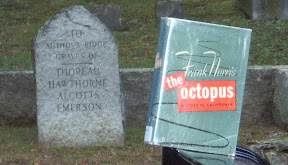
ETA image adjustments
ETA image adjustments
13absurdeist
I really like what Norris does (even though, yes, he's no Hawthorne or Thoreau or Emerson, you snootmeister Gehlen; not every book can be an M&M!) in chapter One. Keep an eye out in for any shepherd and sheep references, as I suspect (w/out having referenced online helps...yet!) that they will play huge in this novel (just consider the bloody ending of chap 1).
And ask yourself, why is the "poignant grief" of Vanamee important to this novel? Vanamee loved a girl who was raped and died giving birth to the child born from her violation. Vanamee then became a wanderer of the West, a recluse, a Poet, a mystic, a shepherd. And keep in mind that shepherds are generally the bottom of the barrel in just about any economic food chain and generally condescended upon by more esteemed means of living, say, cattlemen and ranchers.
What I found quite striking and unexpected in chap. 1 in particular, was Norris, the Zola influenced naturalist, the realist, getting metaphysical or paranormal on us, whatever you want to call it, when depicting Vanamee's ability to "call to people" (and his sheep) without using his audible voice. Norris may be a realist, but he's not so hardcore in his realism as to disallow Vanamee's extrasensory abilities. Vanamee, of course, is a Christ figure, obviously so, and when Vanamee's flock of sheep meet the "red-eyed cyclops" of the train at chap. 1s disturbing conclusion, as seen through the eyes of Presley, we know Norris is making crystal clear in his social commentary whom he deems good and whom he deems evil.
The Octopus indeed, Anna, has the feel of an epic so far, and it's no coincidence that Norris specifically mentions the 21st chapter of the Odyssey (Presley is reading this chapter presently, perched high on a hill overlooking the valley of wheat farms, composing his own mind's-eye Poem, just prior to the "red-eyed cyclops" devastating arrival).
Pretty rich reading so far....
edited to change "cattle ranches" to "wheat farms"...my great uncle was a cattle rancher, and the chap. 1 heavily detailed descriptions reminded me of his cattle ranching stories
And ask yourself, why is the "poignant grief" of Vanamee important to this novel? Vanamee loved a girl who was raped and died giving birth to the child born from her violation. Vanamee then became a wanderer of the West, a recluse, a Poet, a mystic, a shepherd. And keep in mind that shepherds are generally the bottom of the barrel in just about any economic food chain and generally condescended upon by more esteemed means of living, say, cattlemen and ranchers.
What I found quite striking and unexpected in chap. 1 in particular, was Norris, the Zola influenced naturalist, the realist, getting metaphysical or paranormal on us, whatever you want to call it, when depicting Vanamee's ability to "call to people" (and his sheep) without using his audible voice. Norris may be a realist, but he's not so hardcore in his realism as to disallow Vanamee's extrasensory abilities. Vanamee, of course, is a Christ figure, obviously so, and when Vanamee's flock of sheep meet the "red-eyed cyclops" of the train at chap. 1s disturbing conclusion, as seen through the eyes of Presley, we know Norris is making crystal clear in his social commentary whom he deems good and whom he deems evil.
The Octopus indeed, Anna, has the feel of an epic so far, and it's no coincidence that Norris specifically mentions the 21st chapter of the Odyssey (Presley is reading this chapter presently, perched high on a hill overlooking the valley of wheat farms, composing his own mind's-eye Poem, just prior to the "red-eyed cyclops" devastating arrival).
Pretty rich reading so far....
edited to change "cattle ranches" to "wheat farms"...my great uncle was a cattle rancher, and the chap. 1 heavily detailed descriptions reminded me of his cattle ranching stories
14WilfGehlen
Oh my, I was afraid of that. I had just checked out The Octopus from the library and was retracing the steps of theaelizabet when I saw my photo-op.
ETA But why assume that Norris doesn't belong? He isn't as well known, but Melville died in obscurity, to be revived decades later. Time for a Norris revival?
ETAYA In fact, after reading Chapter I, it is nothing if not evocative of the interruption of Emerson's meditative session at Walden Pond by the locomotive passing through. The guts strewn in this instance, though, were of the figurative kind. This theme is analyzed by Leo Marx in The Machine in the Garden, as, quoting from Wikipedia, 'the dialectical tension between the pastoral ideal in America and the rapid and sweeping transformations wrought by machine technology . . . the sudden and shocking intrusion of technology into a pastoral scene'.
I am also reminded of the scene in the movie "Patton", where Patton visits the battlefield at Carthage. He feels the past viscerally in the ruins, saying "I was here". Presley also surveys the ruins of a rich history from the Mission heights, feels the past in his veins. But the diapason of his imagination is uprooted by the diapason of the locomotive. Like Patton, he is born after his time.
ETA But why assume that Norris doesn't belong? He isn't as well known, but Melville died in obscurity, to be revived decades later. Time for a Norris revival?
ETAYA In fact, after reading Chapter I, it is nothing if not evocative of the interruption of Emerson's meditative session at Walden Pond by the locomotive passing through. The guts strewn in this instance, though, were of the figurative kind. This theme is analyzed by Leo Marx in The Machine in the Garden, as, quoting from Wikipedia, 'the dialectical tension between the pastoral ideal in America and the rapid and sweeping transformations wrought by machine technology . . . the sudden and shocking intrusion of technology into a pastoral scene'.
I am also reminded of the scene in the movie "Patton", where Patton visits the battlefield at Carthage. He feels the past viscerally in the ruins, saying "I was here". Presley also surveys the ruins of a rich history from the Mission heights, feels the past in his veins. But the diapason of his imagination is uprooted by the diapason of the locomotive. Like Patton, he is born after his time.
15anna_in_pdx
I am reading a library book. I just got to the part where Vanamee is in the phalanx of plows on Annixter's ranch doing the plowing and there is this very florid description of the act of plowing using a very sexually fraught metaphor that goes on and on. (This is on page 130-131 of the Penguin paperback edition)
"It was the long stroking caress, vigorous, male, powerful, for which the Earth seemed panting.
...(more of the same)...
...the elemental Male and Female, locked in a colossal embrace, at grapples in the throes of an infinite desire, at once terrible and divine, knowing no law, untamed, savage, natural, sublime."
Someone has pencilled in the margin, "Oh, gimme a break." I could not stop laughing.
"It was the long stroking caress, vigorous, male, powerful, for which the Earth seemed panting.
...(more of the same)...
...the elemental Male and Female, locked in a colossal embrace, at grapples in the throes of an infinite desire, at once terrible and divine, knowing no law, untamed, savage, natural, sublime."
Someone has pencilled in the margin, "Oh, gimme a break." I could not stop laughing.
16WilfGehlen
Hmm, turning swords into plowshares? Fertile ground there. I guess using this flowery language is the only way they could get sex into print. In reading about Angèle's attack, we are never told she was raped, just that she died in childbirth within the year.
17absurdeist
Really? Maybe I deduced too much, but something bad definitely happened to her there under the tree in the dark before Vanamee arrived. But, yes, what kind of violation wasn't explicitly stated.
18anna_in_pdx
16 and 17: I guess I am awfully used to 19th century fiction which always uses euphemisms for rape/affairs/getting pregnant/etc. to the point that I forget they are euphemisms and understand them right away.
To me it was completely obvious that she'd been raped and i didn't expect a graphic description. The rules of this time period are - You can only graphically describe a *metaphoric* rape, that of the earth by the plow for example....
What was even weirder was that it was Vanamee, the person whose love had been destroyed by the original rape, whose eyes we are looking through during the purple-prose part about the plowing.
To me it was completely obvious that she'd been raped and i didn't expect a graphic description. The rules of this time period are - You can only graphically describe a *metaphoric* rape, that of the earth by the plow for example....
What was even weirder was that it was Vanamee, the person whose love had been destroyed by the original rape, whose eyes we are looking through during the purple-prose part about the plowing.
19QuentinTom
Anna in 15, that does sound hilarious! Sounds like the kind of crap DH Lawrence writes.
20WilfGehlen
I think I am not trusting this Osterman.
21urania1
Am I the only one in the group who is bored shitless by this book? I am trying, really, really trying. But can't we switch and do Germinal instead?
22absurdeist
it's not the most...exciting fare is it? Though try looking at, reading it, as more of an historical document with some euphemistic, flowery language, (and blunt force allusions and symbolism; not a so subtle writer, Norris) rather than pure fiction per se. If that doesn't help, then I think someone in the salon reading the writing of the man who inspired Norris more than any other writer could conceivably (most likely, I should say, since we're talking you, Urania) make for some more interesting discussions: some nice comparison/contrasts/juxtapositions, etc. (or even just how much better a writer Zola was than Norris too ;-). Go for it if you like. I'd be interested to hear how the two stack up against one another.
23WilfGehlen
Excellent approach, EF. The first link that comes up in my search is Paul Reuben's. Norris on Realism:
the literature of the normal and the representative - 'the smaller details of everyday life, things that are likely to happen between lunch and supper'.
The link also promises 'prostitution and seduction', 'exposure of social conditions and social evils', so I guess it's not all about wheat field stubble.
Urania, you must embrace boredom. Life on the fast lane passes too quickly. You must stop to smell the roses, or, better, the stinkweed. Nothing prolongs the moment more than being in a situation we detest and can't escape. Norris makes sure that we don't miss the 'smaller details' of the 'mammoth live-oak', the 'venerable pear trees', the hair with 'a tendency to curl in a forward direction'. He anticipates the fast-lane reader who might miss these references by repeating them verbatim so that they appear to us like the road-side Burma Shave ad signs of yore.
the literature of the normal and the representative - 'the smaller details of everyday life, things that are likely to happen between lunch and supper'.
The link also promises 'prostitution and seduction', 'exposure of social conditions and social evils', so I guess it's not all about wheat field stubble.
Urania, you must embrace boredom. Life on the fast lane passes too quickly. You must stop to smell the roses, or, better, the stinkweed. Nothing prolongs the moment more than being in a situation we detest and can't escape. Norris makes sure that we don't miss the 'smaller details' of the 'mammoth live-oak', the 'venerable pear trees', the hair with 'a tendency to curl in a forward direction'. He anticipates the fast-lane reader who might miss these references by repeating them verbatim so that they appear to us like the road-side Burma Shave ad signs of yore.
24atimco
Oh no, it's boring? I was going to start it today. But my reading time is too limited to allow for boring books! Quick, someone explain how thrilling this is.
25J_ipsen
Wilf, a very interesting theory: Get more from life by embracing what we detest. Prolong the beautiful moments (that pass too quickly) by adding a dose of unpleasantness...
The pipe and I are off to the balcony to think that through....
The pipe and I are off to the balcony to think that through....
26WilfGehlen
>25 J_ipsen: It's the best we can do. The Tralfamadorians can choose to linger over just the pleasant moments, but they have the advantage of the 4th dimension. In actuality, our time is not the time of the ticking watch, it speeds and slows according to need, governed by the memories we create in our brain.
I took a break from The Octopus last night to re-read Slaughterhouse Five, which took less time than reading one chapter of TO. That's realism for you. I found myself getting annoyed with the heavy repetition of 'and so it goes', but one facet remains a gem, appending to the Serenity Prayer
God grant me the serenity/To accept the things I cannot change/Courage to change the things I can/And wisdom to know the difference.
Three things we can't change are the past, the present, and the future. And so it goes.
I took a break from The Octopus last night to re-read Slaughterhouse Five, which took less time than reading one chapter of TO. That's realism for you. I found myself getting annoyed with the heavy repetition of 'and so it goes', but one facet remains a gem, appending to the Serenity Prayer
God grant me the serenity/To accept the things I cannot change/Courage to change the things I can/And wisdom to know the difference.
Three things we can't change are the past, the present, and the future. And so it goes.
27urania1
>23 WilfGehlen: Would you call Norris a realist? I would put him in the naturalist camp. To be sure American and French naturalism differed somewhat, but both share certain characteristics. Paul Reuben's site provides a handy outline of the distinction between naturalism and realism including Frank Norris's take on the two terms.
28WilfGehlen
Thanks for the clarification, Urania. This stuff is new to me. I haven't read enough of Norris or of this taxonomy to make a judgment, but the phrase 'accuracy and philosophical depth' is intriguing. I'll be looking for that in The Octopus.
I remember passing by a naturalist camp on the road to Montreal. I'll check that out too next time I go that way.
I remember passing by a naturalist camp on the road to Montreal. I'll check that out too next time I go that way.
29solla
#21 - on page 291, and, as yet, don't even believe in any of the characters enough to care what happens to them. But - spoiler alert - the railroad has just announced the land price that was supposed to be $2.50 an acre with first right of refusal to anyone who took them up on farming it, is now priced at $22 - $30 an acre after the farmers have made costly improvements to it. I am hoping that now at least the intersection with history will give me more interest in it.
30absurdeist
How do you read such a slow book so fast, solla? I just made it to page 50.
31solla
I have nearly an hour bus ride to work, so nearly two hours a day. And unlike with M & M, I have not been rereading any passages.
32WilfGehlen
>29 solla: Norris employs the subtle use of the telegraph which occupies the railroad right of way. POSSIBLE SPOILER ALERT We learn of the RR plans at the first meeting with the Governor where Osterman sleazes through in multiple ways. And Vanamee's occult powers--hoowee! Right under those venerable pears!
I am limiting my reading to the bus and am only at p 154. But it's going faster now. When Norris repeated describes the scent of Angèle in terms of roses, lilies, heliotrope and hyacinth, I can skip over that part.
I am limiting my reading to the bus and am only at p 154. But it's going faster now. When Norris repeated describes the scent of Angèle in terms of roses, lilies, heliotrope and hyacinth, I can skip over that part.
34anna_in_pdx
33: Yeah, the foreshadowing is as subtle as a brick.
35urania1
>34 anna_in_pdx: Yeah, I have a major headache. I may possibly die.
36anna_in_pdx
geneg, we need your input here. Where are you? Turn down the KISS records and give us scholarly advice about why we should love this book! :)
37urania1
As much as I dislike The Octopus, I will resume my former professorial role and try to convince myself and those doubting others why we might read Norris. Several issues to keep in mind, although Norris's purple prose may remind us of some of the excesses of Victorian literature, we might consider him in light of what Bloom refers to as "the anxiety of influence." Norris wants to turn prissy Victorian ideas on end. Consider a Victorian work like Gaskell's North and South. Although Gaskell recognizes the grievances of the factory workers, she dresses her work up in high-minded idealism. Even a work like Rebecca Harding Davis's Life in the Iron Mills (which all of you should read if you haven't already) ends on a didactic note. Hugh's (the protagonist) inchoate artistry beautifies the utter dreariness and desperation of the the novel. Moreover, the biblical didacticism is overt. References to the Sermon on the Mount and to Pilate's comment "I wash my hands," in this case, of a cruelly unjust situation that allows the protagonist no way out. Finally, there's the ending of Life in the Iron Mills, with sanctuary being granted to Deborah by the Quaker woman points to Christian redemption. Davis is definitely superior to Norris in craft.
But back to Norris, his florid prose sets the reader up for one kind of story - one that allows the reader to feel he/she has done her Christian duty by properly sympathizing with the plight of the disempowered - and turns it against the reader. No Christian comfort here. Only the bleak hold of Social Darwinism. Heredity and instinct rule. Here Norris reflects the influence of Joseph Le Conte (author of Evolution and Its Relation to Religious Thought). For Norris, one cannot have evolution and free will. Life is deterministic. This determinism in large degree separates the naturalists from the realists. If anything ultimately triumphs, it is the life force of nature itself.
Norris's American version of naturalism significantly differs from the naturalism of a writer like Emile Zola. Zola's work is utterly devoid of romanticism (in the literary sense of the term). For Norris, naturalism synthesizes realism and romanticism - hence its ability to sock its readers in the stomach. Here we have no pretty story of injustice that allows us to sit back comfortably after reading it, sure that through our sympathy we have done our "Christian" duty. No "individual" gets off lightly, if at all, in Norris.
But back to Norris, his florid prose sets the reader up for one kind of story - one that allows the reader to feel he/she has done her Christian duty by properly sympathizing with the plight of the disempowered - and turns it against the reader. No Christian comfort here. Only the bleak hold of Social Darwinism. Heredity and instinct rule. Here Norris reflects the influence of Joseph Le Conte (author of Evolution and Its Relation to Religious Thought). For Norris, one cannot have evolution and free will. Life is deterministic. This determinism in large degree separates the naturalists from the realists. If anything ultimately triumphs, it is the life force of nature itself.
Norris's American version of naturalism significantly differs from the naturalism of a writer like Emile Zola. Zola's work is utterly devoid of romanticism (in the literary sense of the term). For Norris, naturalism synthesizes realism and romanticism - hence its ability to sock its readers in the stomach. Here we have no pretty story of injustice that allows us to sit back comfortably after reading it, sure that through our sympathy we have done our "Christian" duty. No "individual" gets off lightly, if at all, in Norris.
38anna_in_pdx
37: Thanks! That's actually quite thought-provoking. I loved North and South but you are quite correct. It was literary comfort food and allowed the reader to be complacently satisfied at the end of the book. I can tell already that The Octopus won't turn out that way. (I wish he'd tone down the foreshadowing though. It's worse than a really bad horror movie's soundtrack.)
39absurdeist
Hey, you just resume your former professorial role around here as much as you like -- love it! And thanks for that!
40geneg
I am not, nor, I hope, do I pretend to be a literary scholar. After all, I like the poetry of Robert W. Service, too. I have not read this book before, but I thought it might be useful as an illustration of the way individuals are boxed in by the larger forces around them. Something that I think is very cogent to the situation we face today.
In literary terms, maybe others do this with a greater degree of finesse than Norris, I don't know. On the other hand, maybe my lack of literary discernment protects me from the failure of the words I read to spark. I don't know, but I will say this, I am enjoying this book (I'm at the first meeting at Magnus' ranch), the prose is not off-putting to me, the foreshadowing does not bother me, although I can see that as a literary contrivance it can be a crutch to prepare the reader for later plot elements. I prefer foreshadowing to having something just pop up out of nowhere and have the author do a lot of backtracking to get it to make sense. As I have said before in this group, I prefer straight ahead story telling to other forms of novelization.
What others think of Norris' skill as a writer only bothers me insofar as this is a book I recommended here and to most of the commentators here is a bust. For wasting your time I apologize.
Once again, I am not a person who can explicate a novel as either good or bad beyond how it strikes my own taste. At present I am not far enough along to make a judgment one way or the other. I have done barely a hundred pages so far and see a lot of scene-setting and character development. I do get the feeling some of the characters are merely cutouts for some point Norris wants to make later. I am not disappointed at this point. I find it much easier to read, say than DeLillo's White Noise or Pynchon's Crying of Lot 49, both of which bored me to tears, although I must say, they were both very well-written, but nonetheless boring, or any number of other current literary masterpieces that have ended up doing great damage to the wall opposite my reading space.
We are sheep next to the railroad tracks, the fence is broken and if we don't take care we will be plowed through like so many tenpins. I am interested in how Norris tells that story.
EF, I am not nearly perceptive enough to make a comment on the order of the one made earlier by urania in #37. If that's who I need to be here, then I shall bow out after this read, but I'm afraid I'm not that person. I was just hoping for a good read and a fun time for all. I see now that was too much to hope for.
Does anyone beside me see Vanamee as a Christ figure, The heartbroken shepherd just seems so over the top as a rhetorical device that it jumped out at me, especially when a portion of the flock is plowed under by the avarice and greed of the powers that be. However, I am also interested in where this thread goes.
I see a lot of the world around me as having been created from events such as this story tells. I've watched enough "B" Westerns to know that the story Norris is telling has more truth than fiction in it.
Of course as I write this and think about it, I am convincing myself of its weaknesses, but, as I said I'm going to finish at which time I will make an overall judgment, not until then, unless it just becomes an irredeemable pile of trash. Obviously, I'm hoping against THAT.
In literary terms, maybe others do this with a greater degree of finesse than Norris, I don't know. On the other hand, maybe my lack of literary discernment protects me from the failure of the words I read to spark. I don't know, but I will say this, I am enjoying this book (I'm at the first meeting at Magnus' ranch), the prose is not off-putting to me, the foreshadowing does not bother me, although I can see that as a literary contrivance it can be a crutch to prepare the reader for later plot elements. I prefer foreshadowing to having something just pop up out of nowhere and have the author do a lot of backtracking to get it to make sense. As I have said before in this group, I prefer straight ahead story telling to other forms of novelization.
What others think of Norris' skill as a writer only bothers me insofar as this is a book I recommended here and to most of the commentators here is a bust. For wasting your time I apologize.
Once again, I am not a person who can explicate a novel as either good or bad beyond how it strikes my own taste. At present I am not far enough along to make a judgment one way or the other. I have done barely a hundred pages so far and see a lot of scene-setting and character development. I do get the feeling some of the characters are merely cutouts for some point Norris wants to make later. I am not disappointed at this point. I find it much easier to read, say than DeLillo's White Noise or Pynchon's Crying of Lot 49, both of which bored me to tears, although I must say, they were both very well-written, but nonetheless boring, or any number of other current literary masterpieces that have ended up doing great damage to the wall opposite my reading space.
We are sheep next to the railroad tracks, the fence is broken and if we don't take care we will be plowed through like so many tenpins. I am interested in how Norris tells that story.
EF, I am not nearly perceptive enough to make a comment on the order of the one made earlier by urania in #37. If that's who I need to be here, then I shall bow out after this read, but I'm afraid I'm not that person. I was just hoping for a good read and a fun time for all. I see now that was too much to hope for.
Does anyone beside me see Vanamee as a Christ figure, The heartbroken shepherd just seems so over the top as a rhetorical device that it jumped out at me, especially when a portion of the flock is plowed under by the avarice and greed of the powers that be. However, I am also interested in where this thread goes.
I see a lot of the world around me as having been created from events such as this story tells. I've watched enough "B" Westerns to know that the story Norris is telling has more truth than fiction in it.
Of course as I write this and think about it, I am convincing myself of its weaknesses, but, as I said I'm going to finish at which time I will make an overall judgment, not until then, unless it just becomes an irredeemable pile of trash. Obviously, I'm hoping against THAT.
41anna_in_pdx
geneg, I am already on record as saying that while the style is purple, I don't think I will regret having read it. You're a brave guy to recommend something you have not read yet! Anyhow, I also have to admit that I am finding the purple prose and blatant foreshadowing kind of fun.
I think Vanamee seemed like a Christ figure at first but is now something else. A Jungian archetype, the wild man in the bottom of the pool perhaps, but we will have to see how his character evolves. Others, please weigh in on V.?
I think Vanamee seemed like a Christ figure at first but is now something else. A Jungian archetype, the wild man in the bottom of the pool perhaps, but we will have to see how his character evolves. Others, please weigh in on V.?
42A_musing
Well, I need to thank you all. I have a beautiful turn of the (19th) century volume of the Octopus and have always wondered if I should read it.
It is a beautiful book. With nice engravings.
It is a beautiful book. With nice engravings.
43WilfGehlen
I think it's great to weigh in as we go, to post on the fly. It puts the group into group read. And if we get it wrong based on incomplete knowledge, so what? We'll get it right eventually. Non, je ne regrette rien.
Vanamee certainly has biblical antecedents, wandering through the desert and all that. But he has a decidedly un-Christian proclivity. His power, the presence of the Other, the murder of Angèle, put me in mind of Dr. Caligari.
And what's up with Angèle? Late night trysts and kissing under the venerable pear trees? I think she transgressed, not a good girl at all, not for the 19 century. And her visage. Does she harken back to the Osiris myth? Will all the railroaded sheep be put back together on the Judgment Day? Hmm, probably not, but the existential element does rise up from the grave.
Vanamee certainly has biblical antecedents, wandering through the desert and all that. But he has a decidedly un-Christian proclivity. His power, the presence of the Other, the murder of Angèle, put me in mind of Dr. Caligari.
And what's up with Angèle? Late night trysts and kissing under the venerable pear trees? I think she transgressed, not a good girl at all, not for the 19 century. And her visage. Does she harken back to the Osiris myth? Will all the railroaded sheep be put back together on the Judgment Day? Hmm, probably not, but the existential element does rise up from the grave.
44WilfGehlen
>42 A_musing: So, Sam, did you decide to read it or not? Can you post some engravings?
ETA - Also, kudos to Gene, whatever they are.
ETA - Also, kudos to Gene, whatever they are.
45WilfGehlen
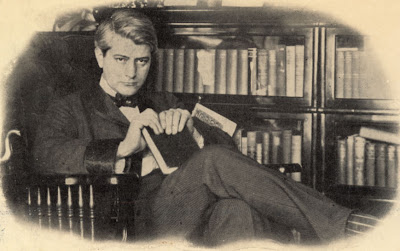
Frank Norris was born in Chicago and grew up in San Francisco. He attended the University of California for a short while and it was there that he discovered Zola. He became fired with the ambition to be the first American realist, and to treat in minute detail of the life he actually saw about him. . .He died in San Francisco at the age of thirty-two.
46absurdeist
I saw some Christ figure stuff going on with Vanamee too, Geneg (check out my post 13 up above).
Geneg...le salon litteraire has one requirement of you: Be yourself. That's it. And you're doing it. You don't need to be professorial in your approach, that's not a requirement; you don't need to be a critic spouting about leitmotif-this and leitmotif-that; all you need to be is (listen up Salonistas! this goes for everybody!) is you.
I'm sorry, Geneg, if I've given the impression that we must be uber- "scholarly" in leading these things. Because that's really not the case at all. I'm no scholar. I may try and pretend to sound like a scholar occasionally since I enjoy sounding pretentious or hoity-toity from time to time (a fun hobby of mine - did you see that ridiculous post of mine on IJ yesterday? - I mean, damn, how many semi-colons does one sentence really need?) But as much as I enjoy sounding pretentious, I also enjoy being earthy, mixing the highbrow with the middlebrow and the lowbrow and everything else inbetween.
I enjoy most the salonistas diversity of leadership styles and approaches to the books we read.
And please don't be put off if you sense people not particularly digging a book you suggested. You may have suggested it, but I'm the one who demanded we read it, and so I bear more culpability in that regard. Just like I've had to live with myself for ever suggesting we all read Ulysses last March - the most unenjoyable blather ever written - and I've suffered mightily inside knowing that I subjected my dear salonistas to such a pile of dung. And some are still angry with me for that, but not as angry as I am at myself.
You damn well better not bail after The Octopus! You're already too valued a member to bail so soon. But if you do bail, God forbid, may your ipod get stuck on an Abba tune forever!
Geneg...le salon litteraire has one requirement of you: Be yourself. That's it. And you're doing it. You don't need to be professorial in your approach, that's not a requirement; you don't need to be a critic spouting about leitmotif-this and leitmotif-that; all you need to be is (listen up Salonistas! this goes for everybody!) is you.
I'm sorry, Geneg, if I've given the impression that we must be uber- "scholarly" in leading these things. Because that's really not the case at all. I'm no scholar. I may try and pretend to sound like a scholar occasionally since I enjoy sounding pretentious or hoity-toity from time to time (a fun hobby of mine - did you see that ridiculous post of mine on IJ yesterday? - I mean, damn, how many semi-colons does one sentence really need?) But as much as I enjoy sounding pretentious, I also enjoy being earthy, mixing the highbrow with the middlebrow and the lowbrow and everything else inbetween.
I enjoy most the salonistas diversity of leadership styles and approaches to the books we read.
And please don't be put off if you sense people not particularly digging a book you suggested. You may have suggested it, but I'm the one who demanded we read it, and so I bear more culpability in that regard. Just like I've had to live with myself for ever suggesting we all read Ulysses last March - the most unenjoyable blather ever written - and I've suffered mightily inside knowing that I subjected my dear salonistas to such a pile of dung. And some are still angry with me for that, but not as angry as I am at myself.
You damn well better not bail after The Octopus! You're already too valued a member to bail so soon. But if you do bail, God forbid, may your ipod get stuck on an Abba tune forever!
47urania1
And geneg,
Your recommendation has sent me scuttling off to read a collection of Norris's essays on literature The Responsibilities of the Novelist - really interesting stuff. I would not have started reading it if we weren't reading The Octopus.
Your recommendation has sent me scuttling off to read a collection of Norris's essays on literature The Responsibilities of the Novelist - really interesting stuff. I would not have started reading it if we weren't reading The Octopus.
48QuentinTom
Well, I'm not even reading the book, but I'm really enjoying the discussion (and Urania's discomfort hehe).
Don't even think of bailing out after this one geneg. Forget that thought. just forget it. We still have to do IJ together.
Don't even think of bailing out after this one geneg. Forget that thought. just forget it. We still have to do IJ together.
49geneg
I'm verklempt! Please, discuss among yourselves.
Seriously, thank you all for bucking me up here, I wasn't sure what I had been called to here, and I appreciate all the cheering up.
Seriously, thank you all for bucking me up here, I wasn't sure what I had been called to here, and I appreciate all the cheering up.
50absurdeist
**group hugs for everybody**
Look! The Psychic Friends Network!
http://www.youtube.com/watch?v=EtGF2m102Wg
Look! The Psychic Friends Network!
http://www.youtube.com/watch?v=EtGF2m102Wg
51urania1
I will be posting summaries of Norris's The Responsibilities of the Novelist and Other Literary Essays as I read it. Perhaps these summaries will help us gain insight into Norris's work. Then again, maybe not.
1. Norris sees the novel as a Tool (and a manly Tool at that).
2. Anti-aestheticism - Norris has it in for the "artistes." The successful tool is that which appeals to the greatest number, but with this proviso - the author has an ethical obligation to the reader. Obviously a logical contradiction exists here. In a deterministic universe, does the term "ethics" even make sense? Norris never touches on this inconsistency.
3. The Pulpit, Press, and Novel - novel comes out on top.
Says Norris,"The Responsibilities of the Novelist"
4. Norris decries the "copyists" of the "School of Sir Walter Scott" - fake histories dressed up in pretty clothes. Note, Norris is not opposed to the overt Romanticism in Scott's work. He merely believes the majority of writers are pulling the same tricks out of their bags with much less effect that Scott.
1. Norris sees the novel as a Tool (and a manly Tool at that).
2. Anti-aestheticism - Norris has it in for the "artistes." The successful tool is that which appeals to the greatest number, but with this proviso - the author has an ethical obligation to the reader. Obviously a logical contradiction exists here. In a deterministic universe, does the term "ethics" even make sense? Norris never touches on this inconsistency.
3. The Pulpit, Press, and Novel - novel comes out on top.
Says Norris,"The Responsibilities of the Novelist"
The People have a right to the Truth as they have a right to life, liberty, and the pursuit of happiness. It is not right that they be exploited and deceived with false views of life, false characters, false sentiment, false morality, false history, false philosophy, false emotions, false heroism, false notions of self-sacrifice, false views of religion, of duty, of conduct and manners. ("The Responsibilities of the Novelist")
4. Norris decries the "copyists" of the "School of Sir Walter Scott" - fake histories dressed up in pretty clothes. Note, Norris is not opposed to the overt Romanticism in Scott's work. He merely believes the majority of writers are pulling the same tricks out of their bags with much less effect that Scott.
52WilfGehlen
I am feeling Magnus Derrick's anguish, to stay true to his ideals or to go with the flow. I may go with the flow and read Stephenie Meyer's Twilight and post a review on the sacred walls of LT. Think of the aggrandizement that would ensue, exceeding anything in Magnus' imagination.
Or I might find something better to do. Which will it be for me? Which will it be for Magnus? I will let Magnus take the lead, as is his wont.
ETA - It seems urania has found another connection between Emerson and Norris. (I mentioned the railroad piercing the pastoral a while back). Norris takes after Emerson, who said, A foolish consistency is the hobgoblin of little minds, adored by little statesmen and philosophers and divines. Not bothered by inconsistencies and we have already seen a divine in Vanamee. Let's see what deep philosophies we still will find.
Or I might find something better to do. Which will it be for me? Which will it be for Magnus? I will let Magnus take the lead, as is his wont.
ETA - It seems urania has found another connection between Emerson and Norris. (I mentioned the railroad piercing the pastoral a while back). Norris takes after Emerson, who said, A foolish consistency is the hobgoblin of little minds, adored by little statesmen and philosophers and divines. Not bothered by inconsistencies and we have already seen a divine in Vanamee. Let's see what deep philosophies we still will find.
53PekoeTheCat
Dear salonists, I apologize for not having joined the conversation earlier. I must admit it, the octopus has scared me. It is that black, inky image, the thought of those slimy tentacles.
However, I have, at long last, completed my review of the Master and Margarite (with its more inviting cover). You can read it here: http://www.librarything.com/work/10151/book/51820751
Perhaps you can forgive me my lack of courage (I am not much beyond my kittenhood), and wish me peace (and light) anyway.
Meow.
However, I have, at long last, completed my review of the Master and Margarite (with its more inviting cover). You can read it here: http://www.librarything.com/work/10151/book/51820751
Perhaps you can forgive me my lack of courage (I am not much beyond my kittenhood), and wish me peace (and light) anyway.
Meow.
54MeditationesMartini
Started it today, and I dunno--is it that florid? I was expecting something like a cross between Henry James ("like a rhinoceros trying to pick up a pea that has rolled into the corner" -HG Wells) and Steinbeck's California fetishism. Seems to me instead what we've got is relatively clean and deft for its era and movement, and with the exception of that one tilling passage mentioned (ugh), not overblown. As somebody else suggested above, I think it's helpful to try and feel the character-descriptive tags in more of a Homeric vein--instead of wily Ulysses and wine-dark seas, we get bald Osterman and fragrant Angele and the exact same words used to describe the way Derrick father and son's hair curls in front of their ears. But the myth is undermined, or if you will the story is salvaged from myth, by all the social realism--it's like an unfolding demonstration of why Presley's romantic yearnings are going to go unfulfilled (because it's all about the wheat$$$). He's not Zola, maybe, but surely our sensibilities aren't so exquisite and easily put off that "not being Zola" is something we're going to hold against him?
55Macumbeira
Let's thumb Pekoe up in the list !
56absurdeist
Thank you Martin for that excellent defense of The Octopus. Well said. Norris has been maligned prematurely, and perhaps unfairly.
57MeditationesMartini
And thank you, m'sieu le Freak, for that excellent defense of my defense! I do get it, though. Like, when Vanamee got all psychic and shit for a second, I was like "oh good, it's gonna get weird!" It's like we can't enjoy anything but pastiche anymore.
58WilfGehlen
Now we come to it, the philosophy underlying the Californial realism. Melville has his Locke and Kant, Norris has his Schopenhauer and Social Injustice.
Just in time for our Salonistical reading, we have In Search of Schopenhauer's Cat (2006). Subtitled, Arthur Schopenhauer's Quantum-Mystical Theory of Justice, the Amazon blurb reveals "The idea of 'community' in its most basic and most literal sense is at the heart of Schopenhauer's deep ontology of justice". Appreciated by Einstein, Schrödinger, and perhaps even Gandhi, Schopenhauer is certainly a worthy addition to the scope of Norris' novel.
To which I must add the name of the famous ecdysiast (H.L. Mencken's term) Gypsy Rose Lee who famously said, or could have said, Schopenhauer was right!
Let's see if Norris blends East and West in his philosophy, as Schopenhauer did, to encompass the Chinese-American railroad men who built the railroad and the Euro-American "Big Four" who owned it.
Just in time for our Salonistical reading, we have In Search of Schopenhauer's Cat (2006). Subtitled, Arthur Schopenhauer's Quantum-Mystical Theory of Justice, the Amazon blurb reveals "The idea of 'community' in its most basic and most literal sense is at the heart of Schopenhauer's deep ontology of justice". Appreciated by Einstein, Schrödinger, and perhaps even Gandhi, Schopenhauer is certainly a worthy addition to the scope of Norris' novel.
To which I must add the name of the famous ecdysiast (H.L. Mencken's term) Gypsy Rose Lee who famously said, or could have said, Schopenhauer was right!
Let's see if Norris blends East and West in his philosophy, as Schopenhauer did, to encompass the Chinese-American railroad men who built the railroad and the Euro-American "Big Four" who owned it.
59MeditationesMartini
I am now on p. 134 and deeply ignorant as I am in all things Schopenhauer, I just want to say cheers to Norris for his description of Annixter waking up in the morning and taking a shower and tightening up his gut; jeers for that German dude's awful accent.
60WilfGehlen
Another take on the railroad:
I've been working on the railroad /All the livelong day. . .
Another diapason heard from.
I've been working on the railroad /All the livelong day. . .
Another diapason heard from.
61WilfGehlen
The outcome of the story turns on German dude, Norris' use of dialect is no worse than Mark Twain's. Slow down at these points, embrace the extra dimension, enjoy!
62WilfGehlen
Book II goes much faster than Book I. If you've made it through Book I, don't stop there, it gets better ahead. If you can't make it through Book I, well, that's OK too.
The Octopus puts me in mind of elements ofThe Leopard, War and Peace, Moby-Dick and The Crying of Lot 49. Not that it is any of these, but more about that later.
The Octopus puts me in mind of elements ofThe Leopard, War and Peace, Moby-Dick and The Crying of Lot 49. Not that it is any of these, but more about that later.
63MeditationesMartini
Yeah, but it is well documented that Mark Twain's use of dialogue ruined Huckleberry Finn for me. Like, Nigger Jim says "uv" because we fucking all do. Especially when there are such stellar literary representations of accent and dialogue out there in the world . . . . linguist pet peeve, I guess:)
65absurdeist
Are you a linguist, martin?
You know that German accent bugged me too right off the bat.
Especially when there are such stellar literary representations of accent and dialogue out there in the world
First example that comes to your mind, if you don't mind, please! I'm curious.
Hi slick!
You know that German accent bugged me too right off the bat.
Especially when there are such stellar literary representations of accent and dialogue out there in the world
First example that comes to your mind, if you don't mind, please! I'm curious.
Hi slick!
66MeditationesMartini
Eh, grad student. But I think it counts!
The first example that comes to mind, and probably the best, is also the most obvious: Irvine Welsh. The stunning inventiveness and surprisingness of the language in Trainspotting was a seminal moment in getting me interested in dialect phonology (the kind of linguistics I do!) in the first place. For another that's a little less obvious, though, how about Thomas Hardy? I think the Wessex dialect in, e.g., Far from the Madding Crowd is quite immaculate, and actually it's been used as (indirect) evidence in historical dialectology before, if memory serves.
The first example that comes to mind, and probably the best, is also the most obvious: Irvine Welsh. The stunning inventiveness and surprisingness of the language in Trainspotting was a seminal moment in getting me interested in dialect phonology (the kind of linguistics I do!) in the first place. For another that's a little less obvious, though, how about Thomas Hardy? I think the Wessex dialect in, e.g., Far from the Madding Crowd is quite immaculate, and actually it's been used as (indirect) evidence in historical dialectology before, if memory serves.
67anna_in_pdx
I have read that James Herriot's Yorkshire dialect impersonations in All things Bright & Beautiful etc. was pretty accurate. May be wrong, I have not been to Yorkshire myself.
68MeditationesMartini
Ooh, haven't read that. Will keep in mind, thanks.
Actually, I think the dialogue in this is maybe part of what's getting people down, beyond accent issues. Like, maybe a hundred years ago Norris could give, for example, Annixter all Annixter's habitual phrases and think it would get across in a Homeric or at least a Dickensian vein, but we've had an intervening century of TV and mass entertainments in which the signature character-displaying catchphrase has become such a rancid cliche . . . that every time he goes "Pip!" or "In a way that's so, but in another way it'snot", I'm all "Show me the money! Where's the beef! Yaaaaarggghh!" Such a crutch.
Actually, I think the dialogue in this is maybe part of what's getting people down, beyond accent issues. Like, maybe a hundred years ago Norris could give, for example, Annixter all Annixter's habitual phrases and think it would get across in a Homeric or at least a Dickensian vein, but we've had an intervening century of TV and mass entertainments in which the signature character-displaying catchphrase has become such a rancid cliche . . . that every time he goes "Pip!" or "In a way that's so, but in another way it'snot", I'm all "Show me the money! Where's the beef! Yaaaaarggghh!" Such a crutch.
69MeditationesMartini
Anyone else not hatin' on this? I am gravitating further toward the positive side of ambivalent as it gets more political. I like Dyke.
70anna_in_pdx
OK, I am finished with The Octopus and here are my preliminary thoughts on it:
- Stylistically, it's kind of dated and precious. For some reason, I'm able to read lots of books from this time period or before without getting irritated at stylistic things. I think this is a personal issue of the author, and am willing to forgive him for it though it's a distracting flaw for me.
- Characters tend to be very symbolic and not very three-dimensional. The way one of the characters changed 180 degrees suddenly based on a single event in his life, for example, was not realistic. However, if the story is read as a symbolic / mythologic type of story, it works. I am used to the "realism" genre having much more ambivalent, unpredictable characters than these but once I decided they were symbols and should be read as such I was able to get into it.
- The predictability and the obvious foreshadowing is a flaw. I have read a lot of novels from this time period and I really prefer not to be so obviously told what's going to happen in advance. (e.g., all those times where Presley mentions that he is worried that Minna will not turn out well... gee, wonder what's gonna happen to Minna by the end of the story?)
- The descriptions of some of the key scenes such as the rabbit hunt and the barn dance were very good. Also descriptions of farming (aside from the plowing metaphor) and scenery. The novel's sense of place was probably the strongest thing about it in spite of flowery language. I really felt like I had actually been to the San Joaquin after reading it.
I've turned to Foucault's Pendulum now, having heard from many people that it is really fun to read. I will be ready for Les Miz whenever the kickoff is...
- Stylistically, it's kind of dated and precious. For some reason, I'm able to read lots of books from this time period or before without getting irritated at stylistic things. I think this is a personal issue of the author, and am willing to forgive him for it though it's a distracting flaw for me.
- Characters tend to be very symbolic and not very three-dimensional. The way one of the characters changed 180 degrees suddenly based on a single event in his life, for example, was not realistic. However, if the story is read as a symbolic / mythologic type of story, it works. I am used to the "realism" genre having much more ambivalent, unpredictable characters than these but once I decided they were symbols and should be read as such I was able to get into it.
- The predictability and the obvious foreshadowing is a flaw. I have read a lot of novels from this time period and I really prefer not to be so obviously told what's going to happen in advance. (e.g., all those times where Presley mentions that he is worried that Minna will not turn out well... gee, wonder what's gonna happen to Minna by the end of the story?)
- The descriptions of some of the key scenes such as the rabbit hunt and the barn dance were very good. Also descriptions of farming (aside from the plowing metaphor) and scenery. The novel's sense of place was probably the strongest thing about it in spite of flowery language. I really felt like I had actually been to the San Joaquin after reading it.
I've turned to Foucault's Pendulum now, having heard from many people that it is really fun to read. I will be ready for Les Miz whenever the kickoff is...
71urania1
>70 anna_in_pdx: Foucault's Pendulum is a much better read. One of my unrealized dreams was to teach a class on detective fiction using Foucault's Pendulum as the sole text. The class's mission? To create a hypertext links for each chapter containing explanations, bibliography, quotations, etc., for all the esoteric references.
72absurdeist
Sign me up for that class urania!
73MeditationesMartini
Term 2 could be Gravity's Rainbow! Actually, Urania, are you familiar with Alan Moore's League of Extraordinary Gentlemen project? (It has very little to do with the awful movie). It started out as sort of an adventure story with characters drawn from Victorian fiction--Mina Harker, the Invisible Man, Captain Nemo, etc. But it's grown into this sort of attempt to fit every fictional story ever written into the same world, by hook or crook. The comics have had a "world tour" prose story appearing in the back that takes us from Avalon to Brobdingnag to Freedonia to the Island of Dr. Moreau. There are online concordances and things out there, and I'm always amazed to realize how many Easter eggs I've missed in each issue. Possibly there might be something there that would serve as a model for doing something similar with Foucault's Pendulum (such a great idea, and I wish I'd taken that class!:)
74LolaWalser
#71
That's what I fantasised about when reading Claudio Magris's Danube. Following all the references, back- and foreground, one could build a solid liberal arts degree from that single book.
That's what I fantasised about when reading Claudio Magris's Danube. Following all the references, back- and foreground, one could build a solid liberal arts degree from that single book.
75aethercowboy
>73 MeditationesMartini:.
I love League. I totally devoured The New Traveller's Almanac in back of Vol. 2. Jess Nevins has written a guide for each volume, which I am in desperate need to get once I have more reading time. Because of League, Moore has made himself one of my favorite graphic novel authors.
Also, anybody want to do a mashup of Gravity's Rainbow and Finnegans Wake? I have an odd theory that it will actually make sense.
Also, ironic you mention Gravity's Rainbow in the Octopus Place. Who could forget the conditioned octopus, Grigori.
I love League. I totally devoured The New Traveller's Almanac in back of Vol. 2. Jess Nevins has written a guide for each volume, which I am in desperate need to get once I have more reading time. Because of League, Moore has made himself one of my favorite graphic novel authors.
Also, anybody want to do a mashup of Gravity's Rainbow and Finnegans Wake? I have an odd theory that it will actually make sense.
Also, ironic you mention Gravity's Rainbow in the Octopus Place. Who could forget the conditioned octopus, Grigori.
76MeditationesMartini
I think someone needs to do a mashup of Gravity's Rainbow and The Octopus, consisting solely of letting Grigori loose to wreak havoc among the townsfolk.
77A_musing
>44 WilfGehlen: - Sorry not to get back to this thread in so long, I've been busy causing trouble elsewhere.
I went back and discovered a three things about my copy of the Octopus - it's actually not got the engravings I was remembering, just a map; it's an actual first edition (with the right typo on p. 49) that I got for $1 at our town's annual carnival/book sale; and I mislabeled it as 19th century instead of 20th century. I don't think it's worth much, but it's still kind of neat.
To answer the question of what this thread convinced me to do - I intend to invest 1-2 hours reading here and there in the book as an exercise in literary history rather than spending a couple of days on literary retreat savoring. It looks like an interesting period piece. I do not intend to pick up part 2 of the Epic of the Wheat, though I expect that this group will want to read through that volume in order to be thorough.
I went back and discovered a three things about my copy of the Octopus - it's actually not got the engravings I was remembering, just a map; it's an actual first edition (with the right typo on p. 49) that I got for $1 at our town's annual carnival/book sale; and I mislabeled it as 19th century instead of 20th century. I don't think it's worth much, but it's still kind of neat.
To answer the question of what this thread convinced me to do - I intend to invest 1-2 hours reading here and there in the book as an exercise in literary history rather than spending a couple of days on literary retreat savoring. It looks like an interesting period piece. I do not intend to pick up part 2 of the Epic of the Wheat, though I expect that this group will want to read through that volume in order to be thorough.
78QuentinTom
>71 urania1: sign me up as well! sounds great!
79Torikton
I've finished Book I and am on the brink of moving into Book II. I'm actually enjoying this. It isn't fantastic, but I find it interesting. Definitely not what I expected (Oil! mixed with In Dubious Battle), more like a prose epic.
I found hysterical the description of the labors’ supper (last paragraph pg. 84, Dover Edition). “It was no longer a supper. It was a veritable barbeque, a crude and primitive feasting, barbaric, homeric.” As a born-and-raised Kansas City-ian, the idea of barbeque as homeric strikes me as trés amusante.
Despite its faults, I’m rather pleased with The Octopus. However, I must agree that Pendulum is a better read.
I found hysterical the description of the labors’ supper (last paragraph pg. 84, Dover Edition). “It was no longer a supper. It was a veritable barbeque, a crude and primitive feasting, barbaric, homeric.” As a born-and-raised Kansas City-ian, the idea of barbeque as homeric strikes me as trés amusante.
Despite its faults, I’m rather pleased with The Octopus. However, I must agree that Pendulum is a better read.
80QuentinTom
Torikton, the Homeric epics are full of barbeques. in gaps between fighting, and any opportunity Odysseus gets on his journey home, they light a fire, sacrifice a goat or a sheep and make kebabs. All described in great detail.
81anna_in_pdx
Martin! Your review sounds like you've *more than* come around to several other people's points of view!
82MeditationesMartini
Anna! Heh, yeah, it's a bit of a Stockholm Syndrome thing maybe--I defended him all along and couldn't see that he was manipulating me, and then at the end it just all went to hell completely, the scales fell from my eyes, I couldn't lie to myself anymore, etc.:)
83absurdeist
o geneg, o geneg, you're our only hope to say something nice about The Octopus.
I like calamari.
I like calamari.
84aethercowboy
Ooh. Calamari. The only seafood I actually like, or am not allergic to.
85absurdeist
Has anyone read The Calamari by any chance? I hear it's quite good.
86Torikton
>80 QuentinTom: Perhaps...but I can hardly imagine Achilles and Agamemnon eating lunch at Oklahoma Joe's...
87Macumbeira
85 Do you mean : The Calamari Code: An Agatha Pixie Mystery (Paperback)
by Larry Mike Garmon (Author) ?
by Larry Mike Garmon (Author) ?
88bokai
I'm only on page 144 and it isn't -that- bad. I've spoiled myself by reading the reviews and am dreading what is to come, but besides having a dated style nothing has stood out as really bad beyond Norris' tendency for over the top descriptors.
So far I agree with everything Anna's said in post 70 (though I must be dense because I don't see any for shadowing (or the foreshadowing is so obvious I don't see it as foreshadowing!)). There are some good passages so far.
And where is all this realist/naturalist stuff coming from? Norris' writing feels much more figurative than that label would suggest (Also see: ESP. I mean, come on.). Am I missing a particular stylistic definition?
So far I agree with everything Anna's said in post 70 (though I must be dense because I don't see any for shadowing (or the foreshadowing is so obvious I don't see it as foreshadowing!)). There are some good passages so far.
And where is all this realist/naturalist stuff coming from? Norris' writing feels much more figurative than that label would suggest (Also see: ESP. I mean, come on.). Am I missing a particular stylistic definition?
89MeditationesMartini
Bokai:
From the ol' Wikipedia. I think the mystical side of things in Norris comes from a nineteenth-century positivist-religious sort of deal that saw science and spirituality in the same terms, and as ultimately supporting and explaining one another. Like, exploring the nature of the mind and self through a character like Vanamee is seen as an ongoing project, and freed from reliance on traditional religion and its mysteries, a writer like Norris can start with human "irrationality" as mentioned below and essay into a speculative enquiry on a connection of the human spirit and some kind of world-soul that is also, ultimately, subject to scientific and empirical and literary enquiry--and these are not adequately distinguished from one another.
_________________________
Naturalism in American literature is therefore best understood historically in the generational manner outlined in the first paragraph above. In philosophical and generic terms, American naturalism must be defined rather more loosely, as a reaction against the realist fiction of the 1870s and 1880s, whose scope was limited to middle-class or "local color" topics, with taboos on sexuality and violence. The most significant elements of this reaction can be summarized as follows.
Naturalist fiction in the United States often concentrated on the non-Anglo, ethnically marked inhabitants of the growing American cities, many of them immigrants and most belonging to a class-spectrum ranging from the destitute to the lower middle-class. The naturalists were not the first to concentrate on the industrialized American city, but they were significant in that they believed that the realist tools refined in the 1870s and 1880s were inadequate to represent it. Abraham Cahan, for example, sought both to represent and to address the Jewish community of New York's East Side, of which he was a member. The fiction of Theodore Dreiser, the son of first and second generation immigrants from Central Europe, features many German and Irish figures. Frank Norris and Stephen Crane, themselves from established middle-class Anglophone families also registered the ethnic mix of the metropolis, though for the most part via reductive stereotypes. In somewhat different ways, more marginal to the mainstream of naturalism, Ellen Glasgow's version of realism was specifically directed against the mythologizing of the South, while the series of "problem novels" by David Graham Phillips, epitomized by the prostitution novel Susan Lenox: Her Fall and Rise (1917), can be regarded as naturalistic by virtue of their underclass subject-matter.
Allied to this, naturalist writers were skeptical towards, or downright hostile to, the notions of bourgeois individualism that characterized realist novels about middle-class life. Most naturalists demonstrated a concern with the animal or the irrational motivations for human behavior, sometimes manifested in connection with sexuality and violence. Here they differed strikingly from their French counterparts.
From the ol' Wikipedia. I think the mystical side of things in Norris comes from a nineteenth-century positivist-religious sort of deal that saw science and spirituality in the same terms, and as ultimately supporting and explaining one another. Like, exploring the nature of the mind and self through a character like Vanamee is seen as an ongoing project, and freed from reliance on traditional religion and its mysteries, a writer like Norris can start with human "irrationality" as mentioned below and essay into a speculative enquiry on a connection of the human spirit and some kind of world-soul that is also, ultimately, subject to scientific and empirical and literary enquiry--and these are not adequately distinguished from one another.
_________________________
Naturalism in American literature is therefore best understood historically in the generational manner outlined in the first paragraph above. In philosophical and generic terms, American naturalism must be defined rather more loosely, as a reaction against the realist fiction of the 1870s and 1880s, whose scope was limited to middle-class or "local color" topics, with taboos on sexuality and violence. The most significant elements of this reaction can be summarized as follows.
Naturalist fiction in the United States often concentrated on the non-Anglo, ethnically marked inhabitants of the growing American cities, many of them immigrants and most belonging to a class-spectrum ranging from the destitute to the lower middle-class. The naturalists were not the first to concentrate on the industrialized American city, but they were significant in that they believed that the realist tools refined in the 1870s and 1880s were inadequate to represent it. Abraham Cahan, for example, sought both to represent and to address the Jewish community of New York's East Side, of which he was a member. The fiction of Theodore Dreiser, the son of first and second generation immigrants from Central Europe, features many German and Irish figures. Frank Norris and Stephen Crane, themselves from established middle-class Anglophone families also registered the ethnic mix of the metropolis, though for the most part via reductive stereotypes. In somewhat different ways, more marginal to the mainstream of naturalism, Ellen Glasgow's version of realism was specifically directed against the mythologizing of the South, while the series of "problem novels" by David Graham Phillips, epitomized by the prostitution novel Susan Lenox: Her Fall and Rise (1917), can be regarded as naturalistic by virtue of their underclass subject-matter.
Allied to this, naturalist writers were skeptical towards, or downright hostile to, the notions of bourgeois individualism that characterized realist novels about middle-class life. Most naturalists demonstrated a concern with the animal or the irrational motivations for human behavior, sometimes manifested in connection with sexuality and violence. Here they differed strikingly from their French counterparts.
91absurdeist
What ImNotDedalus was for Ulysses; martinmccarvill has become for The Octopus (and I suspect & hope) many more to come. . . .
92absurdeist
87> Mac, forgive me for overlooking your question. The answer is no, I did in fact mean the fabled classic, The Calamari rather than The Calamari Code.
I hear The DaVinci Octopus is excellent as well. Have you read it Mac?
I hear The DaVinci Octopus is excellent as well. Have you read it Mac?
93Macumbeira
Thanks for reacting after 10 posts ! I felt ostracized !
it is "Da inky squid" which is the world renown classic !
it is "Da inky squid" which is the world renown classic !
94absurdeist
My delay in responding is an oversight for which I'm truly mortified. I'm sorry my lagging elicited an unintended sense of being ostracized.
You're absolutely right about Da Inky Squid. Reminds me a lot of The Squid & the Whale, another delightful, if not quite so classic, work.
You're absolutely right about Da Inky Squid. Reminds me a lot of The Squid & the Whale, another delightful, if not quite so classic, work.

