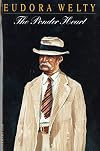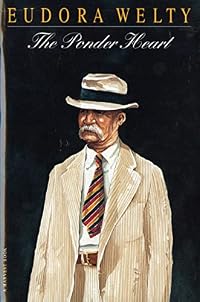
The Ponder Heart
by Eudora Welty
On This Page
Description
Originally published in The New Yorker in 1954, The Ponder Heart is easily Eudora Welty's most comic novel, a lighthearted burlesque that rivals Caldwell's Tobacco Road for capturing rural idioms, and the novels of Mark Twain for high farce. Edna Earle, a person of large distinction in Clay County, and the talkative owner of the Beulah Hotel, tells the story of her Uncle Daniel Ponder, a local hero whose over-affection for society compels him to give everything he owns away. The show more disappearance of Uncle Daniel's second wife, the waifish and willowy Bonnie Dee Peacock, leads to his arrest for murder. The trial, which comprises the second half of the novel, is a masterpiece of courtroom anarchy. A cast of Dickensian characters coupled with Edna's hysterically accurate observations of small-town life, transport the reader, like a raucous family drive, to a truly original conclusion. show lessTags
Recommendations



















Member Reviews
The Publisher Says: Daniel Ponder is the amiable heir to the wealthiest family in Clay County, Mississippi. To friends and strangers, he’s also the most generous, having given away heirlooms, a watch, and so far, at least one family business. His niece, Edna Earle, has a solution to save the Ponder fortune from Daniel’s mortifying philanthropy: As much as she loves Daniel, she’s decided to have him institutionalized.
Foolproof as the plan may seem, it comes with a kink—one that sets in motion a runaway scheme of mistaken identity, a hapless local widow, a reckless wedding, a dim-witted teenage bride, and a twist of dumb luck that lands this once-respectable Southern family in court to brave an embarrassing trial for murder. show more It’s become the talk of Clay County. And the loose-tongued Edna Earle will tell you all about it.
“The most revered figure in contemporary American letters,” said the New York Times of Eudora Welty, which also hailed The Ponder Heart—a winner of the William Dean Howells Medal which was adapted into both a 1956 Broadway play and a 2001 PBS Masterpiece series—as “Miss Welty at her comic, compassionate best.”
THIS IS MY ENTRY INTO THE 1954 CLUB...reviews of books published in 1954.
My Review: This magical moment of Southern history was first published in The New Yorker magazine, with the whimsically funny line drawings in my Kindle edition, in 1953. How I wish I had been there, that I'd seen it in that form...I was, obviously, unable to attend the 1956 Broadway performance of the play adapted from this book (being still as yet unborn) but I certainly saw the PBS Masterpiece Theater production with Peter MacNicol and JoBeth Williams as Uncle Daniel and Edna Earle Ponder. It was...fine. Not a patch on the read, but...fine. Like 2001 itself, it was no patch on 1953, or 1956.
The reason this novella marches on, I think, is that it is the perfect length and in the precise emotional register for Miss Eudora Welty's powers to come full bore on it. I am certain that its long-term popularity is down to Miss Edna Earle Ponder and her absolutely amazing narrative voice:
It's the voice that I sense in all Miss Eudora's very best writing, the voice of a certain woman whose presence in every Southern matriarchy is inevitable: The "excellent woman" of Barbara Pym's stories with a different accent and a slightly more acid tongue. In Miss Edna Earle, I do believe the type reached her apotheosis. She narrates the whole sorry saga of Grandpa Ponder's attempts to corral his son's bizarre, generous heart within the Institution of Marriage. After all, the mental institution couldn't even hold him a week. The problem is, you see, Uncle Daniel Ponder isn't crazy. Isn't, in fact, much of anything except smilingly delighted to be alive, and willing to do whatever it takes to give that same joy to others. And Miss Edna Earle, being a true-born Ponder and a lot sharper than Uncle Daniel, sees Grandpa's point...helps him as best she can...and, when the marriage "didn't hold out," she accepts Uncle Daniel's just going to need watching so he doesn't give away the whole of the Ponder fortune.
Nobody thought to worry about the dear soul finding another wife.
This time, though, as one might expect, Uncle Daniel finds the wrongest wife possible: A silly little girl of seventeen from a family of no-count nobodies. The shock of it! Why, Grandpa Ponder finally succumbs to this shock to "the Ponder heart" and now where is Miss Edna Earle going to get help dealing with Uncle Daniel? Especially now that his little child bride is all of a sudden dead....
What follows is an absolutely side-splittingly funny murder trial, a startling bunch of revelations about Uncle Daniel (not really) and a juicy trial for the gossips to chew over til Kingdom Come (that bit's true). There is, as always, The Welty Touch over every square inch of this magical little farce. There's the occasional nasty epithet, but never from Miss Edna Earle or Uncle Daniel; there's not one single sign of modernity in the story, in the structure or the tale of it. This is the way Southern women of a century ago told their stories to anyone who desired to listen.
I desired to listen. show less
Foolproof as the plan may seem, it comes with a kink—one that sets in motion a runaway scheme of mistaken identity, a hapless local widow, a reckless wedding, a dim-witted teenage bride, and a twist of dumb luck that lands this once-respectable Southern family in court to brave an embarrassing trial for murder. show more It’s become the talk of Clay County. And the loose-tongued Edna Earle will tell you all about it.
“The most revered figure in contemporary American letters,” said the New York Times of Eudora Welty, which also hailed The Ponder Heart—a winner of the William Dean Howells Medal which was adapted into both a 1956 Broadway play and a 2001 PBS Masterpiece series—as “Miss Welty at her comic, compassionate best.”
THIS IS MY ENTRY INTO THE 1954 CLUB...reviews of books published in 1954.
My Review: This magical moment of Southern history was first published in The New Yorker magazine, with the whimsically funny line drawings in my Kindle edition, in 1953. How I wish I had been there, that I'd seen it in that form...I was, obviously, unable to attend the 1956 Broadway performance of the play adapted from this book (being still as yet unborn) but I certainly saw the PBS Masterpiece Theater production with Peter MacNicol and JoBeth Williams as Uncle Daniel and Edna Earle Ponder. It was...fine. Not a patch on the read, but...fine. Like 2001 itself, it was no patch on 1953, or 1956.
The reason this novella marches on, I think, is that it is the perfect length and in the precise emotional register for Miss Eudora Welty's powers to come full bore on it. I am certain that its long-term popularity is down to Miss Edna Earle Ponder and her absolutely amazing narrative voice:
I used to dread he might get hold of one of these occasional travelers that wouldn’t come in unless they had to—the kind that would break in on a story with a set of questions, and wind it up with a list of what Uncle Daniel’s faults were: some Yankee.
–and–
Miss Teacake Magee lived here all her life. She sings in the choir of the Baptist Church every blessed Sunday; couldn’t get her out. And sings louder than all the rest put together, so loud it would make you lose your place.
–and–
The Peacocks are the kind of people keep the mirror outside on the front porch, and go out and pick railroad lilies to bring inside the house, and wave at trains till the day they die. The most they probably hoped for was that somebody’d come find oil in the front yard and fly in the house and tell them about it.
It's the voice that I sense in all Miss Eudora's very best writing, the voice of a certain woman whose presence in every Southern matriarchy is inevitable: The "excellent woman" of Barbara Pym's stories with a different accent and a slightly more acid tongue. In Miss Edna Earle, I do believe the type reached her apotheosis. She narrates the whole sorry saga of Grandpa Ponder's attempts to corral his son's bizarre, generous heart within the Institution of Marriage. After all, the mental institution couldn't even hold him a week. The problem is, you see, Uncle Daniel Ponder isn't crazy. Isn't, in fact, much of anything except smilingly delighted to be alive, and willing to do whatever it takes to give that same joy to others. And Miss Edna Earle, being a true-born Ponder and a lot sharper than Uncle Daniel, sees Grandpa's point...helps him as best she can...and, when the marriage "didn't hold out," she accepts Uncle Daniel's just going to need watching so he doesn't give away the whole of the Ponder fortune.
Nobody thought to worry about the dear soul finding another wife.
This time, though, as one might expect, Uncle Daniel finds the wrongest wife possible: A silly little girl of seventeen from a family of no-count nobodies. The shock of it! Why, Grandpa Ponder finally succumbs to this shock to "the Ponder heart" and now where is Miss Edna Earle going to get help dealing with Uncle Daniel? Especially now that his little child bride is all of a sudden dead....
What follows is an absolutely side-splittingly funny murder trial, a startling bunch of revelations about Uncle Daniel (not really) and a juicy trial for the gossips to chew over til Kingdom Come (that bit's true). There is, as always, The Welty Touch over every square inch of this magical little farce. There's the occasional nasty epithet, but never from Miss Edna Earle or Uncle Daniel; there's not one single sign of modernity in the story, in the structure or the tale of it. This is the way Southern women of a century ago told their stories to anyone who desired to listen.
I desired to listen. show less
About halfway through this book I stopped and looked up and said something forceful to the effect that Holy God, this was the funniest book I'd read in ages. But I hadn't laughed out loud once, because, I realised, there weren't any jokes in it. Narrator Edna Earl is not the sort to go telling jokes; but when she described something as being done 'politely' she actually means the exact opposite, and that's what my English teacher taught me was the definition of irony. It's a little masterpiece of southern US voice and place, like Faulkner via Austen - all the wonderful locutions of language and syntax without the apocalyptic passions. Instead we get Edna Earl and her Uncle Daniel and their familial doings and complications, most arising show more from Uncle Daniel's heedless largesse and the efforts to restrain his prodigal generosity and the rich comic drama arising from his precipitative second marriage. show less
Southern literature is a thing unto itself, isn't it? Distinctly regional, heavy on common-way-of-talking storytelling, and events that seem unlikely to happen anywhere else. Eudora Welty adds a layer of describing a character impeccably with just a few words or phrases.
Unfortunately - especially at the time of publication of this novella - it can also include race-based terms, attitudes and characters that make most of us uncomfortable today.
I struggle with whether that means I can't like the story and the telling of it, which I did, with its pettiness between families, the accommodation of oddball family members, and classic events and scenes that can be found in other Southern novels - like the summer trial in a sweltering show more courthouse.
In this Southern story in particular, I liked Miss Welty's pinpoint description of people - the woman who wears black glasses in white frames that she keeps in a case that's a celluloid butterfly from Woolworth's, the man with a diamond on this little finger that's "bigger than mine, but not half as expensive."
Nevertheless, any conversation about this book (just like 'Huckleberry Finn') is probably going to lead to a discussion about what to do about the "uncomfortable" parts of the book - acknowledge them and write them off to the book being a product of its day, condemn the book and try to make sure no one reads it, republish it with special editing? show less
Unfortunately - especially at the time of publication of this novella - it can also include race-based terms, attitudes and characters that make most of us uncomfortable today.
I struggle with whether that means I can't like the story and the telling of it, which I did, with its pettiness between families, the accommodation of oddball family members, and classic events and scenes that can be found in other Southern novels - like the summer trial in a sweltering show more courthouse.
In this Southern story in particular, I liked Miss Welty's pinpoint description of people - the woman who wears black glasses in white frames that she keeps in a case that's a celluloid butterfly from Woolworth's, the man with a diamond on this little finger that's "bigger than mine, but not half as expensive."
Nevertheless, any conversation about this book (just like 'Huckleberry Finn') is probably going to lead to a discussion about what to do about the "uncomfortable" parts of the book - acknowledge them and write them off to the book being a product of its day, condemn the book and try to make sure no one reads it, republish it with special editing? show less
What a crazy, nonstop kind of book - Welty fills the story with a remarkable bunch of loons and nit-wits, and yet the story comes all together so perfectly that you don't mind how everything and everybody is so much larger than life.
This novella (157 pages in the edition I read) was recommended to me as an enjoyable example of Southern literature. As such, it is mostly a portrait of a small-town community in Mississippi in the 1940’s. Talky Edna Earle narrates the story of how her generous-to-a-fault (literally) Uncle Daniel came to be falsely accused of murdering his wife, and what happened after that. The pleasures of this novella are not in the plot, but mostly in the language and the comic depictions of the characters.
This is one of the funniest novels you'll ever read. Read it slowly and try to imagine the dialects and relaxed culture of the old American South. How anyone could read these words from the trial of Uncle Daniel Ponder and not come near to falling over laughing is beyond me!
Uncle Daniel has stopped his murder trial cold by standing up, throwing open his coat and grabbing fistfulls of money and tossing it to the courtroom spectators.
"Next, Mr. Bank Sistrunk stands up and roars out, "Daniel Ponder! Where did you get that money?" It was too late then. "Well," says Miss Missionary Sistrunk - the oldest one, returned from wildest Africa just twenty-four hours before - "the Ponders as I've always been told did not burn their cotton when show more Sherman came, and maybe this is their judgment." "Take that back, Miss Florette," I says over people's heads. " The Ponders did not make their money that way. You got yours suing," I says. "What if that train hadn't hit Professor Magee, where'd any Sistrunks be today? Ours was pine trees and 'way after Sherman, and you know it."
Another touching quote about Uncle Daniel spoken by his niece, the narrator of the tale.
"I don't know if you can measure love at all. But Lord knows there's a lot of it, and seems to me from all the studying I've done over Uncle Daniel - and he loves more people than you and I put together ever will - that if the main one you've set your heart on isn't speaking for your love, or is out of your reach some way, married or dead, or plain nitwitted, you've still got that love banked up somewhere. What Uncle Daniel did was just bestow his all around quick - men, women, and children. Love! There's always somebody wants it. Uncle Daniel knew that. He's smart in a way you aren't, child."
Tell me that's not great writing! Anyone? Anyone? Get this book. Read this book. You'll LOVE THIS BOOK! show less
Uncle Daniel has stopped his murder trial cold by standing up, throwing open his coat and grabbing fistfulls of money and tossing it to the courtroom spectators.
"Next, Mr. Bank Sistrunk stands up and roars out, "Daniel Ponder! Where did you get that money?" It was too late then. "Well," says Miss Missionary Sistrunk - the oldest one, returned from wildest Africa just twenty-four hours before - "the Ponders as I've always been told did not burn their cotton when show more Sherman came, and maybe this is their judgment." "Take that back, Miss Florette," I says over people's heads. " The Ponders did not make their money that way. You got yours suing," I says. "What if that train hadn't hit Professor Magee, where'd any Sistrunks be today? Ours was pine trees and 'way after Sherman, and you know it."
Another touching quote about Uncle Daniel spoken by his niece, the narrator of the tale.
"I don't know if you can measure love at all. But Lord knows there's a lot of it, and seems to me from all the studying I've done over Uncle Daniel - and he loves more people than you and I put together ever will - that if the main one you've set your heart on isn't speaking for your love, or is out of your reach some way, married or dead, or plain nitwitted, you've still got that love banked up somewhere. What Uncle Daniel did was just bestow his all around quick - men, women, and children. Love! There's always somebody wants it. Uncle Daniel knew that. He's smart in a way you aren't, child."
Tell me that's not great writing! Anyone? Anyone? Get this book. Read this book. You'll LOVE THIS BOOK! show less
This humorous story of Uncle Daniel Ponder is told through the eyes of his niece, Edna Earle. Much of the action centers on his marriage, his wife's death, and his subsequent trial. An early humorous moment includes when he is committed to the asylum but turns the table on the relative who had him committed. A later humorous scene begins at the moment Uncle Daniel takes the stand in the trial. It is a good example of Southern literature from the period in which it was written. While some may call it racist today, I don't really think that was the author's intent. She was simply using common verbiage that both blacks and whites used at that time period. While this book will never be a favorite with me, it does a good job of evoking a show more by-gone era. show less
Members
- Recently Added By
Lists

Harold Bloom - The Western Canon: D. The Chaotic Age
833 works; 24 members
Author Information

98+ Works 15,279 Members
Eudora Welty was born in Jackson, Mississippi on April 13, 1909. She was educated at the Mississippi State College for Women in Columbus, Mississippi, and at the University of Wisconsin. She moved to New York in 1930 to study advertising at the Columbia University business school. After her father's death, she moved back to Jackson in 1931. She show more held various jobs on local newspapers and at a radio station before becoming a publicity agent for the Works Progress Administration (WPA), part of Franklin Roosevelt's New Deal program. Travelling through the state of Mississippi opened her eyes to the misery of the great depression and resulted in a series of photographs, which were exhibited in a one-women show in New York in 1936 and were eventually published as One Time, One Place: Mississippi in the Depression in 1971. She stopped working for the WPA in 1936. Her first stories, Magic and Death of a Travelling Salesman, were published in small magazines in 1936. Some of her better-known short stories are Why I Live at the P.O., Petrified Man, and A Worn Path. Her short story collections include A Curtain of Green, The Golden Apples, The Wide Net and Other Stories, and The Bride of Innisfallen and Other Stories. Her first novel, The Robber Bridegroom, was published in 1942. Her other novels include Delta Wedding, The Ponder Heart, Losing Battles, and The Optimist's Daughter, which won the Pulitzer Prize in 1972. She received the gold medal for fiction from the National Institute of Arts and Letters in 1972. Her nonfiction works include A Snapshot Album, The Eye of the Storm: Selected Essays and Reviews, and One Writer's Beginnings. She died from complications following pneumonia on July 23, 2001 at the age of 92. (Bowker Author Biography) show less
Some Editions
Awards and Honors
Awards
Distinctions
Notable Lists
Series
Belongs to Publisher Series
Work Relationships
Is contained in
Has the adaptation
Has as a student's study guide
Common Knowledge
- Original title
- The Ponder Heart
- Original publication date
- 1954
- People/Characters
- Uncle Daniel Ponder; Grandpa Ponder; Edna Earle Ponder; Miss Teacake Magee; Bonnie Dee Peacock
- Important places
- Clay, Mississippi
- Related movies
- The Ponder Heart (2001 | TV | IMDb)
- Dedication
- To
Mary Louise Aswell,
William and Emily Maxwell - First words
- My Uncle Daniel's just like your uncle, if you've got one - only he has one weakness.
- Last words
- (Click to show. Warning: May contain spoilers.)Uncle Daniel? Uncle Daniel! We've got company!
Now he'll be down.
Classifications
Statistics
- Members
- 657
- Popularity
- 43,726
- Reviews
- 16
- Rating
- (3.69)
- Languages
- English, Portuguese, Spanish
- Media
- Paper, Audiobook, Ebook
- ISBNs
- 11
- ASINs
- 12