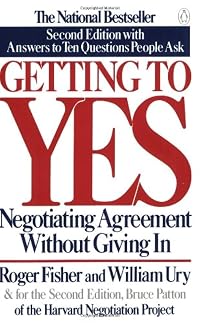
Getting to Yes: Negotiating Agreement without Giving In
by Roger Fisher, Bruce Patton, William Ury
On This Page
Description
"Since it was first published in 1981 Getting to Yes has become a central book in the Business Canon: the key text on the psychology of negotiation. Its message of "principled negotiations"--finding acceptable compromise by determining which needs are fixed and which are flexible for negotiating parties--has influenced generations of businesspeople, lawyers, educators and anyone who has sought to achieve a win-win situation in arriving at an agreement. It has sold over 8 million copies show more worldwide in 30 languages, and since it was first published by Penguin in 1991 (a reissue of the original addition with Bruce Patton as additional coauthor) has sold over 2.5 million copies--which places it as the #10 bestselling title overall in Penguin Books, and #3 bestselling nonfiction title overall. We have recently relicensed the rights to Getting to Yes, and will be doing a new revised edition--a 30th anniversary of the original publication and 20th of the Penguin edition. The authors will be bringing the book up to date with new material and a assessment of the legacy and achievement of Getting to Yes after three decades"-- show lessTags
Recommendations
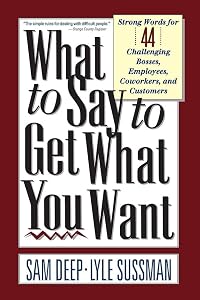
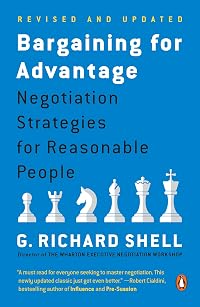
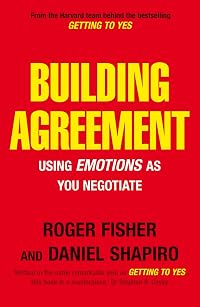

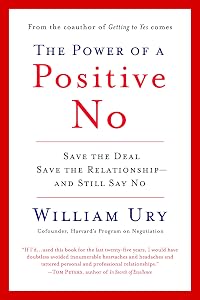




Member Recommendations
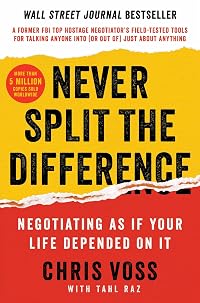
supersidvicious Whilst the work of Fisher, Ury and Patton is the reference for collaborative decision making, Voss goes beyond win-win goal to explain how to sketch out negotiations to win all making at the same time your counterpart satisfied using emotional intelligence.
Member Reviews
Negotiation is a crucial life skill. For some, it’s inherent to being a part of society, especially with expensive purchases or haggling in open markets. For others (like lawyers), it composes a part of their professional skillset. Either way, most people can stand to benefit from learning more about the art of negotiation. Many negotiation guides seek to maximize gains by taking strong positions. However, as these authors point out, this strategy can hurt long-term relationships by hurting the well-being of one party. Instead, they suggest building negotiation around a mutual appreciation of fairness. This leaves relationships and reputations in tact while getting a satisfying result.
The authors make a couple of assumptions. First, show more most people are most afraid of being “taken” in a negotiation. They do not necessarily want to maximize their result, but rather, they mostly do not want to lose the negotiation. Second, fair standards can anchor a negotiation by framing it objectively in a proper ballpark. Instead of taking positions, parties are encouraged to do research to look for a fair result. While this decreases the likelihood of “winning big,” it increases the likelihood of a mutually satisfying agreement. (Thus, it decreases the likelihood of a “bad” agreement.)
With these goals in mind, the authors reframe the language around negotiation to help readers achieve these results. Ample examples from a variety of settings exist within this work. They coach how to deal with trying situations, like power differentials, difficult people, and adversarial tactics. They focus on long-term benefits from reputation and win-win relationships instead of just winning one contest.
Those who value the social fabric will appreciate this book’s approach. It’s goal is to get to “yes” – that is, to get to an agreement instead of dramatically maximizing the windfall. Obviously, not everyone will agree with this style of negotiation, but it has many benefits. Most of all, it encourages fairness and politeness without turning it into passivity. It’s good training (and therapy) to think through dealing with difficult negotiation tactics ahead of time. This sets the stage for real-life encounters. After reading this book, I look back on several big, past negotiations that I could have handled better. At least I’ll be more prepared for the next one. show less
The authors make a couple of assumptions. First, show more most people are most afraid of being “taken” in a negotiation. They do not necessarily want to maximize their result, but rather, they mostly do not want to lose the negotiation. Second, fair standards can anchor a negotiation by framing it objectively in a proper ballpark. Instead of taking positions, parties are encouraged to do research to look for a fair result. While this decreases the likelihood of “winning big,” it increases the likelihood of a mutually satisfying agreement. (Thus, it decreases the likelihood of a “bad” agreement.)
With these goals in mind, the authors reframe the language around negotiation to help readers achieve these results. Ample examples from a variety of settings exist within this work. They coach how to deal with trying situations, like power differentials, difficult people, and adversarial tactics. They focus on long-term benefits from reputation and win-win relationships instead of just winning one contest.
Those who value the social fabric will appreciate this book’s approach. It’s goal is to get to “yes” – that is, to get to an agreement instead of dramatically maximizing the windfall. Obviously, not everyone will agree with this style of negotiation, but it has many benefits. Most of all, it encourages fairness and politeness without turning it into passivity. It’s good training (and therapy) to think through dealing with difficult negotiation tactics ahead of time. This sets the stage for real-life encounters. After reading this book, I look back on several big, past negotiations that I could have handled better. At least I’ll be more prepared for the next one. show less
Getting to Yes is a book well worth reading. It presents sage advice on how to unlock opposing parties and moving to successful mediation through a variety of arenas. The authors put forth solid, experienced-based approaches that can draw conflicting agendas on to common turf. He denigrates much of the traditional approaches to negotiation and dispute resolution and shows step-by-step processes about how to focus on individual interests rather than cement ourselves down to opposing positions. He suggests that using an objective criteria is much longer lasting and brings faster resolution than trying to get someone to change their mind and feelings about a conflict. The authors' experience ranges from negotiations with business disputes, show more family matters, to international terrorist dispute resolution. show less
This is a surprisingly easy book to read but chalk full of information and examples. The contents are carefully structured and each chapter builds on the previous. It does not oversimplify issues, on the contrary, it recognizes the complexity of some negotiation situations but constantly refers to the same principles to show how they can be applied consistently. Finally, I appreciated the variety of the examples drawn both from common occurrences and exceptionally delicate situations, giving a wide range of possibilities to consider. Very dense but extremely useful, this book gives the secrets to a powerful yet human way to find solutions to tough conflicts.
Unfortunately, the world is full of people who still think that negotiation is a strong-man game. The one who made the least concessions wins.
This is the most fundamental, basic book to break through that view. At this point, the information in here is old-hat if you're dealing with someone who's a professional negotiator (sales, arbitration, etc) but if you hate negotiating because you just see it as an arm-wrestling competition, this is a great book to get started changing that view.
This is the most fundamental, basic book to break through that view. At this point, the information in here is old-hat if you're dealing with someone who's a professional negotiator (sales, arbitration, etc) but if you hate negotiating because you just see it as an arm-wrestling competition, this is a great book to get started changing that view.
This book is an excellent resource for anyone interested in the theory behind effective negotiation, offering plenty of relevant examples and standing as a gold standard in the field. However, it would benefit from more practical guidance on applying the concepts. Despite this, it remains valuable, and I noticed some of the theories reflected in the movie Juror 8 I recently watched.
For instance, on the concept of Separating people from the problem
During the trial, the forensic scientist confidently testified that the victim’s death was caused by a blow from a hammer. However, Juror #6, despite knowing the jury was not allowed to speak, boldly interjected, asserting that the wound on the victim’s head was not from a hammer. With 30 show more years of experience as an embalmer, Juror #6 was certain the wound had a different cause, pointing to the evidence of blood patches rather than the gushing blood one would expect from a hammer strike. Despite his extensive experience in handling corpses, no one chose to believe him, and he was eventually removed from the court for causing a disturbance. Perhaps, if Juror #6 had presented his opinion with more restraint, avoiding the aggressive tone and volume, the judges might have responded differently. His emotional outburst, unfortunately, overshadowed the validity of his argument, leading to his dismissal.
This book is no doubt a very good book for beginners :) show less
For instance, on the concept of Separating people from the problem
During the trial, the forensic scientist confidently testified that the victim’s death was caused by a blow from a hammer. However, Juror #6, despite knowing the jury was not allowed to speak, boldly interjected, asserting that the wound on the victim’s head was not from a hammer. With 30 show more years of experience as an embalmer, Juror #6 was certain the wound had a different cause, pointing to the evidence of blood patches rather than the gushing blood one would expect from a hammer strike. Despite his extensive experience in handling corpses, no one chose to believe him, and he was eventually removed from the court for causing a disturbance. Perhaps, if Juror #6 had presented his opinion with more restraint, avoiding the aggressive tone and volume, the judges might have responded differently. His emotional outburst, unfortunately, overshadowed the validity of his argument, leading to his dismissal.
This book is no doubt a very good book for beginners :) show less
While it does leave to feeling like Jack Donaghy after a six hour Six Sigma marathon, there's plenty of advice.
The whole book can be boiled down to an expression of Wheeton's Law: "Don't be a dick."
The whole book can be boiled down to an expression of Wheeton's Law: "Don't be a dick."
Common sense, very memorable book about negotiating. Major takeaway: start with small things you can agree on and work from there.
(Will have no use in political debates!)
(Will have no use in political debates!)
Members
- Recently Added By
Lists

BusinessBooks
24 works; 5 members

Blue Pyramid 1,276 Best Books of All Time
1,248 works; 32 members

My List
302 works; 1 member

Career
86 works; 1 member

Men's healing resources
750 works; 1 member
Author Information

55+ Works 8,002 Members

3+ Works 8,299 Members

33 Works 8,751 Members
William Ury is the co-founder of Harvard's Program on Negotiation, where he directs the Project on Preventing War. One of the world's leading negotiation specialists, his past clients include dozens of Fortune 500 companies as well as the White House and Pentagon. Ury received his B.A. from Yale and a Ph.D. in Anthropology from Harvard. His books show more Getting to YES and Getting Past No have sold more than five million copies worldwide. He lives in Boulder, Colorado. (Bowker Author Biography) show less
Some Editions
Series
Belongs to Publisher Series
Work Relationships
Is contained in
Has as a reference guide/companion
Common Knowledge
- Canonical title
- Getting to Yes: Negotiating Agreement without Giving In
- Original title
- Getting to Yes: Negotiating Agreement without Giving In
- Alternate titles*
- L'arte del negoziato. Per chi vuole ottenere il meglio in una trattativa ed evitare lo scontro
- Original publication date
- 1991
- Dedication*
- To our fathers, Walter T. Fisher and Melvin C. Ury, who by examples taught us the power of principle.
- First words*
- During the last ten years negotiation as a field for academic and professional concern has grown dramatically.
- Last words*
- (Click to show. Warning: May contain spoilers.)This may require experimentation and a period of adjustment that is not so comfortable, but in the end, you are likely to maximize your negotiation power if you believe what you say and say what you believe.
- Original language*
- Inglês
- Canonical DDC/MDS
- 158.2
- Canonical LCC
- BF637.N4 F57
- Disambiguation notice
- This is the revised / second edition, first published in 1991 with additional material and adding Bruce Patton as an author (instead of an editor). Please do not combine it with the original 1981 edition.
*Some information comes from Common Knowledge in other languages. Click "Edit" for more information.
Classifications
Statistics
- Members
- 5,729
- Popularity
- 2,303
- Reviews
- 55
- Rating
- (3.88)
- Languages
- 13 — Chinese, Dutch, English, Estonian, French, German, Hungarian, Italian, Norwegian (Bokmål), Polish, Spanish, Swedish, Portuguese (Brazil)
- Media
- Paper, Audiobook, Ebook
- ISBNs
- 73
- UPCs
- 1
- ASINs
- 42