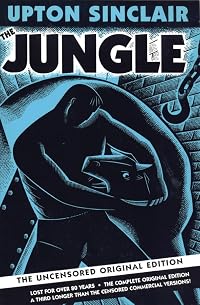
The Jungle: The Uncensored Original Edition
by Upton Sinclair
On This Page
Description
The horrifying conditions in the meatpacking industry in the early 1900's are revealed through the experiences of immigrants as they try to make a living by working in the Chicago stockyards.Tags
Recommendations






Member Reviews
Rarely is a book truly too good to put down. I must just love reading about misery, because this book really did it for me. I found myself hoping the characters would just die to escape the miseries of life--as though that would be their triumph over those who oppressed and exploited them. If only it had not puttered out at the end. I almost thought Sinclair was indulging in a bit of self-targeting satire with regards to his beloved Socialism by the way he presented it as (practically) a religion, but I think he was in earnest. I wonder if they make kids read this in school. Probably not--too dangerous to make them see too much behind the curtain.
Half a century before her time, Upton Sinclair entirely invalidates everything written by Ayn Rand. He perfectly illustrates why capitalism is like a jungle, in which the only way to survive is to be the most wicked and brutal, killing and swindling for moments of relief. It is a life in which no one is happy and everyone lives in fear and filth, living only by the misfortune of others. Political freedom is useless in a nation of wage slavery, and a government that does not exercise control over the economy is a government in name only.
This is a horror masterpiece. Horror because it was real and because it is real.
Read for provoking thoughts on
-poverty
-immigrants/the masses
-politics (the boss!)
-employment
-oppression
-& socialism
But, I would add, that I don't think it presents the right solution on the surface. I think it proposes the easy solution. And the easy solution never works. It's been tried.
But, if you look a little deeper, it poses a good solution. Not a political movement, but community support and care. A sense of belonging, of contributing, of a higher purpose than just the daily grind. And it's hard for people living hand to mouth to ever find that. Trust me, I kinda know.
Books to be read in tandem with this: Fast Food Nation, The Home We Build Together show more & Lost Connections. show less
Read for provoking thoughts on
-poverty
-immigrants/the masses
-politics (the boss!)
-employment
-oppression
-& socialism
But, I would add, that I don't think it presents the right solution on the surface. I think it proposes the easy solution. And the easy solution never works. It's been tried.
But, if you look a little deeper, it poses a good solution. Not a political movement, but community support and care. A sense of belonging, of contributing, of a higher purpose than just the daily grind. And it's hard for people living hand to mouth to ever find that. Trust me, I kinda know.
Books to be read in tandem with this: Fast Food Nation, The Home We Build Together show more & Lost Connections. show less
When I was a senior and in my American History class, we were starting the unit on early 20th century America. Our history book contained a quote from Upton Sinclair (since the chapter was talking about political corruption, etc) and the teacher asked if any of us read the 'Jungle' (which was mentioned in that chapter along with muckraking)
I was the only one to raise my hand.
A couple of years before, I had read it at my leisure on the recommendation of a different teacher who knew I liked to read. The descriptions of the meat-factory and the slums is heart-rending, like others say, but it does not affect the quality of the book. If not for Mr. Sinclair's books, we might not have had as much reform to the meat system as we do now, show more (though today, conditions are still nasty) Plenty of other stuff is explored here - poverty, political corruption, police corruption, and the like. It's all very frank and clearly written with a lot of research from the author. It's hard to not sympathize with Jurgis even after he runs away from his family - or what's left of it, at least. Not that you can blame him, after you read about the ways he has been taken advantage of and abused, something all too common with immigrants, especially poor and uneducated ones. This is a top-notch book which is just as relevant over a century later - we still have problems with political corruption, poverty, tainted meat (read Fast Food Nation), what have you. show less
I was the only one to raise my hand.
A couple of years before, I had read it at my leisure on the recommendation of a different teacher who knew I liked to read. The descriptions of the meat-factory and the slums is heart-rending, like others say, but it does not affect the quality of the book. If not for Mr. Sinclair's books, we might not have had as much reform to the meat system as we do now, show more (though today, conditions are still nasty) Plenty of other stuff is explored here - poverty, political corruption, police corruption, and the like. It's all very frank and clearly written with a lot of research from the author. It's hard to not sympathize with Jurgis even after he runs away from his family - or what's left of it, at least. Not that you can blame him, after you read about the ways he has been taken advantage of and abused, something all too common with immigrants, especially poor and uneducated ones. This is a top-notch book which is just as relevant over a century later - we still have problems with political corruption, poverty, tainted meat (read Fast Food Nation), what have you. show less
Imagine yourself standing in a puddle of blood, covering the entire floor. All around you is corpses, the dead hanging from the ceiling to bleed dry. The smell is so nauseous you don’t understand how such a disgusting mess turns into food for the people. This isn't a horror story or perhaps it is…
Upton Sinclair has created a jaw dropping story that inspired ACTUAL CHANGE. This was a fictional story with truth woven through it, this truth will make you question your political views, it may even change the way you eat. There was a brief part of this book that had me staring at my dinner plate untouched, which then prompted me to run to my computer and look up the TRUTH behind “The Jungle”. After reading about the change this book show more inspired (which I barely knew about from the little history I retained), I felt slightly better about things.
However, some of these issues still exist today. We might not throw scraps of rat chewed meat to be sold BUT look at all the controversy today surrounding antibiotic fed livestock, etc. In some ways we may be coming full circle on some of these issues. The treatment of people in the workplace, rules and unions are still struggling to get basic rights (in some circumstances). Clearly, we still have a lot to learn; maybe someone will be brave like Upton and speak out through storytelling to shock the masses. Oh wait… this does exist… in documentary form… all over Netflix. show less
Upton Sinclair has created a jaw dropping story that inspired ACTUAL CHANGE. This was a fictional story with truth woven through it, this truth will make you question your political views, it may even change the way you eat. There was a brief part of this book that had me staring at my dinner plate untouched, which then prompted me to run to my computer and look up the TRUTH behind “The Jungle”. After reading about the change this book show more inspired (which I barely knew about from the little history I retained), I felt slightly better about things.
However, some of these issues still exist today. We might not throw scraps of rat chewed meat to be sold BUT look at all the controversy today surrounding antibiotic fed livestock, etc. In some ways we may be coming full circle on some of these issues. The treatment of people in the workplace, rules and unions are still struggling to get basic rights (in some circumstances). Clearly, we still have a lot to learn; maybe someone will be brave like Upton and speak out through storytelling to shock the masses. Oh wait… this does exist… in documentary form… all over Netflix. show less
Mind-blowing, ass-kicking, as fine a novel by as intelligent a writer as I have experienced. He begins with an innocent hopeful American immigrant, and by no contrived or shortcut process, pulverizes him, crushes him under poverty, illness, death, injustice, crime, foreclosure, despair, vengeance, every minute cruelty as can be packed into a page. He falters only twice: losing his suspension of disbelief when Jurghis accidentally "tours" the governor's mansion, and again losing the reader's loyalty by rescuing Jurghis into the kind and welcoming arms of the socialist movement. He effectively turns the last fifty pages of his book into a manifesto. What he couldn't quite nail through narrative, he abandons narrative to lecture.
This is the updated edition, meaning that it has five or six extra chapters that Sinclair omitted during the original publication. Personally, I think he made a wise choice (the last chapters weren't added until the late 80s - he found them in his basement or something in the early 80s). Those chapters pretty much just preach, literally preach, socialism, and you lose the thread of the story. I skimmed those parts until I got back to Jurgis, and I don't think I missed anything. Other than that, I really, really enjoyed this book. It was a much easier read than I thought and incredibly interesting.
Members
- Recently Added By
Lists

Books that changed the world
67 works; 63 members
Author Information

246+ Works 21,997 Members
Upton Sinclair, a lifelong vigorous socialist, first became well known with a powerful muckraking novel, The Jungle, in 1906. Refused by five publishers and finally published by Sinclair himself, it became an immediate bestseller, and inspired a government investigation of the Chicago stockyards, which led to much reform. In 1967 he was invited by show more President Lyndon Johnson to "witness the signing of the Wholesome Meat Act, which will gradually plug loopholes left by the first Federal meat inspection law" (N.Y. Times), a law Sinclair had helped to bring about. Newspapers, colleges, schools, churches, and industries have all been the subject of a Sinclair attack, analyzing and exposing their evils. Sinclair was not really a novelist, but a fearless and indefatigable journalist-crusader. All his early books are propaganda for his social reforms. When regular publishers boycotted his work, he published himself, usually at a financial loss. His 80 or so books have been translated into 47 languages, and his sales abroad, especially in the former Soviet Union, have been enormous. (Bowker Author Biography) show less
Common Knowledge
- Original publication date
- 1906
Classifications
Statistics
- Members
- 2,350
- Popularity
- 8,320
- Reviews
- 43
- Rating
- (3.74)
- Languages
- English
- Media
- Paper, Ebook
- ISBNs
- 4
- ASINs
- 9