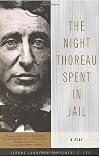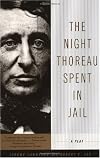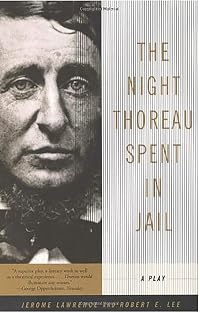
The Night Thoreau Spent in Jail
by Jerome Lawrence, Robert E. Lee
On This Page
Description
A play dramatizing the philosopher, Henry David Thoreau, and his stand concerning civil disobedience. He refused to pay taxes owing to his disapproval of the Mexican War. For his act of protest he was sent to jail.Tags
Recommendations




















Member Reviews
The Night Thoreau Spent in Jail is a compelling and thought-provoking play based on the life of real historical figure Henry David Thoreau. Set in 1846, the story dramatizes the day Thoreau chose to go to jail rather than pay taxes that would fund the Mexican-American War—a war he believed was unjust and driven by the U.S. government’s greed for expansion. This act of civil disobedience, later immortalized in his famous essay, becomes a quiet but powerful form of rebellion that still resonates today.
Though I don’t often read playwrights, this one stands out for its meaningful message and historical weight. Some scenes may feel drawn out or less relevant at first glance, but they serve to highlight Thoreau’s philosophical depth show more and the complexity of his protest. His quiet strength, unconventional thinking, and moral clarity are at the heart of this short but impactful work.
While not a typical narrative, the play is accessible and thought-provoking, making it a worthwhile read for anyone interested in nonviolent resistance, political ethics, or the roots of American protest. It’s a quick read that offers lasting insight into a moment that helped shape the concept of civil disobedience for generations to come. show less
Though I don’t often read playwrights, this one stands out for its meaningful message and historical weight. Some scenes may feel drawn out or less relevant at first glance, but they serve to highlight Thoreau’s philosophical depth show more and the complexity of his protest. His quiet strength, unconventional thinking, and moral clarity are at the heart of this short but impactful work.
While not a typical narrative, the play is accessible and thought-provoking, making it a worthwhile read for anyone interested in nonviolent resistance, political ethics, or the roots of American protest. It’s a quick read that offers lasting insight into a moment that helped shape the concept of civil disobedience for generations to come. show less
The play centers around Thoreau's (real life) night spent in jail for refusing to pay his taxes because of them being used to fund the US intervention/war in Mexico. While the action centers around one war, it was written in 1969 during the time of (& protests against) the Vietnam War. I've never actually read Thoreau (nor R. W. Emerson who also figures considerably in this play) so this was somewhat an introductory experience for me about Thoreau's civil disobedience & quite a few musings on nature, belief in God or lack thereof, & opposition to war & enslaving others.
While Thoreau's curmudgeonly ways (in this play) seem to differ from H.L. Mencken's acid attacks (I recently read A Religious Orgy in Tennessee: A Reporter's Account of show more the Scopes Monkey Trial as 2025 is the 100th anniversary of the trial), both men seem to have clear vision on the follies & stupidities of their fellow humans, especially in relation to religion, education, & society.
I'm glad I read the play. There is a timelessness to it. show less
While Thoreau's curmudgeonly ways (in this play) seem to differ from H.L. Mencken's acid attacks (I recently read A Religious Orgy in Tennessee: A Reporter's Account of show more the Scopes Monkey Trial as 2025 is the 100th anniversary of the trial), both men seem to have clear vision on the follies & stupidities of their fellow humans, especially in relation to religion, education, & society.
I'm glad I read the play. There is a timelessness to it. show less
A very engaging and interesting play highlighting Thoreau's life and primarily his manifestation from hermit at Walden Pond into full-blown civic man, helping to define his philosophy and ideas on/in 'Civil Disobedience'. A great look at a great man.
A play very much of its time (came out in 1970). I'm ashamed to confess that I have never read anything by Thoreau or Emerson and that "transcendentalism" is just a long word to me. So it was enlightening to read this play and learn, not only about the thoughts of both Thoreau and Emerson, but a little about the territorial wars that the US was involved in at that time and Thoreau's act of civil disobedience which was thwarted by those who loved and admired him. What I got from this play is that I really should find a copy of Thoreau and start reading him.
This was an interesting read, and I'd say that the play is benefits from being both read AND seen--not simply one or the other, since I think the two experiences will compliment one another and strengthen the piece with readers/audience. And I enjoyed it for the most part--at times the characters seemed a bit too simple, but for the most part, it was smooth. Yet, I was left wanting a great deal more than what I got.
I think that the authors, simply, tried to cram too much into what needed to be a longer play to meet its potential, and that they were too much focused on ideas and history as opposed to character. It needed a bit more balance. I WANTED to care about Thoreau....but I rarely did, because he seemed more of a mouthpiece or show more charicature at times than a real person. That hurt the play for me, a great deal. I'd like to see it once, if given the opportunity, but it would be only once, just as I can't imagine wanting to come back to read this work again. Simply, it left me dissatisfied, feeling as if more time and care could have made this a masterpiece, but that as is the piece was lacking in passion and sympathy.
If you're interested, I certainly recommend it, as it is a worthwhile and interesting read--I fear though, that particular readers will feel as I do, that the work's potential just wasn't reached, or even necessarily reached for. show less
I think that the authors, simply, tried to cram too much into what needed to be a longer play to meet its potential, and that they were too much focused on ideas and history as opposed to character. It needed a bit more balance. I WANTED to care about Thoreau....but I rarely did, because he seemed more of a mouthpiece or show more charicature at times than a real person. That hurt the play for me, a great deal. I'd like to see it once, if given the opportunity, but it would be only once, just as I can't imagine wanting to come back to read this work again. Simply, it left me dissatisfied, feeling as if more time and care could have made this a masterpiece, but that as is the piece was lacking in passion and sympathy.
If you're interested, I certainly recommend it, as it is a worthwhile and interesting read--I fear though, that particular readers will feel as I do, that the work's potential just wasn't reached, or even necessarily reached for. show less
More or less what one would expect from the authors of Inherit the Wind. The play is of course a study of civil disobedience, but also worthwhile for the presentation of Thoreau as a character. He is always resolute, and yet while never yielding he still manages to grow.
Beautiful play about Henry David Thoreau's life and the circumstances that led to his famous essay, Civil Disobedience. I hope someday to see this on stage.
Members
- Recently Added By
Lists

Plays I Like
230 works; 31 members

Lives of the Poets (and Philosophers)
110 works; 5 members
My Play Collection
769 works; 3 members
Author Information

23+ Works 3,937 Members
Jerome Lawrence was born July 14, 1915, in Cleveland, Ohio, into a literary family. As a teenager, Jerome Lawrence studied writing with Eugene C. Davis. After graduating from Glenville High School in Cleveland in 1933, Lawrence went on to study with Harlan Hatcher, Herman Miller, and Robert Newdick at Ohio State University. He graduated Phi Beta show more Kappa from Ohio State in 1937. Between 1937 and 1939, Lawrence was a graduate student at the Universty of California at Los Angeles. Together, Jerome Lawrence and Robert E. Lee have written famous works of American drama, including Inherit the Wind, The Night Thoreau Spent in Jail, and Auntie Mame. For their work as playwrights, they have won two Peabody Awards, the Variety Critics Poll Award, multiple Tony Award nominations, and many more awards. Both Lawrence and Lee were fundamentally shaped by their participation in World War II. Staff Sergeant Lawrence served as a consultant to the Secretary of War and later as an Army correspondent in North Africa and Italy. In addition to his service in themilitary, he worked as a journalist, reporter, and telegraph editor of small Ohio daily papers and as a continuity editor at KMPC in Beverly Hills. Before World War II, he had worked from 1939 to 1941, as a senior staff writer for CBS Radio, experience that became useful when he and Lee founded Armed Forces Radio. Lawrence's interest in drama extends back to his high school and college days, when he acted in and directed school and summer theater productions. Working together on Armed Forces Radio, Lawrence and Lee produced the official Army-Navy radio programs for D-Day, VE-Day, and VJ-Day. After the war, they created radio programs for CBS, including the series "Columbia Workshop." They also co-wrote radio plays including The Unexpected in 1951, Song of Norway in 1957, Shangri-La in 1960, a radio version of Inherit the Wind in 1965, and Lincoln the Unwilling Warrior in 1974. Inherit the Wind earned Lawrence and Lee numerous awards in the year after its production. The play won the Donaldson Award, the Outer Critics Circle Award, the Variety New York Drama Critics Poll Award, and the Critics Award for Best Foreign Play and was nominated for a Tony Award. Since its publication, the play has been translated into thirty languages. Lawrence and Lee's excellence in theatre has been rewarded by the Ohioana Award, the Lifetime Achievement Award from the American Theatre Assocation, and a number of honorary degrees. Lawrence is the recipient of honorary doctorates from Villanova, the College of Wooster, Farleigh Dickinson University, and Ohio State University. Together, Lawrence and Lee have won numerous Tony nominations, in two separate instances keys to the city of Cleveland, the Moss Hart Memorial Award for Plays of a Free World, a US State Department Medal, an Ohio State Centennial Medal, a Pegasus Award, the Ohio Governor's Award, and a Cleveland Playhouse Plaque. Lawrence was a visiting professor at Ohio State and a master playwright at New York University, Baylor University, and the Salzburg Seminar in American studies. He died in 2004 from complications from a stroke. (Bowker Author Biography) show less

14+ Works 3,845 Members
Work Relationships
Common Knowledge
- Canonical title
- The Night Thoreau Spent in Jail
- Original publication date
- 1970 (performed) (performed)
- People/Characters
- Henry David Thoreau
- Important events
- Mexican-American War (1846 | 1848)
- First words
- Waldo: (Suddenly, as if somebody had stolen his wallet.) What was his name?
- Last words
- (Click to show. Warning: May contain spoilers.)The sun is only a morning star.
Classifications
Statistics
- Members
- 941
- Popularity
- 28,337
- Reviews
- 9
- Rating
- (3.67)
- Languages
- English
- Media
- Paper
- ISBNs
- 16
- ASINs
- 11