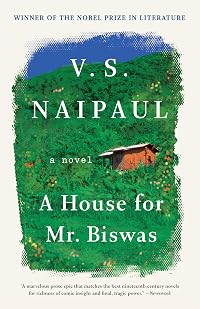
A House for Mr Biswas
by V. S. Naipaul
On This Page
Description
The early masterpiece of V. S. Naipaul's brilliant career, A House for Mr. Biswas is an unforgettable story inspired by Naipaul's father that has been hailed as one of the twentieth century's finest novels.In his forty-six short years, Mr. Mohun Biswas has been fighting against destiny to achieve some semblance of independence, only to face a lifetime of calamity. Shuttled from one residence to another after the drowning death of his father, for which he is inadvertently responsible, Mr. show more Biswas yearns for a place he can call home. But when he marries into the domineering Tulsi family on whom he indignantly becomes dependent, Mr. Biswas embarks on an arduous--and endless--struggle to weaken their hold over him and purchase a house of his own. A heartrending, dark comedy of manners, A House for Mr. Biswas masterfully evokes a man's quest for autonomy against an emblematic post-colonial canvas.From the Trade Paperback edition. show lessTags
Recommendations












Member Recommendations
Member Reviews
Mr. Biswas is one of those characters who you nearly despise....even as you grow more and more attached to him. The character study and exploration conducted here, explicitly and faultlessly, is a journey into one man's existence in Trinidad. His search for dignity centers on the pursuit of his own space and house for he and his family, a goal that (for the reader) seems nearly impossible due to his own missteps and his wife's neverending family. Naipaul's work here is graceful, humorous, and heartbreaking....and, without a doubt, worth reading when you find the time to sprawl into an unfamiliar world and family.
The author has stated publicly that his work is superior to any by women writers. Imagine my disappointment.
It took me over a month to read about the mild misadventures of Mr. Biswas and his efforts to gain a house of his own. (I'm reminded of The Jungle by Upton Sinclair.) There were a few pleasurable episodes (especially during Mr. Biswas' early career as a roving, loose-with-the-facts journalist), but because the book is mostly about a querulous child-man, living in a house of equally querulous childish in-laws and their petty squabbles and name-calling, it was a chore. I suppose ultimately Naipaul was saying something about the simple dignity in having a place to call one's own and the indignity of poverty, and perhaps also how show more Colonialism made children out of men, but Mr. Biswas' personality was so off-putting that it's only now that I think of that message. While reading it mostly I thought, "How many more pages?"
Then, as I turned off the light, I thought instead of other writers I love, "Jane Austen, Willa Cather, Margaret Atwood, Edith Wharton, Marjorie Kinan Rawlings, Katherine Anne Porter, Dorothy Parker, Harriet Doerr, Toni Morrison,......." show less
It took me over a month to read about the mild misadventures of Mr. Biswas and his efforts to gain a house of his own. (I'm reminded of The Jungle by Upton Sinclair.) There were a few pleasurable episodes (especially during Mr. Biswas' early career as a roving, loose-with-the-facts journalist), but because the book is mostly about a querulous child-man, living in a house of equally querulous childish in-laws and their petty squabbles and name-calling, it was a chore. I suppose ultimately Naipaul was saying something about the simple dignity in having a place to call one's own and the indignity of poverty, and perhaps also how show more Colonialism made children out of men, but Mr. Biswas' personality was so off-putting that it's only now that I think of that message. While reading it mostly I thought, "How many more pages?"
Then, as I turned off the light, I thought instead of other writers I love, "Jane Austen, Willa Cather, Margaret Atwood, Edith Wharton, Marjorie Kinan Rawlings, Katherine Anne Porter, Dorothy Parker, Harriet Doerr, Toni Morrison,......." show less
There it is, a modest roofed structure in Sikkim Street standing tall amid the perfumed beds of anthurium lilies. New memories of wet earth after the rain, freshly painted picket fences, the sweet flowers of laburnum tree, mixed aromas flouncing through the warm rooms and wind whiffing through the trees telescoping the painful past. A sense of belonging cherished with merited identity-Mr. Mohun Biswas’s house.
I shy away from the postcolonial contemporary third world fiction. Most of them overwhelm me enlightening the crude aspects of economic claustrophobia which my snobbish approach thoughtlessly overlooks. Keeping in mind this criterion, I cautiously pick out the respected genre books anticipating a satisfying comprehension. Naipaul show more pens a coherent depiction of impoverished dwelling lost between self-identity and rigid ambitions. It is an exasperating yet rewarding life of a simple man who survives the nightmarish surrealism of being born at the devilish midnight hour. Meet Mohun Biswas, the youngest son of a pitiable sugar-cane labourer whose birth was cursed upon by superstitious omen and was destined to be a ruinous disappointment. Mohun’s life churns out be a metaphoric banner for destitution and misfortune. Blamed for his father’s death and the dissolution of the Biswas family, he struggles through every twisted fate of his life trying to find a speck of self-respect, contentment and independence. His marriage in the celebrated Tulsis family is burdensome and intoxicated with him being a mere accessory in his wife’s home. Dutifully carrying on with the mundane obligations, he berates his sympathetic existence. The only shining beacon of hope is a far-fetched dream of buying a house he can call his own. The notion of acquiring an abode becomes an eternal symbol of Mohun’s own existence as a journalist, a father, a husband and moreover a liberated individual.
Naipaul’s vastly elucidated and slow-paced prose underlines quite a few post- colonization inadequacies prevalent in several third world settings till date. Poverty, illiteracy birthing preposterous superstitious dogma, ethnic categorization of class superiority (restricted only to rural infrastructures) and tribulations of pecuniary discrepancies outwitting social hysteria.
Mohun’s tale is heroic in its own humble way. All the man wants in his life is a cozy dwelling without the fear of acerbic prejudices. Some would ridicule on this psychological aspect of obtaining a house. It’s a house, for crying out loud! Why make a big deal of it? For an individual who not only thrives in poverty but is tossed among bizarre quarters of underprivileged hardships; the belief of owning a house becomes deeply satisfying, somewhat a battle in itself. Hear, Hear! To Mohun for making peace with his maddening ordinary living. show less
I shy away from the postcolonial contemporary third world fiction. Most of them overwhelm me enlightening the crude aspects of economic claustrophobia which my snobbish approach thoughtlessly overlooks. Keeping in mind this criterion, I cautiously pick out the respected genre books anticipating a satisfying comprehension. Naipaul show more pens a coherent depiction of impoverished dwelling lost between self-identity and rigid ambitions. It is an exasperating yet rewarding life of a simple man who survives the nightmarish surrealism of being born at the devilish midnight hour. Meet Mohun Biswas, the youngest son of a pitiable sugar-cane labourer whose birth was cursed upon by superstitious omen and was destined to be a ruinous disappointment. Mohun’s life churns out be a metaphoric banner for destitution and misfortune. Blamed for his father’s death and the dissolution of the Biswas family, he struggles through every twisted fate of his life trying to find a speck of self-respect, contentment and independence. His marriage in the celebrated Tulsis family is burdensome and intoxicated with him being a mere accessory in his wife’s home. Dutifully carrying on with the mundane obligations, he berates his sympathetic existence. The only shining beacon of hope is a far-fetched dream of buying a house he can call his own. The notion of acquiring an abode becomes an eternal symbol of Mohun’s own existence as a journalist, a father, a husband and moreover a liberated individual.
Naipaul’s vastly elucidated and slow-paced prose underlines quite a few post- colonization inadequacies prevalent in several third world settings till date. Poverty, illiteracy birthing preposterous superstitious dogma, ethnic categorization of class superiority (restricted only to rural infrastructures) and tribulations of pecuniary discrepancies outwitting social hysteria.
Mohun’s tale is heroic in its own humble way. All the man wants in his life is a cozy dwelling without the fear of acerbic prejudices. Some would ridicule on this psychological aspect of obtaining a house. It’s a house, for crying out loud! Why make a big deal of it? For an individual who not only thrives in poverty but is tossed among bizarre quarters of underprivileged hardships; the belief of owning a house becomes deeply satisfying, somewhat a battle in itself. Hear, Hear! To Mohun for making peace with his maddening ordinary living. show less
The life of Mohun Biswas was very difficult to read. His only success in life is that he marries well. Nothing else goes as planned for him. From birth, Biswas was a marked man, a hapless man. The Tulsi family he marries into is influential, but brutal towards Biswas; constantly mocking and ridiculing him. Imposter syndrome follows him wherever he goes. This was billed as a tragicomedy but I found very little to laugh about in Mr. Biswas's struggles. Every time he is on the cusp of success, something stands in his way or knocks him down. His dreams of becoming a serious journalist are dashed when no one cares about his stories unless they are sensationalized. His dreams of becoming a respected family man are wasted when even his show more children turn against him. The one dream he has left, to own his own house, becomes his entire life. show less
'Bigger than all of them was the house, his house',, May 31, 2014
By
sally tarbox (aylesbury bucks uk) - See all my reviews
This review is from: A House For Mr Biswas (Kindle Edition)
Wonderful read, highly entertaining with laugh-out-loud moments yet touchingly sad as well.
The novel opens shortly before the death of Mr Biswas, with his fear of losing his home. In the narrative that follows, charting Mr Biswas' life, forever vulnerable to the whims of others, and with no place to call his own, we come to see why the house has such significance for him.
For much of his life lack of money compels him to share a large communal house with his wife's family, overseen by the stern and unpredictable matriarch Mrs Tulsi. In his descriptions of the show more 'shifting, tangled, multifarious relationships' of the Tulsis come many of the novel's most vividly comic moments:
'To combat W C Tuttle's gramophone Chinta and Govind had been giving a series of pious singings from the Ramayana....she sang very well. Govind sang less mellifluously: he partly whined and partly grunted, from his habit of singing while lying on his belly, Caught in this crossfire of song, which sometimes lasted a whole evening, Mr Biswas, listening, listening, would on a sudden rush in pants and vest to the inner room and bang on the partition of Govind's room and bang on the partition of W C Tuttle's drawingroom.
The Tuttles never replied. Chinta sang with added zest. Govind sometimes only chuckled between couplets, making it appear to be part of his song.'
or
"One of the sons-in-law was invariably responsible for precipitating Mrs Tulsi's faint. He was now hounded by silence and hostility. If he attempted to make friendly talk many glances instantly reproved him for his frivolity. If he moped in a corner or went up to his room he was condemned for his callousness and ingratitude. He was expected to stay in the hall and show all the signs of contrition and unease.. He waited for the sounds of footsteps coming from the Rose Room; he accosted a busy, offended sister and, ignoring snubs, made whispered enquiries about Mrs Tulsi's condition. Next morning he came down, shy and sheepish. Mrs Tulsi would be better. She would ignore him. But that evening forgiveness would be in the air. The offender would be spoken to as if nothing had happened, and he would respond with eagerness.'
Brilliant observations on human behaviour, an absolute must-read. show less
By
sally tarbox (aylesbury bucks uk) - See all my reviews
This review is from: A House For Mr Biswas (Kindle Edition)
Wonderful read, highly entertaining with laugh-out-loud moments yet touchingly sad as well.
The novel opens shortly before the death of Mr Biswas, with his fear of losing his home. In the narrative that follows, charting Mr Biswas' life, forever vulnerable to the whims of others, and with no place to call his own, we come to see why the house has such significance for him.
For much of his life lack of money compels him to share a large communal house with his wife's family, overseen by the stern and unpredictable matriarch Mrs Tulsi. In his descriptions of the show more 'shifting, tangled, multifarious relationships' of the Tulsis come many of the novel's most vividly comic moments:
'To combat W C Tuttle's gramophone Chinta and Govind had been giving a series of pious singings from the Ramayana....she sang very well. Govind sang less mellifluously: he partly whined and partly grunted, from his habit of singing while lying on his belly, Caught in this crossfire of song, which sometimes lasted a whole evening, Mr Biswas, listening, listening, would on a sudden rush in pants and vest to the inner room and bang on the partition of Govind's room and bang on the partition of W C Tuttle's drawingroom.
The Tuttles never replied. Chinta sang with added zest. Govind sometimes only chuckled between couplets, making it appear to be part of his song.'
or
"One of the sons-in-law was invariably responsible for precipitating Mrs Tulsi's faint. He was now hounded by silence and hostility. If he attempted to make friendly talk many glances instantly reproved him for his frivolity. If he moped in a corner or went up to his room he was condemned for his callousness and ingratitude. He was expected to stay in the hall and show all the signs of contrition and unease.. He waited for the sounds of footsteps coming from the Rose Room; he accosted a busy, offended sister and, ignoring snubs, made whispered enquiries about Mrs Tulsi's condition. Next morning he came down, shy and sheepish. Mrs Tulsi would be better. She would ignore him. But that evening forgiveness would be in the air. The offender would be spoken to as if nothing had happened, and he would respond with eagerness.'
Brilliant observations on human behaviour, an absolute must-read. show less
Mr. Biswas is a stupid, thoughtless, feckless, odious man. His wife and her entire family and all their retainers are likewise stupid and odious, and we can add to the list — conniving.
Nothing of real consequence occurs in this novel. Nobody of consequence graces its pages. No person, with the possible exception of Mr. Burnett, the Sentinel editor who gives Mr. Biswas a job, is portrayed by the author as decent in his or her dealings with family or friends. The author has such contempt for his characters that he only reluctantly names them when he absolutely has to. The most contemptible characters get no name at all or a made-up mock name.
All of this takes place in a milieu of crushing poverty — material and spiritual. And we are show more treated to mind-numbing detail which seems to merely pile on the inconsequential sequence of events and stupefying contemptibility of the entire parade of people who populate this over-long novel. Nothing is served. Nobody learns a thing. The intergenerational poverty is not abated nor is the appalling ignorance.
So I ask, simply: WHY SHOULD ANYBODY SLOG THROUGH 566 PAGES OF SUCH INCONSEQUENTIAL DRIVEL ABOUT SO MANY CLUELESS PEOPLE WHO CANNOT GET OUT OF THEIR OWN WAY?
I have no answer. I am sorry I wasted my time. show less
Nothing of real consequence occurs in this novel. Nobody of consequence graces its pages. No person, with the possible exception of Mr. Burnett, the Sentinel editor who gives Mr. Biswas a job, is portrayed by the author as decent in his or her dealings with family or friends. The author has such contempt for his characters that he only reluctantly names them when he absolutely has to. The most contemptible characters get no name at all or a made-up mock name.
All of this takes place in a milieu of crushing poverty — material and spiritual. And we are show more treated to mind-numbing detail which seems to merely pile on the inconsequential sequence of events and stupefying contemptibility of the entire parade of people who populate this over-long novel. Nothing is served. Nobody learns a thing. The intergenerational poverty is not abated nor is the appalling ignorance.
So I ask, simply: WHY SHOULD ANYBODY SLOG THROUGH 566 PAGES OF SUCH INCONSEQUENTIAL DRIVEL ABOUT SO MANY CLUELESS PEOPLE WHO CANNOT GET OUT OF THEIR OWN WAY?
I have no answer. I am sorry I wasted my time. show less
This novel revolves around Mohun Biswas, who is based on Naipaul's father Seepersad Naipaul. Like the Naipauls, Mr Biswas (who is referred to as "Mr Biswas" throughout the novel, even as an infant) is a Trinidadian of Indian descent. He writes for a local paper, the Trinidad Guardian, and marries into a locally powerful and influential family led by a tight-fisted and petty matriarch. Mr Biswas comes from a poor family, and is perpetually tortured by his wife's family. He wants nothing more than to be able to afford to purchase his own house and be his own man, but is thwarted at every step by his own incompetence and his wife's family. He is a terribly flawed and frustrating but sympathetic character, and the novel, which is one of my show more all time favorites, is tremendously funny and heartbreakingly sad. show less
Members
- Recently Added By
Lists

The Guardian's 1000 Novels Everyone Must Read
1,005 works; 552 members

1001 Books You Must Read Before You Die
1,448 works; 1,137 members

Best of World Literature
437 works; 52 members

BBC's 100 Novels That Shaped Our World
100 works; 22 members
501 Must-Read Books
529 works; 72 members

Books recommended by Barack Obama
295 works; 29 members
Time Magazine's "All-Time 100"
113 works; 15 members
20th Century Literature
1,161 works; 55 members
Favourite Books
1,820 works; 316 members

40 Books to Read Before You’re 40
40 works; 4 members
1960s, Best books published therein
254 works; 22 members

Best family sagas
244 works; 34 members

Top Five Books of 2019
387 works; 111 members
Time's All-Time 100 Novels
100 works; 27 members

Favorite Caribbean Books
60 works; 28 members

Harold Bloom - The Western Canon: D. The Chaotic Age
833 works; 24 members

Big Jubilee List
70 works; 3 members
TML 200 Best Books 1950-1999
202 works; 10 members

Books Set on Islands
190 works; 24 members
The Modern Library's 100 Best Novels: The Board's List
85 works; 5 members

Obama Reads
181 works; 3 members

Five star books
1,767 works; 110 members
Best Domestic Fiction
77 works; 6 members

SHOULD Read Books!
354 works; 9 members

Books Read in 2020
4,379 works; 124 members

The Modern Library (The Two Hundred Best Novels....
202 works; 1 member
Modern Library's 100 Best Novels
100 works; 2 members

.
396 works; 1 member

GREAT 1960s BOOKS
37 works; 1 member

I Could Live There
185 works; 12 members

.
194 works; 2 members

DigitalDreamDoor top 300
300 works; 4 members

Barack Obama's Favorite Books of 2018
29 works; 2 members
Retrospective of 20th- and 21st-century literature
154 works; 1 member

BBC World Book Club
267 works; 5 members

2023 Update: The Best Twenty Books You've Read in the Past Five Years
40 works; 3 members

Mustich's 1000 Books to Read Before You Die: A Life Changing List
1,001 works; 20 members

AP Lit
363 works; 6 members

Allie's Wishlist
217 works; 2 members

Books Read in 2019
4,052 works; 110 members

A Novel Cure
742 works; 23 members

World Book Club (BBC World Service)
212 works; 1 member
Author Information

99+ Works 25,824 Members
Vidiadhar Surajprasad Naipaul was born of Indian ancestry in Chaguanas, Trinidad on August 17, 1932. He was educated at University College, Oxford and lived in Great Britain since 1950. From 1954 to 1956, he edited a radio program on literature for the British Broadcasting Corporation's Caribbean Service. His first novel, The Mystic Masseur, was show more published in 1957. His other novels included A House for Mr. Biswas, A Bend in the River, Guerrillas, and Half a Life. In a Free State won the Booker Prize in 1971. He started writing nonfiction in the 1960s. His first nonfiction book, The Middle Passage, was published in 1962. His other nonfiction works included An Area of Darkness, Among the Believers, Beyond Belief, and A Turn in the South. He was knighted in 1990 and received the Nobel Prize in Literature in 2001. He died on August 11, 2018 at the age of 85. (Bowker Author Biography) show less
Some Editions
Awards and Honors
Awards
Notable Lists
The Big Jubilee Read (1952-1961 – 1961)
Series
Belongs to Publisher Series
Work Relationships
Common Knowledge
- Canonical title
- A House for Mr Biswas
- Original title
- A House for Mr. Biswas
- Alternate titles*
- Una casa per il signor Biswas
- Original publication date
- 1961
- People/Characters
- Mr. Mohun Biswas; Shama Biswas (nee Tulsi)
- Important places
- Trinidad; West Indies
- Dedication
- For this book written between 1957 and 1960 A Late Dedication
P.A.N.
31 July 1932, Gloucester
3 February 1996, Salterton - First words
- Ten weeks before he died, Mr. Mohun Biswas, a journalist of Sikkim Street, St. James, Port of Spain, was sacked.
- Last words
- (Click to show. Warning: May contain spoilers.)Afterwards the sisters returned to their respective homes and Shama and the children went back in the Prefect to the empty house.
- Blurbers
- Burgess, Anthony
- Original language*
- englanti
*Some information comes from Common Knowledge in other languages. Click "Edit" for more information.
Classifications
Statistics
- Members
- 3,846
- Popularity
- 4,130
- Reviews
- 73
- Rating
- (3.78)
- Languages
- 17 — Arabic, Catalan, Chinese, Czech, Danish, Dutch, English, Finnish, French, German, Indonesian, Italian, Norwegian (Bokmål), Polish, Spanish, Swedish, Portuguese (Portugal)
- Media
- Paper, Audiobook, Ebook
- ISBNs
- 76
- UPCs
- 1
- ASINs
- 28