The Golem
by Elie Wiesel
On This Page
Description
"For centuries, Jews have remembered the Golem, a creature of clay said to have been given life by the mystical incantations of the mysterious Maharal, Rabbi Yehuda Loew, leader of the Jewish community of 16th-century Prague. Some versions have the Golem as a lovable, clumsy mute; others as a monster like Frankenstein's who turned against his creator, giving a vivid warning against magic and the occult. In this beautiful book, Elie Wiesel has collected many of the legends associated with show more this enigmatic and elusive figure and retold them as seen through the eyes of a wizened gravedigger who claims to have witnessed as a child the numerous miracles that legend attributes to the Golem. 'I, Reuven, son of Yaakov,' he begins, 'declare under oath that "Yossel the mute," the "Golem made of clay," deserves to be remembered by our people, our persecuted and assassinated, and yet immortal people. We owe it to him to evoke his fate with love and gratitude .... He was a savior, I tell you.' Reuven's Golem is no fool or monster, but a figure of intuition, intelligence, and compassion who may yet return, perhaps in our own generation, to protect the Jews from their enemies. Mark Podwal's highly imaginative drawings recapture the mystery of Gothic Prague, and the elusive Golem is given a shape as the shadow of the Maharal. Thus, two remarkable artists have come together in the creation of a work of rare spiritual beauty which is also a triumph of the bookmaker's art."--Dust jacket. show lessTags
Recommendations






























Member Reviews
Elie Wiesel's beautiful story of the creature made by a rabbi to save the Jews from repeated attacks by Christians. The mute Yossel, created by and beloved of the Maharal ferrets out the perpetrators of crimes, who in this 16th century story always confess when confronted with evidence - would that were still the truth. Though Thadeusz, a convert from Judaism - bishop of Prague and hater of his former brethren, is discovered time and again to be the culprit in trying to frame Jews of the blood libel, he maintains his position of authority in the church and in the town. At last all the bad men are vanquished and the Maharal puts the golem to sleep where he may remain today. If only someone could wake him. The illustrations by Mark Podwal show more that accompany the book show the power of language with Hebrew letters immersed in and surrounding many pictures. show less
Translation is difficult because so many terms contain so much more than just the literal meaning of the words; For example, in the translation "As a member of the Holy Brotherhood, I know the fragility of life and the power of death . . . ." [p. 12] I assume that Holy Brotherhood is Hevra Kaddisha, an organization which helps with the rituals of Jewish burial.
The book begins, "I owe this legend to an old beggar." It came from his uncle, who got it from his maternal grandfather, who heard it from his Master, the Rebbe Ephraim, "who was said to have possessed he powers of the Maharal, the celebrated Wonder Rebbe of Prague, but to have refused to use them for fear of blundering. And also because he claimed that the Lord, blessed be His show more name, ought to save our people without intermediaries." (pp. 11-2) Rebbe Ephraim, in turn, learned from Reuven, a gravedigger, who was an eye witness.
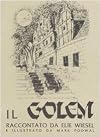
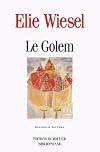
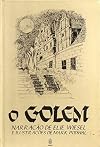
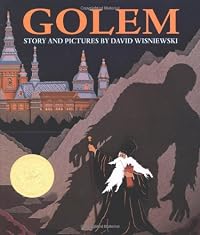
The dust jacket cover and p. 33 shows the Maharal going up some steps with his shadow behind him and another shadow next to his.
Some quotes:
"[the Golem was] created in the year 1580 by the great and famous Rabbi Yehuda Lowe of Prague, known as the Maharal . . . ." [p. 13]
"If you want my opinion, the 'Golem made of clay' was immortal, as immortal as the hatred he was asked to fight." [p. 17-8]
"Yes, the Maharal, in his wisdom, had understood: the society in which the Jews lived, terrified of the future, had fallen so low that only a Golem---an artificial being without a soul, a creature of clay, dedicated to earthly matters and excluded from divine inspiration---could still have an effect and save it from perdition. That is why the heavenly answer given to the Maharal in his dream contained only ten letters from the Aleph-Bet: they were sufficient to create the Golem, or at least to project him into the world. If the message had contained all twenty-two letters, it would have meant that a perfect being was needed." [p. 45] show less
The book begins, "I owe this legend to an old beggar." It came from his uncle, who got it from his maternal grandfather, who heard it from his Master, the Rebbe Ephraim, "who was said to have possessed he powers of the Maharal, the celebrated Wonder Rebbe of Prague, but to have refused to use them for fear of blundering. And also because he claimed that the Lord, blessed be His show more name, ought to save our people without intermediaries." (pp. 11-2) Rebbe Ephraim, in turn, learned from Reuven, a gravedigger, who was an eye witness.
The dust jacket cover and p. 33 shows the Maharal going up some steps with his shadow behind him and another shadow next to his.
Some quotes:
"[the Golem was] created in the year 1580 by the great and famous Rabbi Yehuda Lowe of Prague, known as the Maharal . . . ." [p. 13]
"If you want my opinion, the 'Golem made of clay' was immortal, as immortal as the hatred he was asked to fight." [p. 17-8]
"Yes, the Maharal, in his wisdom, had understood: the society in which the Jews lived, terrified of the future, had fallen so low that only a Golem---an artificial being without a soul, a creature of clay, dedicated to earthly matters and excluded from divine inspiration---could still have an effect and save it from perdition. That is why the heavenly answer given to the Maharal in his dream contained only ten letters from the Aleph-Bet: they were sufficient to create the Golem, or at least to project him into the world. If the message had contained all twenty-two letters, it would have meant that a perfect being was needed." [p. 45] show less
Te Golem is a creature of clay said to have been given life by a mysterious Rabbi. Some legends have the Golem as a lovable, friendly mute, others as a monster who turned against his creator. Elie Wiesel has collected in this book may of the Golem legends.
Ratings
Members
- Recently Added By
Lists

Jewish Books
367 works; 24 members
Author Information

Eliezer "Elie" Wiesel was born in Sighet, Romania on September 30, 1928. In 1944, he and his family were deported along with other Jews to the Nazi death camp Auschwitz. His mother and his younger sister died there. He loaded stones onto railway cars in a labor camp called Buna before being sent to Buchenwald, where his father died. He was show more liberated by the United States Third Army on April 11, 1945. After the war ended, he learned that his two older sisters had also survived. He was placed on a train of 400 orphans that was headed to France, where he was assigned to a home in Normandy under the care of a Jewish organization. He was educated at the Sorbonne and supported himself as a tutor, a Hebrew teacher and a translator. He started writing for the French newspaper L'Arche. In 1948, L'Arche sent him to Israel to report on that newly founded state. He also became the Paris correspondent for the daily Yediot Ahronot. In this capacity, he interviewed the novelist Francois Mauriac, who urged him to write about his war experiences. The result was La Nuit (Night). After the publication of Night, Wiesel became a writer, literary critic, and journalist. His other books include Dawn, The Accident, The Gates of the Forest, The Jews of Silence: A Personal Report on Soviet Jewry, and Twilight. He received a numerous awards and honors for his literary work including the William and Janice Epstein Fiction Award in 1965, the Jewish Heritage Award in 1966, the Prix Medicis in 1969, and the Prix Livre-International in 1980. He received the Nobel Peace Prize in 1986 for his work in combating human cruelty and in advocating justice. He had a leading role in the creation of the United States Holocaust Memorial Museum in Washington, D. C. He died on July 2, 2016 at the age of 87. (Bowker Author Biography) show less
Some Editions
Common Knowledge
- Canonical title
- The Golem
- Original publication date
- 1983
- People/Characters
- Golem; Rabbi Yehuda Lowe of Prague; King Rudolph; Thadeusz
- Dedication
- Mike & Steve Bauer
For our sons Elisha Wiesel and Michael Podwal - First words
- I owe this legend to an old beggar named Shmaike.
- Last words
- (Click to show. Warning: May contain spoilers.)But a wandering beggar whom I met recently gave me, under the seal of secrecy, his own explanation: the Maharal had forbidden access to the attic because, in truth, the Golem had remained alive. And he is waiting to be called. As for me, I wish I knew.
- Original language
- French
Classifications
Statistics
- Members
- 155
- Popularity
- 210,624
- Reviews
- 3
- Rating
- (3.85)
- Languages
- 5 — Dutch, English, French, Italian, Portuguese
- Media
- Paper
- ISBNs
- 7
- ASINs
- 2