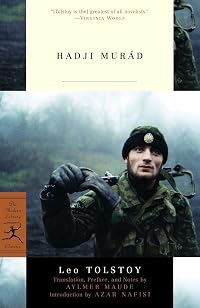
Hadji Murat
by Leo Tolstoy
On This Page
Description
First published in 1914 after Leo Tolstoy's death, "Hadji Murad" was the author's last novel. Drawing upon his own experiences fighting for the Russian army, historical archives, and the true story of the real-life Hadji Murad, the story is a narrative based on actual events that occurred during the Russian war with the Chechens during the 1850's. "Hadji Murad" focuses on the life and struggles of its central character, a Chechen soldier who breaks ranks and flees to the side of the Russians show more in the hope that the Russians will help him free his family from the control of the Muslim religious leader Imam Shamil. Murad does not find the help he seeks though and is not trusted by many of the Russian military commanders, who view him as a potential spy. Frustrated by the lack of progress towards his goal, Murad eventually returns to try and rescue his imprisoned family himself with tragic consequences. "Hadji Murad" is the final masterpiece by a gifted writer which brilliantly examines the brutality and senselessness of war and contrasts it with the beauty of the human spirit and the importance of resistance in the face of injustice. This edition includes a biographical afterword and follows the translation of Aylmer Maude. show lessTags
Recommendations






Member Reviews
You read, and you read, and you read. You read lots of different books, most of them good, some of them great. Then you decide to read some Tolstoy again, because it's been such a long time.
So you dive in, and after a few lines you wonder why on earth anyone would read anything except Tolstoy... Every page steals your heart, every page breaks your heart (and how does Tolstoy create living, breathing people in just two sentences, how!?), and the sheer quality of the writing is such that you are gasping for air.
So you dive in, and after a few lines you wonder why on earth anyone would read anything except Tolstoy... Every page steals your heart, every page breaks your heart (and how does Tolstoy create living, breathing people in just two sentences, how!?), and the sheer quality of the writing is such that you are gasping for air.
This is my introduction to Tolstoy. I'm sure there's little to be said about Tolstoy at this point, especially by a first-time reader, but doggone it I'm committed to my review-all-the-books-I-read policy.
Even in translation Tolstoy is a writer of astonishing craft. While reading this novella, I found myself thinking about the Mennonites out in the country building plain and sturdy wooden furniture with a masterly understanding of their material and their tools. Simple, religious, and strong. Tolstoy's sentences are direct and unadorned. He writes sympathetically, but not sentimentally. His characters are given to the reader in a few telling brush strokes, and while that might be all they get, it's always enough. His sentences are show more straightforward, but not in an affected, stylized manner.
It would be difficult to describe any novella as sweeping, but this one comes close. Hadji Murat is in some ways a conventional story, the tragedy of a great warrior being made obsolete by the winds of change. At each turn of the story, however, Tolstoy brings our attention to the background players, unseen but significant, whose actions ultimately doom Hadji Murat. We see the aristocrats, functionaries, officers, and peasants who stand as Hadji Murat's enemies, and how their actions give shape to his story.
Hadji Murat's own role in the story is interesting. In some ways, he's a cipher. He says little, expresses little, and takes actions that are sometimes difficult to understand. Tolstoy is interested in helping us to understand him, though, and his way of doing this is to give us Hadji Murat's actions then give us all the context that preceded it and to allow us to draw the connections ourselves. Put this way, it may not be entirely apt to describe the novella as a tragedy. Hadji Murat is not doomed by his own flaws--not to say that he has none--but by his circumstances. The real tragedy of the novella is not Hadji Murat's death, but the fact that his life becomes impossible.
Tolstoy's apparent admiration of Hadji Murat makes his death especially poignant. Like any good tragedy, the hero's death is not an isolated phenomenon: it tells us something about ourselves. Only here it is not that we are to see ourselves in Hadji Murat--the thistle being crushed by the great plow tells us nothing about the thistle and everything about the plow. show less
Even in translation Tolstoy is a writer of astonishing craft. While reading this novella, I found myself thinking about the Mennonites out in the country building plain and sturdy wooden furniture with a masterly understanding of their material and their tools. Simple, religious, and strong. Tolstoy's sentences are direct and unadorned. He writes sympathetically, but not sentimentally. His characters are given to the reader in a few telling brush strokes, and while that might be all they get, it's always enough. His sentences are show more straightforward, but not in an affected, stylized manner.
It would be difficult to describe any novella as sweeping, but this one comes close. Hadji Murat is in some ways a conventional story, the tragedy of a great warrior being made obsolete by the winds of change. At each turn of the story, however, Tolstoy brings our attention to the background players, unseen but significant, whose actions ultimately doom Hadji Murat. We see the aristocrats, functionaries, officers, and peasants who stand as Hadji Murat's enemies, and how their actions give shape to his story.
Hadji Murat's own role in the story is interesting. In some ways, he's a cipher. He says little, expresses little, and takes actions that are sometimes difficult to understand. Tolstoy is interested in helping us to understand him, though, and his way of doing this is to give us Hadji Murat's actions then give us all the context that preceded it and to allow us to draw the connections ourselves. Put this way, it may not be entirely apt to describe the novella as a tragedy. Hadji Murat is not doomed by his own flaws--not to say that he has none--but by his circumstances. The real tragedy of the novella is not Hadji Murat's death, but the fact that his life becomes impossible.
Tolstoy's apparent admiration of Hadji Murat makes his death especially poignant. Like any good tragedy, the hero's death is not an isolated phenomenon: it tells us something about ourselves. Only here it is not that we are to see ourselves in Hadji Murat--the thistle being crushed by the great plow tells us nothing about the thistle and everything about the plow. show less
Hadji Murat is a remembered story: "an old story from the Caucasus, part of which I saw, part of which I heard from witnesses, and part of which I imagined to myself." The story depicts the life of soldiers, of nobility, of family life, of the politics of war and the larger-than-life character of Hadji Murat.
Hadji Murat was a real Chechen leader and Tolstoy probably first heard of him while he was serving in the Caucasus, based on his own letters home to his brother. Although it is historical the story reads like a myth in spite of its realism. The primary theme is Murat's struggle to resist his enemies while remaining faithful to himself and his family. But there are many other ideas that can be found in the novel, such as determinism, show more the struggle between a Christian Russia and Muslim Chechnya, and the classic West versus East theme.
The story is told in short chapters or vignettes that ultimately introduce dozens of characters from all levels of Russian and Chechen society. The first two pages of the story are like an overture that depicts the discovery of a thistle bloom in the field that will not "submit" and that reminds the narrator of his memory of the hero, Hadji Murat. The story as remembered begins with Murat and two of his followers fleeing from Shamil, the commander of the Caucasian separatists, who is at war with the Russians. They find refuge at the house of Sado, a loyal supporter of Murat. However, the local people learn of his presence and chase him out of the village.
Murat decides to make contact with the Russians and sends his aide to them eliciting a promise to meet Murat. Arriving at the fortress of Vozdvizhenskaya, he joins the Russian forces, in hopes of drawing their support in order to overthrow Shamil and save his family. Before his arrival, a small skirmish occurs with some Chechens outside the fortress, and Petrukha Avdeyev, a young Russian soldier bleeds out in a local military hospital after being shot. There is a chapter-length aside about the childless Petrukha who volunteered as a conscript in place of his brother who had a family of his own. Petrukha's father regrets this because he was a dutiful worker compared to his complacent brother.
While at Vozdvizhenskaya, Murat befriends Prince Semyon Vorontsov, his wife Maria and his son, and wins over the good will of the soldiers stationed there. They are at once in awe of his physique and reputation, and enjoy his company and find him honest and upright. The Vorontsovs give him a present of a watch which fascinates him.
On the fifth day of Murat's stay, the governor-general's adjutant, Mikhail Loris-Melikov arrives with orders to write down Murat's story, and through this some of his history is told. He was born in the village of Tselmes and early on became close to the local khans due to his mother being the royal family's wet nurse. When he was fifteen some followers of Muridism came into his village calling for a holy war (ghazavat) against Russia. Murat declines at first but after a learned man is sent to explain how it will be run, he tentatively agrees. However, in their first confrontation, Shamil—then a lieutenant for the Muslims hostile to the Russians—embarrasses Murat when he goes to speak with the leader Gamzat. Gamzat eventually launches an attack on the capital of Khunzakh and kills the pro-Russian khans, taking control of this part of Dagestan. The slaughter of the khans throws Hadji and his brother against Gamzat, and they eventually succeed in tricking and killing him, causing his followers to flee. Unfortunately, Murat's brother is killed in the attempt and Shamil replaces Gazmat as leader. He calls on Murat to join his struggle, but Murat refuses because the blood of his brother and the khans are on Shamil.
Once Murat has joined the Russians, who are aware of his position and bargaining ability, they find him the perfect tool for getting to Shamil. However, Vorontsov's plans are ruined by the War Minister, Chernyshov. A rival prince who is jealous of him, and Murat has to remain in the fortress because the Tsar is told he is possibly a spy. The story digresses into a depiction of the Tsar Nicholas I of Russia, which reveals his lethargic and bitter nature and his egotistical complacency, as well as his contempt towards women, his brother-in-law, Frederick William IV of Prussia, and Russian students.
The Tsar orders an attack on the Chechens and Murat's remains in the fortress. Meanwhile, Murat's mother, wife and eldest son Yusuf, whom Shamil hold captive, are moved to a more defensible location. Realizing his position (neither trusted by the Russians to lead an army against Shamil, nor able to return to Shamil because he will be killed), Hadji Murat decides to flee the fortress to gather men to save his family.
At this point the narrative jumps forward in time, to the arrival of a group of soldiers at the fortress bearing Murat's severed head. While Maria Dimitriyevna—the companion of one of the officers and a friend of Murat—comments on the cruelty of men during times of war calling them 'butchers', the soldiers then tell the story of Murat's death. The nightingales, which stopped singing during the battle, begin again and the narrator ends by recalling the thistle that had been the catalyst for his original remembrance of Hadji Murat.
The story is filled with realistic details that bring the family of Murat and his comrades to life. His original decision to go over to the Russian side, while understandable, ultimately puts Murat in an untenable position. A scene between his son and Shamil, who his holding him captive, is both poignant and terrifying when Shamil tells the boy that he will slice off his head. The two cultures seem to be both very different yet similar. For example, the Tsar demonstrates condescension and enmity for his peers but this is also true of Shamil. The literary style of Tolstoy where every detail is important and the structure is held together by the mystical union of man and nature makes this short novel a major masterpiece. show less
Hadji Murat was a real Chechen leader and Tolstoy probably first heard of him while he was serving in the Caucasus, based on his own letters home to his brother. Although it is historical the story reads like a myth in spite of its realism. The primary theme is Murat's struggle to resist his enemies while remaining faithful to himself and his family. But there are many other ideas that can be found in the novel, such as determinism, show more the struggle between a Christian Russia and Muslim Chechnya, and the classic West versus East theme.
The story is told in short chapters or vignettes that ultimately introduce dozens of characters from all levels of Russian and Chechen society. The first two pages of the story are like an overture that depicts the discovery of a thistle bloom in the field that will not "submit" and that reminds the narrator of his memory of the hero, Hadji Murat. The story as remembered begins with Murat and two of his followers fleeing from Shamil, the commander of the Caucasian separatists, who is at war with the Russians. They find refuge at the house of Sado, a loyal supporter of Murat. However, the local people learn of his presence and chase him out of the village.
Murat decides to make contact with the Russians and sends his aide to them eliciting a promise to meet Murat. Arriving at the fortress of Vozdvizhenskaya, he joins the Russian forces, in hopes of drawing their support in order to overthrow Shamil and save his family. Before his arrival, a small skirmish occurs with some Chechens outside the fortress, and Petrukha Avdeyev, a young Russian soldier bleeds out in a local military hospital after being shot. There is a chapter-length aside about the childless Petrukha who volunteered as a conscript in place of his brother who had a family of his own. Petrukha's father regrets this because he was a dutiful worker compared to his complacent brother.
While at Vozdvizhenskaya, Murat befriends Prince Semyon Vorontsov, his wife Maria and his son, and wins over the good will of the soldiers stationed there. They are at once in awe of his physique and reputation, and enjoy his company and find him honest and upright. The Vorontsovs give him a present of a watch which fascinates him.
On the fifth day of Murat's stay, the governor-general's adjutant, Mikhail Loris-Melikov arrives with orders to write down Murat's story, and through this some of his history is told. He was born in the village of Tselmes and early on became close to the local khans due to his mother being the royal family's wet nurse. When he was fifteen some followers of Muridism came into his village calling for a holy war (ghazavat) against Russia. Murat declines at first but after a learned man is sent to explain how it will be run, he tentatively agrees. However, in their first confrontation, Shamil—then a lieutenant for the Muslims hostile to the Russians—embarrasses Murat when he goes to speak with the leader Gamzat. Gamzat eventually launches an attack on the capital of Khunzakh and kills the pro-Russian khans, taking control of this part of Dagestan. The slaughter of the khans throws Hadji and his brother against Gamzat, and they eventually succeed in tricking and killing him, causing his followers to flee. Unfortunately, Murat's brother is killed in the attempt and Shamil replaces Gazmat as leader. He calls on Murat to join his struggle, but Murat refuses because the blood of his brother and the khans are on Shamil.
Once Murat has joined the Russians, who are aware of his position and bargaining ability, they find him the perfect tool for getting to Shamil. However, Vorontsov's plans are ruined by the War Minister, Chernyshov. A rival prince who is jealous of him, and Murat has to remain in the fortress because the Tsar is told he is possibly a spy. The story digresses into a depiction of the Tsar Nicholas I of Russia, which reveals his lethargic and bitter nature and his egotistical complacency, as well as his contempt towards women, his brother-in-law, Frederick William IV of Prussia, and Russian students.
The Tsar orders an attack on the Chechens and Murat's remains in the fortress. Meanwhile, Murat's mother, wife and eldest son Yusuf, whom Shamil hold captive, are moved to a more defensible location. Realizing his position (neither trusted by the Russians to lead an army against Shamil, nor able to return to Shamil because he will be killed), Hadji Murat decides to flee the fortress to gather men to save his family.
At this point the narrative jumps forward in time, to the arrival of a group of soldiers at the fortress bearing Murat's severed head. While Maria Dimitriyevna—the companion of one of the officers and a friend of Murat—comments on the cruelty of men during times of war calling them 'butchers', the soldiers then tell the story of Murat's death. The nightingales, which stopped singing during the battle, begin again and the narrator ends by recalling the thistle that had been the catalyst for his original remembrance of Hadji Murat.
The story is filled with realistic details that bring the family of Murat and his comrades to life. His original decision to go over to the Russian side, while understandable, ultimately puts Murat in an untenable position. A scene between his son and Shamil, who his holding him captive, is both poignant and terrifying when Shamil tells the boy that he will slice off his head. The two cultures seem to be both very different yet similar. For example, the Tsar demonstrates condescension and enmity for his peers but this is also true of Shamil. The literary style of Tolstoy where every detail is important and the structure is held together by the mystical union of man and nature makes this short novel a major masterpiece. show less
É uma ótima novela histórica, mas realmente não consegui me conectar, a não ser com a Maria Dimitrievna (que aparece pouco) e a analogia da morte de Murat na primeira página que mais parece a descrição de um estupro. Essa coisa de homens em guerra foge um pouco do meu escopo de empatia, mesmo quando é para criticar o horror e violência dessa "arte" puramente patriarcal.
Hadji Murat feels like an epic read in spite of its relative brevity.
The story contains portents for our modern era especially in understanding historic grievances between the Caucasus and Russia, Islam and Christianity, which have survived the Communist Soviet era. This tale of power and brutality,subterfuge and corruption, personal and military loyalties divided or switched in unlikely and unholy alliances depending upon who needs what most and when, kidnappings, human shields, sham religiosity, and so on resonates strongly today only the cult of personality, with princes and tsars inspiring military loyalty, was stronger pre World War 1 than the nationhood which supercedes it today especially with the demises of dictatorship.
Tolstoy show more even manages to throw in romantic interludes with the rugged and elegant rebel dangerously and familiarly attractive to the otherwise loyal concubines.
Ultimately it is a personal story which ends in sheer futility and the lesson that nothing changes so long as bad and morally weak men can inspire loyalty to the death in return for power and influence.
Although at times I found keeping up with the various factions a little difficult and re read many passages for clarification, the book had my attention throughout and what I believe was the desired effect. show less
The story contains portents for our modern era especially in understanding historic grievances between the Caucasus and Russia, Islam and Christianity, which have survived the Communist Soviet era. This tale of power and brutality,subterfuge and corruption, personal and military loyalties divided or switched in unlikely and unholy alliances depending upon who needs what most and when, kidnappings, human shields, sham religiosity, and so on resonates strongly today only the cult of personality, with princes and tsars inspiring military loyalty, was stronger pre World War 1 than the nationhood which supercedes it today especially with the demises of dictatorship.
Tolstoy show more even manages to throw in romantic interludes with the rugged and elegant rebel dangerously and familiarly attractive to the otherwise loyal concubines.
Ultimately it is a personal story which ends in sheer futility and the lesson that nothing changes so long as bad and morally weak men can inspire loyalty to the death in return for power and influence.
Although at times I found keeping up with the various factions a little difficult and re read many passages for clarification, the book had my attention throughout and what I believe was the desired effect. show less
Hadji Murad is a story difficult to interprete. Tolstoy seems to be taking shots at Czarism and Russian imperialism holding up for us with admiration Hadji Murad, a muslim and a Chechen repel commander. Bound by honor and duty and reverence for his religion. Yet there’s brutality on each side - maybe more a disillusionment attitude towards war of any kind seems to be preeminent in Tolstoy’s retelling of this story - a mixture of history and fiction, facts and myth.
This novella explores themes of loyalty and the consequences of violence in this novel, which delves into the conflict between the Russian Empire and the Muslim Chechens. I might have enjoyed it more had I been better acquainted with the Caucasian War and the different perspectives involved. The story shifts between various viewpoints and time periods, which gives it a less cohesive feel compared to some of Tolstoy’s more famous works like [War and Peace] or [Anna Karenina]. The pacing is slow and drawn-out, with lengthy passages of philosophical musings or war descriptions that can feel repetitive. These extended sections seem to serve as a substitute for deeper emotional engagement with the characters. Additionally, the novella's show more relatively brief length—just 104 pages—likely contributed to the underdevelopment of its characters. This was Tolstoy’s final work, published posthumously. show less
Members
- Recently Added By
Published Reviews
ThingScore 100
As with War & Peace or Anna Karenina, Tolstoy built Hadji Murad out of multiple plots, which he cycles between to cunning, highly contrastive effect. But because Hadji Murad is only 100 pages long, its structure is more obvious, even flashy. Ludwig Wittgenstein, of all people, admired it. It has the cold, distilled clarity of late work.,, Fit into its 100 pages is every viewpoint: Tolstoy show more fully characterizes and motivates everyone from Tsar Nicholas I (a useless letch) to individual soldiers—like Butler, a good man heartbreakingly addicted to gambling, or Avdeev, whose death opens up a startling sidelight on his peasant parents—to several of Murad’s disciples (notably shy Eldár, with his ram’s eyes) to Shamil himself...
Tolstoy is a master of anticlimax. Apocalypse is not, as some terrorists have it, now. If his final novel presents a more balanced view of imperialist politics than even Heart of Darkness (with which it was contemporary), it is because Tolstoy knows there are no climaxes: conflicts like this one will drag on forever. show less
Tolstoy is a master of anticlimax. Apocalypse is not, as some terrorists have it, now. If his final novel presents a more balanced view of imperialist politics than even Heart of Darkness (with which it was contemporary), it is because Tolstoy knows there are no climaxes: conflicts like this one will drag on forever. show less
added by SnootyBaronet
Lists

Russian Literature
184 works; 35 members

Fake Top 100 Fiction
81 works; 4 members

Books Read in 2023
5,547 works; 145 members

Russian Literature Sequence
28 works; 1 member

Evan's Reading List 2022
18 works; 1 member

Tonikat reading completed on Librarything journals
329 works; 2 members

Caucasus
122 works; 2 members

Further Russian Reading
19 works; 3 members

My Favorite Russian Novels
37 works; 2 members
Talk Discussions
Past Discussions
TonyH reads in 2012 in Club Read 2012 (January 2013)
Author Information

2,512+ Works 129,791 Members
Count Lev Nikolayevich Tolstoy was born on September 9, 1828 in Russia. He is usually referred to as Leo Tolstoy. He was a Russian author who is regarded as one of the greatest authors of all time. Leo Tolstoy is best known for his novels War and Peace (1869) and Anna Karenina (1877). Tolstoy's fiction includes dozens of short stories and several show more novellas such as The Death of Ivan Ilyich, Family Happiness, and Hadji Murad. He also wrote plays and numerous philosophical essays. Tolstoy had a profound moral crisis and spiritual awakening in the 1870's which he outlined in his work, A Confession. His literal interpretation of the ethical teachings of Jesus, centering on the Sermon on the Mount, caused him to become a fervent Christian anarchist and pacifist. His ideas of nonviolent resistance which he shared in his works The Kingdom of God is Within You, had a profund impact on figures such as Mohandas Gandhi and Martin Luther King, Jr. On September 23, 1862 Tolstoy married Sophia Andreevna Behrs. She was the daughter of a court physician. They had 13 children, eight of whom survived childhood. Their early married life allowed Tolstoy much freedom to compose War and Peace and Anna Karenina with his wife acting as his secretary and proofreader. The Tolstoy family left Russia in the aftermath of the Russian Revolution and the subsequent establishment of the Soviet Union. Leo Tolstoy's relatives and descendants moved to Sweden, Germany, the United Kingdom, France and the United States. Tolstoy died of pneumonia at Astapovo train station, after a day's rail journey south on November 20, 1910 at the age of 82. (Bowker Author Biography) Count Leo Tolstoy was born in 1828 on the family estate of Yasnaya Polyana in the Tula province. He married in 1862 & was the father of 13 children. Tolstoy managed the estate of Yasnaya Polyana & ran its peasant schools, while writing his great novels, "War & Peace" (1869) & "Anna Karenina" (1877). He died in 1910. (Publisher Provided) show less
Some Editions
Awards and Honors
Distinctions
Notable Lists
Series
Belongs to Publisher Series
Work Relationships
Is contained in
Common Knowledge
- Canonical title
- Hadji Murat
- Original title
- Хаджи-Мурат
- Alternate titles*
- Hadji Murad : een onvergankelijk monument voor de onderworpen, doch ongebroken Kaukasu
- Original publication date
- 1912 (published) (published); 1971-04: Classics Illustrated Joint European Series E63 (#209 - Sweden) (#209 - Sweden)
- People/Characters
- Hadji Murad; Shamil; Eldar; Sado; Bata; Corporal Antonych Panov (show all 63); Petrukha Mikhailovich Avdeev; Nikitin; Bondarenko; Prince Semyon Mikhailovich Vorontsov; Princess Marya Vassilievna; Vladimir Alexeevich Poltoratsky; Vavilo; Tikhonov; Hanefi; Khan Mahoma; Gamzalo; Baron Freze; Bulka; Seryogin; Akim Avdeev; General Meller-Zakomelsky; Mikhail Semyonovich Vorontsov; Princess Elizaveta Ksaverievna; Princess Manana Orbeliani; Countess Choiseul; General Kozlovsky; Doctor Andreevsky; Giovanni; Prince Tarkhanov; Mikhail Tarielovich Loris-Melikov; Polosatov; Prince Chernyshov; Dolgoruky; Bibikov; Mme. Nelidov; Baron Liven; Count Rzhevussky; Butler; Major Petrov; Marya Dmitrievna; Ivan Matveevich; Patimat; Jemal ed-Din; Zaidet; Yusuf Murat; Petrokovsky; Arslan Khan; Prince Baryatinsky; Kirillov; Bogdanovich; Pyotr Nokolaevich Kamenev; Chikhirev; Nazarov; Ferrapontov; Ignatov; Mishkin; Petrakov; Iosif Ivanovich Karganov; Ghadji Aga; Kurban; Akhmet Khan; Sofiat Murat
- Important places
- Russia; Makhet, Chechnya; Chechnya
- First words
- I was returning home by the fields. It was midsummer; the hay harvest was over, and they were just beginning to reap the rye.
- Original language
- Russian
*Some information comes from Common Knowledge in other languages. Click "Edit" for more information.
Classifications
- Genres
- General Fiction, Fiction and Literature
- DDC/MDS
- 891.733 — Literature & rhetoric Literatures of other languages East Indo-European and Celtic literatures Russian and East Slavic languages Russian fiction 1800–1917
- LCC
- PG3366 .K5 — Language and Literature Slavic languages and literatures. Baltic languages. Albanian language Slavic. Baltic. Albanian Russian literature Individual authors and works 1800-1870 Tolstoi
- BISAC
Statistics
- Members
- 1,295
- Popularity
- 18,788
- Reviews
- 35
- Rating
- (3.75)
- Languages
- 22 — Catalan, Czech, Danish, Dutch, English, Estonian, Finnish, French, German, Hungarian, Indonesian, Italian, Norwegian (Bokmål), Polish, Portuguese, Romanian, Russian, Serbian, Slovenian, Spanish, Swedish, Turkish
- Media
- Paper, Audiobook, Ebook
- ISBNs
- 131
- UPCs
- 1
- ASINs
- 32