On This Page
Description
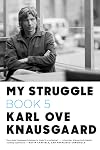
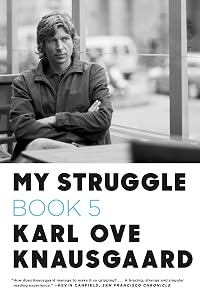
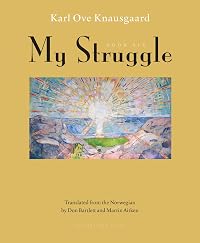
"As a nineteen-year-old, Karl Ove moves to Bergen and invests all of himself in his writing. But his efforts get the opposite effect - he wants it so much that he gets writer's block. At the same time, he sees his friends, one-by-one, publish their debuts. He suspects that he will never get anything published. Book Five is also a book about strong new friendships and a shattering love affair. Then one day Karl Ove reaches two crucial points in his life: his father dies, and shortly show more thereafter, he completes his first novel."-- show lessTags
Recommendations














Member Reviews
Still utterly mesmerizing. This penultimate volume is funny, disturbing and sad. We revisit his father's death and dredge up old infidelities which can't have been pleasant reading for those involved. Karl Ove is as narcissistic as ever but he's also generous and reverent about art and literature and his friends who are artists. Weirdly, he finishes this volume by reading a couple of Ian Rankin books, so it's possible that his literary tastes aren't quite as refined as I imagined.
Sometimes I feel daunted by the task of explaining why a novel works for me, knowing that for many others the novel might not only NOT work, but be tedious or incomprehensible or just seem beyond arrogant in the focus on the self--in this case the self that happens to be Karl Ove Knausgaard. Not to mention that for many readers grasping that Knausgaard really is writing fiction is difficult. And indeed one could make a case for all of the above being justifiable criticisms. In a certain way all four objections are true but that is why the book (and the four previous ones) work so well for me. Because to these critics I would counter: What else is there? From moment to moment living, precious as it is, is strangely tedious in the details show more (I mean, cutting your nails? Picking cat poop out of litter? Filling your gas tank>) (and don't tell me you LOVE doing any of those things, they are examples, merely, there are plenty of things you don't like doing). Next, much, if not most, of what we think about is a jumble, unsorted, straight from the bin of the unconscious and which we shove right back down out of sight. Finally the person we are stuck with and know the most (and least) about and are, frankly, obsessed with is ourself. Finally, all narratives--and that includes your math textbook--are fictions. History? Pah! We interpret our experiences after the fact. We make things up. We can't tell the truth ever because we don't really know what the truth is. What we can do is reach some kind of emotional truth. And that is what Knausgaard does. Brilliantly, in my view. In this volume Knausgaard now in his young adulthood reveals his raw ambition to be a writer. He is also falling into more serious and frightening bouts of drinking. For me it was occasionally overwhelming, the ambition part, because I did not overcome my diffidence and, for lack of a more graceful phrase, 'will to fail' in my young or middle years, and am only coming to grips with the issue when, in some ways, it is too late. So I am daunted by the sheer energy he poured into this part of his youth, attracted and repelled and, yeah, humbled by his energy and passion. Here Knausgaard grapples with what it means not just to be a writer, but to become a writer. Here, his world opens as he begins to read widely, not only in fiction but philosophy and art. There is much more reflection here than in the earlier books, very welcome as evidence of maturation. Many things go on in his family and personal life, but to mention those would be spoiling. They really are, in a way, incidental or part of, the deeper story of his struggle to become a "real" writer.
One more to go, coming out in September. *****
My copy bristles with post-its:
"Actually there were only two forms of existence, I reflected: one that was tied to a place and one that wasn't. Both had always existed. Neither could be chosen."
Having read some very imaginative stories:
"I liked these short stories so much, but I couldn't write like this, I didn't have the imagination. I didn't have any imagination at all. Everything I wrote was connected to reality and my own experiences."
I've been here:
"Deep down, I was decent and proper, a goody-goody, and, I thought, perhaps that was also why I couldn't write. I wasn't wild enough, not artistic enough, in short, much too normal for my writing to take off. Why had made me believe anything else? Oh, but this was the life-lie."
"Such was my experience of reading Naipaul, like reading almost all the other good writers, enjoyment and jealousy, happiness and despair, in equal portions."
"For hospitals all hearts are the same."
On writing, being a writer:
"What was this feeling?
I didn't know. It was beyond investigation, beyond explanation, or justification, there was no rationality in it at all, yet it was self-evident, all-eclipsing: anything other than writing was meaningless for me. Nothing else would be enough, would quench my thirst.
But thirst for what?"
On his parents:
"My God, they had been twenty when they got married. If they had been as immature when I was when I was twenty, it was quite a feat they had pulled off." show less
One more to go, coming out in September. *****
My copy bristles with post-its:
"Actually there were only two forms of existence, I reflected: one that was tied to a place and one that wasn't. Both had always existed. Neither could be chosen."
Having read some very imaginative stories:
"I liked these short stories so much, but I couldn't write like this, I didn't have the imagination. I didn't have any imagination at all. Everything I wrote was connected to reality and my own experiences."
I've been here:
"Deep down, I was decent and proper, a goody-goody, and, I thought, perhaps that was also why I couldn't write. I wasn't wild enough, not artistic enough, in short, much too normal for my writing to take off. Why had made me believe anything else? Oh, but this was the life-lie."
"Such was my experience of reading Naipaul, like reading almost all the other good writers, enjoyment and jealousy, happiness and despair, in equal portions."
"For hospitals all hearts are the same."
On writing, being a writer:
"What was this feeling?
I didn't know. It was beyond investigation, beyond explanation, or justification, there was no rationality in it at all, yet it was self-evident, all-eclipsing: anything other than writing was meaningless for me. Nothing else would be enough, would quench my thirst.
But thirst for what?"
On his parents:
"My God, they had been twenty when they got married. If they had been as immature when I was when I was twenty, it was quite a feat they had pulled off." show less
Ah, Knausgaard - my unashamed literary crush. In this Book 5 he is at his archetypal bad boy best (or rather worst), and even though as a reader I regularly rolled my eyes at his behaviour it's impossible not to fall for him as protagonist just a little bit.
This book is much more linear than many of the previous books in the series. It follows on directly from Book 4 (which made me regret not reading them a little closer together), starting with Knausgaard moving to Bergen to take up his privileged place at the Writing Academy there and continuing for almost a decade through his twenties up to his publishing debut with Out of the World.
The youngest student on his writing course, Knausgaard's writing confidence is quickly squashed as he show more becomes horribly self-aware that his fictional writing capability and credibility pales significantly in comparison with that of his peers. As the years go by, he struggles to come to terms with his consistent writing failure, particularly as his friends' writing careers take off, drifting in terms of career, focus and general maturity. He falls in love, yet a pattern emerges of a struggle between his all consuming introspection and self-sufficiency and his partners' needs from the relationships. Socially, he suffers from a huge inferiority complex amongst work colleagues, friends and family, compensating with mortifyingly out of control drinking which made me want to hide behind a cushion.
As always with this series, this book was pure reading joy from the first word to the last. As I galloped through this latest instalment (despite its humungous size) I found myself wondering yet again what is it about Knausgaard's writing that pulls us in. For me, I think it is his unsurpassed ability to put you directly inside his head. In this series he doesn't just recount these past years in his life - rather, you live them out as him, experiencing his every thought and emotion. It sounds so simple, yet I cannot think of another author who has pulled it off to this extent. It is as if he has plugged us directly into his very thought process, and to put us retrospectively into his fictionalised mind as a child, a teenager, a 20-something year old, a young father is an incredible feat. Who remembers at a detailed level exactly how they thought at different stages in their life? Yet in this work of autofiction Knausgaard makes us believe that he really does. Couple that with the fact that he lives in an intriguing part of the world that I know little about in terms of day-to-day life and you have something really special.
Whilst this series is notorious for the backlash Knausgaard suffered from his family post-publication, I was conscious in this Book 5 that he was persistently respectful towards his friends and family, consistently shining them in a positive light which he largely used to illuminate his own shortcomings. He is brutal in his honesty about himself. If you have ever watched Jim Carrey's film 'Liar, Liar', you probably had a thought or two whilst watching along the lines of 'good job no one can get inside my head to know what I'm actually thinking most of the time'. If you've not read one of Knausgaard's book from this series yet, this is exactly what he does. He lets us into those deepest, truest thoughts that the rest of us keep us tightly locked away from everyone else.
I read somewhere that Knausgaard said that he has no imagination and cannot write proper fiction. I suspect that this may actually be true, as in this book he includes the first few pages of some short stories he was working on at the time which I couldn't wait to skip past. However, who cares. His approach to autofiction is like nothing that's been done before. It doesn't need flowery literary descriptions. Who looks for that when they find someone's diary lying open?
It's not often I say this about a large book, but I was so glad that he strung this Book 5 out for a delicious 663 pages. I'm sad that I have only one book left to go in the series, especially as the reviews have not generally been so kind given its 400 page segue into talking about Hitler. This series is a truly unique reading experience, and I suspect I'll have to come back to it as some stage despite my own general 'no reading twice' rule.
5 stars - I'm running out of superlatives for this guy. Still crushing. show less
This book is much more linear than many of the previous books in the series. It follows on directly from Book 4 (which made me regret not reading them a little closer together), starting with Knausgaard moving to Bergen to take up his privileged place at the Writing Academy there and continuing for almost a decade through his twenties up to his publishing debut with Out of the World.
The youngest student on his writing course, Knausgaard's writing confidence is quickly squashed as he show more becomes horribly self-aware that his fictional writing capability and credibility pales significantly in comparison with that of his peers. As the years go by, he struggles to come to terms with his consistent writing failure, particularly as his friends' writing careers take off, drifting in terms of career, focus and general maturity. He falls in love, yet a pattern emerges of a struggle between his all consuming introspection and self-sufficiency and his partners' needs from the relationships. Socially, he suffers from a huge inferiority complex amongst work colleagues, friends and family, compensating with mortifyingly out of control drinking which made me want to hide behind a cushion.
As always with this series, this book was pure reading joy from the first word to the last. As I galloped through this latest instalment (despite its humungous size) I found myself wondering yet again what is it about Knausgaard's writing that pulls us in. For me, I think it is his unsurpassed ability to put you directly inside his head. In this series he doesn't just recount these past years in his life - rather, you live them out as him, experiencing his every thought and emotion. It sounds so simple, yet I cannot think of another author who has pulled it off to this extent. It is as if he has plugged us directly into his very thought process, and to put us retrospectively into his fictionalised mind as a child, a teenager, a 20-something year old, a young father is an incredible feat. Who remembers at a detailed level exactly how they thought at different stages in their life? Yet in this work of autofiction Knausgaard makes us believe that he really does. Couple that with the fact that he lives in an intriguing part of the world that I know little about in terms of day-to-day life and you have something really special.
Whilst this series is notorious for the backlash Knausgaard suffered from his family post-publication, I was conscious in this Book 5 that he was persistently respectful towards his friends and family, consistently shining them in a positive light which he largely used to illuminate his own shortcomings. He is brutal in his honesty about himself. If you have ever watched Jim Carrey's film 'Liar, Liar', you probably had a thought or two whilst watching along the lines of 'good job no one can get inside my head to know what I'm actually thinking most of the time'. If you've not read one of Knausgaard's book from this series yet, this is exactly what he does. He lets us into those deepest, truest thoughts that the rest of us keep us tightly locked away from everyone else.
I read somewhere that Knausgaard said that he has no imagination and cannot write proper fiction. I suspect that this may actually be true, as in this book he includes the first few pages of some short stories he was working on at the time which I couldn't wait to skip past. However, who cares. His approach to autofiction is like nothing that's been done before. It doesn't need flowery literary descriptions. Who looks for that when they find someone's diary lying open?
It's not often I say this about a large book, but I was so glad that he strung this Book 5 out for a delicious 663 pages. I'm sad that I have only one book left to go in the series, especially as the reviews have not generally been so kind given its 400 page segue into talking about Hitler. This series is a truly unique reading experience, and I suspect I'll have to come back to it as some stage despite my own general 'no reading twice' rule.
5 stars - I'm running out of superlatives for this guy. Still crushing. show less
Picks up right where vol 4 left off, and it’s college time. Young Karl Ove enrolls in a creative writing class, thinking he’s going to become a literary wunderkind, being a writer is all he wants… and he can’t. He writes and reads and reads and writes and gets drunk and gets a girlfriend and writes and gets drunk and fucks around and writes and splits up and writes and drinks and throws up in Björk’s bathroom and writes and gets married and writes and nothing happens. He’s a fraud, he’s useless, he has nothing to say, and he can’t even say it in an original way, he reads Dante and Ellis and Cortázar and all his writer friends who go on to get published and he’s left behind struggling to write more than a single page show more before his stories die. The only thing that makes him a writer is the way he fetichizes his own self-important suffering and his own depravity.
Vol 5 is a deceptive beast; Knausgård is comfortable in his public literary suicide by now, and continues to put everything about himself into the story of his life – essentially transferring himself (or his image and his memories of himself) to book form; picture that scene in Tron where Jeff Bridges gets scanned and disappears only to reappear inside the computer. For the most part, the story remains mundane, and while it’s all good, it’s rarely as utterly entrancing as some passages in the first two volumes were… until you realise that this is all setup, that he’s working himself up to not only Knausgård the novelist, but also Knausgård the son; the book ends up where the first one did, with the death of his father and the immediate aftermath, this time taking the long way around and hitting even harder for it; after page upon page of wanting to smack the conceited little asshole, I find myself almost crying in the middle of Schiphool Airport reading about his father’s funeral. You could write a book about how he does it (and people have – Knausgårdkoden by Eivind Tjønneland is interesting) but fact remains, this is a remarkable… project, for lack of a better word. Cleaning house. The sixth volume is 1000 pages, supposedly including every idea for a novel he’s ever had. I wonder what will be left of him by then. I hope there’s something, because Knausgård is one of the great writers. show less
Vol 5 is a deceptive beast; Knausgård is comfortable in his public literary suicide by now, and continues to put everything about himself into the story of his life – essentially transferring himself (or his image and his memories of himself) to book form; picture that scene in Tron where Jeff Bridges gets scanned and disappears only to reappear inside the computer. For the most part, the story remains mundane, and while it’s all good, it’s rarely as utterly entrancing as some passages in the first two volumes were… until you realise that this is all setup, that he’s working himself up to not only Knausgård the novelist, but also Knausgård the son; the book ends up where the first one did, with the death of his father and the immediate aftermath, this time taking the long way around and hitting even harder for it; after page upon page of wanting to smack the conceited little asshole, I find myself almost crying in the middle of Schiphool Airport reading about his father’s funeral. You could write a book about how he does it (and people have – Knausgårdkoden by Eivind Tjønneland is interesting) but fact remains, this is a remarkable… project, for lack of a better word. Cleaning house. The sixth volume is 1000 pages, supposedly including every idea for a novel he’s ever had. I wonder what will be left of him by then. I hope there’s something, because Knausgård is one of the great writers. show less
How can I NOT give a top rating to such an achievement? The writing is so weirdly compelling, despite (or because of?) the plethora of the details of daily life. The period covers KO's 14 years in Bergen, from his initial struggles at age 19+ at the Writing Academy, through to: his first love; his marriage; the death of his father (briefly revisited main focus of Book I); the successful publication and critical acclaim for his first novel (and the subsequent writer's block and depression). KO is totally self-obsessed but the writing is gripping. This book fully explores Knausgaard's development as a writer, and his personal emotional issues and shortcomings.
There doesn’t feel like much point to doing a typical review since it’s unlikely someone will have read the previous four volumes but is waiting to hear if Volume 5 is worth it—you’re already either on board or checked out after Volume1.
The good news is that I feel like this is the most engaging so far. It’s mostly chronological, beginning with him at age 19 at a writing academy and culminating in the end of his first marriage.
The main character (the author) continues to be a intriguing/frustrating mix of ego, ambition, intelligence self-awareness and oblivious, and for better or for worse you feel as if you’ve walked a kilometer in his Norwegian shoes.
Next up we have the finale of Vol. 6–which is three times longer show more than Vol. 5! A happy ending seems unlikely. show less
The good news is that I feel like this is the most engaging so far. It’s mostly chronological, beginning with him at age 19 at a writing academy and culminating in the end of his first marriage.
The main character (the author) continues to be a intriguing/frustrating mix of ego, ambition, intelligence self-awareness and oblivious, and for better or for worse you feel as if you’ve walked a kilometer in his Norwegian shoes.
Next up we have the finale of Vol. 6–which is three times longer show more than Vol. 5! A happy ending seems unlikely. show less
Airport literature for high-brows, and sometimes that's what you want. I enjoyed this one more than the first four, which is not to say it's better, but on the other hand, it's airport literature, so perhaps that is precisely to say it's better, but better for me. Four stars for how much I enjoyed it then, and two for quality. Basically, I'd much rather read about young KOK's days at university, hanging out with Jon Fosse and talking about Tor Ulven than another 80000000 pages about how his father wasn't the nicest guy, and the father's absence from this volume made that possible.
Is there any literary merit to this volume? Not really. Some striking scenes, but it's mostly kitsch. It's also impressive that he can remember any of this show more stuff, given how much booze and drugs he claims to have been taking. Which is a snide way of saying he must be making some of it up, or have written it down, or something.
But KOK is as good as anyone I've ever read on the bizarre experience of becoming an intellectual. On the one hand, you're pumped up with your own self-importance, because you're reading (e.g.,) Foucault while listening to Cecil Taylor and those around you aren't, but you're also terrified, because that's your first real jazz album and your first book of philosophy and what happens if that's not really the cool thing anymore, the cool thing now is to read Deleuze while listening to John Zorn? This volume lays out that to-and-fro between overwhelming self-importance and overwhelming self-doubt with almost Tolstoyan brilliance. show less
Is there any literary merit to this volume? Not really. Some striking scenes, but it's mostly kitsch. It's also impressive that he can remember any of this show more stuff, given how much booze and drugs he claims to have been taking. Which is a snide way of saying he must be making some of it up, or have written it down, or something.
But KOK is as good as anyone I've ever read on the bizarre experience of becoming an intellectual. On the one hand, you're pumped up with your own self-importance, because you're reading (e.g.,) Foucault while listening to Cecil Taylor and those around you aren't, but you're also terrified, because that's your first real jazz album and your first book of philosophy and what happens if that's not really the cool thing anymore, the cool thing now is to read Deleuze while listening to John Zorn? This volume lays out that to-and-fro between overwhelming self-importance and overwhelming self-doubt with almost Tolstoyan brilliance. show less
Members
- Recently Added By
Lists

Top Five Books of 2015
811 works; 241 members

Top Five Books of 2016
795 works; 229 members

Books Read in 2017
4,249 works; 129 members

Books Read in 2022
5,226 works; 115 members

Books Read in 2025
4,128 works; 98 members
Author Information

63+ Works 12,665 Members
Karl Ove Knausgaard is a Norwegian author known for his six autobiographical novels called "My Struggle". His debut novel Out of This World won the Norwegian Critics Prize and his A Time for Everything was a finalist for the Nordic Council Prize. My Struggle: Book One was a New Yorker Book of the Year and Book Two was listed among the Wall Street show more Journal's 2013 Books of the Year. In 2014, Book Three was named a New York Times Notable Book of the Year. His new autobiographical quartet is based on the four seasons. Autumn was relased in August 2017. (Bowker Author Biography) show less
Some Editions
Awards and Honors
Awards
Distinctions
Series

Belongs to Publisher Series
btb (71526)
Gallimard, Folio (6804)
Common Knowledge
- Canonical title*
- Träumen
- Original title
- Min Kamp. Femt Bok
- Alternate titles
- Some Rain Must Fall
- Original publication date
- 2016 (English translation) (English translation); 2015-06 (suom.) (suom.); 2010
- Important places*
- Bergen, Norwegen
- First words*
- Die vierzehn Jahre, die ich in Bergen lebte, von 1988 bis 2002, sind längst vorbei, geblieben sind von ihnen lediglich einige Episoden, an die sich manche Menschen eventuell erinnern, ein Geistesblitz hier, ein Geistesblitz... (show all) da, und natürlich alles, was mir selbst aus jener Zeit im Gedächtnis geblieben ist.
- Quotations
- ‘...as horny as a billy goat,...’ (p.512)
- Last words*
- (Click to show. Warning: May contain spoilers.)So verließ ich Bergen.
- Blurbers
- Eugenides, Jeffrey
- Original language*
- Norwegisch
*Some information comes from Common Knowledge in other languages. Click "Edit" for more information.
Classifications
- Genres
- General Fiction, Biography & Memoir, Fiction and Literature
- DDC/MDS
- 839.8238 — Literature & rhetoric German & related literatures Other Germanic literatures Danish and Norwegian literatures Norwegian literature Norwegian Bokmål fiction 2000–
- LCC
- PT8951.21 .N38 .M5713 — Language and Literature German, Dutch and Scandinavian literatures Norwegian literature Individual authors or works 1961-2000
- BISAC
Statistics
- Members
- 829
- Popularity
- 33,332
- Reviews
- 26
- Rating
- (4.11)
- Languages
- 15 — Catalan, Danish, Dutch, English, Finnish, French, German, Greek, Italian, Norwegian (Bokmål), Norwegian, Polish, Portuguese (Portugal), Spanish, Swedish
- Media
- Paper, Audiobook, Ebook
- ISBNs
- 49
- ASINs
- 11