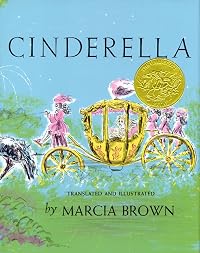
Cinderella
by Marcia Brown
On This Page
Description
In her haste to flee the palace before the fairy godmother's magic loses effect, Cinderella leaves behind a glass slipper.Tags
Recommendations
Member Reviews
Three-time Caldecott medalist and six-time Caldecott honoree Marcia Brown retells that most famous of fairy-tales in this lovely picture book from 1954. A loose translation of Charles Perrault's original French story, in which a beautiful and good young maiden named Cinderella is aided by her fairy godmother in attending the prince's ball and in winning her heart's desire, is paired with Brown's own artwork, and the result is a delight, both from a narrative and artistic standpoint...
It is not difficult to see why Brown's Cinderella; or, The Little Glass Slipper was awarded the Caldecott Medal in 1955. Her artwork here is lovely, capturing the magic of the story and the changing emotions of the titular heroine, while making use of a show more beautiful array of colors, and featuring elegantly stylized figures. I don't know how faithful the conclusion is to the Perrault original, having not read that in some time, but I also greatly appreciated the fact that Cinderella forgives her stepsisters, and sees that they are provided for. I've nothing to say against versions in which the stepsisters are punished, but it's also nice to see one that shows the heroine staying true to her kind nature. Recommended to young fairy and folktale lovers, and to any picture book readers who enjoy Cinderella retellings. My favorite in this vein will always be the version done by Evelyn Andreas and Ruth Ives (the standard of my childhood), but this is another that I hold in high regard. show less
It is not difficult to see why Brown's Cinderella; or, The Little Glass Slipper was awarded the Caldecott Medal in 1955. Her artwork here is lovely, capturing the magic of the story and the changing emotions of the titular heroine, while making use of a show more beautiful array of colors, and featuring elegantly stylized figures. I don't know how faithful the conclusion is to the Perrault original, having not read that in some time, but I also greatly appreciated the fact that Cinderella forgives her stepsisters, and sees that they are provided for. I've nothing to say against versions in which the stepsisters are punished, but it's also nice to see one that shows the heroine staying true to her kind nature. Recommended to young fairy and folktale lovers, and to any picture book readers who enjoy Cinderella retellings. My favorite in this vein will always be the version done by Evelyn Andreas and Ruth Ives (the standard of my childhood), but this is another that I hold in high regard. show less
This is a new translation / adaptation of Charles Perrault’s famous story, with wonderful illustrations by Marcia Brown (for which she was awarded the Caldecott Medal).
What I really like about this version of the story is the way that Cinderella is portrayed as a very kind young woman, but clearly not a doormat. She speaks up for herself when it counts. Her stepsisters are never referred to as “ugly” either; rather they are selfish, self-absorbed, and rather hateful towards Cinderella. They are as blind to her virtues as they are to their own faults.
The translation also differs from original versions of the story in the way it ends – for the stepsisters. Cinderella, in her goodness, arranges good marriages for them to two lords show more in the Prince’s Court.
I was fascinated by the technique of Brown’s illustrations. She uses a few pen strokes to suggest a gown, for example, and then a wash of color to complete the image. This lends a rather ethereal, fairy-tale feeling to the drawings; very effective. show less
What I really like about this version of the story is the way that Cinderella is portrayed as a very kind young woman, but clearly not a doormat. She speaks up for herself when it counts. Her stepsisters are never referred to as “ugly” either; rather they are selfish, self-absorbed, and rather hateful towards Cinderella. They are as blind to her virtues as they are to their own faults.
The translation also differs from original versions of the story in the way it ends – for the stepsisters. Cinderella, in her goodness, arranges good marriages for them to two lords show more in the Prince’s Court.
I was fascinated by the technique of Brown’s illustrations. She uses a few pen strokes to suggest a gown, for example, and then a wash of color to complete the image. This lends a rather ethereal, fairy-tale feeling to the drawings; very effective. show less
I loved this adaption of Cinderella translated from French. It had more magic and whim than the Disney version! I liked the watercolor illustrations which showed emotion using colors and stroke marks. As I was reading, it felt like a flowing poem. “Cinderella reached home all out of breath, with neither coach nor footmen, and in rags. Nothing was left of her finery but one little slipper, the mate to the one she had lost.” The translation to English is beautiful and moving. I also enjoyed the happy ending. In a twist, Cinderella’s stepsisters apologize and then also find dashing princes. The big idea of this story is choose to be positive in the worst times because the best times are soon to come. Cinderella waited patiently and show more happily for her royal future while she scrubbed floors in her own home. show less
I really, truly love this book! Cinderella has always been my favorite princess, and I love Marcia Brown's adaptation of the classic story. The main idea of the story is that you can go from rags to riches, and from sadness to happiness. One reason I like this adaptation is because of the translations by Brown. She uses traditional vocabulary that adds to the fact that this story is traditional fantasy. For example, it uses words like 'Madame', 'bedchamber', and 'livery'. I also like this book because of its illustrations. I love that the illustrations are both whimsical and yet childish. Because they are drawn in pen and watercolor, it looks like a child could have drawn it. However, the thin pen lines also add a feeling of whimsy, show more which adds to the 'fairy tale', or traditional fantasy story. show less
This has been rejected so often by princess-loving kiddos, I feel like I already have a sympathetic relationship with this book. Poor thing rarely gets read these days. It's too bad, too, because it's a great version of the fairytale - a good long read with plenty of detail and voice. The line drawn illustrations don't grab students, but on close examination they are expressive and done in a floaty style that suits the story. I'm filing this under "give it a chance" and will try it as a read aloud to see if I can get some of my Disney-obsessed girls to try it.
Cinderella is a classic fairytale that I grew up listening to, but this version was not as captivating as other versions I have encountered. Visually, the illustrations were very bland, and lacked detail. This might make kids have a hard time visualizing the story as they hear it if the illustrations are not intriguing. The characters were not very well developed. I had a hard time connecting with any of the characters, or feeling any sentiment towards them. The plot followed the typical Cinderella story, but I felt like the language did not do the tale justice. The ending seemed rushed, and I felt like it lacked the proper falling action from the climax. Personally, I think the language lacked the essential energy that I, as the show more reader, needed to experience. Cinderella teaches us to always stay positive, and most importantly to remain kind, no matter how tough life may be. If you persevere through, there may be a brighter future on the other side. show less
Category/Genre: Fairytale
Notable: Caldecott medal award
This book is another version of the most common fairytale story, cinderella.The book is very to the point with the story with not much room for humor. This is not my favorite version of the story although it does stick to the story line and its details. The illustrations are very interesting and unique, the many watercolors fill the pages with life. I would probably not read this to my classroom because it is not the most interesting or humorous version.
Notable: Caldecott medal award
This book is another version of the most common fairytale story, cinderella.The book is very to the point with the story with not much room for humor. This is not my favorite version of the story although it does stick to the story line and its details. The illustrations are very interesting and unique, the many watercolors fill the pages with life. I would probably not read this to my classroom because it is not the most interesting or humorous version.
Members
- Recently Added By
Lists

Caldecott Medal Books
91 works; 15 members

Romalda Spalding's Writing Road To Reading
213 works; 3 members

Princess Tales
130 works; 4 members

Books Read in 2022
5,168 works; 114 members
Author Information

23+ Works 8,864 Members
Awards and Honors
Awards
Work Relationships
Is a retelling of
Common Knowledge
- Canonical title
- Cinderella
- Original title
- Cinderella
- Original publication date
- 1954
- People/Characters
- Cinderella; Wicked Stepmother; Ugly Stepsisters; Fairy Godmother; Prince Charming
- Dedication
- For Mary Gould Davis who understands the true spirit of Charles Perrault
- First words
- Once upon a time there was a gentleman who took for his second wife the proudest and haughtiest woman that was ever seen.
- Last words
- (Click to show. Warning: May contain spoilers.)Cinderella, who was as good as she was beautiful, gave her sisters a home at the palace and on the same day married them to two great lords of the court.
- Disambiguation notice
- Cinderella by Marcia Brown is *not* the same adaptation as the one by Charles Perrault (or any other author). Each author's adaptation should be treated as a distinct work and *not* combined.
Classifications
Statistics
- Members
- 1,437
- Popularity
- 16,384
- Reviews
- 113
- Rating
- (3.94)
- Languages
- Chinese, English
- Media
- Paper, Audiobook, Ebook
- ISBNs
- 19
- ASINs
- 10