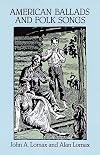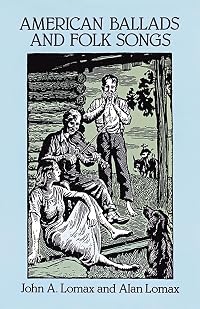
American Ballads and Folk Songs
by John A. Lomax, Alan Lomax
On This Page
Description
Music and lyrics for over 200 songs. John Henry, Goin' Home, Little Brown Jug, Alabama-Bound, Ten Thousand Miles from Home, Shack Bully Holler, Black Betty, The Hammer Song, Bad Man Ballad, Jesse James, Down in the Valley, The Bear in the Hill, Shortenin' Bread, The Ballad of Davy Crockett, and many more.Tags
Recommendations



















Member Reviews
Think of this volume as a folk music equivalent of a Greek Tragedy: It's a great book with a fatal flaw.
It's a great book because it is one of the largest collections of American folk songs ever published. There is no question but that it was a seminal production.
The problem is, the songs have been Lomax-ized.
This is an old, old problem in folk music publications. Percy's Reliques started the trend: Take an old song and rewrite and refine and don't admit to it -- and even if the author does admit to it, he doesn't list where he made changes.
This is not to absolutely reject rewriting. If a song collector finds a version of a song which lacks a key verse, and wants to include it in a book for general audiences (and this book was intended show more for popular audiences), then the collector needs to put in that verse. But put it in [brackets] to show that it is spurious, and list the source for the interpolation.
And, while he's at it, he needs to list from whom the song was collected, and where, and when.
This volume fails on all these counts. And the Lomaxes did an incredible amount of tampering. Bottom line: There are a lot of great songs here. There is also a lot of very, very bad scholarship. If all you care about is the songs, by all means, pick up this book. But don't trust anything it says unless you can (for instance) verify it against the Lomax field recordings. Those, at least, are highly valuable and unadulterated. show less
It's a great book because it is one of the largest collections of American folk songs ever published. There is no question but that it was a seminal production.
The problem is, the songs have been Lomax-ized.
This is an old, old problem in folk music publications. Percy's Reliques started the trend: Take an old song and rewrite and refine and don't admit to it -- and even if the author does admit to it, he doesn't list where he made changes.
This is not to absolutely reject rewriting. If a song collector finds a version of a song which lacks a key verse, and wants to include it in a book for general audiences (and this book was intended show more for popular audiences), then the collector needs to put in that verse. But put it in [brackets] to show that it is spurious, and list the source for the interpolation.
And, while he's at it, he needs to list from whom the song was collected, and where, and when.
This volume fails on all these counts. And the Lomaxes did an incredible amount of tampering. Bottom line: There are a lot of great songs here. There is also a lot of very, very bad scholarship. If all you care about is the songs, by all means, pick up this book. But don't trust anything it says unless you can (for instance) verify it against the Lomax field recordings. Those, at least, are highly valuable and unadulterated. show less
I didn't read the whole book; I skimmed a lot of the text and skipped ahead to the music. There's a lot to discover in here. There are a few (now) popular songs everyone knows and loves, alongside (equally good) songs you've probably never heard of. But I find most of the songs are different versions of songs I know -- such as "Amazing Grace" with an unrecognizable melody, or "Yankee Doodle" with words about fighting the Civil War (and no mention of macaroni).
The book is sort of torn between being a songbook for general readers and being a sort of reference for people with a scholarly interest in American folk songs; whether it's the best of both worlds or the worst, I guess depends on what you're looking for. The Lomaxes combined show more different versions of songs, picking the bits they happened to think were best (not most representative), which makes for more of a popular songbook than anything else. But they also leave out any harmonization (ironically, for the sake of not editing), and they include songs which have no written music and songs which cannot be notated (but they approximate notating them anyway), so there's a lot of content which is useless as a songbook but potentially interesting as a reference work.
That duality has a lot to do with why I like the work of the Lomaxes. They were the sort of people who wrote arrangements for their field recordings. For people like me who are just interested in good music, not in "scholarly" accuracy, it's perfect. show less
The book is sort of torn between being a songbook for general readers and being a sort of reference for people with a scholarly interest in American folk songs; whether it's the best of both worlds or the worst, I guess depends on what you're looking for. The Lomaxes combined show more different versions of songs, picking the bits they happened to think were best (not most representative), which makes for more of a popular songbook than anything else. But they also leave out any harmonization (ironically, for the sake of not editing), and they include songs which have no written music and songs which cannot be notated (but they approximate notating them anyway), so there's a lot of content which is useless as a songbook but potentially interesting as a reference work.
That duality has a lot to do with why I like the work of the Lomaxes. They were the sort of people who wrote arrangements for their field recordings. For people like me who are just interested in good music, not in "scholarly" accuracy, it's perfect. show less
A compilation of music collected by John Lomax in the early 1900s from all over the United States. Categories: Railroad, Levee camp, chain gangs, Negro bad men, white desperadoes, Mountain, Cocaine and Whiskey, Blues, Creole, Reels, Minstrel, Breakdowns and Play Parties, Songs of Childhood, Miscellany, Vaqueros of the Southwest, Cowboy Songs, Overlanders, Miners, Shan't Boy, The Erie Canal, The Great Lakes, Sailors and Sea Fights, War and Soldiers, While Spirituals, Negro Spirituals.
Songs are grouped into 15 categories in table of contents. Tune name listed under each category and page number referenced. Bibliography of American folk song compiled by Harold W. Thompson for his class on American Folk literature at New York State college for Teachers is provided starting on page 613.
Ratings
Members
- Recently Added By
Lists

Best Books of 1926-1935
403 works; 10 members
Author Information

21+ Works 522 Members
John A. Lomax (1867-1948)recorded classics such as "Home on the Range" and "Goodnight Irene" and with son Alan helped launch the musical careers of Lead Belly and Pete Seeger. His extensive recordings and papers are housed in the Library of Congress and the Dolph Briscoe Center for American History at the University of Texas at Austin.

118+ Works 1,787 Members
Born in Austin, Texas, and educated at Harvard University, the University of Texas, and Columbia University, American folklorist Alan Lomax is one of the most dedicated and knowledgeable folk-music scholars of the twentieth century. Lomax became interested in collecting and recording folk songs through the work of his father, John Avery Lomax, a show more curator at the Library of Congress and a pioneer in the field of folk music. After college, he toured prisons in the South, recording folk song performances for the Archive of American Song of the Library of Congress. During his travels, he met the great blues singer Huddie Ledbetter ("Leadbelly"). Lomax later became responsible for introducing radio audiences to a number of folk and blues artists, including Woody Guthrie and Burl Ives. Between 1951 and 1958, he traveled throughout Europe, recording hundreds of folk songs in England, Scotland, Italy, and Spain. His most important work is, perhaps, "The Folk Songs of North America" (1959). He also published a number of works with his father, including "American Ballads and Folk Songs" (1934) and "Folk Song: USA" (1946). In addition to his work with folk songs, Lomax was very interested in the historical and social origins of jazz, and he wrote a notable biography of the early jazzman Ferdinand "Jelly Roll" Morton entitled "Mister Jelly Roll" (1950). (Bowker Author Biography) show less
Series
Belongs to Publisher Series
Common Knowledge
- Original publication date
- 1934
- People/Characters
- Sam Bass; Mustang Gray; John Henry; Casey Jones; Stagolee; John Hardy (show all 9); Sweet Betsy from Pike; Skewball, a racehorse; Sam Hall
- Important places
- USA
- Important events
- Braddock's Defeat
- Dedication
- To the Mother who sang many of these songs into the lives of Shirley, John, Jr., Alan, and Bess Brown, in grateful and loving memory, we dedicate this book.
- First words
- FOREWORD
[by George Lyman Kittredge]
Professor Lomax needs no introduction.
INTRODUCTION
The sun is sorta sinkin', an' the road is clear,
An' the wind is singin' ballads that I got to hear.
-- Berton Braley
Recently a professor of music from Oxford University s... (show all)aid in a public lecture at Bryn Mawr College: "Since America has no peasant class, there are, of course, no American folk songs." - Original language
- English
Classifications
Statistics
- Members
- 167
- Popularity
- 196,543
- Reviews
- 4
- Rating
- (4.30)
- Languages
- English
- ISBNs
- 5
- UPCs
- 1
- ASINs
- 6