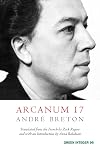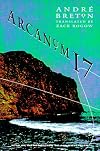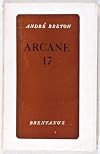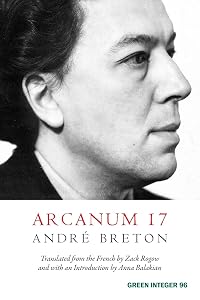
Arcanum 17
by André Breton
On This Page
Description
Considered radical at the time, Breton's ideas today seem almost prescient, yet breathtaking in their passionate underlying belief in the indestructibility of life and the freedom of the human spirit. Breton wrote Arcanum 17 during a trip to the Gaspe Peninsula in Quebec in the months after D-Day in 1944, when the allied troops were liberating Occupied Europe. Using the huge Perce Rock - its impermanence, its slow-motion crumbling, its singular beauty - as his central metaphor, Breton show more considers issues of love, loss, aggression, war, pacifism and feminism. show lessTags
Recommendations














Member Reviews
Intriguing, but I found the introduction & translator's preface to be more interesting than the book itself! For certain moods and connoisseurs of surrealism, I suppose.
Arcanum 17 by Breton
3 stars (2 for enjoyment and a bump for intelligence and wonderfully lyrical prose)
Breton's Arcanum 17 is essentially a long essay in which he muses about love, loss, war, feminism, and a number of other things. Inspired by the image of the Perce Rock in Quebec, he uses this vision as a metaphor for a range of topics. The book itself was barely larger than my cellphone and only 133 pages (with additional pages for an intro and other material) but it took me over two weeks to read. This is one of those books that I couldn't read in bed for fear of falling asleep. In fact I fell asleep reading this on my couch, in my car (with my husband driving), and multiple times in bed.
It's well written and there is no question show more that he is an intellectual powerhouse. I did enjoy some parts of the book but it required such intensity of focus and concentration, that it felt like a chore. He has some interesting thoughts about the rights and roles women that are quite advanced for the period in which they were written. The writing is poetic and I liked how he blended imagery form nature into his philosophical musings.
I am at a loss for why it is on the 1001 list. It is certainly not a novel but rather reads like an academic essay. I could really only read two pages at a time because I found it fairly boring albeit beautifully written. show less
3 stars (2 for enjoyment and a bump for intelligence and wonderfully lyrical prose)
Breton's Arcanum 17 is essentially a long essay in which he muses about love, loss, war, feminism, and a number of other things. Inspired by the image of the Perce Rock in Quebec, he uses this vision as a metaphor for a range of topics. The book itself was barely larger than my cellphone and only 133 pages (with additional pages for an intro and other material) but it took me over two weeks to read. This is one of those books that I couldn't read in bed for fear of falling asleep. In fact I fell asleep reading this on my couch, in my car (with my husband driving), and multiple times in bed.
It's well written and there is no question show more that he is an intellectual powerhouse. I did enjoy some parts of the book but it required such intensity of focus and concentration, that it felt like a chore. He has some interesting thoughts about the rights and roles women that are quite advanced for the period in which they were written. The writing is poetic and I liked how he blended imagery form nature into his philosophical musings.
I am at a loss for why it is on the 1001 list. It is certainly not a novel but rather reads like an academic essay. I could really only read two pages at a time because I found it fairly boring albeit beautifully written. show less
> Par Grégoire Leménager ( BibliObs) : Pour les fous de Breton : l'extraordinaire manuscrit d'"Arcane 17"
23 fév. 2012 ... L'un des plus beaux manuscrits du poète reproduit (presque) à l'identique: c'est le résultat d'un an et demi de travail, pour un tirage à 100 exemplaires. Etonnant.
... Pour cet universitaire renommé, spécialiste du surréalisme, cela ne fait aucun doute: le «manuscrit autographe» d'«Arcane 17» (à découvrir sur CanalObs.tv en cliquant ici), ce long poème en prose rédigé par André Breton pendant l'été 1944, au cours d'un périple en Gaspésie avec sa seconde femme, Elisa, n'est pas seulement «un des plus beaux du XXème siècle». Il s'agit aussi d'un véritable «poème-objet», conçu comme une show more oeuvre d'art à part entière... show less
23 fév. 2012 ... L'un des plus beaux manuscrits du poète reproduit (presque) à l'identique: c'est le résultat d'un an et demi de travail, pour un tirage à 100 exemplaires. Etonnant.
... Pour cet universitaire renommé, spécialiste du surréalisme, cela ne fait aucun doute: le «manuscrit autographe» d'«Arcane 17» (à découvrir sur CanalObs.tv en cliquant ici), ce long poème en prose rédigé par André Breton pendant l'été 1944, au cours d'un périple en Gaspésie avec sa seconde femme, Elisa, n'est pas seulement «un des plus beaux du XXème siècle». Il s'agit aussi d'un véritable «poème-objet», conçu comme une show more oeuvre d'art à part entière... show less
Dec 31, 2018 (Edited)French
Edition en partie originale sur papier courant et sous couverture de remise en vente chez Jean-Jacques Pauvert.
Papier jauni comme généralement.
Papier jauni comme généralement.
Oct 5, 2025French
Ratings
Members
- Recently Added By
Lists

My TBR
371 works; 3 members

1,001 BYMRBYD Concensus
723 works; 27 members
Author Information

199+ Works 6,462 Members
Andre Breton was born in Normandy, France on 19, 1896 and died on September 28, 1966. Breton was a poet, novelist, philosophical essayist, and art critic. He is considered to be the father of surrealism. From World War I to the 1940s, Breton was at the forefront of the numerous avant-garde activities that centered in Paris. Breton's influence on show more the art and literature of the twentieth century has been enormous. Picasso, Derain, Magritte, Giacometti, Cocteau, Eluard, and Gracq are among the many whose work was affected by his thinking. From 1927 to 1933, Breton was a member of the Communist party, but thereafter he opposed communism. His writings include the first Surrealist Manifesto (Manifeste du surréalisme) of 1924, in which he defined surrealism as "pure psychic automatism". He also wrote Nadja in 1928. Breton died in 1966 at 70 and was buried in the Cimetière des Batignolles in Paris. (Bowker Author Biography) show less
Some Editions
Awards and Honors
Series
Belongs to Publisher Series
Common Knowledge
- Canonical title
- Arcanum 17
- Original title
- Arcane 17
- Original publication date
- 1945
- Original language
- French
Classifications
Statistics
- Members
- 225
- Popularity
- 144,769
- Reviews
- 4
- Rating
- (3.15)
- Languages
- 7 — English, French, German, Greek, Japanese, Portuguese, Spanish
- Media
- Paper
- ISBNs
- 10
- ASINs
- 7