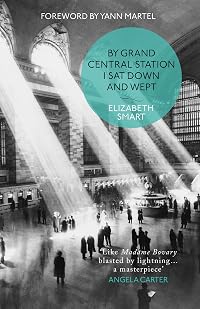
By Grand Central Station I Sat Down and Wept
by Elizabeth Smart
On This Page
Description
Elizabeth Smart's passionate fictional account of her intense love-affair with the poet George Barker, described by Angela Carter as 'Like Madame Bovary blasted by lightening ... A masterpiece'.Tags
Recommendations









Member Reviews
Such a beautifully written book! Every page is imbued with the passion Smart felt for her lover, George Barker. Though, since Barker was married and a Catholic, their love would forever be carried out in secret or if not secret then without the approbation of society.
At one point, as detailed in the book, Smart and Barker were actually arrested in Arizona for sharing a bed when they were not married. Smart's mother was mortified by the affair and when this book was published she tried to have it banned in Ottawa. When that didn't work she went out and purchased all the copies she could find and burned them.
It would be interesting to know what Barker's wife felt during all this. Initially it seems that Smart was reluctant to consummate show more the affair because of his marriage. They were all living in a small community in California when the affair started so she must have know what was going on. And from some of the passages about her it seems that she had at least one miscarriage.
In the night she moans with the voice of the stream below my window, searching for the child whose touch she once felt and can never forget: the child who obeyed the laws of life better than she....Her shoulders have always the attitude of grieving, and her thin breasts are pitiful like Virgin Shrines that have been robbed.
So how difficult it must have been for her to see her husband's mistress give him a child.
I must confess I don't think I care for George Barker. Information available on the internet details that he had affairs with other women and at least 7 other children in addition to the 4 Smart eventually had with him. If he had remained true to her I would have felt that the affair was understandable as a grand passion but since he impregnated other women he obviously didn't feel as bound to her as she was to him. 'Twas ever thus. show less
At one point, as detailed in the book, Smart and Barker were actually arrested in Arizona for sharing a bed when they were not married. Smart's mother was mortified by the affair and when this book was published she tried to have it banned in Ottawa. When that didn't work she went out and purchased all the copies she could find and burned them.
It would be interesting to know what Barker's wife felt during all this. Initially it seems that Smart was reluctant to consummate show more the affair because of his marriage. They were all living in a small community in California when the affair started so she must have know what was going on. And from some of the passages about her it seems that she had at least one miscarriage.
In the night she moans with the voice of the stream below my window, searching for the child whose touch she once felt and can never forget: the child who obeyed the laws of life better than she....Her shoulders have always the attitude of grieving, and her thin breasts are pitiful like Virgin Shrines that have been robbed.
So how difficult it must have been for her to see her husband's mistress give him a child.
I must confess I don't think I care for George Barker. Information available on the internet details that he had affairs with other women and at least 7 other children in addition to the 4 Smart eventually had with him. If he had remained true to her I would have felt that the affair was understandable as a grand passion but since he impregnated other women he obviously didn't feel as bound to her as she was to him. 'Twas ever thus. show less
Hmmm.... so this starts with what i thought was someone planning a murder, an interesting but wrong assumption as it was just an allegory for sleeping with someones husband. On the other hand while the mistaken premise was good the writing was some of the worst stuff i’ve ever read.
I mean it was truly terrible writing with just an absurd amount of mixed metaphors piled on top of one another. I really didn’t think the novel/poem/whatever could recover from my disappointment at the discovery of the actual plot combined with that writing.
However it does improve. Its still quite fragmentary but overall you get a fair understanding of whats happening. The writing is certainly better overall than the openng portions although there are show more still odd metaphors here and there.
Later it actually felt like they were purposefuly bad at times, maybe a bile filled sarcasm but i definitely felt some sort of dark humour in places.
Overall the almost 18th century, romantic, overemotional, emo, melodrama combining with the modern settings and vocabulary do create something of interest. Still.. a very low 3 stars. show less
I mean it was truly terrible writing with just an absurd amount of mixed metaphors piled on top of one another. I really didn’t think the novel/poem/whatever could recover from my disappointment at the discovery of the actual plot combined with that writing.
However it does improve. Its still quite fragmentary but overall you get a fair understanding of whats happening. The writing is certainly better overall than the openng portions although there are show more still odd metaphors here and there.
Later it actually felt like they were purposefuly bad at times, maybe a bile filled sarcasm but i definitely felt some sort of dark humour in places.
Overall the almost 18th century, romantic, overemotional, emo, melodrama combining with the modern settings and vocabulary do create something of interest. Still.. a very low 3 stars. show less
This writing just intoxicates me. Makes me feel like I finally understand how to be less of a dick to women even when they're also being kind of a dick. (It's not like a manual--it's just Elizabeth Smart brings you into her world and you can't be a dick to someone without knowing it once you've been in their world).
The high-pitched tonal uniformity of this raw nerved outpouring is fortunately slim in pages (just 112 in my edition) but it's verging on being overweight when it comes to fabulous imagery. I found my copy in a street library. Whoever had previously read it had some kind of religious obsession and had heavily (urgently) underlined (in pencil) any conceivable reference to anything biblical, god, angels, martyrdom, and flowers. This meant that most pages bore marks but then books can bear that and, if anything, it enhanced my reading. I wondered what I would have made of the book if I knew nothing of Elizabeth Smart's life or had not read the foreword by Brigid Brophy. Nevertheless, there were many wonderful moments. For example,
Parent'sshow more
imaginations build frameworks out of their own hopes and regrets into which children seldom grow, but instead , contrary as trees, grow sideways out of the architecture, blown by a fatal wind their parents never envisaged.show less
I had missed this book but, in one of those odd coincidences, my son brought it home one day and the next day the Globe and Mail got five literary types to list the top ten Canadian books and this book appeared on three of the lists.
I don't know who is harder on whom: young people on old people or old people on young people. The old think the young are naive and the young think the old don't have a feeling in their heart or a thought in their head. This is a young person's book. It doesn't read like any other 1945 book you'll ever read (or, in fact, like any other book I've read) and for that alone I'm glad I have read it. Raw, melodramatic, devastated and poetic.
I don't know who is harder on whom: young people on old people or old people on young people. The old think the young are naive and the young think the old don't have a feeling in their heart or a thought in their head. This is a young person's book. It doesn't read like any other 1945 book you'll ever read (or, in fact, like any other book I've read) and for that alone I'm glad I have read it. Raw, melodramatic, devastated and poetic.
When I wrote the entry for this book in my reading catalogue, I added one word beside it: “amazing.” It is simply amazing. I found it by chance while browsing at a bookstore a while back. I had remembered hearing the title several times before, but it had never really registered with me. But for some reason that day it did, so I read the back cover and then flipped to the first page. After reading the first couple of sentences, I knew I had to stop and wait until I got home to continue. I read the book in one sitting, in a blur, in what I remember felt like one sharp intake of breath.
The basic plot is the love affair between the author and the poet George Barker. He was married when they met and had countless affairs with women over show more the years — despite this, Smart ended up having four children by him. So, it’s based in reality while still being a novel. However, the style of the writing has been described as prose poetry, and is full of emotion and imagery. I remember thinking as I read it that I would need to read it again at least once, if not twice, but at that moment I was just savouring the feelings caused by the words, as opposed to the words themselves.
I think it’s one of those books I will return to over the years. It’s definitely one that sticks in your head after you’ve finished it, which is nice because you can re-live the emotion all the more. In fact, I was so impressed with this book after I read it that I searched for, and was fortunate to find, a copy of the first edition published in 1945. The print run was only 2000 copies, and Smart’s family was not impressed with her subject of choice so they tried to have the book banned from entry into Canada (it was published in London). For its time, I suppose it was scandalous to have a book that is so explicitly about an illicit affair, but I’m certainly glad we have the chance to read it today.
http://lebookshelf.tumblr.com/post/4829037667/19-by-grand-central-station-i-sat-... show less
The basic plot is the love affair between the author and the poet George Barker. He was married when they met and had countless affairs with women over show more the years — despite this, Smart ended up having four children by him. So, it’s based in reality while still being a novel. However, the style of the writing has been described as prose poetry, and is full of emotion and imagery. I remember thinking as I read it that I would need to read it again at least once, if not twice, but at that moment I was just savouring the feelings caused by the words, as opposed to the words themselves.
I think it’s one of those books I will return to over the years. It’s definitely one that sticks in your head after you’ve finished it, which is nice because you can re-live the emotion all the more. In fact, I was so impressed with this book after I read it that I searched for, and was fortunate to find, a copy of the first edition published in 1945. The print run was only 2000 copies, and Smart’s family was not impressed with her subject of choice so they tried to have the book banned from entry into Canada (it was published in London). For its time, I suppose it was scandalous to have a book that is so explicitly about an illicit affair, but I’m certainly glad we have the chance to read it today.
http://lebookshelf.tumblr.com/post/4829037667/19-by-grand-central-station-i-sat-... show less
A prose poem of exquisite beauty, a tale of the overwhelming love of an intelligent, articulate woman for a man unworthy of her, a long drawn-out howl in the service of the idea that love can change the world for the better while simultaneously causing grief and mayhem wherever it goes. This is a flawless work, eloquent and moving and in some ways profoundly disturbing. Smart's writing is like fire dancing and flickering - beautiful and terrible in equal measure. Although those readers who like the simpleton A-to-B plotting that dominates so much of modern literature will perhaps find nothing here to like this is a hugely impressive achievement. English has such a massive vocabulary and flexibility to it yet there are few writers who show more take advantage of that to produce something that stretches the language to breaking point in the service of communicating depth and truth of experience. Anyone who loves language, who loves writing, who loves the idea that words on the page can be more than simple fireside tales writ large, should be thanking whatever deity they believe in every day that people like Elizabeth Smart chose to enter the ring and fight hard to put words on the page. This is a classic, and rightly so, and anyone who picks it up and remains unmoved should perhaps consider seeking professional help. show less
Members
- Recently Added By
Lists

The Guardian's 1000 Novels Everyone Must Read
1,005 works; 551 members

CBC Books - Canada's 100 (+ bonus 10): Which have you read?
110 works; 23 members

Pleasant Surprises: Books That Exceeded Our Expectations
418 works; 143 members

A Novel Cure
742 works; 23 members

Books Read in 2016
4,666 works; 199 members

Stuff from Bard
70 works; 1 member

Books With the Most Memorable Titles
478 works; 158 members

Our Favorite Banned Books
138 works; 122 members
Author Information

12+ Works 1,447 Members
Elizabeth Smart was born in Ottawa, Ontario on December 27, 1913. She attended King's College of the University of London for a year. Her titles include By Grand Central Station I Sat Down and Wept, A Bonus, Ten Poems, Eleven Poems, the Assumption of the Rogues and Rascals and In the Mean Time. She died March 4, 1986 in London of a heart attack.
All Editions
Some Editions
Awards and Honors
Series
Belongs to Publisher Series
Work Relationships
Is contained in
Is abridged in
Is replied to in
Common Knowledge
- Original title
- By Grand Central Station I Sat Down and Wept
- Original publication date
- 1945
- Epigraph*
- Presso le fiumane di Babilonia
sedevano e piangevano,
ricordando Sion.
Salmo 137 - Dedication
- to Maximiliane von Upani Southwell
- First words
- I am standing on a corner in Monterey, waiting for the bus to come in, and all the muscles of my will are holding my terror to face the moment I most desire. Apprehension and the summer afternoon keep drying my lips, prepared... (show all) at ten-minute intervals all through the five-hour wait.
- Last words
- (Click to show. Warning: May contain spoilers.)My dear, my darling, do you hear me where you sleep?
- Blurbers
- Connolly, Cyril; Ondaatje, Michael; Brophy, Brigid; Bainbridge, Beryl
- Original language
- English
*Some information comes from Common Knowledge in other languages. Click "Edit" for more information.
Classifications
Statistics
- Members
- 1,152
- Popularity
- 21,862
- Reviews
- 30
- Rating
- (3.53)
- Languages
- 8 — Catalan, Dutch, English, French, Italian, Portuguese, Spanish, Swedish
- Media
- Paper, Audiobook, Ebook
- ISBNs
- 25
- ASINs
- 11