
Brigid Brophy (1929–1995)
Author of Hackenfeller's Ape
About the Author
Works by Brigid Brophy
Mozart the Dramatist: The Value of His Operas to Him, to His Age and to Us (1988) 56 copies, 1 review
Associated Works
Lesbian Pulp Fiction: The Sexually Intrepid World of Lesbian Paperback Novels 1950-1965 (2005) — Contributor — 190 copies, 3 reviews
Femmes de Siècle: Stories from the 90s - Women Writing at the End of Two Centuries (1992) — Contributor — 18 copies
Sylvia Plath's Tomato Soup Cake: A Compendium of Classic Authors' Favourite Recipes (2024) — Contributor — 6 copies
Die Zauberflöte [and] Die Entführung aus dem Serail (Universe Opera Guide) (1971) — Introduction — 5 copies
Sex education. The erroneous zone ... Foreword: Brigid Brophy — Preface, some editions — 1 copy
The London Magazine : April 1963, New series Volume 3, No. 1 — Contributor — 1 copy
Tagged
Common Knowledge
- Canonical name
- Brophy, Brigid
- Legal name
- Brophy, Brigid Antonia Susan
- Other names
- Levey, Lady
- Birthdate
- 1929-06-12
- Date of death
- 1995-08-07
- Gender
- female
- Education
- The Abbey School, Reading
St Paul's Girls' School, London
University of Oxford (St Hugh's College) - Occupations
- novelist
essayist
social critic
biographer
dramatist
short story writer - Awards and honors
- Royal Society of Literature (Fellow)
- Relationships
- Levey, Sir Michael (husband)
Brophy, John (father) - Short biography
- The Telegraph said of her: "Brigid Brophy was an outspoken campaigner on issues as diverse as humanism, animal rights, feminism, pornography, homosexual rights, the Vietnam War and religious education in schools (she disapproved of only the last two)." She was 25 when her first book of short stories, The Crown Princess, was published; it was followed in the same year by her novel, Hackenfeller's Ape.
In 1954, she married Michael Levey, an art historian who became director of the British National Gallery and was knighted in 1981. The couple had one daughter. She wrote further novels, several non-fiction books and essays. She wrote about her struggle with multiple sclerosis in her book, Baroque 'n' Role (1987). - Cause of death
- multiple sclerosis
- Nationality
- UK
- Birthplace
- Ealing, Middlesex, England, UK
- Places of residence
- London, England, UK
- Place of death
- Louth, Lincolnshire, England, UK
- Map Location
- England, UK
Members
Discussions
Brigid Brophy in Book talk (July 2015)
Reviews

Ronald Firbank's grandfather was the classic Victorian self-made man, who started out as a Durham mineworker at the age of seven, educated himself and became one of the leading railway contractors of his time. Just to prove that there's nothing in heredity, Ronald (called Artie before he became a writer) turned out to be allergic to all forms of organised schooling, never passed an exam in his life, and was so unsuccessful as a writer in his own short lifetime that he had to use his (quite show more modest) inherited wealth to subsidise the publication of all of his books.
He's scarcely better known nowadays: if you come from a certain kind of background (mostly centred around middle-aged Oxbridge/Ivy League queens of high-anglican leanings, I suspect) you'll have heard of him as a cult early-20th-century author of camp novels with a hint of LGBT naughtiness, but the chance of your actually having read him is pretty minimal. And that's despite the way a whole succession of influential writers have gone out of their way to promote him, including in his own time Evelyn Waugh(*), the Sitwells, Lord Berners, and Carl Von Vechten; later on others including Anthony Powell, John Betjeman, Brigid Brophy and Alan Hollinghurst stood up to be counted.
Brophy's critical study of Firbank is almost as long as his collected works, coming in at some 600 pages in paperback, but it turns out to be a very lively read, because she has strong opinions about the merits of his writing and the way it's been treated by people who don't have the perception to appreciate it properly (including his previous biographers). She makes a very strong case for Firbank as someone who made an important contribution to modernist ideas about fiction and how it should work: at times she seems to see him as the Stravinsky of Eng Lit, but she doesn't seem to be able to tie him into direct influences on later writers. Or indeed contemporaries. We don't get much more than hints that Virginia Woolf read Firbank, for instance.
Naturally, Brophy has some sillinesses of her own too: she's writing in 1973, so there is far more Freud than we really need (to give her credit, she has clearly read Freud attentively and criticises him from time to time: she isn't just quoting off the peg theories). And she has a bee in her bonnet about Firbank's Irishness, through his Anglo-Irish mother, something there's scarcely any trace of in his writings.
Where she is undoubtedly on the mark is in her close attention to the huge influence Oscar Wilde had on Firbank, and the way he used his early writings to work this out of his system, culminating in the Salome-pastiche in The accidental princess.
In the final chapters of the book, we are led one by one through all of Firbank's books in quite some detail: this turns out to be very helpful, both in revealing patterns that we might otherwise have missed and in giving hints at decoding some of the more deeply encoded references in the text. She also discusses Firbank's many oddities of spelling, grammar, punctuation, translation, etc., some of which are clearly simple mistakes, but many turn out to be stretching language in unexpected ways. He seems to have had a kind of horror of being quite precise in any language other than French, including English. His Italian and Spanish are both horrible (intentionally or not), and his English often picks up odd French tinges of word-order and vocabulary. For instance, he uses "berce" as a verb several times, a word that doesn't appear in the OED, but whose meaning "to cradle" would be obvious to anyone who understands French (and could be guessed from the context anyway).
What Brophy doesn't bother to explain are Firbank's occasional buried dirty jokes: those are left to surprise the reader (including some I only picked up on a second or third reading...).
---
(*)The young Waugh gave Firbank rave reviews — later on he cooled off rather. Brophy suggests this is because he didn't want readers to see how much he'd stolen from Firbank's techniques in his early books. More prosaically it's probably got a lot to do with the older Waugh's lack of sense of humour where Catholicism was concerned. show less
He's scarcely better known nowadays: if you come from a certain kind of background (mostly centred around middle-aged Oxbridge/Ivy League queens of high-anglican leanings, I suspect) you'll have heard of him as a cult early-20th-century author of camp novels with a hint of LGBT naughtiness, but the chance of your actually having read him is pretty minimal. And that's despite the way a whole succession of influential writers have gone out of their way to promote him, including in his own time Evelyn Waugh(*), the Sitwells, Lord Berners, and Carl Von Vechten; later on others including Anthony Powell, John Betjeman, Brigid Brophy and Alan Hollinghurst stood up to be counted.
Brophy's critical study of Firbank is almost as long as his collected works, coming in at some 600 pages in paperback, but it turns out to be a very lively read, because she has strong opinions about the merits of his writing and the way it's been treated by people who don't have the perception to appreciate it properly (including his previous biographers). She makes a very strong case for Firbank as someone who made an important contribution to modernist ideas about fiction and how it should work: at times she seems to see him as the Stravinsky of Eng Lit, but she doesn't seem to be able to tie him into direct influences on later writers. Or indeed contemporaries. We don't get much more than hints that Virginia Woolf read Firbank, for instance.
Naturally, Brophy has some sillinesses of her own too: she's writing in 1973, so there is far more Freud than we really need (to give her credit, she has clearly read Freud attentively and criticises him from time to time: she isn't just quoting off the peg theories). And she has a bee in her bonnet about Firbank's Irishness, through his Anglo-Irish mother, something there's scarcely any trace of in his writings.
Where she is undoubtedly on the mark is in her close attention to the huge influence Oscar Wilde had on Firbank, and the way he used his early writings to work this out of his system, culminating in the Salome-pastiche in The accidental princess.
In the final chapters of the book, we are led one by one through all of Firbank's books in quite some detail: this turns out to be very helpful, both in revealing patterns that we might otherwise have missed and in giving hints at decoding some of the more deeply encoded references in the text. She also discusses Firbank's many oddities of spelling, grammar, punctuation, translation, etc., some of which are clearly simple mistakes, but many turn out to be stretching language in unexpected ways. He seems to have had a kind of horror of being quite precise in any language other than French, including English. His Italian and Spanish are both horrible (intentionally or not), and his English often picks up odd French tinges of word-order and vocabulary. For instance, he uses "berce" as a verb several times, a word that doesn't appear in the OED, but whose meaning "to cradle" would be obvious to anyone who understands French (and could be guessed from the context anyway).
What Brophy doesn't bother to explain are Firbank's occasional buried dirty jokes: those are left to surprise the reader (including some I only picked up on a second or third reading...).
---
(*)The young Waugh gave Firbank rave reviews — later on he cooled off rather. Brophy suggests this is because he didn't want readers to see how much he'd stolen from Firbank's techniques in his early books. More prosaically it's probably got a lot to do with the older Waugh's lack of sense of humour where Catholicism was concerned. show less
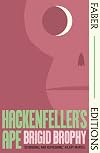
A note at the front of this book says: "All the characters in this novel are fictitious; so is the species Hackenfeller's Ape, but not the species Homo Sapiens". This nicely both creates a parallel between the two species and hints at the implausibility of human behaviour.
Hackenfeller's Ape is the closest living species to humanity. There is a pair of them in London Zoo, given the improbable names of 'Percy' and 'Edwina'. Professor Darrelhyde spends each day outside their enclosure, hoping show more to be the first scientist to observe them mating. As he sits there, he starts to imagine a personality for Percy - cultured and diffident, much like himself. So he is horrified to learn one day that Percy is due to be shot into space as part of testing a rocket design.
I don't suppose there are any books about monkeys which aren't really books about humans. This book contains interesting themes around empathy, connection, and getting yourself in over your head - as well as plenty of witty and satirical writing.
If the Chimpanzees’ Tea Party, which sometimes took place on a nearby lawn, was a rollicking caricature of human social life, here was a satire on human marriage. Separated by the yard or two that was the extent of their cage, not looking at one another, tensed, and huffy, Percy and Edwina might have been sitting at a breakfast table.
Brophy's [The Snow Ball] was one of the best books I read last year and made me want to read everything else she's written. [Hackenfeller's Ape] was her first novel, and doesn't really match up the [The Snow Ball] - there are some great bits, but also some satire which feels pretty dated now. It's also not as good as the other odd-couple-team-up-to-bust-animals-out-of-London-Zoo novel that I've read (!), [Turtle Diary]. But I'm still glad I read it - the good parts on their own make it worthwhile.
Picking up the book again to write this review, I've just realised the genius of the cover art - I thought it was just part of a monkey's face, but I now see that there's also a rocket to the moon. show less
Hackenfeller's Ape is the closest living species to humanity. There is a pair of them in London Zoo, given the improbable names of 'Percy' and 'Edwina'. Professor Darrelhyde spends each day outside their enclosure, hoping show more to be the first scientist to observe them mating. As he sits there, he starts to imagine a personality for Percy - cultured and diffident, much like himself. So he is horrified to learn one day that Percy is due to be shot into space as part of testing a rocket design.
I don't suppose there are any books about monkeys which aren't really books about humans. This book contains interesting themes around empathy, connection, and getting yourself in over your head - as well as plenty of witty and satirical writing.
If the Chimpanzees’ Tea Party, which sometimes took place on a nearby lawn, was a rollicking caricature of human social life, here was a satire on human marriage. Separated by the yard or two that was the extent of their cage, not looking at one another, tensed, and huffy, Percy and Edwina might have been sitting at a breakfast table.
Brophy's [The Snow Ball] was one of the best books I read last year and made me want to read everything else she's written. [Hackenfeller's Ape] was her first novel, and doesn't really match up the [The Snow Ball] - there are some great bits, but also some satire which feels pretty dated now. It's also not as good as the other odd-couple-team-up-to-bust-animals-out-of-London-Zoo novel that I've read (!), [Turtle Diary]. But I'm still glad I read it - the good parts on their own make it worthwhile.
Picking up the book again to write this review, I've just realised the genius of the cover art - I thought it was just part of a monkey's face, but I now see that there's also a rocket to the moon. show less

Amusing, though intended seriously, takedown of some works of high repute and others now almost forgotten. Lovers of Shakespeare may be amazed to see Hamlet listed, but admit it, don't you really want to give that young man a kick in the trunk hose? And I have often felt that Hemingway got his reputation because he allowed male English professors to feel manly by association.
What a fun, odd, and specifically atmospheric novel—I can't think of anything else like it I've read. It all takes place during one New Year's Eve costume party in England in the early 1960s, I think, with the guests dressed as 18th-century figures—many out of Don Giovanni, which makes me wish I were more up on my opera, but it's not necessary to enjoy the slightly plotless action: a one-night stand, a deflowering, a death, a pompous professorial lecture, and a bunch of missed show more connections with masks on that make the whole thing quite delicious. show less
Lists
Awards

You May Also Like


Associated Authors
Statistics
- Works
- 23
- Also by
- 11
- Members
- 1,040
- Popularity
- #24,754
- Rating
- 4.4
- Reviews
- 24
- ISBNs
- 73
- Languages
- 2
- Favorited
- 2