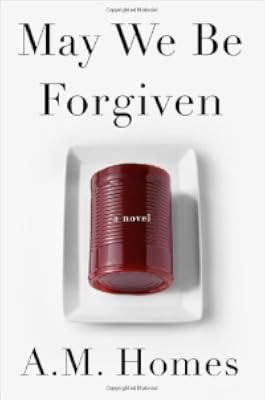
May We Be Forgiven
by A. M. Homes
On This Page
Description
Feeling overshadowed by his more-successful younger brother, Harold is shocked by his brother's violent act that irrevocably changes their lives, placing Harold in the role of father figure to his brother's adolescent children and caregiver to his aging parents.Tags
Recommendations









Member Recommendations
Member Reviews
Change comes in a variety of forms. The rarest, because it is usually virtuous and permanent, is the change a person chooses to make as a result of a realisation followed by a decision, for instance not to drink as much booze, or to eat many cup cakes, or to dedicate quite so much energy to levelling up and instead read a book occasionally. More usually, change arises as a result of a reaction to external events. Intervention change is very popular. Rule of thumb, if you get home and you are greeted by your dog wagging its tail with unconditional love, you can expect to go for a walk, have a beer, watch some telly and go to bed. If you get home and you are greeted with a room full of friends and family who begin the conversation with a show more declaration of their love for you (note not unconditional) then you had better develop a liking for orange juice, because chances are you are going to be drinking a shitload of it in future. Intervention change is so popular that it's become a television format, usually involving a host with a health related qualification from an educational establishment that only exists on the Internet confronting some poor sod with their weekly consumption of cheeseburgers, or porn (OK I made that last one up but that's the show I want to see, the amount of porn some poor pale bloke views on the web printed out in hard copy and used to stock a newsagent's shelves. Or a warehouse). And of course their is sudden change, either subtle or catastrophic, that is forced upon one and can be the result of years of smoking, a moment's inattention at your lathe, or an out-of-character unprovoked act of rage against some public art, or busker, as they are also known. How we deal with change is a mark of our character.
Change is in the wind for Harry, the protagonist in A. M. Homes's 'May we be forgiven'. Harry is not so much subject to the winds of change, but a full on blizzard of change, being a wind of change that snowballs.
Change is needed. Harry is unfulfilled and is just beginning to realise that his marriage is not successful and his job, if gauged by how interested his students are in his teaching, is frankly crap. Harry lacks the energy to do anything about this, but that's alright because his life is about to be dramatically changed for him. What begins with an apparent accident leads him to making some truly bad decisions and his life first falling apart and then arguably coming together in a wholly unexpected way that leaves him changed forever.
Family and relationships are at the centre of the novel. It's Harry's bullying younger brother whose car accident (or was it?) precipitates a tectonic shift in Harry's life and sees him go from married man to (in an unexpected but not wholly unbelievable twist) suburban sex-toy, from remote uncle to caring parent and from lacklustre teacher to scholar. All this and becoming a responsible pet-owner too.
It's a funny book, although at times the humour is found in some pretty dark places.
It's also surprisingly random and covers a lot of themes and issues. Although some ideas, like Harry's brother being released into the wild instead of banged up in prison, don't work so well, there's enough ideas and material in here for half a dozen novels, about middle aged people using the Internet to hook up for sex, and the consequences of this, about private education and its privileges and perils, about the relationship between monied America and poor America and between monied America and the developing world, about family and commitment and growing old.
The novel is, like Harry, deeply rooted in suburbia. It stresses the importance of home and family, is critical of boarding schools but chillingly acknowledges their occasional necessity, and is clear that the best place for children (of all ages) is in the home, not so that they can be watched over, but so that they can keep wayward adults on the straight and narrow. show less
Change is in the wind for Harry, the protagonist in A. M. Homes's 'May we be forgiven'. Harry is not so much subject to the winds of change, but a full on blizzard of change, being a wind of change that snowballs.
Change is needed. Harry is unfulfilled and is just beginning to realise that his marriage is not successful and his job, if gauged by how interested his students are in his teaching, is frankly crap. Harry lacks the energy to do anything about this, but that's alright because his life is about to be dramatically changed for him. What begins with an apparent accident leads him to making some truly bad decisions and his life first falling apart and then arguably coming together in a wholly unexpected way that leaves him changed forever.
Family and relationships are at the centre of the novel. It's Harry's bullying younger brother whose car accident (or was it?) precipitates a tectonic shift in Harry's life and sees him go from married man to (in an unexpected but not wholly unbelievable twist) suburban sex-toy, from remote uncle to caring parent and from lacklustre teacher to scholar. All this and becoming a responsible pet-owner too.
It's a funny book, although at times the humour is found in some pretty dark places.
It's also surprisingly random and covers a lot of themes and issues. Although some ideas, like Harry's brother being released into the wild instead of banged up in prison, don't work so well, there's enough ideas and material in here for half a dozen novels, about middle aged people using the Internet to hook up for sex, and the consequences of this, about private education and its privileges and perils, about the relationship between monied America and poor America and between monied America and the developing world, about family and commitment and growing old.
The novel is, like Harry, deeply rooted in suburbia. It stresses the importance of home and family, is critical of boarding schools but chillingly acknowledges their occasional necessity, and is clear that the best place for children (of all ages) is in the home, not so that they can be watched over, but so that they can keep wayward adults on the straight and narrow. show less
How do adults and children rebound from a catastrophe? That's what concerns a very diverse group of people who form a new family in response to what life does to them. We are with these characters for a year, and it is Homes' gift that we, the readers, join the family as well. This is book that incorporates what might be called American magical realism, like The World According to Garp. As in that classic, you suspend your disbelief and accept the novel because it has such joy and love in it (as well as violence and pain). The wild card here is the lead character's fascination with Richard M. Nixon. You rejoice as you watch these men, women, and children grow up a great deal in 365 days. New love comforts the loss of old, and by the show more book's conclusion, you are pretty sure that nearly everyone has learned critical lessons that will enable them to live satsfying and moral lives. show less
”May we be forgiven,” an incantation, a prayer, the hope that somehow I come out of this alive. Was there ever a time you thought – I am doing this on purpose, I am fucking up and I don’t know why.
Do you want my recipe for disaster?
So begins the new novel from A. M. Homes. It shoots off like a rocket, then jolts with hilarious situations combined with numbing tragedy. And as with many of her books the children are more the adults than the adults. The children are the responsible, caring, thoughtful people while the parents act like children. And in this one the adult narrator finally learns what is important in life, mostly gleaned from the children.
Last night we went to the movies and saw Fruitvale Station. This, a movie based show more off of a true story about a man being killed senselessly be police, reminded me of May We Be Forgiven. Both are stories of life and why we are here. They both say: Just be good to other people. Be kind, not “even”, but “especially” to strangers. Give. Don’t take. Family is of vital importance. It is a world that you (at least I) rarely see. Both stories combined this kind of truth with brutal violence and reality. There were people in the theater weeping openly by the end of the movie as I wept a few times during the reading of this novel.
A.M Homes may not be Dostoevsky, but she knows how to pierce you through the heart and then make you laugh your ass off. She may not ever win the Nobel Prize in Literature, but this very well may be her masterpiece. show less
Do you want my recipe for disaster?
So begins the new novel from A. M. Homes. It shoots off like a rocket, then jolts with hilarious situations combined with numbing tragedy. And as with many of her books the children are more the adults than the adults. The children are the responsible, caring, thoughtful people while the parents act like children. And in this one the adult narrator finally learns what is important in life, mostly gleaned from the children.
Last night we went to the movies and saw Fruitvale Station. This, a movie based show more off of a true story about a man being killed senselessly be police, reminded me of May We Be Forgiven. Both are stories of life and why we are here. They both say: Just be good to other people. Be kind, not “even”, but “especially” to strangers. Give. Don’t take. Family is of vital importance. It is a world that you (at least I) rarely see. Both stories combined this kind of truth with brutal violence and reality. There were people in the theater weeping openly by the end of the movie as I wept a few times during the reading of this novel.
A.M Homes may not be Dostoevsky, but she knows how to pierce you through the heart and then make you laugh your ass off. She may not ever win the Nobel Prize in Literature, but this very well may be her masterpiece. show less
Harry and his brother George have not really got along for most of their lives. Harry is a mild-mannered historian who teaches at a college, George is high-flying tv executive. One Thanksgiving after dinner George's wife kisses Harry and their affair ends up with George charged with the murder of his wife and Harry losing his wife and his job. Facing life as a single man and charged with looking after George's children, Harry has to find a new path in life.
In this book A M Homes has taken a simple story of rivalry and infidelity and created a funny and clever novel. Neither Harry nor George is particularly likeable at the start but in exploring his new life Harry has a series of professional and sexual encounters that have huge show more influence on his future. The sub-plots about love among the retirees and the nature of Jewish families are wonderfully entertaining. Whilst this is a long book, it never seems overly extended and delights regularly. show less
In this book A M Homes has taken a simple story of rivalry and infidelity and created a funny and clever novel. Neither Harry nor George is particularly likeable at the start but in exploring his new life Harry has a series of professional and sexual encounters that have huge show more influence on his future. The sub-plots about love among the retirees and the nature of Jewish families are wonderfully entertaining. Whilst this is a long book, it never seems overly extended and delights regularly. show less
During the course of a single year, from one Thanksgiving to the next, Harold Silver goes through a lot. Things start badly when his sister-in-law, whom he secretly covets, kisses him in the kitchen as they are cleaning up after the festive dinner. That sets something in motion, or maybe it just latches onto something that was already in motion. Within a few pages, Harold’s brother, George, commits vehicular manslaughter killing two strangers, then whilst supposedly under supervision in a hospital he walks out and makes his way home and kills his adulterous wife, Jane, after first beating his brother senseless. By now, the reader is most certainly gripping the pages of the book with both hands much like a correspondingly terrifying show more roller-coaster. But this is only the beginning. Better hold on tight for the ride ahead.
A.M. Homes has a remarkable ability to thrust the reader directly into the action. You can begin to feel a bit breathless and perhaps start hoping for a bit of descriptive relief or nuanced character development to take the edge off. Not happening! Homes instead turns the crank on the plot so that more and more and more stuff just keeps happening. To accomplish this, she seems entirely willing to forego any depth of character, specificity of locale, or plausibility. Harold, a typical Homes protagonist, is a bit befuddled, weighted down with an unpleasant childhood, guilt ridden but earnest, ineffectual at least initially, and, curiously, an apparent sexual magnet, though his life before these events would not have led one to expect this. Harold takes on the burden of his brother’s two young children, his dog and cat, and eventually numerous others as he works through a form of atonement perhaps. But it is atonement that gradually changes Harold himself so that by the end of his annus horribilis he is almost a different person.
The writing here is all surface. But not superficial. At times Homes brilliantly invokes the writing of others. How? By simply having Don DeLillo appear briefly as a character. Or John Cheever. It is a fascinating approach to post-modernism, I suppose. And perhaps it even works. It is hard to say. I’m prepared to accept that views on this novel might diverge drastically. For me, it almost worked and so I gently recommend it to others. show less
A.M. Homes has a remarkable ability to thrust the reader directly into the action. You can begin to feel a bit breathless and perhaps start hoping for a bit of descriptive relief or nuanced character development to take the edge off. Not happening! Homes instead turns the crank on the plot so that more and more and more stuff just keeps happening. To accomplish this, she seems entirely willing to forego any depth of character, specificity of locale, or plausibility. Harold, a typical Homes protagonist, is a bit befuddled, weighted down with an unpleasant childhood, guilt ridden but earnest, ineffectual at least initially, and, curiously, an apparent sexual magnet, though his life before these events would not have led one to expect this. Harold takes on the burden of his brother’s two young children, his dog and cat, and eventually numerous others as he works through a form of atonement perhaps. But it is atonement that gradually changes Harold himself so that by the end of his annus horribilis he is almost a different person.
The writing here is all surface. But not superficial. At times Homes brilliantly invokes the writing of others. How? By simply having Don DeLillo appear briefly as a character. Or John Cheever. It is a fascinating approach to post-modernism, I suppose. And perhaps it even works. It is hard to say. I’m prepared to accept that views on this novel might diverge drastically. For me, it almost worked and so I gently recommend it to others. show less
I loved this book but am going to find it hard to explain why. It starts pretty dramatically and then follows Harry as he drifts from one ludicrous situation to another, with very little rhyme or reason to it. Don De Lillo keeps turning up in the local shop, there's a big subplot about Nixon, random women keep wanting to have sex with him, his brother is in a world of madness, there's a Bar Mitzah in South Africa. None of it quite makes sense, but it's a great read, and beyond the flippant funny stuff it's ultimately a story of a disparate group of people becoming better people, becoming a family.
On re-reading 9 years later it is still a great book. It has something of a Corrections vibe to it.
On re-reading 9 years later it is still a great book. It has something of a Corrections vibe to it.
A little far-fetched and just downright bizarre at times, but still, an overall wonderful ride of a book, through all the complexities of the family you are born into, and the one you create. This reminded me in many ways of Homes's other novels, filled with disenchanted suburbanites, unlikely friendships, ramifications of horrific decisions (and some good ones too) and at the core, the desire to find better and do better. Uncomfortable sex, dark humor, bad habits and poking fun at all kinds of spiritual paths abound, but what I think her novels do ultimately, is lighten me up. Yes, life can be hard, but truly, it is what you make of it. Highly recommended for awesome entertainment and escaping into other people's really weird lives. show more She also writes incredibly well not only from a male perspective, but her teenager/child characters are frighteningly real. show less
Members
- Recently Added By
Published Reviews
ThingScore 75
Almost exactly three-quarters of the way through this wonderful, wild, heartbreaking, hilarious and astonishing novel, A M Homes gives us this paragraph: "And then – the real craziness starts. Later, I will wonder if this part really happened or if I dreamed it."
Given the huge amount of craziness in the 355 pages that precedes that paragraph, this really sets the reader up for a humdinger of show more a finale, one that Homes delivers with aplomb.....This is a piercing, perceptive and deeply funny novel about the nature of life, and about finding your family wherever you can, wherever you get comfort and something approaching love. show less
added by vancouverdeb
The narrative is unrelenting, and yet it makes a kind of sense that all these troubles should be brought to bear on a few individuals. What’s interesting about this book is that for all its ferocious now-ness, its messages are old fashioned. Peace is found in a South African village, amongst community and participation; acts of kindness bring their own rewards. Homes, however, is not a pious show more or a schmaltzy writer – she is aware that things are compromised, as when George’s son Nate realises that the South African villagers he’s been supporting are really only interested in what material goods they can buy. But this doesn’t detract from the morality of the book’s core. Only connect, Homes tells us, and we can escape the nightmare of the 21st century – if only for a while. .....AM Homes’s ambitious novel, May We Be Forgiven, impresses. show less
added by vancouverdeb
To pair sociological sweep with psychological intimacy, as this book sets out to do, is a laudable ambition. It may even be where the vital center of American fiction is, circa 2012. But Homes hasn’t yet developed the formal vocabulary to reconcile her Cheever side and her DeLillo side. Instead, they end up licensing each other’s failures, canceling each other out. And so what might have show more been a stereoscopic view of The Way We Live Now ends as an ungainly portmanteau: a picaresque in which nothing much happens, a confession we can’t quite believe, a satire whose targets are already dead. show less
added by vancouverdeb
Lists

Favourite books from the 2013 Women's Prize for Fiction (Orange Prize) long
20 works; 17 members

Top Five Books of 2013
1,562 works; 721 members

Favourite Women's Prize for Fiction, Orange & Bailey's Prize contenders
132 works; 52 members

Recommend the 20 best books you've read in the last five years
2,168 works; 607 members

Baileys Women's Prize for Fiction Winners and Shortlisted Books
61 works; 11 members

Pleasant Surprises: Books That Exceeded Our Expectations
418 works; 143 members

Women's Prize for Fiction
29 works; 5 members

BBC Radio 4 Bookclub
341 works; 13 members

IMPAC Dublin Literary Award 2014 longlist
150 works; 3 members

A Novel Cure
742 works; 23 members

to get
244 works; 2 members
Author Information

Some Editions
Awards and Honors
Awards
Series
Belongs to Publisher Series
Heyne Allgemeine Reihe (43817)
Common Knowledge
- Canonical title
- May We Be Forgiven
- Original title
- May We Be Forgiven
- Original publication date
- 2012
- People/Characters
- Harry Silver; George Silver
- Important places
- Nateville, South Africa
- Dedication
- For Claudia to whom I owe a debt of gratitude
- First words
- Do you want my recipe for disaster?
- Last words
- (Click to show. Warning: May contain spoilers.)May we be forgiven.
- Blurbers
- Rushdie, Salman; Winterson, Jeanette; McInerny, Jay; Shteyngart, Gary; Sayles, John
- Disambiguation notice
- Please do not combine with the single title book or the book containing this story. Thanks.
Classifications
Statistics
- Members
- 1,211
- Popularity
- 20,547
- Reviews
- 60
- Rating
- (3.66)
- Languages
- 8 — Dutch, English, Estonian, French, German, Italian, Portuguese, Spanish
- Media
- Paper, Audiobook, Ebook
- ISBNs
- 29
- ASINs
- 12