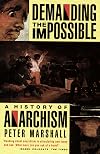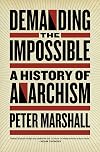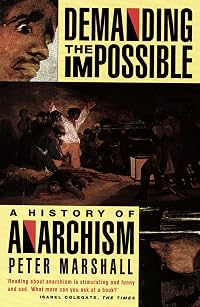
Demanding the Impossible: A History of Anarchism
by Peter H. Marshall
On This Page
Description
Lively and authoritative, this study of a widely misunderstood subject skillfully navigates the rough waters of anarchistic concepts?from Taoism to Situationism, ranters to punk rockers, individualists to communists, and anarcho-syndicalists to anarcha-feminists. Exploring key anarchist ideas of society and the state, freedom and equality, authority and power, the record investigates the successes and failures of anarchist movements throughout the world. Presenting a balanced and critical show more survey, the detailed document covers not only classic anarchist thinkers?such as Godwin, Proudhon, Bakunin, Kropotkin, Reclus, and Emma Goldman?but also other libertarian figures, such as Nietzsche, Camus, Gandhi, Foucault, and Chomsky. Essential reading for anyone wishing to understand what anarchists stand for and what they have achieved, this fascinating account also includes an epilogue that examines the most recent developments, including postanarchism and anarcho-primitivism as well as the anarchist contributions to the peace, green, and global justice movements of the 21st century. show lessTags
Recommendations






























Member Reviews
This is a fairly substantial and worthy account of the history of anarchism, largely built around review chapters of prominent figures and historical reviews of anarchism in action. It takes a broad view by including writers and thinkers who might better or equally be considered liberal or libertarian, although Marshall is always at pains to show their differences from classical anarchist thought.
It has to be said that it can be a little dull at times and there is a lack of a sustained overview, something that would give us a better idea of what it all may mean. It was also written in or around 1991/2 so the 'action' (such as it is) takes place at one of the low points in anarchist history - a quarter of a century after the collapse of show more the student hopes of the 1960s.
Similarly, Marshall is writing at least a decade and probably more before the internet permits the creation of a new politically-directed hacker activism and the emergence of the post-2008 insurrectionism that, one suspects, would have thoroughly confused the somewhat earnest intellectuals who dominate his book.
Indeed, that is the problem with the tale told here. This is mostly a story of intellectuals pontificating from on high about ‘shoulds’ and ‘oughts’ and about the nature of humanity and the world in a way that bears little relationship to the actual lived-in world of the people they claim that they want to liberate.
And it gets worse over time. The culmination of the book is a deathly dull (I skimmed in the end) account of the thoughts of that dodgy old Hegelian Murray Bookchin, a throw-back to the nineteenth century if ever there was one.
Marshall is old-school. The succession of (mostly) dead and nearly-dead white males leaves one, ultimately, less minded to anarchism at the end than one was at the beginning, partly because of the brutal realization that, if most of these gentlemen could have achieved their utopian dreams, the rest of us would have been oppressed and miserable before very long, certainly from utter boredom in their craftsman/peasant, neighbourly, crushingly dull, little communities.
At the end of the day, most of these thinkers (as opposed to the far more interesting practical seizures of power by anarchists in the Latin street) have no real language for accepting humanity as it is and so they rapidly go scuttling into a world of claimed reason where you can read petit-bourgeois tyranny on every page, at least when the people do not match up to the dreams of their saviours.
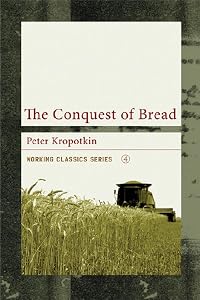
The Green Anarchism of Murray Bookchin is typical. His is a turgid and unrealistic Hegelianism that has very little to do with real freedom, calling us back to what amounts to the faith-based politics of dreamers like Kropotkin and Tolstoy via that German theoretician.
Anything that is ultimately faith-based or essentialist is definitely a bit creepy to anyone with their two feet placed firmly on the earth and many anarchists can be lumped with the Marxists and New Age loons in that respect.
In the end, one is thrown back to a place somewhere between the minimal state libertarianism and a humane left-libertarianism that permits some state action to enable all to be autonomous on equal terms. Grand theory has little to say to us here, praxis everything.
But even the praxis leaves us with a romantic bad taste in the mouth because every decent anarchist experiment – the Paris Commune, the Kronstadt rebellion, Makhno in the Ukraine, the POUM in Catalonia, the Evenements of ‘68 and many others – is quite simply crushed by superior reality.
Not just by superior force but by the fact that the force represents something – the reality of the situation. As a romantic, I am definitely with all these rebellions but, let's face it, participation is heroic but futile, an act of suicide. It would be like Mishima's hari-kiri only for the goodies.
It is not enough to say that these experiments ‘should have won’ because they were ‘right’. The truth is they did not win for very good reasons related to what we are as human beings. The only successful anarchist rebellion would be one that could change humanity – and that is very dangerous territory indeed, a repetition by force of what the Bolsheviks tried and failed to do.
All in all, this book, which is highly sympathetic to the movement, tells us that anarchic thinking is like a chair that is very appealing to the eye but falls apart when someone tries to sit on it. If it did not exist, it would have to be invented but only as a constraint or restraint on power, by promising rebellion if lines were crossed but not as an option for any social organization that is actually viable.
This has implications for the four main current strands of quasi-anarchic thinking in the world today – hacker activism, greenery (which has already compromised with reality to gain a power that it probably does not deserve), the Occupy Movement and anarcho-capitalist libertarianism.
All of these are troublesome for the prevailing order but none of them represent a terminal threat – indeed, the Occupy Movement’s achievement may have been little more than mobilizing the vote for Tweedledum Obama over Tweedledee Romney and giving the State some populist welly when it is minded to bring the capitalists to heel for its own tax-raising purposes. It is interesting that the State did not even bother to do that.
Occupy is particularly daft from a classical anarchist perspective. It is led by naïve middle class students and activists whose sole purpose seems to be to get more cash into the hands of the State from the private sector or give the NGOs a bit more oomph in the street so that money can then be diverted to their latest pet project. The general public, of course, has seen through this.
The most threatening to the State may be hacker activism and then only because its more louche side is quite prepared to act as intellectual muscle for organized crime. But it can just as easily be co-opted into the State Department’s manipulative cyberwars against states it does not approve of and it is most effective as trail-blazer for anarcho-capitalism’s darker side. Kim Dotcom is an anarchist of sorts but not quite what Prince Pyotr Kropotkin had in mind.
Even in Greece today, where one would most expect insurrection, the struggle for mastery over a corrupt and failed bourgeois elite, backed by the European Union, is in the hands either of sensible Leftists who have no intention of unraveling the State and a bunch of gangster fascists. In Catalonia, the drive for independence is also no longer associated with anarchist ideology but with a revived Leftism.
Worse, this Euro-Leftism is not only not anarchist in the traditional sense but is imbued with an ideology of identity politics that wholly relies on the State to impose its cultural agenda on an increasingly resentful mass (at least that proportion of the mass not on the State pay roll, admittedly a decreasing proportion).
Having said all that, if we winnow out perhaps seven out of ten of the anarcho-intellectuals as either faith-based essentialists (and we include the Hegelians) or narcissistic imposers of their values and personality on the world, we are left with some good people and good thinking. The American Paul Goodman stood out in this respect. And it was good to see Foucault briefly included as gad fly.
There is real value in anarchism but not as praxis or ideology. Its value lies in it being a reminder of the core value to humanity of personal autonomy and of individuation. People of anarchist bent would do much better to hold their noses and engage with the political process and the State through improved organization, if only to halt the growing power of authoritarian Leftists, fascists and religious believers. Camus' concept of rebellion as preferable to revolution holds water here - we can all constantly rebel against the unwarranted demands and claims of others.
The final pages of the book raise issues with anarchism as practical politics but by this time we have all made our mind up – either we are anarchists or we are not. I am not – more so after reading the book than before. My initial sympathies dissipated chapter by chapter as I realized that I would be filled with a terminal boredom by these men and their utopias.
Anarchists are too often people who have lost their sense of reality, equally as much as the religious types they claim to despise. In some cases (horror of horrors!), they will even claim to have found a better God or reality as did Tolstoy. Any politics that has a place for invented beings and universal consciousnesses must be considered dangerous and yet a small minority of anarchists persist in this sort of flummery.
Like Marxism, anarchism can be religion by other means and so deeply dangerous to non-believers in the long run. Nevertheless, this book is strongly recommended as a sound guide to what anarchists have thought in the past and what they did in history. show less
It has to be said that it can be a little dull at times and there is a lack of a sustained overview, something that would give us a better idea of what it all may mean. It was also written in or around 1991/2 so the 'action' (such as it is) takes place at one of the low points in anarchist history - a quarter of a century after the collapse of show more the student hopes of the 1960s.
Similarly, Marshall is writing at least a decade and probably more before the internet permits the creation of a new politically-directed hacker activism and the emergence of the post-2008 insurrectionism that, one suspects, would have thoroughly confused the somewhat earnest intellectuals who dominate his book.
Indeed, that is the problem with the tale told here. This is mostly a story of intellectuals pontificating from on high about ‘shoulds’ and ‘oughts’ and about the nature of humanity and the world in a way that bears little relationship to the actual lived-in world of the people they claim that they want to liberate.
And it gets worse over time. The culmination of the book is a deathly dull (I skimmed in the end) account of the thoughts of that dodgy old Hegelian Murray Bookchin, a throw-back to the nineteenth century if ever there was one.
Marshall is old-school. The succession of (mostly) dead and nearly-dead white males leaves one, ultimately, less minded to anarchism at the end than one was at the beginning, partly because of the brutal realization that, if most of these gentlemen could have achieved their utopian dreams, the rest of us would have been oppressed and miserable before very long, certainly from utter boredom in their craftsman/peasant, neighbourly, crushingly dull, little communities.
At the end of the day, most of these thinkers (as opposed to the far more interesting practical seizures of power by anarchists in the Latin street) have no real language for accepting humanity as it is and so they rapidly go scuttling into a world of claimed reason where you can read petit-bourgeois tyranny on every page, at least when the people do not match up to the dreams of their saviours.
The Green Anarchism of Murray Bookchin is typical. His is a turgid and unrealistic Hegelianism that has very little to do with real freedom, calling us back to what amounts to the faith-based politics of dreamers like Kropotkin and Tolstoy via that German theoretician.
Anything that is ultimately faith-based or essentialist is definitely a bit creepy to anyone with their two feet placed firmly on the earth and many anarchists can be lumped with the Marxists and New Age loons in that respect.
In the end, one is thrown back to a place somewhere between the minimal state libertarianism and a humane left-libertarianism that permits some state action to enable all to be autonomous on equal terms. Grand theory has little to say to us here, praxis everything.
But even the praxis leaves us with a romantic bad taste in the mouth because every decent anarchist experiment – the Paris Commune, the Kronstadt rebellion, Makhno in the Ukraine, the POUM in Catalonia, the Evenements of ‘68 and many others – is quite simply crushed by superior reality.
Not just by superior force but by the fact that the force represents something – the reality of the situation. As a romantic, I am definitely with all these rebellions but, let's face it, participation is heroic but futile, an act of suicide. It would be like Mishima's hari-kiri only for the goodies.
It is not enough to say that these experiments ‘should have won’ because they were ‘right’. The truth is they did not win for very good reasons related to what we are as human beings. The only successful anarchist rebellion would be one that could change humanity – and that is very dangerous territory indeed, a repetition by force of what the Bolsheviks tried and failed to do.
All in all, this book, which is highly sympathetic to the movement, tells us that anarchic thinking is like a chair that is very appealing to the eye but falls apart when someone tries to sit on it. If it did not exist, it would have to be invented but only as a constraint or restraint on power, by promising rebellion if lines were crossed but not as an option for any social organization that is actually viable.
This has implications for the four main current strands of quasi-anarchic thinking in the world today – hacker activism, greenery (which has already compromised with reality to gain a power that it probably does not deserve), the Occupy Movement and anarcho-capitalist libertarianism.
All of these are troublesome for the prevailing order but none of them represent a terminal threat – indeed, the Occupy Movement’s achievement may have been little more than mobilizing the vote for Tweedledum Obama over Tweedledee Romney and giving the State some populist welly when it is minded to bring the capitalists to heel for its own tax-raising purposes. It is interesting that the State did not even bother to do that.
Occupy is particularly daft from a classical anarchist perspective. It is led by naïve middle class students and activists whose sole purpose seems to be to get more cash into the hands of the State from the private sector or give the NGOs a bit more oomph in the street so that money can then be diverted to their latest pet project. The general public, of course, has seen through this.
The most threatening to the State may be hacker activism and then only because its more louche side is quite prepared to act as intellectual muscle for organized crime. But it can just as easily be co-opted into the State Department’s manipulative cyberwars against states it does not approve of and it is most effective as trail-blazer for anarcho-capitalism’s darker side. Kim Dotcom is an anarchist of sorts but not quite what Prince Pyotr Kropotkin had in mind.
Even in Greece today, where one would most expect insurrection, the struggle for mastery over a corrupt and failed bourgeois elite, backed by the European Union, is in the hands either of sensible Leftists who have no intention of unraveling the State and a bunch of gangster fascists. In Catalonia, the drive for independence is also no longer associated with anarchist ideology but with a revived Leftism.
Worse, this Euro-Leftism is not only not anarchist in the traditional sense but is imbued with an ideology of identity politics that wholly relies on the State to impose its cultural agenda on an increasingly resentful mass (at least that proportion of the mass not on the State pay roll, admittedly a decreasing proportion).
Having said all that, if we winnow out perhaps seven out of ten of the anarcho-intellectuals as either faith-based essentialists (and we include the Hegelians) or narcissistic imposers of their values and personality on the world, we are left with some good people and good thinking. The American Paul Goodman stood out in this respect. And it was good to see Foucault briefly included as gad fly.
There is real value in anarchism but not as praxis or ideology. Its value lies in it being a reminder of the core value to humanity of personal autonomy and of individuation. People of anarchist bent would do much better to hold their noses and engage with the political process and the State through improved organization, if only to halt the growing power of authoritarian Leftists, fascists and religious believers. Camus' concept of rebellion as preferable to revolution holds water here - we can all constantly rebel against the unwarranted demands and claims of others.
The final pages of the book raise issues with anarchism as practical politics but by this time we have all made our mind up – either we are anarchists or we are not. I am not – more so after reading the book than before. My initial sympathies dissipated chapter by chapter as I realized that I would be filled with a terminal boredom by these men and their utopias.
Anarchists are too often people who have lost their sense of reality, equally as much as the religious types they claim to despise. In some cases (horror of horrors!), they will even claim to have found a better God or reality as did Tolstoy. Any politics that has a place for invented beings and universal consciousnesses must be considered dangerous and yet a small minority of anarchists persist in this sort of flummery.
Like Marxism, anarchism can be religion by other means and so deeply dangerous to non-believers in the long run. Nevertheless, this book is strongly recommended as a sound guide to what anarchists have thought in the past and what they did in history. show less
Anarchism is a philosophical and political creed which many individuals have subscribed to over the centuries, and for which many have been persecuted by other more authoritive ideologies like fascism and state socialism. There have been anarchist-inspired revolutions - in Spain, in the Ukraine, in Mexico - which have in turn led to (however short-lived) anarchist administrations. But anarchism's power has, first and foremost, been the power of the lone protestor, the dissenter who is unafraid to expose himself to reprisal for the sake of preaching the real gospel of liberty, equality and fraternity which so many so-called revolutionaries usually leave in tatters once they graduate from barricades to corridors of power. The author show more argues that the spirit of anarchism is in the voice of Tolstoy, of Gandhi, of Bakunin and of Godwin, of Camus and of Chomsky. show less
Vast amount of material, yet only just over 700 pages.
Ratings
Members
- Recently Added By
Lists

Book Riot Read Harder 2026
80 works; 1 member

r/AskHistorians' Recommended Books
1,068 works; 19 members
Author Information

18 Works 1,218 Members
Common Knowledge
- Canonical title
- Demanding the Impossible: A History of Anarchism
- Original title
- Be realistic: demand the impossible!
- Original publication date
- 1992
Classifications
Statistics
- Members
- 587
- Popularity
- 50,168
- Reviews
- 3
- Rating
- (3.93)
- Languages
- English, Turkish
- Media
- Paper, Ebook
- ISBNs
- 8
- ASINs
- 5