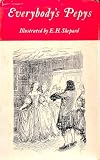
Everybody's Pepys
by Samuel Pepys
On This Page
Tags
Recommendations

























Member Reviews
There are countless versions of Pepys out there (testament to the enduring fascination of the man), but this is my favorite - not only has Morsehead chosen exquisitely from among the many volumes of Pepys, but illustrator Ernest Shepard's line drawings are memorably playful, as are his illustrations for 'Everybody's Johnson' and 'Everybody's Lamb'
Delightful reading of life and times of London 1660 - 1669, Written as a diary in short-hand and only deciphered and first published in 1865. Several editions were translated from the original 6 volume leather bound octavo volumes found in the Magdalene College, Cambridge University. This edition first published in 1926. Reprinted in 1948. 60 Illustrations by Ernest H. Shepard. 4 Maps of London in the 1660s and an index by C. McL. Morley. Blue stiff cover of 570 pages, 130mm wide x 187mm high x 22.5mm thick.
Abridged from the complete cpoyright text edited by Henry B, Wheatley.
Four Maps of London in the Sixsteen-Sixties by A.E. Taylor
Four Maps of London in the Sixsteen-Sixties by A.E. Taylor
Aug 1, 2016Dutch
Ratings
Members
- Recently Added By
Lists

Trinity College Booklist (1951): Class Six, Biography
119 works; 4 members
Author Information

363+ Works 6,798 Members
Samuel Pepys was an English naval administrator and Member of Parliament who is now most famous for the diary he kept for a decade while still a relatively young man. By his hard work and his talent for administration, he rose to be the Chief Secretary to the Admiralty under both King Charles II and King James II. The detailed private diary Pepys show more kept from 1660 until 1669 was first published in the 19th century, and is one of the most important primary sources for the English Restoration period. It provides a combination of personal revelation and eyewitness accounts of great events, such as the Great Plague of London, the Second Dutch War and the Great Fire of London. Pepys's diary has become a national monument. The diary was written in one of the many standard forms of shorthand used in Pepys's time, in this case called Tachygraphy; devised by Thomas Shelton. At the end of May 1669, he reluctantly concluded that, for the sake of his eyes, he should completely stop writing and, from then on, only dictate to his clerks which meant he could no longer keep his diary. In total, Pepys wrote for approximately nine years. This collection of both personal and political accounts is an important timepiece that illustartes life in 17th Century England. When Pepys died on May 26, 1703, he had no children and left his entire estate to his nephew, John Jackson. His estate included over 3,000 volumes in his collection of books. All of these were indexed and catalogued; they form one of the most important surviving private laibraries of the 17th century. (Bowker Author Biography) show less
Common Knowledge
- Original publication date
- 1669 (diary) (diary); 1926 (abridgement) (abridgement)
- People/Characters
- John Crew (Baron Crew of Stene); Samuel Pepys; Matthew Lock (composer in ordinary to Charles II); Charles II, King of England, Scotland, and Ireland
- Important places
- London, England, UK
Classifications
- Genres
- Biography & Memoir, History, Nonfiction
- DDC/MDS
- 828.403 — Literature & rhetoric English & Old English literatures English miscellaneous writings English miscellaneous writings 1625-1702 Diaries, journals, notebooks, reminiscences
- LCC
- DA447 .P4 .A4 — History of Europe, Asia, Africa and Oceania Great Britain History of Great Britain England History By period Modern, 1485- Later Stuarts
Statistics
- Members
- 120
- Popularity
- 272,295
- Reviews
- 3
- Rating
- (4.04)
- Languages
- Dutch, English
- Media
- Paper
- ISBNs
- 1
- ASINs
- 18