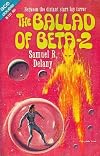
The Ballad of Beta-2
by Samuel R. Delany
On This Page
Description
Centuries ago, the Star Folk had left Earth on twelve spaceships on a generations-long mission to colonize the distant stars. Ten of the ships had reached their destinations. Two had failed-and nobody, in the hundreds of years since the disaster, had the slightest inkling of what had happened. Joneny, a student of galactic anthropology, was assigned the problem. It had seemed routine to him. Just some faster-than-light travel to the two wrecked ships, a bit of poking around, and then writing show more up his findings. But he was ill-prepared for what he found in space at the site of the two ancient wrecks. One, the Sigma-9, was not subject to the laws of time-stasis (the only exception to a universal law), and it was covered entirely with a mysterious green fire that shimmered so much that it seemed alive! And the other ship, the Beta-2, was nowhere to be found. Only a fragment of a mysterious poem could possibly provide a clue. show lessTags
Recommendations























Member Reviews
Delany, Samuel R. The Ballad of Beta-2. Orion, 1965. Gateway, 2012.
Even in his earliest novels, Samuel R. Delany was always stretching the boundaries of science fiction. The Ballad of Beta-2 (1965) is more comfortably in the genre than Nova or Babel-17, but it, too, would really rather be something else—an invented myth or a future bardic epic. Here is the science fiction premise: in the far future, an anthropology student researching the meaning of an ancient ballad, originated on an early interstellar colony ship, visits its wreck, still traveling through space. To his surprise, he finds the wreck still inhabited by the much-changed descendants of its original crew. In the end, the reader may learn more from the ballad and its story show more than the graduate student does. It has always struck me as ironic that in his middle age Delany became a professor. I wonder if he would now look at the limitations of his protagonist more sympathetically than he did in his early 20s. show less
Even in his earliest novels, Samuel R. Delany was always stretching the boundaries of science fiction. The Ballad of Beta-2 (1965) is more comfortably in the genre than Nova or Babel-17, but it, too, would really rather be something else—an invented myth or a future bardic epic. Here is the science fiction premise: in the far future, an anthropology student researching the meaning of an ancient ballad, originated on an early interstellar colony ship, visits its wreck, still traveling through space. To his surprise, he finds the wreck still inhabited by the much-changed descendants of its original crew. In the end, the reader may learn more from the ballad and its story show more than the graduate student does. It has always struck me as ironic that in his middle age Delany became a professor. I wonder if he would now look at the limitations of his protagonist more sympathetically than he did in his early 20s. show less
while working on his epic trilogy The Fall of the Towers, Chip had reached an impasse. In order to feel like he could finish something, he wrote this book, and then proceeded to finish the trilogy.
This is where Delany truly finds his voice.
The first time I read it I was tickled by his creation of an interstellar folk song; this time around I focused on it as a story about learning. Also, there's like only two actual people, and yet it really feels like there's a universe behind it.
This is where Delany truly finds his voice.
The first time I read it I was tickled by his creation of an interstellar folk song; this time around I focused on it as a story about learning. Also, there's like only two actual people, and yet it really feels like there's a universe behind it.
Here is the story of mankind's first, and unsuccessful, attempt to colonize another planet.
A dozen slow, multi-generation ships were sent to a distant star system called the Leffer System. Soon afterwards, mankind developed a star drive, so that by the time the ships reached their destination, mankind had been traveling around the galaxy for a hundred years. Of the dozen ships, two arrived empty, and two others never arrived at all. The ships were simply parked in orbit, and abandoned. Beta-2, one of the ships, even has its own ballad. Years later, as a college assignment, Joneny, a young researcher, is sent to find out just what happened.
Several of the supposedly indestructible ships show evidence of huge internal explosions. Some old show more audio recordings talk of being attacked by some sort of green humanoid that communicates by telepathy. Joneny meets the humanoid's half-human son, who is able to exist slightly outside of time, and live in hard vaccuum with no problem at all. He watches video from the other ships where the inhabitants have physically, and mentally, de-evolved to the level of an early human. "The Norm" is taken very seriously on the ships. If a person was found to be outside physical norms in any way, whether it's being too tall, or left-handed, or having the "wrong" eye color, they were immediately executed. By the end, Joneny understands just what The Ballad of Beta-2 is all about.
This is a short novel, but a very good one. It's an interesting story about how things on a multi-generation ship can go very wrong, and it's worth reading. show less
A dozen slow, multi-generation ships were sent to a distant star system called the Leffer System. Soon afterwards, mankind developed a star drive, so that by the time the ships reached their destination, mankind had been traveling around the galaxy for a hundred years. Of the dozen ships, two arrived empty, and two others never arrived at all. The ships were simply parked in orbit, and abandoned. Beta-2, one of the ships, even has its own ballad. Years later, as a college assignment, Joneny, a young researcher, is sent to find out just what happened.
Several of the supposedly indestructible ships show evidence of huge internal explosions. Some old show more audio recordings talk of being attacked by some sort of green humanoid that communicates by telepathy. Joneny meets the humanoid's half-human son, who is able to exist slightly outside of time, and live in hard vaccuum with no problem at all. He watches video from the other ships where the inhabitants have physically, and mentally, de-evolved to the level of an early human. "The Norm" is taken very seriously on the ships. If a person was found to be outside physical norms in any way, whether it's being too tall, or left-handed, or having the "wrong" eye color, they were immediately executed. By the end, Joneny understands just what The Ballad of Beta-2 is all about.
This is a short novel, but a very good one. It's an interesting story about how things on a multi-generation ship can go very wrong, and it's worth reading. show less
A riff on "pale fire" and a meditation on the relationship between history and language but also there are big spaceships and stuff. Very sick
This is a short novel featuring a couple of powerful ideas and some effective imagery, but not much in terms of characterization or story. A bored young graduate student is sent to investigate the scene of a curiously neglected space disaster, and finds out quite a bit more than he expected. Not one of Delany's best, but it does feature one of the author's typical "out there" characters, and certainly causes you to think about "the tyranny of mediocrity." It will only take you a couple of hours to read.
Really seemed like a short story. Author could have explored the topic in more depth.
Una de las primeras expediciones interestelares sufre un accidente cuyas causas se ignoran. La nave Beta-2 queda confinada en un lejano rincón de la galaxia, junto con la colonia humana que transportaba. Siglos después, Beta-2 y su Pueblo Estelar son ya leyenda. Los viejos lobos del espacio le cantan en Puertotierra, bajo los neones de las tabernas. Los profesores recogen los fragmentos de la antigua epopeya. Y los estudiantes se inclinan sobre ella para desentrañar la verdad de lo ocurrido.
Dec 13, 2022Spanish
Members
- Recently Added By
Lists

Books Read in 2015
3,299 works; 126 members
Author Information

194+ Works 28,955 Members
Samuel R. Delany Jr. was born in Harlem, New York on April 1, 1942. He is a science fiction and short story writer. His first novel, The Jewels of Aptor, was published in 1962. He has written more than 20 novels and collections of short stories, memoirs, and critical essays. He has received numerous awards including the Nebula Award for best novel show more for Babel-17 in 1966 and The Einstein Intersection in 1967, the Nebula Award for best short story for Aye, and Gomorrah and Time Considered as a Helix of Semi-Precious Stones, the Hugo Award for best short story for Time Considered as a Helix of Semi-Precious Stones in 1970 and for his non-fiction book, The Motion of Light in Water, and the Bill Whitehead Award for Lifetime Achievement in Gay Literature in 1993. He is as a professor in the department of English at the University at Buffalo, Buffalo, New York. (Bowker Author Biography) Samuel R. Delany is a professor of English & Creative Writing at Temple University in Philadelphia. (Publisher Provided) show less
All Editions
Some Editions
Awards and Honors
Awards
Series
Belongs to Publisher Series
Work Relationships
Is contained in
Common Knowledge
- Original title
- The Ballad of Beta-2
- Original publication date
- 1965
- People/Characters
- Joneny Horatio T'waboga; Captain Leela RT-857; Destroyer's Children; Judge Cartrite; Captain Alva
- First words
- "Quite simply, the answer is -- because they are there!"
- Quotations
- On the desk was a pile of books. Books! Real books were Joneny's delight. Heavy, cumbersome, difficult to store, they were the bane of most scholars. Joneny found them entrancing. He didn't care what was in them. Any b... (show all)ook today was so old that each word glittered to him like the facet of a lost gem. The whole conception of a book was so at odds with this compressed, crowded, breakneck era that he was put into ecstasy by the simple heft of the paper. His own collection, some seventy volumes, was considered a pretentious luxury by everyone at the University. The glory of the collection, each page impregnated with plastic, was the Manhattan Telephone Directory for 1975.
- Original language*
- English
- Disambiguation notice
- This work was also published as part of Ace Double M-121, (Alpha Yes, Terra No! . The Ballad of Beta-2). That work should NOT be combined with this one!
Furthermore, an anthology, edited by Delaney, and containing work... (show all) by Delaney, Bailey, Ellison, and others, appeared under the same title. That work, which is very rare, must be differentiated as well.
*Some information comes from Common Knowledge in other languages. Click "Edit" for more information.
Classifications
Statistics
- Members
- 403
- Popularity
- 77,314
- Reviews
- 10
- Rating
- (3.49)
- Languages
- English, French, Italian, Spanish
- Media
- Paper, Ebook
- ISBNs
- 8
- ASINs
- 8