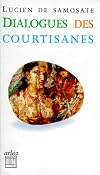
The Mimes des Courtisanes (Dialogues of the Courtesans)
by Lucian
On This Page
Description
Lucian of Samosata was a rhetorician and satirist who wrote in the Greek language. He is noted for his witty and scoffing nature. Although he wrote solely in Greek, he was ethnically Assyrian. Living at the height of the Roman Empire, the audience Lucian wrote for was hardly shocked by these short dialogues of the Greek hetaerae. However, two millenia of ensuing prudery made it impossible to acknowledge this part of the Lucian corpus, a set of humorous vignettes set in the context of the show more 'oldest profession,' let alone translate it into a vernacular language. These comedic sketches are timeless: working girls competing for clients, dishing gossip and candid tips of the trade, men trying to keep their girls' attention with expensive gifts. It also portrays the dark side of the hetaera's life: out-of-control parties, blowhard men, and putting up with rough treatment by clients show lessTags
Recommendations
































Member Reviews
This is a collection of 15 short dialogs among courtesans & their circle - lovers, mothers, and others... They're just little snapshots, a few pages. Very candid and earthy. Lots of art-deco type illustrations with bare breasts and bare asses. I didn't get any profound meaning out of this but it is a wonderfully lively portrayal of a facet of the society of Lucian's time.
Ratings
Members
- Recently Added By
Author Information

502+ Works 3,879 Members
Lucian, the wit and satirist, was a brilliant Greek writer in the time of the Roman Empire. He was born in Samosata, Syria. He traveled and lectured in Italy, Asia Minor, and Gaul; and in later life, held a government position in Egypt. Of nearly 80 works, the most important and characteristic are his essays written in dialogue form. "Dialogues of show more the Gods," which satirizes mythology; "Dialogues of the Dead," which are expositions of human vanity; and "The Sale of Lives," which satirizes various schools of philosophy. He is a good critical source for ancient art and for information about his literary contemporaries. "The True History," a nonsense fantasy and parody of adventure stories, influenced Rabelais, Swift 1), and Voltaire. (Bowker Author Biography) show less
Some Editions
Awards and Honors
Notable Lists
Series
Belongs to Publisher Series
Aetas (2)
Work Relationships
Is contained in
Dialogues of the Dead; Dialogues of the Sea-Gods; Dialogues of the Gods; Dialogues of the Courtesans by Lucian
Diálogos de los dioses / Diálogos de los muertos / Diálogos marinos / Diálogos de las cortesanas (Biblioteca tematica) (Spanish Edition) by Luciano de Samosata
Lucian's Dialogues of the Courtesans: An Intermediate Greek Reader: Greek Text with Running Vocabulary and Commentary by Lucian
Has as a reference guide/companion
Common Knowledge
- Canonical title
- The Mimes des Courtisanes (Dialogues of the Courtesans) (Dialogues of the Courtesans)
- Original title
- Ἑταιρικοὶ Διάλογοι
- Important places
- Alexandria, Egypt
- First words
- Well, Corinna, you see now that it wasn't so terrible to lose your virginity.
- Last words
- (Click to show. Warning: May contain spoilers.)We courtesans must not allow those whiskered philosophers to mislead the young generation.
- Original language
- Ancient Greek
Classifications
- Genres
- Fiction and Literature, General Fiction
- DDC/MDS
- 888.01 — Literature & rhetoric Classical & modern Greek literatures Classical Greek miscellaneous writings Greek miscellany Byzantine philosophy
- LCC
- PA4231 .D5 — Language and Literature Greek language and literature. Latin language and literature Greek literature Individual authors
- BISAC
Statistics
- Members
- 81
- Popularity
- 390,697
- Reviews
- 1
- Rating
- (3.44)
- Languages
- 6 — Catalan, Dutch, English, French, German, Italian
- Media
- Paper, Ebook
- ISBNs
- 15
- ASINs
- 11