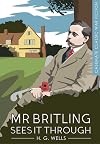
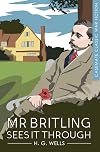
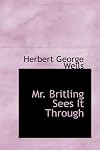
Mr. Britling Sees It Through
by H. G. Wells
On This Page
Description
Something of a departure from Wells' best-known works of science fiction, this domestic drama follows the wartime experiences of a famous writer and his family as they struggle to survive—physically and mentally—through World War I. Although the Britlings are far from the battlefront, they are still forced to make sacrifices of their own. This gratifying page-turner will please fans of historical fiction..
Tags
Recommendations


















Member Reviews
https://fromtheheartofeurope.eu/mr-britling-sees-it-through-by-h-g-wells/
I had no expectations whatsoever of this novel, originally published in 1916, one of the last of the novels in my big H.G. Wells collection. I found it a really impressive work, one of the best non-sf novels by Wells that I have read. Mr Britling is a self-parody of the author, a complacent intellectual writer with a nice place in the country, extended family around him and a lover in London. In 1914 he thinks that war is impossible, and if it comes it will be brief because sensible people of all countries will reject it. It turns out that he is wrong, and his world diminishes through loss and tragedy. I like Wells all the more for putting such a flawed version of show more himself front and centre; Britling is a very imperfect human being, but his tragedy is discovering that the imperfections of the world he lives in are much worse than he had imagined. There are some nice and respectful bits with Belgian refugees as well. show less
I had no expectations whatsoever of this novel, originally published in 1916, one of the last of the novels in my big H.G. Wells collection. I found it a really impressive work, one of the best non-sf novels by Wells that I have read. Mr Britling is a self-parody of the author, a complacent intellectual writer with a nice place in the country, extended family around him and a lover in London. In 1914 he thinks that war is impossible, and if it comes it will be brief because sensible people of all countries will reject it. It turns out that he is wrong, and his world diminishes through loss and tragedy. I like Wells all the more for putting such a flawed version of show more himself front and centre; Britling is a very imperfect human being, but his tragedy is discovering that the imperfections of the world he lives in are much worse than he had imagined. There are some nice and respectful bits with Belgian refugees as well. show less
I’ve always associated H. G. Wells with science fiction but this book, written in 1916 in the midst of WWI, provides a thought-provoking look at what appears to be a typical British family before and during the war. Mr. Britling is a writer of some renown whose commentaries on the British government, politics and the Irish question provide insight into his thoughts in the book’s early going. His adventures with “Gladys,” his newly acquired automobile provide a light and humorous touch that will later be countered by the impending talk of war. His greatest enjoyment is the Sunday hockey games played by everyone who happens to be in attendance---family members, friends, visitors including an American, Mr. Direck, and those in his show more employ including Herr Heinrich, the Britling boys’ tutor. The descriptions of the games brought to mind the depiction of the Kennedy family in the early 60s and their regular touch football games. Mr. Britling is also juggling his second wife, Edith, and his most recent in a long line of lovers, Mrs. Harrowdean. But utmost in his mind is his teenage son Hugh, born of his first wife and only true love, Mary. That she died so young and unexpectedly, when Hugh was just a toddler, grieves Mr. Britling these many years later.
As the narrative proceeds and we move closer to war, we leave behind the fun that “Gladys” and hockey provided, and Mr. Britling realizes that Mrs. Harrowdean would be better left to a younger man. To me, that narrative shift was quite brilliantly employed to announce the inevitable war years, and its accompanying hardships, shortages, and denial of any actual conflict:
”There was a quite genuine belief that the war might easily be too exclusively considered; that for the great mass of people it was a disturbing and distracting rather than a vital interest. The phrase ‘Business as Usual’ ran about the world, and the papers abounded in articles in which going on as though there was no war at all was demonstrated to be the truest form of patriotism….’Business as usual during Alterations to the Map of Europe’ was the advertisement of one cheerful barber, widely quoted.”
But unfortunately there was an actual conflict and it doesn’t take very long before it is “stretching out a long and shadowy arm…towards Hugh.” And Mr. Britling lives the war through Hugh’s letters from the trenches in Europe where we get an eye witness view of the boredom and disappointment of life in the trenches, the lack of leadership, and the gross shortages of guns and other supplies. Through some of the most poignant writing I’ve read about the Great War, we learn about the guts of the war first hand. The dire change from the light-hearted start of the novel to the moving last few chapters is just heartbreaking. This is a wonderful depiction of the effects of WWI on the family of a soldier and I can highly recommend it. show less
As the narrative proceeds and we move closer to war, we leave behind the fun that “Gladys” and hockey provided, and Mr. Britling realizes that Mrs. Harrowdean would be better left to a younger man. To me, that narrative shift was quite brilliantly employed to announce the inevitable war years, and its accompanying hardships, shortages, and denial of any actual conflict:
”There was a quite genuine belief that the war might easily be too exclusively considered; that for the great mass of people it was a disturbing and distracting rather than a vital interest. The phrase ‘Business as Usual’ ran about the world, and the papers abounded in articles in which going on as though there was no war at all was demonstrated to be the truest form of patriotism….’Business as usual during Alterations to the Map of Europe’ was the advertisement of one cheerful barber, widely quoted.”
But unfortunately there was an actual conflict and it doesn’t take very long before it is “stretching out a long and shadowy arm…towards Hugh.” And Mr. Britling lives the war through Hugh’s letters from the trenches in Europe where we get an eye witness view of the boredom and disappointment of life in the trenches, the lack of leadership, and the gross shortages of guns and other supplies. Through some of the most poignant writing I’ve read about the Great War, we learn about the guts of the war first hand. The dire change from the light-hearted start of the novel to the moving last few chapters is just heartbreaking. This is a wonderful depiction of the effects of WWI on the family of a soldier and I can highly recommend it. show less
This is a surprisingly powerful novel, but not one with aliens or fantastic machines or representations of utopian futures, which are the things for which H.G. Wells is most noted. This is not that kind of book. There isn’t a driving plot that requires resolution. It falls firmly into the ‘literary’ genre, exploring how people react to events that threaten to change their view of the world. The event, of course, is World War I, and the story is a personal and very human account of the war’s first years, not from one of the combatants, but from a father who provides a broader yet still intimate perspective. When it was published in 1916, it would be considered contemporary fiction. Now, it might be seen as historical fiction.
The show more first quarter of the book sets a scene of tranquil Essex in 1914, relatively untainted by the hustle and bustle of nearby London or by the changes going on throughout the rest of the world. The main character, Mr. Britling, is a fairly well known writer of essays and articles. He is an optimist. He believes in reason and in humanity’s ability to exercise good judgment. His worldview is about to be challenged. (I got the distinct impression that much of Mr. Britling was an autobiographical representation of Mr. Wells.)
As fiction, this book humanizes the experience of WWI in a way that history cannot. It shows the initial disbelief, denial, outrage, grief, and attempts at rationalization that Mr. Britling experiences. It comments on politics, ideology, religion, and the stupidity and waste of war from the perspective of a person detached enough to observe it rationally while involved enough to experience it emotionally. It’s a powerful combination. It stimulates the readers’ minds as well as their feelings.
I won’t summarize the story. Others have done that. If you wish, you can view the Wikipedia entry. One overriding theme of the book is how the characters perform mental gymnastics to adjust the reality of the war with their understanding of the world. Mr. Britling observes that the war is incompatible with the idea of God promoted by the Church, so he imagines a different one, which still allows him to retain his optimism about humanity. In this way, he carries on. He sees it through.
I can’t honestly recommend this book for everyone, but I would suggest it to fans of H.G. Wells and those with an interest in WWI. I enjoyed it immensely. show less
The show more first quarter of the book sets a scene of tranquil Essex in 1914, relatively untainted by the hustle and bustle of nearby London or by the changes going on throughout the rest of the world. The main character, Mr. Britling, is a fairly well known writer of essays and articles. He is an optimist. He believes in reason and in humanity’s ability to exercise good judgment. His worldview is about to be challenged. (I got the distinct impression that much of Mr. Britling was an autobiographical representation of Mr. Wells.)
As fiction, this book humanizes the experience of WWI in a way that history cannot. It shows the initial disbelief, denial, outrage, grief, and attempts at rationalization that Mr. Britling experiences. It comments on politics, ideology, religion, and the stupidity and waste of war from the perspective of a person detached enough to observe it rationally while involved enough to experience it emotionally. It’s a powerful combination. It stimulates the readers’ minds as well as their feelings.
I won’t summarize the story. Others have done that. If you wish, you can view the Wikipedia entry. One overriding theme of the book is how the characters perform mental gymnastics to adjust the reality of the war with their understanding of the world. Mr. Britling observes that the war is incompatible with the idea of God promoted by the Church, so he imagines a different one, which still allows him to retain his optimism about humanity. In this way, he carries on. He sees it through.
I can’t honestly recommend this book for everyone, but I would suggest it to fans of H.G. Wells and those with an interest in WWI. I enjoyed it immensely. show less
When is a novel not a novel? That is a question that readers may well ask of [Mr Britling Sees it Through] as Wells seems more intent in depicting the life of a family in Essex (England) in the early years of the first World War than in developing a story line with a plot that might capture our imagination. This is more like a slice of Literary Realism with Mr Britling as a stand in for H G Wells. The book is still a work of fiction, but for most of the time is does nor read like one. It is a platform for Wells to expound his ideas on the state of the Nation, religion, world war and world peace.
Published in 1916: [Mr Britling Sees it Through] was an enormous success, generating good sales and plenty of critical acclaim and today can be show more enjoyed as a valuable document from a literary man of affairs who had never been afraid to voice his opinion on what was wrong with his country and how he might improve things. H G Wells hated the war and he hated the war mongers, but there is still an underlying tide of optimism in Mr Britling that in the end “sees him through.”
Like Many of H G Wells novels [Mr Britling Sees it Through] gets off to a slow start and I wonder if this had anything to do with H G Wells method of writing. He was prolific: publishing on average three books a year and while I can’t imagine that when it was time to write his next novel he would sit down with a blank sheet of paper and just let his thoughts flow, it strikes me however, that he may have had only an outline plan of what he wanted to say and was content to let his books develop organically. Take Mr Britling as an example. It starts with an American (Mr Direck) coming over to England in early 1914 to meet Mr Britling with a view of securing publishing deal/lecture tour with this notable man of letters. The reader sees England and the Britling family from Mr Direck’s point of view as he travels through London to Matching Easy; a village in Essex to stay with the Britlings as a house guest. First impressions of Mr Britling are of a rather comic character bumbling his way through the world; most notably in one of the early motor cars which is proving to be difficult to control. There are crashes, mishaps and missteps as Mr Direck tries to get a toe hold into the family and into his conversations with Mr Britling. American efficiency and business acumen is contrasted with the more laid back approach of the Essex man. Suddenly there is a change of gear as the point of view shifts to Mr Britling and Mr Direck is sent away to the continent. Now H G Wells wants to write about the first world war, how it began and it’s immediate effects on the lives of the community in Essex.
We get Mr Britling’s views on how the war started, how the politicians were at fault, the general state of British unpreparedness, the muddled thinking, in short; H G Well’s views. In book 2 of the novel Wells concentrates on the family circle and how they as individuals came to realise that their world was changing rapidly and they must become part of the war machine. Seen through the eyes of the now thoughtful and serious Mr Britling, the reader finds that decisions that would have been impossible just a few months earlier now have to be made, amid confusion and unreliable reporting. A world in turmoil which does not as yet have much of an inkling of the horrors to come; is brilliantly portrayed. Throughout it all Mr Britling/Wells reflects; for example after reading about the atrocities committed by the Germans:
“And in the case of these Germans and the outrages they had committed and the retaliations they had provoked, he perceived that always there was an element of a perceptible if inadequate justification. Just as there would be if presently he were to maltreat a fallen German airman. There was anger in their vileness. These Germans were an unsubtle people, a people in the worst and best sense of the words; plain and honest; they were prone to moral indignation; and moral indignation is the mother of most of the cruelty in the world. They perceived the indolence of the English and Russians, they perceived their disregard of science and system, they could not perceive the longer reach of these greater races, and it seems to them that the mission of Germany was too chastise and correct this laxity. Surely they argued, God was not on the side of those who kept an untilled field.”
Here lies the strength of this extraordinary novel in depicting the mindset of an intelligent Englishman faced with the inevitability of going to war.
This intelligent human being: Mr Britling because he is H G Wells also had to face problems concerning the breakup of yet another extra-marital affair. This pales into insignificance when he learns that his secretary and then his beloved son have volunteered to fight. Wells had long before predicted that modern warfare would be carnage for those involved in fighting and Wells is able to write about this through the medium of letters sent home from Hugh his son, who sooner rather than later takes his place on the front line. There is enough here to appreciate the other-worldly life and death situation faced by the men in the trenches, but really the focus of the novel is how this plays on the minds of the people at home. Wells rails against the ineptitude of the Military machine and of the ineptitude, or worse, of the politicians, he puts himself in the position of a man powerless to stop the dogs of war that have been unleashed. What can he do, what can anyone do in this situation and as readers we feel his anxieties.
There is a romance of sorts between the American Mr Direck (we had almost forgotten about him) and Cissie one of Mr Britling’s house guests that serves to demonstrates how desperate people were to go and fight and to encourage others to do so. As we leave the novel the war of course is still underway and Mr Britling having faced his own personal tragedies looks towards religion as a possible salvation, but the feeling is one of halfheartedness, perhaps that of a desperate man unable to make sense of the world at war.
Over the last couple of years I have read 25 books by H G Wells in chronological order, however the prognosis is not so good for the rest of his oeuvre. H G Wells went on to write another 60 odd books before his death in 1946, but the general view is that for the most part the polemics got in the way of his novel writing. I can see this happening in [Mr Britling sees it Through] and so 3.5 stars. show less
Published in 1916: [Mr Britling Sees it Through] was an enormous success, generating good sales and plenty of critical acclaim and today can be show more enjoyed as a valuable document from a literary man of affairs who had never been afraid to voice his opinion on what was wrong with his country and how he might improve things. H G Wells hated the war and he hated the war mongers, but there is still an underlying tide of optimism in Mr Britling that in the end “sees him through.”
Like Many of H G Wells novels [Mr Britling Sees it Through] gets off to a slow start and I wonder if this had anything to do with H G Wells method of writing. He was prolific: publishing on average three books a year and while I can’t imagine that when it was time to write his next novel he would sit down with a blank sheet of paper and just let his thoughts flow, it strikes me however, that he may have had only an outline plan of what he wanted to say and was content to let his books develop organically. Take Mr Britling as an example. It starts with an American (Mr Direck) coming over to England in early 1914 to meet Mr Britling with a view of securing publishing deal/lecture tour with this notable man of letters. The reader sees England and the Britling family from Mr Direck’s point of view as he travels through London to Matching Easy; a village in Essex to stay with the Britlings as a house guest. First impressions of Mr Britling are of a rather comic character bumbling his way through the world; most notably in one of the early motor cars which is proving to be difficult to control. There are crashes, mishaps and missteps as Mr Direck tries to get a toe hold into the family and into his conversations with Mr Britling. American efficiency and business acumen is contrasted with the more laid back approach of the Essex man. Suddenly there is a change of gear as the point of view shifts to Mr Britling and Mr Direck is sent away to the continent. Now H G Wells wants to write about the first world war, how it began and it’s immediate effects on the lives of the community in Essex.
We get Mr Britling’s views on how the war started, how the politicians were at fault, the general state of British unpreparedness, the muddled thinking, in short; H G Well’s views. In book 2 of the novel Wells concentrates on the family circle and how they as individuals came to realise that their world was changing rapidly and they must become part of the war machine. Seen through the eyes of the now thoughtful and serious Mr Britling, the reader finds that decisions that would have been impossible just a few months earlier now have to be made, amid confusion and unreliable reporting. A world in turmoil which does not as yet have much of an inkling of the horrors to come; is brilliantly portrayed. Throughout it all Mr Britling/Wells reflects; for example after reading about the atrocities committed by the Germans:
“And in the case of these Germans and the outrages they had committed and the retaliations they had provoked, he perceived that always there was an element of a perceptible if inadequate justification. Just as there would be if presently he were to maltreat a fallen German airman. There was anger in their vileness. These Germans were an unsubtle people, a people in the worst and best sense of the words; plain and honest; they were prone to moral indignation; and moral indignation is the mother of most of the cruelty in the world. They perceived the indolence of the English and Russians, they perceived their disregard of science and system, they could not perceive the longer reach of these greater races, and it seems to them that the mission of Germany was too chastise and correct this laxity. Surely they argued, God was not on the side of those who kept an untilled field.”
Here lies the strength of this extraordinary novel in depicting the mindset of an intelligent Englishman faced with the inevitability of going to war.
This intelligent human being: Mr Britling because he is H G Wells also had to face problems concerning the breakup of yet another extra-marital affair. This pales into insignificance when he learns that his secretary and then his beloved son have volunteered to fight. Wells had long before predicted that modern warfare would be carnage for those involved in fighting and Wells is able to write about this through the medium of letters sent home from Hugh his son, who sooner rather than later takes his place on the front line. There is enough here to appreciate the other-worldly life and death situation faced by the men in the trenches, but really the focus of the novel is how this plays on the minds of the people at home. Wells rails against the ineptitude of the Military machine and of the ineptitude, or worse, of the politicians, he puts himself in the position of a man powerless to stop the dogs of war that have been unleashed. What can he do, what can anyone do in this situation and as readers we feel his anxieties.
There is a romance of sorts between the American Mr Direck (we had almost forgotten about him) and Cissie one of Mr Britling’s house guests that serves to demonstrates how desperate people were to go and fight and to encourage others to do so. As we leave the novel the war of course is still underway and Mr Britling having faced his own personal tragedies looks towards religion as a possible salvation, but the feeling is one of halfheartedness, perhaps that of a desperate man unable to make sense of the world at war.
Over the last couple of years I have read 25 books by H G Wells in chronological order, however the prognosis is not so good for the rest of his oeuvre. H G Wells went on to write another 60 odd books before his death in 1946, but the general view is that for the most part the polemics got in the way of his novel writing. I can see this happening in [Mr Britling sees it Through] and so 3.5 stars. show less
In 2014 I set myself a reading challenge that, on the centenary of events in the First World War, I would read the relevant book out of a pile I have had accumulating unread over the past twenty years. This challenge has expanded a bit and, to add to the military, economic, and political history, I've been reading novels, poems, and plays written by those who lived through the war. Lately I've been assisted in this by the publication by Casemate of its Classic War Fiction series of which this book is part.
Published in September 1916, mid way through the battle of the Somme, this must be one of the first novels about World War One. This has its drawbacks. The book feels rather like an early draft. Much that would have been excluded with show more more reflection is left in making for an occasionally bloated, lumpy read. If Mr. Britling is an alter ego for Wells, then the lengthy extracts from letters written by his son in the trenches are, quite possibly, simply copied in from letters Wells was receiving at the time. It also leaves much unresolved. What did Mr Direck do when the United States entered the war in April 1917?
But, at the same time, it does convey a evocative picture of England during the war. Some passages are almost unbearably powerful; the death of Mr Britling's aunt in a zeppelin raid, the death of his son, Hugh, and his reflections on the fate of Heinrich, his pre-war German lodger. While many of the books about combat in the war convey an immediate experience, Mr Britling Sees it Through conveys a deep sense of the emotional pain caused by the war.
This is an obscure and atypical book about the First World War now thankfully back in print. It is well worth reading to connect with the pain of those who experienced it. show less
Published in September 1916, mid way through the battle of the Somme, this must be one of the first novels about World War One. This has its drawbacks. The book feels rather like an early draft. Much that would have been excluded with show more more reflection is left in making for an occasionally bloated, lumpy read. If Mr. Britling is an alter ego for Wells, then the lengthy extracts from letters written by his son in the trenches are, quite possibly, simply copied in from letters Wells was receiving at the time. It also leaves much unresolved. What did Mr Direck do when the United States entered the war in April 1917?
But, at the same time, it does convey a evocative picture of England during the war. Some passages are almost unbearably powerful; the death of Mr Britling's aunt in a zeppelin raid, the death of his son, Hugh, and his reflections on the fate of Heinrich, his pre-war German lodger. While many of the books about combat in the war convey an immediate experience, Mr Britling Sees it Through conveys a deep sense of the emotional pain caused by the war.
This is an obscure and atypical book about the First World War now thankfully back in print. It is well worth reading to connect with the pain of those who experienced it. show less
Autobiographical novel in which Wells details the shattering impact of WWI on his idealistic worldview. It's too long, especially in the first, pre-war, part, as Wells wastes a lot of words on the POV of a visitor from America who subsequently recedes from the plot. It's disorganised and rambling — much of this book is Wells thinking out loud, deliberating with himself in his elastic, scattershot way as he seeks to understand the war he and virtually all his associates never thought could happen. But its strengths are its immediacy — it was published in 1916 and the uncertainty regarding the progress and outcome of the war is palpable — and, especially, its emotional core as the title character (aka Wells) processes his grief at show more the death of his young son, Hugh, in action. Hugh's letters home from the trenches, presumably quoted from or based on originals, are as moving as that kind of primary source tends to be. It adds up to an interesting contemporary indictment of the war, of all war, and those who aid and abet it. show less
I've read a lot of WWI era literature and Mr. Britling Sees It Through still both suprised and moved me. It's an excellent record of British society and thought during the first two years of WWI and has a added poignancy in that, since it was written in 1916, Wells couldn't know how things would end or what disappointments the post-war world would bring.
One of the suprises is that it lacks the usual jingoism about brutal Huns. Mr. Britling wants to believe good of everybody, even the enemy, and he dreams of a better world in which something like the League of Nations/the UN keeps war from every occuring again.
Part I takes place in the summer of 1914 when an American businessman visits Mr. Britling at his country house. Various family show more members and hangers-on are introduced, there is discussion of the situation in Ireland, they play field hockey and go to a fete and everybody dismisses the idea of war.
Part II begins with war being declared, and covers the gradual changes it brings to all the characters. Wells frequently breaks out of the narrative and articulates, via long passages in Mr. Britling's voice, all the confusion, worry and agony of a world in crisis. Yet you feel for the characters and the ending is quite moving. show less
One of the suprises is that it lacks the usual jingoism about brutal Huns. Mr. Britling wants to believe good of everybody, even the enemy, and he dreams of a better world in which something like the League of Nations/the UN keeps war from every occuring again.
Part I takes place in the summer of 1914 when an American businessman visits Mr. Britling at his country house. Various family show more members and hangers-on are introduced, there is discussion of the situation in Ireland, they play field hockey and go to a fete and everybody dismisses the idea of war.
Part II begins with war being declared, and covers the gradual changes it brings to all the characters. Wells frequently breaks out of the narrative and articulates, via long passages in Mr. Britling's voice, all the confusion, worry and agony of a world in crisis. Yet you feel for the characters and the ending is quite moving. show less
Members
- Recently Added By
Lists

1910s
90 works; 16 members

Books about World War I
80 works; 14 members

Books referenced in A Very Great Profession: The Woman's Novel 1914-39
199 works; 6 members

First published in 1916
68 works; 4 members

Publisher's Weekly Bestsellers Part I - 1895-1939
399 works; 8 members
Author Information

1,563+ Works 109,364 Members
H. G. Wells was born in Bromley, England on September 21, 1866. After a limited education, he was apprenticed to a draper, but soon found he wanted something more out of life. He read widely and got a position as a student assistant in a secondary school, eventually winning a scholarship to the Royal College of Science in South Kensington, where show more he studied biology. He graduated from London University in 1888 and became a science teacher. He also wrote for magazines. When his stories began to sell, he left teaching to write full time. He became an author best known for science fiction novels and comic novels. His science fiction novels include The Time Machine, The War of the Worlds, The Wonderful Visit, The Island of Doctor Moreau, The Invisible Man, The First Men in the Moon, and The Food of the Gods. His comic novels include Love and Mr. Lewisham, Kipps: The Story of a Simple Soul, The History of Mr. Polly, and Tono-Bungay. He also wrote several short story collections including The Stolen Bacillus, The Plattner Story, and Tales of Space and Time. He died on August 13, 1946 at the age of 79. (Bowker Author Biography) show less
Some Editions
Awards and Honors
Distinctions
Series
Belongs to Publisher Series
Work Relationships
Is contained in
Common Knowledge
- Canonical title
- Mr. Britling Sees It Through
- Original publication date
- 1916
- People/Characters
- Mr. Britling
- First words
- It was the sixth day of Mr. Direck's first visit to England, and he was at his acutest perception of differences.
- Quotations
- "The English," Herr Heinrich had said, "do not understand indexing. It is the root of all good organization."
- Last words
- (Click to show. Warning: May contain spoilers.)From away towards the church came the sound of some early worker whetting a scythe.
- Original language
- English
Classifications
Statistics
- Members
- 328
- Popularity
- 97,350
- Reviews
- 13
- Rating
- (3.57)
- Languages
- 5 — Dutch, English, Finnish, Hungarian, Swedish
- Media
- Paper, Ebook
- ISBNs
- 65
- ASINs
- 20