On This Page
Description
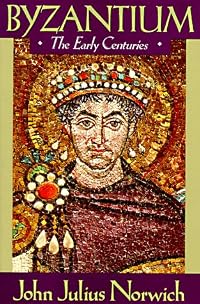
'This thrilling book is the first occasion on which early Byzantine history has been rendered both readable and credible' - Independent. 'He is brilliant . . . He writes like the most cultivated modern diplomat attached by a freak of time to the Byzantine court, with intimate knowledge, tactful judgement and a consciousness of the surviving monuments' - Independent. 'Lord Norwich's skill is to communicate . . . the humanity of his subject - the human faces of emperor and priest - and to show more transmit his own imaginative interest to ourselves . . . Lord Norwich has appeared as a silver-tongued Virgil to guide us through Tartarian regions with the amenity and amusement of a luxury tour' - Sunday Times. 'The reader is conveyed in comfort, as it were in a very superior hovercraft, which glides smoothly over all the unevenness of the ground, to the regular, melodious sound of the author's prose' - Sunday Telegraph. show lessTags
Recommendations


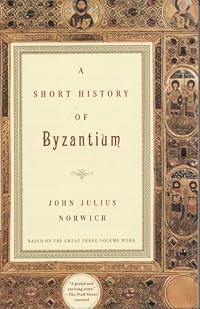





Member Recommendations
Member Reviews
This is a great overview of the first centuries of the Byzantine empire. The writing is clear (unlike other history books, this one never had me mixing up emperors), smooth and insightful. Having always been exposed to the Western-centric view of the alleged end of the Roman empire, I found this view from Constantinople very refreshing; I now think it's the only view that truly sheds a light on the barbarian-vs-empire dynamics of these centuries.
The author doesn't shy away from passing moral judgment on the various protagonists. He does it so well that this doesn't disturb at all; in fact I found myself agreeing with him.
I can't wait to read the other volumes of his history of Byzantium.
The author doesn't shy away from passing moral judgment on the various protagonists. He does it so well that this doesn't disturb at all; in fact I found myself agreeing with him.
I can't wait to read the other volumes of his history of Byzantium.
Readable, at times witty, account of the formative years of B. Mais quelle galore! The imperial team dedicate themselves generation upon generation to lechery, avarice, torture and murder spiced up with theological nit-picking. The prize must go to Irene, whom most people that mattered didn't even recognise as ruler, given her sex. But she didn't let that hold her back: she arranged for her own son to be blinded (in a lethal manner, so murdered really) since he held different views from her on whether Christ had one, two or a mix of several natures.Few of the emperors appear to have been even slightly competent. Justinian for example, one of the stronger contenders, was viciously jealous of his brilliant general Belisarius, such that he show more starved him of resources and thus undermined his successes. How does a regime like that last a thousand years?
It's a rollicking read, if hard to follow in detail, especially as the leading names are often the same or similar; "Theo- this and that", "Constan-give or take" recur over the centuries. Makes Hannibal Lektor or Scandi Noir seem pretty tame. show less
It's a rollicking read, if hard to follow in detail, especially as the leading names are often the same or similar; "Theo- this and that", "Constan-give or take" recur over the centuries. Makes Hannibal Lektor or Scandi Noir seem pretty tame. show less
This book and the two subsequent volumes are among my favourite pieces of historical writing. Anyone who thinks history is boring should be directed toward's Norwich's books anf these three in particular. Norwich turns what otherwise might seem a long dreary list of emperors overs hundreds of years into a rollicking read, full of violence, romance, treachery, religious fanaticism and heartbreaking tragedy. I had hardly any knowledge of the Byzantine Empire before I read this, now I'm imbued with a great sense of loss as a magnificent culture of art, literature and architecture was lost to us in 1453 when Constantinople finally fell to the Turks. In a way its as great a loss for the world as the destruction of the Library of Alexandria, show more although at least some of its great monuments still survive, such as the Hagia Sophia. A terriffic read, I have read all 3 volumes a number of times and never tire of them. Highly recommended. show less
This is great man (and great woman) history but very well written. The text flows easily and you feel you know the characters. There's not much social history - you don't get a feel for the lives of ordinary Byzantines but that would make it a bigger and/or different kind of book. Religion is an important part of the story but the author treats this as an outsider unlike, say, MacCulloch. I got the sense that he wasn't much interested in the theological intricacies.
JJ Norwich has a good basic book here with enough colour and usable blocks of solid narrative. From Constantine's re-foundation to Irene's precarious rule, it lays down good tracks to follow. If you are reading this at the same time as Judith Herrin's "the Formation of Christendom", I think you'll be doing good follow up to Gibbon's majestic account in the Decline and Fall. A good part of your library for quick reference and colourful turns of phrase.
John Julius Norwich provides in his trilogy an excellent overview of Byzantine civilization. For the general reader looking to get the whole picture, or for the scholar probing into a new field, this book is an excellent introduction. For someone already well acquainted with the Byzantines, this is a narrative history, useful for quick consultation but not as deep in any particular subject as you would probably require.
Fans of Byzantium will find this an interesting history of the first centuries.
Members
- Recently Added By
Lists

r/History Recommended Reading List
603 works; 12 members

r/AskHistorians' Recommended Books
1,068 works; 17 members
Author Information

100+ Works 12,604 Members
John Julius Norwich was born in the United Kingdom on September 15, 1929. He served in the Royal Navy before receiving a degree in French and Russian at New College, Oxford. After graduation, he joined the H. M. Foreign Service and served in Belgrade, Beirut, and as a member of British delegation to the Disarmament Conference in Geneva. In 1954, show more he inherited the title of Viscount Norwich. In 1964, he resigned from the Foreign Service to become a writer. He was a historian, travel writer, and television personality. His books included The Normans in the South, A History of Venice, The Italian World, Venice: A Traveller's Companion, 50 Years of Glyndebourne: An Illustrated History, A Short History of Byzantium, Absolute Monarchs: A History of the Papacy, Sicily: An Island at the Crossroads of History, and A History of France. He and H. C. Robbins Landon wrote Five Centuries of Music in Venice. Norwich was the host of the BBC radio panel game My Word! from 1978 to 1982. He wrote and presented more than 30 television documentaries including Maestro, The Fall of Constantinople, Napoleon's Hundred Days, Cortés and Montezuma, Maximilian of Mexico, The Knights of Malta, The Treasure Houses of Britain, and The Death of the Prince Imperial in the Zulu War. In 1993, he was appointed CVO for having curated an exhibition at the Victoria and Albert Museum to mark the 40th anniversary of the Queen's accession to the throne. In 2015, he was awarded the Biographers' Club award for his lifetime service to biography. He died on June 1, 2018 at the age of 88. (Bowker Author Biography) show less
Series

Work Relationships
Is contained in
Common Knowledge
- Canonical title*
- Bizancio. Los primeros siglos.
- Original title
- Byzantium: The Early Centuries
- Original publication date
- 1988
- People/Characters
- Alaric; Anastasius Flavius; Arius Didymus (250/256-336); Eudocia, Byzantine Empress; Belisarius; Chosroes I, Persian Emperor (show all 33); Chosroes II, Persian Emperor; Constans II, Byzantine Emperor; Constantine the Great; Constantine IV, Byzantine Emperor; Constantine V, Byzantine Emperor; Constantius II; Eudoxia; Eusebius of Caesarea (260/265–339/340); Edward Gibbon; Helena [Mother of Constantine the Great]; Heraclius, Byzantine Emperor; Honorius; Irene, Empress of Byzantium; Julian the Apostate; Justinian I, Emperor; Justinian II, Byzantine Emperor; Martina, Byzantine Empress; Narses; Procopius; Shahr-Baraz; Stilicho; Theodora, Empress consort; Theodosius I; Theodosius II; Totila, King of the Ostrogoths; Vigilius, Pope; Zeno, Byzantine Emperor
- Important places
- Antioch; Armenia; Carthage; Constantinople; Jerusalem; Persia (show all 10); Ravenna, Italy; Rome, Italy; Byzantine Empire; Byzantium
- Dedication
- For Moll
- First words
- Of that Byzantine Empire the universal verdict of history is that it constitutes, without a single exception, the most thoroughly base and despicable form that civilization has yet assumed....
This somewhat startling d... (show all)iatribe is taken from W. E. H. Lecky's History of European Morals, published in 1869, and although to modern ears it is perhaps not quite so effective as the author meant it to be - his last sentence makes Byzantine history sound not so much monotonous as distinctly entertaining - the fact remains that for the last 200 years and more, what used to be known as the Later Roman Empire has had an atrocious press. - Last words
- (Click to show. Warning: May contain spoilers.)The Christian world would never be the same again.
- Original language
- English
*Some information comes from Common Knowledge in other languages. Click "Edit" for more information.
Classifications
- Genres
- History, Nonfiction, General Nonfiction, Religion & Spirituality
- DDC/MDS
- 949.5 — History & geography History of Europe Greece, Albania, Yugoslavia, Serbia, Romania, Bulgaria Greece and the Byzantine Empire
- LCC
- DF553 .N67 — History of Europe, Asia, Africa and Oceania Greece History of Greece Medieval Greece. Byzantine Empire, 323-1453 History Eastern Empire, 323/476-1057. Constantine the Great
- BISAC
Statistics
- Members
- 1,072
- Popularity
- 23,773
- Reviews
- 8
- Rating
- (4.11)
- Languages
- English, German, Spanish, Turkish
- Media
- Paper
- ISBNs
- 7
- ASINs
- 3