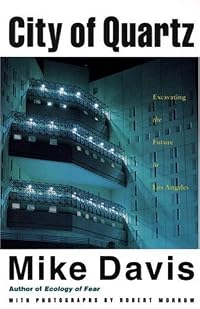
City of Quartz: Excavating the Future in Los Angeles
by Mike Davis
On This Page
Description
No metropolis has been more loved or more hated. To its official boosters, "Los Angeles brings it all together." To detractors, LA is a sunlit mortuary where "you can rot without feeling it." To Mike Davis, the author of this fiercely elegant and wide-ranging work of social history, Los Angeles is both utopia and dystopia, a place where the last Joshua trees are being plowed under to make room for model communities in the desert, where the rich have hired their own police to fend off street show more gangs, as well as armed Beirut militias. In City of Quartz, Davis reconstructs LA's shadow history and dissects its ethereal economy. He tells us who has the power and how they hold on to it. He gives us a city of Dickensian extremes, Pynchonesque conspiracies, and a desperation straight out of Nathaniel West-a city in which we may glimpse our own future mirrored with terrifying clarity. In this new edition, Davis provides a dazzling update on the city's current status. show lessTags
Recommendations















Member Reviews
The first chapter alone makes City of Quartz a worthwhile read: Davis presents an idiosyncratic outline history of culture produced about Los Angeles, by what he calls ‘fabricators of the spectacle’—littérateurs, filmmakers, musicians and artists—engaged in a series of ‘attempts to establish authentic epistemologies’ for the city.
In the early 20th c., a group of writers and publicists (goaded by a syndicate of developers, bankers and transport magnates) created an ersatz history of Los Angeles that romanticized race relations and a fictional Spanish Colonial past, and promoted the power of sunshine to reinvigorate the racial energies of Anglo-Saxons. The imagery, motifs, values and legends of the Arroyo Set have been show more endlessly reproduced ever since. In the 1920s, a number of anti-romantic writers and painters and Popular Front-affiliated journalists worked to unmask the booster mythology and to recover the historical roles of labor and oppressed minority groups while originating observations that appeared decades later in the obscurantist vocabulary of cultural theorists.
The most influential counter to the utopist ideology came in the form of noir, first as fiction then on film, as the setting shifted from suburban bungalows to the ‘epic dereliction’ of Bunker Hill downtown. Beyond the conventional works, Davis includes in his capacious discussion of noir the fictions of John Fante, Chester Himes and John Rechy, the autobiography of Art Pepper, and Aldous Huxley’s Ape and Essence, described here as a predecessor to films like “Planet of the Apes,” “Omega Man,” and “Blade Runner.”
Huxley came to Los Angeles between the wars as part of a wave of pacifist and anti-fascist European exiles, most of whom—‘clinging to their Old World prejudices,’ as Davis tells it—responded to the ‘counterfeit urbanity’ of L.A. with melancholy, pessimism and/or panic. (One exception was Huxley, who embraced mysticism, health food and hallucinogens). It is amusing to find out that the whole Frankfurt critique of the “Culture Industry” is based upon Adorno and Horkheimer’s blinkered misreading of their first-hand L.A. ‘data.’
Toward the end of the chapter, Davis sketches a few notes on several ‘heroic’ underground cultural moments around Eric Dolphy and Ornette Coleman (elevator operator at the Bullock Wilshire), Jack Parsons, Kenneth Anger and others. The moments pass quickly, and with little discernible effect, as the 1970s and 80s were characterized by 'a mercenary, corporate-dominated arts dispensation' and an influx of celebrity architects, designers, artists and cultural theorists arriving for their adventures in hyperreality. pshaw show less
In the early 20th c., a group of writers and publicists (goaded by a syndicate of developers, bankers and transport magnates) created an ersatz history of Los Angeles that romanticized race relations and a fictional Spanish Colonial past, and promoted the power of sunshine to reinvigorate the racial energies of Anglo-Saxons. The imagery, motifs, values and legends of the Arroyo Set have been show more endlessly reproduced ever since. In the 1920s, a number of anti-romantic writers and painters and Popular Front-affiliated journalists worked to unmask the booster mythology and to recover the historical roles of labor and oppressed minority groups while originating observations that appeared decades later in the obscurantist vocabulary of cultural theorists.
The most influential counter to the utopist ideology came in the form of noir, first as fiction then on film, as the setting shifted from suburban bungalows to the ‘epic dereliction’ of Bunker Hill downtown. Beyond the conventional works, Davis includes in his capacious discussion of noir the fictions of John Fante, Chester Himes and John Rechy, the autobiography of Art Pepper, and Aldous Huxley’s Ape and Essence, described here as a predecessor to films like “Planet of the Apes,” “Omega Man,” and “Blade Runner.”
Huxley came to Los Angeles between the wars as part of a wave of pacifist and anti-fascist European exiles, most of whom—‘clinging to their Old World prejudices,’ as Davis tells it—responded to the ‘counterfeit urbanity’ of L.A. with melancholy, pessimism and/or panic. (One exception was Huxley, who embraced mysticism, health food and hallucinogens). It is amusing to find out that the whole Frankfurt critique of the “Culture Industry” is based upon Adorno and Horkheimer’s blinkered misreading of their first-hand L.A. ‘data.’
Toward the end of the chapter, Davis sketches a few notes on several ‘heroic’ underground cultural moments around Eric Dolphy and Ornette Coleman (elevator operator at the Bullock Wilshire), Jack Parsons, Kenneth Anger and others. The moments pass quickly, and with little discernible effect, as the 1970s and 80s were characterized by 'a mercenary, corporate-dominated arts dispensation' and an influx of celebrity architects, designers, artists and cultural theorists arriving for their adventures in hyperreality. pshaw show less
A panoramic look at the failure of labor rights, preservation, and racial equality all told through the physical infrastructure of the city.
This book is dense and winding. I listened to it as an audio book the past three months and realized I had to just let the thing wash over me. Davis doesn't write a straightforward history of Los Angeles, instead driving through avenues of historic situations in roughly chronological order to illustrate the particular theme of each chapter. Each chapter is about a specific area (except the one on Catholicism, my favorite chapter), and it's only while you're halfway through that you start to see the forest for the trees. This book is a remarkable achievement and rightly a classic of urbanist show more theory.
Growing up and living here again it's nice to finally learn about all the places I see daily. The fact close to no one here knows about the history of the city sadly illustrates the part of his argument that this place is a fucking shithole show less
This book is dense and winding. I listened to it as an audio book the past three months and realized I had to just let the thing wash over me. Davis doesn't write a straightforward history of Los Angeles, instead driving through avenues of historic situations in roughly chronological order to illustrate the particular theme of each chapter. Each chapter is about a specific area (except the one on Catholicism, my favorite chapter), and it's only while you're halfway through that you start to see the forest for the trees. This book is a remarkable achievement and rightly a classic of urbanist show more theory.
Growing up and living here again it's nice to finally learn about all the places I see daily. The fact close to no one here knows about the history of the city sadly illustrates the part of his argument that this place is a fucking shithole show less
What is it that turns smart people into Marxists?
I cannot write this review without prefacing the perspective that I come from: I'm from LA, a member of a West Side Jewish family involved in real estate development, and these days a grad student in science and technology studies. What I was interested in was what Los Angeles means; is it the American dream or the American nightmare? Davis almost gets there, but instead gets stuck reproducing the shibboleths of political economy.
Davis chronicles the struggles of various LA power centers: the downtown establishment against the Westside insurgency; boosters against noir exiles; white and black; police and gangs; factions within the catholic church. But while he starts from a fascinating show more premise the LA is somehow a uniquely post-modern city, he quickly becomes embroiled in standard narratives about oppressed minorities struggling against fascist power structures. I don't disagree with him here, LA is a racist and oppressive city, and was more so in the late 80s when this book was researched, but saying so isn't particularly interesting. I enjoyed the chapters on noir and police brutality, and a glimpse into the hidden workings of the Catholic church, but Davis spent so much time look for the periphery that he misses the centers of power lie the LA Times, the County Board of Supervisors, Home Owners Associations, or transit planning (these are centers he himself brings up, and then glosses over in favor of community organizers and unions).
This isn't the worst book ever, and it's actually a fun read for Marxist geography, but it's not the LA that I know, (development, freeways, Hollywood, Judaism, the West Side, and The Valley), and it's not the "real LA" either, whatever that is. show less
I cannot write this review without prefacing the perspective that I come from: I'm from LA, a member of a West Side Jewish family involved in real estate development, and these days a grad student in science and technology studies. What I was interested in was what Los Angeles means; is it the American dream or the American nightmare? Davis almost gets there, but instead gets stuck reproducing the shibboleths of political economy.
Davis chronicles the struggles of various LA power centers: the downtown establishment against the Westside insurgency; boosters against noir exiles; white and black; police and gangs; factions within the catholic church. But while he starts from a fascinating show more premise the LA is somehow a uniquely post-modern city, he quickly becomes embroiled in standard narratives about oppressed minorities struggling against fascist power structures. I don't disagree with him here, LA is a racist and oppressive city, and was more so in the late 80s when this book was researched, but saying so isn't particularly interesting. I enjoyed the chapters on noir and police brutality, and a glimpse into the hidden workings of the Catholic church, but Davis spent so much time look for the periphery that he misses the centers of power lie the LA Times, the County Board of Supervisors, Home Owners Associations, or transit planning (these are centers he himself brings up, and then glosses over in favor of community organizers and unions).
This isn't the worst book ever, and it's actually a fun read for Marxist geography, but it's not the LA that I know, (development, freeways, Hollywood, Judaism, the West Side, and The Valley), and it's not the "real LA" either, whatever that is. show less
I first published review in the June 2008 Bulletin of the Kate Sharpley Library.
Mike Davis “City Of Quartz “ (£10.99, Verso, 2006).
This is a history of Los Angeles and its environs. It is not the sort of history you associate with America – Davis does not exclude the Anarchists, Socialists, company towns and class struggles that lie hidden, deep in the void of US folklore. Where it touches upon the history of ‘great men’, it is one where they are shown, warts and all.
City of Quartz is not necessarily a straightforward book for the non-American reader. Davis never misses an opportunity to go into detail, and that means covering many places and individuals that will be utterly unfamiliar to European readers.
The issues, even show more when they appear unique to LA are however all too often universal - in particular Davis concentrates on a city choking on its waste, and an area deeply damaged by the contradictions of capitalism – the over-production, greed, social stratification, gentrification, political chicanery, religious revivalism and ignorance of the environment. If LA is a glimpse of our own futures, you don’t want to go there.
Davis’ sense of humour, and cutting attitude to the well-heeled, peeks through. LA appears to have been a trailblazer of homeowner associations and all manner of NIMBY groups. Of one such body he comments “When it comes to solving major urban problems, moreover, the Valley homesteaders are about as patient and constructive as Sendero Luminoso”.
A sorry picture emerges in particular of black working class Los Angeles squeezed from all sides – left behind by de-industrialisation and under-priced by Latino labour, the 1980s found south central LA surrounded by a hostile police force and a corrupt political system where even so-called 1960s radicals had long since given up on black youth. However, as America was to see in the 1992 riots, the one thing the youth of Los Angeles had not done, was give up.
Davis inadvertently raises hard questions for radicals. Whilst we can no doubt all agree that the environment cannot survive if every American businessman who wants to build a new development in the desert does so, can everyone who wants to live in California do so, and continue doing so?
It is one thing to believe in “No Borders” - another to see it implemented solely by capitalism’s need for mass migrant labour. Those issues, and the one’s thrown up by the creation of an increasingly Spanish speaking and Catholic California, are unlikely to go away.
Davis’ narrative stops in 1990, and whilst this book claims to be a ‘new edition’ it is in fact the old one, but with a new 14 page preface. Given that, if you bought this first time round, there is probably little point in rushing out to get the 2006 remix.
That should not take away from the importance of City of Quartz. If like me, this is your first book by Davis, it is unlikely to be your last. This is a guy who knows what he is talking about. show less
Mike Davis “City Of Quartz “ (£10.99, Verso, 2006).
This is a history of Los Angeles and its environs. It is not the sort of history you associate with America – Davis does not exclude the Anarchists, Socialists, company towns and class struggles that lie hidden, deep in the void of US folklore. Where it touches upon the history of ‘great men’, it is one where they are shown, warts and all.
City of Quartz is not necessarily a straightforward book for the non-American reader. Davis never misses an opportunity to go into detail, and that means covering many places and individuals that will be utterly unfamiliar to European readers.
The issues, even show more when they appear unique to LA are however all too often universal - in particular Davis concentrates on a city choking on its waste, and an area deeply damaged by the contradictions of capitalism – the over-production, greed, social stratification, gentrification, political chicanery, religious revivalism and ignorance of the environment. If LA is a glimpse of our own futures, you don’t want to go there.
Davis’ sense of humour, and cutting attitude to the well-heeled, peeks through. LA appears to have been a trailblazer of homeowner associations and all manner of NIMBY groups. Of one such body he comments “When it comes to solving major urban problems, moreover, the Valley homesteaders are about as patient and constructive as Sendero Luminoso”.
A sorry picture emerges in particular of black working class Los Angeles squeezed from all sides – left behind by de-industrialisation and under-priced by Latino labour, the 1980s found south central LA surrounded by a hostile police force and a corrupt political system where even so-called 1960s radicals had long since given up on black youth. However, as America was to see in the 1992 riots, the one thing the youth of Los Angeles had not done, was give up.
Davis inadvertently raises hard questions for radicals. Whilst we can no doubt all agree that the environment cannot survive if every American businessman who wants to build a new development in the desert does so, can everyone who wants to live in California do so, and continue doing so?
It is one thing to believe in “No Borders” - another to see it implemented solely by capitalism’s need for mass migrant labour. Those issues, and the one’s thrown up by the creation of an increasingly Spanish speaking and Catholic California, are unlikely to go away.
Davis’ narrative stops in 1990, and whilst this book claims to be a ‘new edition’ it is in fact the old one, but with a new 14 page preface. Given that, if you bought this first time round, there is probably little point in rushing out to get the 2006 remix.
That should not take away from the importance of City of Quartz. If like me, this is your first book by Davis, it is unlikely to be your last. This is a guy who knows what he is talking about. show less
Tediously marxist.
Davis is infected with the idea that nothing good happens unless it is progress towards Socialism, and nothing bad happens when it is performed by the "marginalized" or "alienated" of society. This idea blinds him to the vigor and dynamism of Los Angeles, and to the benefits that have accumulated to anyone other than the rich, or the middle-class white homeowners who are the secondary demons of his story. If one is capable of filtering out all the marxian cant and "un-class-angle" the text, it can be quite informative on both the shifts of the power structure in Los Angeles and the sources of the Tax Revolt of the 1970s and 1980s, but the book is otherwise an unrewarding slog.
Davis is infected with the idea that nothing good happens unless it is progress towards Socialism, and nothing bad happens when it is performed by the "marginalized" or "alienated" of society. This idea blinds him to the vigor and dynamism of Los Angeles, and to the benefits that have accumulated to anyone other than the rich, or the middle-class white homeowners who are the secondary demons of his story. If one is capable of filtering out all the marxian cant and "un-class-angle" the text, it can be quite informative on both the shifts of the power structure in Los Angeles and the sources of the Tax Revolt of the 1970s and 1980s, but the book is otherwise an unrewarding slog.
Even Better Than The Original
I recently re-read this updated edition of the classic "City of Quartz" by noted socialist scholar Mike Davis. This text is quickly becoming a classic and belongs alongside the great urban sociological texts such as Jane Jacobs' "The Death and Life of Great American Cities."
The history of the development of Los Angeles is really like no other story in America, and indeed the world. And while some may not appreciate the Marxist interpretations and the dialectical method which Davis uses, nevertheless, the depth of intellectual analysis is simply breathtaking. When the original book was written, Davis correctly foreshadowed the Rodney King riots.
Davis pulls no punches in his research. He covers the early show more railroad and oil speculators, Otis and Harry Chandler, the development of Hollywood, Catholicism in LA, defense industrial production, postwar suburbanization, Kaiser steel, housing covenants, the Watts riots, large Japanese investments of the 80s, and more and more. The book is extremely dense so prepare to spend several weeks, maybe even months to fully absorb the details. Certainly whole books can be written on each of the major topical areas.
Included in this new edition are some fabulous new photos, all by Robert Morrow. The extended prologue in the new edition isn't anything revolutionary, but Davis does update the recent history of Los Angeles.
Obviously, I recommend this book, especially for anyone wanting a deeper intellectual, cultural, and social understanding of the major ideological undercurrents that make up the wonderful city of Los Angeles. show less
I recently re-read this updated edition of the classic "City of Quartz" by noted socialist scholar Mike Davis. This text is quickly becoming a classic and belongs alongside the great urban sociological texts such as Jane Jacobs' "The Death and Life of Great American Cities."
The history of the development of Los Angeles is really like no other story in America, and indeed the world. And while some may not appreciate the Marxist interpretations and the dialectical method which Davis uses, nevertheless, the depth of intellectual analysis is simply breathtaking. When the original book was written, Davis correctly foreshadowed the Rodney King riots.
Davis pulls no punches in his research. He covers the early show more railroad and oil speculators, Otis and Harry Chandler, the development of Hollywood, Catholicism in LA, defense industrial production, postwar suburbanization, Kaiser steel, housing covenants, the Watts riots, large Japanese investments of the 80s, and more and more. The book is extremely dense so prepare to spend several weeks, maybe even months to fully absorb the details. Certainly whole books can be written on each of the major topical areas.
Included in this new edition are some fabulous new photos, all by Robert Morrow. The extended prologue in the new edition isn't anything revolutionary, but Davis does update the recent history of Los Angeles.
Obviously, I recommend this book, especially for anyone wanting a deeper intellectual, cultural, and social understanding of the major ideological undercurrents that make up the wonderful city of Los Angeles. show less
What I loved about this polemic is that it sent me in so many directions for other readings and exploring previous demythologizers.
I can’t believe it’s taken me this long to read this. Next up is Ecology Of Fear.
He's such an inspiration.
Not everything he says is probably 100% accurate but the general thrusts of his arguments seem to ring true.
I can’t believe it’s taken me this long to read this. Next up is Ecology Of Fear.
He's such an inspiration.
Not everything he says is probably 100% accurate but the general thrusts of his arguments seem to ring true.
Members
- Recently Added By
Lists

California Cultural History
23 works; 4 members

The War on Cars podcast
108 works; 1 member
Author Information

41+ Works 6,980 Members
Mike Davis is the author of many books, including City of Quartz, The Monster at Our Door, Buda's Wagon, and Planet of Slums. He is the recipient of the MacArthur Fellowship and the Lannan Literary Award. He lives in San Diego.
All Editions
Some Editions
Awards and Honors
Series
Belongs to Publisher Series
Common Knowledge
- Canonical title
- City of Quartz: Excavating the Future in Los Angeles
- Original title
- City of Quartz: Excavating the Future in Los Angeles
- Original publication date
- 1990
- Important places
- Los Angeles, California, USA; California, USA; Llano, California, USA; Fontana, California, USA; Hollywood, California, USA; San Fernando Valley, California, USA (show all 8); San Gabriel Valley, California, USA; Orange County, California, USA
- Epigraph
- The superficial inducement, the exotic, the picturesque has a effect only on the foreigner. To portray a city, a native must have other, deeper motives -- motives on one who travels into the past instead of into the distanc... (show all)e. A native's book about his city will always be related to memoirs; the writer has not spent his childhood there in vain. -Walter Benjamin
- Dedication
- for m sweet Roisin, to remember her grandmother by...
- First words
- The best place to view Los Angeles of the next millennium is from the ruins of its alternative future. (Prologue The View from Futures Past)
In the summer of 1989, a well-known fashion magazine constantly on the prowl for lifestyle trends reported from Los Angeles that "intellectualism" has arived there as the latest fad. (Chapter One, Sunshine or Noir?) - Last words
- (Click to show. Warning: May contain spoilers.)The past generations are like so much debris to be swept away by the developers' bulldozers. In which case it is only appropriate that they should end up here, in Fontana -- the junkyard of dreams. (Chapter Seven, Junkyard of Dreams)
- Blurbers
- Gibson, William; Gitlin, Todd; Sigal, Clancy
- Original language*
- Englisch
- Canonical DDC/MDS
- 307.760979494
- Canonical LCC
- HN80.L7
*Some information comes from Common Knowledge in other languages. Click "Edit" for more information.
Classifications
- Genres
- Sociology, Nonfiction, History, General Nonfiction, Art & Design
- DDC/MDS
- 307.760979494 — Society, Government, and Culture Social sciences, sociology & anthropology Communities Specific kinds of communities Urban communities Biography And History North America West Coast U.S.
- LCC
- HN80 .L7 — Social sciences Social history and conditions. Social problems. Social reform Social history and conditions. Social problems. By region or country
- BISAC
Statistics
- Members
- 1,756
- Popularity
- 12,471
- Reviews
- 16
- Rating
- (4.03)
- Languages
- 7 — English, French, German, Italian, Portuguese, Spanish, Swedish
- Media
- Paper, Audiobook, Ebook
- ISBNs
- 25
- ASINs
- 15