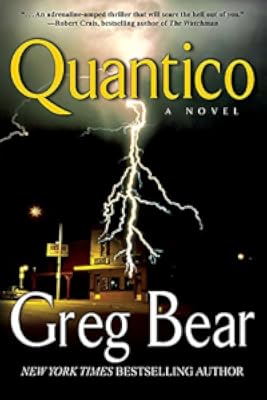
On This Page
Description
It's the second decade of the twenty-first century, and terrorism has escalated almost beyond control. The Dome of the Rock in Jerusalem has been blown to bits by extremists, and, in retaliation, thousands have died in another major attack on the United States. The War on Terror has reached a deadly stalemate. Now the FBI has been dispatched to deal with a new menace. A plague targeted to ethnic groups--Jews or Muslims or both--has the potential to wipe out entire populations. But the FBI show more itself is under political assault. There's a good chance agents William Griffin, Fouad Al-Husam, and Jane Rowland will be part of the last class at Quantico. As the young agents hunt a brilliant homegrown terrorist, they join forces with veteran bio-terror expert Rebecca Rose. But the plot they uncover--and the man they chase--prove to be far more complex than anyone expects. show lessTags
Recommendations













Member Reviews
Greg Bear’s novel Quantico was a long time coming to the U.S. market, his publisher evidently thinking that it was too real for tender American sensibilities in the wake of events in late 2001.
Finally released in the U.S., the novel is more startling now than when it was first published in the U.K. in 2006, especially in the wake of the recent suicide of Bruce Ivins, the federal biodefense scientist who was being investigated for the 2001 anthrax mailings in the FBI case known as Amerithrax. The mailings resulted in the death of five people and the infection of 17 others.
Using Amerithrax as a jumping-off point, Bear has constructed a gripping thriller in which the anthrax mailer (based on Ivins, perhaps, but more likely on Steven show more Hatfill, the scientist originally indicted in the case but who was recently exonerated and given a nearly $6 million settlement) is himself a pawn in an even more nefarious plot.
The novel opens with the FBI under a political cloud, just as it was post-9/11: the Bureau is threatened with extinction for having bungled its chance to apprehend the terrorists responsible for 9/11 and other atrocities. (The Dome of the Rock, for instance, has been blown to bits.) Evidence that something even worse in the words is being ignored by top officials in the intelligence community. It looks like a new plague is set to be unleashed, and this one targets specific ethnicities – Muslims, Jews, maybe both.
Novice agent Bill Griffin goes to work with bioterror investigator Rebecca Rose. Large quantities of a weird hybrid yeast are discovered at a defunct winery in Temecula, California, and the same spores turn up at the compound of a religious fanatic in backwoods Washington State. Thing is, the yeast spores aren’t lethal or even dangerous; after all, yeast is yeast, right? So the FBI agents are taken off the case and redeployed as, basically, floor moppers.
But then there’s a strange outbreak of memory loss in middle America. Rose and Griffin finagle their way back onto the case and learn that the situation isn’t one of typical bioterror but something much, much more dire.
As ever, Bear spins a great, tightly plotted tale full of speculative but plausible scenarios and gadgets. Although this isn’t Bear’s best novel, a middling effort from this writer is better than the best from almost any other writer of high-tech thrillers. Bear is smart and imaginative and manages, novel after novel, to harness his talents to produce thought-provoking, spine-tingling goodness. show less
Finally released in the U.S., the novel is more startling now than when it was first published in the U.K. in 2006, especially in the wake of the recent suicide of Bruce Ivins, the federal biodefense scientist who was being investigated for the 2001 anthrax mailings in the FBI case known as Amerithrax. The mailings resulted in the death of five people and the infection of 17 others.
Using Amerithrax as a jumping-off point, Bear has constructed a gripping thriller in which the anthrax mailer (based on Ivins, perhaps, but more likely on Steven show more Hatfill, the scientist originally indicted in the case but who was recently exonerated and given a nearly $6 million settlement) is himself a pawn in an even more nefarious plot.
The novel opens with the FBI under a political cloud, just as it was post-9/11: the Bureau is threatened with extinction for having bungled its chance to apprehend the terrorists responsible for 9/11 and other atrocities. (The Dome of the Rock, for instance, has been blown to bits.) Evidence that something even worse in the words is being ignored by top officials in the intelligence community. It looks like a new plague is set to be unleashed, and this one targets specific ethnicities – Muslims, Jews, maybe both.
Novice agent Bill Griffin goes to work with bioterror investigator Rebecca Rose. Large quantities of a weird hybrid yeast are discovered at a defunct winery in Temecula, California, and the same spores turn up at the compound of a religious fanatic in backwoods Washington State. Thing is, the yeast spores aren’t lethal or even dangerous; after all, yeast is yeast, right? So the FBI agents are taken off the case and redeployed as, basically, floor moppers.
But then there’s a strange outbreak of memory loss in middle America. Rose and Griffin finagle their way back onto the case and learn that the situation isn’t one of typical bioterror but something much, much more dire.
As ever, Bear spins a great, tightly plotted tale full of speculative but plausible scenarios and gadgets. Although this isn’t Bear’s best novel, a middling effort from this writer is better than the best from almost any other writer of high-tech thrillers. Bear is smart and imaginative and manages, novel after novel, to harness his talents to produce thought-provoking, spine-tingling goodness. show less
Ok, I've previously drawn parallels between Greg Bear's "Blood Music" & Michael Crichton's "Prey" that were unflattering to Crichton (see http://www.goodreads.com/book/show/341816.Prey) & then I HATED Crichton's "State of Fear" (see http://www.goodreads.com/book/show/15860.State_of_Fear). SO, I credited Bear w/ being original & discredited Crichton w/ being a paltry 2nd (or 3rd or whatever). THEN Bear writes this - a novel not that dissimilar from Crichton's "State of Fear" but coming out a yr or 2 later.
NOW, to give Bear credit, I wdn't quite call this propaganda in the same way that I accused Crichton. It's nowhere near as simple-minded. It's acknowledged that the FBI has been culpable, Muslims are presented as a diverse batch of show more humans, the person(s) responsible for the diabolical plot are complex - they're not caricatures. That's all well & good. Nonetheless, there are parallels w/ Crichton: page 285:
""He was dealing with domestic and ecological terrorists - Animal Rescue, Earth Liberation Front, Gaia Brigade. Dangerous people. [..]"
Then I look at the author's foto on the back: this guy is straight, straight, STRAIGHTER - as is going, going, GONE. What I mean is that, ultimately, this guy buys the lies of "law & order" - in other words, he's naive as fuck(less). Sorry, Greg, I like yr novels but you're as clueless as James Gunn (see my review of "Kampus": http://www.goodreads.com/book/show/2144066.Kampus). Bear gets the tech details down pretty well, has a solid wide vision, but ultimately misses out on the human stuff just a little too much. He's a wishful thinker: the American Dream, yeah, it's been a nightmare.. but, c'mon, we're really the good guys in the long run n'at.
AND I ALMOST AGREE - but only ALMOST. Ultimately, for me, there's a 'dream' of people, just PEOPLE, not just 'Americans', of justice - &, sorry, FBI agents (as heroicized in this bk) are not my idea of the ones who have this dream most firmly ensconced in their noggins. They're just too embedded in American historical lies & mythology. Has Bear forgotten exactly how fucked Hoover was? How fucked COINTELPRO was? I'll take the non-racist version of the Black Panthers over the FBI anyday - even if they 'lack' the technology. show less
NOW, to give Bear credit, I wdn't quite call this propaganda in the same way that I accused Crichton. It's nowhere near as simple-minded. It's acknowledged that the FBI has been culpable, Muslims are presented as a diverse batch of show more humans, the person(s) responsible for the diabolical plot are complex - they're not caricatures. That's all well & good. Nonetheless, there are parallels w/ Crichton: page 285:
""He was dealing with domestic and ecological terrorists - Animal Rescue, Earth Liberation Front, Gaia Brigade. Dangerous people. [..]"
Then I look at the author's foto on the back: this guy is straight, straight, STRAIGHTER - as is going, going, GONE. What I mean is that, ultimately, this guy buys the lies of "law & order" - in other words, he's naive as fuck(less). Sorry, Greg, I like yr novels but you're as clueless as James Gunn (see my review of "Kampus": http://www.goodreads.com/book/show/2144066.Kampus). Bear gets the tech details down pretty well, has a solid wide vision, but ultimately misses out on the human stuff just a little too much. He's a wishful thinker: the American Dream, yeah, it's been a nightmare.. but, c'mon, we're really the good guys in the long run n'at.
AND I ALMOST AGREE - but only ALMOST. Ultimately, for me, there's a 'dream' of people, just PEOPLE, not just 'Americans', of justice - &, sorry, FBI agents (as heroicized in this bk) are not my idea of the ones who have this dream most firmly ensconced in their noggins. They're just too embedded in American historical lies & mythology. Has Bear forgotten exactly how fucked Hoover was? How fucked COINTELPRO was? I'll take the non-racist version of the Black Panthers over the FBI anyday - even if they 'lack' the technology. show less
Stripped from its 'science friendly' stuff like the gadgets used by the military and the police and the bioterrorism threat, there's not that much left apart from a lot of full-packed action and fights. It's credible, clever and, describes convincingly an alarming near-future where delusional teenagers can be as dangerous as religious fanatics; plus, its lack of Manicheism (the complexity of the Muslim world, the motives and intricacies of the American bureaucracies and administrations) is an appreciated bonus. However it reads more like a thriller than a SF novels. Very good but, not the kind of plot I was expecting.
Michael Cricton meet Tom Clancy.
Much unlike some of Greg Bear's earlier and more epic hard science fiction and space opera, this is closer to being a techno thriller. There's lots of build up - shady characters having backstreet meetings, samples being exchanged etc. And various law enforcement agents catching little snippets of info. It look slike someone somewhere is cultivating Anthrax (yes of the 2001 postal US scare) and possibly modifying it with the intent to just infect Jews. And then obviously planning a worldwide relase through key cities. The law enforecement officials from various agencies tread on each other's toes as they try and follow various leads, including inkjet printers, sales of gardening chemicals and more high show more tech surveillance methods. It's not quite clear when thebook is set - obviously sometime very close to now, but also still in the future. There is some missmatch between the technological advances and the biology - when it's currently looking like the biology will be there before the technology is.
It turns out that Jews are not the target - but Bear doesn't explain well or strongly enough why this would have been a biological impossability. And the switch in law Enforecement focus comes as a bit of a confusing abrupt change in direction. As usual Bear is concerned more for the ideas - which leaves the characters more than a bit flat in places. There are a lot of law enforement people, the left and right hands not knowing what the other is doing. This - while maybe realistic - means that it's very difficult to sympathise with any of them. Unusually the motivation for the 'bad guy' is more clearly explained and he becomes almost credible.
Ultimately though it all becomes too confused, and although there is some effort to crank up the tensions as our heros rush in to save the day - the outcome is all too predictable, and I'd long since stopped caring whether they survived.
The author's note clearly explains his concerns with modern bio-terror possabilities. But to me the book reads much more as 'Little Brother' by Cory did - as a warning against excessive law enforement and infringement of civil liberties. The bioattacks never come across as being particularly credible threat - even though the inkjet printer technologies are already a reality. show less
Much unlike some of Greg Bear's earlier and more epic hard science fiction and space opera, this is closer to being a techno thriller. There's lots of build up - shady characters having backstreet meetings, samples being exchanged etc. And various law enforcement agents catching little snippets of info. It look slike someone somewhere is cultivating Anthrax (yes of the 2001 postal US scare) and possibly modifying it with the intent to just infect Jews. And then obviously planning a worldwide relase through key cities. The law enforecement officials from various agencies tread on each other's toes as they try and follow various leads, including inkjet printers, sales of gardening chemicals and more high show more tech surveillance methods. It's not quite clear when thebook is set - obviously sometime very close to now, but also still in the future. There is some missmatch between the technological advances and the biology - when it's currently looking like the biology will be there before the technology is.
It turns out that Jews are not the target - but Bear doesn't explain well or strongly enough why this would have been a biological impossability. And the switch in law Enforecement focus comes as a bit of a confusing abrupt change in direction. As usual Bear is concerned more for the ideas - which leaves the characters more than a bit flat in places. There are a lot of law enforement people, the left and right hands not knowing what the other is doing. This - while maybe realistic - means that it's very difficult to sympathise with any of them. Unusually the motivation for the 'bad guy' is more clearly explained and he becomes almost credible.
Ultimately though it all becomes too confused, and although there is some effort to crank up the tensions as our heros rush in to save the day - the outcome is all too predictable, and I'd long since stopped caring whether they survived.
The author's note clearly explains his concerns with modern bio-terror possabilities. But to me the book reads much more as 'Little Brother' by Cory did - as a warning against excessive law enforement and infringement of civil liberties. The bioattacks never come across as being particularly credible threat - even though the inkjet printer technologies are already a reality. show less
The first third of the book really had me wondering if the pages of my Greg Bear science fiction novel had been secretly replaced with the pages from some randomly average thriller about post-9/11 terrorism. Then the science started appearing and things got more interesting.
The structure of the book made it a bit difficult to always keep in mind what was happening to whom and what the reader was already supposed to know about each character. I think there were just too many of them. Some would be introduced early, only to disappear for a long time and then suddenly reappear when they were needed. Some would just appear and have a larger role than expected. This does not make a compelling thriller for me. I think it would have been show more better to stick, really stick to the three characters that really mattered.
As for the science, it's all near-future extrapolation of existing technology. Much of this is common to almost any futuristic film being made. Some of it was just plain fun. However, the realistic portrayal of the remote possibility of unknown parties acquiring and/or manipulating bio-terrorism materials is quite unsettling and thought provoking.
This is not a great book. But it was ultimately satisfying and I will probably give the next one in the series a try. show less
The structure of the book made it a bit difficult to always keep in mind what was happening to whom and what the reader was already supposed to know about each character. I think there were just too many of them. Some would be introduced early, only to disappear for a long time and then suddenly reappear when they were needed. Some would just appear and have a larger role than expected. This does not make a compelling thriller for me. I think it would have been show more better to stick, really stick to the three characters that really mattered.
As for the science, it's all near-future extrapolation of existing technology. Much of this is common to almost any futuristic film being made. Some of it was just plain fun. However, the realistic portrayal of the remote possibility of unknown parties acquiring and/or manipulating bio-terrorism materials is quite unsettling and thought provoking.
This is not a great book. But it was ultimately satisfying and I will probably give the next one in the series a try. show less
Timely post-9-11 early 21st-century thriller that puts into play religious hatred, bioterrorism, unrest in the Middle East, and internecine conflict among U.S. government agencies. The chief actors are FBI agents, and include gruff Erwin Griffin, tough Rebecca Rose, confused William Griffin (son of Erwin), and used Fouad Al-Husam (American and Muslim). Leading them all on a chase are a religious cult leader; a mysterious tall man with sandy blond hair; and an idiot savant who has a way with anthrax. The plot is fast-moving (at least in the beginning), but very confusing; at the end, I'm still not sure who was who and what was what. Bear said in the Afterword that he agreed deliberately to obfuscate some details so as not to facilitate show more terrorism; he seems also to have thought we would benefit illegally by knowing too much about the sympathies of the characters.
Bear is a good writer, even when not at his best, and his fictional scenario is near-real enough to be frightening. But the promising beginnings of characterization at the book's onset get bogged down in Bear's desire (I am assuming) to cram too much into his story (without sufficient clarification). Nevertheless, I enjoyed getting depressed over the evil of some of mankind, and the impotence of the rest of it.
(JAF) show less
Bear is a good writer, even when not at his best, and his fictional scenario is near-real enough to be frightening. But the promising beginnings of characterization at the book's onset get bogged down in Bear's desire (I am assuming) to cram too much into his story (without sufficient clarification). Nevertheless, I enjoyed getting depressed over the evil of some of mankind, and the impotence of the rest of it.
(JAF) show less
Greg Bear is a giant in the circles of pre-millennial "hard" science fiction. His previous books have dealt scientifically with time travel, interstellar war, and the destruction of the Earth. With Quantico, he takes the William Gibson approach and sets the story in the not-so-distant future; in fact, the world in the book isn't much different from our own in the present.The premise of a post-9/11 future still wracked by terrorism is as far removed from the comfort zone of sci-fi that one hesitates to keep this book within that genre. A few of the futuristic conceits, like remote disabling of vehicles and pocket-sized substance analysis devices, are either already in play or are in development today; so the usual sci-fi separation of show more our time from a future time by way of advanced technology simply isn't there. Overall, the storyline comes across as any other crime-thriller novel on the shelf, which is not necessarily a bad thing. Bear is strong when it comes to making ridiculous astrophysics shit make sense, but he also draws fairly intricate and deep characters, and the FBI agents he creates for Quantico are no exception.The story itself, about planning and quashing a bioterror attack in the Middle East, reminded me a lot of Frank Herbert's The White Plague; not just for the germ warfare angle, but also because the primary antagonist's personality splinters along the way to the point where he doesn't know what he's doing the attack for or why.One of the more interesting things about reading a book like this, where the author is writing more or less out of their natural element, is that with the veneer of their customary genre stripped away, you can examine their writing style in the raw. Imagine if other, more commercial authors tried the same thing; would their audiences remain loyal? show less
Members
- Recently Added By
Lists

Sarah's Wish List
48 works; 1 member
Author Information

Greg Bear was born in San Diego, California, on August 20, 1951. He received a Bachelor of Arts degree from San Diego State University in 1973. At age 14, he began submitting pieces to magazines and at 15 he sold his first story to Robert Lowndes' Famous Science Fiction. It would be five years before he sold another piece, but by 23 he was selling show more stories regularly. He has written more than 30 science fiction and fantasy books and has won numerous awards for his work. In 1984, Hardfought and Blood Music won the Nebula Awards for best novella and novelette; Blood Music went on to win the Hugo Award. The novel version of that story, also called Blood Music, won the Prix Apollo in France. In 1987, Tangents won the Hugo and Nebula awards for best short story. He also won a Nebula in 1994 for Moving Mars and in 2001 for Darwin's Radio. Both Dinosaur Summer and Darwin's Radio have been awarded the Endeavour for best novel published by a Northwest science fiction author. He is also an illustrator and his work has appeared in Galaxy, Fantasy and Science Fiction, and Vertex, and in both hardcover and paperback books. He was a founding member of ASFA, the Association of Science Fiction Artists. His works include City at the End of Time, Hull Zero Three, The Mongoliad, Mariposa, Halo: Cryptum, Halo: Primordium and Halo: Silentium. (Bowker Author Biography) show less
Some Editions
Awards and Honors
Awards
Series

Common Knowledge
- Original publication date
- 2005
- People/Characters
- Fouad Al-Husam; William Griffin; Rebecca Rose; Jane Rowland
- Important places
- Mecca, Saudi Arabia; Washington, USA; Quantico, Virginia, USA; Washington, D.C., USA; Virginia, USA
- First words
- From the front seat of the Range Rover, the small fat man with the sawed-off shotgun reached back and pulled the hood from his passenger's head.
- Last words
- (Click to show. Warning: May contain spoilers.)For they had been to Mecca and listened to God, and soon they would be going home.
Classifications
Statistics
- Members
- 873
- Popularity
- 31,046
- Reviews
- 29
- Rating
- (3.27)
- Languages
- English, German, Spanish
- Media
- Paper, Audiobook, Ebook
- ISBNs
- 18
- ASINs
- 12