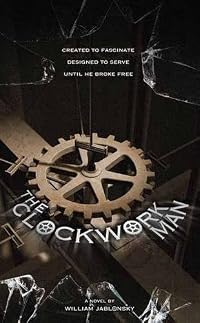
The Clockwork Man
by William Jablonsky
On This Page
Description
"Ernst's world is one of endless admirers, including foreign dignitaries and heads of state. Hailed as a marvel of late nineteenth-century automation, he is the crowning achievement of his master, Karl Gruber. A world-famous builder of automated clocks, Gruber has reached the pinnacle of his art in Ernst--a man constructed entirely of clockwork. Educated and raised in the Gruber household to be a gentle, caring soul, Ernst begins to discover a profound love for his master's daughter, show more Giselle. Just as their relationship becomes intimate, however, tragedy strikes and the family falls apart. Ernst's serene and happy existence is shattered and changed forever. Abandoned, knowing no other life but the one he has led, Ernst allows himself to wind down in a kind of suicide. Over one hundred years later, he awakens in a strange new land, the world he's known long gone. Along with his mentor and guide, a well-meaning if slightly unstable homeless man, Ernst attempts to piece together the events that brought him to his new home--and to let go of the century-old tragedy that still haunts him."--P. [4] of cover. show lessTags
Recommendations
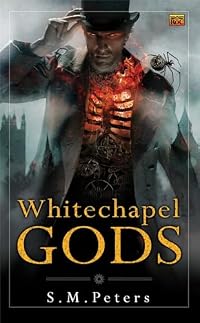

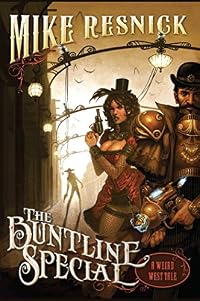





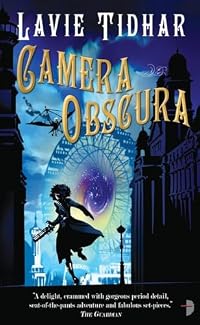



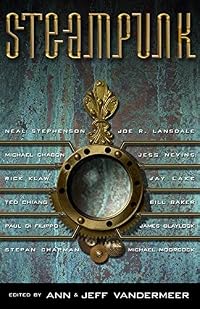


















Member Recommendations
Member Reviews
This was a very easy book to read – the way that Jablonsky narrates the story drew me in completely until I was fully submerged in Ernst’s story. Now, normally it takes a lot for me to like epistolary novel – especially in the form of a journal. I always find reading the character’s thoughts is just way too distrustful to really know 100% what is going on… But in the case when the character who is recording everything is an automaton, it automatically has a higher level of trustfulness – I mean, really, when was the last time a machine lied to you? Other than Bender of course…
Half of this book took place back in the very late 1800′s, while the other half takes place in 2005. One of the most interesting aspects of this show more book was seeing, not only how Ernst grasped mentally with the huge gap in time, but also in how he really adapted to it and how it changed him. He was everything that a gentleman could be at the beginning of the book, and by the end while he was still a gentleman, he was a lot rougher around the edges. The way he went from trusting people, to trusting no one (and fearing everyone), to eventually trusting a select group of people again, showed how much this automaton had some sort of intelligence beyond being just some sort of AI being.
I really enjoyed the relationship between Ernst and Giselle – how an automaton can discover what jealousy is, how a human girl can have such strong feelings towards an automaton, and even the love that they share. It not only helps Ernst to a new level as a character, but it also influences him throughout the rest of the book – and this was very clever and had me so intrigued as to why Ernst kept seeing vision of Giselle throughout the second half of the book.
Overall, I found The Clockwork Man to be a very well developed book, and I highly enjoyed spending time with Ernst – if I could have an automaton, I would want one just like him!
The Bottom Line
Highly recommended to speculative fiction fans! It feels like it would be a good introduction to the steampunk genre. I definitely enjoyed this, and I look forward to reading more from this author. show less
Half of this book took place back in the very late 1800′s, while the other half takes place in 2005. One of the most interesting aspects of this show more book was seeing, not only how Ernst grasped mentally with the huge gap in time, but also in how he really adapted to it and how it changed him. He was everything that a gentleman could be at the beginning of the book, and by the end while he was still a gentleman, he was a lot rougher around the edges. The way he went from trusting people, to trusting no one (and fearing everyone), to eventually trusting a select group of people again, showed how much this automaton had some sort of intelligence beyond being just some sort of AI being.
I really enjoyed the relationship between Ernst and Giselle – how an automaton can discover what jealousy is, how a human girl can have such strong feelings towards an automaton, and even the love that they share. It not only helps Ernst to a new level as a character, but it also influences him throughout the rest of the book – and this was very clever and had me so intrigued as to why Ernst kept seeing vision of Giselle throughout the second half of the book.
Overall, I found The Clockwork Man to be a very well developed book, and I highly enjoyed spending time with Ernst – if I could have an automaton, I would want one just like him!
The Bottom Line
Highly recommended to speculative fiction fans! It feels like it would be a good introduction to the steampunk genre. I definitely enjoyed this, and I look forward to reading more from this author. show less
Although Jablonsky limits his story from the perspective of only one character in his story, the character has a distinct and clear voice. Ernst, the clockwork man in "The Clockwork Man" is born to a very progressive family in 19th century Germany. His genius creator recognizes and encourages his creation's potential and Ernst inherits his creator's ideal and values in a way very similar to how a son adopts his father's views and practices in an effort to earn his father's pride. Ernst is exposed to a great many situations, some of which he can directly apply is creator's guidance and others that are so new to Ernst that he is forced to use his judgment and being a very powerful but "young" character, he often makes the wrong decision. show more As he expresses his experiences in his diary ("The Clockwork Man" is Ernst's diary), the readers have a clear view of his personality as it develops and have insight to Ernst's conscience and the human characteristics his artificial intelligence allows him.
Unfortunately, tragedy strikes the Gruber family to which Ernst is born and he eventually winds down into decades of unconsciousness, being revived in twenty-first century America. Although there were those who feared and misunderstood Ernst in nineteenth century Germany, the extent to which he is undervalued in modern day America is nearly obscene. He does not know the love and appreciation he knew with his original family and is treated as nothing more than an investment that will some day turn a profit by his new owner. Ernst befriends a homeless man who despite his transient nature is loyal to Ernst and appreciates him where others do not. The modern world is full of new wonders for Ernst, but also new challenges and opportunities for heroics. As in nineteenth century Germany, his mechanical strengths makes him well suited for heroic feats, but even these do not generate the same positive karma for him in modern day America as the did in the past.
"The Clockwork Man" is a well-written tale of an artifically intelligent clockwork man finding himself in the world over more than a decade of time. The world is not much changed from our own so not much time is spent setting up and explaining the setting and the story unfolds from Ernst's experiences directly. While not necessarily dry, Ernst's view is somewhat limited so the scene is not as complete as it might have been from a fuller perspective. Still, the story is never boring and is occasionally compelling. The contrast between nineteenth century Germany to present-day America seems to suggest a statement being made by the other, but it is never quite clear what the statement is. Has the New School lost the lost the pride in its work that the Old School held so dear? Are the Germans concerned more with quality and less with profit in contrast to the Americans as depicted in this book? Questions like these being left for debate make it quite easy for me to imagine this book being used as required reading in an English or Literature class. If so, this would be quite a treat for the class, especially when compared to some of the more tired classical offerings. show less
Unfortunately, tragedy strikes the Gruber family to which Ernst is born and he eventually winds down into decades of unconsciousness, being revived in twenty-first century America. Although there were those who feared and misunderstood Ernst in nineteenth century Germany, the extent to which he is undervalued in modern day America is nearly obscene. He does not know the love and appreciation he knew with his original family and is treated as nothing more than an investment that will some day turn a profit by his new owner. Ernst befriends a homeless man who despite his transient nature is loyal to Ernst and appreciates him where others do not. The modern world is full of new wonders for Ernst, but also new challenges and opportunities for heroics. As in nineteenth century Germany, his mechanical strengths makes him well suited for heroic feats, but even these do not generate the same positive karma for him in modern day America as the did in the past.
"The Clockwork Man" is a well-written tale of an artifically intelligent clockwork man finding himself in the world over more than a decade of time. The world is not much changed from our own so not much time is spent setting up and explaining the setting and the story unfolds from Ernst's experiences directly. While not necessarily dry, Ernst's view is somewhat limited so the scene is not as complete as it might have been from a fuller perspective. Still, the story is never boring and is occasionally compelling. The contrast between nineteenth century Germany to present-day America seems to suggest a statement being made by the other, but it is never quite clear what the statement is. Has the New School lost the lost the pride in its work that the Old School held so dear? Are the Germans concerned more with quality and less with profit in contrast to the Americans as depicted in this book? Questions like these being left for debate make it quite easy for me to imagine this book being used as required reading in an English or Literature class. If so, this would be quite a treat for the class, especially when compared to some of the more tired classical offerings. show less
I can't add too much on the basis of the other review (by TheDavisChanger) other than this book reminded me very strongly of a certain movie, The Bicentennial Man, for obvious reasons--other than that Ernst had no desire to be human. I would like to note that while the book is in the form of journal entries written by the main character, he wrote said entries for somebody else, and so they are more conversational in tone than you might expect.
I found the novel, on the whole, to be charming and somewhat touching. It was engrossing enough that I could not put it down--definitely a worthwhile read and one I will revisit.
I found the novel, on the whole, to be charming and somewhat touching. It was engrossing enough that I could not put it down--definitely a worthwhile read and one I will revisit.
Ratings
Members
- Recently Added By
Author Information
5+ Works 67 Members
Common Knowledge
- Original title
- The Clockwork Man
- Original publication date
- 2010
- People/Characters
- Ernst; Karl Gruber; Giselle Gruber
Classifications
Statistics
- Members
- 59
- Popularity
- 520,043
- Reviews
- 3
- Rating
- (3.61)
- Languages
- English
- Media
- Paper, Ebook
- ISBNs
- 6