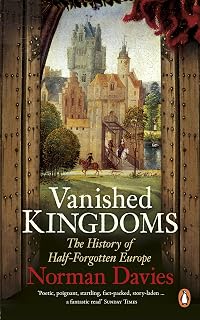
Vanished Kingdoms: The History of Half-Forgotten Europe
by Norman Davies
On This Page
Description
An evocative account of fourteen European kingdoms-their rise, maturity, and eventual disappearance. There is something profoundly romantic about lost civilizations. Europe's past is littered with states and kingdoms, large and small, that are scarcely remembered today, and while their names may be unfamiliar-Aragon, Etruria, the Kingdom of the Two Burgundies-their stories should change our mental map of the past. We come across forgotten characters and famous ones-King Arthur and Macbeth, show more Napoleon and Queen Victoria, right up to Stalin and Gorbachev-and discover how faulty memory can be, and how much we can glean from these lost empires. Davies peers through the cracks in the mainstream accounts of modern-day states to dazzle us with extraordinary stories of barely remembered pasts, and of the traces they left behind. This is Norman Davies at his best: sweeping narrative history packed with unexpected insights. Vanished Kingdoms will appeal to all fans of unconventional and thought-provoking history, from listeners of Niall Ferguson to Jared Diamond. show lessTags
Recommendations






Member Recommendations
Member Reviews
A pedantic, inept piece of work. The areas I happened to be familiar with were handled so badly it called into question the rest of it. (e.g. The German Vormarz is misidentified as a movement, rather than a historical period.)
The conceptual basis was incoherently fuzzy. The people of the former Soviet Union might understand that they are included metaphorically as one of the 'kingdoms' (chapter 15), but the Irish may be quite surprised to find themselves among the 'vanished' (chapter 14). This sort of sloppy thinking is reminiscent of Huntington's Clash of Civilizations, where the concept of 'civilization' was as broad or narrow as it needed to be at any given moment.
The author also has a bafflingly freshmanlike affection for citing show more dictionary definitions, encyclopedia entries, and tourist board websites, but spends and inordinate amount of time criticizing them as insufficiently detailed--not only a pedant, then, but one punching well below his weight. Based on this work's lazy lack of precision or clarity, it's a haughtiness that is thoroughly unjustified.
I could also go into the author's hilariously reactionary personal attitudes as well (a royalist conservative my grandfathers grandfathers' would have considered out of touch), but it wouldn't really be relevant. Bad history is bad history, regardless of one's politics. Besides, these attitudes aren't presented any more coherently than his theory.
Any student of history, serious or casual, liberal or conservative, should avoid this book if at all possible. If you are unfortunate enough to be assigned it in class, you can at least take solace in the fact that your professor is not as clever as he thinks he is.
[EDITED: 'Their was frequency a problematic with autocorrect.'] show less
The conceptual basis was incoherently fuzzy. The people of the former Soviet Union might understand that they are included metaphorically as one of the 'kingdoms' (chapter 15), but the Irish may be quite surprised to find themselves among the 'vanished' (chapter 14). This sort of sloppy thinking is reminiscent of Huntington's Clash of Civilizations, where the concept of 'civilization' was as broad or narrow as it needed to be at any given moment.
The author also has a bafflingly freshmanlike affection for citing show more dictionary definitions, encyclopedia entries, and tourist board websites, but spends and inordinate amount of time criticizing them as insufficiently detailed--not only a pedant, then, but one punching well below his weight. Based on this work's lazy lack of precision or clarity, it's a haughtiness that is thoroughly unjustified.
I could also go into the author's hilariously reactionary personal attitudes as well (a royalist conservative my grandfathers grandfathers' would have considered out of touch), but it wouldn't really be relevant. Bad history is bad history, regardless of one's politics. Besides, these attitudes aren't presented any more coherently than his theory.
Any student of history, serious or casual, liberal or conservative, should avoid this book if at all possible. If you are unfortunate enough to be assigned it in class, you can at least take solace in the fact that your professor is not as clever as he thinks he is.
[EDITED: 'Their was frequency a problematic with autocorrect.'] show less
This was a disappointing book. Ostensibly telling the story of European history somewhat indirectly through fifteen case studies of States that had ultimately ceased to exist, this very long book ultimately collapses on the self-indulgent approach of the author.
Let us start with the positive aspects of the book. The meat of each case study is solid and offers presumably reliable basic narrative history of the old school that will give any reader with a general education important and probably new insights into bits of history too often neglected.
Davies rightly points out that a history that reads back from the winners is no history at all since it does not give you the full picture. He aims to correct this and does us a service in show more doing so. In essence, he fills in some of the gaps and give these lost States their due as a part of history.
From Visigothic Tolosa in the fifth century AD to Litva and Borussia and thence to Eire under the British Crown after the Free State was formed, the stories are broadly well told and most of it will be new material to most readers. The maps and dynastic charts throughout are excellent.
So what is wrong with the book? First, it is too long for the material. Each chapter is padded out with an introductory 'travelogue' that is mostly redundant while a closing mini-essay often seems to be pot-boiling to meet a deadline.
In the end, you wonder what precisely you are learning here beyond 'one damned fact after another'. Anecdotes abound. There is plenty of detail. There are 'ah-ha' moments of real insight. But interpretation seems to be reserved for the business of meeting private prejudices.
And these self-indulgent prejudices are worn on the sleeve. Davies is clearly an old style European conservative, romantic about small nations, with an inherent gut dislike of Russia and of the Soviet system that makes some sections read like the worst sort of Cold War propaganda.
While his points are often fair, there is a lack of sophistication here. Some of the thinking seems muddled with personal moral judgements running through the text sotto voce like thin streams of ore in the rock of the narrative.
Almost every case study in the book can reasonably be considered to be a 'vanished kingdom' insofar as some dynastic family business was involved but he stretches the point on Rusyn in 1939 while Byzantion seems stuck in there with little new to say just to permit space for an empire.
But the final case study is little more than extended riff on the iniquities of Sovietism in relation to Estonia and other small nations. This East European specialist strikes me as just getting something off his chest. His account of the Soviet Union is unsubtle and grossly simplistic.
The book seems to be little more at times that the dumping on the reader of extensive notes made for his earlier history of Europe (another very big book) to which he has then added some local colour and some of his regional small nation and romantic-dynastic prejudices.
The book was thus a lot less enjoyable than it should have been. The very short theoretical chapter at the end, on the death of States, seemed to offer yet more potboiling with its rather unnecessary listing of the opinions of dead white luminaries from Aristotle to Rousseau.
It stays in the library because the meat in the case studies remains valuable and some of the potboiling stuff, the bread surrounding the meat sandwich, could be entertaining on occasions but the overall experience was disheartening. One was left with a sense of intellectual laziness.
What I wish had happened was a tough Editor cutting out the guff at the beginning and end of each case study, dropping the self-indulgent chapter on the Soviet Union and Rusyn (and the unnecessary discursion on Byzantion) and giving us 13 solid narrative case studies.
If there had then been a more thoughtful review of the failure of these warlord and dynastic states in a final chapter (perhaps pulling together some of the material in the final sections of each chapter), he might have cut 120 pages and walked away with something more impressive. show less
Let us start with the positive aspects of the book. The meat of each case study is solid and offers presumably reliable basic narrative history of the old school that will give any reader with a general education important and probably new insights into bits of history too often neglected.
Davies rightly points out that a history that reads back from the winners is no history at all since it does not give you the full picture. He aims to correct this and does us a service in show more doing so. In essence, he fills in some of the gaps and give these lost States their due as a part of history.
From Visigothic Tolosa in the fifth century AD to Litva and Borussia and thence to Eire under the British Crown after the Free State was formed, the stories are broadly well told and most of it will be new material to most readers. The maps and dynastic charts throughout are excellent.
So what is wrong with the book? First, it is too long for the material. Each chapter is padded out with an introductory 'travelogue' that is mostly redundant while a closing mini-essay often seems to be pot-boiling to meet a deadline.
In the end, you wonder what precisely you are learning here beyond 'one damned fact after another'. Anecdotes abound. There is plenty of detail. There are 'ah-ha' moments of real insight. But interpretation seems to be reserved for the business of meeting private prejudices.
And these self-indulgent prejudices are worn on the sleeve. Davies is clearly an old style European conservative, romantic about small nations, with an inherent gut dislike of Russia and of the Soviet system that makes some sections read like the worst sort of Cold War propaganda.
While his points are often fair, there is a lack of sophistication here. Some of the thinking seems muddled with personal moral judgements running through the text sotto voce like thin streams of ore in the rock of the narrative.
Almost every case study in the book can reasonably be considered to be a 'vanished kingdom' insofar as some dynastic family business was involved but he stretches the point on Rusyn in 1939 while Byzantion seems stuck in there with little new to say just to permit space for an empire.
But the final case study is little more than extended riff on the iniquities of Sovietism in relation to Estonia and other small nations. This East European specialist strikes me as just getting something off his chest. His account of the Soviet Union is unsubtle and grossly simplistic.
The book seems to be little more at times that the dumping on the reader of extensive notes made for his earlier history of Europe (another very big book) to which he has then added some local colour and some of his regional small nation and romantic-dynastic prejudices.
The book was thus a lot less enjoyable than it should have been. The very short theoretical chapter at the end, on the death of States, seemed to offer yet more potboiling with its rather unnecessary listing of the opinions of dead white luminaries from Aristotle to Rousseau.
It stays in the library because the meat in the case studies remains valuable and some of the potboiling stuff, the bread surrounding the meat sandwich, could be entertaining on occasions but the overall experience was disheartening. One was left with a sense of intellectual laziness.
What I wish had happened was a tough Editor cutting out the guff at the beginning and end of each case study, dropping the self-indulgent chapter on the Soviet Union and Rusyn (and the unnecessary discursion on Byzantion) and giving us 13 solid narrative case studies.
If there had then been a more thoughtful review of the failure of these warlord and dynastic states in a final chapter (perhaps pulling together some of the material in the final sections of each chapter), he might have cut 120 pages and walked away with something more impressive. show less
Norman Davies is one of my favourite writers of European history, as he has ways of making connections between different countries and events and individuals that lead the reader to a richer understanding of that continent. In Vanished Kingdoms: The History of Half-Forgotten Europe, he describes 15 nation-states from the past, ranging from a Visigoth kingdom in the 5th Century to Estonia and Ireland (Eire) in the 20th Century. Along the way, we learn a great deal about the interactions, and inter-dependencies, among, especially, the Baltic region and Eastern Europe (which is well-represented with about half of the countries described), and particularly we learn about how the "larger" powers of any given time tended to give the needs of show more the populations of the smaller nations scant attention, even when those nations were allies of the larger ones. Each chapter is divided into three parts: a look at the modern region under discussion, a much longer delve into the history of the place, and a final summation of treatments and futures for the area (he's especially melancholy about the survival of the United Kingdom in the third part of the Eire chapter, considering that once Scotland leaves the Union - which he believes it is likely to do - the rest of the remaining countries of the Kingdom will break away from England too). I find his style of writing to be very vivid and at the same time very clear; he footnotes everything meticulously, like the scholar he is, although his footnotes are of the more boring variety (citations of sources; no more than a handful of interesting tidbits of informational asides) so unless you're a scholar too, it's not necessary to check the footnotes obsessively. And I like the fact that in this book he's looking at parts of Europe that might be very well-known (France, Scotland, Spain) to Western readers, and at the less-known Eastern regions too, in ways that allow us to see the development of that continent over centuries in a very different way than is usually presented in history books. I think interest in historical matters is a very individual taste; but if you have that interest, particularly in the European realm, this is a really informative and interesting book to peruse, though you might want to take it in chunks rather than all in one go. Recommended! show less
This took me a long time to work through, especially at the beginning, and truth be told there was a moment when I was on the point of giving up. The problem is this - Davies's study of the kingdoms that have come and gone from the European map is massively erudite, but when discussing the kingdoms of long ago there is so little for the lay reader to hold onto that the prospect of reading sixty pages more before the end of the chapter is almost too daunting. That was certainly the case with the chapters on Tolosa and Alt Clud. Things improved drastically after that - and remember, the fault lies more with the reader than the writer in the present case.
Davies also reveals himself to be a surprisingly good travel writer. The chapter on show more Galicia in particular is a joy to read - part one especially - and I wished that these lead-ins were longer. All in all, though, this is a fantastic read, and now I only wish I could still remember the tenth part of what I've read... show less
Davies also reveals himself to be a surprisingly good travel writer. The chapter on show more Galicia in particular is a joy to read - part one especially - and I wished that these lead-ins were longer. All in all, though, this is a fantastic read, and now I only wish I could still remember the tenth part of what I've read... show less
An excellent book and one that I'd give 4.5 to if I could, dropping the half just because you have to have an interest to value it.
Opinionated, impressively researched and excellently written this is a book that anyone with any kind of interest in history really should read. Apart from making you think quite hard about states and nationalism it is peppered with revelatory snippets (at least it was for me).
Opinionated, impressively researched and excellently written this is a book that anyone with any kind of interest in history really should read. Apart from making you think quite hard about states and nationalism it is peppered with revelatory snippets (at least it was for me).
A curious book: Davies is capable of writing vivid prose (see the initial pages of the ninth chapter, on Galicia) but this book often gets quite, uh, boggy with lists of monarchs and reigns and ... well. Maybe the vividness maps to Davies' own enthusiasm level ... one of the only things I know about him is that he's an expert on Eastern Europe and Poland in particular ... maybe the vivid prose only comes when he's in that element. I don't know. There's a load of interesting information here, but it often feels like a slog.
Holy crap, I finished it! It took me two months, but I did it. (To be fair, I had a 'few' things going on, and finished a few other books over the same period.)
This book is dense. It really is. But it is also really interesting. I didn't think I could enjoy this level of detail about states, family lines, successions, etc.; and in a sense it was as boring as it might sound (depending on your tastes/interests.) But the thing is... it actually was well worth the read, and maintained my interest throughout.
As an American, even one who reads a lot, the rise and fall of political units/states seems distant. Somehow, drowning in detail, this book manages to give a sense of the complexity and enormity of political changes that --even having show more read some previous history-- I was simply lacking. And not just the human suffering and cost (though there is plenty of that.) The sense of shifting identity, lost identity, just the vagaries of time, etc....
Yeah, this was a good book :) show less
This book is dense. It really is. But it is also really interesting. I didn't think I could enjoy this level of detail about states, family lines, successions, etc.; and in a sense it was as boring as it might sound (depending on your tastes/interests.) But the thing is... it actually was well worth the read, and maintained my interest throughout.
As an American, even one who reads a lot, the rise and fall of political units/states seems distant. Somehow, drowning in detail, this book manages to give a sense of the complexity and enormity of political changes that --even having show more read some previous history-- I was simply lacking. And not just the human suffering and cost (though there is plenty of that.) The sense of shifting identity, lost identity, just the vagaries of time, etc....
Yeah, this was a good book :) show less
Members
- Recently Added By
Lists

Recommend the 20 best books you've read in the last five years
2,168 works; 606 members

Books Read in 2016
4,666 works; 199 members

Five star books
1,767 works; 109 members

Books Read in 2019
4,052 works; 110 members

Library Books
71 works; 1 member
Author Information

49+ Works 8,653 Members
Norman Davies is a Supernumerary Fellow at Wolfson College, Oxford, and is a Fellow of the British Academy, Fellow of the Royal Historical Society, and Professor Emeritus of London University
Some Editions
Awards and Honors
Work Relationships
Common Knowledge
- Canonical title
- Vanished Kingdoms: The History of Half-Forgotten Europe
- Original title
- Vanished Kingdoms
- Alternate titles
- Vanished Kingdoms: The Rise and Fall of States and Nations
- Original publication date
- 2011
- People/Characters
- Wilfred the Hairy; Charles Edward, Duke of Saxe-Coburg and Gotha
- Important places
- Kingdom of Tolosa (Toulouse); Kingdom of Strathclyde (Alt Clud); Duchy of Burgundy (Burgundia); Kingdom of Aragon; Kingdom of Lithuania (Litva); Byzantium (Byzántion) (show all 14); Borussia; Sabaudia; Kingdom of Galicia; Etruria (Etruscan); Rosenau; Tsernagora; Rusyn; Eire
- Epigraph*
- I'r anghofiedig
Dla tych, o których historycy przeważnie zapominają - Dedication
- I'r anghofiedig
Dla tych, o których historycy przeważnie zapominają
I'r anghofiedig
For those whom historians tend to forget - First words
- (from Introduction)
All my life, I have been intrigued by the gap between appearances and reality. Things are never quite what they seem. I was born a subject of the British Empire, abd as a child, read in my Child... (show all)ren's Encyclopaedia that 'our empire' was one 'on which the sun never set'. - Quotations
- All the nations that have ever lived have left their footsteps in the sand. The traces fade with every tide, the echoes grow faint, the images are fractured, the human material is atomized and recycled. But if we know where t... (show all)o look, there is always a remnant, a remainder, an irreducible residue. (p.393)
- Last words
- (Click to show. Warning: May contain spoilers.)Men are we, and must grieve when even the Shade
Of that which once was great is passed away. - Blurbers
- Grayling, A.C.; Fernandez-Armesto, Felipe; Wilson, Ben; Appleyard, Bryan; Snyder, Timothy; Sandbrook, Dominic (show all 7); Adamson, John
- Original language
- English
*Some information comes from Common Knowledge in other languages. Click "Edit" for more information.
Classifications
Statistics
- Members
- 1,527
- Popularity
- 15,101
- Reviews
- 29
- Rating
- (3.77)
- Languages
- 9 — Dutch, English, Estonian, German, Korean, Polish, Portuguese, Spanish, Swedish
- Media
- Paper, Audiobook, Ebook
- ISBNs
- 28
- ASINs
- 11