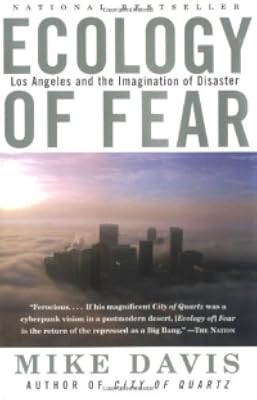
Ecology of Fear: Los Angeles and the Imagination of Disaster
by Mike Davis
On This Page
Description
Rich with detail, bold and original, Mike Davis's Ecology of Fear is a gripping reconnaissance into the urban future, an essential portrait of America at the millennium. Los Angeles has become a magnet for the American apocalyptic imagination. Riot, fire, flood, locusts are missing from the almost biblical list of disasters that have struck the city in the 1990s. From Ventura to Laguna, more than one million Southern Californians have been directly touched by disaster-related death, injury, show more or damage to their homes and businesses. Middle-class apprehensions about angry underclasses are exceeded only by anxieties about blind thrust faults underlying downtown L.A. or about the firestorms that periodically incinerate Malibu. And the force of real catastrophe has been redoubled by the obsessive fictional destruction of Los Angeles--by aliens, comets, and twisters--in scores of novels and films. The former "Land of Sunshine" is now seen by much of the world, including many of L.A.'s increasingly nervous residents, as a veritable Book of the Apocalypse theme park. In this extraordinary book, Mike Davis, the author of City of Quartz and our most fascinating interpreter of the American metropolis, unravels the secret political history of disaster, real and imaginary, in Southern California. As he surveys the earthquakes of Santa Monica, the burning of Koreatown, the invasion of "man-eating" mountain lions, the movie Volcano, and even Los Angeles's underrated tornado problem, he exposes the deep complicity between social injustice and perceptions of natural disorder. Arguing that paranoia about nature obscures the fact that Los Angeles has deliberately put itself in harm's way, Davis reveals how market-driven urbanization has for generations transgressed against environmental common sense. And he shows that the floods, fires, and earthquakes reaped by the city were tragedies as avoidable--and unnatural--as the beating of Rodney King and the ensuing explosion in the streets. show lessTags
Recommendations







Member Reviews
Los Angeles has been going through it. Deep droughts. A lot of rain. The constant expectation regarding earthquakes. Political unrest. And, of course, the wildfires.
This accurately reflects the situation in 2025. It also was accurate in the 1990s. And many times beforehand.
In 1998, Mike Davis published Ecology of Fear: Los Angeles and the Imagination of Disaster. In it he gives voice to disaster in Los Angeles, both in reality and in imagination.
He ran through the gamut of disasters which Los Angeles has, does, and will continue to experience. He spoke of the flooding which can attend to the “Pineapple Express,” which we now understand as atmospheric rivers (ARs), and detailed the many floods which the Los Angeles Basin has show more experienced over the past century and a half. He addressed the rampant urban expansion within the Los Angeles Basin, how and why it went down, and the consequences which attend to it. His famous longform article, The Case for Letting Malibu Burn, is presented in its fullness, not merely a discourse on the Santa Ana winds and the inevitability of major fires like the Palisades and Eaton Fires, but also embedded within it a discussion of the many urban fires within slums in the history of Los Angeles which tend not to get the same press. The author then presented his personal research into the history of tornadoes in Los Angeles: their very real existence despite all attempts to redefine them or suppress knowledge of them, the patterns they follow, how no one has died from them in the past century (extraordinarily), and how they will persist despite everyone thinking we do not get tornadoes in Los Angeles. He also spoke of the wildlife within the mountains and how we relate to them. He provided a masterful exploration into all the various ways Los Angeles has been destroyed in literature and film and what those stories say about how Los Angeles was perceived and those who came up with them. He concluded by considering Los Angeles’ unique “official nightmare,” Blade Runner, and what seemed like, in the late 90s, the ways in which society in Los Angeles would continue to degenerate.
The author’s cynicism overall does him well until at the end, for whereas the 21st century surely has seen a lot of challenges for Los Angeles, it has not quite turned out to be Blade Runner just yet.
This is a powerful and prescient compilation of essays, and one very much worth reading for those who wish to understand the dark side of this paradise. It should not be a surprise when a lot of these things happen. We just do well to mitigate our risk to the best of our abilities, be prepared for the likely disaster prospects, and negotiate life in this environment appropriately. show less
This accurately reflects the situation in 2025. It also was accurate in the 1990s. And many times beforehand.
In 1998, Mike Davis published Ecology of Fear: Los Angeles and the Imagination of Disaster. In it he gives voice to disaster in Los Angeles, both in reality and in imagination.
He ran through the gamut of disasters which Los Angeles has, does, and will continue to experience. He spoke of the flooding which can attend to the “Pineapple Express,” which we now understand as atmospheric rivers (ARs), and detailed the many floods which the Los Angeles Basin has show more experienced over the past century and a half. He addressed the rampant urban expansion within the Los Angeles Basin, how and why it went down, and the consequences which attend to it. His famous longform article, The Case for Letting Malibu Burn, is presented in its fullness, not merely a discourse on the Santa Ana winds and the inevitability of major fires like the Palisades and Eaton Fires, but also embedded within it a discussion of the many urban fires within slums in the history of Los Angeles which tend not to get the same press. The author then presented his personal research into the history of tornadoes in Los Angeles: their very real existence despite all attempts to redefine them or suppress knowledge of them, the patterns they follow, how no one has died from them in the past century (extraordinarily), and how they will persist despite everyone thinking we do not get tornadoes in Los Angeles. He also spoke of the wildlife within the mountains and how we relate to them. He provided a masterful exploration into all the various ways Los Angeles has been destroyed in literature and film and what those stories say about how Los Angeles was perceived and those who came up with them. He concluded by considering Los Angeles’ unique “official nightmare,” Blade Runner, and what seemed like, in the late 90s, the ways in which society in Los Angeles would continue to degenerate.
The author’s cynicism overall does him well until at the end, for whereas the 21st century surely has seen a lot of challenges for Los Angeles, it has not quite turned out to be Blade Runner just yet.
This is a powerful and prescient compilation of essays, and one very much worth reading for those who wish to understand the dark side of this paradise. It should not be a surprise when a lot of these things happen. We just do well to mitigate our risk to the best of our abilities, be prepared for the likely disaster prospects, and negotiate life in this environment appropriately. show less
This is an outstanding book with a wide appeal. I think everyone from people interested in the sociology of cities to science fiction fans to readers who wonder how humans can ignore obvious risks will find something in this book to like. It discusses many of the problems of Los Angeles including earthquakes, droughts, mudslides, unplanned urbanization, wildfires, tornadoes, wild animals and urban blight. In the middle he pauses to read every book and see every movie that depicts the destruction of Los Angeles. He breaks them down into categories and then discusses several from each group.
On top of having so much information, this book is a joy to read, moving along at a rapid pace and pulling the reader in. I have only two complaints show more which made me rate this 4 instead of 5. One, there isn't one cohesive over-riding thesis. Two, is that there is no bibliography so when you want more information (or the list of all the dystopian LA fiction), you have to ferret it out of the footnotes. show less
On top of having so much information, this book is a joy to read, moving along at a rapid pace and pulling the reader in. I have only two complaints show more which made me rate this 4 instead of 5. One, there isn't one cohesive over-riding thesis. Two, is that there is no bibliography so when you want more information (or the list of all the dystopian LA fiction), you have to ferret it out of the footnotes. show less
Loved this book and City of Quartz. Highly recommended to anyone interested in LA or southern California.
Davis is a brainwashed rabid Marxist and uses natural disasters combined with convoluted reasoning and his dubious ethics to attack capitalism and wealthy people. Sometimes he does come to some valid conclusions, like his case for letting brush fires burn in Malibu but he does so for all the wrong reasons (his bitter desire to punish the wealthy instead of promoting individual preparedness and cost cutting on firefighting). Book is replete with recent California history of disasters, photos, and policy advocacy. Despite being an evil Marxist he brings up some good points and this book is thought provoking in a refreshing "think-outside-the-box," sort of way.
LOCWALLCASE1S6
Members
- Recently Added By
Lists

BingoDOG - Books With Natural Disasters: Nonfiction
18 works; 5 members

California Cultural History
23 works; 4 members

Books to Recommend to My Niece/Nephew (The late teenage years)
29 works; 3 members

Non-Fiction Worth Reading
1,016 works; 262 members

Caring for the Earth
19 works; 2 members

Environmental History
46 works; 8 members

5 Best 5 Years
71 works; 4 members
Author Information

41+ Works 6,980 Members
Mike Davis is the author of many books, including City of Quartz, The Monster at Our Door, Buda's Wagon, and Planet of Slums. He is the recipient of the MacArthur Fellowship and the Lannan Literary Award. He lives in San Diego.
Awards and Honors
Awards
Notable Lists
Work Relationships
Contains
Common Knowledge
- Important places
- Los Angeles, California, USA
- Epigraph
- No place on Earth offers greater security to life and grater freedom from natural disasters than Southern California. --Los Angeles Times, 1934
- Dedication
- for my kids, Jack and Roisin
- First words
- Once or twice each decade, Hawaii sends Los Angeles a big, wet kiss. (1, The Dialectic of Ordinary Disaster)
- Last words
- (Click to show. Warning: May contain spoilers.)Seen from space, the city that once hallucinated itself as an endless future without natural limits or social constraints now dazzles observers with the eerie beauty of an erupting volcano. (7, Beyond Blade Runner)
- Publisher's editor
- Bershtel, Sara; Englehardt, Tom
- Blurbers
- Starr, Kevin; Faludi, Susan; Hayden, Tom; Hiss, Tony
- Canonical DDC/MDS
- 303.4850979494; 307.760979494
- Canonical LCC
- HN80.L7
Classifications
- Genres
- Sociology, Science & Nature, Nonfiction, General Nonfiction, History
- DDC/MDS
- 303.4850979494 — Society, government, & culture Social sciences, sociology & anthropology Social processes Social change Causes of change Disasters
- LCC
- HN80 .L7 — Social sciences Social history and conditions. Social problems. Social reform Social history and conditions. Social problems. By region or country
- BISAC
Statistics
- Members
- 797
- Popularity
- 34,954
- Reviews
- 7
- Rating
- (4.07)
- Languages
- English, German, Italian, Portuguese (Portugal)
- Media
- Paper, Ebook
- ISBNs
- 13
- ASINs
- 5