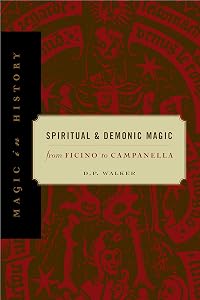
Spiritual & Demonic Magic: from Ficino to Campanella
by D. P. Walker
Studies of the Warburg Institute (Volume 22)
On This Page
Description
First published by the Warburg Institute in 1958, this book is considered a landmark in Renaissance studies. Whereas most scholars had tended to view magic as a marginal subject, Walker showed that magic was one of the most typical creations of the late fifteenth and sixteenth centuries. Walker takes readers through the magical concerns of some of the greatest thinkers of the Renaissance, from Marsilio Ficino, Giovanni Pico della Mirandola, and Jacques Lefevre d'Etaples to Jean Bodin, show more Francis Bacon, and Tommaso Campanella. Ultimately he demonstrates that magic was interconnected with religion, music, and medicine, all of which were central to the Renaissance notion of spiritus. Remarkable for its clarity of writing, this book is still considered essential reading for students seeking to understand the assumptions, beliefs, and convictions that informed the thinking of the Renaissance. This edition features a new introduction by Brian Copenhaver, one of our leading experts on the place of magic in intellectual history. show lessTags
Recommendations






Member Reviews
LA MAGIE SPIRITUELLE ET ANGELIQUE
Le livre de Walker montre comment la magie angélique, dans son mariage avec la magie planétaire du Moyen-Âge, aboutit chez Cornelius Agrippa à une magie non orthodoxe, puis par quels parcours la magie « spirituelle » (celle qui fait appel aux « esprits ») s'est transmuée pour devenir musique et poésie chez La Boderie, christianisme orthodoxe chez Giorgi, christianisme non orthodoxe chez Persio.
A la fin du xvie siècle, ces deux directions prises par la « tradition magique » se sont de nouveau rejointes dans l'oratoire planétaire de Paolini et la magie pratiquée par Tommaso Campanella, pour marquer plus tard de leur sceau spécifique certains courants culturels de notre histoire.
Le livre de Walker montre comment la magie angélique, dans son mariage avec la magie planétaire du Moyen-Âge, aboutit chez Cornelius Agrippa à une magie non orthodoxe, puis par quels parcours la magie « spirituelle » (celle qui fait appel aux « esprits ») s'est transmuée pour devenir musique et poésie chez La Boderie, christianisme orthodoxe chez Giorgi, christianisme non orthodoxe chez Persio.
A la fin du xvie siècle, ces deux directions prises par la « tradition magique » se sont de nouveau rejointes dans l'oratoire planétaire de Paolini et la magie pratiquée par Tommaso Campanella, pour marquer plus tard de leur sceau spécifique certains courants culturels de notre histoire.
Sep 5, 2024Spanish
Ratings
Members
- Recently Added By
Lists

The ESOTERICA Library by Dr. Justin Sledge (Renaissance Magic)
10 works; 1 member
Author Information

7 Works 339 Members
D. P. Walker was Reader in Renaissance Studies at the Warburg Institute of the University of London and subsequently Professor of the History of the Classical Tradition there.
Some Editions
Series

Belongs to Publisher Series
Magic in History (6)
Studies of the Warburg Institute (Volume 22)
Common Knowledge
- Canonical title
- Spiritual & Demonic Magic: from Ficino to Campanella
- Original publication date
- 1958
- Important places
- Italy
- First words
- Of the three books of Ficino's De Triplici Vita, the first deals with preserving the health of scholars, the second with prolonging their life, and the third with astral influences on them (De Vita Coeletus Comparanda).
- Last words
- (Click to show. Warning: May contain spoilers.)And with Urban VIII he came very near to success.
- Blurbers
- Brian Copenhaver, UCLA; Richard Kieckhefer, Northwestern University, Illinois
Classifications
- Genres
- Nonfiction, Religion & Spirituality, History, General Nonfiction, Philosophy
- DDC/MDS
- 133 — Philosophy & psychology Parapsychology & occultism Specific topics in parapsychology and occultism
- LCC
- BF1593 .W2 — Philosophy, Psychology and Religion Psychology Occult sciences Magic. Hermetics. Necromancy
- BISAC
Statistics
- Members
- 240
- Popularity
- 136,010
- Reviews
- 1
- Rating
- (4.38)
- Languages
- English, French, Croatian
- Media
- Paper
- ISBNs
- 6
- ASINs
- 2