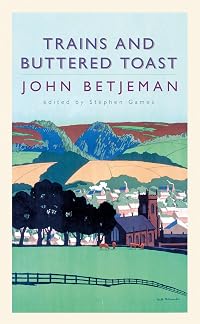
Trains and Buttered Toast
by John Betjeman
On This Page
Description
Eccentric, sentimental and homespun, John Betjeman's passions were mostly self-taught. He saw his country being devastated by war and progress and he waged a private war to save it. His only weapons were words--the poetry for which he is best known and, even more influential, the radio talks that first made him a phenomenon. From fervent pleas for provincial preservation to humoresques on eccentric vicars and his own personal demons, Betjeman's talks combined wit, nostalgia and criticism in show more a way that touched the soul of his listeners from the 1930s to the 1950s. Now, collected in book form for the first time, his broadcasts represent one of the most compelling archives of 20th-century broadcasting. show lessTags
Recommendations













Member Recommendations


Member Reviews
The BBC (British Broadcasting Service) felt that it had, under its Chairman Lord Reith, a moral obligation to educate and elevate the taste of ‘the masses’ – their listeners. In 1938 John Betjeman gave his first radio talk, on the architecture and renovation of Waterloo Bridge in London, and launched a broadcasting career that ran until the 1960s. His areas of interest were architecture and the ‘trashing’ of the English countryside, religion and, of course, books, authors, literature and poetry. One of his last radio talks , in 1959, was a celebratory reading of his own – by then - immensely popular poetry. He became, according to The Times, the ‘first Teddy Bear of the nation’, and that nation erected a charming statue show more of him, holding onto his hat whilst peering about in perpetual enthusiastic curiosity in the now renovated St. Pancras Railway station, whose architectural façade he was instrumental in preserving from demolition.
His popularity was established by these hundreds of radio talks and his participating in ”The Brains Trust” a quiz show in the common knowledge format, where this self-proclaimed “semi-intellectual” was able to show off a flexible extemporizing intelligence which appealed to those broad ‘masses’ of the BBC listeners. One of his producers, the later infamous spy Guy Burgess asked him to give a series of interviews and talks on the ‘British Eccentric’, explaining that he thought to himself ‘…. who more suitable to than you to talk about one of the others?’
John was not a handsome man, Wilhelmine Cresswell, once briefly his fiancé, recalled in an interview later “ …his hair was like last year’s birds nest and his teeth were covered in slime’! Despite this, he made an equally successful migration to the medium of television and became one of the most popular British Poet Laureates.
Betjeman published over a hundred books of Victorian architectural comment, hymns, country guides and – of course – dozens of his poetry. His keystone work ”Summoned by Bells” was autobiographical and was made into a film. It is from that work that the title of this book was taken;
Safe in a world of trains and buttered toast
Where things inanimate could feel and think.
The pieces in the book are from his radio talks and cover a broad spectrum of his thoughts and interests – I would have liked more of his train-travel narratives or period pieces like those I enjoy from J.B. Priestley or Eeh Bah Goom Priestley as Betjeman described him with that wicked sense of humour he sometimes flashed.
However; Betjeman’s poetry, as distinct from the marvelously evocative town and country descriptive pieces in this book does not engage me very much, but, with that humour again, he writes “I ought to warn you that my verse is of no interest to people who can think. It jingles for the slaves of their own passions”. show less
His popularity was established by these hundreds of radio talks and his participating in ”The Brains Trust” a quiz show in the common knowledge format, where this self-proclaimed “semi-intellectual” was able to show off a flexible extemporizing intelligence which appealed to those broad ‘masses’ of the BBC listeners. One of his producers, the later infamous spy Guy Burgess asked him to give a series of interviews and talks on the ‘British Eccentric’, explaining that he thought to himself ‘…. who more suitable to than you to talk about one of the others?’
John was not a handsome man, Wilhelmine Cresswell, once briefly his fiancé, recalled in an interview later “ …his hair was like last year’s birds nest and his teeth were covered in slime’! Despite this, he made an equally successful migration to the medium of television and became one of the most popular British Poet Laureates.
Betjeman published over a hundred books of Victorian architectural comment, hymns, country guides and – of course – dozens of his poetry. His keystone work ”Summoned by Bells” was autobiographical and was made into a film. It is from that work that the title of this book was taken;
Safe in a world of trains and buttered toast
Where things inanimate could feel and think.
The pieces in the book are from his radio talks and cover a broad spectrum of his thoughts and interests – I would have liked more of his train-travel narratives or period pieces like those I enjoy from J.B. Priestley or Eeh Bah Goom Priestley as Betjeman described him with that wicked sense of humour he sometimes flashed.
However; Betjeman’s poetry, as distinct from the marvelously evocative town and country descriptive pieces in this book does not engage me very much, but, with that humour again, he writes “I ought to warn you that my verse is of no interest to people who can think. It jingles for the slaves of their own passions”. show less
Ratings
Members
- Recently Added By
Author Information

130+ Works 3,910 Members
A leading modern champion of the values of an older England, John Betjeman was born in Highgate, London, to a well-off merchant family. The loneliness and suffering of his upbringing, first under nursemaids and then at a series of schools, often surface in his poetry. He went to Magdalene College, Oxford, where he belonged to the same smart social show more set as Evelyn Waugh. Deliberately free from the difficulties of much modern verse, Betjeman's poetry harks back to a more accessible British tradition that includes Alfred, Lord Tennyson and Thomas Hardy. With quiet wit he resisted the debasements of modern mass culture in favor of an older England simpler, more rural, and more religious than the current one. Both W. H. Auden and Philip Larkin especially admired his work, and Auden even edited a selection of it. His harsher critics have found him unintellectual and sentimental. His poetry has achieved a huge circulation in Great Britain, with the Collected Poems (1958) reputedly selling more than 100,000 copies. Considered a national institution, he succeeded Cecil Day Lewis as poet laureate in 1972. Betjeman worked in a variety of media and achieved wide public attention as host for a television series on the history of British architecture, one of his prime interests. He wrote a great deal on architecture, especially for the Architectural Review. Betjeman died in 1984. (Bowker Author Biography) show less
Some Editions
Common Knowledge
- People/Characters
- John Betjeman
- Important places
- England, UK
Classifications
- Genres
- Nonfiction, History
- DDC/MDS
- 791.4472 — Arts & recreation Recreation, sports, and performing arts Movies, TV, Video Motion pictures, radio, television, podcasting Radio Radio programs; radio plays Single programs
- LCC
- PN1991.3 .G7 .B4 — Language and Literature Literature (General) Literature (General) Drama Broadcasting Radio broadcasts
- BISAC
Statistics
- Members
- 212
- Popularity
- 153,984
- Reviews
- 1
- Rating
- (3.53)
- Languages
- English
- Media
- Paper
- ISBNs
- 3