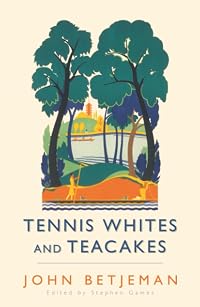
Tennis Whites and Teacakes
by John Betjeman
On This Page
Description
Betjeman's England is a place of patriotic poets and seaside coves, provincial cathedrals and eccentric dons. For fifty years, Betjeman celebrated the glories of Englishness and what it meant to be English. Against a tide of rapid change, he unearthed forgotten heroes, bygone haunts and old-fashioned modes of thought. But as this original collection reveals, his appeal goes far beyond simple nostalgia. It lies in his passionate convictions, his humor and his humanity. What does it mean to be show more English? What is Englishness? For fifty years, at a time when other people were becoming more internationally aware, John Betjeman immersed himself in the glories of English culture - its places, its writings, its heroes. Seaside architecture, national poets, the great cathedrals, our ancient townscapes—all were hard-won achievements, he pleaded, with pleasures and delights that we threw away at our peril. Tennis Whites and Teacakes brings together the best of Betjeman’s poetry, private letters, journalism and musings to present a fully rounded picture of what he stood for. From his arguments for new steel buildings to his amusement about the etiquette of village teashops, it reveals Betjeman not just as a sentimentalist but as a passionate observer with a wonderful sense of humor and an acute eye. show lessTags
Recommendations














Member Recommendations




Member Reviews
Weeeell ... I've been reading this on and off, mostly off, for about four years. Finally finished it, and I must say it's something of a relief. It wasn't hard going - far from it - very pleasant and readable in most places ... just not in the least bit gripping. Perhaps this was because most of the prose sections were descriptive of people and things and lifestyles long since gone? Who knows. I tend to quite like the light pastoral tone of Betjeman's poetry (I enjoyed the collection Summoned by Bells), but this left me a bit cold. A particular downer was the way that it closed with a few pages of faith-filled naive religious writing, which felt a bit odd and left a slightly bitter taste in my mouth. Hey ho.
A Miss Sparrow, of London, in her review of this book wrote ’If you thought Betjeman was just a poet, then read this and you'll find he's just as entertaining and thought-provoking as a journalist, a diarist and a correspondent. This book is a must-buy for anyone who wants to understand the patron saint of Englishness…’ remarking that it was a “delicious” read.
So it is.
One of the sub-sections of this edited collection (yet another fine job by Stephen Games) is titled Englishness and the pieces written by our ”Patron Saint” are appropriate – on Teas, High Teas and even Dainty Teas and why Betjeman wished he was a Station Master. Not of British rail of course, but a ‘branch-line’ in the country with rambling roses show more climbing the station’s wall, two Clydesdales thumping aboard a van, the rattle of milk churns and the ‘crunch of steps on the gravel’. All vaguely remembered even in my generation. Another included piece is almost a hymn, from our Saint, on the old country railroads “The Great Western” with descriptions of it’s great Pullman’s service to Cornwall, it’s sleepy branch lines and cuts and Betjeman’s feeling that it was a privilege for him to have been born so early in the century (1906) that he was to enjoy it all.
It is, of course, on churches, cottages and old building that the Poet laureate waxes most lyrical – if he was a Patron Saint of anything it was the education – by poetry, prose, radio and television - of the British to encourage and support the preservation and renovation of fine old buildings - and of taste. show less
So it is.
One of the sub-sections of this edited collection (yet another fine job by Stephen Games) is titled Englishness and the pieces written by our ”Patron Saint” are appropriate – on Teas, High Teas and even Dainty Teas and why Betjeman wished he was a Station Master. Not of British rail of course, but a ‘branch-line’ in the country with rambling roses show more climbing the station’s wall, two Clydesdales thumping aboard a van, the rattle of milk churns and the ‘crunch of steps on the gravel’. All vaguely remembered even in my generation. Another included piece is almost a hymn, from our Saint, on the old country railroads “The Great Western” with descriptions of it’s great Pullman’s service to Cornwall, it’s sleepy branch lines and cuts and Betjeman’s feeling that it was a privilege for him to have been born so early in the century (1906) that he was to enjoy it all.
It is, of course, on churches, cottages and old building that the Poet laureate waxes most lyrical – if he was a Patron Saint of anything it was the education – by poetry, prose, radio and television - of the British to encourage and support the preservation and renovation of fine old buildings - and of taste. show less
Ratings
Members
- Recently Added By
Published Reviews
How delightful that a statue of the man who wrote "It is useless to pretend that I enjoy myself abroad" adorns the refurbished St Pancras. Equally dubious about the expat life ("Our savings gone, we climb the stony path/ Back to the house with scorpions in the bath"), Betjeman extolled the delights of the Northern Line's City Branch ("a strong smell of wet feet"). What he wrote of Waugh – show more "he will always appeal to those who like the English language" – applies equally to himself. show less
added by John_Vaughan
Author Information

130+ Works 3,910 Members
A leading modern champion of the values of an older England, John Betjeman was born in Highgate, London, to a well-off merchant family. The loneliness and suffering of his upbringing, first under nursemaids and then at a series of schools, often surface in his poetry. He went to Magdalene College, Oxford, where he belonged to the same smart social show more set as Evelyn Waugh. Deliberately free from the difficulties of much modern verse, Betjeman's poetry harks back to a more accessible British tradition that includes Alfred, Lord Tennyson and Thomas Hardy. With quiet wit he resisted the debasements of modern mass culture in favor of an older England simpler, more rural, and more religious than the current one. Both W. H. Auden and Philip Larkin especially admired his work, and Auden even edited a selection of it. His harsher critics have found him unintellectual and sentimental. His poetry has achieved a huge circulation in Great Britain, with the Collected Poems (1958) reputedly selling more than 100,000 copies. Considered a national institution, he succeeded Cecil Day Lewis as poet laureate in 1972. Betjeman worked in a variety of media and achieved wide public attention as host for a television series on the history of British architecture, one of his prime interests. He wrote a great deal on architecture, especially for the Architectural Review. Betjeman died in 1984. (Bowker Author Biography) show less
Common Knowledge
- Original publication date
- 2007
Classifications
Statistics
- Members
- 86
- Popularity
- 371,345
- Reviews
- 2
- Rating
- (3.73)
- Languages
- English
- Media
- Paper
- ISBNs
- 5