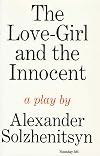
The Love-Girl and the Innocent
by Aleksandr Solzhenitsyn
On This Page
Description
'The Love-Girl and the Innocent' is a brilliant play about the inhuman world of the [Stalinist] camps, that have their own rules, and where nothing of the world outside matters. The 'Innocent' is a newly arrived prisoner, who still bears idealism and is reluctant to adopt the camp techniques of survival. His love for Lyuba, one of the many women forced by circumstances to sell themselves for privileges and rations, tempts him to compromise with himself and betray his moral and emotional show more loyalties. --Kabanowa at Amazon.com. show lessTags
Recommendations























Member Reviews
Solzhenitsyn's Gulag play examines the moral, sexual and criminal corruption of the Gulag system and its inhabitants. Although the title suggests a love story, the drama focuses more on the absurdity of the work system, in which everyone is forced to falsify productivity, bend rules and bribe others (with goods, threat or sex), just to stay alive. It is a fitting literary companion to his other early camp novel 'One Day in the Life of Ivan Denisovich', and tries to cover much of the ground that 'The Gulag Archipelago' would plough years later. It is this last comparison that illuminates the play's only real flaws, which is that it tries to cram in too much. Whereas 'One Day...' was a relatively simple tale of survival, 'The show more Love-Girl...' relies heavily on the subtelties of relationships between politicals, non-politicals, free men, camp guards, work quotas, different camp types, etc. In 'The Gulag Archipelago', Solzhenitsyn takes 1800 pages to illuminate his ideas, in 'The Love-Girl...' he has just 140, and it does feel a bit cramped. There are too many characters and too many threads. Nevertheless, it is still a worthy part of his Gulag canon, and worth a read for anyone interested in a terrible period of Russian history. show less
Comrade Stalin was quite right. He said, "Personnel selection is decisive. People are our most valuable capital." I want that slogan up in the camp yard.
Unlike our pantomime morality dramas where there are villains of the first order, a Platonic form of Evil -- what this play depicts is that everyone has a jackal within. Well, almost everyone. The gulag simply brought these lesser angels to the fore, a character here calls their world Campland and one of its cardinal features is that 99 people cry and one person laughs. The titular characters are swept into a labor camp in the aftermath of the Great Patriotic War and find a fleeting human connection while they are tortured by the logic of their present existence. He a former officer in show more the Soviet army is the rube, unwilling to accept the human costs of his position as labor organizer. She is an orphan of Koba's wet dream of socialist perfection. He is soon demoted and she must satisfy the carnal whims of her superiors. Despite the debasement both recognize their doomed attraction as palpable. Such are the consolations of the informed. show less
Unlike our pantomime morality dramas where there are villains of the first order, a Platonic form of Evil -- what this play depicts is that everyone has a jackal within. Well, almost everyone. The gulag simply brought these lesser angels to the fore, a character here calls their world Campland and one of its cardinal features is that 99 people cry and one person laughs. The titular characters are swept into a labor camp in the aftermath of the Great Patriotic War and find a fleeting human connection while they are tortured by the logic of their present existence. He a former officer in show more the Soviet army is the rube, unwilling to accept the human costs of his position as labor organizer. She is an orphan of Koba's wet dream of socialist perfection. He is soon demoted and she must satisfy the carnal whims of her superiors. Despite the debasement both recognize their doomed attraction as palpable. Such are the consolations of the informed. show less
This is a rough read, and in the end, I have to suggest that seeing it on stage would be a better prospect than trying to get through the text (and no, I don't recommend that for every play). There are so many different scenes and characters, though, that it's hard to keep track even for someone who's prepared to read it in a few sittings or pay extra attention as they go. It's a powerful book as is, but hard to get through. Also, I wanted more. I wanted more time in some of the scenes, more from the different characters, and I was left somewhat dissatisfied--not with the story, but with how much was given along the way. If you're interested in the subject or in an interesting directing project, this could be the perfect play for you to show more look into, but it is a heavy read. show less
A play by Solzhenitsyn, perhaps drawing from his own experiences in a Stalinist slave-labor camp following his arrest for making critical comments about Stalin. It is a love story of two prisoners, Rodion the "Innocent" and Lyuba the "love-girl", and the impasse Rodion comes to when he must decide between the integrity of his love and his soul, and compromising by sharing Lyuba with the prison doctor who desires her, in return for extra food, a comfortable job and the woman he loves. A good one by a Soviet icon who knows intimately the system he rails against.
It's always tough to read a play instead of seeing it. I usually imagine myself watching the play, and that works pretty well.
Life in the camps, Solzhenitsyn's specialty. Idealism and compromise in prison. A bit hard to follow as a play, but still good stuff.
Life in the camps, Solzhenitsyn's specialty. Idealism and compromise in prison. A bit hard to follow as a play, but still good stuff.
Members
- Recently Added By
Author Information

217+ Works 44,428 Members
Aleksandr Solzhenitsyn was born on December 11, 1918 in Kislovodsk in the northern Caucusus Mountains. He received a degree in physics and math from Rostov University in 1941. He served in the Russian army during World War II but was arrested in 1945 for writing a letter criticizing Stalin. He spent the next decade in prisons and labor camps and, show more later, exile, before being allowed to return to central Russia, where he worked as a high school science teacher. His first novel, One Day in the Life of Ivan Denisovich, was published in 1962. In 1970, he was awarded the Nobel Prize for Literature. In 1974, he was arrested for treason and exiled following the publication of The Gulag Archipelago. He moved to Switzerland and later the U. S. where he continued to write fiction and history. When the Soviet Union collapsed, he returned to his homeland. His other works include The First Circle and The Cancer Ward. He died due to a heart ailment on August 3, 2008 at the age of 89. (Bowker Author Biography) show less
Some Editions
Series
Belongs to Publisher Series
Penguin Plays (PL109)
Work Relationships
Common Knowledge
- Canonical title
- The Love-Girl and the Innocent
- Original title
- Олень и шалашовка
- Alternate titles
- The Tenderfoot and the Tart; The Greenhorn and the Tramp
- Original publication date
- 1969
- People/Characters*
- Njemov; Ljoeba
- Important places*
- Rusland
- Blurbers
- Marchenko, Anatoly
- Original language*
- Russisch
*Some information comes from Common Knowledge in other languages. Click "Edit" for more information.
Classifications
- Genre
- Fiction and Literature
- DDC/MDS
- 891.7 — Literature & rhetoric Literatures of other languages East Indo-European and Celtic literatures Russian and East Slavic languages
- LCC
- PG3488 .O4 .L6 — Language and Literature Slavic languages and literatures. Baltic languages. Albanian language Slavic. Baltic. Albanian Russian literature Individual authors and works 1961-2000
- BISAC
Statistics
- Members
- 323
- Popularity
- 99,129
- Reviews
- 7
- Rating
- (3.56)
- Languages
- 5 — Dutch, English, French, German, Italian
- Media
- Paper, Ebook
- ISBNs
- 10
- ASINs
- 15