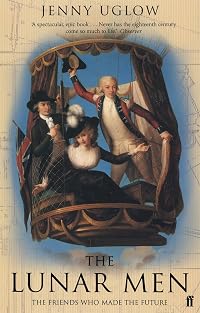
The Lunar Men: Five Friends whose Curiosity Changed the World
by Jenny Uglow
On This Page
Description
"In the 1760s a group of amateur experimenters met and made friends in the English Midlands. Most came from humble families, all lived far from the center of things, but they were young and their optimism was boundless: together they would change the world. Among them were the ambitious toymaker Matthew Boulton and his partner James Watt, of steam-engine fame; the potter Josiah Wedgwood; and the larger-than-life Erasmus Darwin, physician, poet, inventor, and theorist of evolution (a show more forerunner of his grandson Charles). Later came Joseph Priestly, discover of oxygen and fighting radical." "With a small band of allies - the chemist James Keir, the doctors William Small and William Withering (the man who put digitalis on the medical map), and two wild young followers of Rousseau, Richard Lovell Edgeworth and Thomas Day - they formed the Lunar Society of Birmingham, so called because it met at each full moon, and kick-started the Industrial Revolution. Blending science, art, and commerce, the Lunar Men built canals; launched balloons; named plants, gases, and minerals; changed the face of England and the china in its drawing rooms; and plotted to revolutionize its soul."--Jacket. show lessTags
Recommendations









Member Recommendations


nessreader Both books about groups of 18th century English intellectuals - liberals, scientists, engineers, writers, medicos, philosophers- whose shared social life sparked their ideas and enriched their lives. Uglow writes about the northerners, Hay about a London set radiating from the bookseller Johnson. Quite an overlap of characters; Priestly, Edgeworth, Franklin and erasmus Darwin feature in both.
Member Reviews
https://fromtheheartofeurope.eu/the-lunar-men-the-friends-who-made-the-future-by...
A lovely in-depth look at the men behind the Industrial Revolution and the Age of Enlightenment in the mid-19th century West Midlands of England, focussing especially on Erasmus Darwin as the key figure, but also looking at Matthew Boulton, Josiah Wedgwood, Joseph Priestley, James Watt, Richard Lovell Edgeworth and Samuel Galton, and a number of others whose names I was less familiar with. They were all members of the Lunar Society, which met monthly in Birmingham from the 1760s to around the end of the century.
There is a lot of loving detail about their lives, with common threads including Methodism and other minority Protestant traditions (especially show more Quakers); pottery; lots of children (Darwin had fourteen with his two wives, and maybe more besides); investments; the abolition of slavery; and of course engineering. It could have been overwhelming, but it’s broken up with black-and-white illustrations and some lovely plates. I was particularly struck by Joseph Wright’s paintings of the orrery and the air pump.
I learned a lot from this; in particular I realised how well the author had managed to gain my sympathy when I found myself horrified by the 1791 Priestley Riots, where a right-wing mob targeted the local religious minorities in Birmingham, including especially the vulnerable and visible Joseph Priestley; the local authorities appear to have colluded in the outbreak of violence and then (as usual) blamed the victims for bringing it on themselves. Some things never change.
Anyway, this is a tremendously engaging book about a part of history that I should have known more about; and now I do. show less
A lovely in-depth look at the men behind the Industrial Revolution and the Age of Enlightenment in the mid-19th century West Midlands of England, focussing especially on Erasmus Darwin as the key figure, but also looking at Matthew Boulton, Josiah Wedgwood, Joseph Priestley, James Watt, Richard Lovell Edgeworth and Samuel Galton, and a number of others whose names I was less familiar with. They were all members of the Lunar Society, which met monthly in Birmingham from the 1760s to around the end of the century.
There is a lot of loving detail about their lives, with common threads including Methodism and other minority Protestant traditions (especially show more Quakers); pottery; lots of children (Darwin had fourteen with his two wives, and maybe more besides); investments; the abolition of slavery; and of course engineering. It could have been overwhelming, but it’s broken up with black-and-white illustrations and some lovely plates. I was particularly struck by Joseph Wright’s paintings of the orrery and the air pump.
I learned a lot from this; in particular I realised how well the author had managed to gain my sympathy when I found myself horrified by the 1791 Priestley Riots, where a right-wing mob targeted the local religious minorities in Birmingham, including especially the vulnerable and visible Joseph Priestley; the local authorities appear to have colluded in the outbreak of violence and then (as usual) blamed the victims for bringing it on themselves. Some things never change.
Anyway, this is a tremendously engaging book about a part of history that I should have known more about; and now I do. show less
England in the late 18th Century was surely a crucible for the transformation of our world, and the group that Uglow sketches were leaders. What's wonderful about this book is not so much the depth of investigation into any particular person or topic, but the network of people and topics that gives a sense of how the world was changing.
Watt's improvements to steam engines let them extend the range of their application beyond pumping water to turning shafts to drive mills to grind grain, spin cotton, etc. There was a frenzy to catalog minerals and plants. Chemistry was transformed as different types of gases were discovered and classified.
Uglow covers a wide range of such discoveries and inventions, painting in the political and show more economic landscape that the creative geniuses had to work with.
What I found most remarkable - maybe it's just because it was at the end of the book, so it's freshest in my mind - was the transformation in the political landscape brought about by the French Revolution. Priestey's house was burned down by a reactionary mob and he ended up fleeing to America.
That's a remarkable feature of history. The stream of trouble is never ending but constantly shifting. If you're lucky enough to figure out how to crack a problem or two, it just earns you the opportunity to confront new challenges from whole other directions.
Uglow's book was a fascinating portrait of a time and place that have had a huge impact on history and our world today. show less
Watt's improvements to steam engines let them extend the range of their application beyond pumping water to turning shafts to drive mills to grind grain, spin cotton, etc. There was a frenzy to catalog minerals and plants. Chemistry was transformed as different types of gases were discovered and classified.
Uglow covers a wide range of such discoveries and inventions, painting in the political and show more economic landscape that the creative geniuses had to work with.
What I found most remarkable - maybe it's just because it was at the end of the book, so it's freshest in my mind - was the transformation in the political landscape brought about by the French Revolution. Priestey's house was burned down by a reactionary mob and he ended up fleeing to America.
That's a remarkable feature of history. The stream of trouble is never ending but constantly shifting. If you're lucky enough to figure out how to crack a problem or two, it just earns you the opportunity to confront new challenges from whole other directions.
Uglow's book was a fascinating portrait of a time and place that have had a huge impact on history and our world today. show less
Way too long and, what a pity one has to overcome the poor, dull and heavy writing style of Jenny Uglow to learn about such men! I would have expected something more exciting and engaging. However, polymaths gifted, passionate, philanthropists and dedicated the Lunar Men were such a remarkable bunch of inventors and intellectuals that, their incredible story deserves to be discovered. So, pick up that book and learn about these geniuses, this small group of friends who changed the world just by believing in science and all it can unravel for the benefit of mankind -you won't be disappointed! The writing is dull but, the topic is a wonder.
Darwin's support of Beddoes and work on Zoonomia let him envisage the improvement of society through medicine, rather than politics. Most of his work was serious; some of it was fun, like his correspondence with Tom Wedgewood on making an air bed. ('He thinks feathers always stink', Darwin told Watt with amusement, 'and wishes to rest on clouds, like the Gods and Goddesses, which you see sprawling on ceilings.')
The second half of the eighteenth century was a ferment of invention and the Lunar Society of Birmingham, a group whose members were mostly Midlands and Lowland Scots, was in the thick of it. Members included engineers, manufacturers, potters, chemists and doctors, but their scientific and entrepreneurial interests were varied show more and overlapping. They competed and collaborated, and urged each other onwards. They went into business together, their sons and daughters married each other, and their friendships were lifelong, excepting the relationship between William Withering and Erasmus Darwin, which was irreparably damaged by accusations of plagiarism.
A well-written and engrossing tale, of pumping engines, porcelain and patent infringements, canals, caves and chemistry, mining, manufacturing and minting, botanical taxonomy and balloons. show less
The second half of the eighteenth century was a ferment of invention and the Lunar Society of Birmingham, a group whose members were mostly Midlands and Lowland Scots, was in the thick of it. Members included engineers, manufacturers, potters, chemists and doctors, but their scientific and entrepreneurial interests were varied show more and overlapping. They competed and collaborated, and urged each other onwards. They went into business together, their sons and daughters married each other, and their friendships were lifelong, excepting the relationship between William Withering and Erasmus Darwin, which was irreparably damaged by accusations of plagiarism.
A well-written and engrossing tale, of pumping engines, porcelain and patent infringements, canals, caves and chemistry, mining, manufacturing and minting, botanical taxonomy and balloons. show less
I am in awe of this lady! I would find it difficult to write the biography of a single person: to take on that of a group, would appear madness!
Not to Jenny Uglow, she takes it in her stride. She seems to effortlessly pass from one member to another and to keep the characters as separate personae. Whilst reading, I never once got confused as to whether a certain character was the one with a set trait, or another.
The only people that I could admire as much, are her subjects - the Lunar Men. These are a group of eighteenth century men of science; Wedgwood, Boulton,Watt et al, who communicated regularly and met monthly (on the night of the full moon, so that there was light to find their way home!) At this early stage in science, the world show more was ruled by amateurs who could move effortlessly from chemistry to biology to physics. Their grasp of concepts which the lay man struggles with today, is truly awesome.
This book is am eminently simple read but filled with information. I defy anyone to read this book and nit be entertained and enlightened. show less
Not to Jenny Uglow, she takes it in her stride. She seems to effortlessly pass from one member to another and to keep the characters as separate personae. Whilst reading, I never once got confused as to whether a certain character was the one with a set trait, or another.
The only people that I could admire as much, are her subjects - the Lunar Men. These are a group of eighteenth century men of science; Wedgwood, Boulton,Watt et al, who communicated regularly and met monthly (on the night of the full moon, so that there was light to find their way home!) At this early stage in science, the world show more was ruled by amateurs who could move effortlessly from chemistry to biology to physics. Their grasp of concepts which the lay man struggles with today, is truly awesome.
This book is am eminently simple read but filled with information. I defy anyone to read this book and nit be entertained and enlightened. show less
I am fascinated by the history of science and technology, and I found this long and very thoroughly researched book to be a real treat. I hadn’t realised until reading it how closely the leading lights of British science and industry were connected to each other in the late 1700s.
But close they were, and often met monthly in an informal association called the Lunar Society (because they met on nights with a full moon).
Just a list of those who came to those meetings is almost sufficient to show what an immensely talented group they were, and how much they influenced the development of technology and knowledge in that period:
ERASMUS DARWIN, grandfather of Charles Darwin, but also a hugely important figure in the intellectual world of show more the time. A practising medical doctor, who also made many inventions and wrote several long descriptions of the natural world in the form of poetry. His views on evolution weren’t as well grounded as those of his more famous grandson, but were nevertheless very advanced for his time.
JOSIAH WEDGEWOOD, famous for his creation of beautiful English ceramics, but also as I found out from this book, a major force in the establishment of Britain’s network of navigiable canals. His interest in developing canals came from the fact that he was sick of his beautiful pottery being broken when being transported over the terrible unmade roads of the time. On the smooth waters of a canal, his precious cargos would be far more likely to survive the journey.
JAMES WATT of steam engine fame. Watt didn’t by any means invent the first steam engine, but he developed many significant improvements which greatly increased their efficiency and power, as well as making smaller engines possible. Initially only used in mining, Watt’s more efficient engines eventually saw use in the early textile industry in Britain, which made use of his engines to drive the powered looms in factories.
MATTHEW BOULTON, prominent in manufacturing, and for a long time Watt’s business partner. I get the impression that Boulton was the optimistic, outgoing character in the partnership compared with Watt. Without Boulton, Watt may never have achieved any success.
JOSEPH PRIESTLY the chemist, the first person to isolate the gas oxygen (though he clung to the old ‘phlogiston’ theory and so called it ‘de-phlogisticated air’). I also discovered from this book that he was a prominent preacher with radical views. So radical that eventually his house and laboratory were destroyed by a mob and he eventually left England for the Americas.
As well as these five, there were at least seven other men prominent in the Lunar Society over the years. Alas, they were all men, but their wives, sisters and daughters also played their part in the intellectual ferment of the time, and it is interesting that most of these men seemed very willing, even eager, to have their daughters as well as their sons educated.
The closeness of the relationships between these people may be indicated by the fact that Erasmus Darwin’s son married a Wedgwood daughter, and one of their sons was the more familiar Charles Darwin of evolutionary reknown.
A very interesting book, but I do need to say that I found it a difficult read as an ebook, mainly because there are so many characters and so many of their friends, acquaintances and relations mentioned that I did often find it difficult to remember who everyone was. I almost needed a ‘cheat-sheet’ or a ‘dramatis personae’ by my side. It would have been easier to cope with a paper book, I think, in that it’s very easy with a physical book to flip back and forth to scan for forgotten names and passages. So much so that, even though I now own the ebook, I think I’ll go looking for a paper copy to put on my shelf.
Highly recommended if you are at all interested in the history of technology. show less
But close they were, and often met monthly in an informal association called the Lunar Society (because they met on nights with a full moon).
Just a list of those who came to those meetings is almost sufficient to show what an immensely talented group they were, and how much they influenced the development of technology and knowledge in that period:
ERASMUS DARWIN, grandfather of Charles Darwin, but also a hugely important figure in the intellectual world of show more the time. A practising medical doctor, who also made many inventions and wrote several long descriptions of the natural world in the form of poetry. His views on evolution weren’t as well grounded as those of his more famous grandson, but were nevertheless very advanced for his time.
JOSIAH WEDGEWOOD, famous for his creation of beautiful English ceramics, but also as I found out from this book, a major force in the establishment of Britain’s network of navigiable canals. His interest in developing canals came from the fact that he was sick of his beautiful pottery being broken when being transported over the terrible unmade roads of the time. On the smooth waters of a canal, his precious cargos would be far more likely to survive the journey.
JAMES WATT of steam engine fame. Watt didn’t by any means invent the first steam engine, but he developed many significant improvements which greatly increased their efficiency and power, as well as making smaller engines possible. Initially only used in mining, Watt’s more efficient engines eventually saw use in the early textile industry in Britain, which made use of his engines to drive the powered looms in factories.
MATTHEW BOULTON, prominent in manufacturing, and for a long time Watt’s business partner. I get the impression that Boulton was the optimistic, outgoing character in the partnership compared with Watt. Without Boulton, Watt may never have achieved any success.
JOSEPH PRIESTLY the chemist, the first person to isolate the gas oxygen (though he clung to the old ‘phlogiston’ theory and so called it ‘de-phlogisticated air’). I also discovered from this book that he was a prominent preacher with radical views. So radical that eventually his house and laboratory were destroyed by a mob and he eventually left England for the Americas.
As well as these five, there were at least seven other men prominent in the Lunar Society over the years. Alas, they were all men, but their wives, sisters and daughters also played their part in the intellectual ferment of the time, and it is interesting that most of these men seemed very willing, even eager, to have their daughters as well as their sons educated.
The closeness of the relationships between these people may be indicated by the fact that Erasmus Darwin’s son married a Wedgwood daughter, and one of their sons was the more familiar Charles Darwin of evolutionary reknown.
A very interesting book, but I do need to say that I found it a difficult read as an ebook, mainly because there are so many characters and so many of their friends, acquaintances and relations mentioned that I did often find it difficult to remember who everyone was. I almost needed a ‘cheat-sheet’ or a ‘dramatis personae’ by my side. It would have been easier to cope with a paper book, I think, in that it’s very easy with a physical book to flip back and forth to scan for forgotten names and passages. So much so that, even though I now own the ebook, I think I’ll go looking for a paper copy to put on my shelf.
Highly recommended if you are at all interested in the history of technology. show less
Top notch read. Sort of a biography of a group that met monthly and were movers and shakers of science and engineering. Excellent writing covers a fascinating period of English history. I grabbed it because Joseph Priestley was a member and I have driven past his home in PA for years without learning more about him. Terrific book that I highly recommend.
Members
- Recently Added By
Lists

Club Read's Recommended Nonfiction Written by Women
618 works; 30 members

The Torchlight List
95 works; 1 member

In Our Time books
4,934 works; 2 members
Author Information

26+ Works 3,408 Members
Jenny Uglow is an editor at Chatto & Windus and lives in Canterbury, England
Awards and Honors
Common Knowledge
- Canonical title
- The Lunar Men: Five Friends whose Curiosity Changed the World
- Original title
- The Lunar Men: The Friends who Made the Future
- Original publication date
- 2002
- People/Characters
- Matthew Boulton; Josiah Wedgwood; Erasmus Darwin; James Watt; Joseph Priestley; John Whitehurst (show all 12); William Small; James Keir; William Withering; Richard Lovell Edgeworth; Thomas Day; Samuel Galton
- Important places
- Birmingham, England, UK
- Epigraph
- 'O! pray! move on, Sir, and she, and this is amazingly fine; I fancy myself travelling along with that little earth in its course round the gilded Sun . . .'
- Dedication
- To Desmond King-Hele and Shena Mason
- First words
- On 12 December 1731, Erasmus Darwin was born at the Old Hall in Elston, about ten miles north-east of Nottingham, the sturdy seventh child of Robert and Elizabeth Darwin.
- Last words
- (Click to show. Warning: May contain spoilers.)The legacy of the Lunar men is with us still, in the making of the modern world, and in the inspiring confidence with which all these friends, in their different ways, reached so eagerly for the moon.
Classifications
Statistics
- Members
- 1,016
- Popularity
- 25,755
- Reviews
- 14
- Rating
- (3.81)
- Languages
- English
- Media
- Paper, Ebook
- ISBNs
- 6
- ASINs
- 4