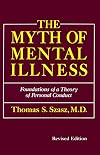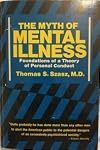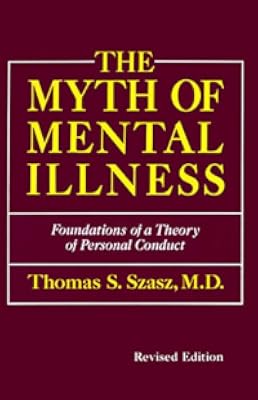
The Myth of Mental Illness : Foundations of a Theory of Personal Conduct
by Thomas S. Szasz
On This Page
Description
The fiftieth anniversary edition of the most influential critique of psychiatry every written, with a new preface on the age of Prozac and Ritalin and the rise of designer drugs, plus two bonus essays. Thomas Szasz's classic book revolutionized thinking about the nature of the psychiatric profession and the moral implications of its practices. By diagnosing unwanted behavior as mental illness, psychiatrists, Szasz argues, absolve individuals of responsibility for their actions and instead show more blame their alleged illness. He also critiques Freudian psychology as a pseudoscience and warns against the dangerous overreach of psychiatry into all aspects of modern life. show lessTags
Recommendations






























Member Reviews
Szasz makes a frontal assault on the power of psychiatry, arguing that mental illness is a myth and that the power accorded to psychiatrists to decide if people are legally responsible for their actions, have them committed to hospitals, and prescribe various psychotropic medications is fundamentally misfounded. The basic premise of his argument is that only organs can be sick, and the mind is not an organ. Rather, what we see as mental illness are the results of rule-breaking behavior by "mentally ill" people, an attempt to game their social interactions to receive the socially beneficial role of a "sick person" as accorded by Judeo-Christian morality and modern standards of care.
While there is some benefit to challenging the hegemony show more of mental illness (a recent paper says "Almost half of college-aged individuals had a psychiatric disorder in the past year."), Szasz's argument fails on two major grounds.
The first is modern understanding that cognitive events are linked to neurological events, or in other words, that mental illness are in some way brain disorders. We can draw a spectrum from something totally neurological--Parkinson's disease, to something totally psychological--Borderline Personality Disorder, say, and put things like schizophrenia, depression, bipolar, and their related pharmacological treatments and neurological origins somewhere between them. It's unfair to hold a book published in the late 1960s to modern beliefs, but again, Szasz doesn't have much to say about this.
The second problem is more damning: even if we accept Szasz's belief that the mentally ill are just playing the game of life by different rules, what is to be done with them? As any good historian of mental illness knows, the lines between insane, criminal, and sinful are far from clear. Psychiatry is the modern way of dealing with malcontents, of offering a source of power and authority that people can draw on to change their lives and social behaviors. Szasz might be right in his argument that psychiatry probably isn't medicine, and it certainly isn't science, but he doesn't engage with the notion that psychiatry is something, and that it performs a socially necessary role. Rather than assailing psychiatry as an evil system of fraud that makes people crazy, we must ask how unhappy people can be helped, how their complex problems can be untangled, and what resources are necessary for that to happen. show less
While there is some benefit to challenging the hegemony show more of mental illness (a recent paper says "Almost half of college-aged individuals had a psychiatric disorder in the past year."), Szasz's argument fails on two major grounds.
The first is modern understanding that cognitive events are linked to neurological events, or in other words, that mental illness are in some way brain disorders. We can draw a spectrum from something totally neurological--Parkinson's disease, to something totally psychological--Borderline Personality Disorder, say, and put things like schizophrenia, depression, bipolar, and their related pharmacological treatments and neurological origins somewhere between them. It's unfair to hold a book published in the late 1960s to modern beliefs, but again, Szasz doesn't have much to say about this.
The second problem is more damning: even if we accept Szasz's belief that the mentally ill are just playing the game of life by different rules, what is to be done with them? As any good historian of mental illness knows, the lines between insane, criminal, and sinful are far from clear. Psychiatry is the modern way of dealing with malcontents, of offering a source of power and authority that people can draw on to change their lives and social behaviors. Szasz might be right in his argument that psychiatry probably isn't medicine, and it certainly isn't science, but he doesn't engage with the notion that psychiatry is something, and that it performs a socially necessary role. Rather than assailing psychiatry as an evil system of fraud that makes people crazy, we must ask how unhappy people can be helped, how their complex problems can be untangled, and what resources are necessary for that to happen. show less
Szasz, a psychiatrist and academic of considerable reputation, here argues that much of what passes as mental illness and its treatment is a fraud perpetrated on the public. His thesis is that people who don´t fit into the mainstream of society, particularly those that are inconvenient or disruptive, are classified by society as ´mentally ill´ rather than socially ´uneasy´. He suggests that Psychiatry (as individuals and as a profession sponsored by that society) then perpetuate and dignify this process by providing labels and treatments which reinforce the concept of these people and their attitudes to life as not just being equivalent to medically ill, but actually medically unfit. Szasz takes an essentially libertarian view, show more championing the rights of the individual against the power of the medical, psychological and pharmaceutical industrial/academic complex.
The reader (and reviewer) face some hurdles in dealing with ´The Myth of Mental Illness´. Foremost is that to be able to follow Szasz´s argument you need to start with a good understanding of psychological theory and history. Then there is an issue of context, noting that this book first came out in the 1950´s. It would be wrong to say that Szasz´s argument was simply with the way mental illness was defined and treated at that time (much of what he had to say is even more relevant today). But it must be said that this book develops the argument using examples and references to the state of scientific knowledge from the 1950´s. That is a perspective that is alien to much of his readership today, and which invites the reflection ´well I wonder how much of this has been overturned by developments in neurology and psychobiology since then´.
So anyone wanting to come to grips with his theories might do better to start with one of his later books, or some excellent articles about (rather than by) Szasz himself, and then work their way back to ´The Myth of Mental Illness´. The point of this book is that it contains Szasz´s first development of his theories. It is a landmark in the evolution of modern psychological theory, and like much of Freud´s work deserves to be read not so much for how true it stands today (always a contentious point), but for how it helps us understand where we have come from. The reader may need to choose between the original (much longer) and the abbreviated version released by Szasz in 1972, depending on their needs.
This book (the 1972 version) should be mandatory (and uncomfortable) reading for students of psychology, psychiatry and sociology. Otherwise it is recommended as further reading for anyone interested in Szasz´s theories who might have started with some of his later work. And it is a very important document from the perspective of both psychology and libertarian theory. But I could not recommend this as an introduction to Szasz in preference to any of his much more accessible later works, given that so many of them are available. show less
The reader (and reviewer) face some hurdles in dealing with ´The Myth of Mental Illness´. Foremost is that to be able to follow Szasz´s argument you need to start with a good understanding of psychological theory and history. Then there is an issue of context, noting that this book first came out in the 1950´s. It would be wrong to say that Szasz´s argument was simply with the way mental illness was defined and treated at that time (much of what he had to say is even more relevant today). But it must be said that this book develops the argument using examples and references to the state of scientific knowledge from the 1950´s. That is a perspective that is alien to much of his readership today, and which invites the reflection ´well I wonder how much of this has been overturned by developments in neurology and psychobiology since then´.
So anyone wanting to come to grips with his theories might do better to start with one of his later books, or some excellent articles about (rather than by) Szasz himself, and then work their way back to ´The Myth of Mental Illness´. The point of this book is that it contains Szasz´s first development of his theories. It is a landmark in the evolution of modern psychological theory, and like much of Freud´s work deserves to be read not so much for how true it stands today (always a contentious point), but for how it helps us understand where we have come from. The reader may need to choose between the original (much longer) and the abbreviated version released by Szasz in 1972, depending on their needs.
This book (the 1972 version) should be mandatory (and uncomfortable) reading for students of psychology, psychiatry and sociology. Otherwise it is recommended as further reading for anyone interested in Szasz´s theories who might have started with some of his later work. And it is a very important document from the perspective of both psychology and libertarian theory. But I could not recommend this as an introduction to Szasz in preference to any of his much more accessible later works, given that so many of them are available. show less
A classic work that has revolutionized thinking throughout the Western world about the nature of the psychiatric profession and the moral implications of its practices.
I discovered this book while browsing for source material for a paper I wrote in a history class. The assignment was to write about a minority group and the problems they faced in the United States during the years up until 1867.
The instructor was suggesting it might be a group that we had a personal involvement with and the thought occurred to me to do it on the history of the mentally ill since I have had some involvement with that.
I really appreciated Szasz's opinions on coercion since I had suffered a great deal from the coercive treatment I had been given at different times. I appreciate most of his work that I have seen on these subjects. He does advocate the elimination of governmental support for people with mental (I prefer the show more word emotional) illnesses since it is paying people to be ill. He suggests that without the payment they would have to get well and back into society out of need. I am not sure that this is necessary. Getting back into society after being on disability is hard but mostly because of the stigma and prejudice from employers against people who have not been in the job market all along.
I got an A on the paper and the teacher asked me some annoying questions about where had I been all this time because of my age, I was 36. I told him I had been abused with psychiatry by my mother and sister. show less
The instructor was suggesting it might be a group that we had a personal involvement with and the thought occurred to me to do it on the history of the mentally ill since I have had some involvement with that.
I really appreciated Szasz's opinions on coercion since I had suffered a great deal from the coercive treatment I had been given at different times. I appreciate most of his work that I have seen on these subjects. He does advocate the elimination of governmental support for people with mental (I prefer the show more word emotional) illnesses since it is paying people to be ill. He suggests that without the payment they would have to get well and back into society out of need. I am not sure that this is necessary. Getting back into society after being on disability is hard but mostly because of the stigma and prejudice from employers against people who have not been in the job market all along.
I got an A on the paper and the teacher asked me some annoying questions about where had I been all this time because of my age, I was 36. I told him I had been abused with psychiatry by my mother and sister. show less
Still brilliant after all these years, and underappreciated in the world of psychoanalysis. His work is influenced by Karl Popper and not Ludwig Witgenstein.
As revelatory and relevant today, if not more so, than one it first was published.
To be taken with doses of Lamp,Foucault, Dubois and Illich
Members
- Recently Added By
Lists

Psicología - Clásicos
165 works; 2 members
Author Information

59+ Works 2,444 Members
Thomas Szasz is professor emeritus of psychiatry at the State University of New York's Upstate Medical University in Syracuse, New York.
Awards and Honors
Series
Belongs to Publisher Series
Perennial Library (P330)
Common Knowledge
- Canonical title
- The Myth of Mental Illness : Foundations of a Theory of Personal Conduct
- Original title
- The Myth of Mental Illness: Foundations of a Theory of Personal Conduct
- Original publication date
- 1961
- Original language
- English
Classifications
- Genres
- Nonfiction, General Nonfiction
- DDC/MDS
- 616.8907 — Applied science & technology Medicine & health Diseases, Allergies, Skin Conditions Nervous Disorders: Autism, Anorexia, OCD Mental disorders: bi-polar/schizophrenia
- LCC
- RC455 .S93 — Medicine Internal medicine Internal medicine Neurosciences. Biological psychiatry. Neuropsychiatry Psychiatry
- BISAC
Statistics
- Members
- 723
- Popularity
- 39,291
- Reviews
- 10
- Rating
- (3.75)
- Languages
- 7 — Dutch, English, French, German, Italian, Russian, Spanish
- Media
- Paper, Audiobook, Ebook
- ISBNs
- 16
- ASINs
- 15