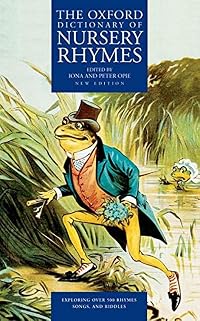
The Oxford Dictionary of Nursery Rhymes
by Iona Opie (Editor), Peter Opie (Editor)
On This Page
Description
Over five hundred traditional nursery rhymes, accompanied by illustrations and detailed notes about each rhyme.Tags
Recommendations



















Member Reviews
Most reference books inspire imitation. This one inspires only admiration.
The reason is simple: To create another such reference, particularly one that would improve on the Opies's work, would be almost impossible.
There are a number of factors that make this a great book. To begin with, its fullness -- 550 nursery rhymes. Also there is the organization: The rhymes are organized topically by the key concept, but with an index of first lines so that they can be found by that means also. This organization has the advantage that it makes it easy to find multiple rhymes on the same topic. There is also an index of "notable figures" so that a reader can track down which editors were responsible for preserving and setting down particular show more rhymes.
And, in addition to the rhymes, there are the notes. These include historical and background notes, source notes, and cross-references. Often these are longer than the nursery rhyme itself, and frequently include variant forms of the rhyme.
Throw in a significant number of illustrations from early printings of the rhymes, and the net result is a book that almost certainly contains just about every useful fact known about these much-loved short poems. There are a few places where one can quibble with the result. But, after more than half a century, there has been no attempt to replace, or even to supplement, this book. That should be testimony enough to its quality. show less
The reason is simple: To create another such reference, particularly one that would improve on the Opies's work, would be almost impossible.
There are a number of factors that make this a great book. To begin with, its fullness -- 550 nursery rhymes. Also there is the organization: The rhymes are organized topically by the key concept, but with an index of first lines so that they can be found by that means also. This organization has the advantage that it makes it easy to find multiple rhymes on the same topic. There is also an index of "notable figures" so that a reader can track down which editors were responsible for preserving and setting down particular show more rhymes.
And, in addition to the rhymes, there are the notes. These include historical and background notes, source notes, and cross-references. Often these are longer than the nursery rhyme itself, and frequently include variant forms of the rhyme.
Throw in a significant number of illustrations from early printings of the rhymes, and the net result is a book that almost certainly contains just about every useful fact known about these much-loved short poems. There are a few places where one can quibble with the result. But, after more than half a century, there has been no attempt to replace, or even to supplement, this book. That should be testimony enough to its quality. show less
This is an older edition, originally published in 1951. The authors, Iona and Peter Opie, were a couple who compiled what’s probably the most extensive collection of “children’s ephemera” in the world. Their introduction debunks a number of myths about nursery rhymes – most are not of extreme age; most are not some sort of coded reference to political events; and most were originally not intended for the nursery but were, rather “preserved by the nursey”. (There are exceptions; “Thirty days has September” goes back to the 13th century; but “Old King Cole” does not reference the 3rd century British king). There are equivalents in other languages: “Humpty Dumpty sat on a wall” in England, while show more “Hümpelken-Pümpelken sat op de Bank” in Saxony. Alphabet rhymes are a category legitimate to the nursery, with “A was an apple pie…” and “A was an archer who shot at a frog…” Counting rhymes are popular all over the world – the authors collected “Eeny, meeny, mony, my” from Wisconsin and “Ena, mena, mona, mite” from Cornwall and “Hana, mana, mona, mike” from New York and “Ene, tene, mone, mei” from Germany. After the introduction, the actual rhymes are collected by categories, ranging from “Apples” through “Father” to “Master” and finishing with “York”. Delightful; but will likely evoke a little pensive nostalgia, show less
This was an interesting read. I have always loved nursery rhymes; in reading this, I find that some are much older than I imagined, some are newer than I was led to believe, and most tales about their origins are either untrue or unprovable. Also that many were originally "bawdy" songs, which the authors did not see fit to include.
My mum had this book when I wee, and I remember being fascinated by all the little drawings throughout. I've got that copy now, coverless and dog-eared, but I still love it. It's full of nursery rhymes and poems, both well-known and unfamiliar, and a great wee riddle game.
The history notes and the illustrations make this a great reference work,
I enjoyed reading this book. I found that many of these poems have been turned into songs. I would use this to introduce poetry to young students. Children love to sing and by using these poems in a song might make the lesson more engaging for students.
Here are more poems by Iona And Peter Opie. I think many of these poems can be used in any classroom. http://www.indiana.edu/~liblilly/shorttitle/opie.html
Here are more poems by Iona And Peter Opie. I think many of these poems can be used in any classroom. http://www.indiana.edu/~liblilly/shorttitle/opie.html
From the back cover: The Oxford Dictionary of Nursery Rhymes brings together over 500 well-loved and lesser-known nursery rhymes, songs, jingles and lullabies traditionally handed on to young children. Each rhyme is accompanied by fascinating and detailed notes on its its origins and development, literary associations, social and even political uses, variations and parallels in other languages. The result is a unique guide to our most fundamental, memorable and delightful cultural heritage. In their famous introduction, Iona and Peter Opie describe the different types of rhyme and discuss theories of origin. Complementing the rhymes are nearly 100 illustrations, including reproductions of early appearances in ballad sheets and music show more books, which show the development of nursery-rhyme illustrations over the last two centuries. For this second edition, the notes have been updated and extended in the light of recent scholarship from around the world, providing an unrivalled wealth of literary and bibliographic information. There is also a new essay on the singing tradition of nursery rhymes by the musicologist Cecily Raysor Hancock, making The Oxford Dictionary of Nursery Rhymes an indispensible source of reference for scholars and book collectors, as well as a volume to be treasured by parents and children alike. show less
Members
- Recently Added By
Author Information

Iona Margaret Opie was born on October 13, 1923. During World War II, she made meteorological maps in the Women's Auxiliary Air Force. She married Peter Opie in 1943. Together they collected children's rhymes, riddles, and street culture. Their books included I Saw Esau, The Oxford Dictionary of Nursery Rhymes, The Oxford Nursery Rhyme Book, The show more Lore and Language of Schoolchildren, Children's Games in Street and Playground, and The Classic Fairy Tales. After her husband's death in 1982, she continued the work alone. Her books included The People in the Playground, Tail Feathers from Mother Goose, Here Comes Mother Goose, A Dictionary of Superstitions, and Children's Games with Things. Her son Robert collaborated with her on The Treasures of Childhood. She was made CBE in 1999. She died on October 23, 2017 at the age of 94. (Bowker Author Biography) show less

Common Knowledge
- Original publication date
- 1951; 1973 (corrected edition) (corrected edition)
- People/Characters
- Bobby Shaftoe; Mother Goose; Elsie Marley; John Aubrey; L. Leslie Brooke; Robert Burns (show all 20); Randolph Caldecott; Henry Carey; James Catnach; Robert Chambers; Walter Crane; Walter de la Mare; James O. Halliwell; John Harris; David Herd; Charles Lamb; John Marshall (publisher); Beatrix Potter; J. G. Rusher; Sir Walter Scott
- First words
- A hundred years have passed since the first publication of The Nursery Rhymes of England, 'collected principally from oral tradition' by James Orchard Halliwell. (Preface)
In Britain and America, and wherever the English word is spoken, the children become joyful and wise listening to the same traditional verses. (Introduction)
Classifications
Statistics
- Members
- 611
- Popularity
- 47,753
- Reviews
- 8
- Rating
- (4.08)
- Languages
- English
- Media
- Paper
- ISBNs
- 2
- ASINs
- 20