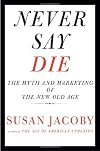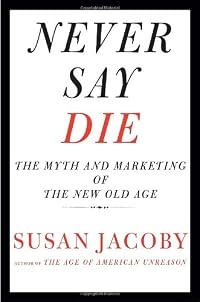
Never Say Die: The Myth and Marketing of the New Old Age
by Susan Jacoby
On This Page
Description
In a narrative that combines the intensely personal with social, economic, and historical analysis, Jacoby turns an unsparing eye on the marketers of longevity--pharmaceutical companies, lifestyle gurus, and scientific businessmen who suggest that there will soon be a "cure" for the "disease" of aging.Tags
Recommendations
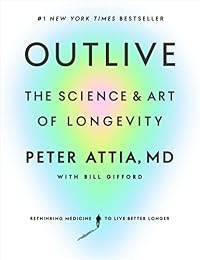


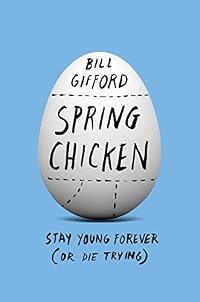
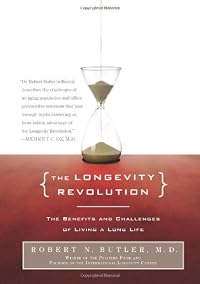
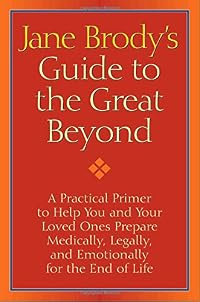







Member Reviews
What a fantastic get-a-hold-of-yourselves-people book. Centered and rational, mature and eloquent, Jacoby gives the best honest assessment of aging that I have not seen anywhere else. "Anywhere else" being mass media, who continues to hawk old age as utopia, less free of infirmities than actual reality. Very impressive in this book as well is that any time research or findings are cited, she puts it in proper context by revealing what salient questions were not asked, what missing data implies, etc. An excellent read that never becomes treacly despite her mention of sad personal experiences.
This book stands out as being both extremely disturbing and extremely important. It argues that aging is not, in fact, enjoyable. The societal myth that turning 65 will usher in the Golden Years if only you do things right only makes it more difficult economically, socially, emotionally, and physically, for both the old and their caretakers, when that inevitably turns out not to be the case.
My big take-aways from this book are the following: (1) No matter how physically and mentally spry you are, you will start watching more and more of the people you love die, more and more often, right up until you yourself die. I need to be emotionally prepared for that eventuality, and sensitive to it as a very real cause for depression in the old. show more (2) Dementia is a disease of old age -- and if you live long enough, it is very likely you will get it. Half of people over 85 have dementia. I should live as if I will become demented in time, and I should *expect* one or both of my parents to lose their minds as they age. (3) It is very hard and very rare to successfully exert control over your death, especially as your caretakers further infantilize you (whether warranted or not). I should make plans now, to avoid burdening my caretakers with what often amounts to an emotionally exhausting decision topped off with medical debt.
Scary, intimidating stuff. But important. And highly recommended for that reason. show less
My big take-aways from this book are the following: (1) No matter how physically and mentally spry you are, you will start watching more and more of the people you love die, more and more often, right up until you yourself die. I need to be emotionally prepared for that eventuality, and sensitive to it as a very real cause for depression in the old. show more (2) Dementia is a disease of old age -- and if you live long enough, it is very likely you will get it. Half of people over 85 have dementia. I should live as if I will become demented in time, and I should *expect* one or both of my parents to lose their minds as they age. (3) It is very hard and very rare to successfully exert control over your death, especially as your caretakers further infantilize you (whether warranted or not). I should make plans now, to avoid burdening my caretakers with what often amounts to an emotionally exhausting decision topped off with medical debt.
Scary, intimidating stuff. But important. And highly recommended for that reason. show less
Excellent corrective to the media/advertising blitz encouraging people to think they are going to live forever, or worse, live until 100 and feel like 30 up to that time. Those of us who are 50+ know from our own experiences that the sheer unpredictability of aging mitigates against the idea that ingesting anti-oxidants or other potions will ensure a smooth ride. Those of us with aging parents further understand the profound limitations of reaching 80 and beyond, notwithstanding the very few outliers who beat the odds. Problem is that we all think we will beat the odds. Jacoby is a long overdue wakeup call on that sort of fallacious thinking.
This book changed the way we were all thinking about aging. A walk through the American history of aging, perspectives, and marketing to the end. Jacoby cuts through the romantic notions of aging, that it will eventually be cured, that we can be ourselves up to the very old end of a healthy dynamic life. Her writing style of mixing personal anecdotes with statistics, facts and straight-shooting reporting makes this a very readable tome on a very sobering topic; one we try to avoid.
Susan Jacoby would have more appropriately titled Never Say Die, her look at aging in America, if she had called it The Worst Years of Our Lives – for that is what she predicts the ninth and tenth decades of life will be for those “fortunate” enough to live very far into them. (I do want to note that she clarifies the purpose of her book with its subtitle: The Myth and Marketing of the New Old Age.) She sees few exceptions (and she attributes most of those to class and money) to the rule: those who reach old old age invariably enter a world impacted more by Alzheimer’s, poverty, family neglect, suicide and assisted suicide, and painful disease than by everything that came before.
To Jacoby, this is a given, and there is no room show more for debate. She believes that those who are blind to this truth have been brainwashed by unscrupulous marketers having some dubious product to sell, some magic pill, cream, liquid, book, or surgery that promises to stop aging in its tracks. As millions of baby boomers reach or approach their 65th birthdays, it is more and more difficult to avoid these hucksters. They are everywhere. We are, after all, easy-sells; we want desperately to believe that the suffering associated with the aging process will be defeated just in time for us to enjoy life well into our nineties, if not beyond.
As Jacoby points out, it is not that older people become obsessed by death. Rather, it is that death “becomes a more conscious presence” in their lives as the decades pass. Losing grandparents is somewhat expected and acceptable; losing parents, less so; and losing siblings, old high school friends, and office mates at a steady clip is what finally hits home – we, too, are going to die soon. At sixty-five it is still easy for many of us to believe that the “best years of our lives” are still ahead of us but at eighty-five only “a fool or someone who has led an extraordinarily unhappy life can imagine the best years are still to come.”
Never Say Die is a wake-up call, a warning that old age is best handled by preparing oneself for it long before it happens. Jacoby warns of the generational warfare that is likely to erupt when younger workers can no longer afford to finance the medical costs required to keep their elders alive. The difficult choices that have been avoided by politicians for decades will finally have to be made. Those who can afford to save enough to pay their own way in old age need to do just that. Those who cannot, face a much less clear future because it will be up to politicians to figure a way out of the impending mess.
It is impossible, of course, to avoid politics in any discussion of health care and caring for a rapidly aging population in the future. Jacoby, however, takes the approach of blaming almost everything bad on conservatives and giving liberals credit for almost everything good. It is only in the book’s last few pages that she effectively dares to criticize the liberal point-of-view at all. Jacoby’s criticism of conservatism often can be justified – but the tone of that criticism, as seen below, often lessens its credibility:
“Since we do not euthanize the old when they become too expensive (teabagger fantasies notwithstanding), society winds up paying in the end if government does not require young adults to contribute to the maintenance of a strong public safety net.” (Surely Jacoby understands the sexual connotation of the term “teabagger,” but she chooses to use it anyway.)
“While I considered John Paul Stevens the wisest member of the Supreme Court before his retirement at age ninety, I shudder to think about the possibility of Antonin Scalia serving on the Court until his late eighties.” (Agreeing with Jacoby’s political point-of-view earns one a free pass that disagreeing with her politics does not earn.)
“Many of these people are former full-time retirees who were victimized by conservative-backed federal policies that enabled companies to break their pension and health care promises to retired workers.” (This issue is not as black and white as Jacoby portrays it.)
“The rationally-challenged but cleverly opportunistic fringe was represented by the shameless hustler Sarah Palin, who – blogging away viciously after walking away from her job as governor of Alaska – transformed entirely voluntary consultations into “death panels” that would decide whether old people and children like her son with Down syndrome would continue to receive medical care.” (Here, in her choice of adjectives, Jacoby shows her own irrational hatred of Sarah Palin and the “fringe” she represents.)
Never Say Die has some important things to say about medicine, aging, long term care of the elderly, and the hucksters trying to make a fast buck from a generation’s wishful thinking. It is, despite the author’s failure to resist taking a few cheap shots at those who happen to disagree with her, a good addition to the conversation.
Rated at: 3.5 show less
To Jacoby, this is a given, and there is no room show more for debate. She believes that those who are blind to this truth have been brainwashed by unscrupulous marketers having some dubious product to sell, some magic pill, cream, liquid, book, or surgery that promises to stop aging in its tracks. As millions of baby boomers reach or approach their 65th birthdays, it is more and more difficult to avoid these hucksters. They are everywhere. We are, after all, easy-sells; we want desperately to believe that the suffering associated with the aging process will be defeated just in time for us to enjoy life well into our nineties, if not beyond.
As Jacoby points out, it is not that older people become obsessed by death. Rather, it is that death “becomes a more conscious presence” in their lives as the decades pass. Losing grandparents is somewhat expected and acceptable; losing parents, less so; and losing siblings, old high school friends, and office mates at a steady clip is what finally hits home – we, too, are going to die soon. At sixty-five it is still easy for many of us to believe that the “best years of our lives” are still ahead of us but at eighty-five only “a fool or someone who has led an extraordinarily unhappy life can imagine the best years are still to come.”
Never Say Die is a wake-up call, a warning that old age is best handled by preparing oneself for it long before it happens. Jacoby warns of the generational warfare that is likely to erupt when younger workers can no longer afford to finance the medical costs required to keep their elders alive. The difficult choices that have been avoided by politicians for decades will finally have to be made. Those who can afford to save enough to pay their own way in old age need to do just that. Those who cannot, face a much less clear future because it will be up to politicians to figure a way out of the impending mess.
It is impossible, of course, to avoid politics in any discussion of health care and caring for a rapidly aging population in the future. Jacoby, however, takes the approach of blaming almost everything bad on conservatives and giving liberals credit for almost everything good. It is only in the book’s last few pages that she effectively dares to criticize the liberal point-of-view at all. Jacoby’s criticism of conservatism often can be justified – but the tone of that criticism, as seen below, often lessens its credibility:
“Since we do not euthanize the old when they become too expensive (teabagger fantasies notwithstanding), society winds up paying in the end if government does not require young adults to contribute to the maintenance of a strong public safety net.” (Surely Jacoby understands the sexual connotation of the term “teabagger,” but she chooses to use it anyway.)
“While I considered John Paul Stevens the wisest member of the Supreme Court before his retirement at age ninety, I shudder to think about the possibility of Antonin Scalia serving on the Court until his late eighties.” (Agreeing with Jacoby’s political point-of-view earns one a free pass that disagreeing with her politics does not earn.)
“Many of these people are former full-time retirees who were victimized by conservative-backed federal policies that enabled companies to break their pension and health care promises to retired workers.” (This issue is not as black and white as Jacoby portrays it.)
“The rationally-challenged but cleverly opportunistic fringe was represented by the shameless hustler Sarah Palin, who – blogging away viciously after walking away from her job as governor of Alaska – transformed entirely voluntary consultations into “death panels” that would decide whether old people and children like her son with Down syndrome would continue to receive medical care.” (Here, in her choice of adjectives, Jacoby shows her own irrational hatred of Sarah Palin and the “fringe” she represents.)
Never Say Die has some important things to say about medicine, aging, long term care of the elderly, and the hucksters trying to make a fast buck from a generation’s wishful thinking. It is, despite the author’s failure to resist taking a few cheap shots at those who happen to disagree with her, a good addition to the conversation.
Rated at: 3.5 show less
Susan Jacoby believes that aging Americans have been led to seriously underestimate the financial and health problems they may face as they age. An emphasis on the relatively healthy young/old encourages them to think that normal health and activity levels can be maintained into later life. The truth, according to Jacoby, is that nearly 50% will suffer some degree of dementia as they age and that many will outlive friends, spouses and siblings to face a life restricted by societal barriers such as lack of suitable housing and transport, health problems and finances.
Rich Fisher interviewed the author on his "Studio Tulsa" KWGS radio program. Bitter medicine, but recommended. A hard-edged look at the realities of aging today.
Members
- Recently Added By
Published Reviews
ThingScore 75
It is Jacoby’s mission to deflate the exaggeration and to expose all that she considers humbug. She wants to be sure her readers are aware that—hope as we might—aging inevitably brings on a series of gradual, and sometimes rapid, debilitations that are physical, mental, financial, and social, especially for the great majority of Americans who do not fall into the category known as upper show more middle class or higher. Very appropriately and with forceful emphasis, she points out that “inflated expectations about successful aging, if the body imposes a cruel old age, can lead to real despair.”...
Statistics supporting Jacoby’s viewpoint pour forth from the pages of her book, sometimes so relentlessly on the heels of one another that they make for difficult reading and tempt one to skim sections of the arguments that she presents. The result, unfortunately, is a volume far less powerful than it should have been. show less
Statistics supporting Jacoby’s viewpoint pour forth from the pages of her book, sometimes so relentlessly on the heels of one another that they make for difficult reading and tempt one to skim sections of the arguments that she presents. The result, unfortunately, is a volume far less powerful than it should have been. show less
added by atbradley
Author Information

16+ Works 3,629 Members
Susan Jacoby began her writing career as a reporter for The Washington Post. Her first book, Moscow Conversations, was based on the articles she contributed to the Post from Moscow between 1969 and 1971. Her other books include Wild Justice: The Evolution of Revenge, The Possible She, Half-Jew: A Daughter's Search for Her Family's Buried Past, show more Freethinkers: A History of American Secularism, The Age of American Unreason, The Great Agnostic: Robert Ingersoll and American Freethought, and Strange Gods: A Secular History of Conversion. (Bowker Author Biography) show less
Awards and Honors
Notable Lists
Common Knowledge
- Original title
- Never say die : the myth and marketing of the new old age
- Epigraph
- Can you imagine old age? Of course you can't. I didn't. I couldn't. I had no idea what it was like. Not even a false image--no image. And nobody wants anything else. Nobody wants to face any of this before he ... (show all)has to. How is it all going to turn out? Obtusenes is de rigeur.
--Philip Roth, The Dying Animal - Dedication
- In memory of Dr. Robert N. Butler
1927-2010 - First words
- Anyone who has not been buried in a vault for the past two decades is surely aware of the media blitz touting the "new old age" as a phenomenon that enables people in their sixties, seventies, eighties, nineties, and beyond t... (show all)o enjoy the kind of rich, full, healthy, adventurous, sexy, financially secure lives that their ancestors could never have imagined. (Preface)
The last time I saw my grandmother Minnie Broderick, in the summer of her hundredth year, we sat on a riverbank, ate turkey sandwiches, and watched children playing on the grass. (chapter one) - Quotations
- And those who live in the kingdom of the well cannot even be certain about the unawareness of a terminal Alzheimer's patient. "At least she doesn't know" is the conventional salve applied to those grieving for someone who h... (show all)as lost all powers of communication but is still technically alive. It is indeed terrible to suspect that, in the broken synapses of a broken mind, there might still be seconds or moments of reconnection in which the person is aware of helplessness--rather like those rare patients who become conscious in the middle of surgery but are unable to move or cry for help.
- Last words
- (Click to show. Warning: May contain spoilers.)This poet with an eighth-grade education also said, taking a long, last look at the river, "It's good to know that the beauty of the world will go on without me." If I can say that, in full knowledge of my rapidly approaching extinction, I will consider my life a success even though I have failed, as everyone ultimately does, to defy my old age.
- Blurbers
- Ehrenreich, Barbara; Harris, Sam; Angell, Marcia
Classifications
- Genres
- Nonfiction, Sociology, General Nonfiction
- DDC/MDS
- 305.260973 — Society, government, & culture Social sciences, sociology & anthropology Social group - Age, Gender, Ethnicity Age groups Older people (60+)
- LCC
- HQ1064 .U5 .J324 — Social sciences The family. Marriage, Women and Sexuality The Family. Marriage. Women The family. Marriage. Home Aged. Gerontology (Social aspects).
- BISAC
Statistics
- Members
- 145
- Popularity
- 225,054
- Reviews
- 7
- Rating
- (4.16)
- Languages
- English
- Media
- Paper, Audiobook, Ebook
- ISBNs
- 8
- ASINs
- 2