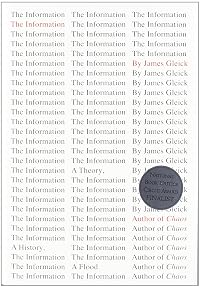
The Information: A History, a Theory, a Flood
by James Gleick
On This Page
Description
From the invention of scripts and alphabets to the long misunderstood "talking drums" of Africa, James Gleick tells the story of information technologies that changed the very nature of human consciousness. He also provides portraits of the key figures contributing to the inexorable development of our modern understanding of information, including Charles Babbage, Ada Byron, Samuel Morse, Alan Turing, and Claude Shannon.Tags
Recommendations
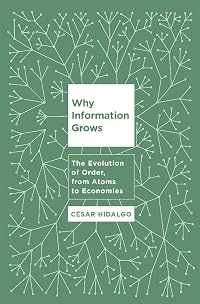
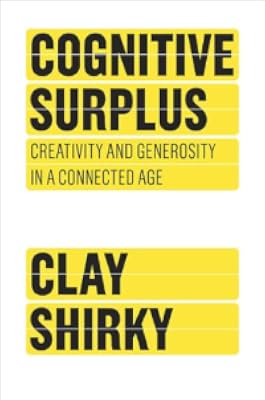
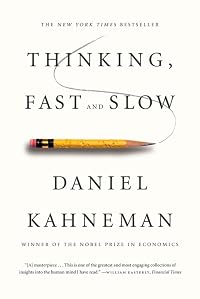
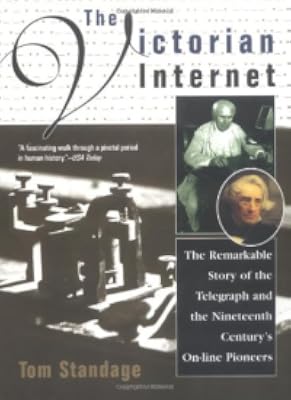

Member Recommendations
Popup-ch Gleicks book makes innumerable references to this classic.
30
Popup-ch Both books address the fundamental problems of communication, but in a slightly different manner. Where Gleick concentrates on the encoder, and Shannon's coding efficiency, Nørretranders instead looks at how this is perceived by the receiver, and ultimately at how the human brain makes sense of the world around us.
Decoding the Universe: How the New Science of Information Is Explaining Everything in the Cosmos, from Our Brains to Black Holes by Charles Seife
waitingtoderail Gleick looks at information theory with more of a view from a mathematical side, Seife more from a scientific side. They complement each other wonderfully.
Member Reviews
The history of information theory is a history of increasing abstraction. To the point where the meaning of information becomes irrelevant. To the point where the universe itself can be seen as a giant computer, and each of our choices, thoughts, movements become like states in the machine. I loved reading about the African drummers who communicated over long
distances via a tonal drum language with built in redundancy. I loved reading about Babbage and his calculating machine, and to think about it as a kind of steam-punk calculator fantasy world of the future. I loved reading about people decrying the telegraph and the telephone as technologies that will ruin humanity. And to read about the shortening of telegraph messages to save show more time and money, with phrases like wyegfef which stands for 'will you exchange gold for eastern funds?' which is interesting because here we are in 2012
coming full circle, a form of regression maybe, by using codes like ROFLOL and BRB in our chatboxes and cellphones. And also that the telegraph reminds me a bit of twitter in its shortness. I didn't love reading about Godel and Turing and Shannon, but only because I've read so much about them already in other books just like this one, but it was still interesting enough. I liked reading about genes and the gene code ok, but I really loved reading about quantum computers because I knew next to nothing about them. Something I never thought about before is how a message sent using a quantum computer cannot be intercepted or wiretapped because of Heisenberg's principle
which says that you can't look at a quantum particle without effecting it, so in effect the intercepter cannot go undetected! This blew my mind. I loved reading the more philosophical chapters about how we have too much information for us to ever process, and how we must now deal with it. I loved reading about the library of babel and borges of course, how could I not? I loved thinking about how we have too much information and how everything is documented. "It did not occur to Sophocle's audiences that it would be sad for his plays to be lost; they enjoyed the show". I thought about that and I thought
about how every performance, ceremony, or event that I've been to in the last year or so has been recorded on video (and probably up on YouTube already) and how or whether that took away from the experience, whether knowing something will be archived later makes you pay attention less now, or is it a form of insurance, a kind of just-in-case, which then made me wonder how many times I (or anyone) will ever go and watch those videos again. I thought about the last chapters and how Google and other search engines are our only means of not being completely lost in meaningless data and then I thought about how much power the role of a search engine is, to make sense of the information is also to hold all the power, to control the information, to control what information people see or don't see. I'm looking forward to the sequel. show less
distances via a tonal drum language with built in redundancy. I loved reading about Babbage and his calculating machine, and to think about it as a kind of steam-punk calculator fantasy world of the future. I loved reading about people decrying the telegraph and the telephone as technologies that will ruin humanity. And to read about the shortening of telegraph messages to save show more time and money, with phrases like wyegfef which stands for 'will you exchange gold for eastern funds?' which is interesting because here we are in 2012
coming full circle, a form of regression maybe, by using codes like ROFLOL and BRB in our chatboxes and cellphones. And also that the telegraph reminds me a bit of twitter in its shortness. I didn't love reading about Godel and Turing and Shannon, but only because I've read so much about them already in other books just like this one, but it was still interesting enough. I liked reading about genes and the gene code ok, but I really loved reading about quantum computers because I knew next to nothing about them. Something I never thought about before is how a message sent using a quantum computer cannot be intercepted or wiretapped because of Heisenberg's principle
which says that you can't look at a quantum particle without effecting it, so in effect the intercepter cannot go undetected! This blew my mind. I loved reading the more philosophical chapters about how we have too much information for us to ever process, and how we must now deal with it. I loved reading about the library of babel and borges of course, how could I not? I loved thinking about how we have too much information and how everything is documented. "It did not occur to Sophocle's audiences that it would be sad for his plays to be lost; they enjoyed the show". I thought about that and I thought
about how every performance, ceremony, or event that I've been to in the last year or so has been recorded on video (and probably up on YouTube already) and how or whether that took away from the experience, whether knowing something will be archived later makes you pay attention less now, or is it a form of insurance, a kind of just-in-case, which then made me wonder how many times I (or anyone) will ever go and watch those videos again. I thought about the last chapters and how Google and other search engines are our only means of not being completely lost in meaningless data and then I thought about how much power the role of a search engine is, to make sense of the information is also to hold all the power, to control the information, to control what information people see or don't see. I'm looking forward to the sequel. show less
_The Information_ offers a bracing overview of Shannon and Information Theory, though it might be more accurate that Gleick uses Information Theory as an organizing concept for surveying the development of writing, the printing press, telegraphs, cryptography, computing, mathematical logic, philosophy, quantum physics, and the internet.
None of the topics Gleick surveys receives extensive attention. One can find better explanations of any individual topic elsewhere. Godel's incompleteness theorem, for example, has been explicated in any number of sources (including, for those curious but not formally trained in mathematics, Raymond Smullyan's The Lady or the Tiger?). What Gleick offers is a novel scope and narrative that draws a line show more from the fundamental shift from oral history to written history all the way up to the recent "information revolution." Besides offering a stimulating introduction to a range of important concepts, this narrative provides some historical points of comparison for our self-centered concerns about the overwhelming struggle of too much information and too little knowledge. While the scale of information overload of our current era may be unprecedented, Gleick's narrative presents a picture of human history involving a steady direction of increasing content and a common experience of having to triage an unremitting stream of information demanding our attention. show less
None of the topics Gleick surveys receives extensive attention. One can find better explanations of any individual topic elsewhere. Godel's incompleteness theorem, for example, has been explicated in any number of sources (including, for those curious but not formally trained in mathematics, Raymond Smullyan's The Lady or the Tiger?). What Gleick offers is a novel scope and narrative that draws a line show more from the fundamental shift from oral history to written history all the way up to the recent "information revolution." Besides offering a stimulating introduction to a range of important concepts, this narrative provides some historical points of comparison for our self-centered concerns about the overwhelming struggle of too much information and too little knowledge. While the scale of information overload of our current era may be unprecedented, Gleick's narrative presents a picture of human history involving a steady direction of increasing content and a common experience of having to triage an unremitting stream of information demanding our attention. show less
This is the first James Gleick book I've read. About 50% of it was over my head because my understanding of math and technology is not great. However, I collect quotes that inspire me or help me see the world in new ways. This book was a mine of those. The stories of how we have gotten to the point we are now (4G) were fascinating. I was amazed at Ada Byron and how she actually was the first to invent programming. The impact of information theory on psychology and the "soft" sciences was eye-opening as well. Maybe one day I will go back and reread it and absorb more of what it was saying. Until then, I'll ponder what I did understand.
I think this is my favorite quote: A library is a sort of ammunition dump of unexploded arguments ready show more to burst forth the moment a live reader looks at a page. show less
I think this is my favorite quote: A library is a sort of ammunition dump of unexploded arguments ready show more to burst forth the moment a live reader looks at a page. show less
We were taught that atoms and the quarks that compose them are the fundamental building blocks of nature. Gleick teaches how bits—discrete pieces of information—are a more helpful way of understanding the world.
Gleick's book is ambitious. It weighs in at 426 pages with 98 subsequent pages of notes, bibliography, and index. The size of the book reflects the scope. In it, Gleick begins surveying information by considering the birth of language and ends with Wikipedia. He traces the understanding and transferring of information through all of human history!
There are many fascinating insights throughout the book. Have you ever considered the task the first dictionary compiler faced in standardizing regional spelling? Did you know that show more Napoleon had a system of mechanical signal towers that could pass messages throughout France (at least on a clear day)? How many repeated numbers would you expect in a long random number? Did you know that Beethoven would have only heard a small amount of Bach's musical output, but we can now hear it all? Have you ever considered what effect knowing everything has on us?
Gleick has written more than a history here—he reveals insight into the human condition. Take this meditation on forgetfulness:
"Forgetting used to be a failing, a waste, a sign of senility. Now it takes effort. It may be as important as remembering" (407).
The Information is a book from a Renaissance man who has though deeply about the human quest to relay and understand information. I found something interesting on every page. show less
Gleick's book is ambitious. It weighs in at 426 pages with 98 subsequent pages of notes, bibliography, and index. The size of the book reflects the scope. In it, Gleick begins surveying information by considering the birth of language and ends with Wikipedia. He traces the understanding and transferring of information through all of human history!
There are many fascinating insights throughout the book. Have you ever considered the task the first dictionary compiler faced in standardizing regional spelling? Did you know that show more Napoleon had a system of mechanical signal towers that could pass messages throughout France (at least on a clear day)? How many repeated numbers would you expect in a long random number? Did you know that Beethoven would have only heard a small amount of Bach's musical output, but we can now hear it all? Have you ever considered what effect knowing everything has on us?
Gleick has written more than a history here—he reveals insight into the human condition. Take this meditation on forgetfulness:
"Forgetting used to be a failing, a waste, a sign of senility. Now it takes effort. It may be as important as remembering" (407).
The Information is a book from a Renaissance man who has though deeply about the human quest to relay and understand information. I found something interesting on every page. show less
This may not be my favorite book of the year, but it's up there, and it may be the most influential. This is an introduction to information theory that isn't perfect, but is pretty understandable - I lost him a bit near the end - and has me wanting to learn more. Anyone who can get me to add a book on hard-core math to my wish list must be doing something right.
Gleick manages something incredibly, a deeply scholarly work that is also highly accessible. Today, information is like air, or water to a fish, so omnipresent we do not even see it. But Gleick traces the origins of this strange concept back through the technologies of the difference engine, telegraphy, writing, and speech; and the theories of mathematican Claude Shannon and a host of allied thinkers. Information has infected biology, physics, psychology, mathematics, and almost every other science, placing limits on what can be known.
The history of technology and science is well-done, but Gleick doesn't quite live up to his potential in examining the social and political consequences of information. Words and their flow have shaped the show more course of history. What does it mean now when every object is linked to a stream of information? Has information theory truly overtaken and unified science? (CERN and the Human Genome Project, both epicenters of 'Big Data' might argue so). Has the immense agglomeration of facts, and the news ways in which they are created, made us better, worse, or just different? In the face of these big questions, Gleick retreats to platitudes, but that doesn't detract from the scope and power of the rest of the work. show less
The history of technology and science is well-done, but Gleick doesn't quite live up to his potential in examining the social and political consequences of information. Words and their flow have shaped the show more course of history. What does it mean now when every object is linked to a stream of information? Has information theory truly overtaken and unified science? (CERN and the Human Genome Project, both epicenters of 'Big Data' might argue so). Has the immense agglomeration of facts, and the news ways in which they are created, made us better, worse, or just different? In the face of these big questions, Gleick retreats to platitudes, but that doesn't detract from the scope and power of the rest of the work. show less
I've had this on my TBR for several years, and am glad I finally got to it. This is sweeping and somewhat surface-level in its look at information from drum communication in small tribes to DNA and memes of current day. The topics are expansive as well, touching on mathematics and physics and technology of all sorts as well as dictionary creation and libraries and all the obvious things. This is written very clearly and engagingly, though it is long so you might want to consume in pieces.
Members
- Recently Added By
Published Reviews
ThingScore 83
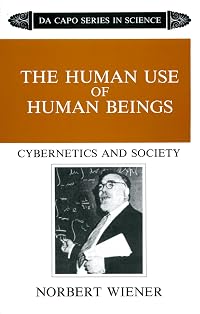
The heart of Gleick’s book is his treatment of the new information theory that Shannon — and computer scientist and mathematician Alan Turing, noisily brilliant pioneer Norbert Stuart Wiener and many others — created in the middle decades of the 20th century. But Gleick loops backward to discuss early efforts at messaging and storage, from drum messages to dictionaries, and forward to show more make clear the massive consequences of what Shannon and the others wrought. ...
Gleick is a technological determinist, in a moderate way. He argues elegantly that the telegraph promoted everything from the weaving of networks to the building of skyscrapers and the creation of a new “telegraphic” style of communication.
It seems a pity, accordingly, that he does not say more about the ways in which information theory and its technical progeny have changed our ways of reading and writing, doing research and listening to music. ... show less
Gleick is a technological determinist, in a moderate way. He argues elegantly that the telegraph promoted everything from the weaving of networks to the building of skyscrapers and the creation of a new “telegraphic” style of communication.
It seems a pity, accordingly, that he does not say more about the ways in which information theory and its technical progeny have changed our ways of reading and writing, doing research and listening to music. ... show less
added by tim.taylor
A highly ambitious and generally brilliant effort to tie together centuries of disparate scientific efforts to understand information as a meaningful concept. For a society that believes itself to live in an information age, the subject could hardly be more important. That the project doesn't fully succeed has more to do with the limits of our understanding than with Gleick's efforts.
added by Shortride
Bestselling science and technology writer Gleick (Genius) gives a brilliant, panoramic view of how we save and communicate knowledge-from ancient African drumming to alphabets, the telegraph, radio, telephone and computers-and provides thrilling portraits of the geniuses behind the inventions.
added by vancouverdeb
Lists

A Brilliant List of Science Books for People Who Want Their Minds Blown
16 works; 3 members

Recommend the 20 best books you've read in the last five years
2,168 works; 601 members

Non-Fiction Worth Reading
1,015 works; 261 members

Big History
72 works; 1 member

2008-2012 Notable Books for Adults
127 works; 10 members

Works cited in Palimpsest: A History of the Written Word by Matthew Battles
79 works; 2 members

r/History Recommended Reading List
603 works; 12 members

Books in the Bibliography of The Alchemy of Us by Ainissa Ramirez
181 works; 1 member
Author Information

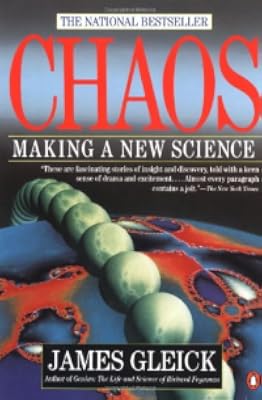
He wrote the worldwide bestseller Chaos, which was nominated for the National Book Award. He was the 1990 McGraw Distinguished Lecturer at Princeton University. (Publisher Provided) James Gleick was born in New York City on August 1, 1954. He received a degree in English and linguistics from Harvard College in 1976. He helped found Metropolis, an show more alternative weekly newspaper in Minneapolis. After the newspaper folded, he worked for ten years as an editor and reporter for The New York Times. In 1989-1990, he was the McGraw Distinguished Lecturer at Princeton University. He has written several books including Chaos: Making a New Science, Genius: The Life and Science of Richard Feynman, Faster: The Acceleration of Just About Everything, What Just Happened: A Chronicle from the Information Frontier, and The Information: A History, a Theory, a Flood. (Bowker Author Biography) show less
Some Editions
Awards and Honors
Awards
Distinctions
Series
Belongs to Publisher Series
Common Knowledge
- Original title
- Information: A history, a theory, a flood
- Original publication date
- 2011-02-03
- People/Characters
- Claude Shannon; Charles Babbage; Ada Byron Lovelace; Vannevar Bush; Alan Turing; Samuel Morse
- Epigraph
- Anyway, those tickets, those old ones, they didn't tell you where you were going, much less where you came from. He couldn't remember seeing any dates on them, either, and there was certainly no mention of time. It was all d... (show all)ifferent now, of course. All this information. Archie wondered why that was.
— Zadie Smith
What we call the past is built on bits.
— John Archibald Wheeler - Dedication
- For Cynthia
- First words
- Prologue
After 1948, which was the crucial year, people thought they could see the clear purpose that inspired Claude Shannon's work, but that was hindsight.
Chapter 1
No one spoke simply on the drums. - Last words
- (Click to show. Warning: May contain spoilers.)We walk the corridors, searching the shelves and rearranging them, looking for lines of meaning amid leagues of cacophony and incoherence, reading the history of the past and of the future, collecting our thoughts and collecting the thoughts of others, and every so often glimpsing mirrors, in which we may recognize creatures of the information.
- Original language
- English
Classifications
- Genres
- Technology, General Nonfiction, Science & Nature, History, Nonfiction
- DDC/MDS
- 020.9 — Computer science, information & general works Library & information sciences Science and administration of libraries in general History of library economy
- LCC
- Z665 .G547 — Bibliography, Library Science and Information Resources Libraries Library science. Information science
- BISAC
Statistics
- Members
- 3,696
- Popularity
- 4,366
- Reviews
- 120
- Rating
- (3.95)
- Languages
- 16 — Chinese, Czech, Dutch, English, Estonian, Finnish, French, German, Greek, Italian, Japanese, Polish, Portuguese, Russian, Spanish, Turkish
- Media
- Paper, Audiobook, Ebook
- ISBNs
- 33
- UPCs
- 1
- ASINs
- 23