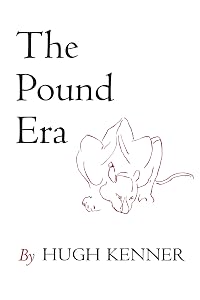
The Pound Era
by Hugh Kenner
On This Page
Description
";Hugh Kenner's The Pound Era could as well be known as the Kenner era, for there is no critic who has more firmly established his claim to valuable literary property than has Kenner to the first three decades of the 20th century in England. Author of pervious studies of Joyce, T.S. Eliot, Wyndham Lewis and Pound (to name a few), Kenner bestrides modern literature if not like a colossus then at least a presence of formidable proportions. A new book by him is certainly an event.A demanding, show more enticing book that glitters at the same time it antagonizes.";The Pound Era presents us with an idiosyncratic but sharply etched skeletal view of our immediate literary heritage.";—The New York Times show lessTags
Recommendations

















Member Reviews
As a youth, Ezra Pound aspired to know everything that could be known about poetry. Nearly seven decades later, his lifework culminated in a last book, tellingly entitled Drafts and Fragments, and he wondered where he had gone wrong.
Hugh Kenner chronicles these decades in this thick book, weighty with bone and sinew. In the course of it, he makes a convincing case that his title, The Pound Era, is a fitting description of what passed for modern English literature when I went to college. Pound and his friends in pre-war London defined themselves, their movement, and their time as a vortex. It was a brief, transcendent moment. The major work of most of them still lay ahead but was carried out under a cloud of tragedy. The destruction of show more the Great War took the life of one of their number, Gaudier-Brzeska, and hurtled the survivors on parallel, lonely trajectories.
They (Joyce, Eliot, Williams, and the others) lived in a time when the newly-discovered cave paintings in southern France and the etymological turn in linguistics made them aware of the inheritance of eons. The gift of their intelligence was to make the past as vibrant as the present. Pound was at the forefront, blending modern idiom with Chinese ideograms, Provençal ballads, the Jefferson-Adams correspondence, and Homer. From beginning to end, Homer. And let's not forget the golden-clad goddess.
To read this magisterial book is an education. I learned many things, such as why the anthropologist Frobenius rejected a word in his own language, Zeitgeist, and used instead an ancient Greek work, paideuma, to express what he meant by a shared culture.
The Pound of the wartime radio broadcasts from Italy is neither excused nor trivialized. The reader is left to ponder what led him to such a quixotic mission, but Kenner supplies much of the background. Pound’s fascination with the economic theories of Douglas, for instance, seems understandable, as it becomes ever clearer that the dominant force in the world is avarice.
When I first discovered Pound a half-century ago, I was fascinated by his Imagist poems. I read and re-read them. I tried his Guide to Kulchur but gave up. And I assumed I was too dense even to attempt the Cantos. With Kenner to breathe courage into me, I just ordered them, and I’m impatient to give them a go. show less
Hugh Kenner chronicles these decades in this thick book, weighty with bone and sinew. In the course of it, he makes a convincing case that his title, The Pound Era, is a fitting description of what passed for modern English literature when I went to college. Pound and his friends in pre-war London defined themselves, their movement, and their time as a vortex. It was a brief, transcendent moment. The major work of most of them still lay ahead but was carried out under a cloud of tragedy. The destruction of show more the Great War took the life of one of their number, Gaudier-Brzeska, and hurtled the survivors on parallel, lonely trajectories.
They (Joyce, Eliot, Williams, and the others) lived in a time when the newly-discovered cave paintings in southern France and the etymological turn in linguistics made them aware of the inheritance of eons. The gift of their intelligence was to make the past as vibrant as the present. Pound was at the forefront, blending modern idiom with Chinese ideograms, Provençal ballads, the Jefferson-Adams correspondence, and Homer. From beginning to end, Homer. And let's not forget the golden-clad goddess.
To read this magisterial book is an education. I learned many things, such as why the anthropologist Frobenius rejected a word in his own language, Zeitgeist, and used instead an ancient Greek work, paideuma, to express what he meant by a shared culture.
The Pound of the wartime radio broadcasts from Italy is neither excused nor trivialized. The reader is left to ponder what led him to such a quixotic mission, but Kenner supplies much of the background. Pound’s fascination with the economic theories of Douglas, for instance, seems understandable, as it becomes ever clearer that the dominant force in the world is avarice.
When I first discovered Pound a half-century ago, I was fascinated by his Imagist poems. I read and re-read them. I tried his Guide to Kulchur but gave up. And I assumed I was too dense even to attempt the Cantos. With Kenner to breathe courage into me, I just ordered them, and I’m impatient to give them a go. show less
Delightful and brilliant plunge into the Modernist epoch. As much a work of art as criticism, Kenner’s book brings the 1905-1939 era alive with surging yet layered vividness. Like his subjects (Pound, Eliot, Joyce, HD) Kenner has mastered the "luminous detail" -the one vivid image that achieves a "raid on the inarticulate" giving clarity and voice to the formerly murky and unsung.
(Late, after finishing): Kenner's writing is a work of poetry on its own; combine that with a thorough examination of Pound and his peers and their era, and you've got a book that can't be beat.
My god, I love this book so far: https://zwieblein.bearblog.dev/on-putting-your-reflective-back-into-it/
My god, I love this book so far: https://zwieblein.bearblog.dev/on-putting-your-reflective-back-into-it/
This is one of those academic major works which collects and encapsulates decades of the author's teaching. The Pound Era is incontestably Kenner's most important work, but it sets out no new system and overturns no set orthodoxies, except in so far as it makes a bit-by-bit presentation of the case for Pound's centrality to International Modernism, or at least that subset of it which occurred in the English-speaking world: Musil, Perse, and company are not part of the scope of this book. Typically of Kenner, this is an assembly of detailed, concrete perceptions, sometimes in providing readings, sometimes in providing backgrounds or making linkages. It is a central work for anyone studying Modernism, and a rewarding book for anyone show more interested in (more generally) modern poetry and prose. show less
You are about to take American Literature, prescribed US high school class, and I doubt if you will come across Pound, but he is important. However what you need to know now is that if, like me, a 19 in 1954, thinking you can read and understand just about anything you set your mind to, taking a volume of Pound's poems to the beach for several afternoons will no do it. It is this kind of book, actually by a man who was a student of his subject, knew him for 20 years, who then wrote to place him in context (with some useful and surprising photographs interspersed) may help you get started. So far I have just sampled THIS book and find it tough sledding. Will I really be able to read Pound's own verse later, or will I want to do so ?
Stay show more tuned. show less
Stay show more tuned. show less
hugh kenner's magnum opus, the title refers to western modernism's debt to pound
well worth reading
well worth reading
Ratings
Members
- Recently Added By
Lists

Literary Theory and Criticism: What Happens and Why
37 works; 5 members

Modernism
140 works; 8 members

Five star books
1,767 works; 110 members

Mustich's 1000 Books to Read Before You Die: A Life Changing List
1,001 works; 19 members
Author Information

79+ Works 2,707 Members
Hugh Kenner (1923-2003) was one of America's great literary critics. He wrote on a range of subjects, including Ezra Pound, James Joyce, Samuel Beckett, T. S. Eliot, and geodesic domes. The following books by Hugh Kenner are available from Dalkey Archive Press: The Counterfeiters, Flaubert, Joyce, and Beckett: The Stoic Comedians and Joyce's show more Voices. show less
Awards and Honors
Awards
Notable Lists
Common Knowledge
- People/Characters
- Ezra Pound; T. S. Eliot; James Joyce; Samuel Beckett; Wyndham Lewis
Classifications
Statistics
- Members
- 505
- Popularity
- 59,595
- Reviews
- 6
- Rating
- (4.56)
- Languages
- English, Italian
- Media
- Paper, Ebook
- ISBNs
- 8
- ASINs
- 6