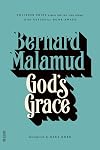
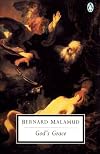
God's Grace
by Bernard Malamud
On This Page
Description
In his final novel, the acclaimed novelist spins an apocalyptic tale that recounts the experiences of Calvin Cohn, who, through a divine slip, is the only human being left alive after the apocalypse. Reprint.Tags
Recommendations






















Member Recommendations

Member Reviews
This visionary tale with a prophetic warning could have been written only by a superb artist who dares to take risks. "Of all men, Calvin Cohn lived on, passionate to survive. " After the Djanks and the Drushkies do themselves (and the world) in, with their thermonuclear war. God speaks: "They have destroyed my handiwork: the sweet air I gave them to breathe; the fresh water I blessed them with; the fertile green
earth. They tore apart my ozone. carbonized my oxygen, acidified my refreshing rain. Now they affront my cosmos. How much shall the Lord endure?" And so the second Flood follows...
earth. They tore apart my ozone. carbonized my oxygen, acidified my refreshing rain. Now they affront my cosmos. How much shall the Lord endure?" And so the second Flood follows...
Not the sort of thing I usually enjoy, and I didn't. Calvin Cohn, scientist and ex-rabbinical student, is the only human survivor of a nuclear holocaust. Being the protagonist of a novel by a Jewish, male, American, he naturally blames God for wiping out the rest of the human race, and has a big argument with Him about it. God finds a peculiarly apt and very nasty way to teach him a lesson.
This satirical fable, Malamud's last completed novel, is very cleverly done, full of references to literature, philosophy, science, and - above all - the Old Testament. The bleak message seems to be that, however sophisticated and enlightened the civilization we build up for ourselves, selfishness and violence will smash it all up again. I'm not sure show more why he really needs a complicated structure of apocalypse, flood, and talking chimpanzees to demonstrate that, though. show less
This satirical fable, Malamud's last completed novel, is very cleverly done, full of references to literature, philosophy, science, and - above all - the Old Testament. The bleak message seems to be that, however sophisticated and enlightened the civilization we build up for ourselves, selfishness and violence will smash it all up again. I'm not sure show more why he really needs a complicated structure of apocalypse, flood, and talking chimpanzees to demonstrate that, though. show less
This is an amazing book, it sticks with me years after reading. A post-apocalyptic tale of the last man standing, and chimps. Four stars b/c his male chimp competitors would have ripped... various parts off shortly after encountering him - but that would have made a much less interesting story.
An allegory, a fairy story, another end of the world drama where the only question is does the human screw up paradise yet again?
Malamud's writing is so excellent, his characterisation so real, that whether or not the plot is quite 'all there', the book is thoroughly enjoyable to read.
Malamud's writing is so excellent, his characterisation so real, that whether or not the plot is quite 'all there', the book is thoroughly enjoyable to read.
I thought the premise sounded interesting - last man on the earth - talking chimpanzees - a new world. The book was interesting, though the religious elements were somewhat odd - a jewish man who believes and yet doesn't believe. A God who talks to Cohn (maybe - I was never quite sure). However, in the end, this seemed to be yet another book of the same - we hope for better but we are what we are. Cohn conceives a new, better world. But even the destruction of all but a handful of survivors doesn't change the essential nature. Events don't change nature. Maybe a second reading will illuminate more of what Mr. Malamud was saying in this short novel.
Never know what to expect from Malamud, but it's always worth reading
Ratings
Members
- Recently Added By
Lists

Genesis in literature
47 works; 7 members
Author Information

98+ Works 11,783 Members
Bernard Malamud was born in 1914 in New York City and later received his B. A. from City College of New York and his M. A. from Columbia University. All of Malamud's works are highly respected, including "Armistice" (his first), "The Magic Barrel," which won the National Book Award, "The Fixer," which received a Pulitzer Prize. "The Assistant," show more "The Natural," "The Fixer," and "The Angel Levine," which were all adapted as films. Bernard Malamud died in 1986. (Bowker Author Biography) show less
Some Editions
Awards and Honors
Awards
Notable Lists
Series
Belongs to Publisher Series
Common Knowledge
- Canonical title
- God's Grace
- Original title
- God's Grace
- Original publication date
- 1982
- People/Characters
- Calvin Cohn
- Epigraph
- The Holy One, blessed be He, cast a stone into the sea and from it the world was founded
R. Yitzhaq Nappaha
I came upon the horrible remains of a cannibal feast.
Robinson Crusoe
Nobody seemed to know where George's name came from.
Johanson, Edey
This is that story
The heaving high seas were laden with scum
The dull sky glowed red
Dust and ashes drifted in the wind circling the earth
The burdened seas slanted this way, and that, flooding the scorched ... (show all)land under a daylight moon
A black oily rain rained
No one was there - Dedication
- To Diarmid Russell
gone now;
and for Rose Russell - First words
- At the end, after the thermonuclear war between the Djanks and the Druzhkies, in consequence of which they had destroyed themselves, and madly, all the other inhabitants of the earth, God spoke through a glowing crack in a b... (show all)ulbous black cloud to Calvin Cohn, the paleologist, who of all men had miraculously survived in a battered oceanography vessel with sails, as the swollen seas tilted this way and that;
(Continues on for about 2 pages) - Last words
- (Click to show. Warning: May contain spoilers.)In his throaty, gruff voice he began a long Kaddish for Calvin Cohn.
Classifications
Statistics
- Members
- 427
- Popularity
- 72,560
- Reviews
- 6
- Rating
- (3.43)
- Languages
- 10 — Czech, Danish, Dutch, English, Finnish, French, Hebrew, Hungarian, Italian, Spanish
- Media
- Paper, Audiobook, Ebook
- ISBNs
- 20
- ASINs
- 9