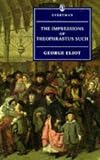
Impressions of Theophrastus Such
by George Eliot
On This Page
Description
George Eliot (1819-80) is one of the most widely-read of the 19th-century novelists and story-writers. "Impressions of Theophrastus Such" appeared in 1879, Eliot's last completed work. It consists of 18 short essays narrated by a middle-aged bachelor, Theophrastus.Tags
Recommendations



















Member Reviews
Written two years before her death, this is Eliot’s summing up, her distillation of her atheistically yet humanly ethical philosophy, her ultimate meditations on the nature of life and writing, her analysis of character without the need to create plot to help the reader along. Couched as a series of reflections on the nature of his friends by the narrator called Theophrastus, the book thus situates itself into the genre of character writing, invented by the eponymous Greek philosopher. However, the book signals its intention to be taken as a meditation on human character generally by the strangeness of the character’s names, which ostensibly hide the identities of the originals and at the same time awake echoes of Medieval morality show more literature and Latin literature: Ganymede for the writer who was famous when young, Sir Gavial Mantrap for the immoral swindler, Mixtus, Scintilla, Lentullus etc. About half way through the book, in the essay called ‘Debasing the Moral Currency’ it seems as if Eliot herself hijacks the narrative voice, and Theophrastus is lost. It’s not so much a stridency of tone, but rather an intensifying of the intellectual argument without the illustration of character: Eliot decides to make no concessions to her readers, and discontinues her attempts to illustrate her arguments by fictional character studies. The book thus swerves from fictional literature to expository literature. The text bristles with erudition in a host of European languages, both living and dead, and there are constant references to contemporary cutting edge scientific and geographical knowledge. This shift in the narrative voice effectively shifts the book into a new genre, that of the humanistic essayist: in her attempts to understand and get to the bottom of her individual relationship with the reality of life and the perception of it by consciousness, Eliot joins Montaigne, Marcus Aurelius and Bacon in a tradition that ultimately descended from Socrates's dictum: the unexamined life is not worth living....
Read the full review on The Lectern
http://thelectern.blogspot.com/2006/08/impressions-of-theophrastus-such_14.html show less
Read the full review on The Lectern
http://thelectern.blogspot.com/2006/08/impressions-of-theophrastus-such_14.html show less
This book has a bad reputation. It suffers from two things: it is not a dense novel with sociological sweep and thematic depth (that is, it is not make the major statement that both "Silas Marner" and "Middlemarch" so obviously did, with success); and it is utterly readable.
It is also very odd, almost its own genre. These are essays written by a fictional character, Theophrastus Such. The name means something, and his philosophical preoccupations are apparently the author's. But, did I detect a level of irony here? The author hid herself behind a pseudonym; here she hides philosophical ruminations behind a fictional character, another male. There are times when reading these serious reflective essays that one gets the notion, however show more faint, that the author realized an element of fussiness, an element of pretense, an element limiting her philosophy.
Or maybe not. This is a book worth reading and then reading again, to decide such questions.
I is a treasure. Forget questions of its greatness. Just read it. You may enjoy it. show less
It is also very odd, almost its own genre. These are essays written by a fictional character, Theophrastus Such. The name means something, and his philosophical preoccupations are apparently the author's. But, did I detect a level of irony here? The author hid herself behind a pseudonym; here she hides philosophical ruminations behind a fictional character, another male. There are times when reading these serious reflective essays that one gets the notion, however show more faint, that the author realized an element of fussiness, an element of pretense, an element limiting her philosophy.
Or maybe not. This is a book worth reading and then reading again, to decide such questions.
I is a treasure. Forget questions of its greatness. Just read it. You may enjoy it. show less
An interesting coda to George Eliot's literary career and one not often read these days. Impressions crosses the boundaries between fiction and fact, as Eliot espouses her views on life through a narrator 'Theophrastus Such', an obscure scholar. It's not essential Eliot by any means and there is little here which is not fully developed in the novels, although there is a passionate attack on anti-Semitism which goes far beyond even Daniel Deronda.
Some of the best writing is contained in the chapter 'Looking Backward' as she vividly brings to life her beloved Midlands countryside with echoes of Loamshire from her first novel, Adam Bede. Truly lump-in-the throat stuff.
Some of the best writing is contained in the chapter 'Looking Backward' as she vividly brings to life her beloved Midlands countryside with echoes of Loamshire from her first novel, Adam Bede. Truly lump-in-the throat stuff.
Ratings
Members
- Recently Added By
Lists

Books Read in 2023
5,638 works; 147 members
Author Information

381+ Works 62,146 Members
George Eliot was born Mary Ann Evans on a Warwickshire farm in England, where she spent almost all of her early life. She received a modest local education and was particularly influenced by one of her teachers, an extremely religious woman whom the novelist would later use as a model for various characters. Eliot read extensively, and was show more particularly drawn to the romantic poets and German literature. In 1849, after the death of her father, she went to London and became assistant editor of the Westminster Review, a radical magazine. She soon began publishing sketches of country life in London magazines. At about his time Eliot began her lifelong relationship with George Henry Lewes. A married man, Lewes could not marry Eliot, but they lived together until Lewes's death. Eliot's sketches were well received, and soon after she followed with her first novel, Adam Bede (1859). She took the pen name "George Eliot" because she believed the public would take a male author more seriously. Like all of Eliot's best work, The Mill on the Floss (1860), is based in large part on her own life and her relationship with her brother. In it she begins to explore male-female relations and the way people's personalities determine their relationships with others. She returns to this theme in Silas Mariner (1861), in which she examines the changes brought about in life and personality of a miser through the love of a little girl. In 1863, Eliot published Romola. Set against the political intrigue of Florence, Italy, of the 1490's, the book chronicles the spiritual journey of a passionate young woman. Eliot's greatest achievement is almost certainly Middlemarch (1871). Here she paints her most detailed picture of English country life, and explores most deeply the frustrations of an intelligent woman with no outlet for her aspirations. This novel is now regarded as one of the major works of the Victorian era and one of the greatest works of fiction in English. Eliot's last work was Daniel Deronda. In that work, Daniel, the adopted son of an aristocratic Englishman, gradually becomes interested in Jewish culture and then discovers his own Jewish heritage. He eventually goes to live in Palestine. Because of the way in which she explored character and extended the range of subject matter to include simple country life, Eliot is now considered to be a major figure in the development of the novel. She is buried in Highgate Cemetery, North London, England, next to her common-law husband, George Henry Lewes. (Bowker Author Biography) show less
Some Editions
Work Relationships
Is contained in
Miscellaneous Essays / Impressions of Theophrastus Such / The Lifted Veil / Brother Jacob by George Eliot
Works of George Eliot. The Mill on the Floss, Daniel Deronda, Adam Bede, Middlemarch, The Lifted Veil & more. (mobi) by George Eliot
George Elliot Works: 7 books - Middlemarch, Adam Bede, Daniel Deronda, Romola, Impressions of Theophrastus Such..., Silas Marner, Felix Holt, the Radical (George Elliot Works, 7 of ? in set) by George Elliot
George Eliot Collection: The Complete Novels, Short Stories, Poems and Essays (Middlemarch, Daniel Deronda, Scenes of Clerical Life, Adam Bede, The Lifted Veil...) by George Eliot
The Spanish Gypsy and Other Poems. Scenes of Clerical Life, Adam Bede, Romola, Felix Holt The Radical., Daniel Deronda, Miscellaneous Essays: Impressions of Theophrastus Such, The Lifted Veil, and Brother Jacob by George Eliot
George Eliot's Works (Six Volumes): Adam Bede, Scenes of Clerical Life, Middlemarch, The Mill On the Floss, Daniel Deronda, Felix Holt (The Radical), The Spanish Gypsy, Jubal and Other Poems, Romola, Theophrastus Such by George Eliot
The Sad Fortunes of Rev. Amos Barton, Brother Jacob, the Lifted Veil, Impressions of Theophrastus Such by George Eliot
Silas Marner; the Lifted Veil, Brother Jacob; the Impressions of Theophrastus Such & Poems by George Eliot
Common Knowledge
- Canonical title
- Impressions of Theophrastus Such
- Original title
- Impressions of Theophrastus Such
- Original publication date
- 1879
- People/Characters
- Theophrastus Such
Classifications
Statistics
- Members
- 100
- Popularity
- 323,658
- Reviews
- 3
- Rating
- (3.19)
- Languages
- English
- Media
- Paper, Ebook
- ISBNs
- 41
- ASINs
- 11